Quick honest review of Keep That Coffee House in Yeouido. I’m a regular here, so take this as a long-term opinion, not a one-time visit verdict. Short version: one of the better specialty coffee spots in Seoul’s financial district. Come early. Skip the lunch hour if you value your peace.
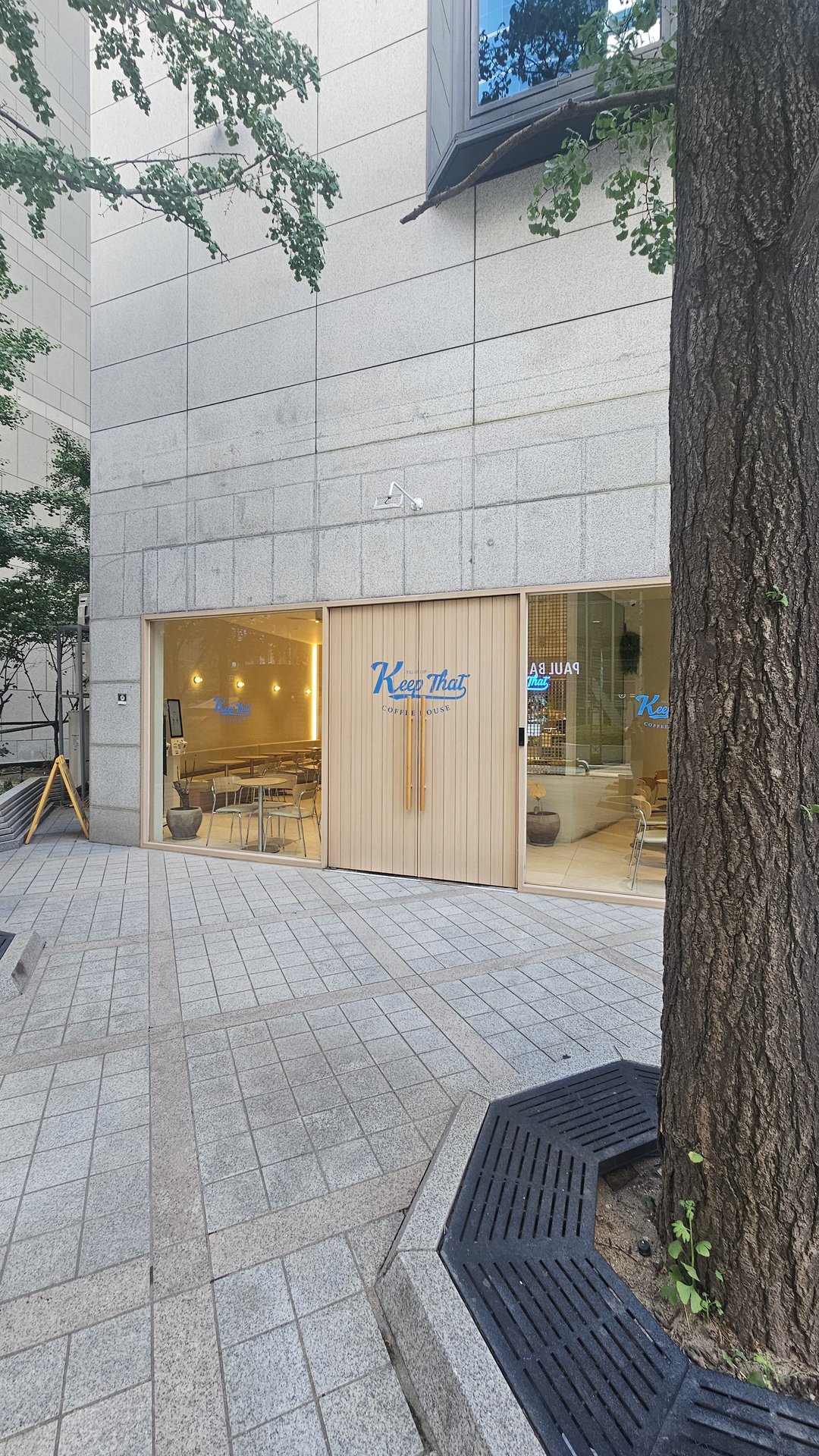
Keep That Coffee House Yeouido exterior with floor-to-ceiling glass facade and street trees
What Is Keep That Coffee House?
Keep That (킵댓) is a specialty coffee cafe in Yeouido — Seoul’s version of a financial district, think something like Canary Wharf in London or the FiDi in New York. Office towers, wide streets, the National Assembly building nearby. Not the most touristy part of Seoul, but if you’re visiting Yeouido Hangang Park or just passing through, this is one of the better coffee stops in the area.
It’s not a chain. The branding is clean and deliberate — logo paper cups, neon sign, wood-tone interior. The kind of place that takes coffee seriously without being pretentious about it.
Getting There
Yeouido station (Line 5, Line 9) or National Assembly station (Line 9) — about a 5–10 minute walk depending on which exit.
From Myeongdong or Hongdae? About 20–30 minutes on the subway. It’s not in the tourist core of Seoul, so unless you’re doing Yeouido specifically, don’t make a special trip just for coffee. But if you’re already here, yes, absolutely stop in.
From Incheon Airport: roughly 50–60 minutes by AREX + subway.
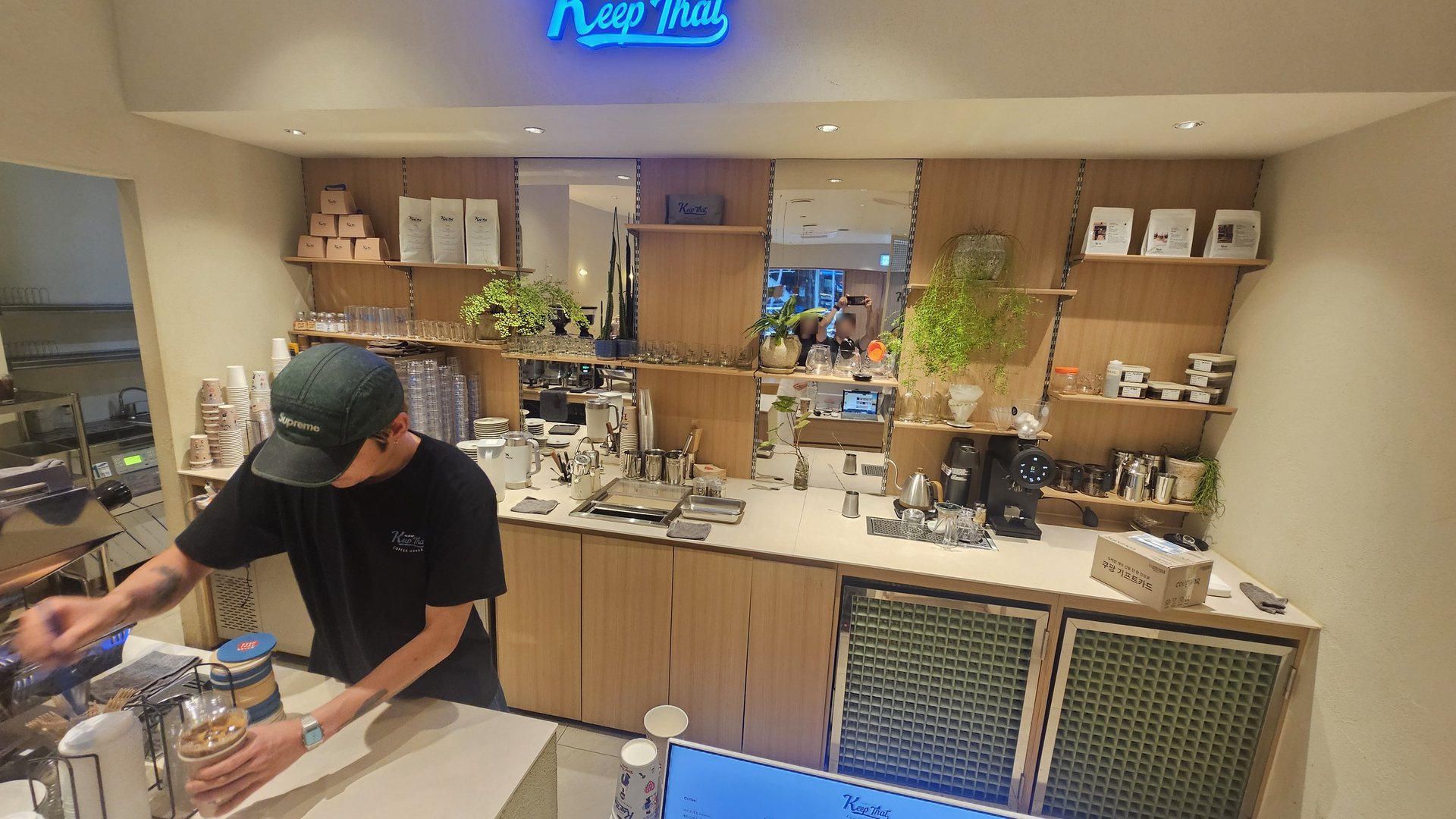
Barista preparing drinks at the bar counter with wood-tone interior and neon Keep That logo sign
The Interior
Modern minimal. Wood tones everywhere — tables, counters, shelving. The neon Keep That logo on the wall is a good photo backdrop if you’re into that. Large floor-to-ceiling glass windows at the front let in natural light.
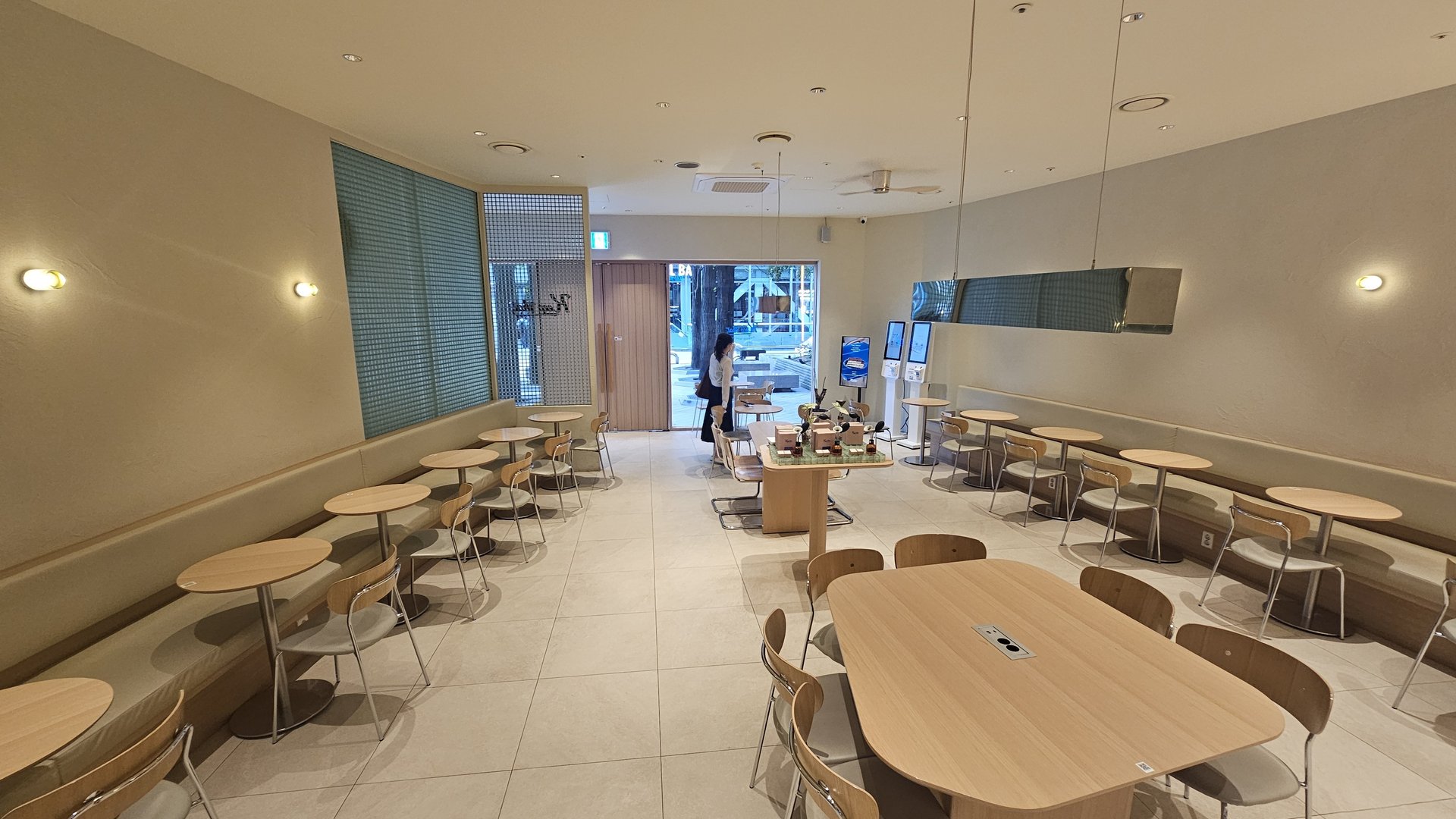
Spacious and clean interior of Keep That Coffee Yeouido with round and oval wooden tables arranged in rows
The seating area is actually spacious for Seoul standards. Round and oval wooden tables spread across the floor — decent group seating, good for solo work too. When I visited early morning, the place was mostly empty and genuinely pleasant to sit in.
Lunch is a different story. Yeouido office workers flood in around noon and it gets loud. Not unpleasant if you’re grabbing and going, but if you want to sit and drink quietly, the vibe completely changes.
What I Ordered
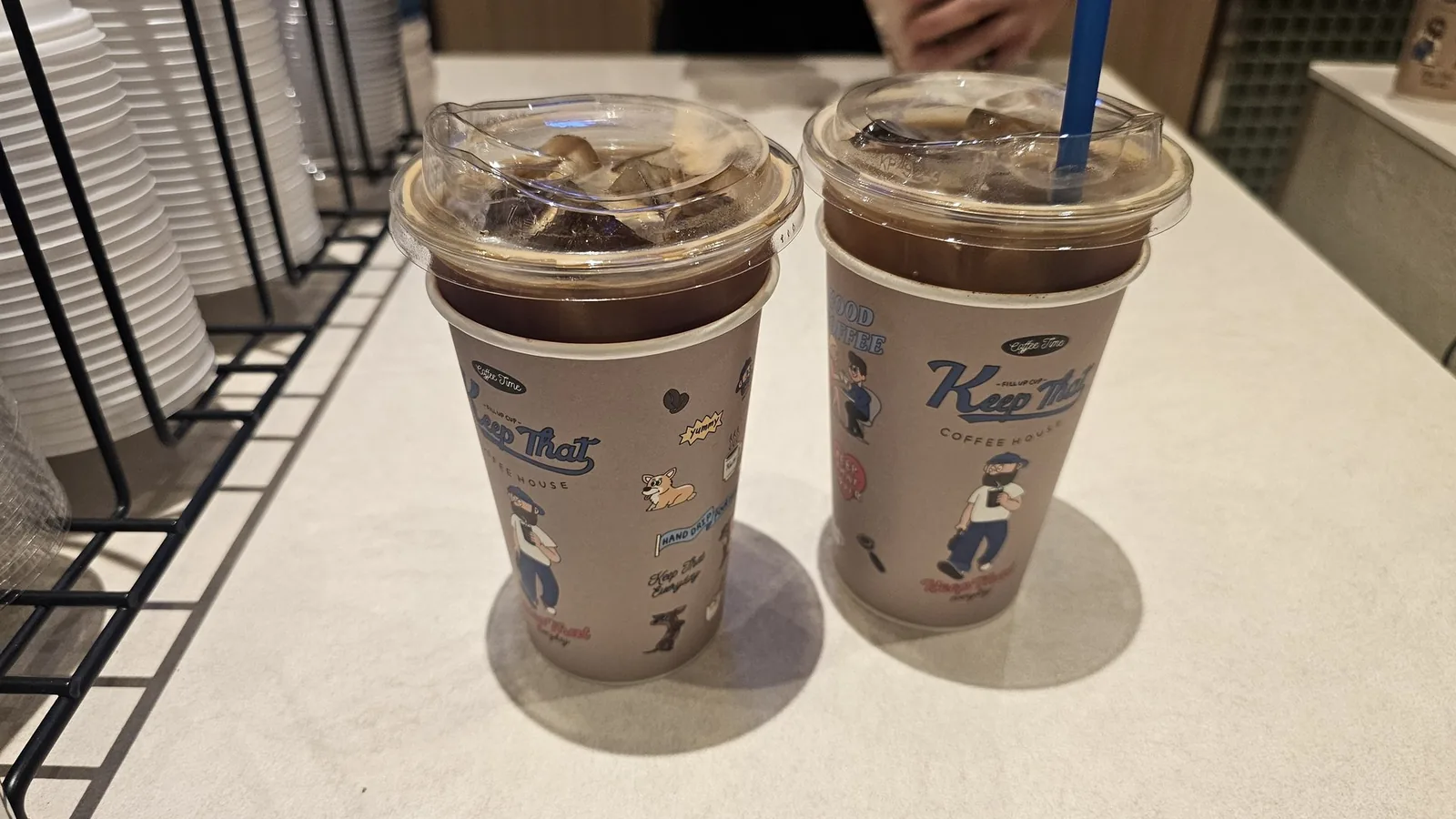
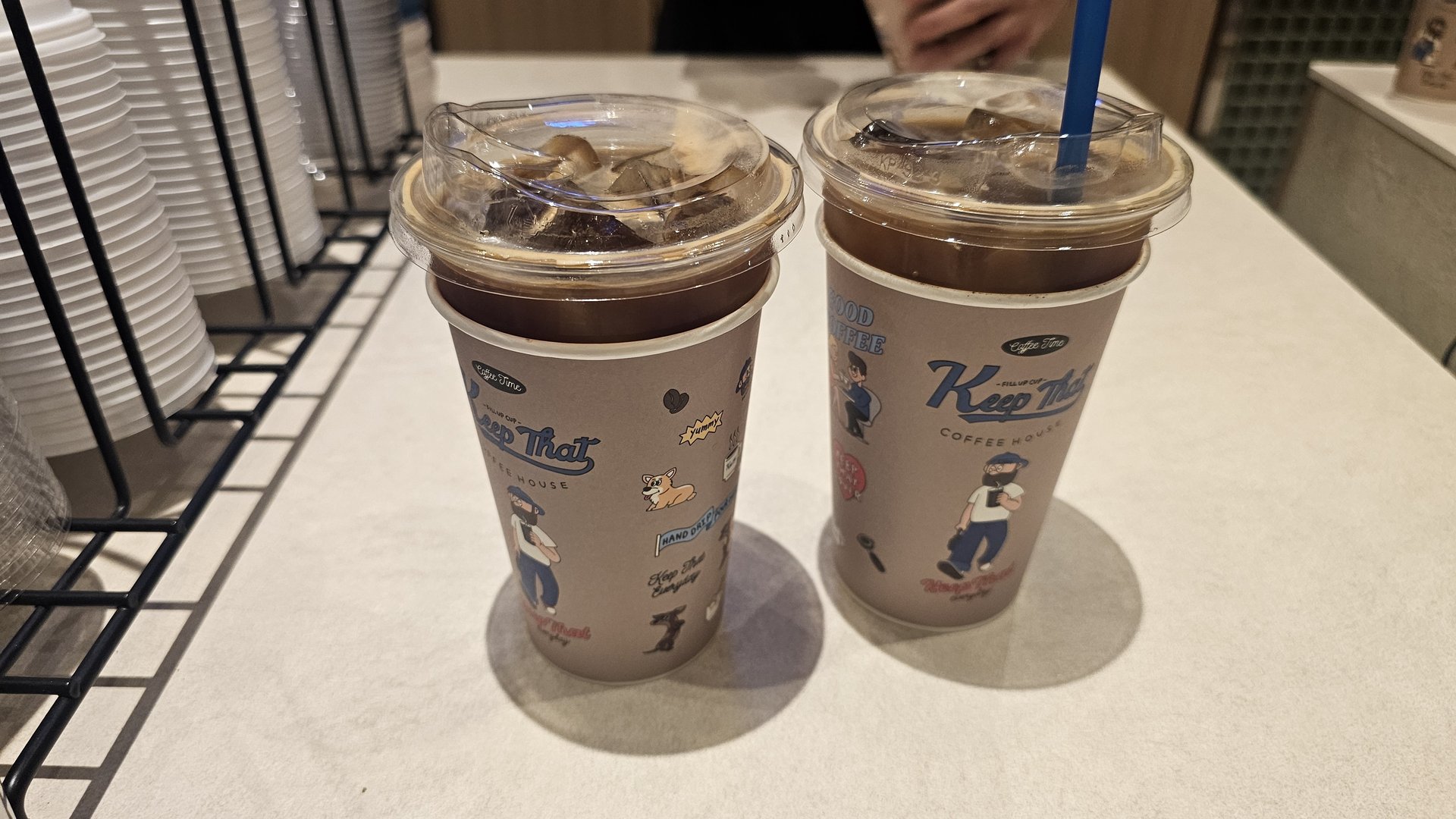
Two iced Americanos in Keep That Coffee House logo paper cups lined up on the counter
Two iced Americanos. That’s it.
Look, sometimes you just want a clean cup of coffee. This delivers. The taste is crisp — not acidic, not bitter, not watery. You can tell the beans aren’t supermarket grade. It’s the kind of Americano you come back to, which is exactly what I do. I’m a regular.
It’s not going to blow your mind if you’ve been to Tokyo’s specialty coffee scene or Melbourne’s cafe culture. But for Yeouido, for a quick morning coffee before doing whatever you’re doing in this part of Seoul? It’s genuinely good.
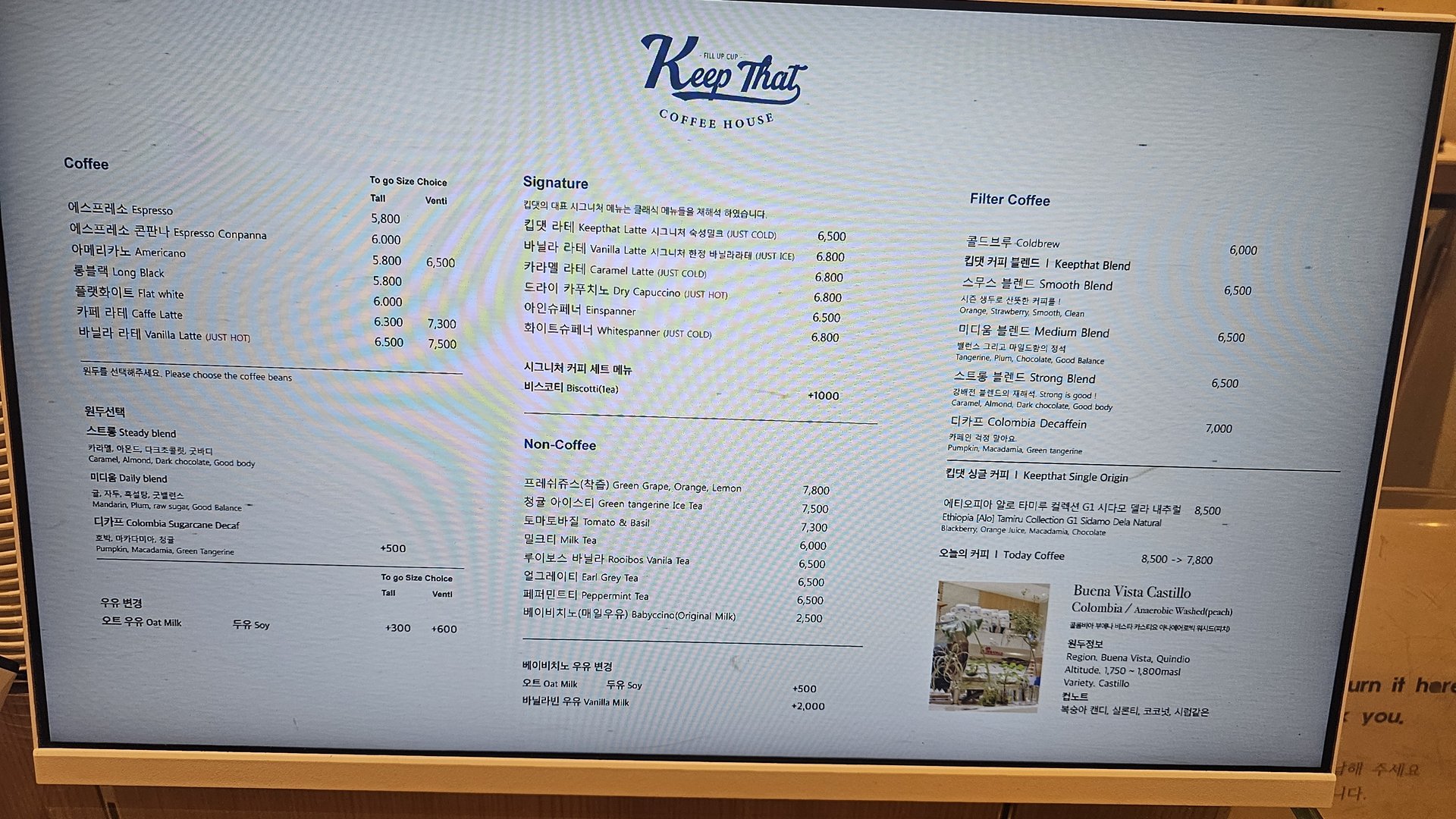
Keep That Coffee House full menu board showing coffee, signature, non-coffee, and filter coffee with prices
The menu has more than just Americanos — signature drinks, non-coffee options, filter coffee. Prices are reasonable for the specialty coffee tier in Seoul, generally 4,500–6,000 KRW (~$3.30–$4.50 USD) range for espresso drinks.
Stuff Tourists Should Know
Language: Basic English is fine for ordering. The menu board is visible and self-explanatory. You can point if needed. No stress.
Payment: Card works. Foreign cards should be fine — most Seoul cafes handle international Visa/Mastercard without issues. There’s no tipping culture in Korea, so don’t worry about that.
Timing: Early morning is the move. The place is calm, the coffee is fresh, and you get to actually enjoy the nice interior. Lunch rush (roughly 12–1:30 PM on weekdays) is hectic. If you’re in Yeouido at that time and need coffee, fine — just grab and go rather than expecting a relaxed sit-down.
Nearby: Yeouido Hangang Park is a short walk away. If you’re doing the park in the morning, this is a natural coffee stop before or after. The National Assembly building is also close if you’re doing a Seoul architecture/landmark tour.
Takeaway vs. Dine-in: Both work. The paper cups with the Keep That logo are clean and well-made — takeaway is fine if you’re heading to the park.
The Verdict
Should you go?
– If you’re in Yeouido for any reason — yes. One of the better coffee options in the area.
– If you’re doing a Seoul cafe crawl specifically — probably not worth the detour from Hongdae, Ikseon, or Seongsu where the cafe density is higher.
– Morning visit? Do it. Lunch hour? Grab and go, don’t linger.
It’s a solid regular spot. I keep coming back, which says more than any review.
FAQ
What is Keep That Coffee House in Yeouido?
It’s a specialty coffee cafe in Seoul’s Yeouido financial district, known for its clean minimal interior and well-made espresso drinks. Popular with office workers.
Is Keep That Coffee good for tourists?
Yes — it’s easy to order (menu board is visible, basic English works fine), and the area is near Yeouido Hangang Park if you’re already in the neighborhood.
How crowded does it get?
Early morning is calm and relaxed. Weekday lunch hours (12–1:30 PM) get packed and noisy with office workers. If you want a quiet coffee, come before 10 AM.
How much does coffee cost at Keep That Coffee Yeouido?
Expect around 4,500–6,000 KRW (~$3.30–$4.50 USD) for espresso-based drinks. Filter coffee and signature drinks may run a bit higher. Check their Instagram for the current menu.
Where is Keep That Coffee in Yeouido and how do I get there?
It’s in Yeouido, Seoul’s financial district. The nearest subway stations are Yeouido (Line 5 and 9) or National Assembly (Line 9). A 5–10 minute walk from either exit.
Do they have non-coffee options?
Yes — the menu includes non-coffee drinks alongside their espresso and filter coffee lineup.
Quick honest review of Patgodang in Myeongdong — a Korean red bean dessert cafe that makes bingsu and freshly baked red bean bread. Short version: the bingsu is solid, the bread is fine, the no-preservatives thing is a genuine selling point, and the price-to-portion ratio is a little annoying. Worth a stop if you’re already in Myeongdong. Probably not worth a special trip.
I went on a Tuesday around 5:30 PM. Packed. Near-full capacity, small waiting line, tourists and locals mixed pretty evenly.
What Is Patgodang?
Patgodang (팥고당) — the name roughly translates to “red bean hall” — is a dessert cafe built entirely around 팥 (pat), Korean red bean. Think adzuki beans, the same kind you find in Japanese mochi or Chinese tang yuan, but prepared the Korean way.
Their pitch is simple: 100% Korean-grown red beans, baked fresh daily, no preservatives. That’s not just a sign on the wall — the bread actually has storage instructions posted (refrigerate within 2 days, freeze for longer), which backs it up.
The main draws are bingsu and 팥빵 (red bean bread). They also do coffee, but that’s clearly not the point of coming here.
What Is Bingsu?
If you’ve never had bingsu before: it’s not a snow cone. Korean shaved ice is milk-based, shaved so fine it comes out like actual snow — light, soft, nothing like the crunchy ice at American street fairs. You get a pile of it topped with sweet red bean, and you eat it before it melts.
Patgodang does the classic version, served in a brass-colored bowl that photographs well.
Getting There
Myeongdong is Seoul’s most tourist-dense neighborhood. If you’ve just landed at Incheon Airport, you’re about 60–70 minutes away by subway (Airport Railroad + transfer at Seoul Station, then Line 4 to Myeongdong Station). Take Exit 5 or 6.
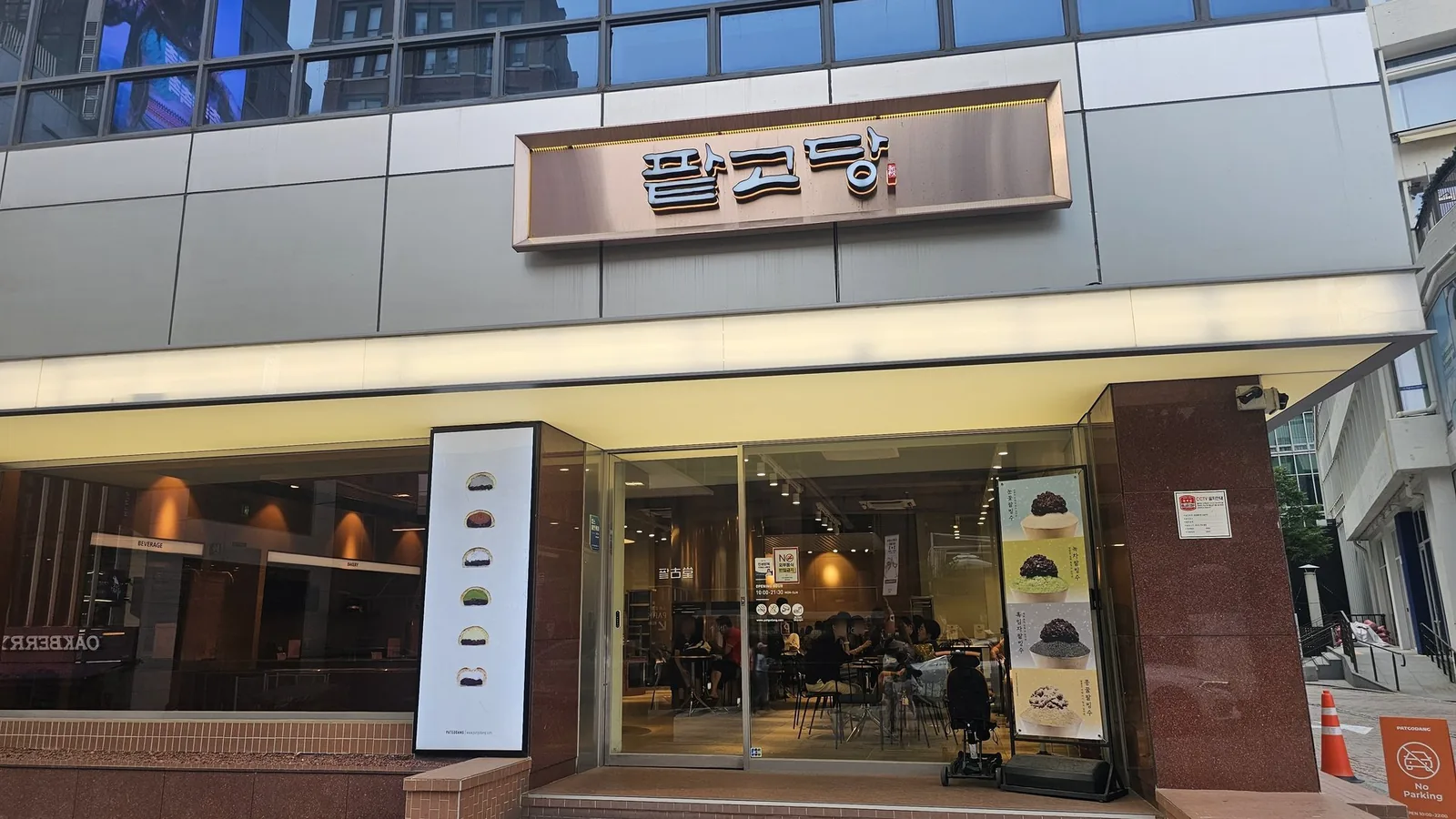
Every major Myeongdong hotel is walkable from the station. You’ll find Patgodang without much effort — the storefront faces the main street with a clear sign, and the bingsu poster in the window is hard to miss.
The Interior
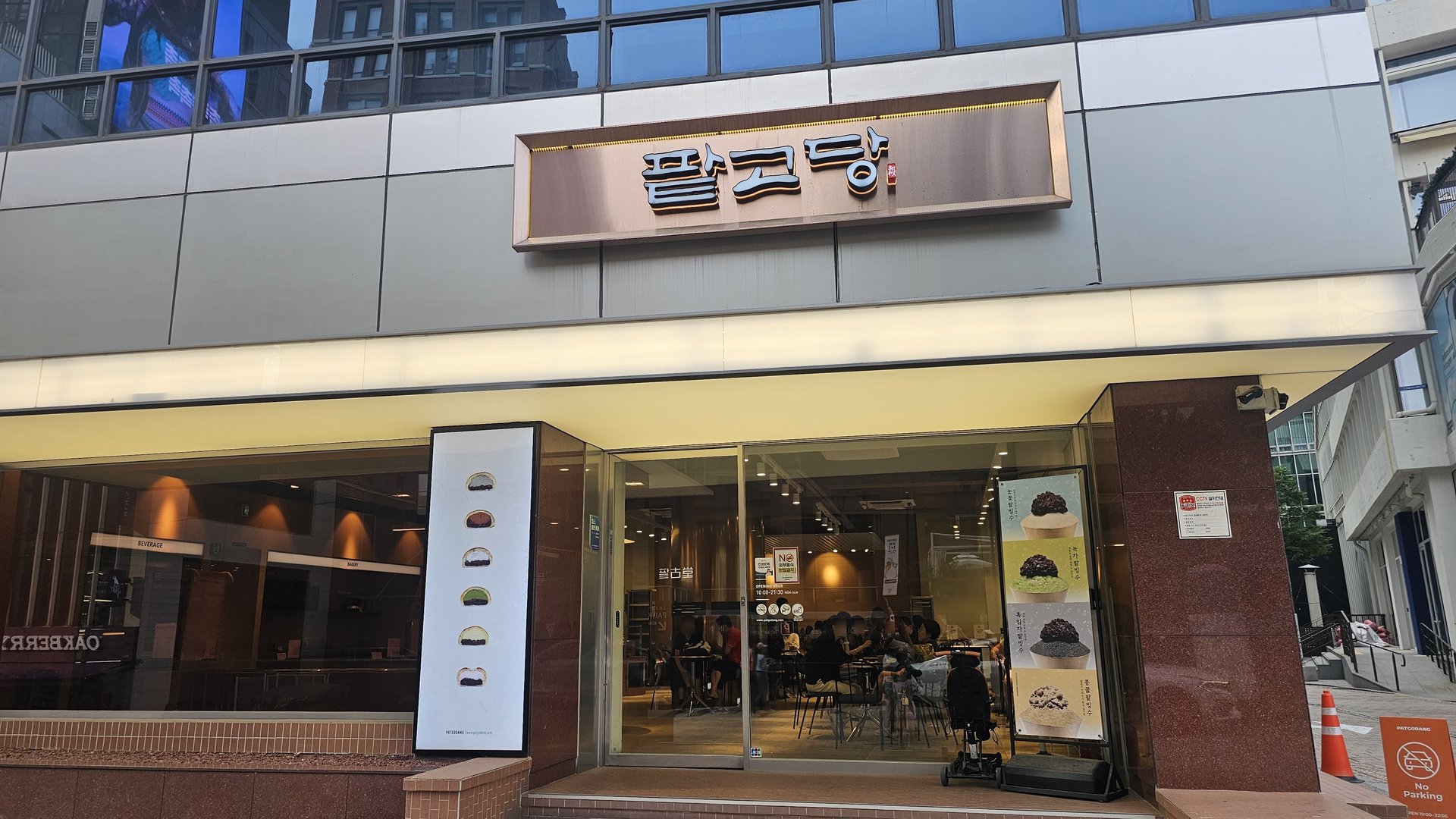
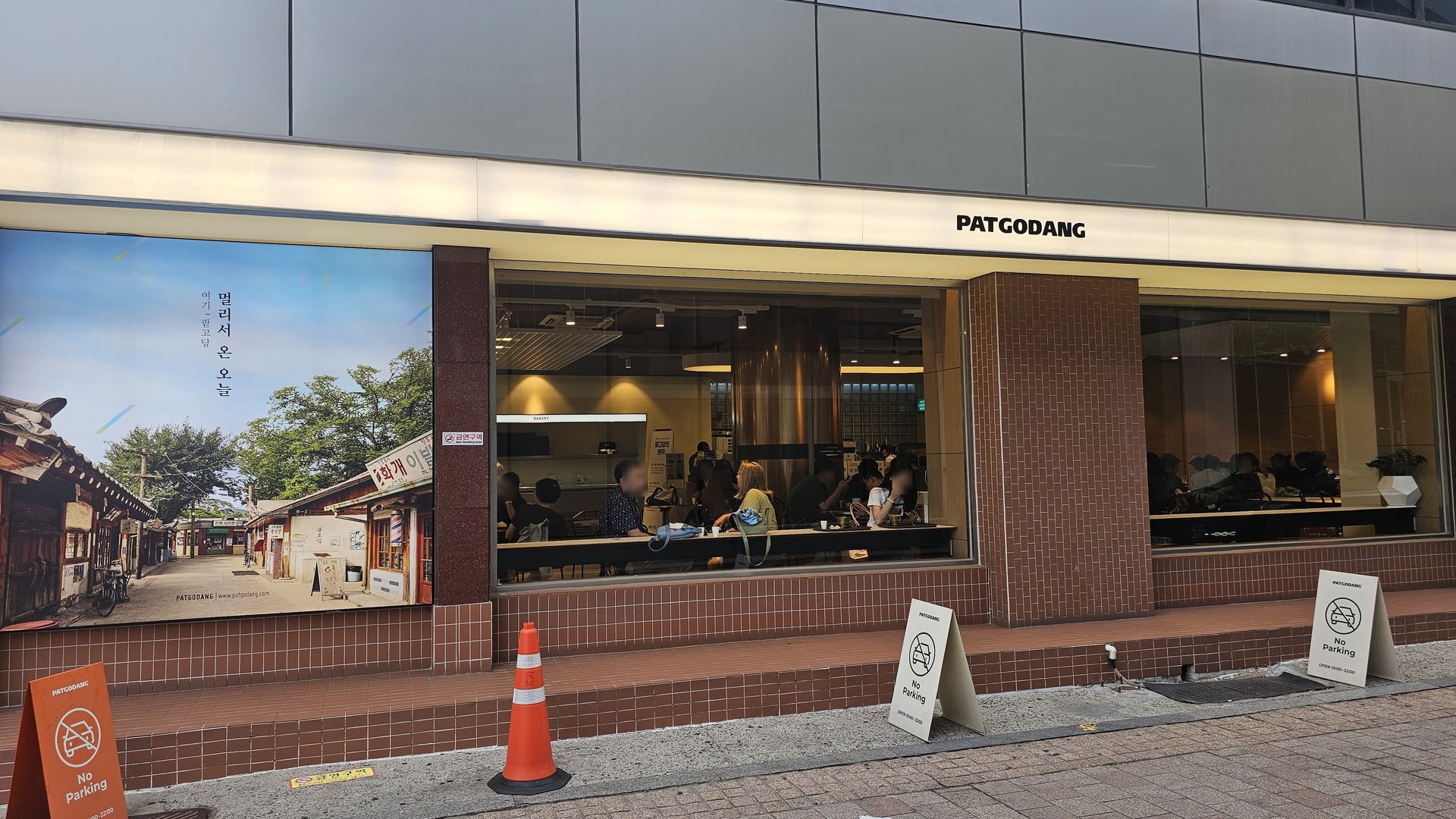
Patgodang Myeongdong storefront exterior with bingsu poster and glass facade showing customers insidePatgodang Myeongdong side exterior with PATGODANG English signage and interior seating visible through window
Gold and beige tones, brass-colored bingsu bowls, individually wrapped breads in clean glass cases. More polished than your average bingsu spot. Not a loud Instagram cafe — more like a refined Korean dessert brand trying to look premium.
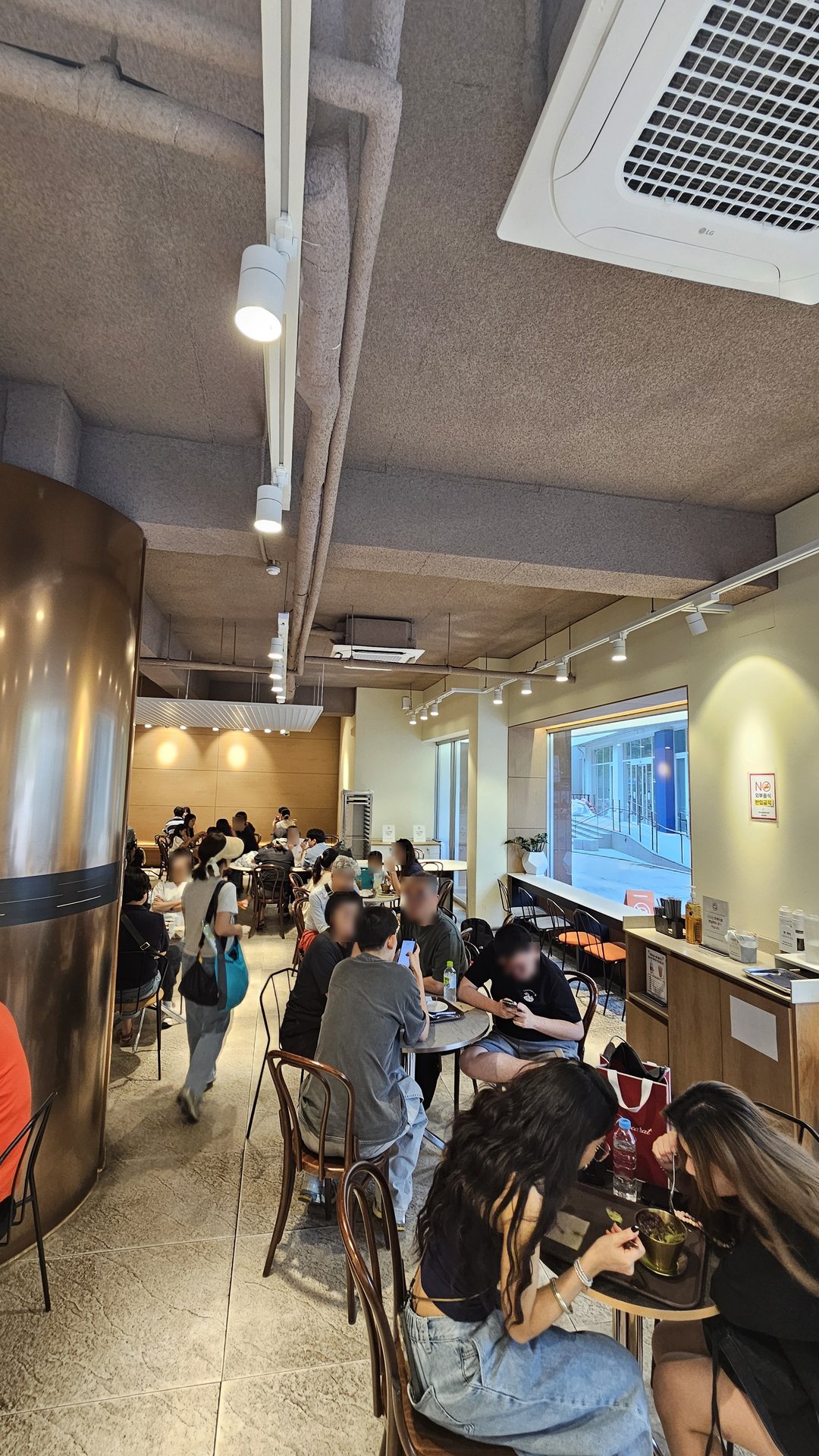
Crowded interior of Patgodang Myeongdong with seated customers and a waiting line near the entrance
At 5:30 PM on a weekday, it was genuinely busy. Plan for a short wait if you’re visiting during afternoon peak hours.
What I Ordered
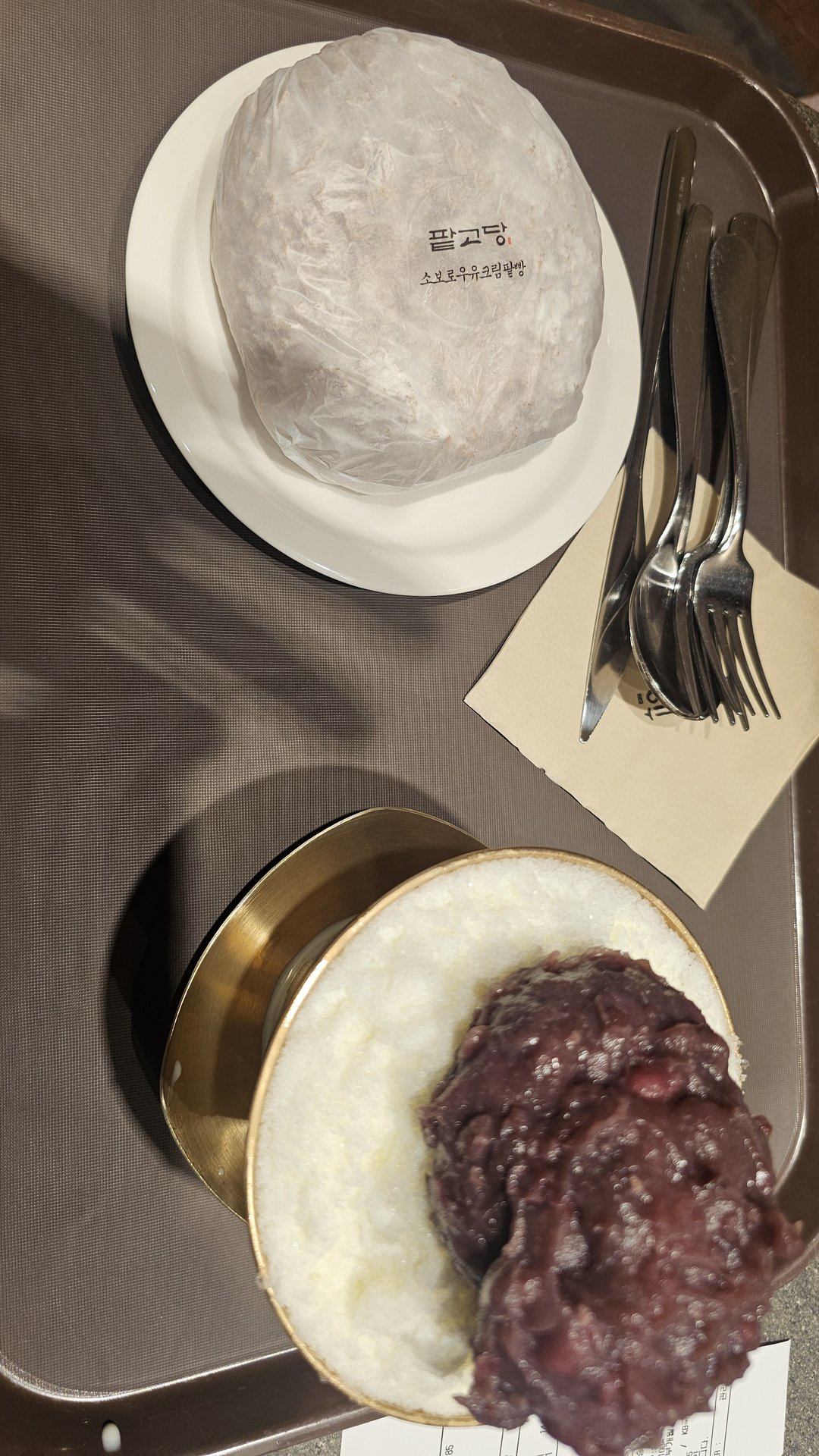
Full tray at Patgodang with red bean bingsu in brass bowl and soboro red bean cream bread on white plate
팥빙수 (Red Bean Bingsu) — 14,000 KRW (~$10.40 USD)
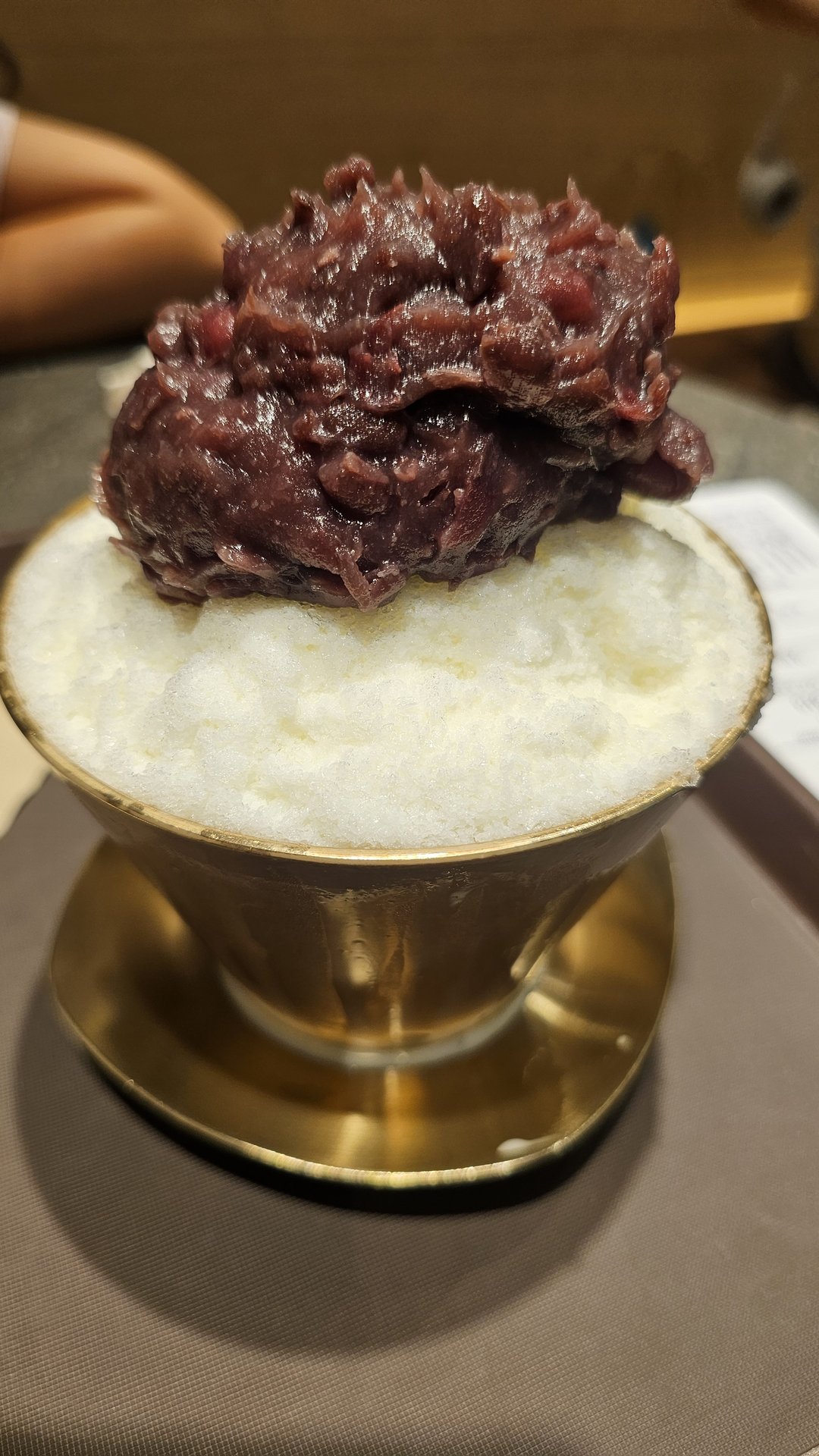
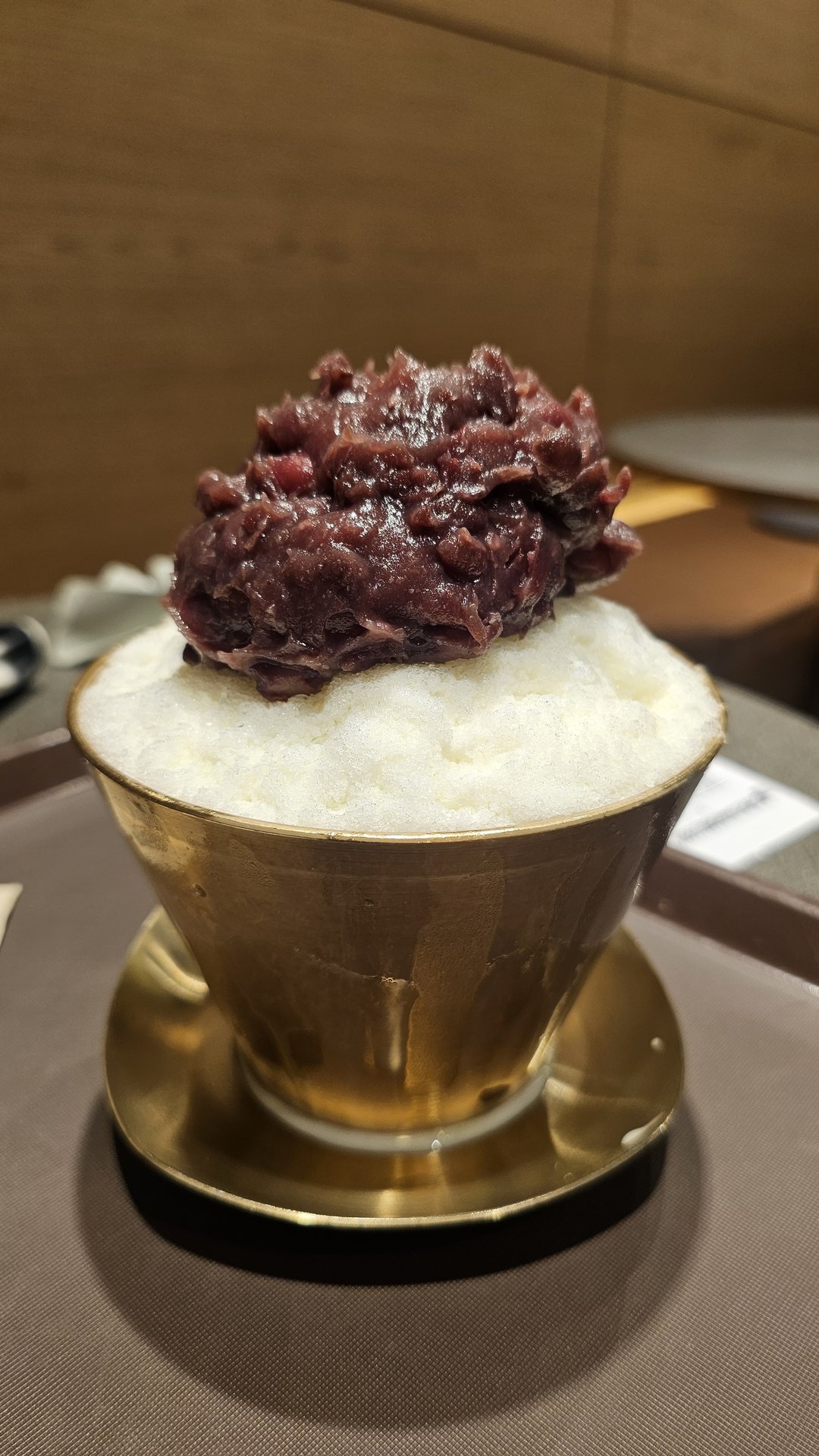
Overhead view of red bean bingsu in brass bowl at Patgodang — snow ice topped with sweet red beansSide view of red bean bingsu in brass bowl at Patgodang Myeongdong showing fluffy snow ice and generous red bean topping
The ice is finely shaved, the red bean is sweet without being cloying. Classic execution. The brass bowl looks good and gives it a bit of weight — like they put thought into the presentation, which they did.
Here’s the honest part though: 14,000 KRW for a standard red bean bingsu is on the higher end for Seoul. You’re paying Myeongdong tourist-area pricing. A similar bingsu at a less branded spot would run 8,000–10,000 KRW. The portion isn’t huge. It’s good, but you’ll feel the gap between what you paid and what you got.
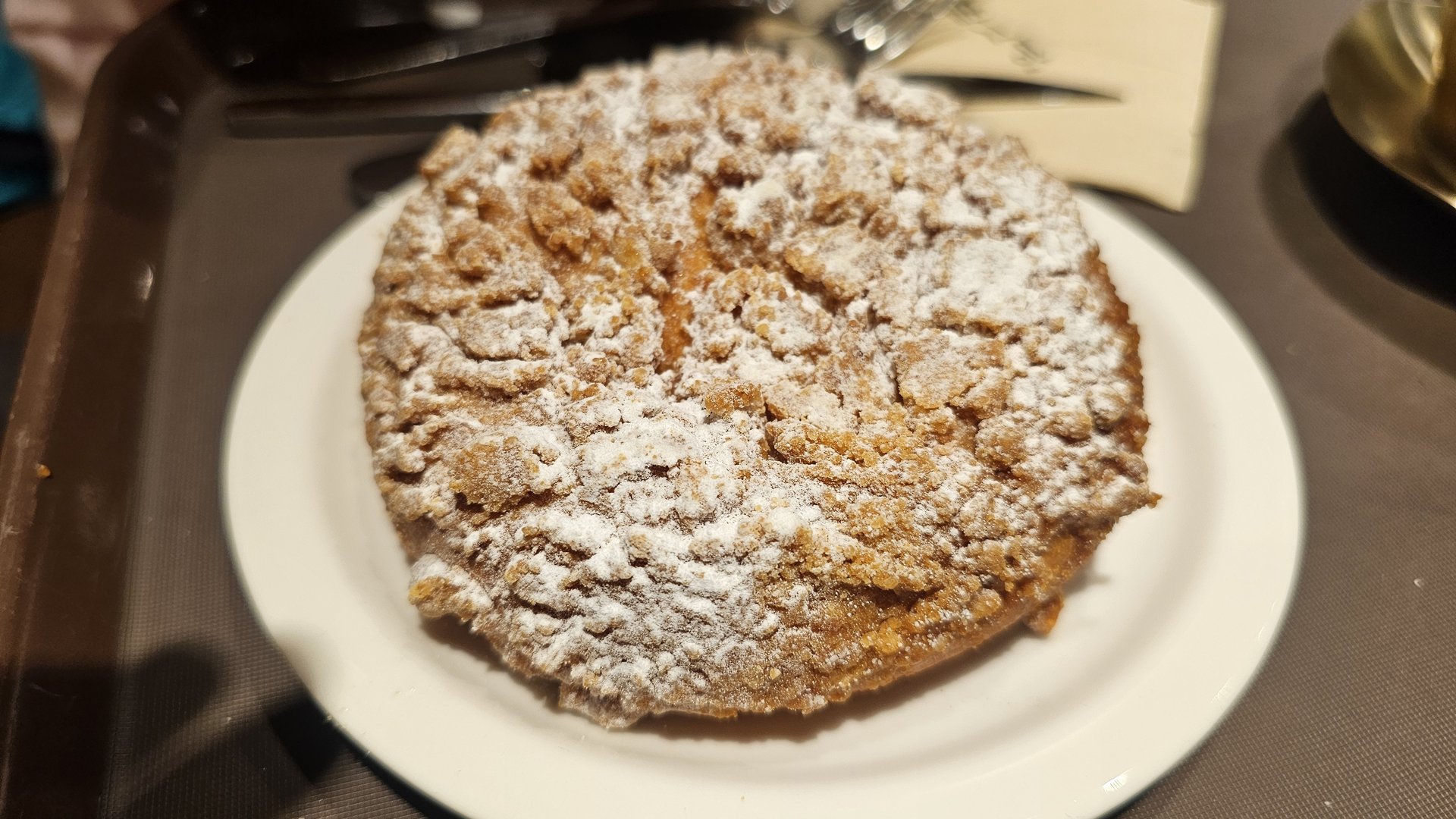
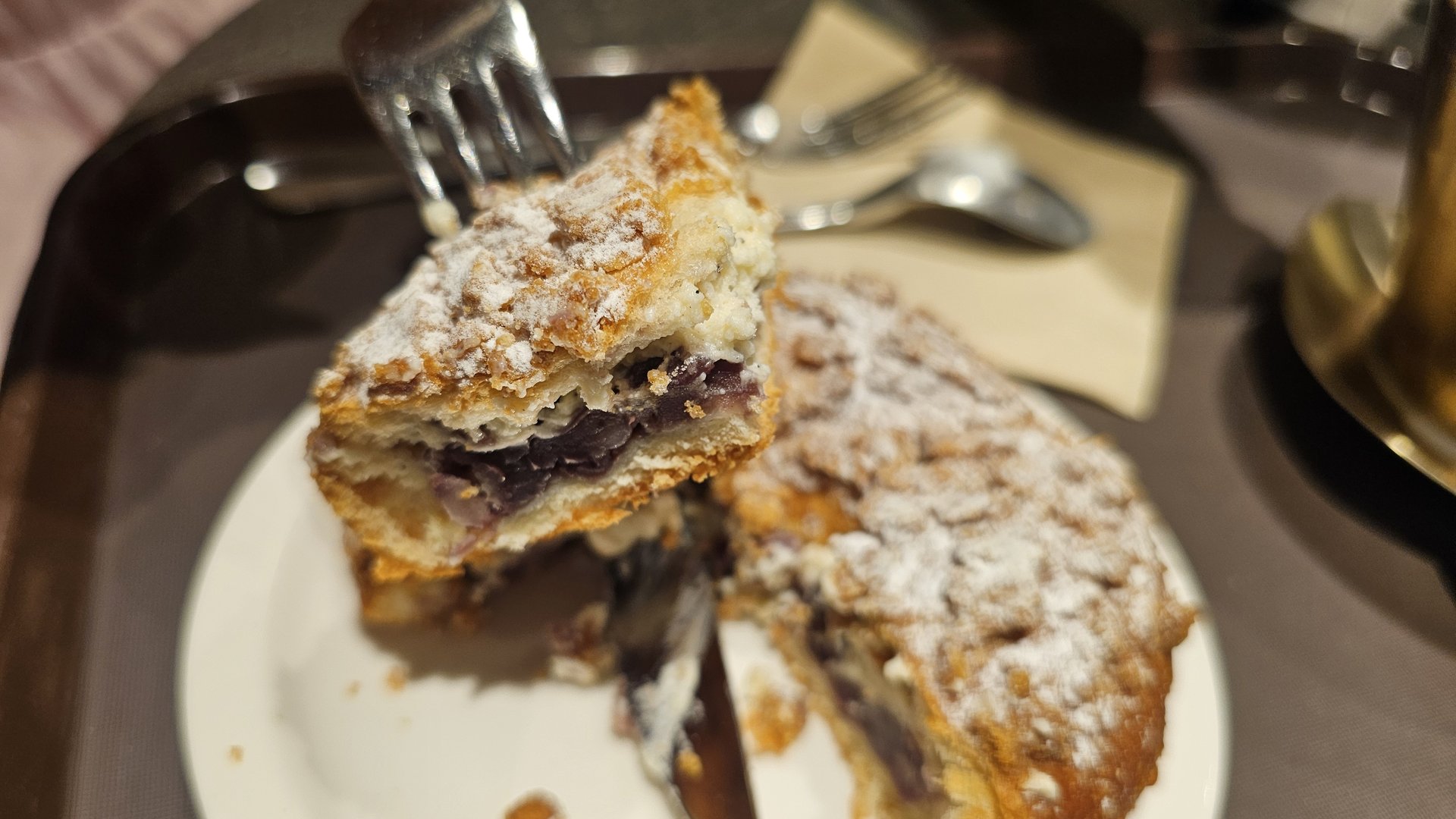
Soboro red bean cream bread on white plate at Patgodang dusted with powdered sugarCross-section of soboro red bean cream bread cut open with fork revealing smooth red bean cream filling at Patgodang
Soboro (소보로) is a crumbly, streusel-like topping baked onto Korean bread — sweetened breadcrumbs that give the crust a rough, sandy texture. Patgodang’s version is filled with red bean cream inside and dusted with powdered sugar on top.
The cream is smooth and the red bean flavor comes through without being too sweet. The soboro topping gives it a nice texture contrast. It’s a good bread.
Small though. 4,500 KRW for a round bun you’ll finish in a few bites.
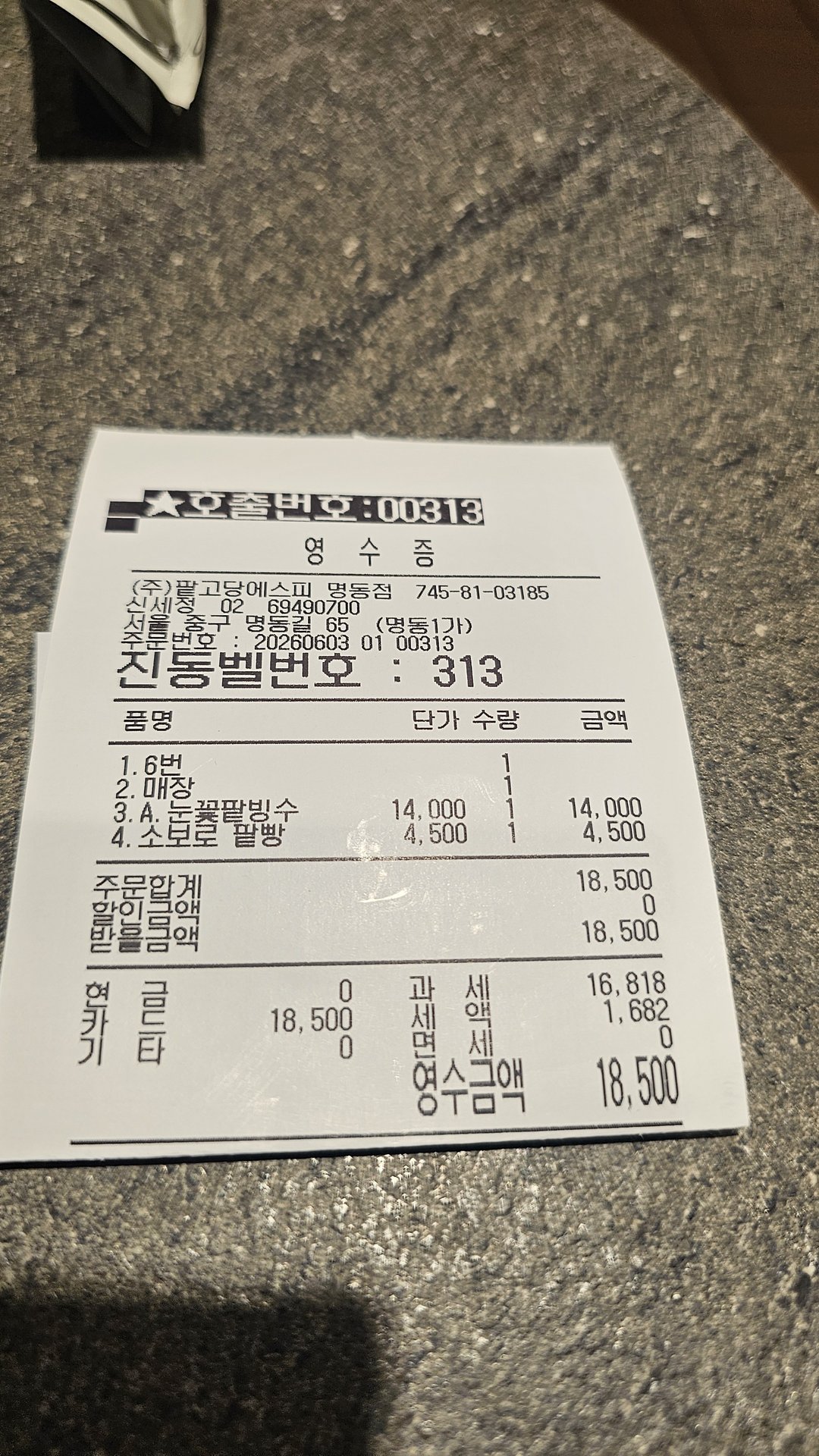
Receipt from Patgodang showing red bean bingsu 14,000 KRW and soboro red bean cream bread 4,500 KRW totaling 18,500 KRW
Total: 18,500 KRW (~$13.70 USD)
For two items at a dessert cafe in Myeongdong, that’s okay. Not shocking. But you won’t leave feeling like you got a lot.
The Bread Counter
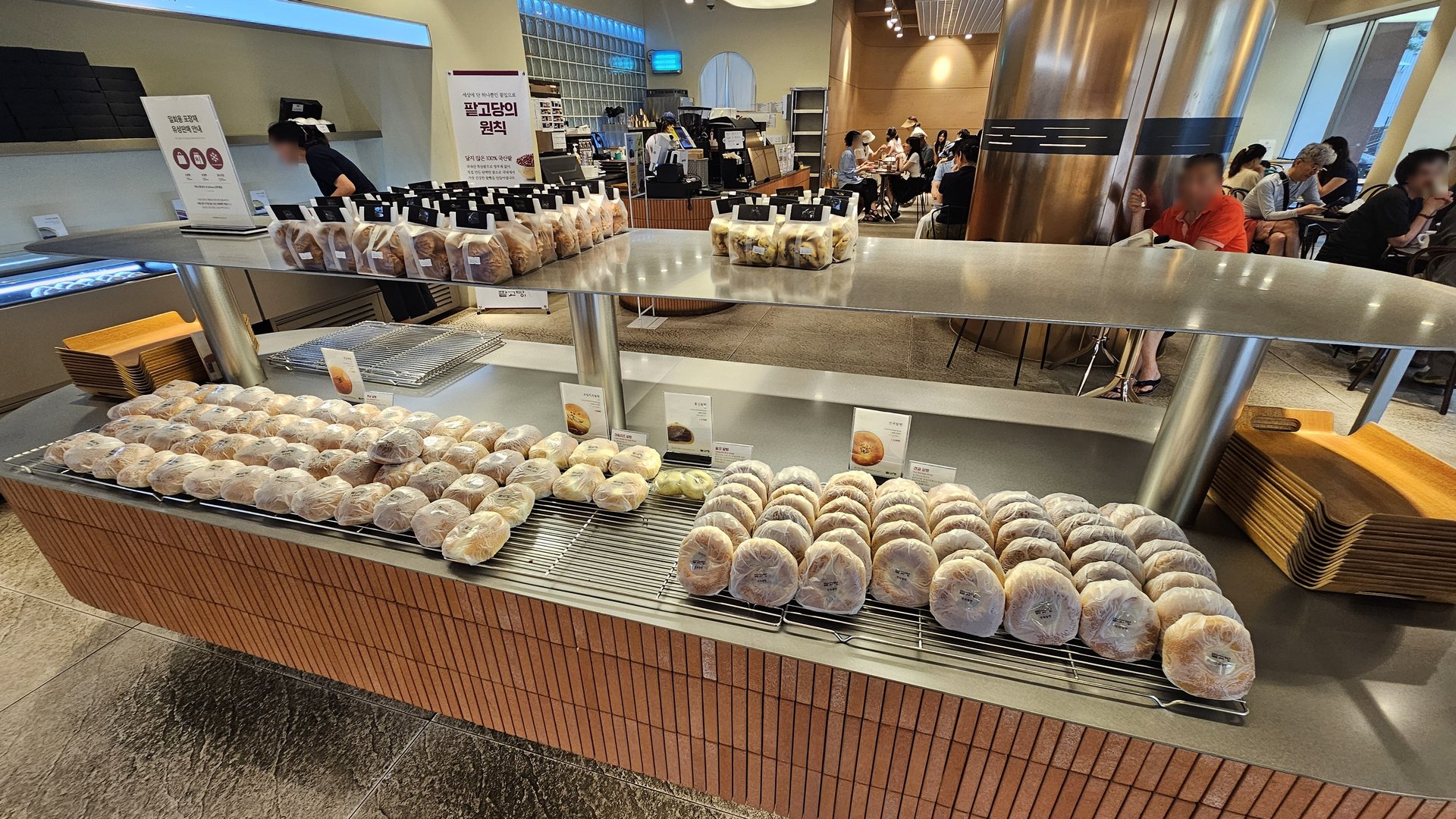
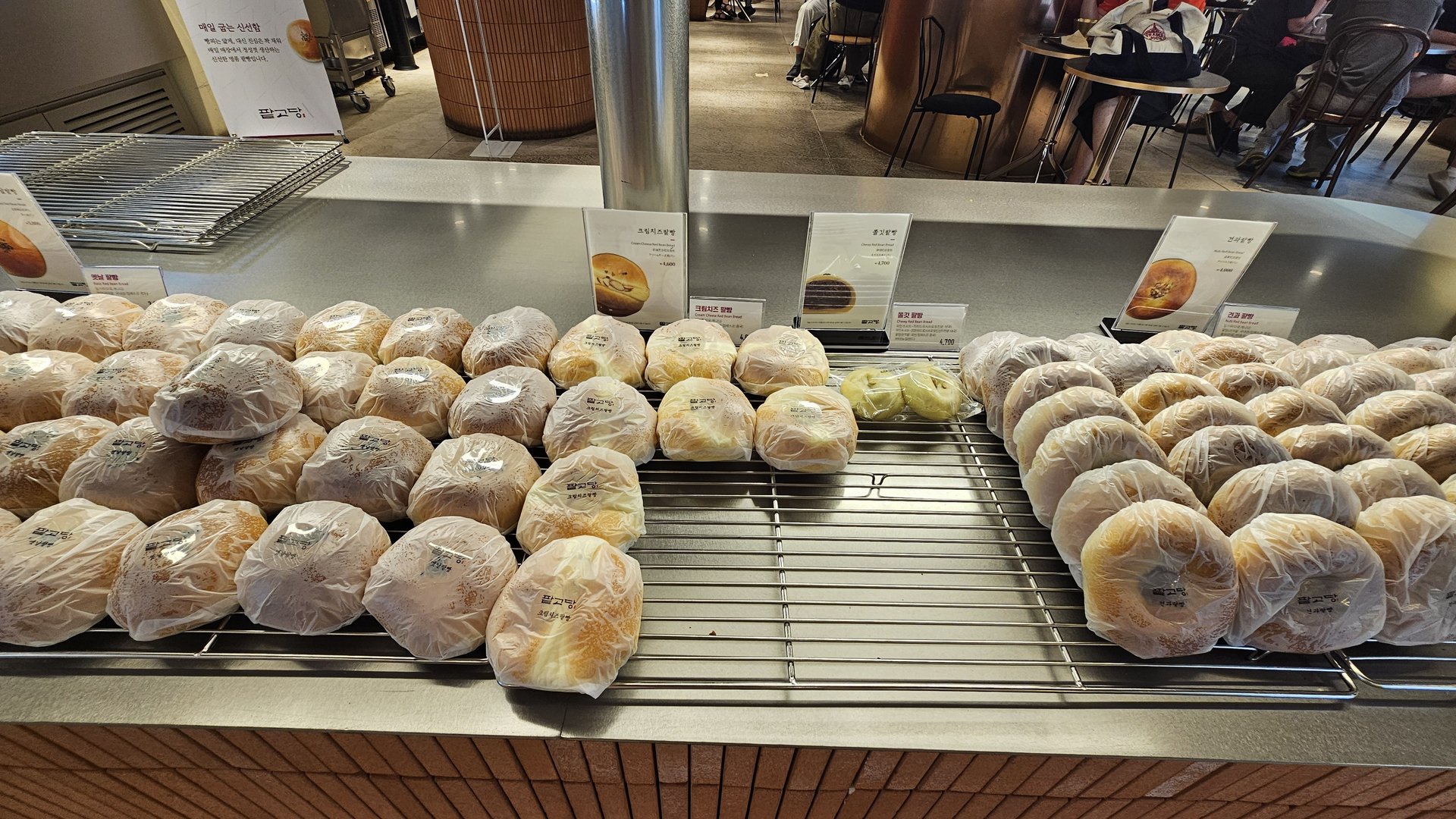
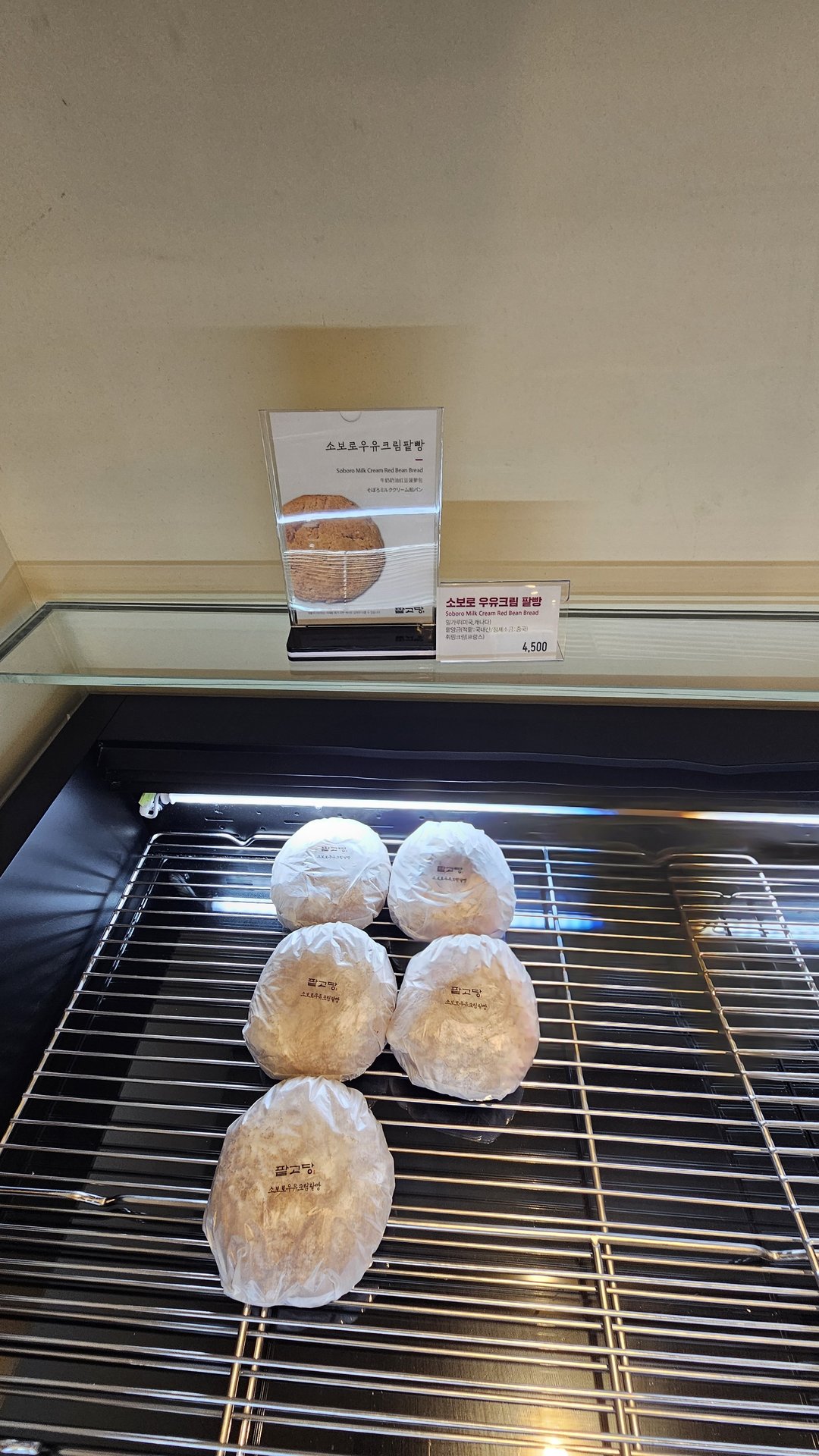
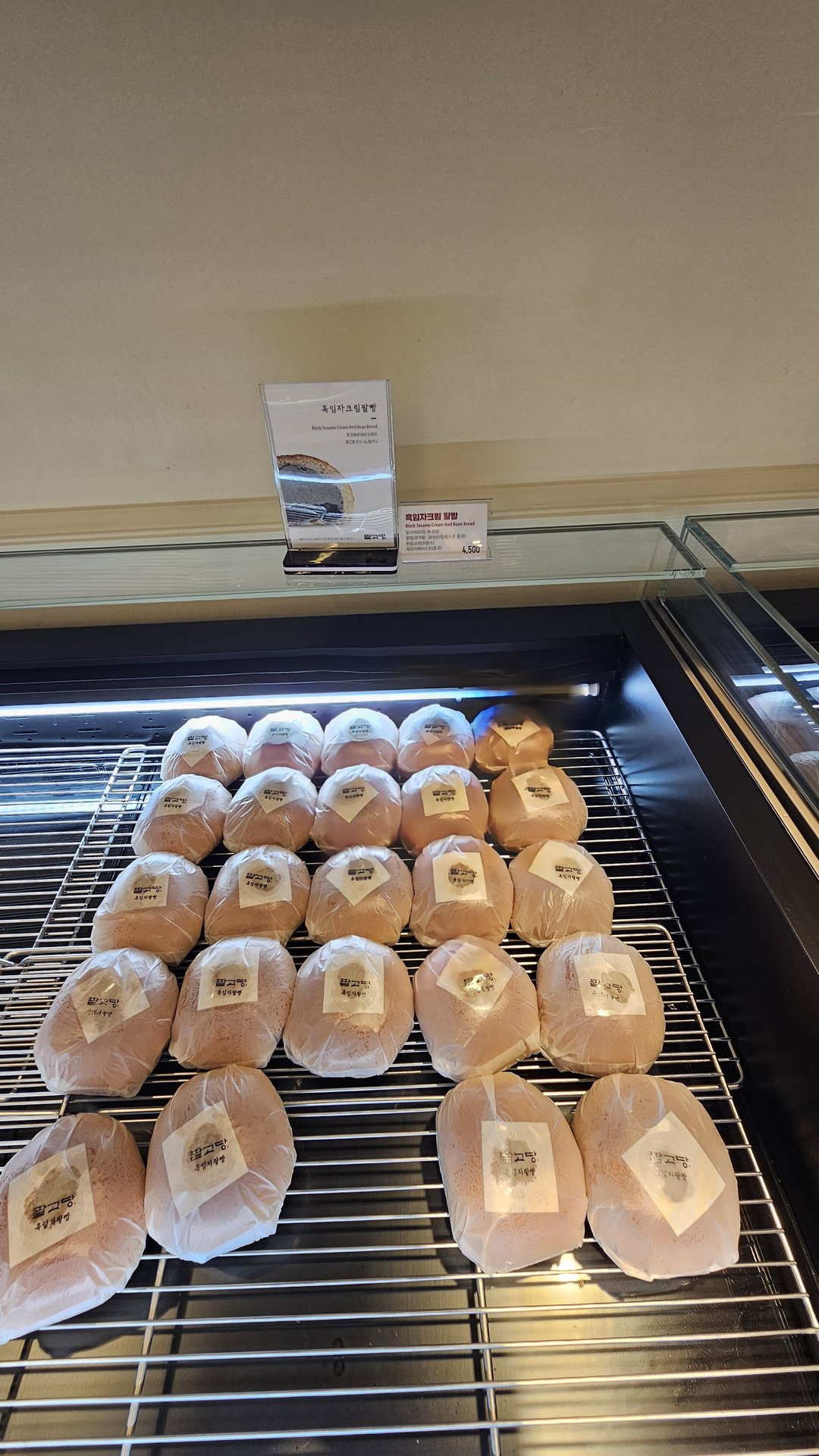
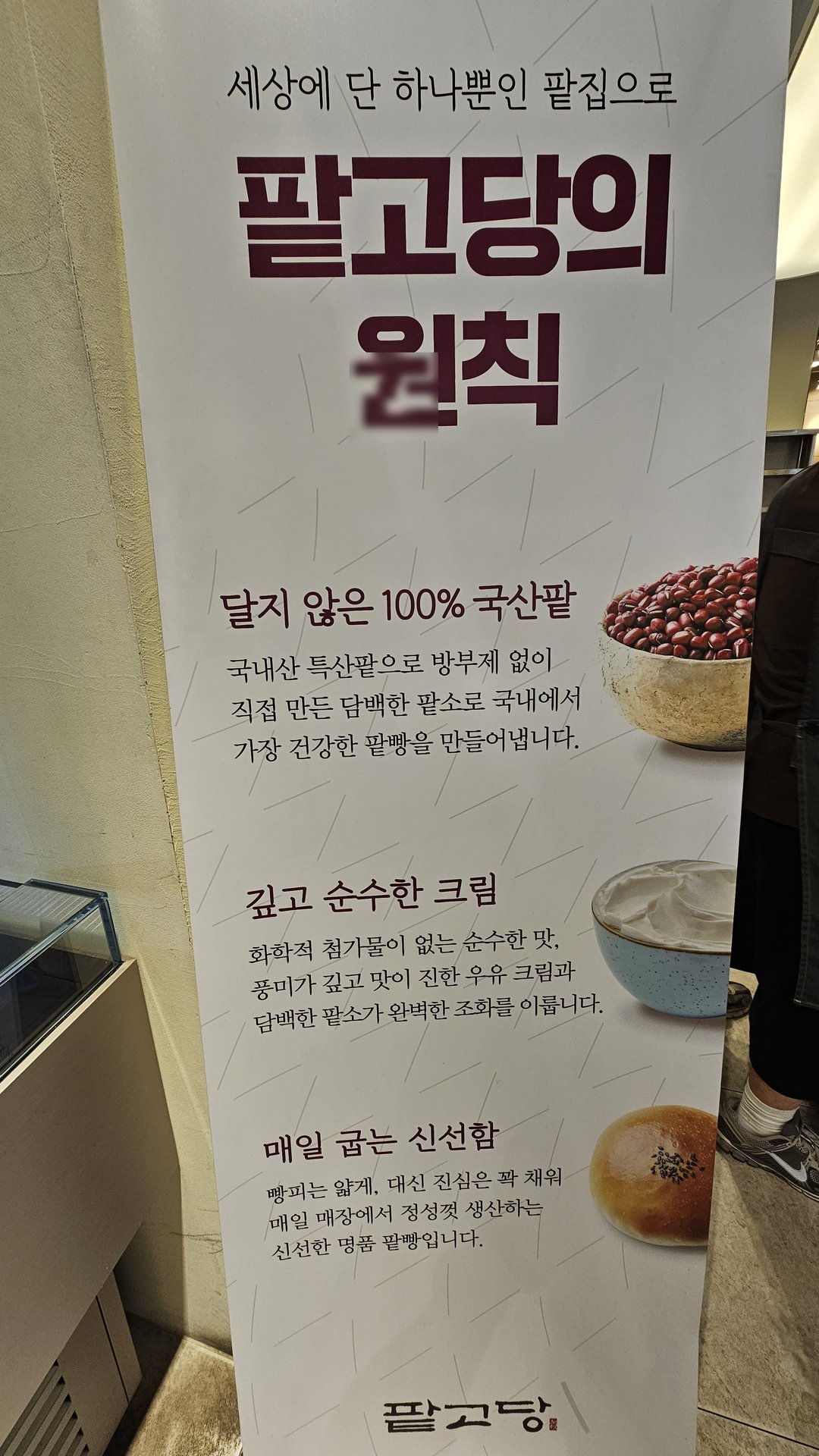
Counter display at Patgodang Myeongdong showing assorted red bean breads with beverage shelves behindFull display of multiple red bean bread varieties at Patgodang counter with price tags and variety labelsSoboro-style red bean breads in refrigerated showcase at Patgodang with price tags attachedPink-toned red bean bread varieties in refrigerated display case at Patgodang MyeongdongPatgodang brand banner stating 100% Korean red beans, no preservatives, baked fresh daily
They carry a wide range of red bean bread varieties — different shapes, fillings, and toppings. Some refrigerated, some at room temperature. All individually wrapped in plastic.
The no-preservatives policy is legit. The storage poster makes it clear: eat within 2 days refrigerated, or freeze if you’re taking them back to your hotel for later in the trip. tbh, this is the best reason to buy bread here. Clean ingredients in a Myeongdong tourist shop isn’t a given.
Stuff Tourists Should Know
– English menu: The bingsu board has English labels. Bread tags are mostly Korean, but staff can help.
– Card payment: Yes, cards accepted. Foreign Visa/Mastercard works fine.
– English-speaking staff: Basic English only, but enough to place an order.
– Tipping: Don’t. No tipping culture in Korea. Ever.
– Bread shelf life: 2 days refrigerated, freeze for longer. Don’t leave it in your bag in summer heat.
– Takeout: Faster than dine-in. Good option if you don’t want to wait for a seat.
– Solo dining: Fine. Counter and small table seating available.
– Vegetarian: Yes, bingsu and red bean breads are vegetarian. Check individual items if you’re avoiding dairy.
The Verdict
Decent. That’s the word. Not amazing, not bad — decent.
The bingsu does what it’s supposed to do. The bread is solid. The no-preservatives thing is a real differentiator and worth caring about. But the price-to-portion ratio leaves you slightly underwhelmed, and Myeongdong has enough tourist traps that you notice when a place is charging a premium for brand and location as much as for food.
Would I go back specifically for this? Probably not. But if I’m already in Myeongdong and want something cold and sweet? Yeah, it works.
Should you go?
– Already in Myeongdong and want Korean bingsu — yes, solid choice. Get the classic red bean bingsu.
– First time trying bingsu in Seoul — decent introduction, though not the best value in the city.
– Budget is tight — look outside the main tourist strip for cheaper bingsu options.
– Care about clean ingredients — the no-preservative bread is worth grabbing as a snack for later.
FAQ
What is bingsu and what does Patgodang serve?
Bingsu (빙수) is Korean shaved ice — milk-based ice shaved to a snow-like texture, topped with sweet red bean or other toppings. Patgodang specializes in red bean (팥) desserts including bingsu and freshly baked red bean bread with no preservatives.
How much does it cost at Patgodang Myeongdong?
Red bean bingsu starts at 14,000 KRW (~$10.40 USD). Red bean breads run 3,500–5,000 KRW (~$2.60–3.70 USD). Budget around 15,000–20,000 KRW per person for a bingsu and a bread.
Do they accept foreign credit cards?
Yes. Myeongdong is one of Seoul’s most foreigner-friendly areas — Visa and Mastercard work without issue.
Is there an English menu at Patgodang?
The main menu board includes English labels for the bingsu varieties. Individual bread tags are mostly in Korean, but staff can assist with basic English. You’ll manage fine without Korean.
How long is the wait at Patgodang?
During peak afternoon hours, expect a short wait for a seat — around 10–20 minutes in tourist season. Takeout bread is faster. Check their official Instagram for current hours before visiting.
Are the breads vegetarian?
Yes, the red bean bingsu and most red bean breads are vegetarian. All bread is made without preservatives and has a short shelf life — refrigerate within 2 days, or freeze for longer storage.
Quick honest review of Sulbing (설빙) in Gocheok, Seoul — one of Korea’s biggest bingsu chains. Came here with kids in the evening, ordered the apple mango cheese bingsu with agar jelly topping. Short version: it was good, the mango was legitimately mango-forward, and the English kiosk made ordering easy. Worth the stop if you’re in west Seoul.
What Is Bingsu — and Why Koreans Take It Seriously
If you’re visiting Korea for the first time and you haven’t heard of bingsu (빙수), here’s the deal.
Bingsu is Korean shaved ice. The OG version is 팥빙수 (patbingsu, pronounced “paht-bing-soo”) — shaved ice piled high with sweet red bean paste, chewy rice cake pieces, and a drizzle of condensed milk. It’s been around in some form since the Joseon Dynasty (14th–19th century), when ice was harvested in winter and stored in stone icehouses for summer. Back then it was basically a royal dessert. Now it’s a franchise staple.
The texture is the thing foreigners usually notice first. Korean bingsu isn’t crunchy like a snow cone or an Italian ice. The good stuff is made from finely shaved milk ice — almost silky, melts fast, light. You’re not crunching through it. You’re eating something closer to a cold, soft cloud.
설빙 (Sulbing, literally “snow ice”) launched in 2013 and became one of the chains that standardized the premium bingsu format: clean shops, consistent product, photogenic bowls. Over 400 locations in Korea now. They’ve moved far beyond red beans — their current menu runs from strawberry and matcha to mango with cheese cream and Dubai chocolate bingsu (yes, that trend made it here too).
About Sulbing the Brand
Not a boutique. Not a hidden gem. It’s a chain, and it operates like one — consistent quality across locations, kiosk ordering, numbered pickup system.
That’s not a knock. When you want reliable bingsu in a clean setting with a legible menu and no language stress, Sulbing delivers. The apple mango cheese bingsu has been one of their signature summer items for a while now.
The Gocheok branch is the 구로고척점 (Guro Gocheok location) — a neighborhood store in west Seoul rather than a touristy flagship.
Getting There
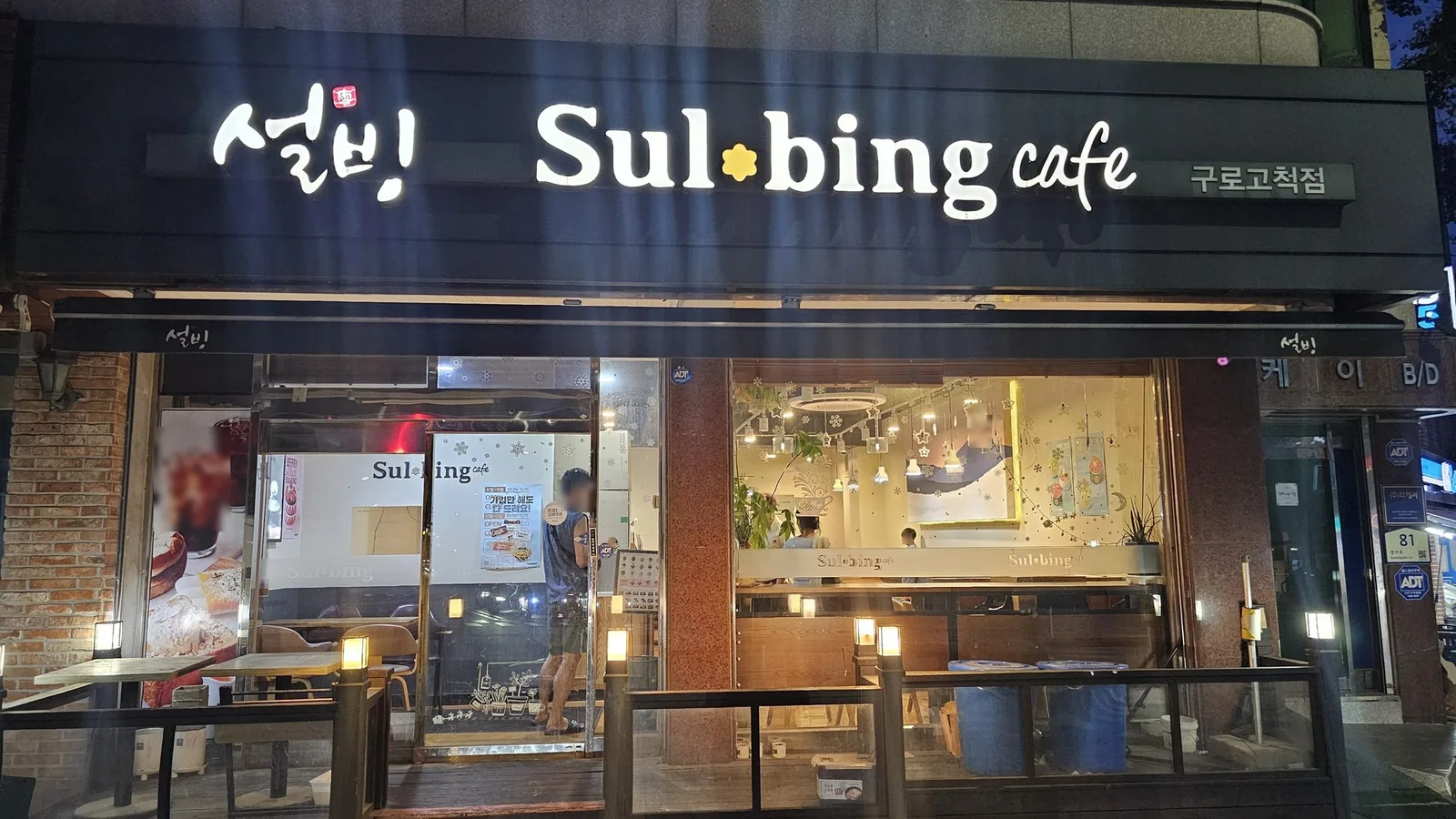
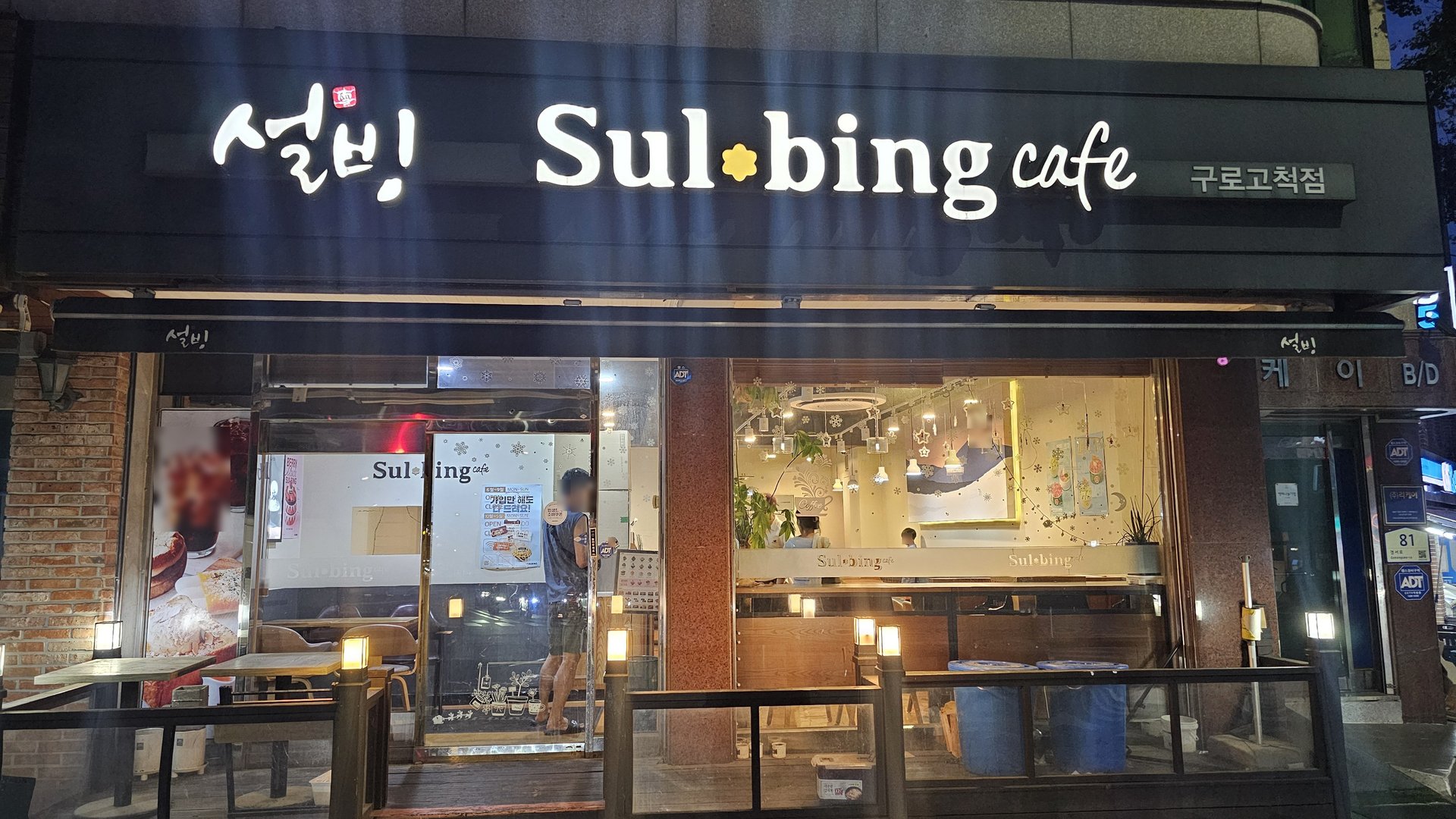
Sulbing Guro Gocheok branch exterior sign at night in Seoul
Gocheok isn’t a tourist neighborhood. It’s a residential area in Guro-gu, west Seoul — best known internationally for the Gocheok Sky Dome, Korea’s first domed baseball stadium (opened 2015, home of the Kiwoom Heroes). If you’re going to a game, this Sulbing is close.
From the main tourist zones:
– From Hongdae: about 30 minutes by subway
– From Myeongdong: around 40 minutes
– From Incheon Airport: roughly 60–70 minutes by subway (Line 9 → transfer)
Not worth a dedicated trip from central Seoul unless you’re already in the area. But if you’re catching a baseball game at Sky Dome, this is a solid dessert stop.
The Interior
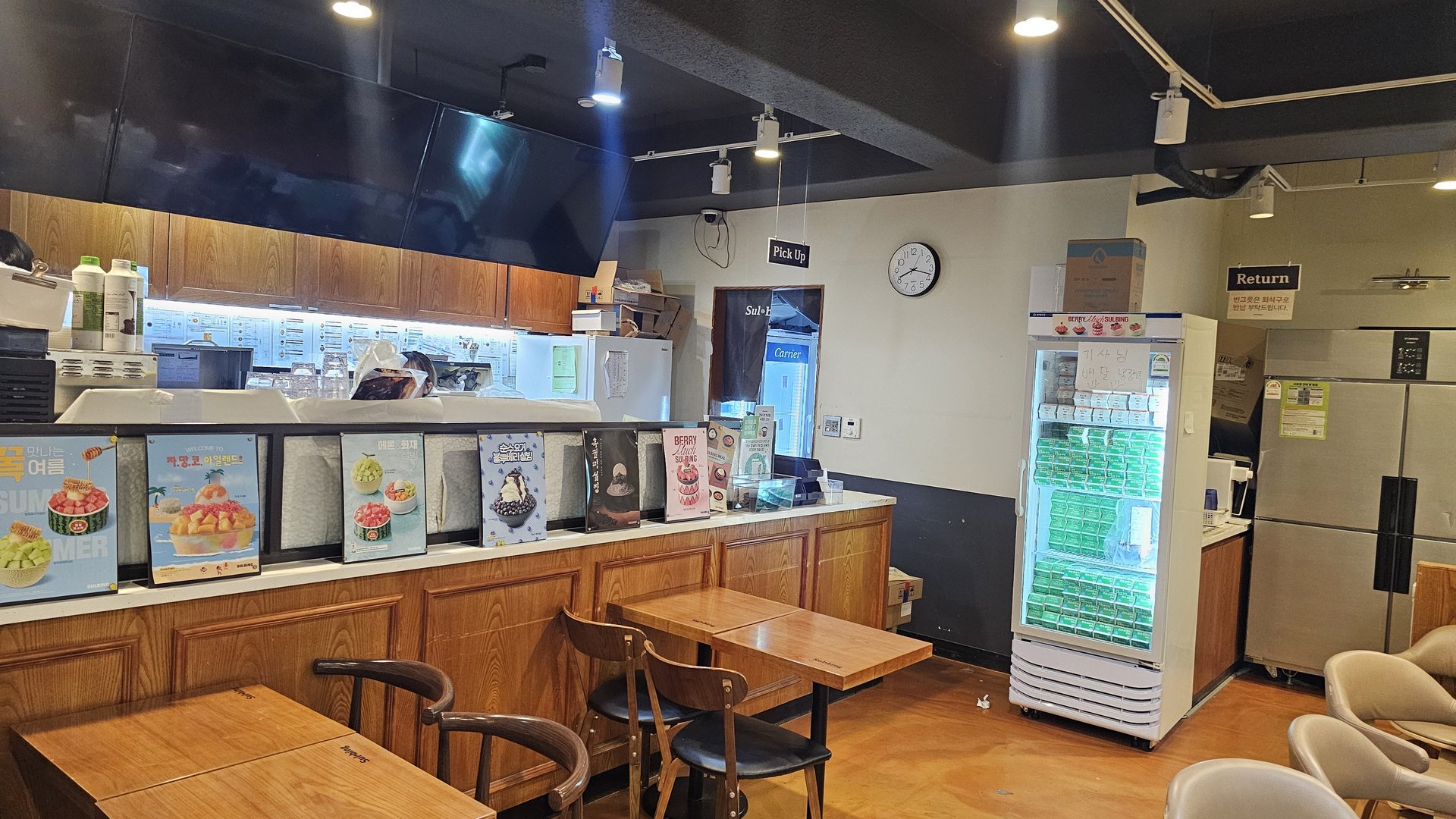
Interior counter and pickup area at Sulbing Gocheok with menu posters and drink fridge
Casual. Bright. Family-friendly. The kind of place where a parent and two kids don’t look out of place at all, which is exactly what this visit was.
There was decent seating when we arrived around 8 PM on a Sunday evening. No scramble for tables. The interior has that standard Sulbing look — clean lines, the signature brand colors, a pickup counter where your number gets called.
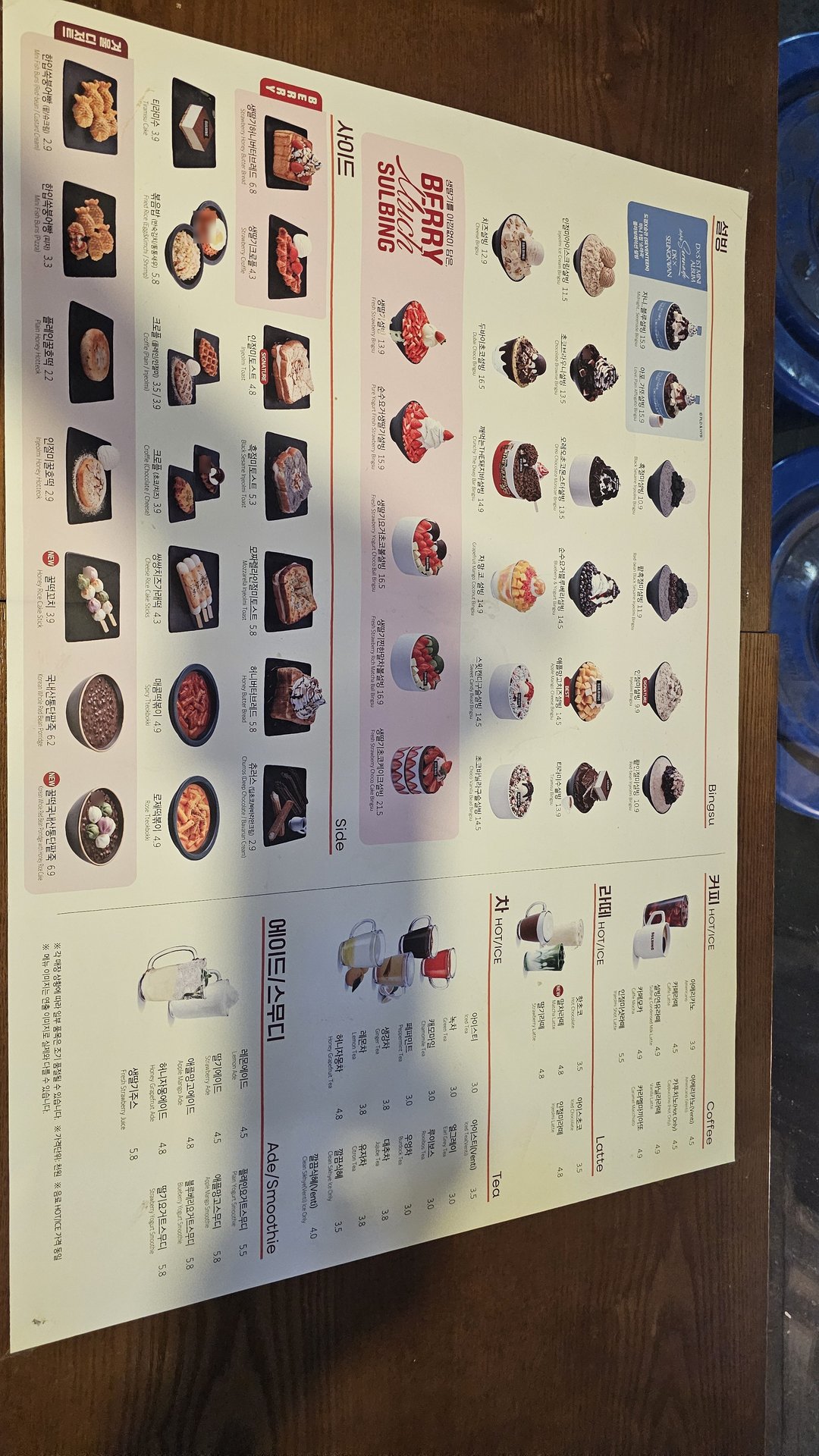
Full paper menu at Sulbing Gocheok showing bingsu, coffee, latte, tea, and ade options with prices
Paper menus are on the tables if you want to browse before hitting the kiosk. The menu is bigger than you’d expect — bingsu, sides, coffee, lattes, teas, ades. Not just a one-trick dessert shop.
Ordering: English Kiosk, No Stress
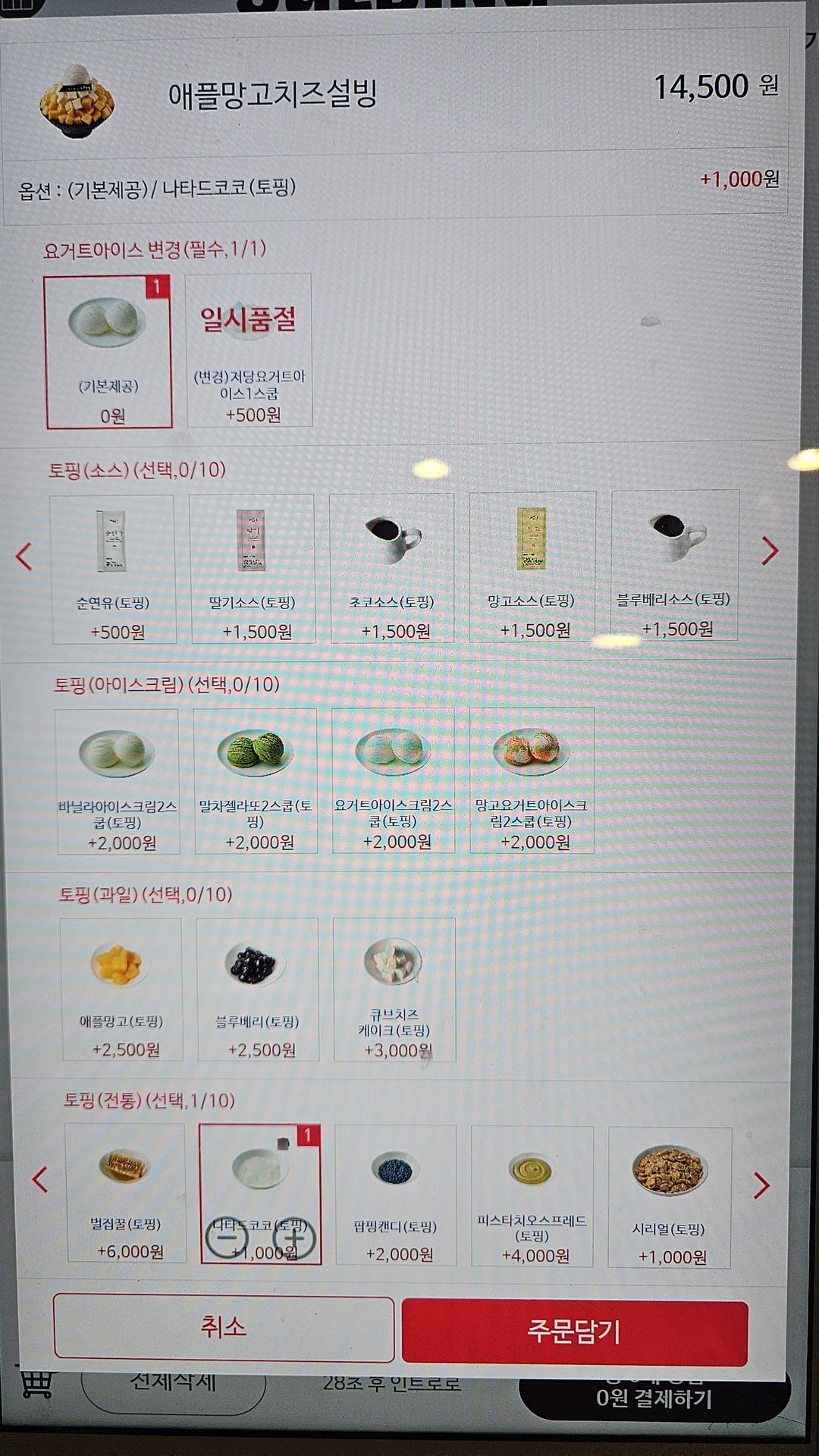
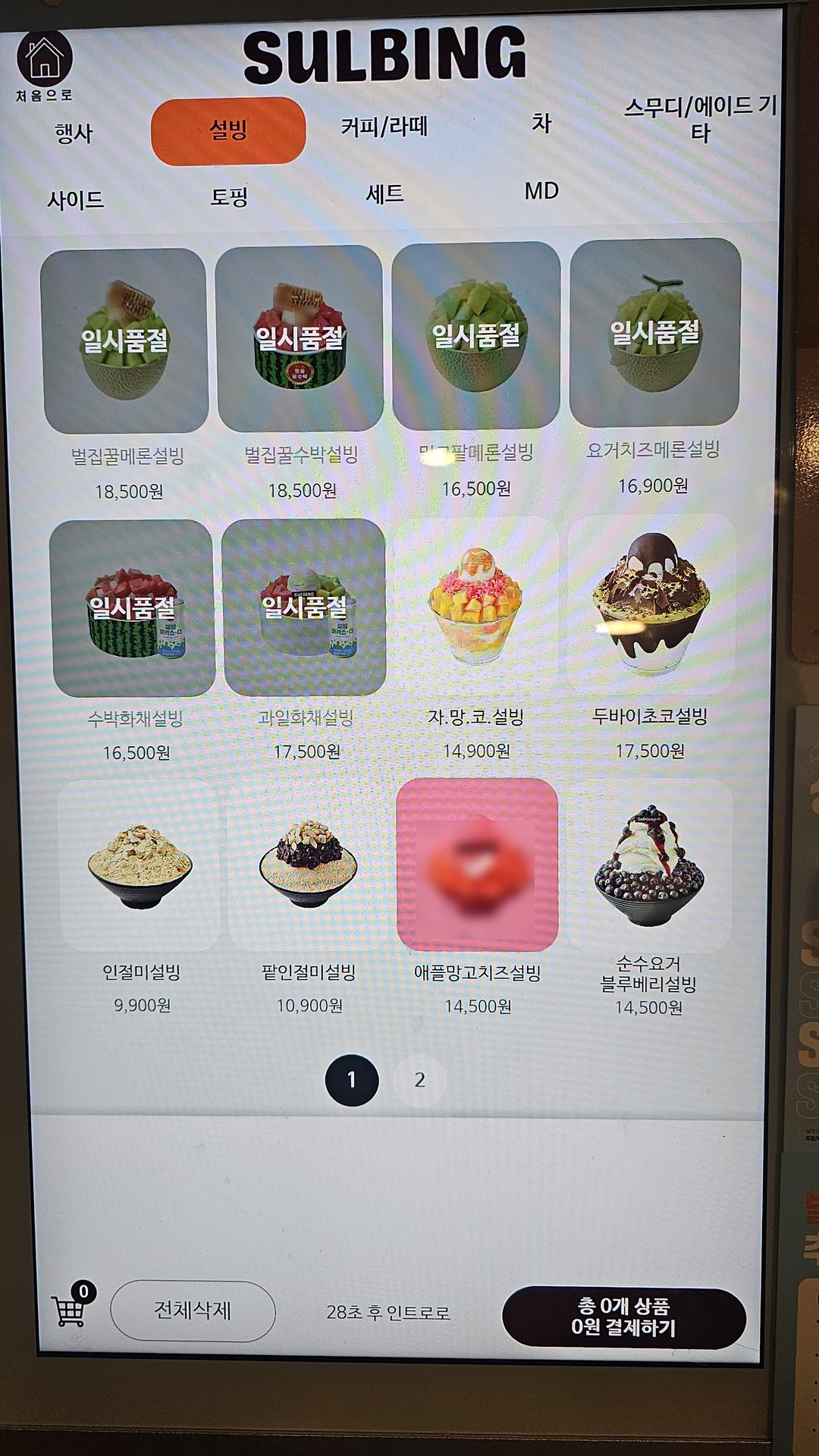
Kiosk screen at Sulbing Gocheok selecting apple mango cheese bingsu at 14,500 KRW with topping optionsKiosk bingsu menu list at Sulbing Gocheok showing full lineup including yogurt cheese melon and Dubai choco bingsu
Good news for non-Korean speakers: the kiosk has English. Switch languages at the start and you’re good. The menu descriptions translate reasonably well. Topping options come up on a separate screen after you pick your base item.
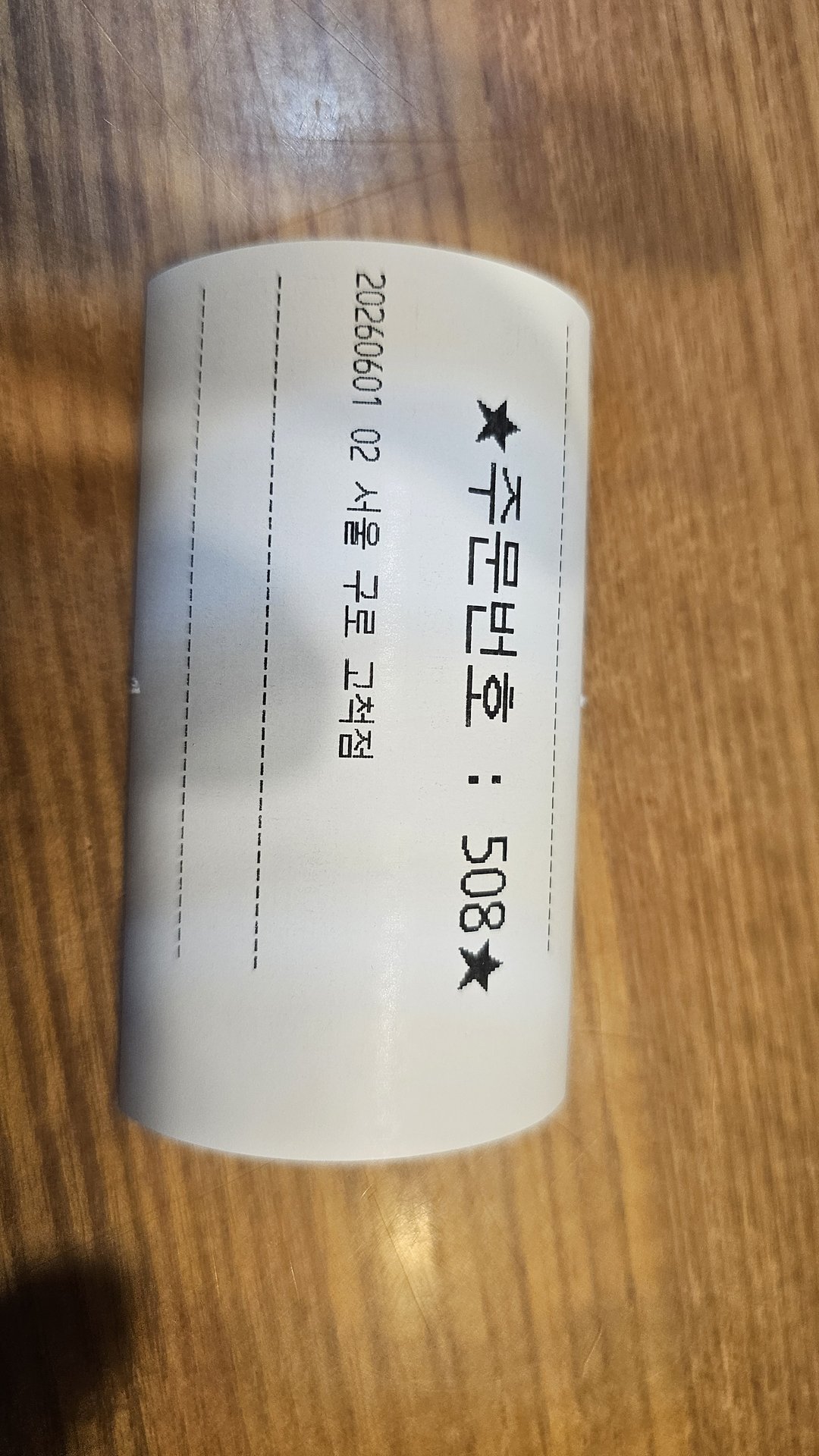
Order receipt number 508 from Sulbing Guro Gocheok dated June 1 2026
We got order #508. Pick up at the counter when your number shows. The whole process took maybe 3–4 minutes from ordering to food in hand.
What We Ordered
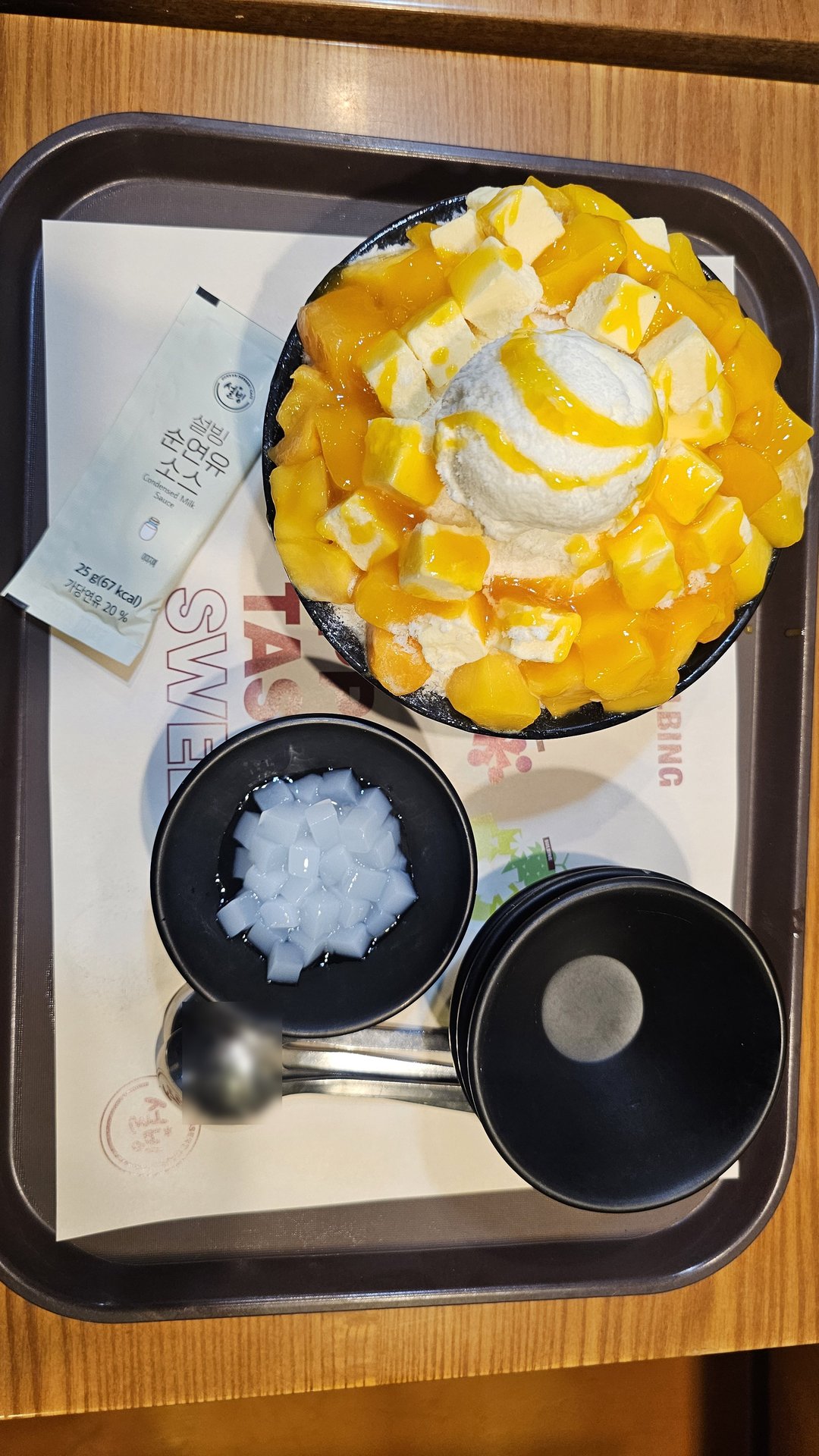
Apple Mango Cheese Bingsu — 14,500 KRW (~$10.75 USD)
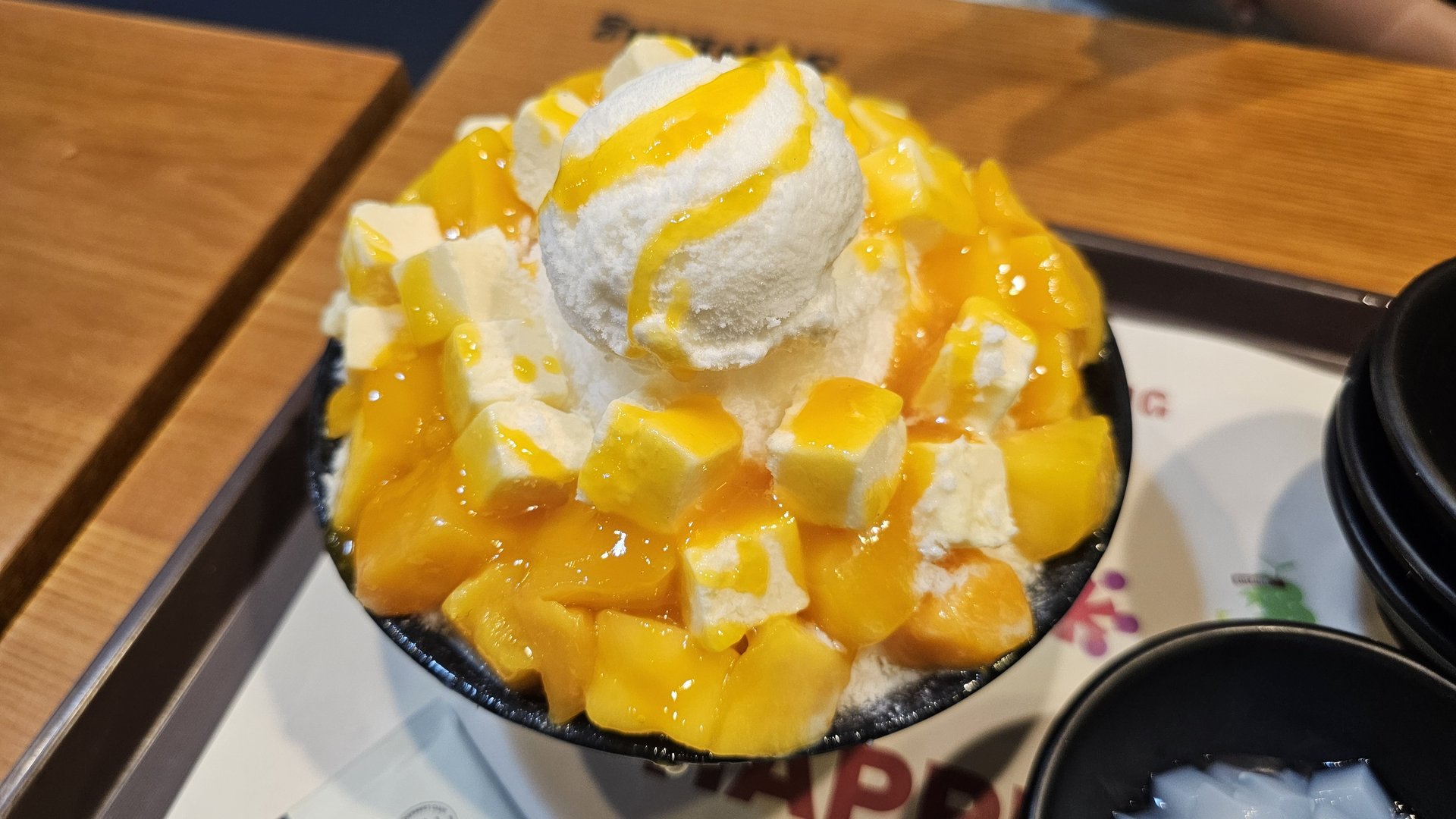
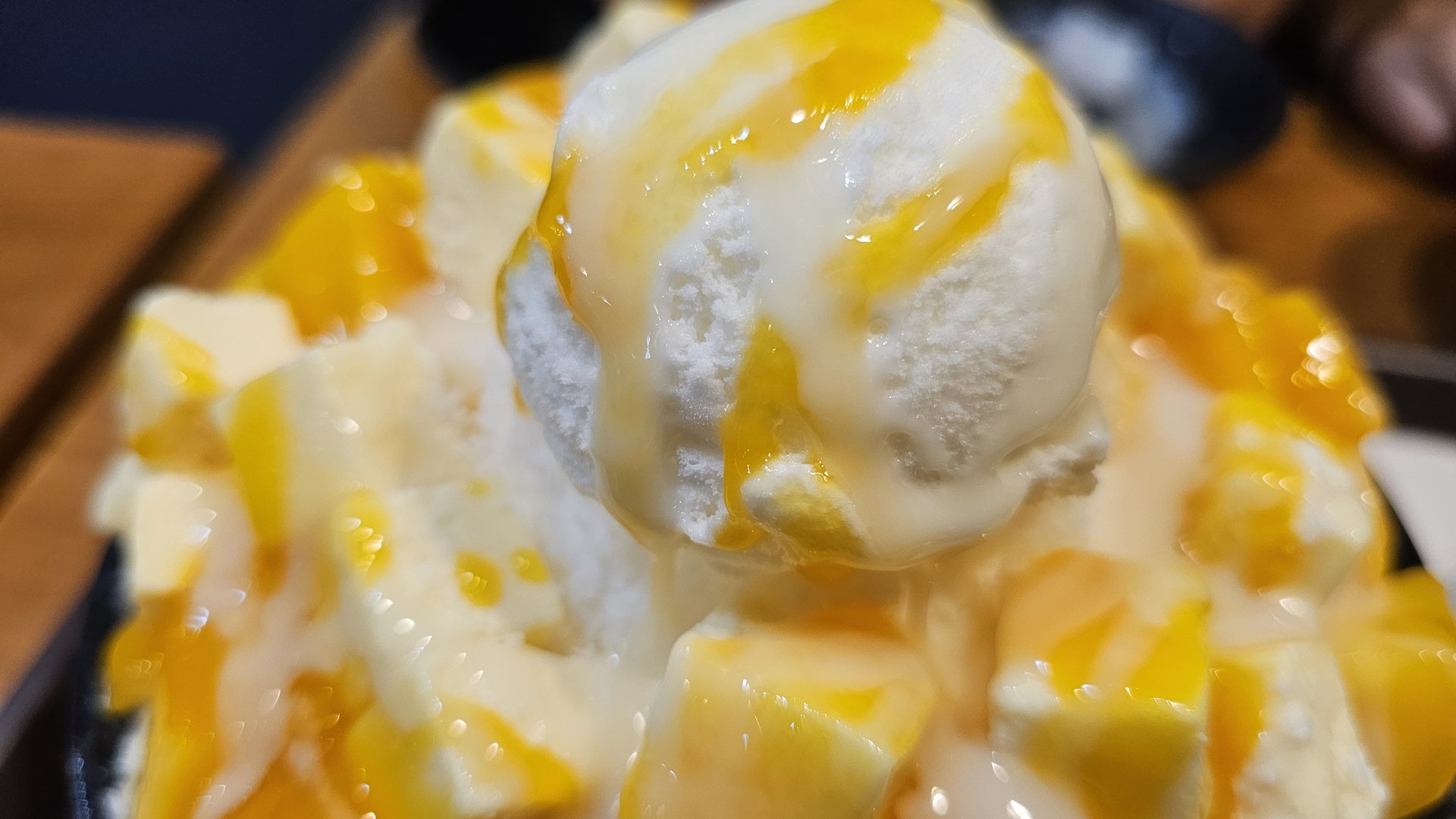
Apple mango cheese bingsu on tray with agar jelly side at Sulbing GocheokApple mango cheese bingsu close-up showing mango cubes cheese cream ice cream scoop and mango sauce
This is the one to get right now.
The bowl comes with shaved milk ice as the base, a generous scoop of what’s basically vanilla soft serve on top, real mango cubes, cheese cream (think: slightly tangy, lightly sweetened cream — closer to cream cheese whipped light than actual cheese), and mango sauce poured over the whole thing.
Extreme close-up of vanilla ice cream scoop on apple mango cheese bingsu with mango sauce melting
The mango flavor is actually present. That sounds like a low bar but it’s not — a lot of “mango” desserts in Korea are using mango-adjacent flavoring. Here you can taste real mango fruit, and the cubes have texture. The cheese cream cuts the sweetness just enough to keep it from being cloying.
Portion is large. One bowl is a lot for one adult. Two kids could split it and be fine. Three adults ordering one each would leave full.
The shaved ice itself melts fast. Eat it quickly. This isn’t a dessert to Instagram for 10 minutes before eating.
Agar Jelly Topping — Add-on
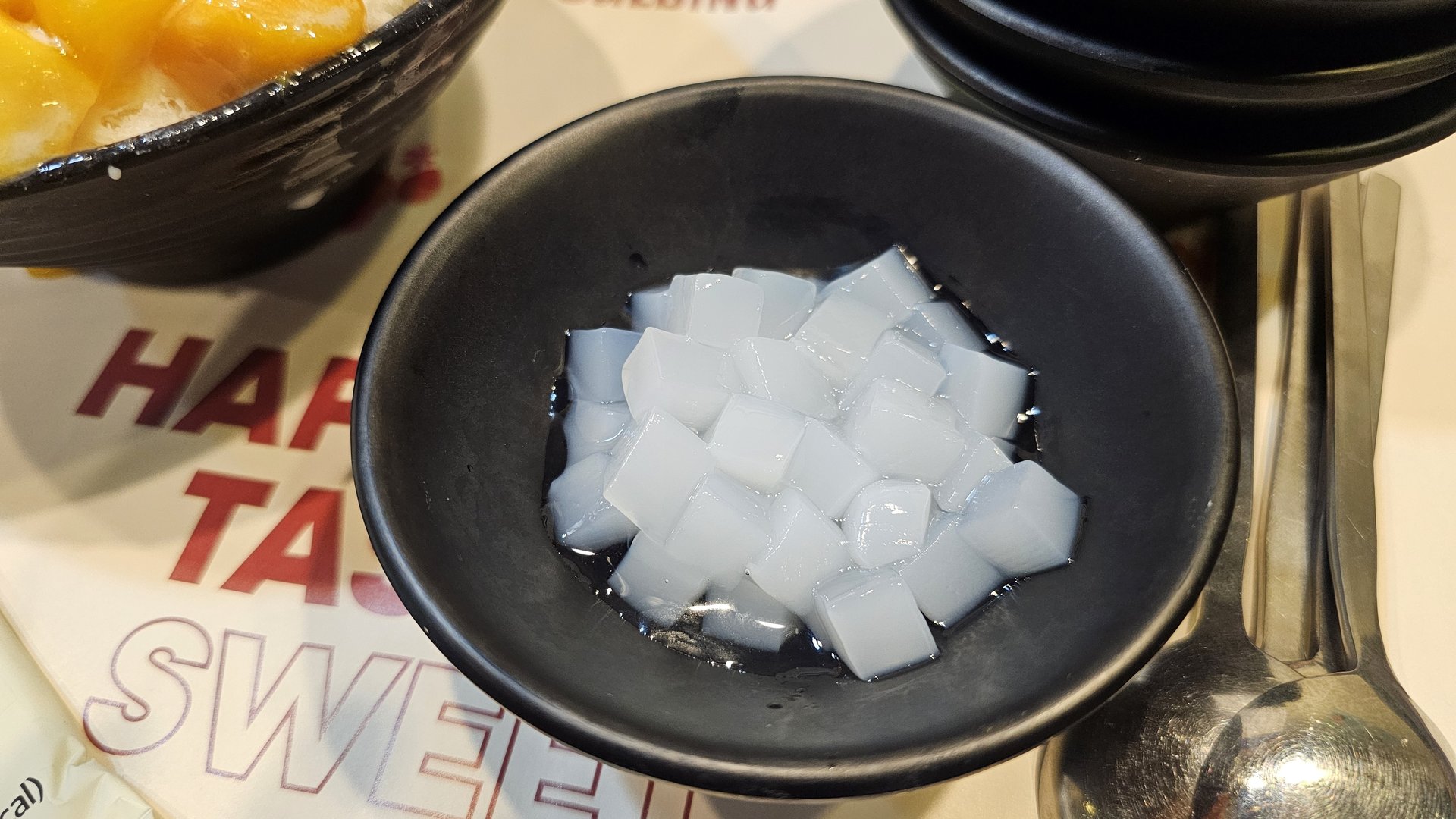
Close-up of agar jelly side topping served with bingsu at Sulbing
We added the agar jelly (한천 젤리) as a side topping. The kid asked for it, and tbh it was the right call.
한천 (hancheon) is agar — a seaweed-derived gelatin substitute. The texture is firmer and cleaner-cutting than regular jelly. No artificial bounce. These come in small, lightly sweetened cubes and act as a textural contrast to the soft ice.
If you’re with kids, add it. If you’re alone and just want the bingsu straight, you can skip it. Either way, it’s cheap.
Stuff Tourists Should Know
Language: Kiosk has English. Ordering is self-serve, so minimal interaction needed with staff. No English on printed signage but you won’t need it.
Payment: Card accepted. Foreign cards (Visa/Mastercard) should work fine on the kiosk. No cash required.
Tips: No. Korea doesn’t tip. Don’t tip.
Dietary notes: The bingsu base uses milk. Not vegan. Agar jelly is plant-based. Check the kiosk for allergen info — it’s listed by item.
Portion size: Large. Plan accordingly. Three adults ordering individual bowls is a lot of sugar.
When to go: Summer is peak season but Sulbing runs year-round. Evening visits on weekdays are low-wait. Weekend afternoons can get busy.
Kids: 100% family-friendly. The setup works well — kiosk ordering, quick pickup, casual seating.
The Verdict
Should you go to this Sulbing specifically?
If you’re already in west Seoul — yes. The apple mango cheese bingsu is genuinely good, the English kiosk removes all friction, and the portions are solid for the price.
If you’re doing a classic Seoul tourist trip (Gyeongbokgung → Insadong → Myeongdong → Hongdae): don’t detour to Gocheok just for this. There are Sulbing locations near tourist areas. Hit one of those.
If you’re going to a game at Gocheok Sky Dome: absolutely stop here before or after.
The brand itself? Honestly one of the more reliable bingsu options in Korea. Not the most creative, not the cheapest, but consistent and tourist-friendly. Good pick for first-time bingsu eaters who want a smooth experience without surprises.
Will I be back? Already have been multiple times. That answers it.
FAQ
What’s the difference between bingsu and a snow cone?
Night and day. A snow cone uses coarse, crunchy water ice. Bingsu uses finely shaved milk ice — almost powdery, soft, melts on contact. The texture is completely different.
Is bingsu a traditional Korean food?
팥빙수 (red bean bingsu) is. It dates back to the Joseon Dynasty as a summer dessert. Modern versions like mango cheese or matcha are recent evolutions, but the base concept — shaved ice as a summer treat — is deeply Korean.
Can I order in English at Sulbing?
Yes, at this location the kiosk has an English option. Switch it at the start screen. Most Sulbing locations have this.
How much does bingsu cost in Korea?
At Sulbing, the premium bingsu items run 13,000–16,000 KRW ($9.50–$12 USD). Cheaper than most Western dessert cafes, but not a budget snack.
Is Sulbing good for vegetarians?
Most bingsu items are vegetarian (no meat). The agar jelly topping is also plant-based. However, most items contain dairy. Not vegan-friendly without modifications.
Where is the nearest Sulbing to Myeongdong or Hongdae?
There are branches near both areas. Search “설빙” on Naver Maps or Kakao Maps — it’ll show you the nearest location with walking distance.
What should I order at Sulbing if I want the most Korean experience?
팥빙수 (patbingsu). It’s the classic — red bean paste, rice cake, condensed milk on shaved ice. It’s the one that’s been around for centuries. Everything else is a modern riff on that foundation.
Quick honest review of Kustom Coffee in Yeouido. If you’re already doing the IFC Mall or Han River park loop, this cafe is right in the neighborhood. Short version: milk tea was genuinely good, pistachio cream latte is a lot — and I mean a lot.
Went on a Wednesday morning around 11 AM with one other person. Kiosk ordering. English menu available. Sat outside on the terrace.
What Is Kustom Coffee?
Kustom Coffee is a Korean specialty coffee brand — the kind that leans into the “third wave” aesthetic. Dark green palette, concrete floors, minimal signage. Very current Seoul.
Not a Starbucks alternative. Not a mom-and-pop either. It’s a local Korean chain that takes its drinks seriously but runs with cafe-chain efficiency. The kind of place Seoul’s Yeouido office crowd hits at 10 AM between meetings.
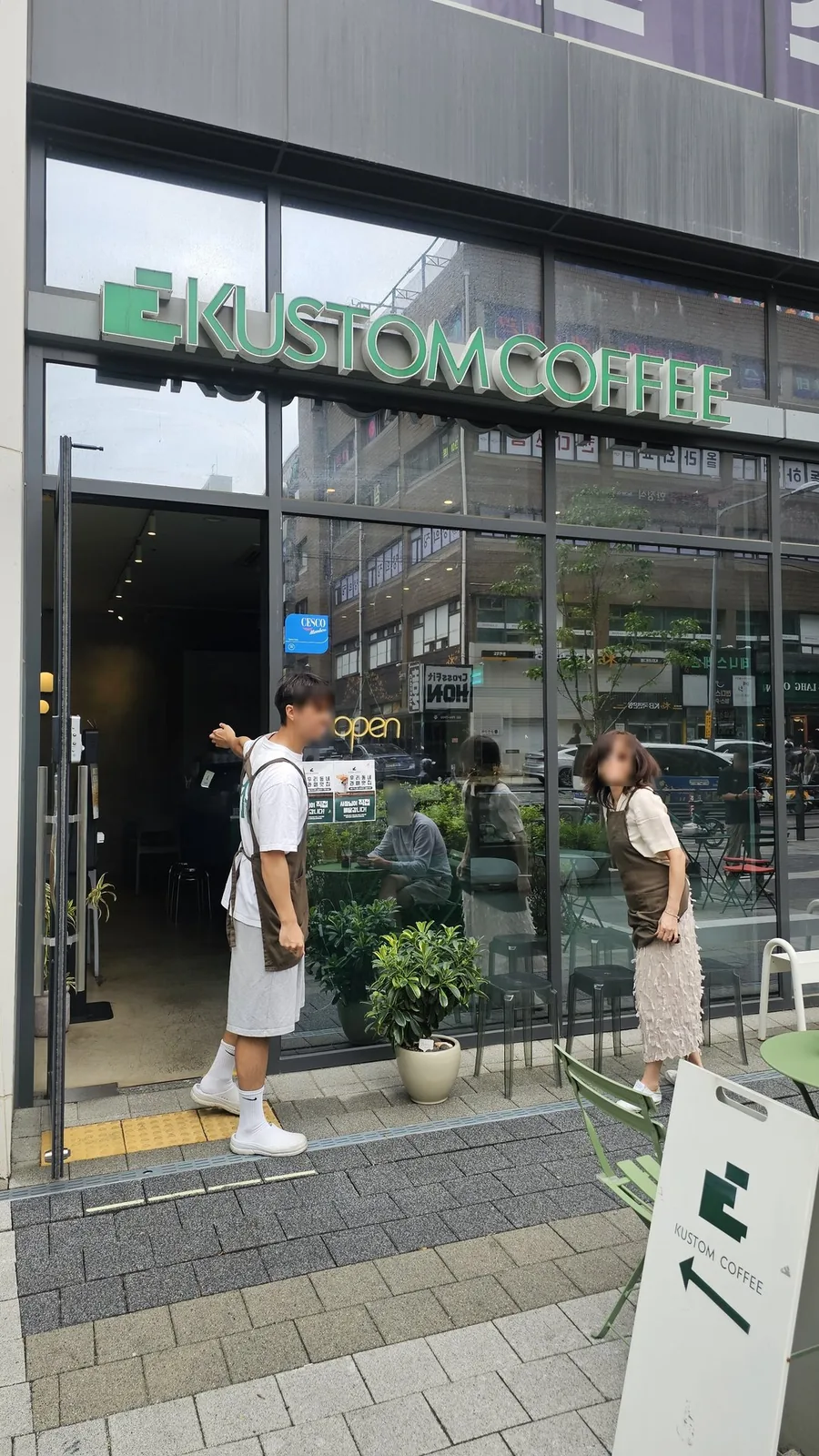
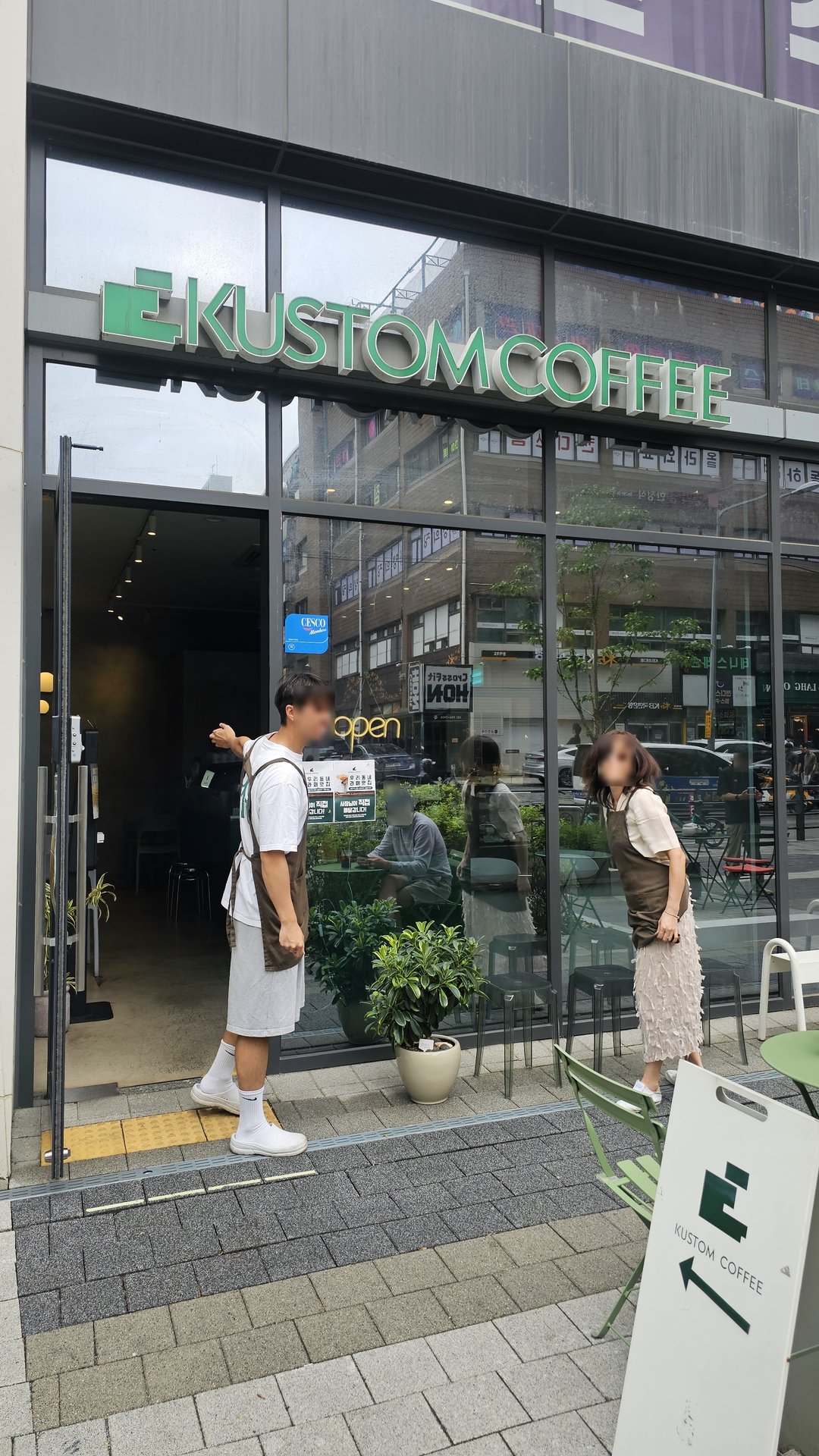
Kustom Coffee Yeouido exterior with green logo on glass facade and customers at entrance
Getting There
Yeouido is Seoul’s financial district — think Canary Wharf or lower Manhattan. Banks, law firms, major TV networks (KBS and MBC are both headquartered here), and the National Assembly building. A lot of the tourist stuff nearby:
– IFC Mall — large underground mall, direct subway access, CGV cinema, food hall
– Yeouinaru Hangang Park — riverside park, about 10–15 minutes walk
– 63 Building — the gold skyscraper you can see from most of Yeouido
Subway: Line 5, Yeouido Station (여의도역) or Line 9, Saetgang Station (샛강역). From Hongdae or Sinchon, take Line 2 to Dangsan, transfer to Line 9.
From Incheon Airport: roughly 55–65 minutes by subway (Airport Railroad Express to Hongik University, then transfer). Or 40 minutes by taxi — expect around 40,000–50,000 KRW (~$30–37 USD) depending on traffic.
The Interior
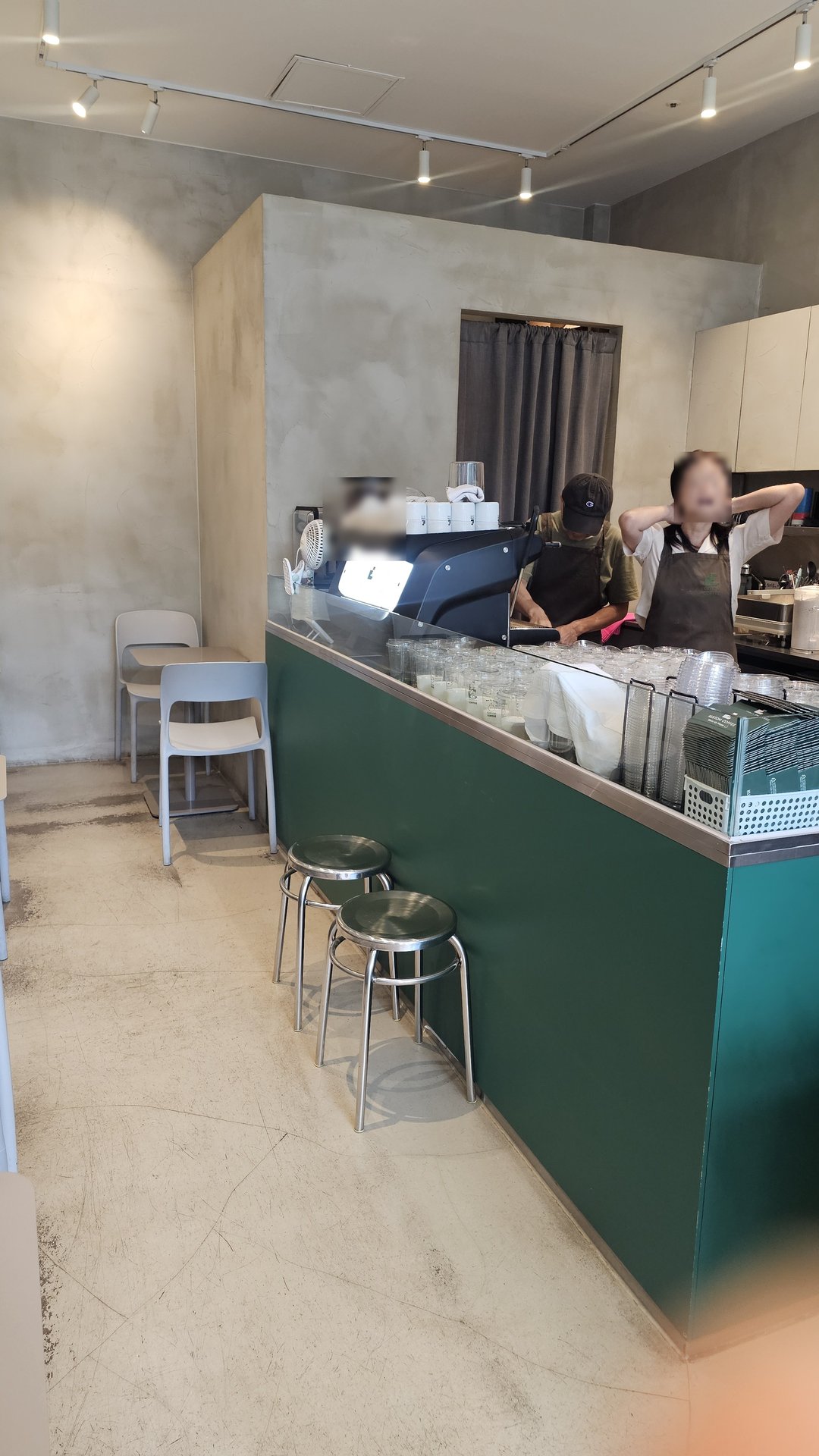
Dark green countertop interior at Kustom Coffee Yeouido with two staff members serving customers
Concrete floors. Dark green countertops. Clean pendant lighting. The interior is styled for the ‘gram and it works without feeling forced.
The space isn’t huge, but there’s outdoor terrace seating — that’s where we sat. Wednesday morning, the terrace was quiet and easy. By lunch it was probably filling up with office workers.
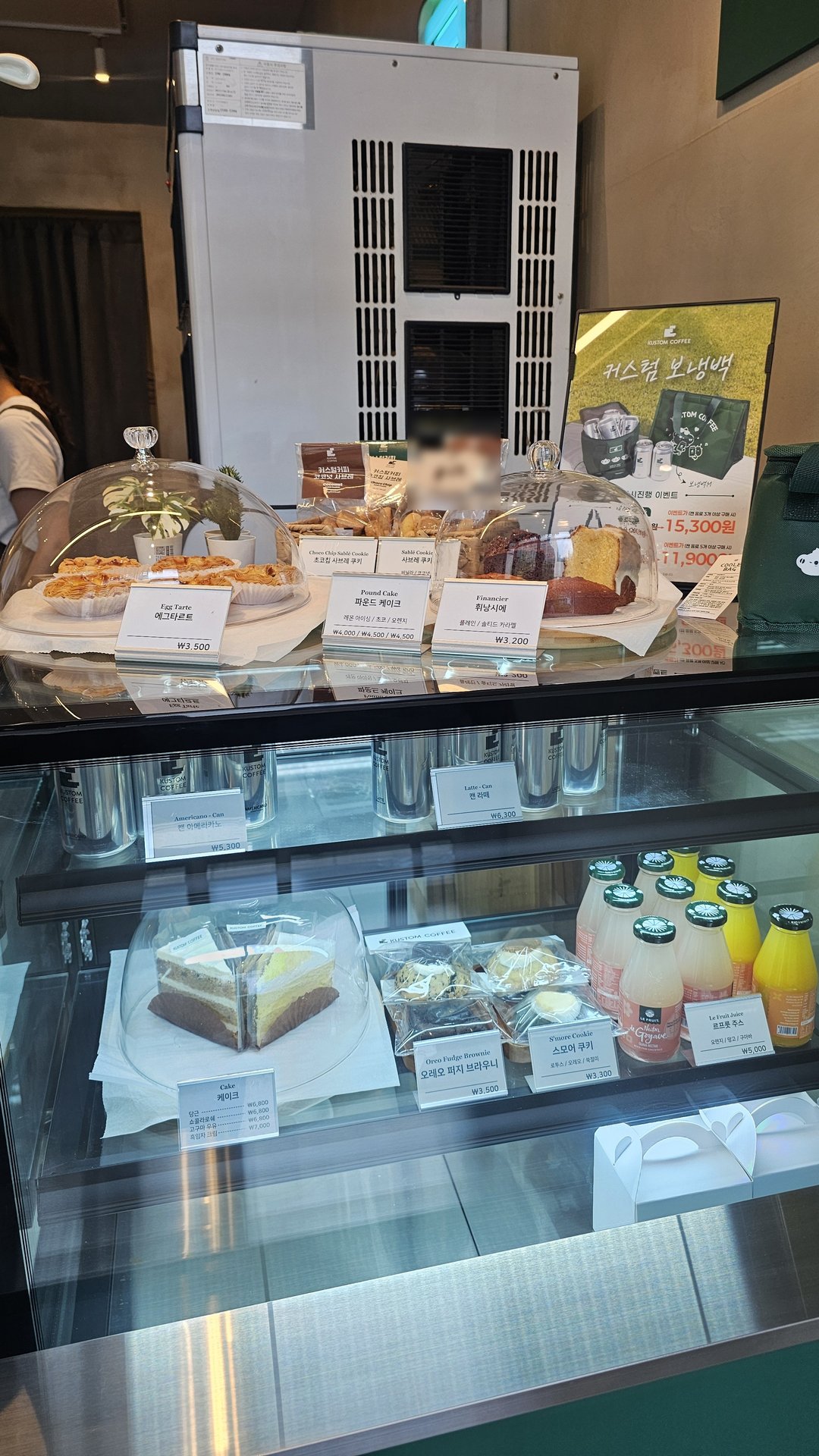
Dessert display case at Kustom Coffee Yeouido with cake slices scones and bottled drinks
The dessert display case near the counter had cake slices, scones, bottled drinks. Looked decent. We didn’t order any so I can’t say more than that.
How to Order
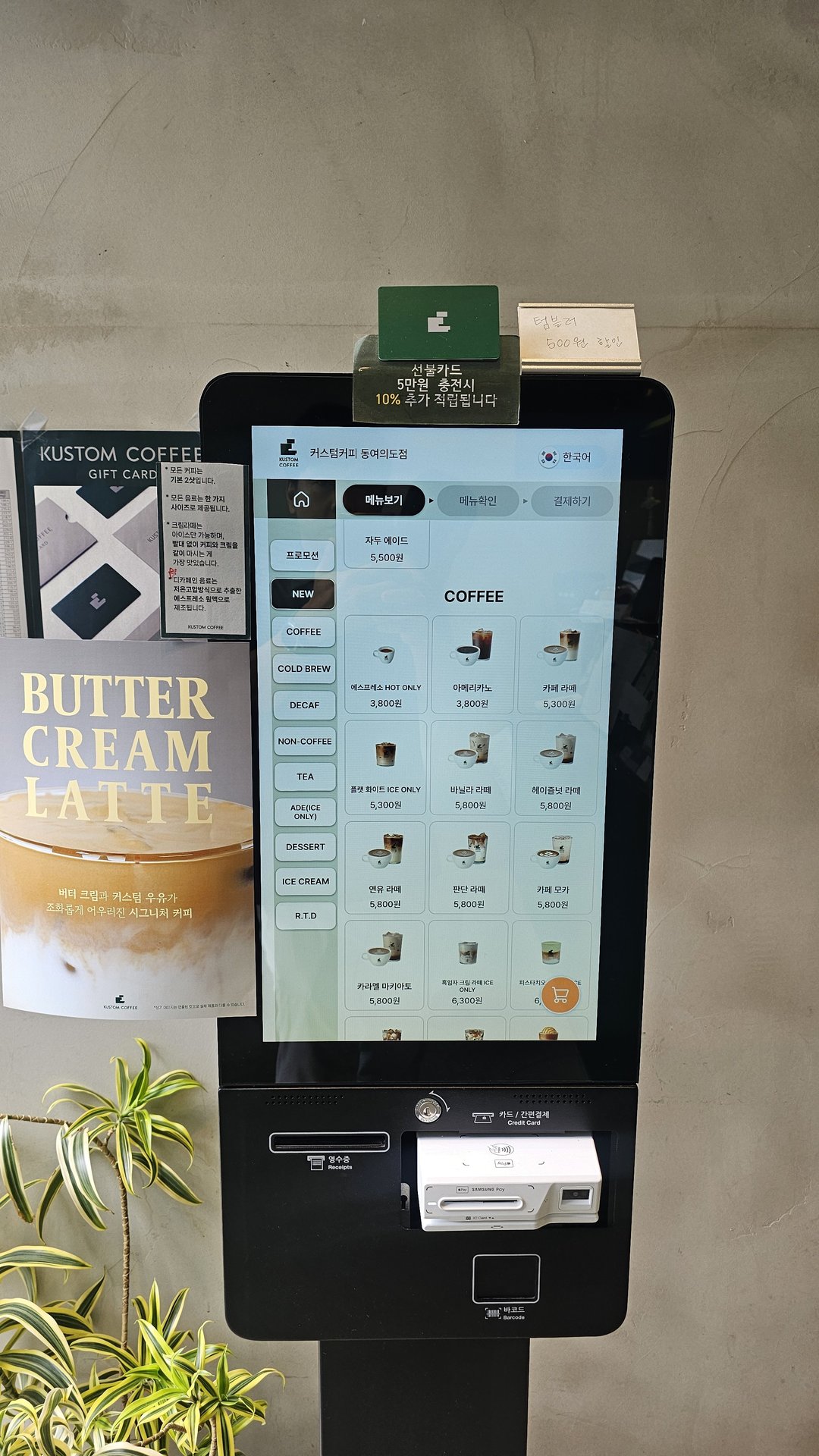
Kiosk only. Walk in, find the kiosk near the entrance.
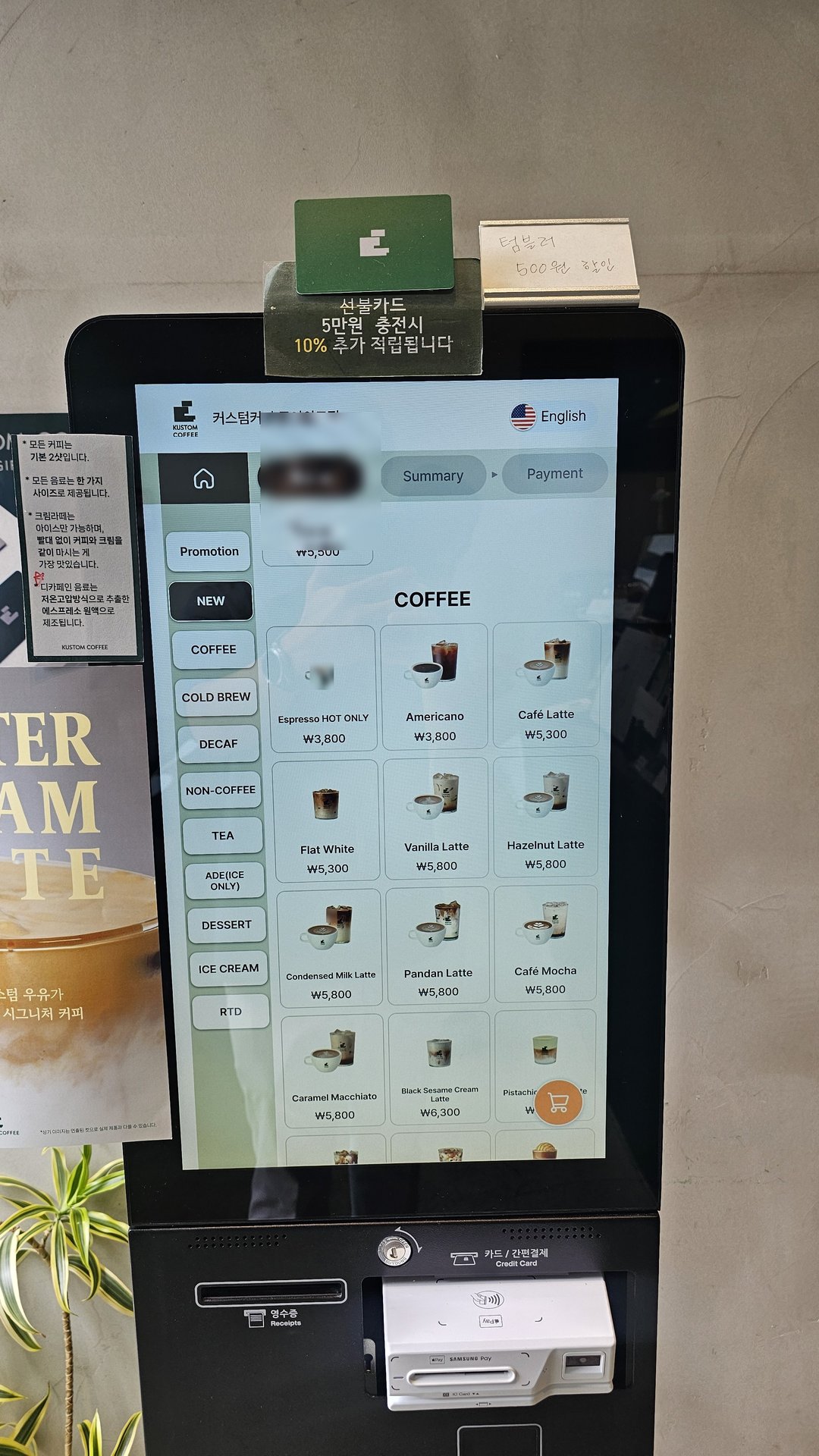
Kustom Coffee kiosk ordering screen in Korean with butter cream latte promotionKustom Coffee kiosk ordering screen in English showing cafe latte hazelnut latte and mocha prices
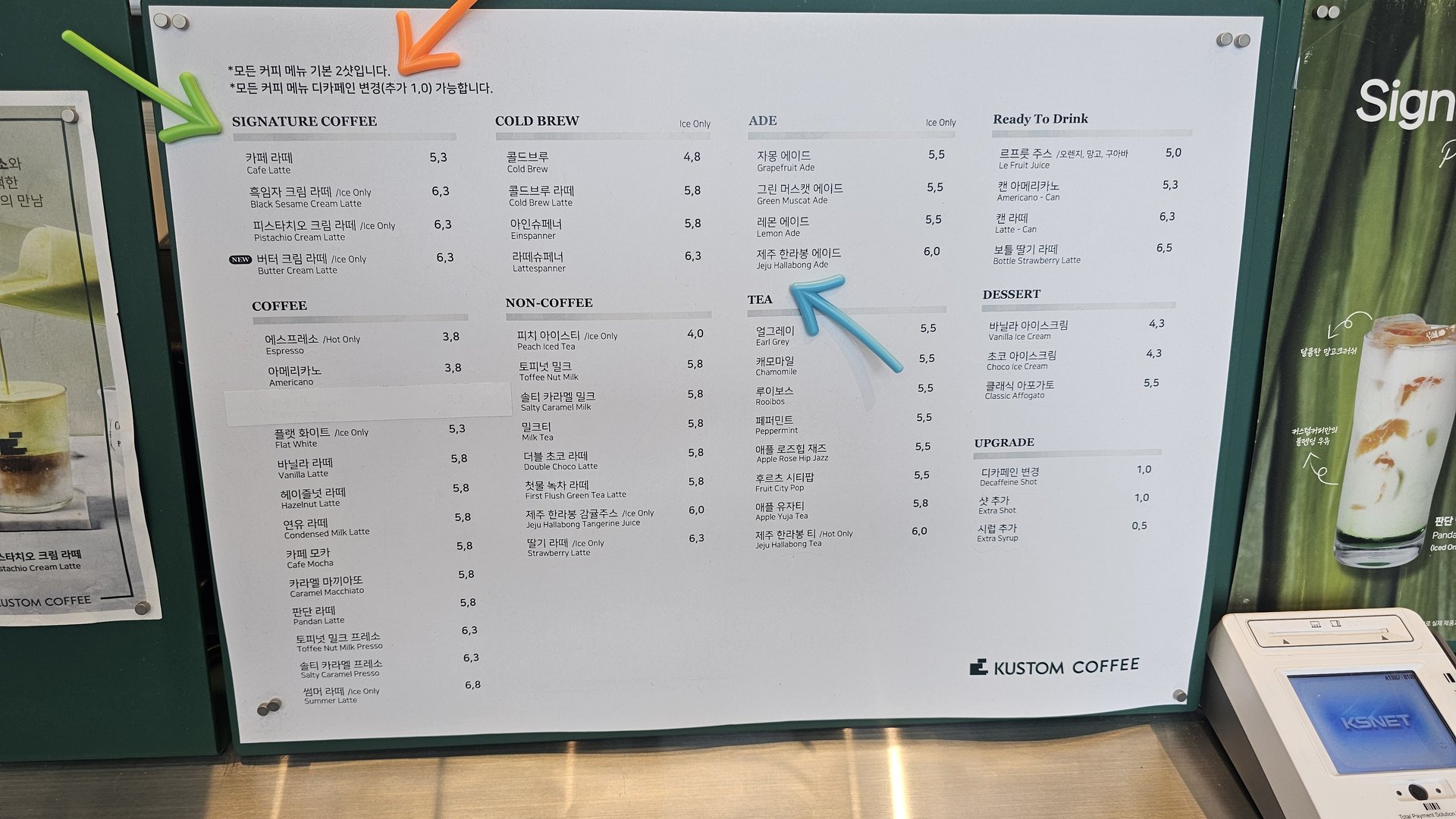
The kiosk has an English option, and it’s actually usable — not the sketchy machine-translated English you see at some spots. Cafe latte, hazelnut latte, cafe mocha, all clearly listed with prices. Pay by card at the kiosk, wait for your number.
What I Ordered
Two drinks total: 12,100 KRW (~$9 USD)
Milk Tea
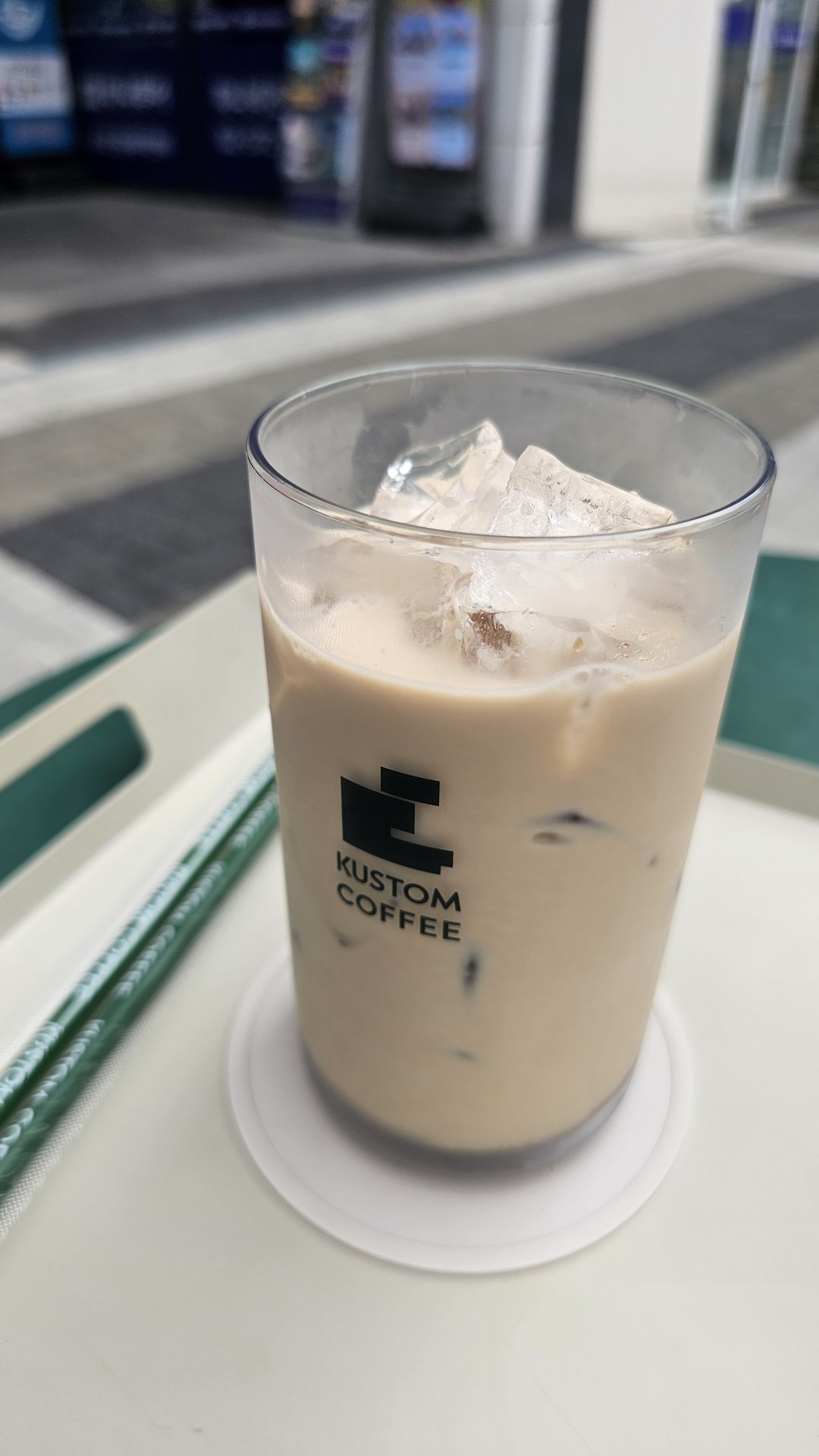
Close-up of iced milk tea with large ice cubes and clean milk base at Kustom Coffee Yeouido
This one surprised me in a good way.
Quick note for the non-Koreans: Korean cafe milk tea is not Taiwanese bubble tea. No tapioca pearls, no thick syrup base. It’s closer to iced tea with milk — lighter, cleaner, more tea-forward.
This one delivered. The tea flavor actually comes through instead of getting buried under sweetener. Large ice cubes, slow melt, still tasted like tea at the bottom. If you want something refreshing and not too heavy — this is the call.
Coming from a bubble tea background expecting thick pearls and syrup? Wrong spot. But as a clean, drinkable iced milk tea? Solid.
Pistachio Cream Latte (Iced)
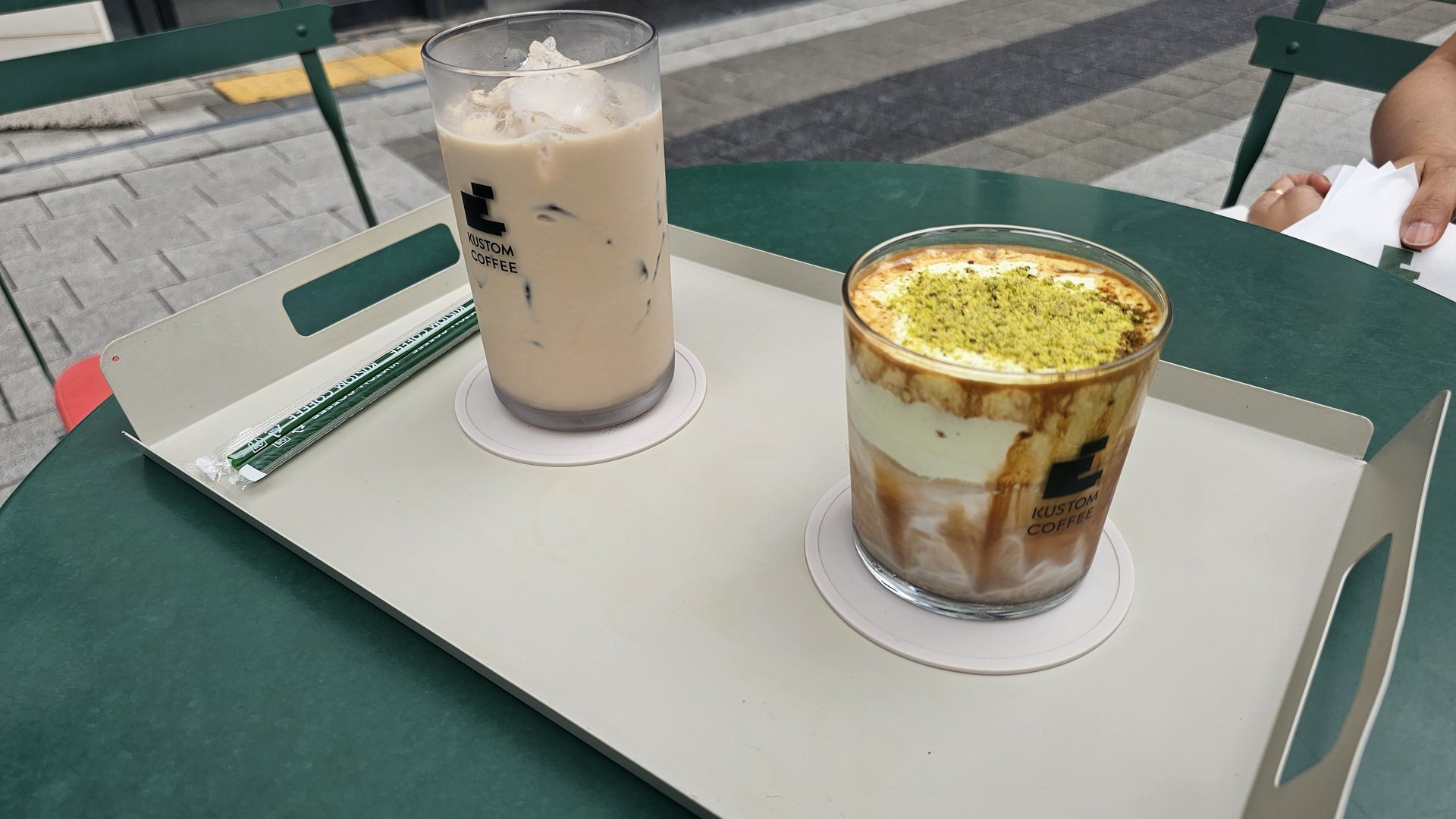
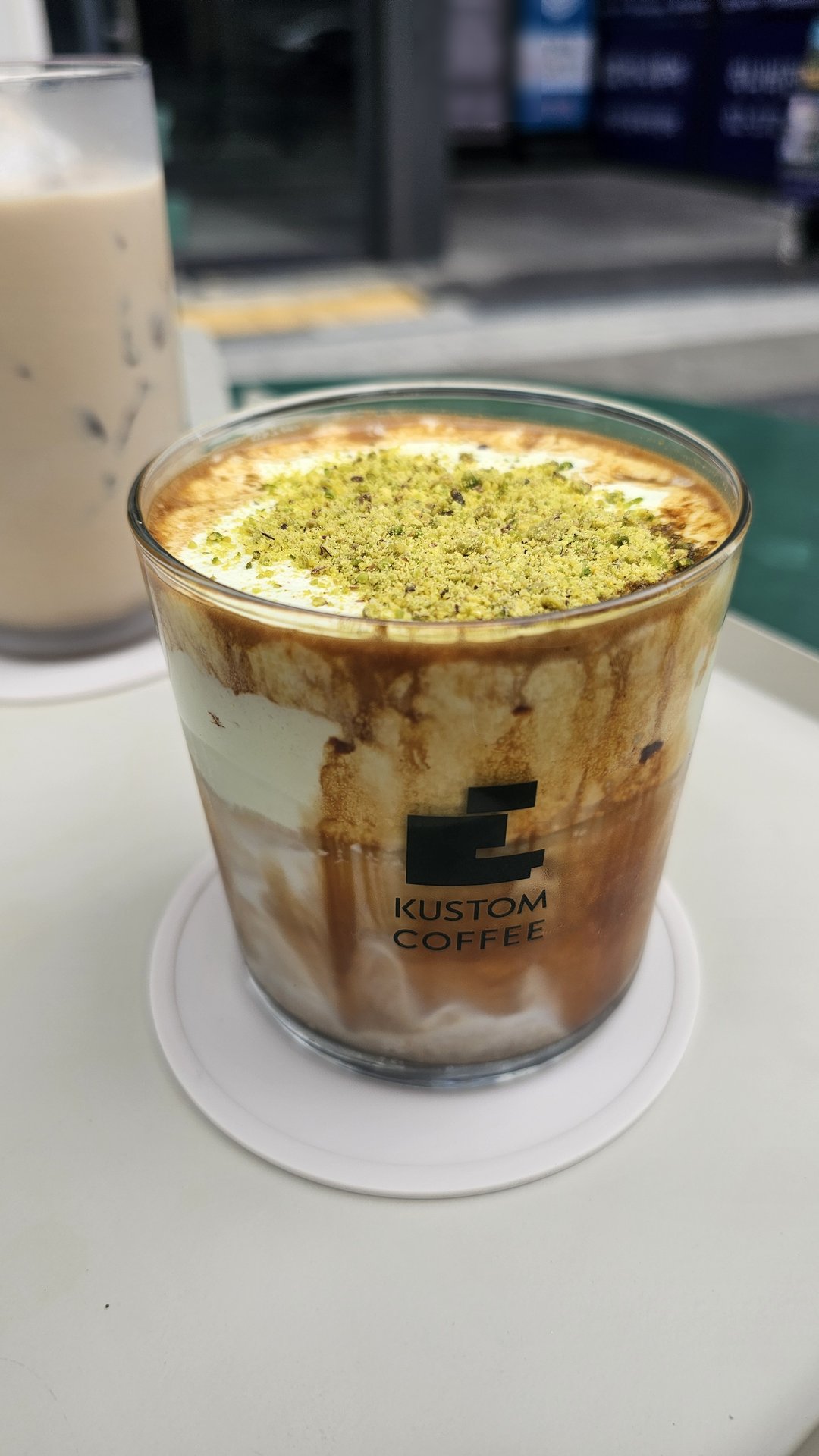
Terrace tray at Kustom Coffee Yeouido with milk tea and pistachio cream latte side by sideClose-up of pistachio cream latte with thick cream layer and heavy pistachio powder at Kustom Coffee Yeouido
Okay. Pistachio cream lattes are everywhere in Seoul right now. Every other specialty cafe has one. The standard formula: espresso base, milk, thick cream layer on top, pistachio powder dusted over the cream.
Kustom went hard on the pistachio. Like, *really* hard.
The cream layer is dense — not light foam, actual thick cream that sits heavy on top. The pistachio powder coating is generous. Layer that over the espresso base and you end up with something that’s very rich, very filling, very intense.
Halfway through, the richness started stacking up on me. It’s not a “sip while scrolling your phone” drink. It’s basically a dessert in a cup.
Tbh, if pistachio desserts are your thing and you want a coffee that tastes like a pistachio confection — this delivers exactly that. If you want a drinkable, relaxed coffee — get the regular latte. Don’t say I didn’t warn you.
Stuff Tourists Should Know
English menu: Yes. Kiosk has a working English option.
Foreign cards: Yes. Standard Korean kiosks take Visa and Mastercard. Contactless works fine.
Tipping: No. Korea has no tipping culture at cafes or restaurants. Zero.
Vegetarian/vegan: Drinks are generally fine. If you need oat milk or a dairy-free option, it’s worth asking at the counter — specialty cafes in Seoul often carry it, but I didn’t confirm for this location.
Solo dining: Easy. Counter seating and terrace both work fine alone.
With kids: The non-coffee menu has juice and tea options. Terrace seating is relaxed. Should be fine.
Date spot? It’s a cafe, so — sure, if you’re doing “coffee then walk along the Han River,” this is a decent starting point. Yeouinaru park is close.
Kustom Coffee Yeouido wall menu board showing full drink and dessert lineup
The Verdict
Kustom Coffee is a solid Yeouido stop if you’re already in the area. Not a cross-town destination — you wouldn’t take the subway from Hongdae specifically for this. But if Yeouido is on your itinerary (IFC, Han River, National Assembly area), worth a stop.
Get: The milk tea. Clean, tea-forward, not sweet-heavy. Good call.
Think twice on: Pistachio cream latte if you’re not into dessert-level richness. It’s well-executed, but it’s intense. Go in knowing that.
Should you go?
– Already doing Yeouido? Yes, stop in.
– Want a specialty cafe with minimal tourist friction (English kiosk, card payment, terrace seating)? Yes, fits the bill.
– Curious about the pistachio cream latte trend hitting Seoul cafes right now? This is a fair representative of the style.
– Flying in from abroad specifically for this? No. Seoul has a lot of cafes.
Would I go back? For the milk tea, yes. For the pistachio cream latte — I’d try something lighter next time.
FAQ
Does Kustom Coffee in Yeouido have an English menu?
Yes. The kiosk ordering system has an English language option that’s clear enough to use without issues.
What does the pistachio cream latte taste like?
Rich and dense. Heavy pistachio cream on top of the espresso base with pistachio powder coating. It’s a dessert-style drink. If you want something lighter, go for the regular latte.
Is Kustom Coffee Yeouido tourist-friendly?
Pretty much. English kiosk, card payment, no Korean required. The terrace makes it easy to relax without navigating a crowded interior.
How much does it cost?
Two drinks (milk tea + pistachio cream latte) came to 12,100 KRW (~$9 USD total). Fair for a specialty cafe in central Seoul.
Do I need a reservation?
No. Walk in, order at the kiosk, done.
Is it near IFC Mall?
Both are in Yeouido so yes, close enough to combine in the same outing without effort.
Is there outdoor seating?
Yes, there’s a terrace. Comfortable in the morning. Expect it to fill up around lunch when the Yeouido office crowd comes out.
Quick honest review of Mochang-po Bread Cafe (무창포 빵명장카페) in Boryeong — a large artisan bakery run by a baker with 43 years of experience. If you’re heading to the Boryeong area for the Mud Festival, a beach weekend, or just passing through South Chungcheong Province, this is worth 30 minutes.
Short version: the salt bread is good, the selection is genuinely impressive for a coastal town bakery, and the whole operation runs on organic wheat and natural fermentation with a strict same-day bake-and-sell rule. We grabbed two salt breads and two Americanos. Both were worth it.
What Is a Korean Bread Cafe?
Korean “빵카페” (bread cafes) sit somewhere between a European-style boulangerie and a regular coffee shop. You grab a tray, pick your bread, pay at the counter, order a drink, and eat in or take out. The better ones make everything in-house.
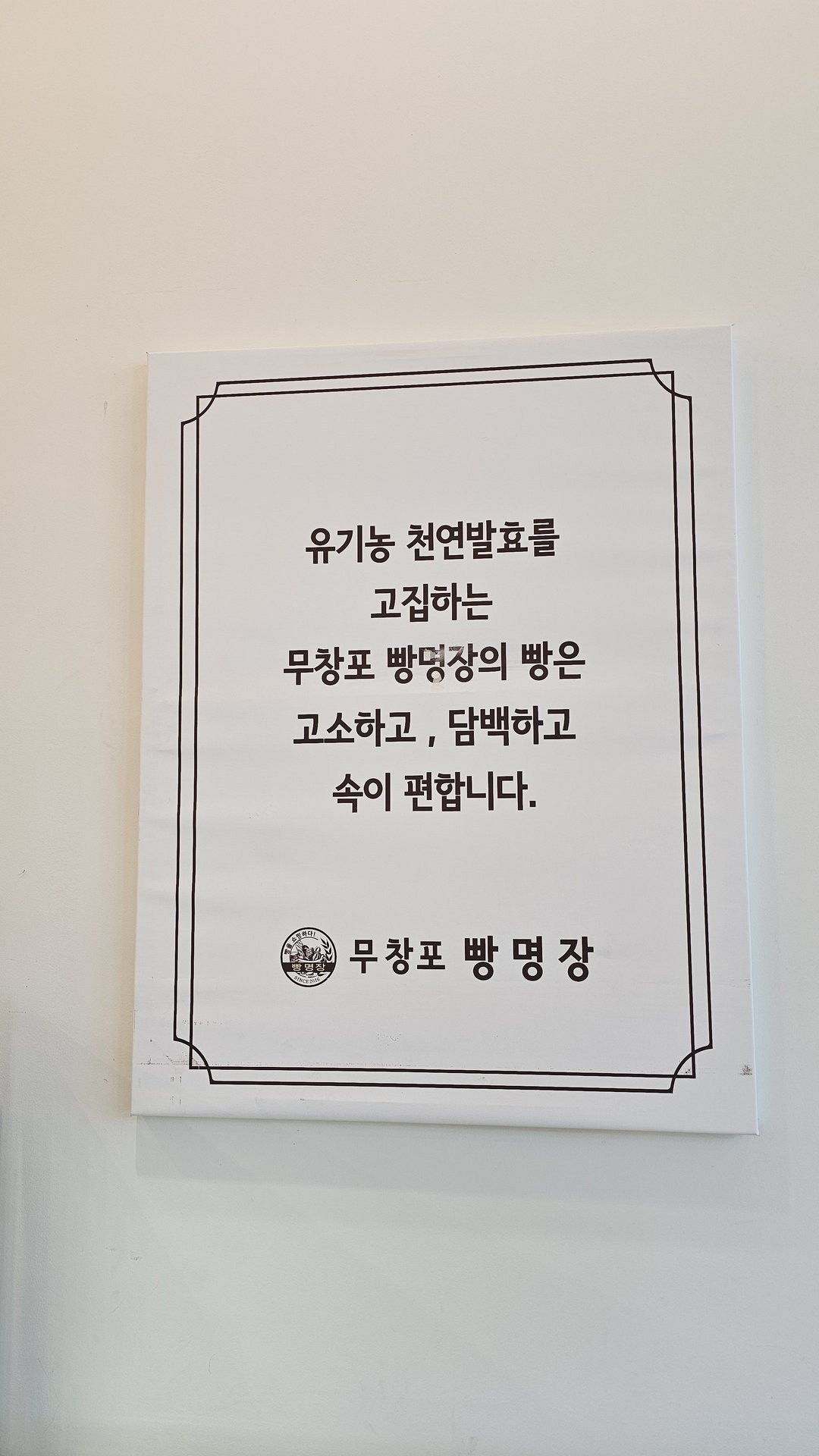
This one goes hard on the artisan angle. Organic wheat (유기농밀), natural fermentation starter (천연발효종 — similar to a sourdough starter, not commercial yeast), same-day production only. It’s not just marketing copy. You can taste the difference in the crumb.
The Baker Behind It
Wall sign introducing master baker concept and organic natural fermentation ingredients at Mochang-po Bread Cafe
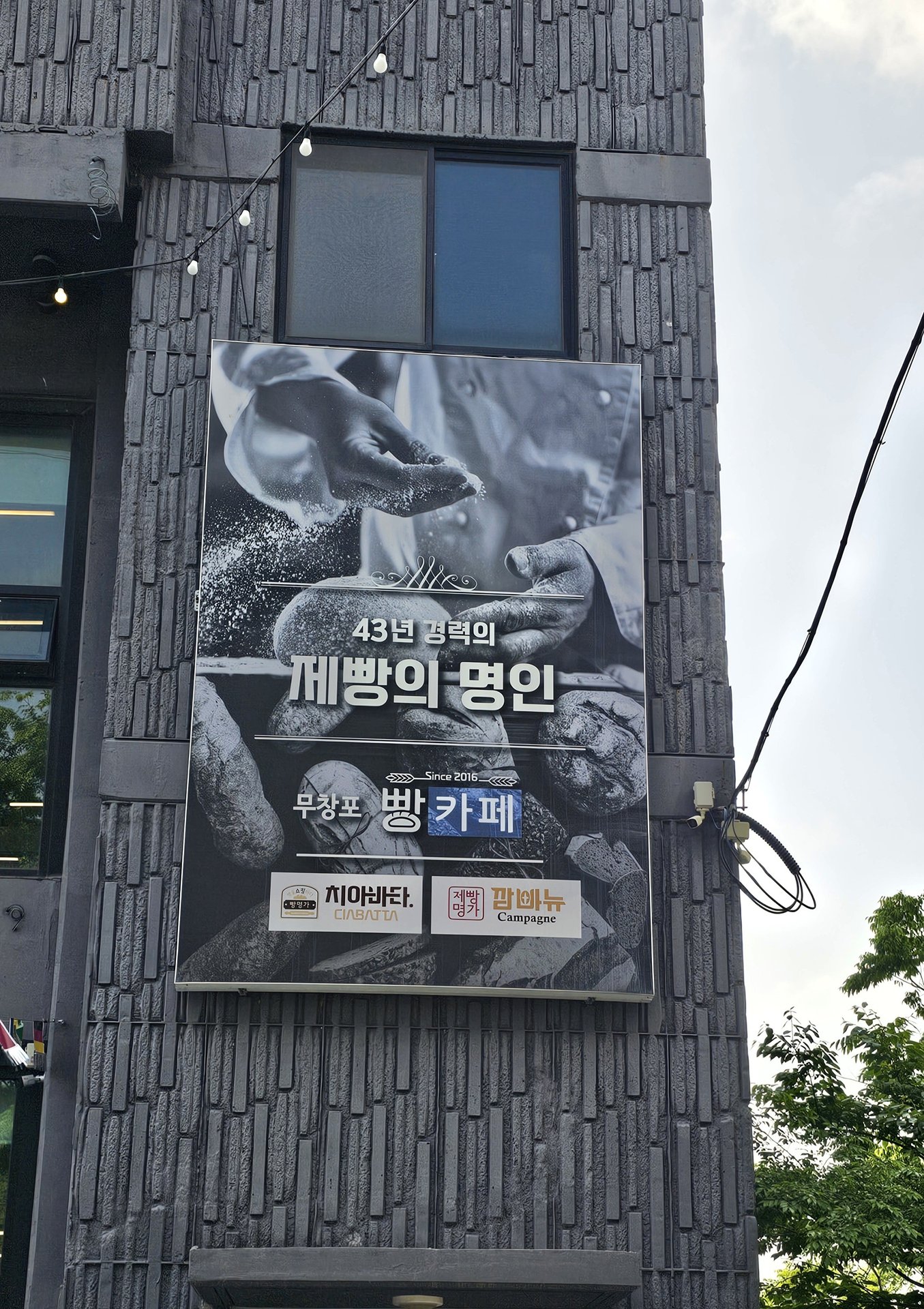
The sign on the wall reads “제빵의 명인” — roughly, Master of Bread-Making. 43 years of experience. The cafe opened in 2018, so the shop is relatively new but the baker is not.
Large exterior sign for Mochang-po Bread Cafe stating 43 years master baker experience since 2018 with ciabatta and campagne logo
You’ll see it on the exterior sign too: “43년 경력의 제빵의 명인 무창포 빵카페 (Since 2018).” Their flagship products — ciabatta and campagne — are printed right on the logo. They know what they’re proud of.
Honestly, 43 years in bread is 43 years in bread. The baguette crumb, the crust on the ciabatta, the way the salt bread holds together — these aren’t things you fake.
Getting There
Mochang-po (무창포) is a coastal area in Boryeong-si (보령시), South Chungcheong Province. Think of it as Seoul’s summer beach getaway — about 2 to 2.5 hours south of the capital by car, down the Seoseo Expressway.
The Boryeong Mud Festival (보령 머드 축제), held annually in late July at Daecheon Beach (대천해수욕장), draws both Korean and international visitors to this region. If you’re coming for the festival, the bakery is about 15–20 minutes from Daecheon Beach.
From Seoul:
– By car: ~2–2.5 hours via Seoseo Expressway
– By bus: Seoul Express Bus Terminal (센트럴시티) → Boryeong (~2 hours, buses run regularly), then taxi to Mochang-po (~20 min, roughly 15,000–20,000 KRW / ~$11–15 USD)
– By train: No direct train. KTX gets you to Cheonan-Asan or Seodaejeon, but you’d still need a bus connection. Just take the express bus or drive.
This is not a Seoul day trip by subway. You need a car or a bus out of the city.
The Interior
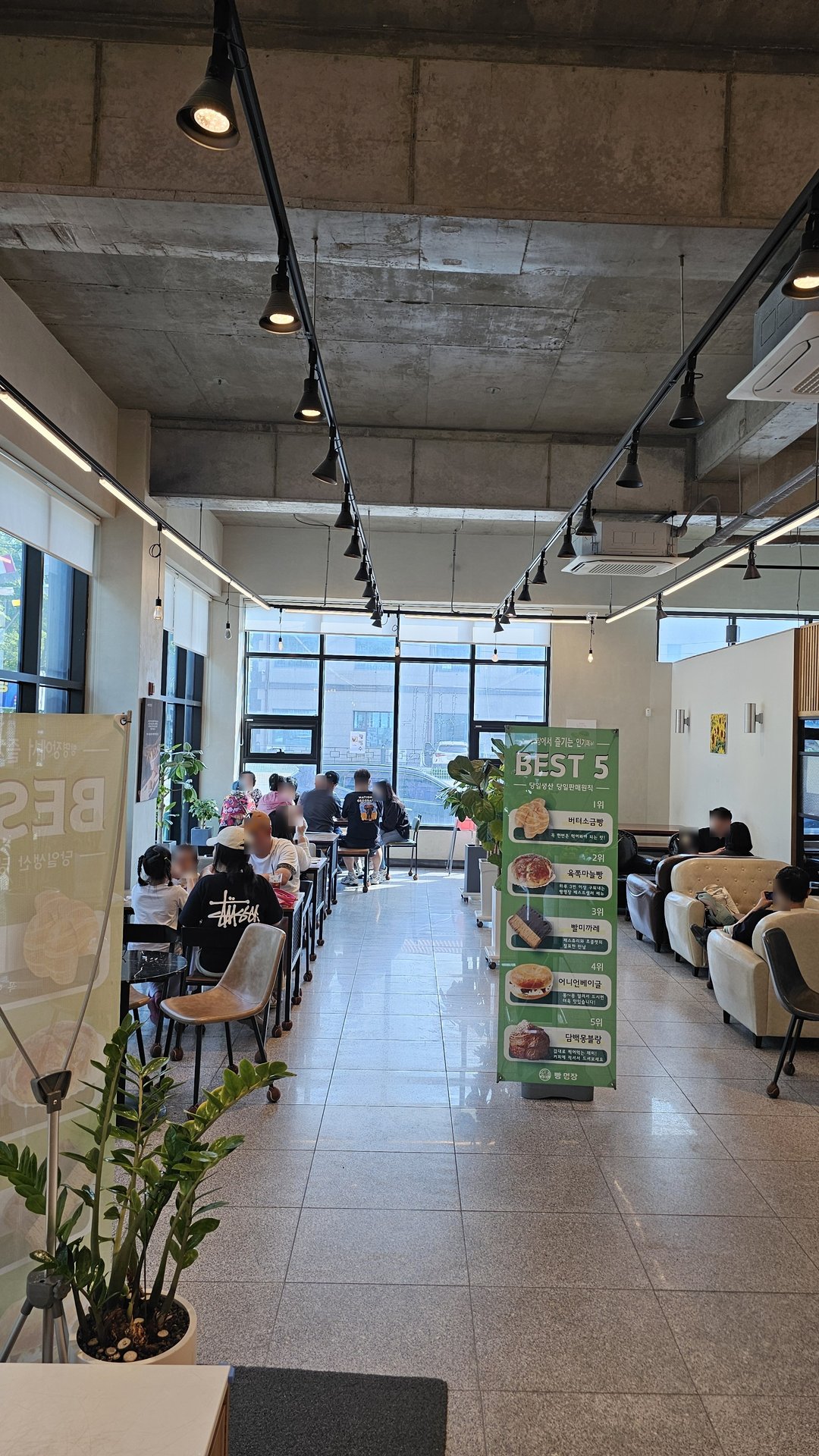
Wide interior view of Mochang-po Bread Cafe with high ceilings, customers, and BEST 5 banner
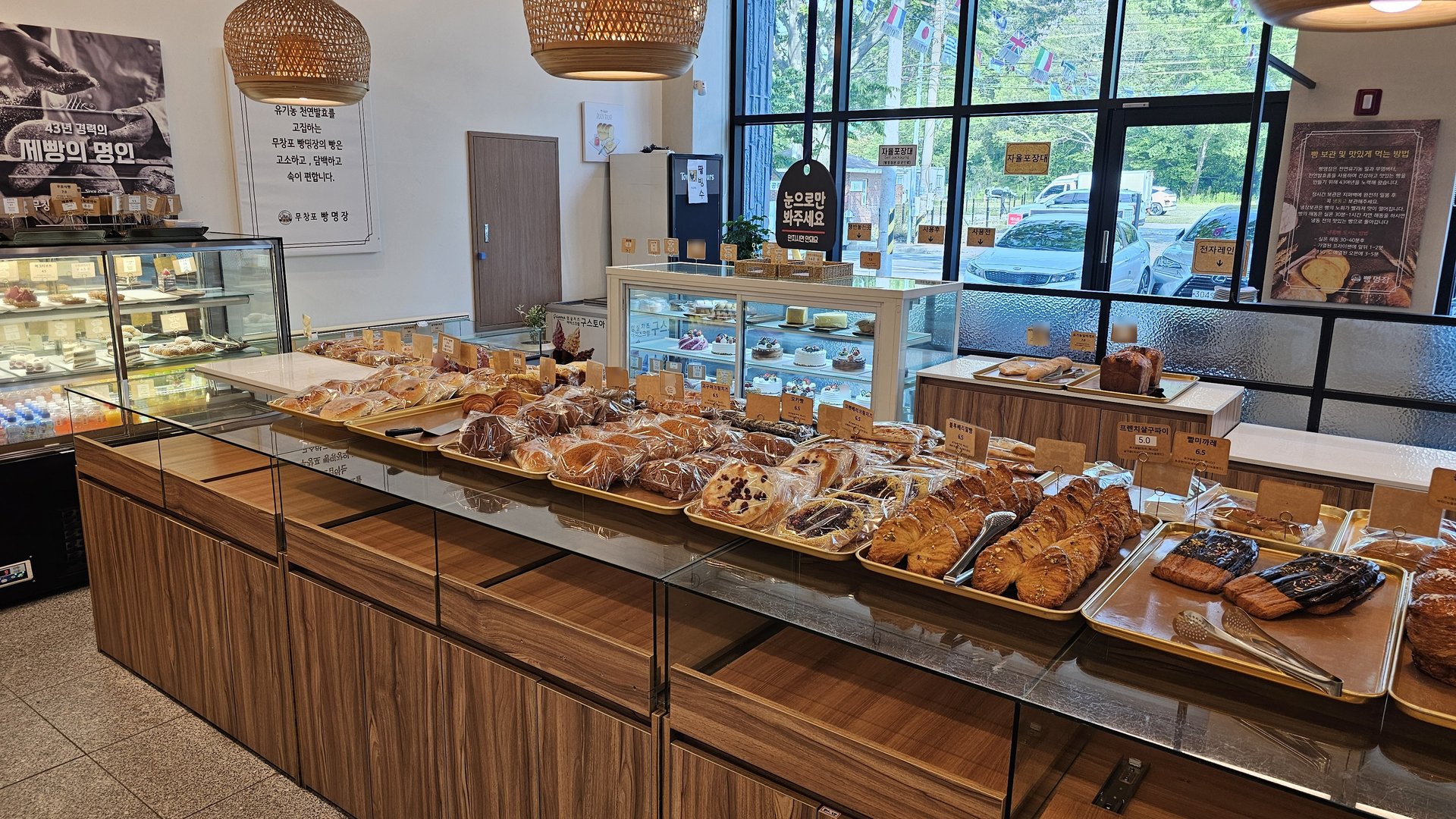
Big. That’s the first impression. High ceilings, wide floor space, a BEST 5 banner near the entrance, plants at the door. This is not a cozy neighborhood bakery — it’s a tourist-volume operation that takes its product seriously.
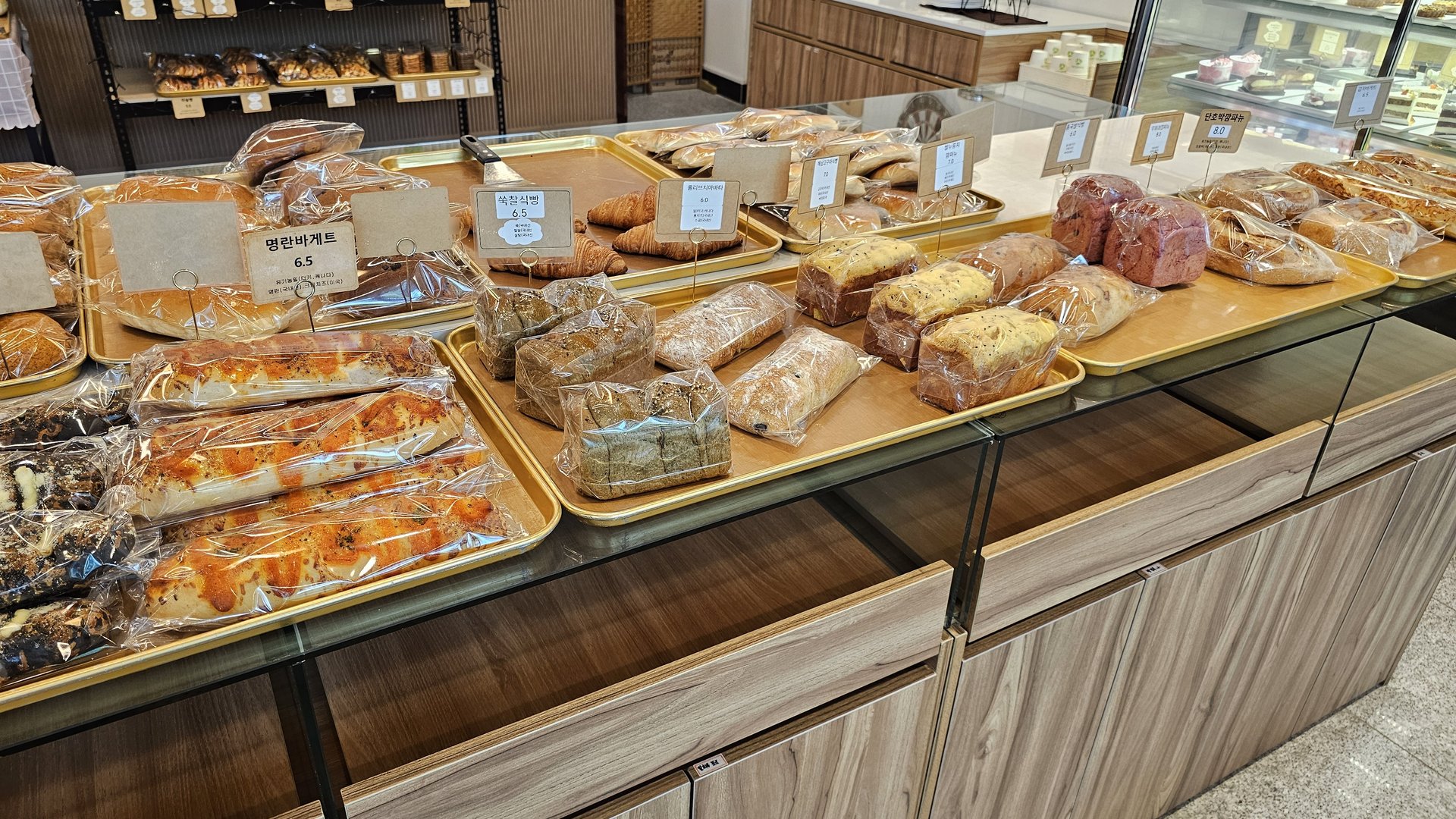
Wide main bread display counter at Mochang-po Bread Cafe with baguettes, loaves, and salt bread
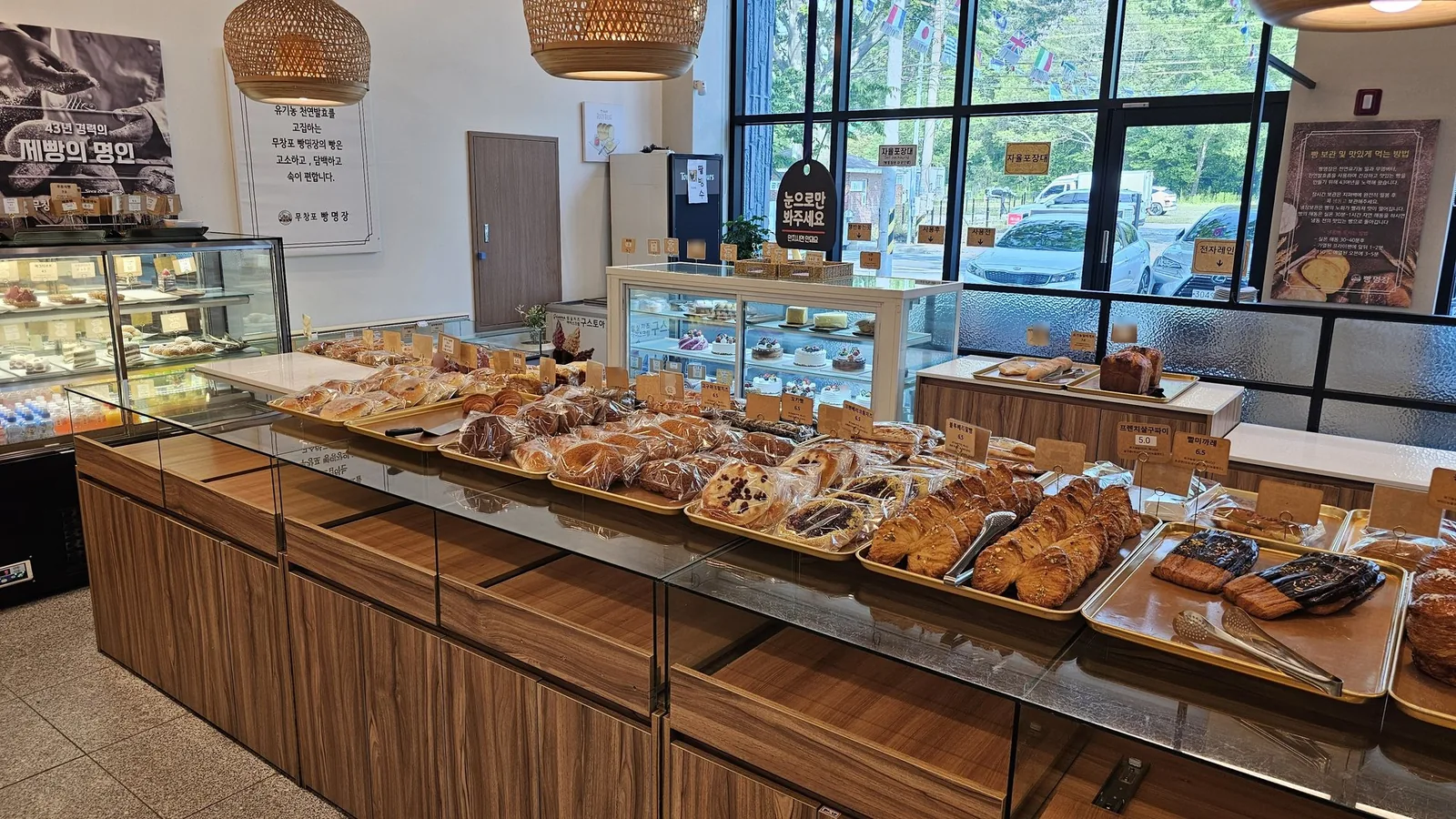
The main bread counter runs along one wall. Baguettes, loaves, salt bread, the full range. Impressive to walk up to.
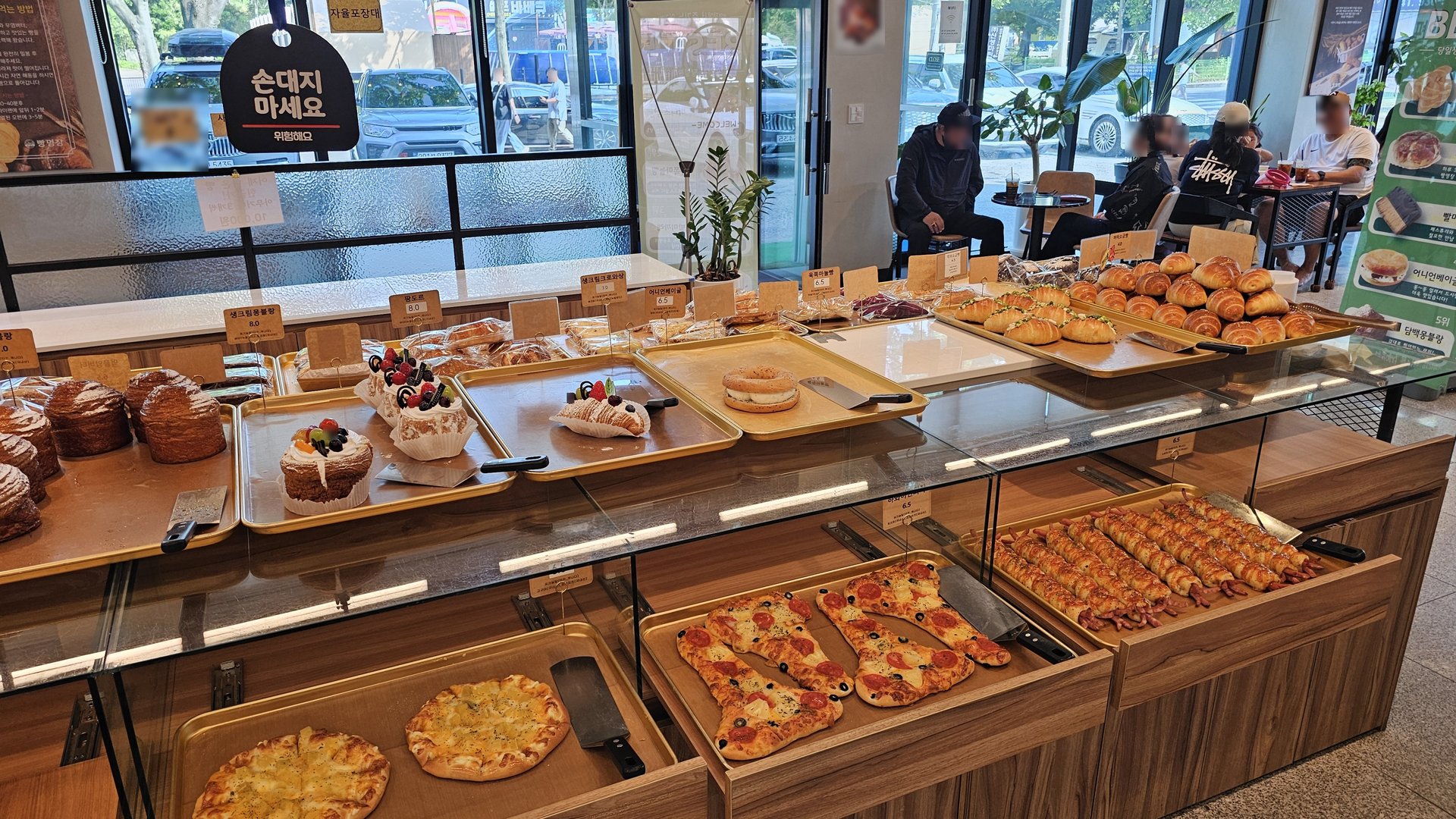
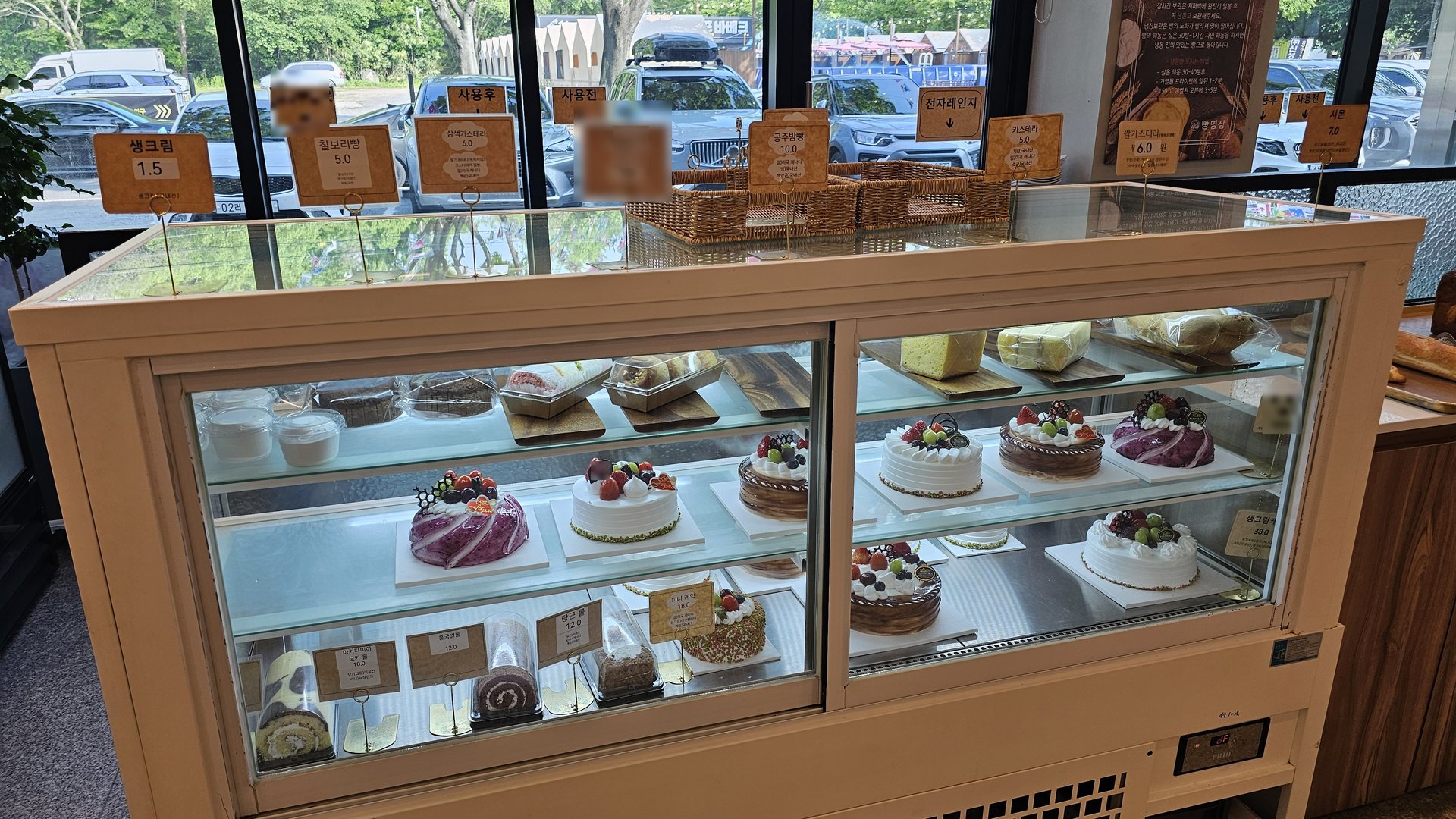
Pizza bread, cakes, donuts, and croissants in display counter with customers browsing at Mochang-po Bread Cafe
On the other side: cakes, pizza bread, donuts, croissants. Customers walking around with trays, browsing.
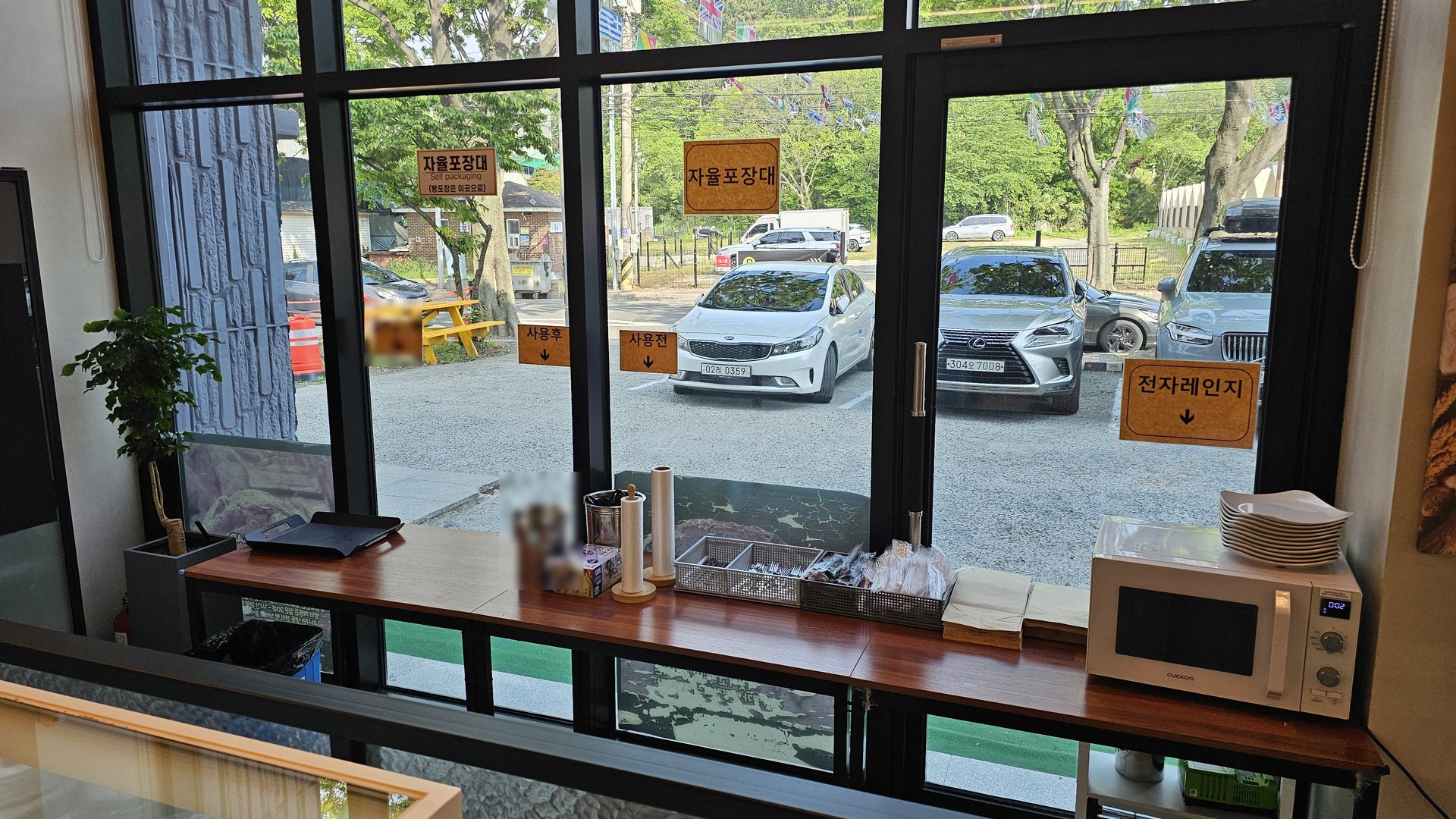
Self-service corner with microwave and bread packaging station at Mochang-po Bread Cafe
There’s a self-service corner near the window with a microwave, packaging materials, and cutlery. They actually want you to reheat the bread.
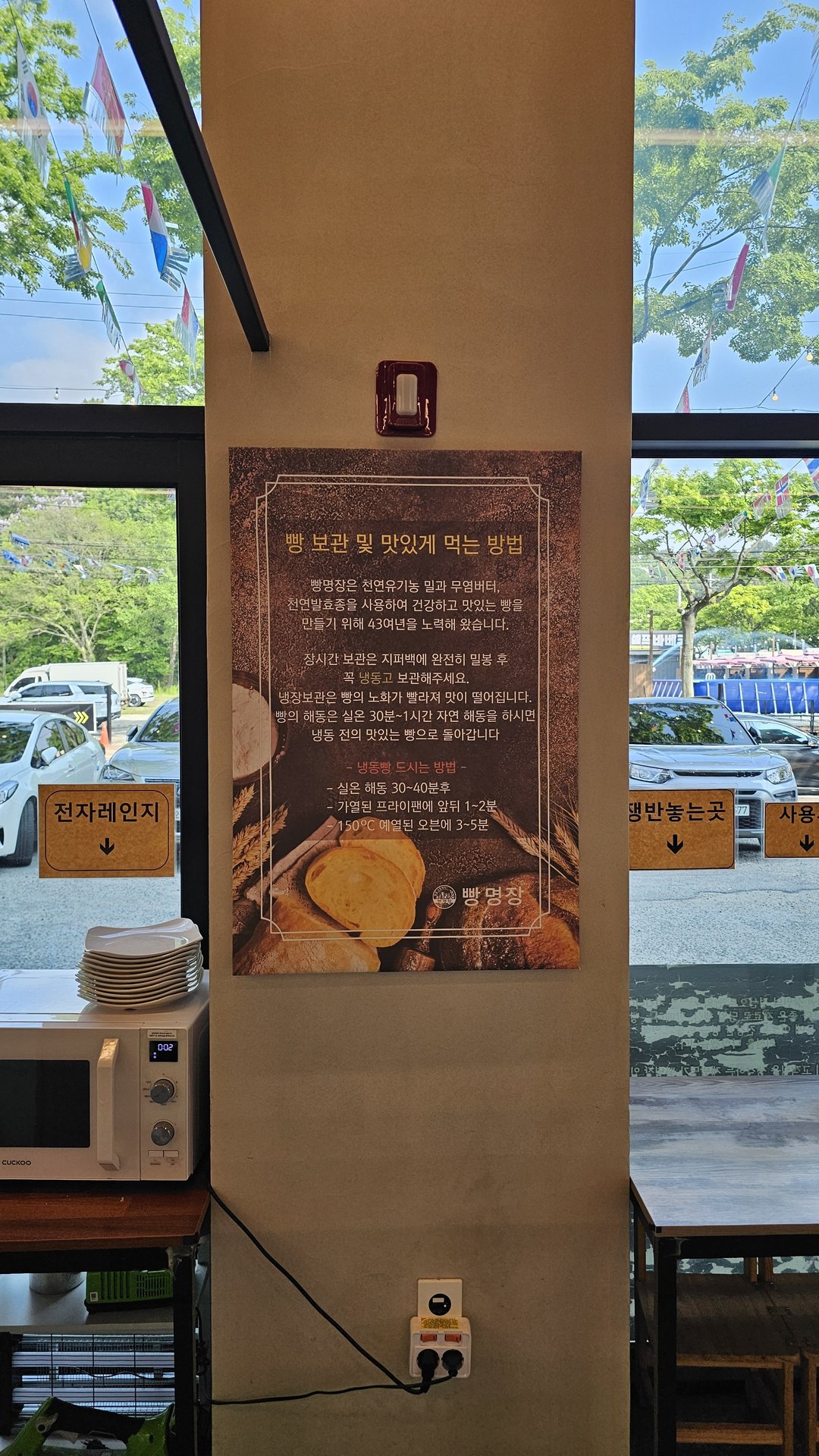
Wall poster explaining how to properly reheat different bread types at Mochang-po Bakery Cafe
There’s a poster on the wall explaining exactly how to warm different types. That’s a good sign — it means they know the bread is best hot and they want you to eat it right.
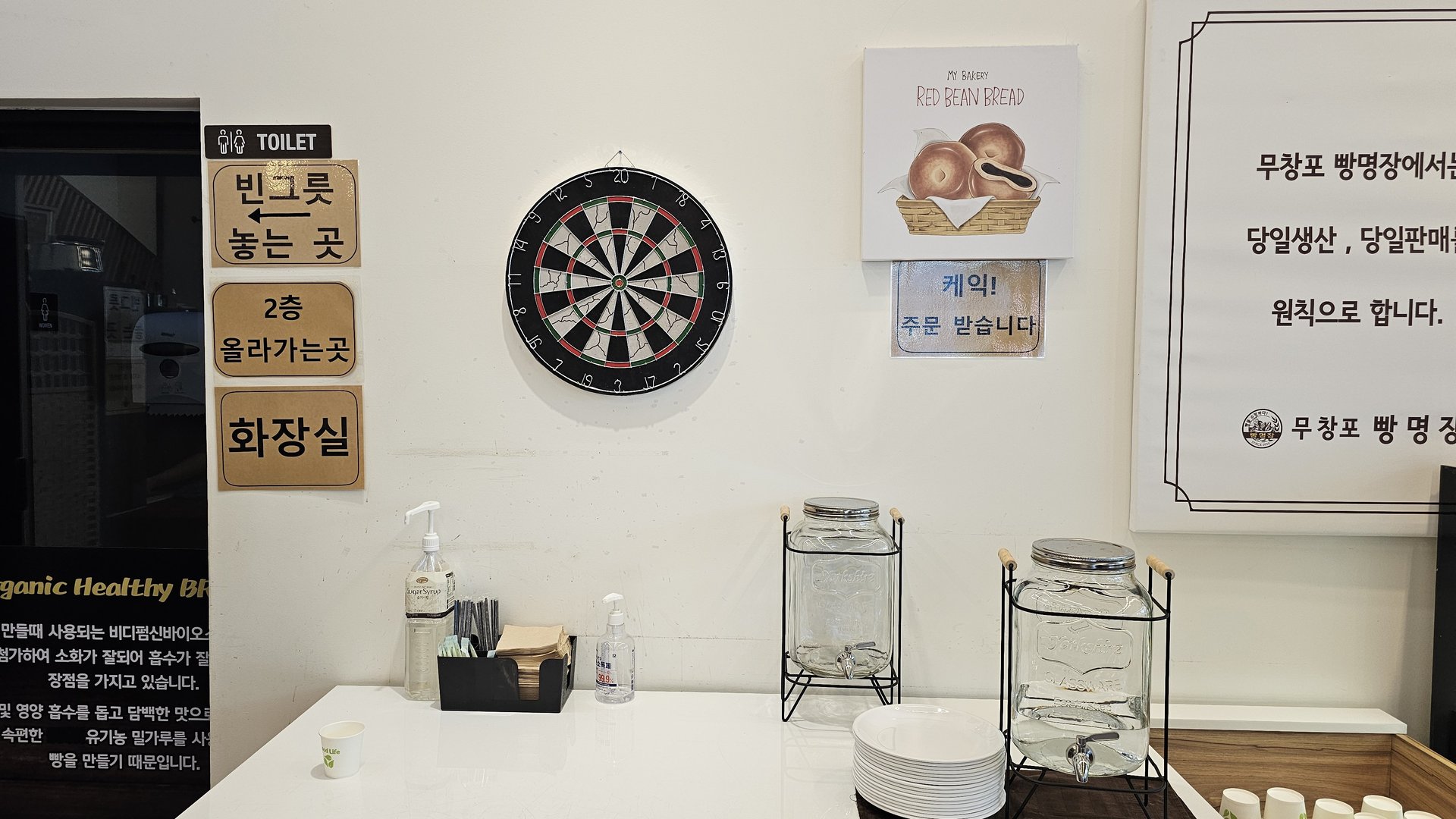
Interior wall with dartboard, cake order sign, same-day baking policy notice, and water dispenser at Mochang-po Bread Cafe
One wall has a dartboard. Also a water dispenser, a cake order notice, and the same-day baking policy printed out. This is a family destination, clearly — not just a quick grab-and-go.
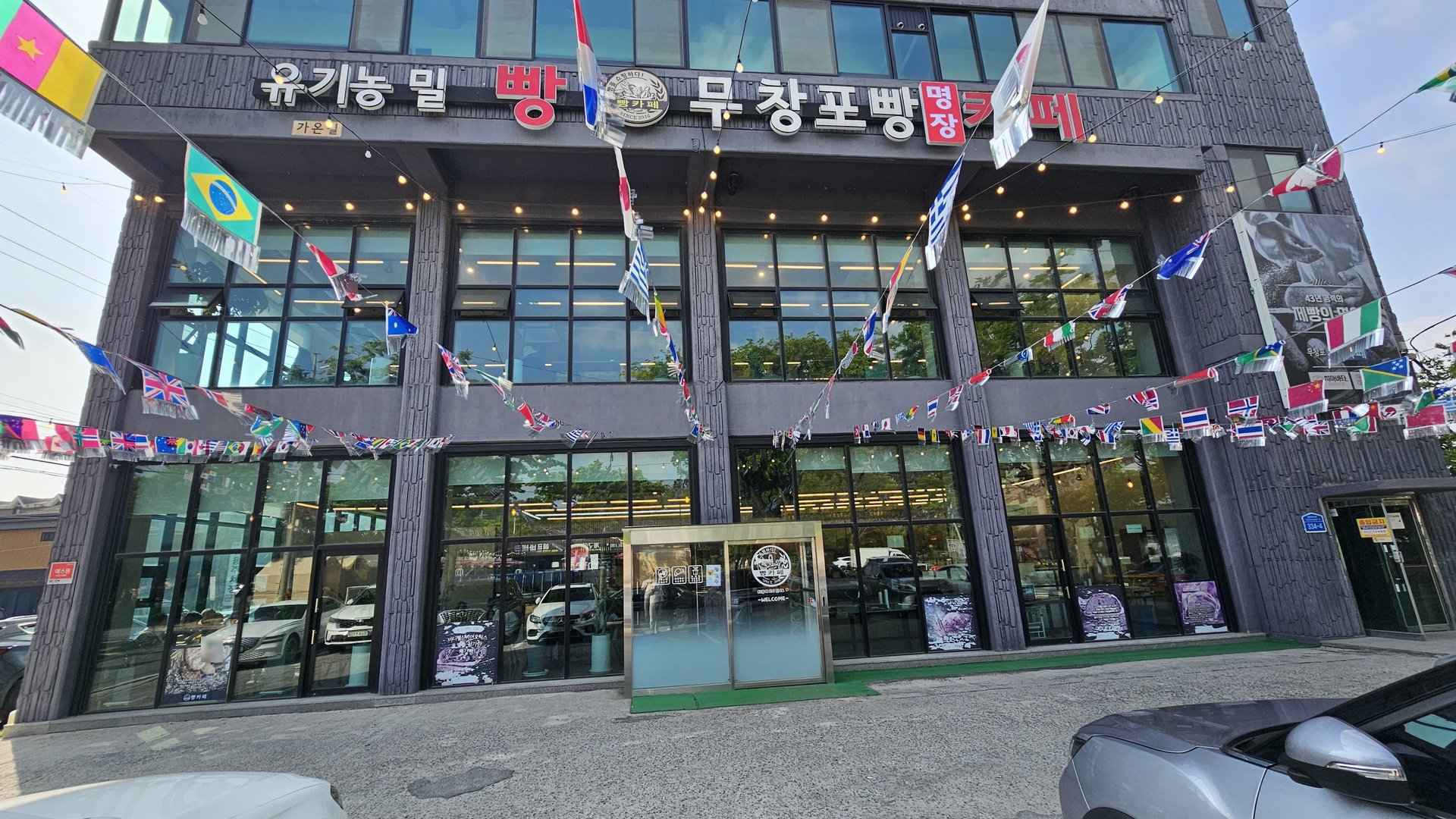
Exterior of Mochang-po Bread Cafe building with organic wheat bread signage and flags from multiple countries
The flags from multiple countries on the exterior tell you they get an international crowd, especially during summer festival season. They know tourists come here.
What We Ordered
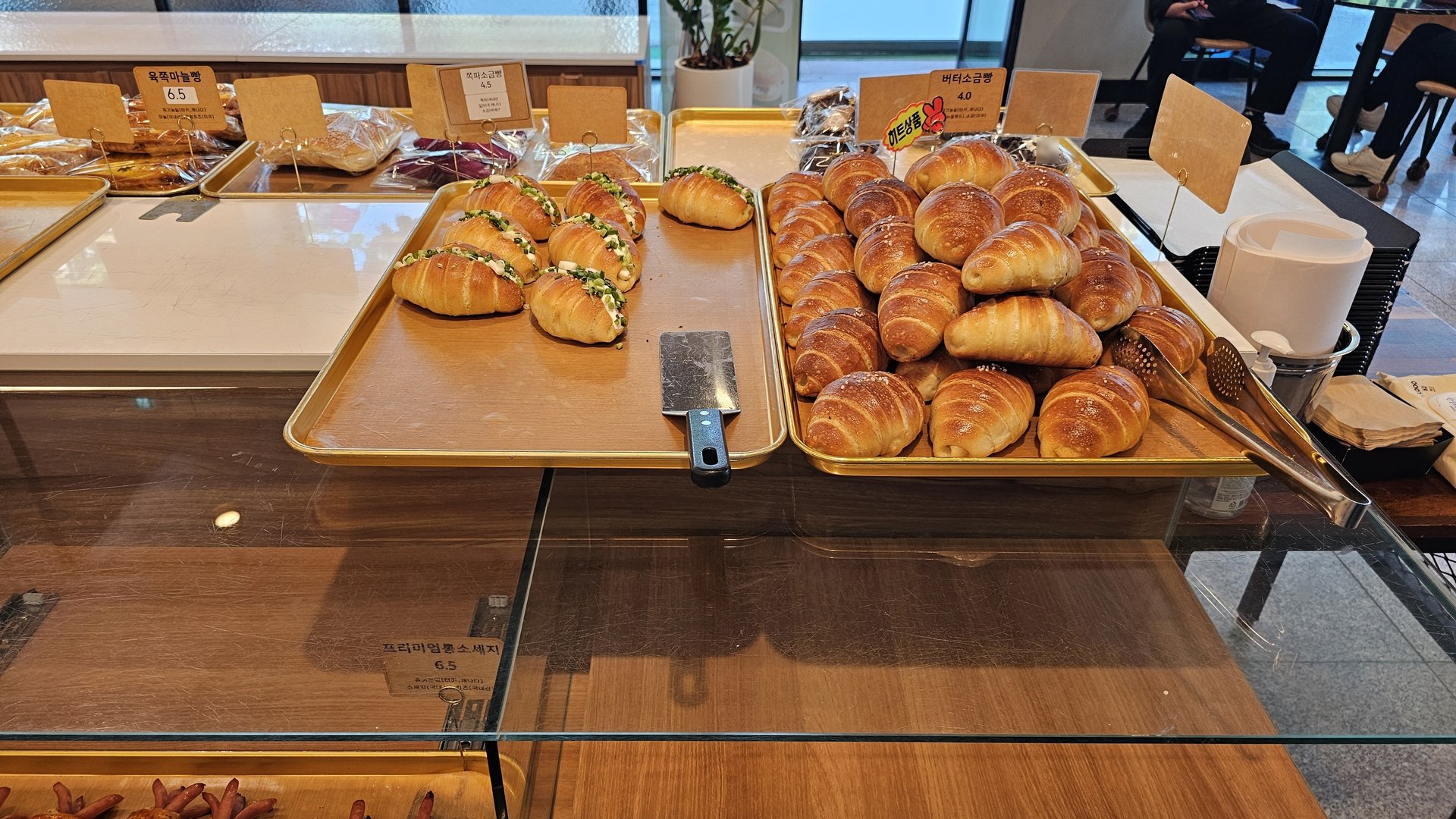
Close-up of salt bread butter rolls and sandwich trays at Mochang-po Bakery Cafe Boryeong
Salt Bread (소금빵 / Sogeumbang) — two of these.
소금빵 is the Korean take on Japanese shio pan (塩パン) — a soft butter roll with a salty, slightly crispy exterior. The style crossed over from Japan and became a massive trend in Korean bakeries starting around 2021. Good ones have a buttery crust and a soft, slightly chewy interior. Bad ones are just dinner rolls with salt sprinkled on top.
These were good. The butter came through, the crust had the right crunch, the inside was properly soft. Freshness matters a lot with this style of bread, and same-day baking means you’re not getting day-old product.
Americano — two of these. Standard Korean cafe Americano. Fine. The coffee does the job. Don’t come here specifically for the Americano — come for the bread.
We didn’t track the exact total. It didn’t sting, which usually means the pricing was reasonable.
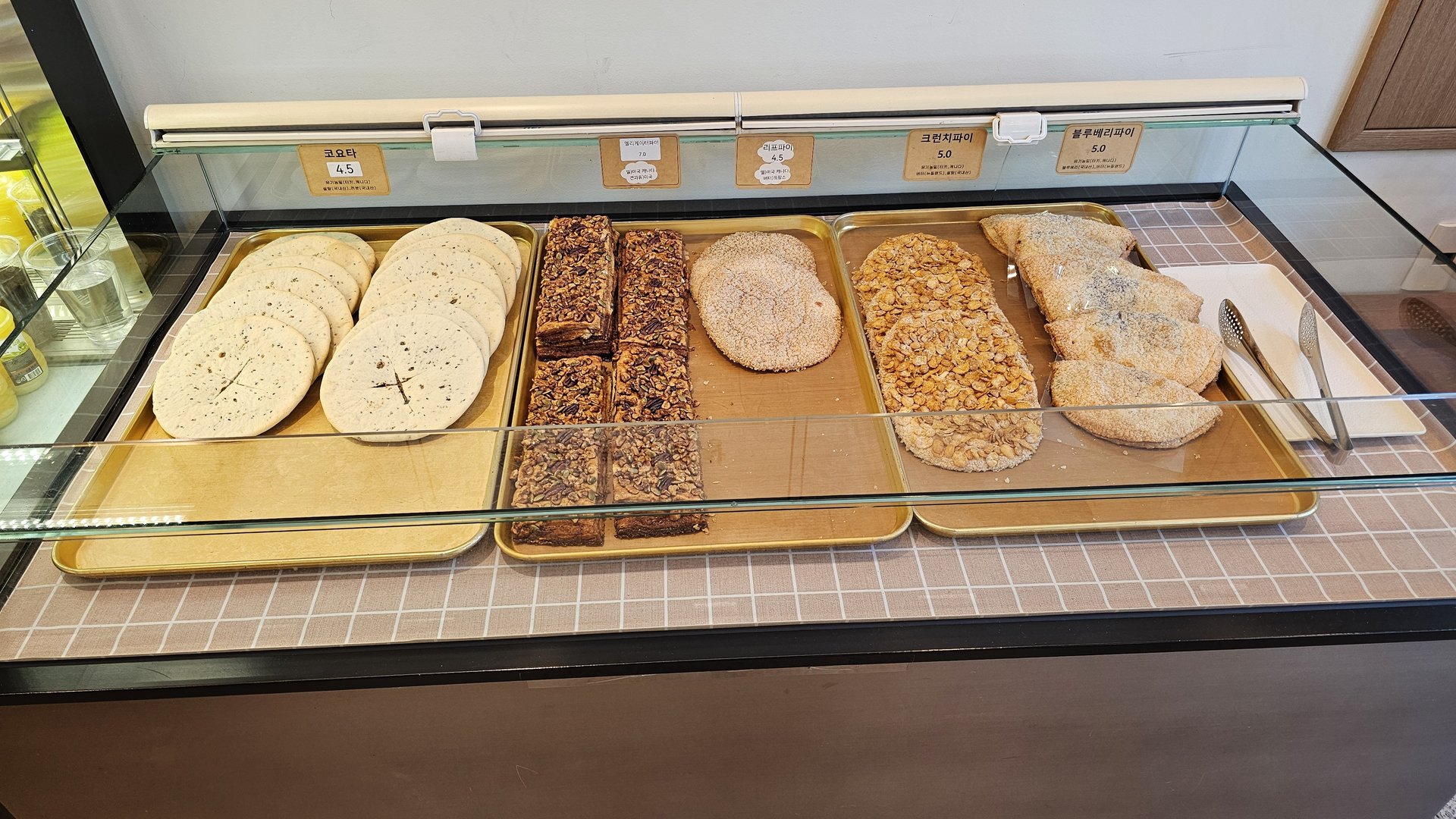
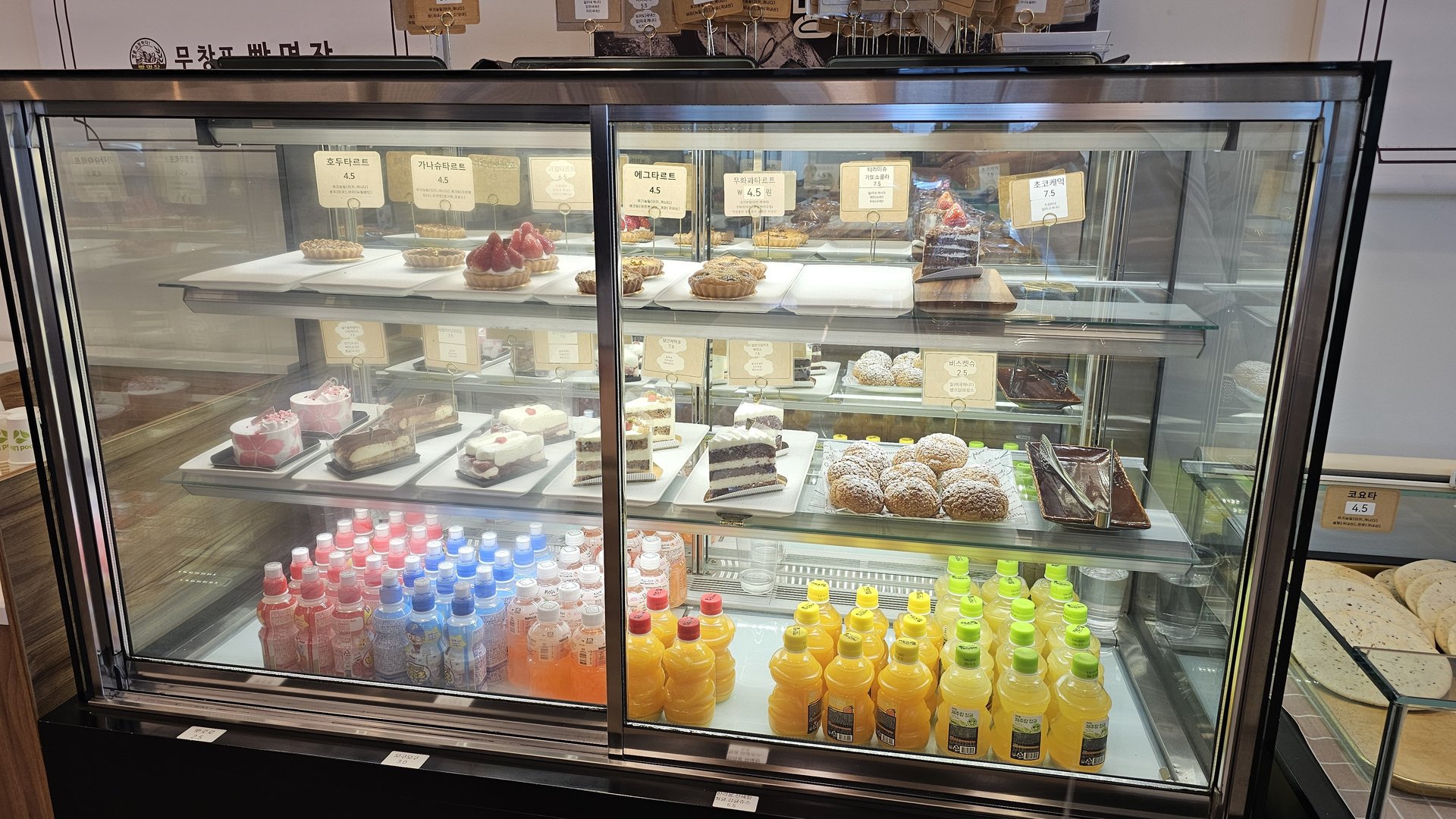
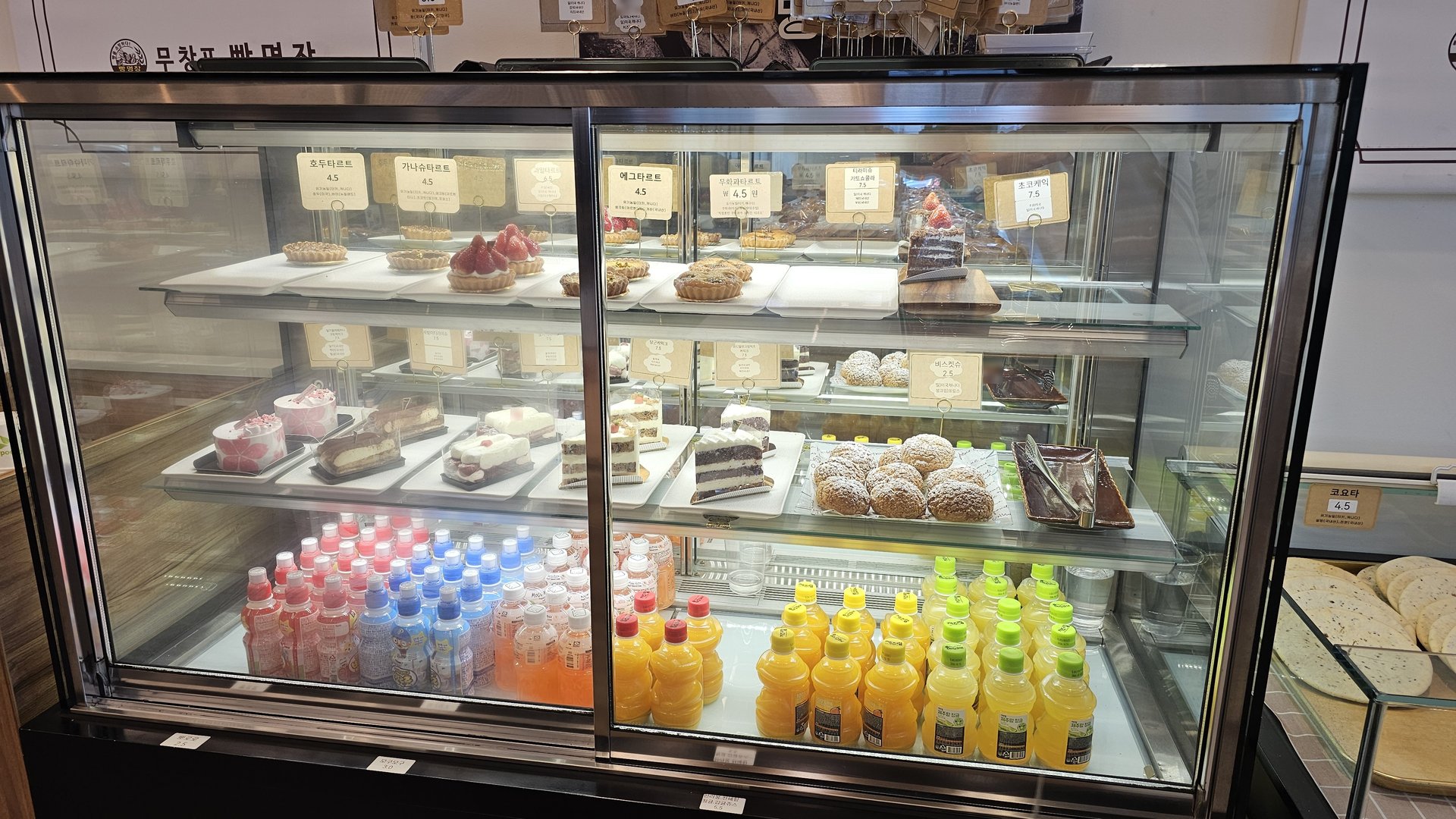
One item worth flagging for next time: Coyota (코요타) at 4,500 KRW (~$3.30 USD) — visible in the glass showcase.
Glass showcase with Coyota seed bread at 4500 KRW, crunch pie, and blueberry pie at Mochang-po Bakery
Seed and nut-topped bread. Looked genuinely good. Didn’t get it this trip. Unfinished business.
The Selection (It’s a Lot)
A quick rundown of what’s on offer:
Hard breads: Baguette, ciabatta, organic whole wheat loaf, campagne
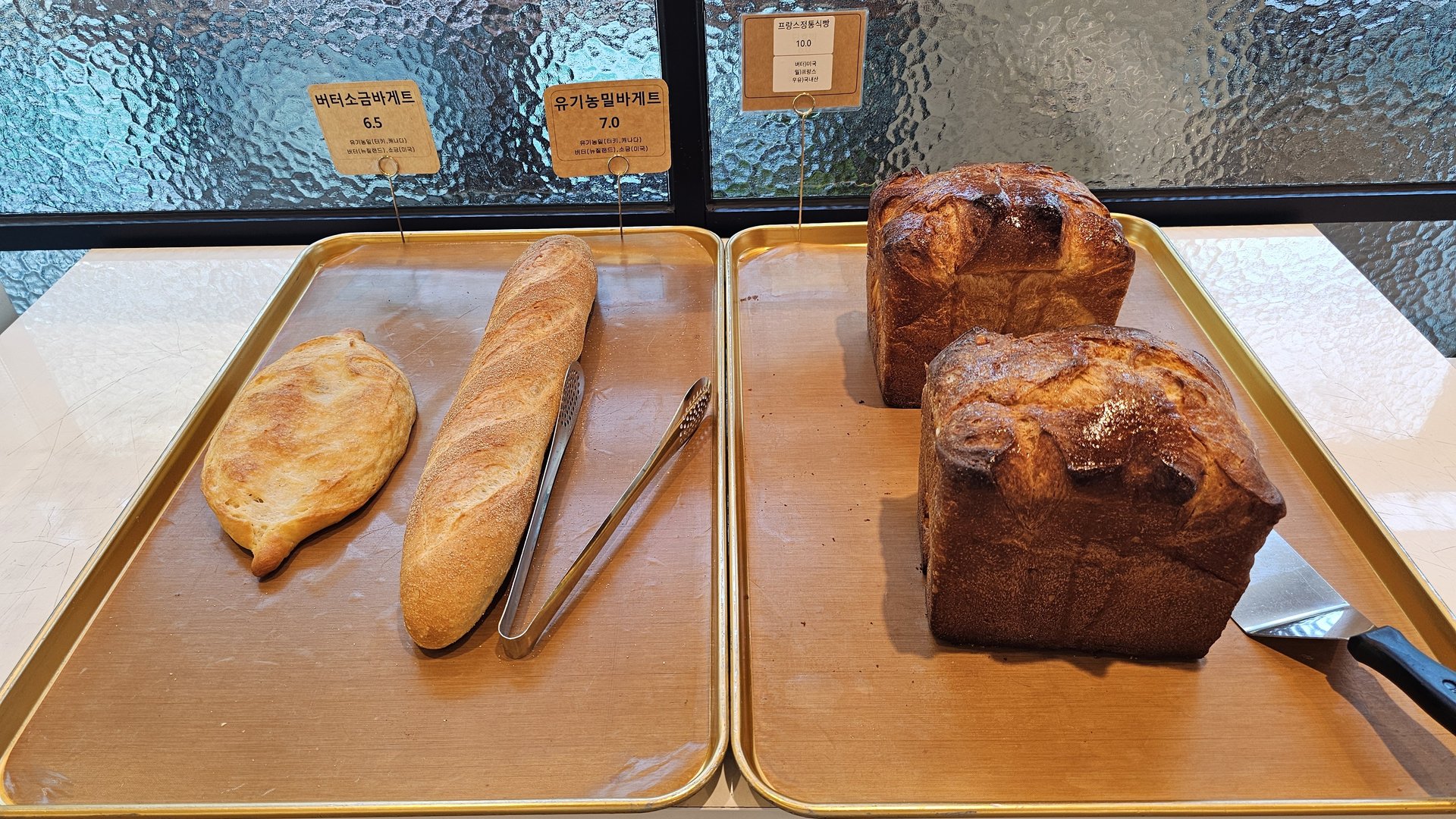
Baguette, ciabatta, and organic whole wheat hard bread loaves on display tray at Mochang-po Master Baker Cafe
Soft and sweet breads: Salt bread, croissant, egg toast, red bean bread (단팥빵), cream bread, chocolate-coated bread, almond bread, garlic baguette, pizza bread, morning rolls
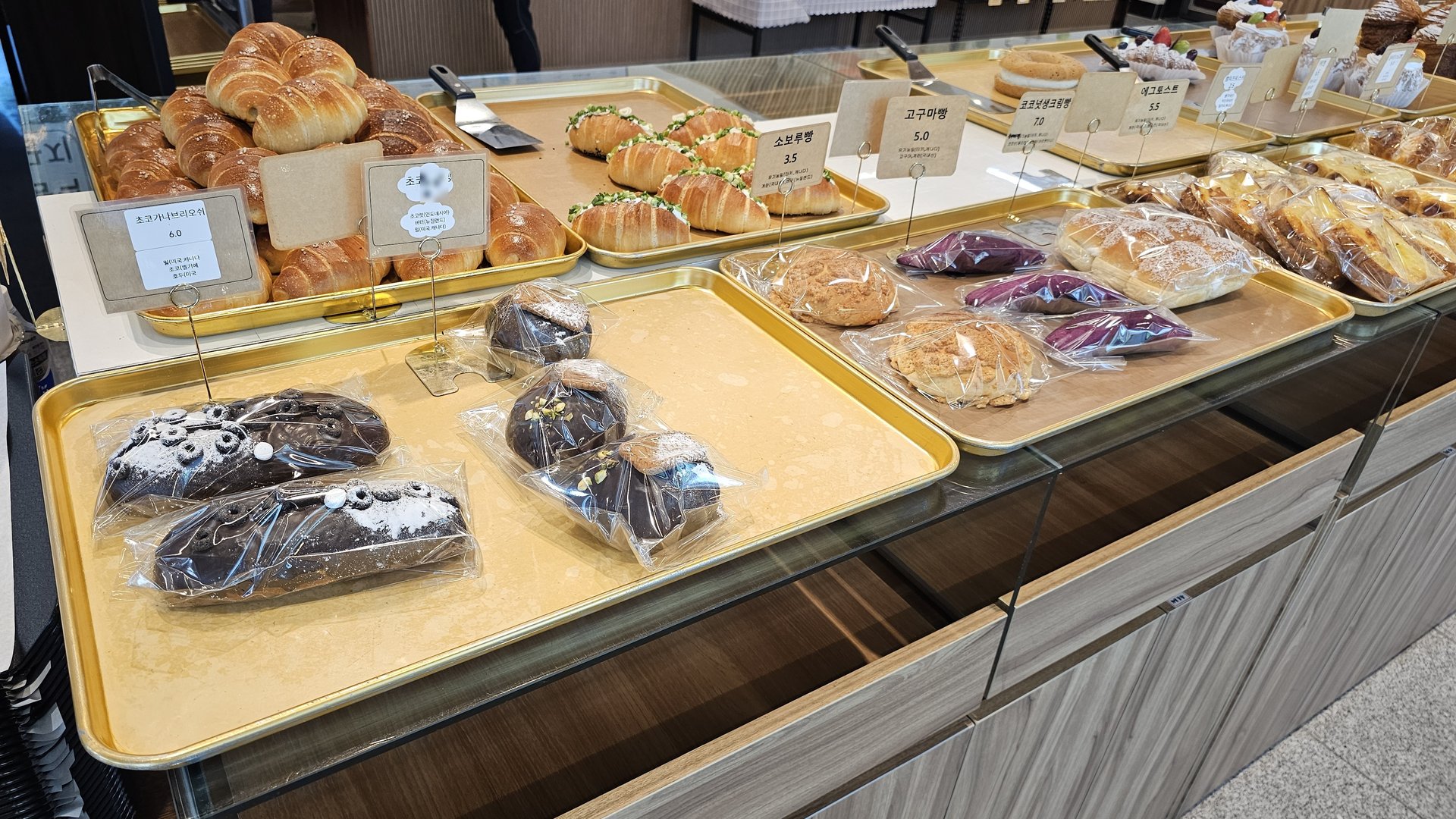
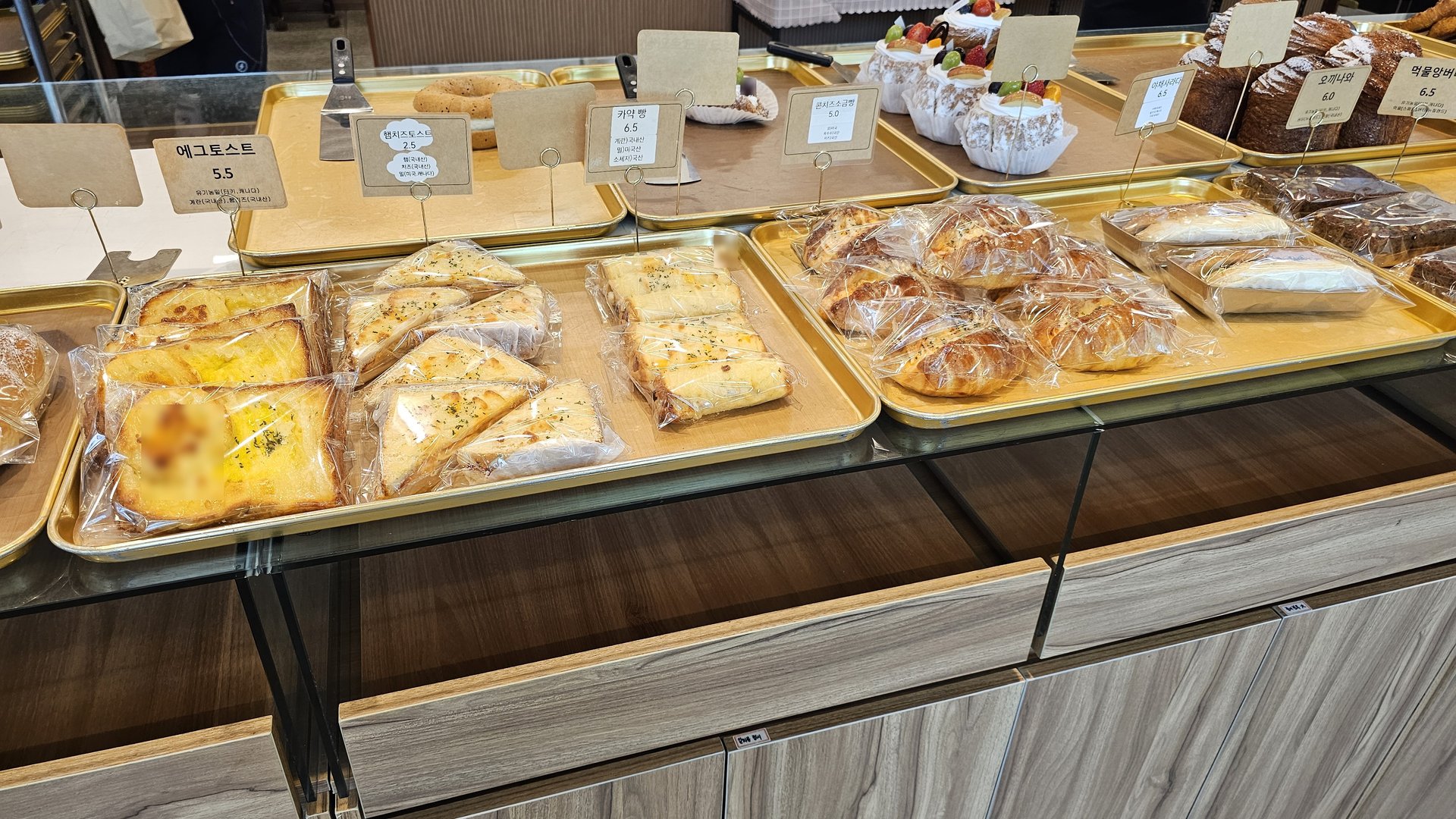
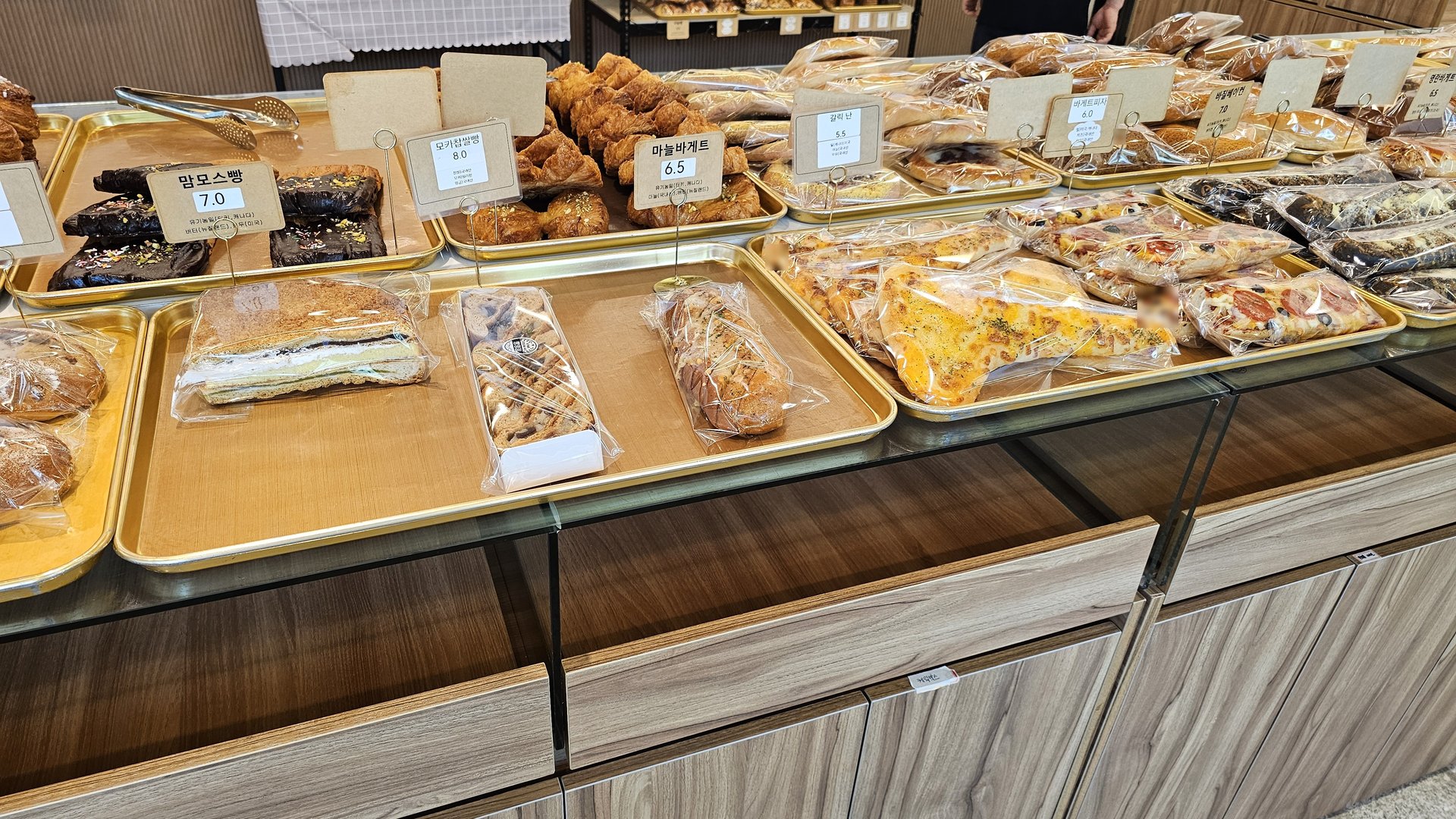
Chocolate-coated bread, red bean bread, and cream bread on individual trays at Mochang-po Bread CafeEgg toast and croissant breads with Korean price tags at Mochang-po Bread Cafe BoryeongAlmond cream bread and garlic baguette trays displayed at Mochang-po Master Baker CafeRed bean loaf, whole wheat sandwich bread, and red bean loaf at Mochang-po Bread Cafe
Cakes: Strawberry, chocolate, roll cake — custom orders available too
Refrigerated cake showcase with strawberry cake, chocolate cake, and roll cake at Mochang-po Bread Cafe BoryeongRefrigerated showcase with whole cakes and colorful drink bottles at Mochang-po Bread CafeRefrigerated display case with cakes, donuts, cookies, and drinks at Mochang-po Bakery Cafe
Small bites: Macarons, cookies, chocolate bars, candy jars
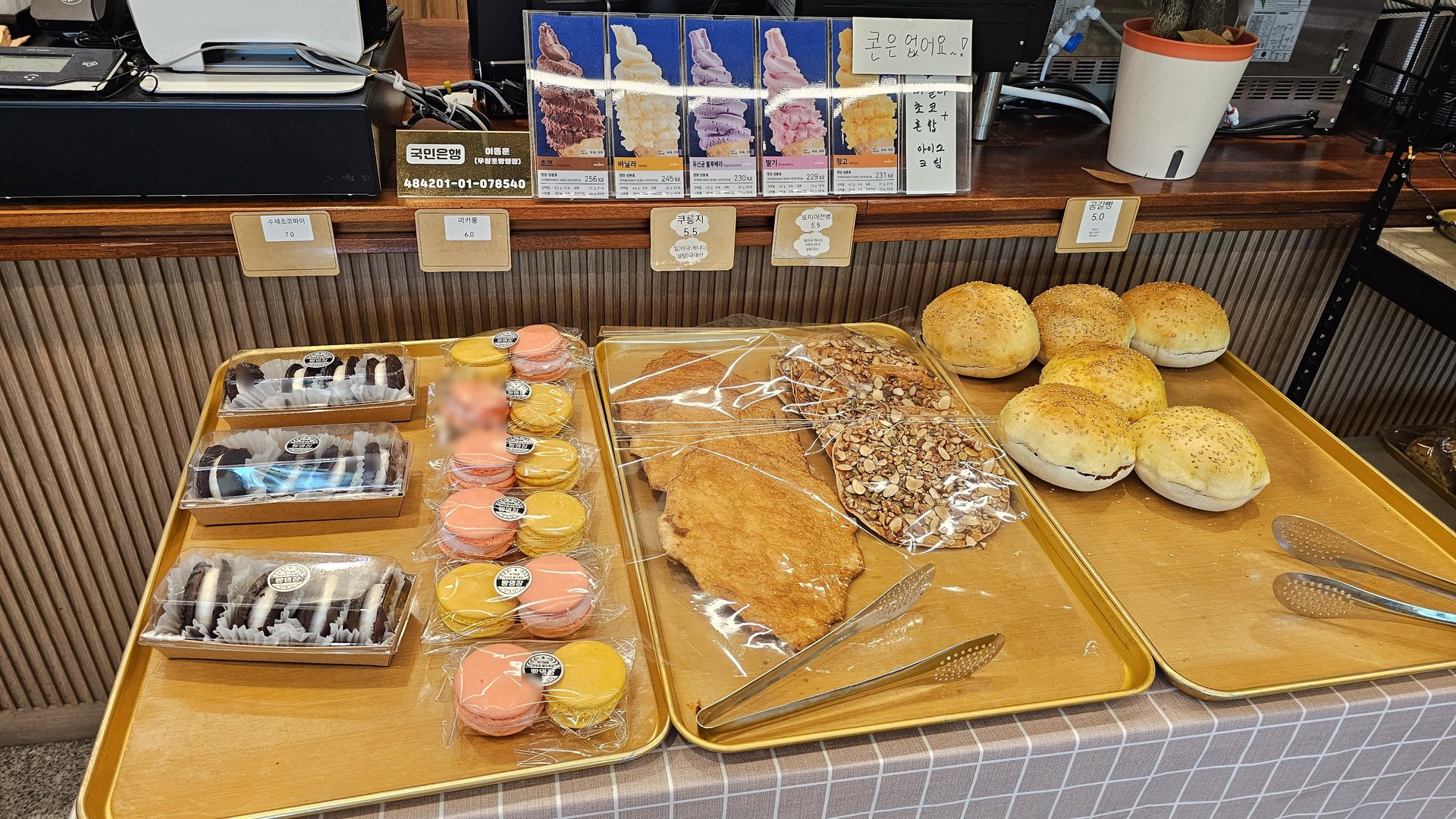
Counter shelf with macarons, cookie jars, and packaged candy snacks at Mochang-po Bread CafeTray display with macarons, chocolate bars, almond croissant bread, and ice cream menu photo at Mochang-po Bakery
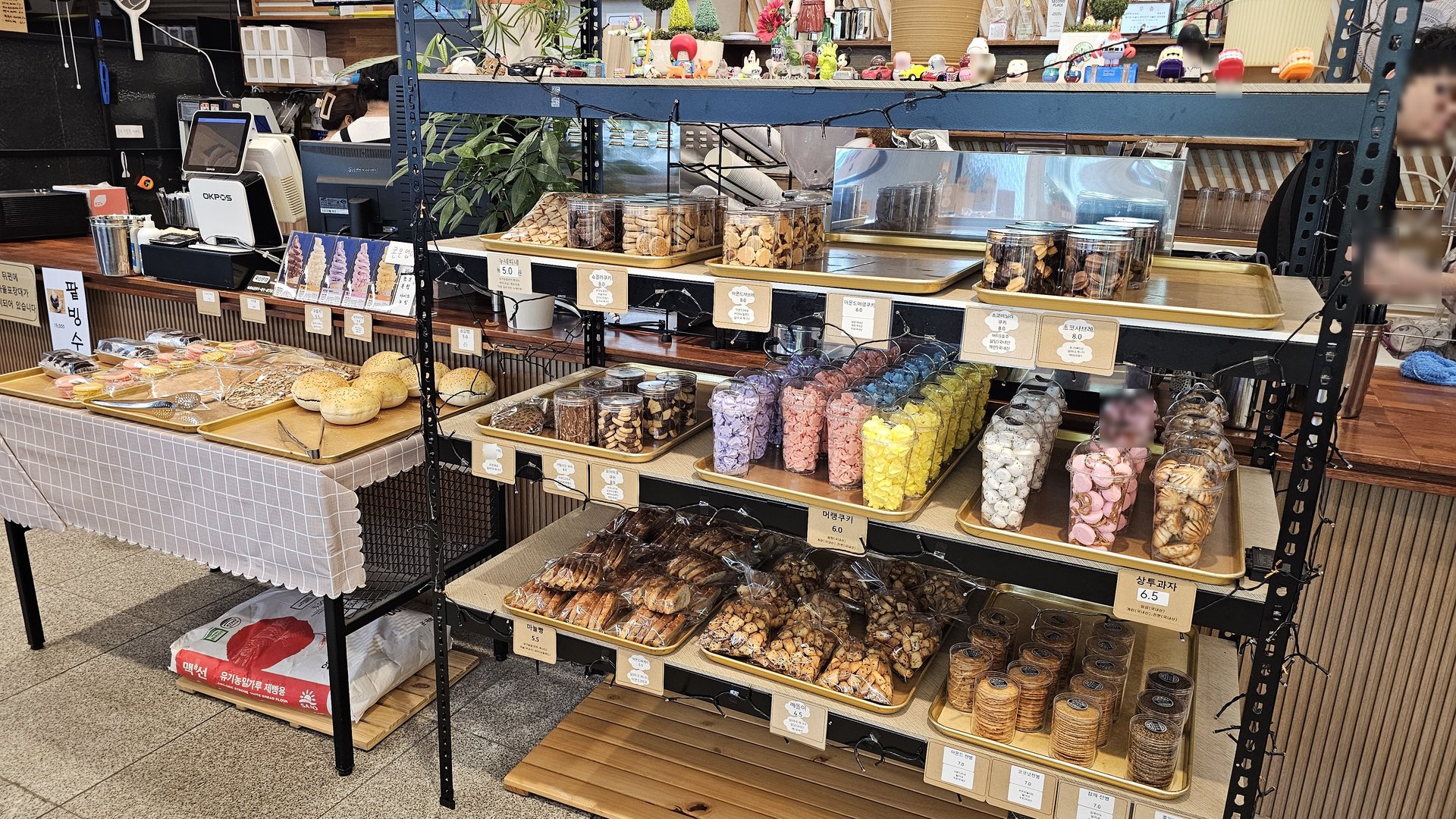
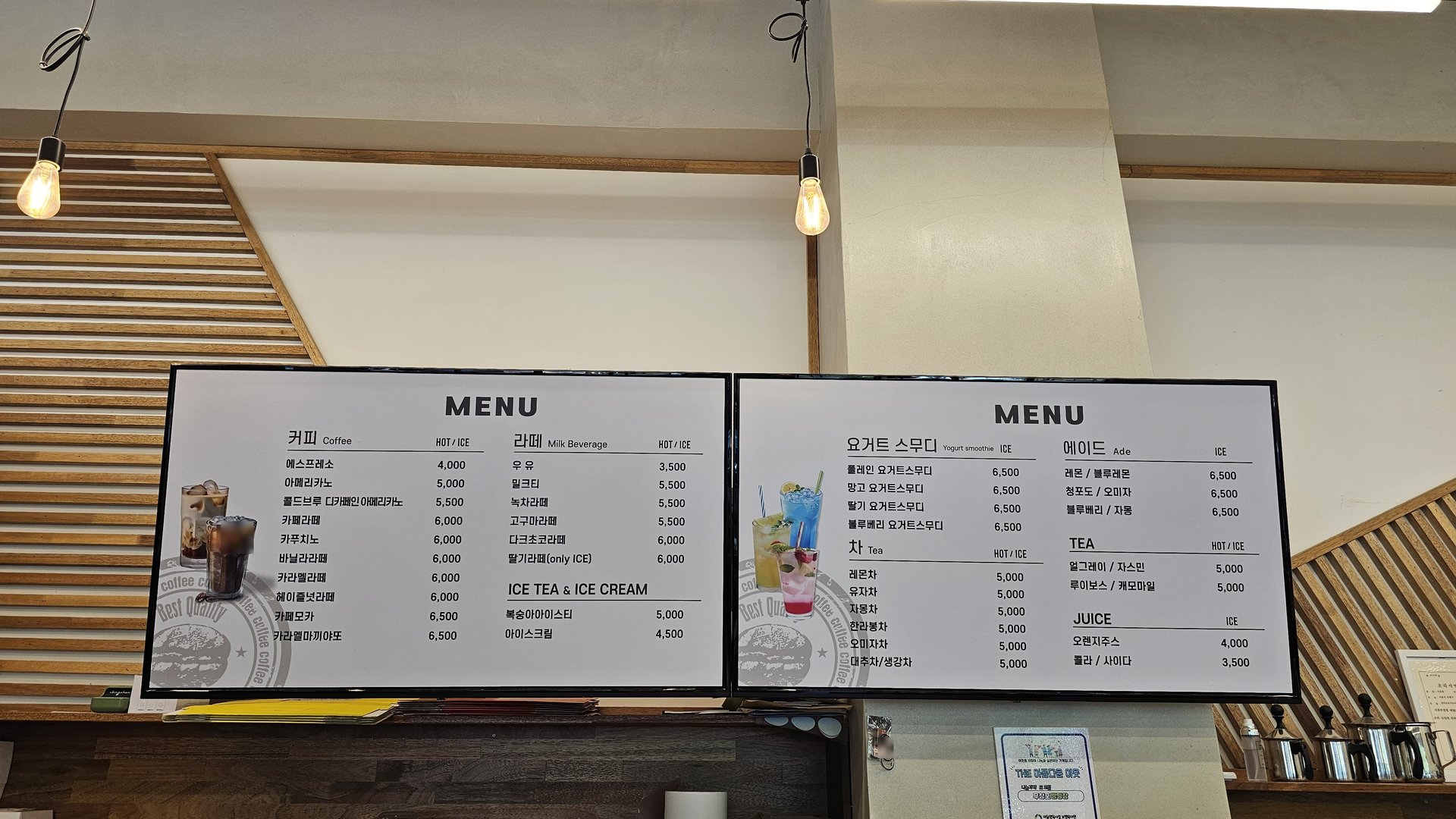
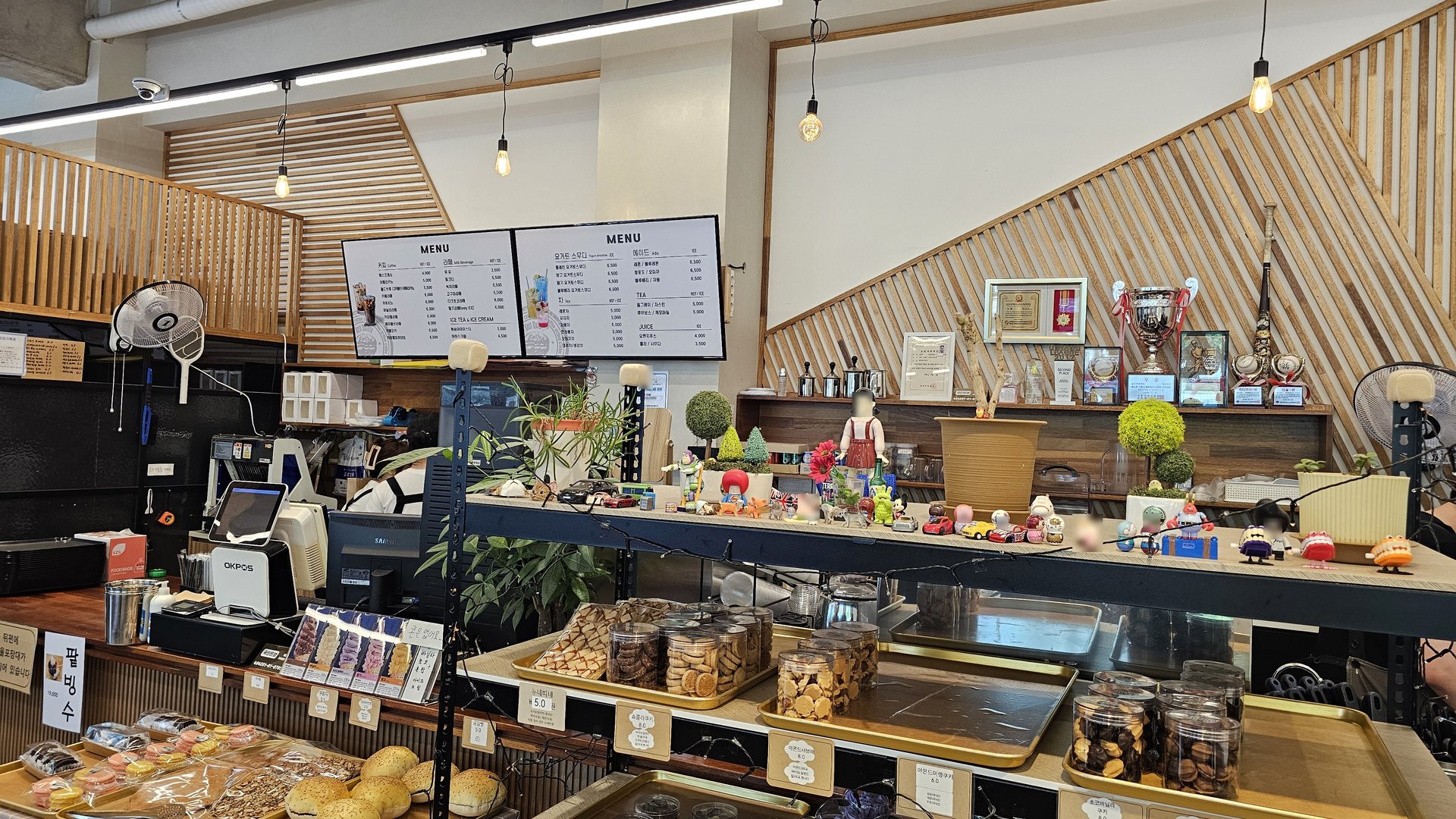
Full drink menu board showing coffee, latte, yogurt smoothie, ade, tea, and juice prices at Mochang-po Bread CafeCounter area with drink menu board, coffee machine, and bakery decor at Mochang-po Bread Cafe
The range is restaurant-menu level for a standalone bakery. You could easily spend 20 minutes just deciding.
Stuff Tourists Should Know
English menu? Not confirmed — the breads are displayed open on trays with Korean labels. Point and pick. You don’t need to read Korean to shop here.
English spoken? Probably basic at best. But it’s a bakery. Point at what you want, hand over a card, done. It works.
Card payment? Most Korean cafes and bakeries accept cards including foreign Visa and Mastercard. Likely fine here. Carry some cash as backup just in case.
Tipping? No. Korea doesn’t tip. Don’t try.
Vegetarian options? Plenty. Most Korean bakery breads are vegetarian (butter and eggs are standard). Hard breads like baguette and ciabatta are typically vegan. Check individual items if you have strict requirements.
Halal/Kosher? Not certified. Can’t confirm halal status — some Korean red bean pastes use lard. Ask if this matters to you.
Kids? Yes. Wide space, dartboard, lots of sweet options. Fine for families.
Best time to visit? Midday when the selection is fullest and bread is freshest. Later in the day they sell out of popular items — same-day baking means no restocking.
Parking? The exterior photos show a standalone building with space around it. Parking is likely available on-site.
The Verdict
Worth stopping if you’re in the Boryeong area.
The 43-year baker credential is real — you can taste it. The salt bread is well-executed, the selection is staggeringly wide for a coastal town, and the same-day baking policy means you’re not getting stale product sitting around from yesterday.
The Americano is just Americano. Go for the bread.
Go if:
– You’re doing the Boryeong Mud Festival or Daecheon Beach
– You’re road-tripping through South Chungcheong Province and want to stock up on good bread
– You’re traveling with family — wide space, sweet options, kid-friendly vibe
– You want to see what a serious Korean artisan bakery looks like outside of Seoul
Skip if:
– You’re in Seoul with 3–5 days and considering a 5-hour round trip just for bakery bread — stay in Seoul, the bread scene there is also strong
– You want a quiet, intimate cafe experience — this is a busy tourist operation
We’ll go back. The Coyota bread didn’t happen this time, and that’s unfinished business.
FAQ
Q: Where exactly is Mochang-po Bread Cafe?
Mochang-po (무창포), Boryeong-si, South Chungcheong Province. About 2–2.5 hours from Seoul by car. Look for the large building with international flags and the big “43년 경력” sign out front — you won’t miss it.
Q: Is it open year-round?
Couldn’t confirm off-season hours. Check Naver Maps (네이버 지도) or Google Maps for current hours before you make the trip, especially outside of summer.
Q: What should I order?
Salt bread (소금빵) if you want something soft and buttery. Baguette or ciabatta if you want to taste what the baker is actually known for. The Coyota (seed and nut bread, 4,500 KRW / ~$3.30 USD) looked worth trying based on the showcase.
Q: Can I order a custom cake?
Yes — there’s a cake order notice inside. You’d need to order ahead; same-day custom cakes are not a thing here.
Q: How much does it cost roughly?
The Coyota in the case was 4,500 KRW (~$3.30 USD), which gives you a rough sense of the price range. Korean artisan bakery items typically run 2,000–6,000 KRW (~$1.50–$4.50 USD) per piece. Not expensive, especially for organic natural fermentation bread.
Q: Do they speak English?
Basic at best. But it’s a bakery — point at what you want, pay, take your bread. You’ll manage fine.
Q: Is parking available?
The building looks standalone with space around it. Parking should be available on-site, but confirm on Google Maps if you’re coming in a larger vehicle or during peak summer festival season.
Quick honest review of BYRONIC ESPRESSO in Yeouido, Seoul. Short version: great specialty espresso bar for office workers. The Yeouido Latte is genuinely good and stupidly reasonable for what it is. Skip the rest of this if you’re in a hurry — just go and order that.
I’ve been here more times than I can count. Always get the same thing.
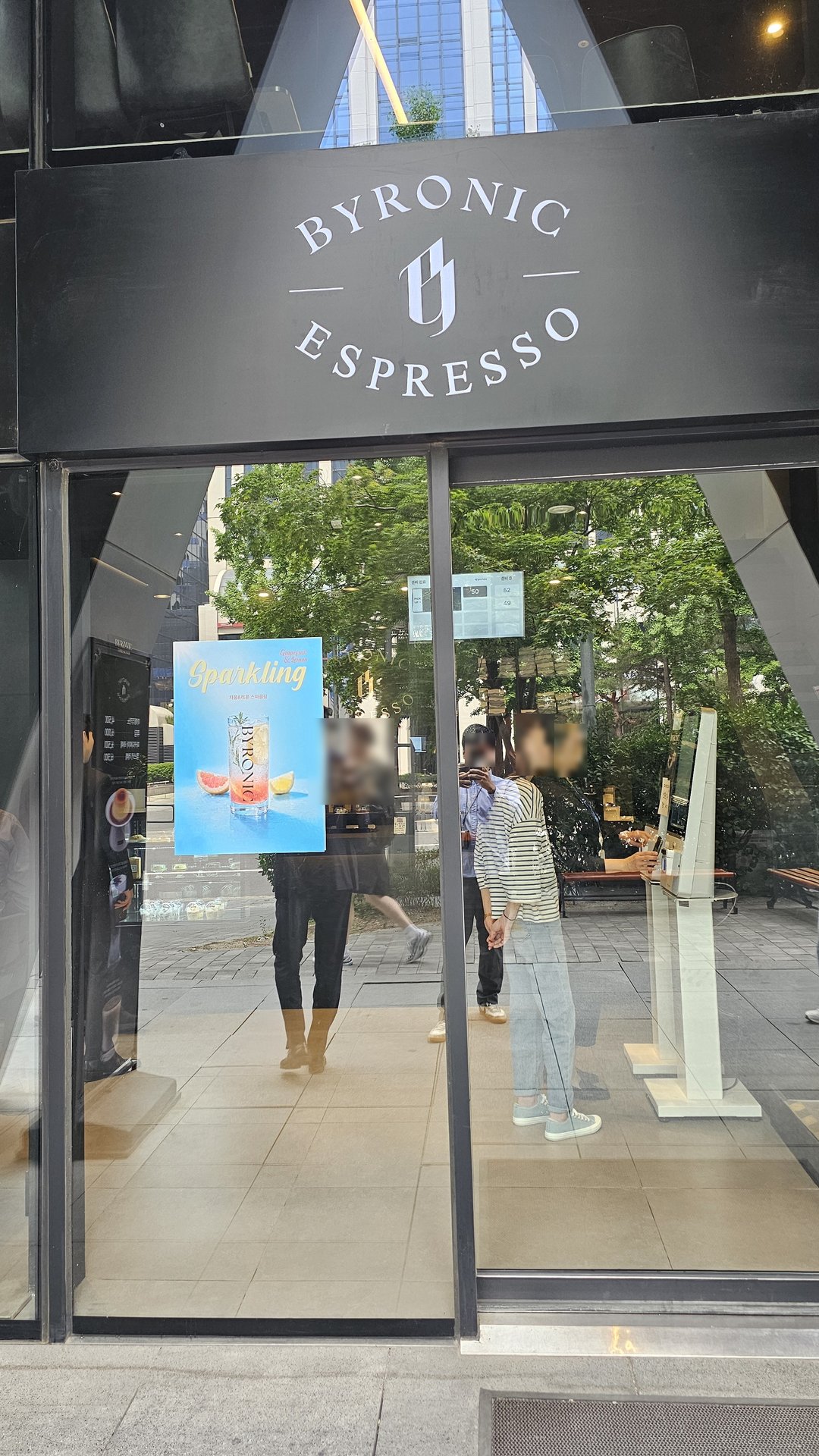
Glass facade exterior of Byronic Espresso Yeouido with logo engraved on floor-to-ceiling windows and Sparkling drink poster
What Is BYRONIC ESPRESSO?
BYRONIC ESPRESSO is a specialty espresso bar tucked into the ground floor of an office building in Yeouido — Seoul’s financial district, roughly the Korean equivalent of Canary Wharf or lower Manhattan. Think suits, lunch rushes, and people who take their coffee seriously because they have a 2 PM presentation.
“Specialty coffee” in Korea means beans sourced for flavor, not volume. Higher extraction standards, trained baristas, and usually a focused menu instead of forty options. BYRONIC leans hard into this. The menu is tight, the execution is consistent, and the vibe is premium-but-functional.
Not a cozy neighborhood cafe. Not a tourist spot. This is where Yeouido office workers get their fix.
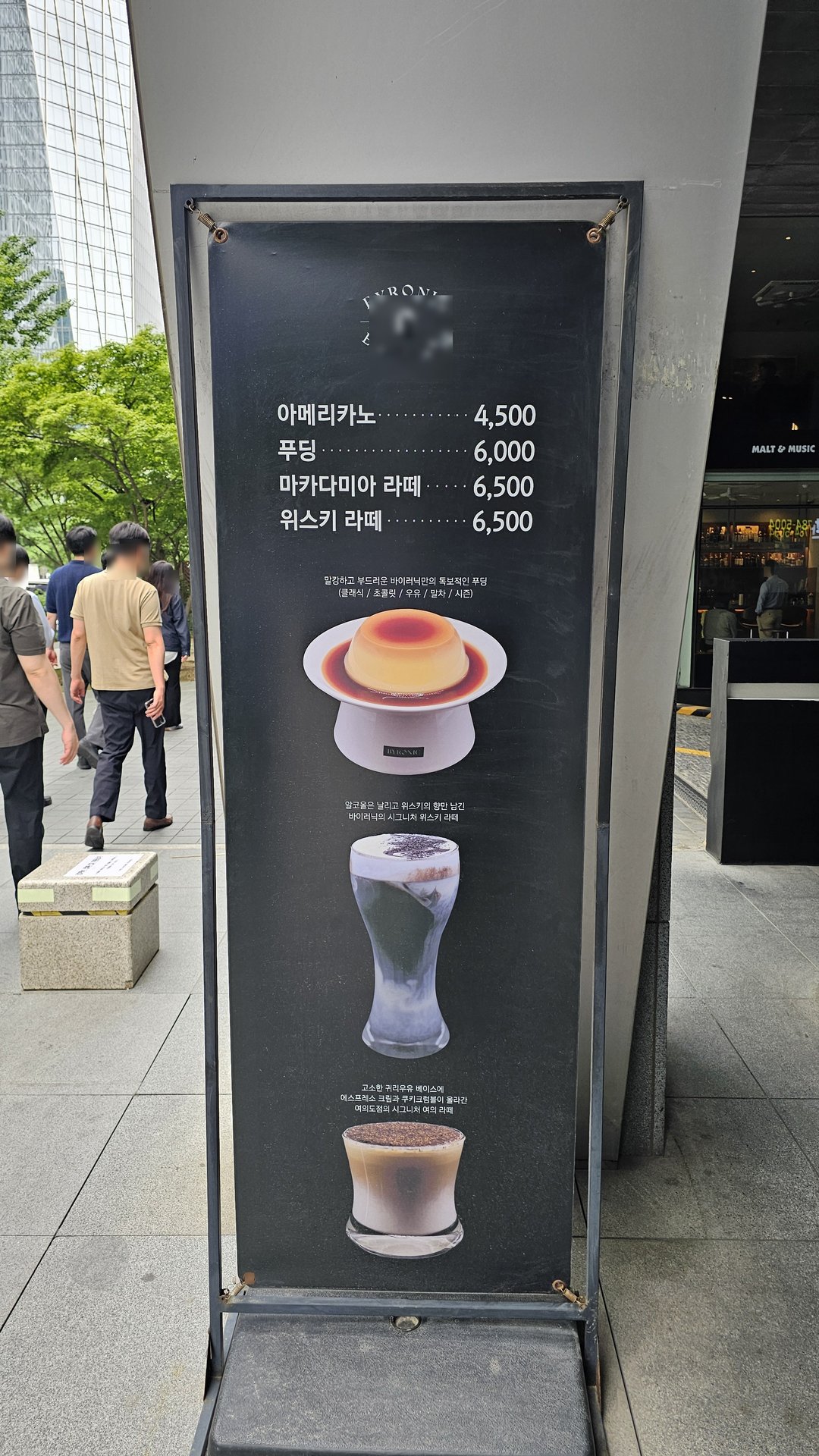
Outdoor menu board at Byronic Espresso Yeouido showing prices for Americano, Macadamia Latte, and Whisky Latte
Getting There
Yeouido is on Line 5 (purple) and Line 9 (gold). Get off at Yeouido Station — the cafe is a short walk into the main office corridor.
From Incheon Airport: about 50–60 minutes by AREX + subway transfer. Not worth a special trip, but if you’re in Yeouido for any reason, it’s easy to stop by.
Most tourists stay near Myeongdong or Gangnam. Yeouido isn’t exactly on the tourist trail. But if you’re here for the Han River park, Yeouido Cherry Blossom Festival (spring), or 63 Building, it’s a solid detour.
The Interior
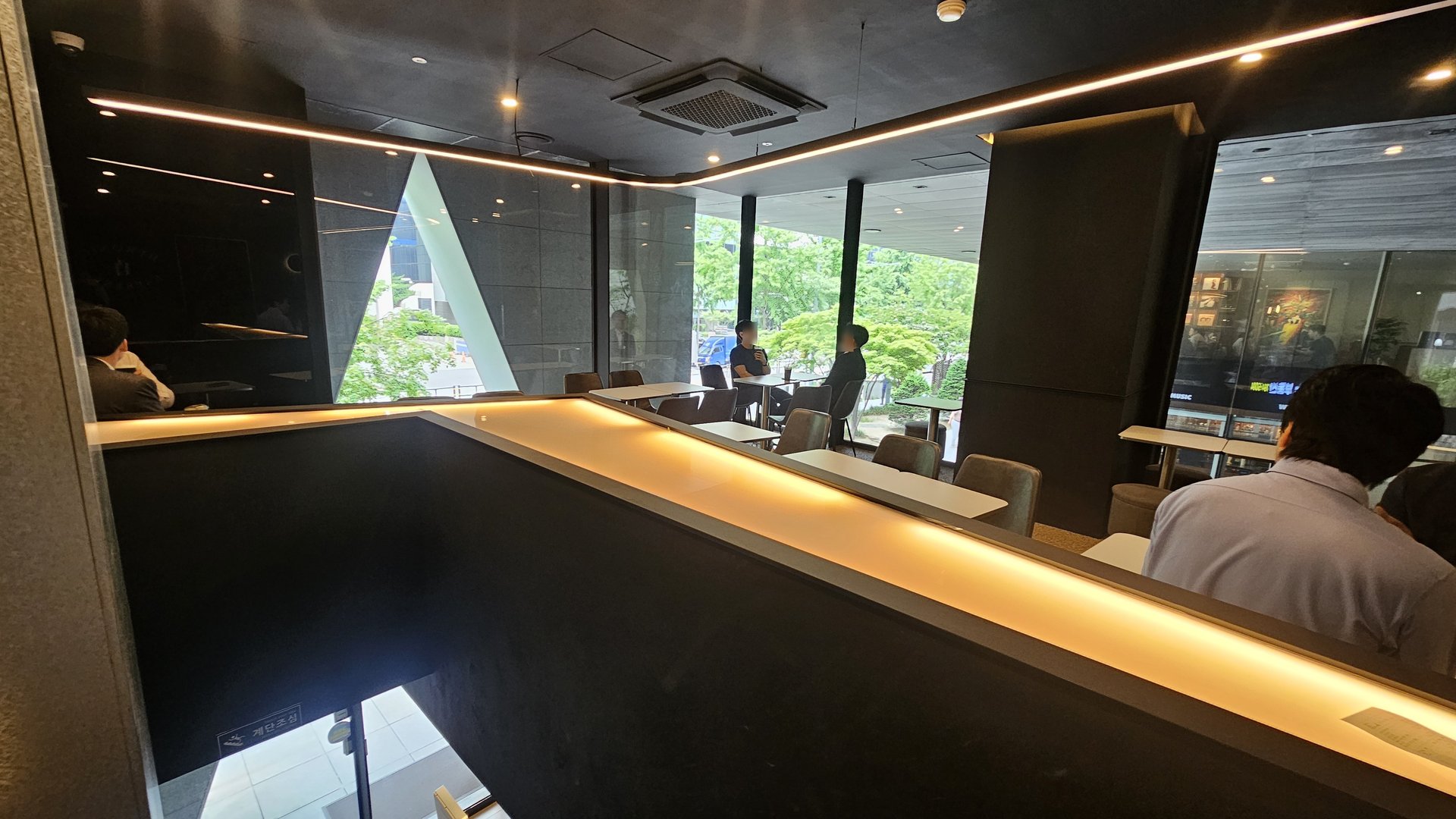
Interior seating area at Byronic Espresso Yeouido with black marble counter seats and window tables in natural daylight
Dark gray. Mezzanine level. Full glass front that looks out onto the street.
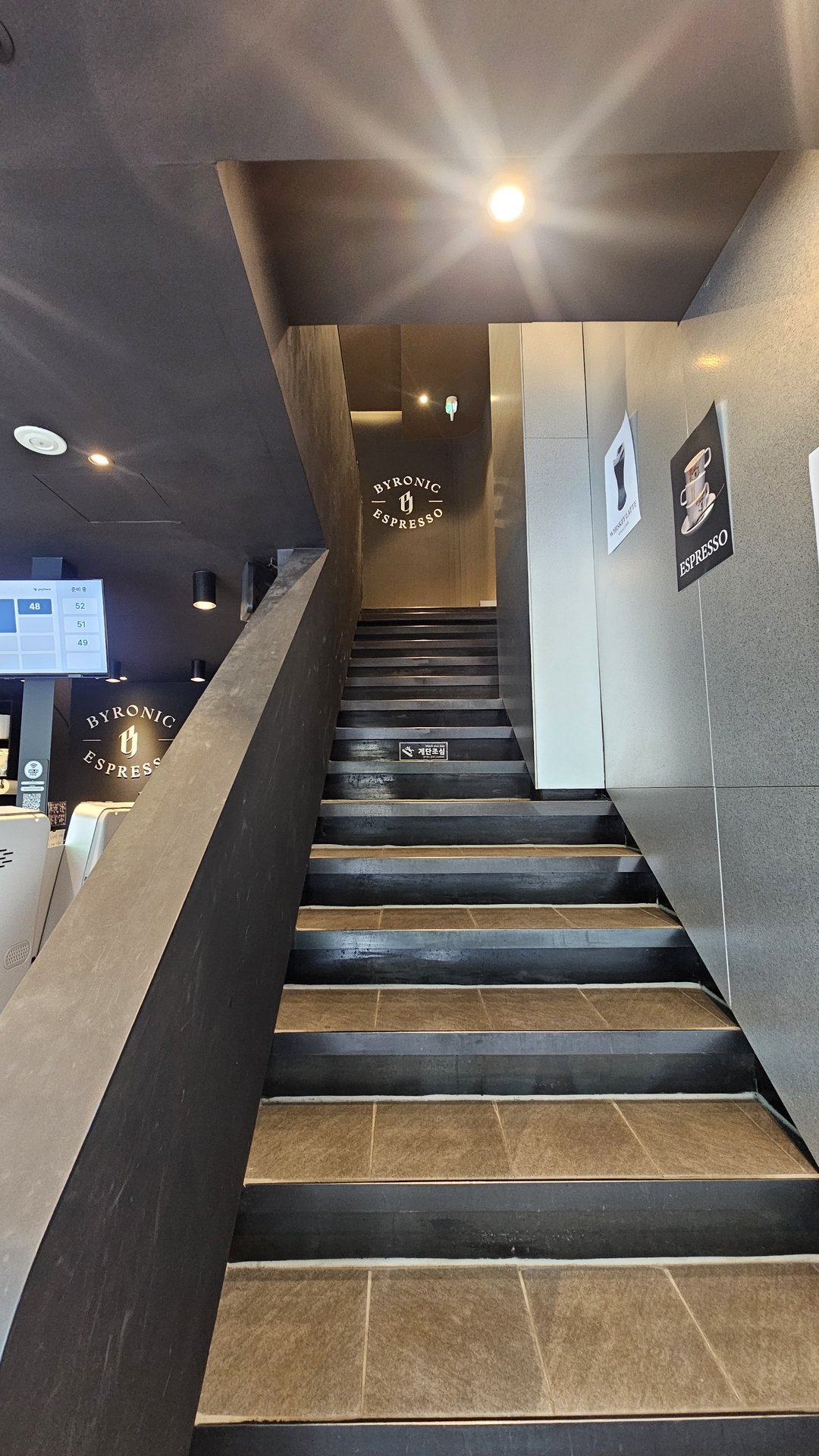
Multi-level mezzanine interior of Byronic Espresso Yeouido with black vertical louver panels and large brand logo sign
It’s genuinely nice inside. Not in a trying-too-hard way — more like someone made deliberate choices and stuck with them. Everything is dark gray and matte. The logo is engraved on the wall near the staircase. It reads “espresso bar” and that’s exactly what it delivers.
Seating is available on both levels. Lots of solo office workers on laptops. Groups at tables near the windows. The natural light from the glass facade keeps it from feeling heavy despite the dark palette.
That said — most people here are on takeout. The pickup counter is the center of gravity.
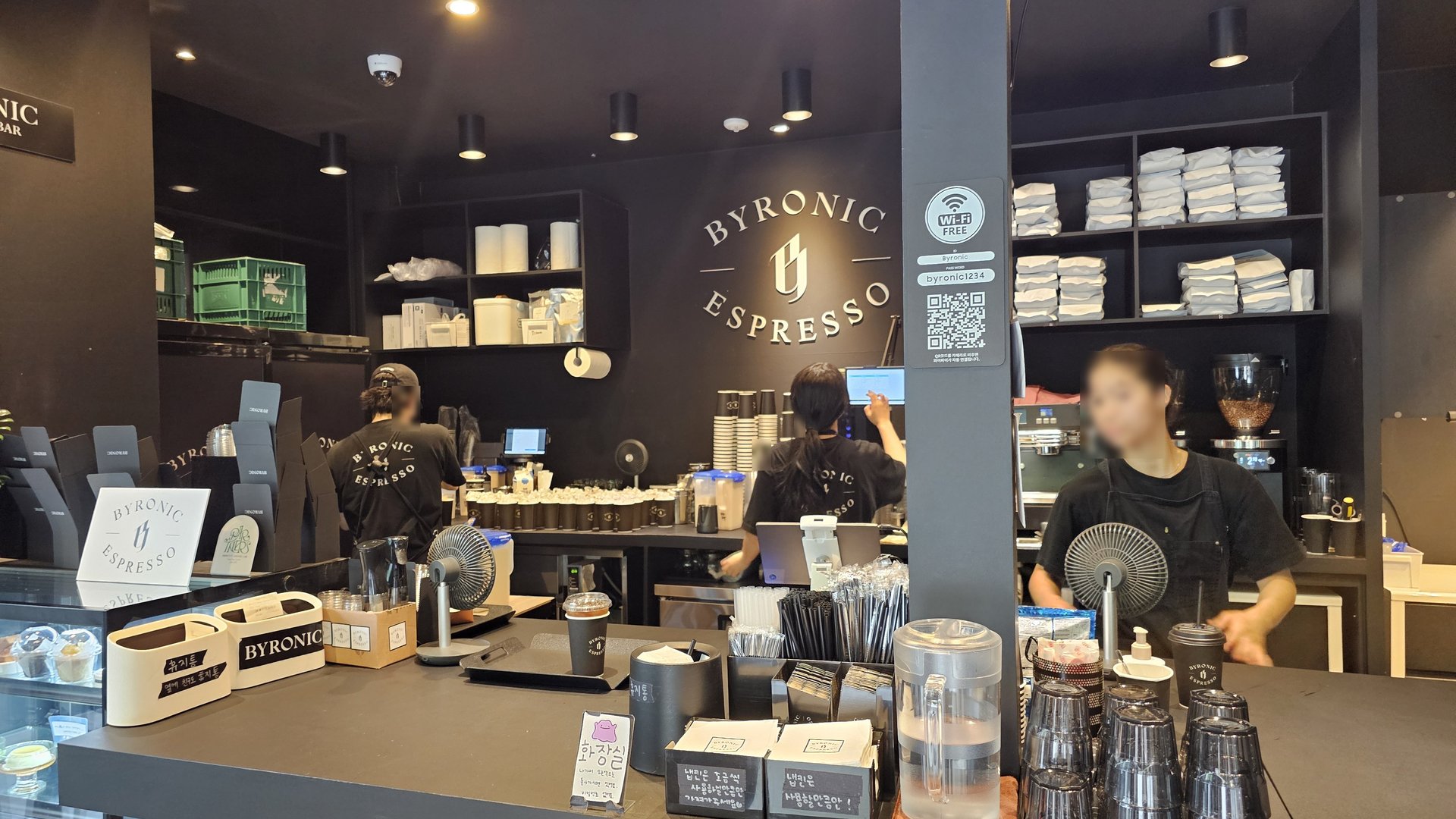
Byronic Espresso Yeouido counter with three baristas and BYRONIC ESPRESSO logo engraved on black wall
How to Order
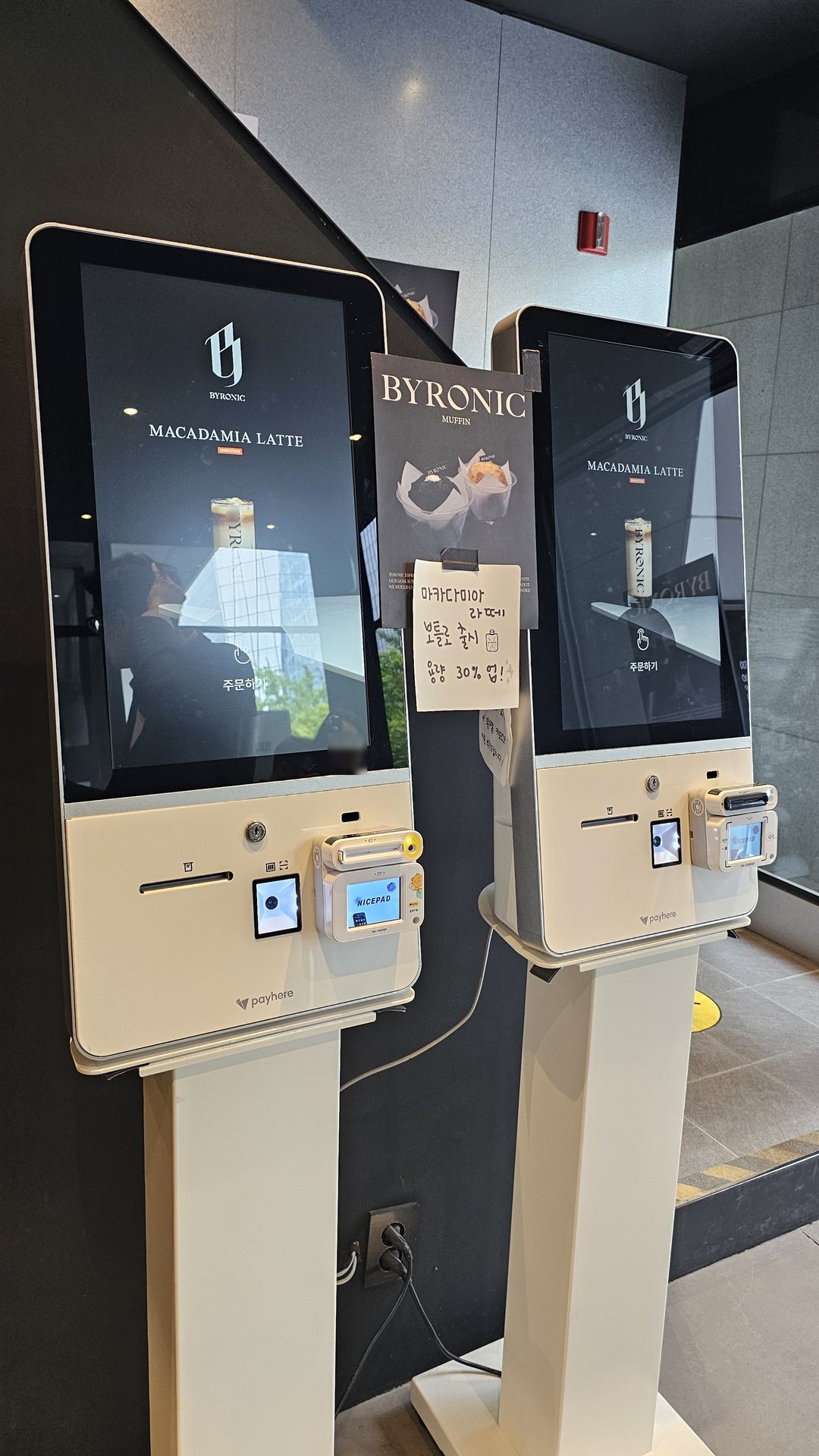
Kiosk only. Two terminals near the entrance.
Self-order kiosk screens at Byronic Espresso Yeouido showing Macadamia Latte menu and muffin promotional leaflet
The screens are in Korean, but the menu items are labeled clearly enough that you can navigate by price and photo. If you’re not sure what to get — just order the Yeouido Latte (여의라떼). It’s their house signature, named after the neighborhood. That’s really all you need to know.
English isn’t really spoken here. This isn’t a tourist cafe. But kiosk ordering means you don’t need to say a word to get your drink. Point, tap, pay, pick up.
Cards work fine, including most international ones.
No tipping in Korea. Don’t leave extra on the counter.
The Yeouido Latte
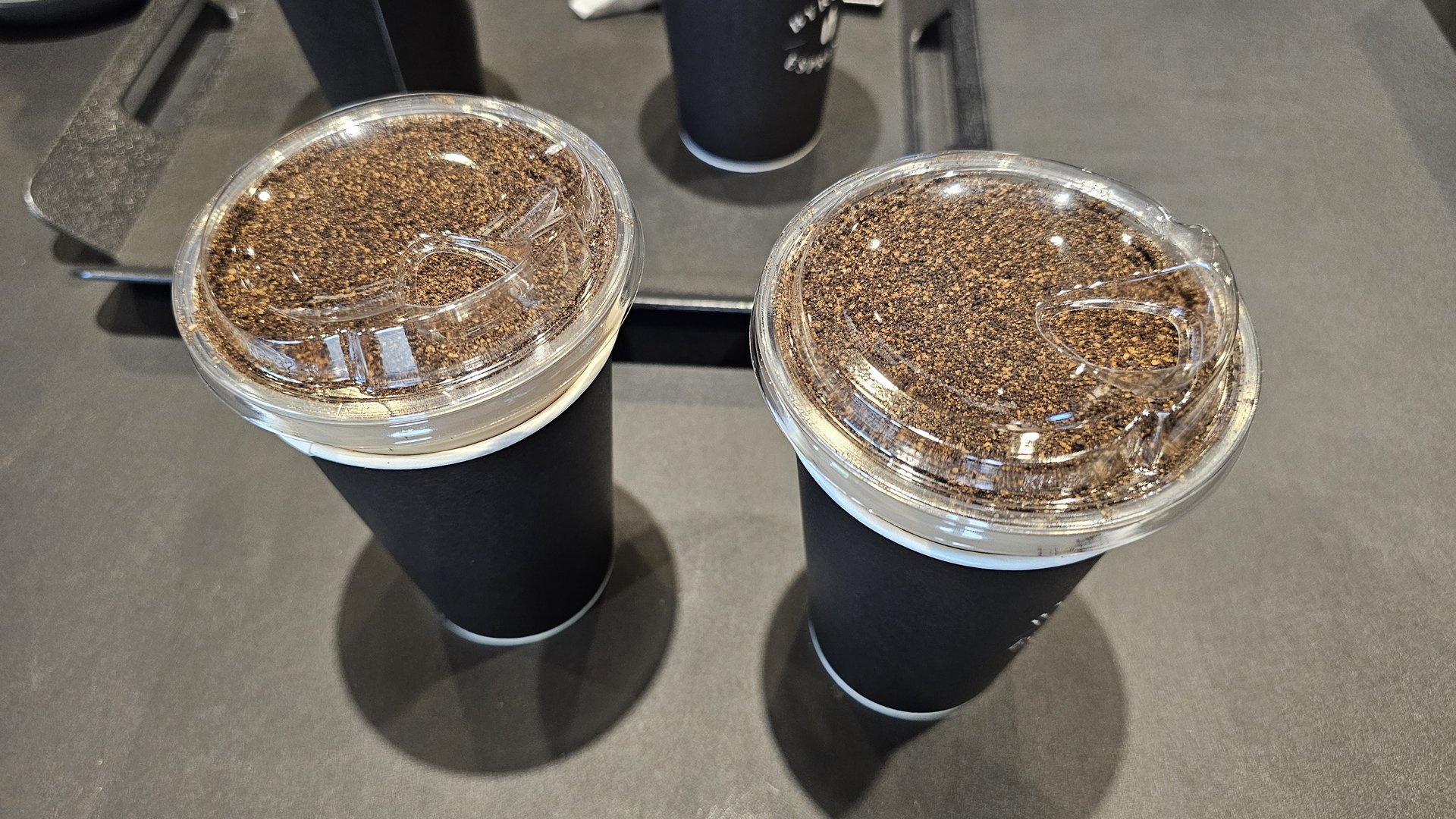
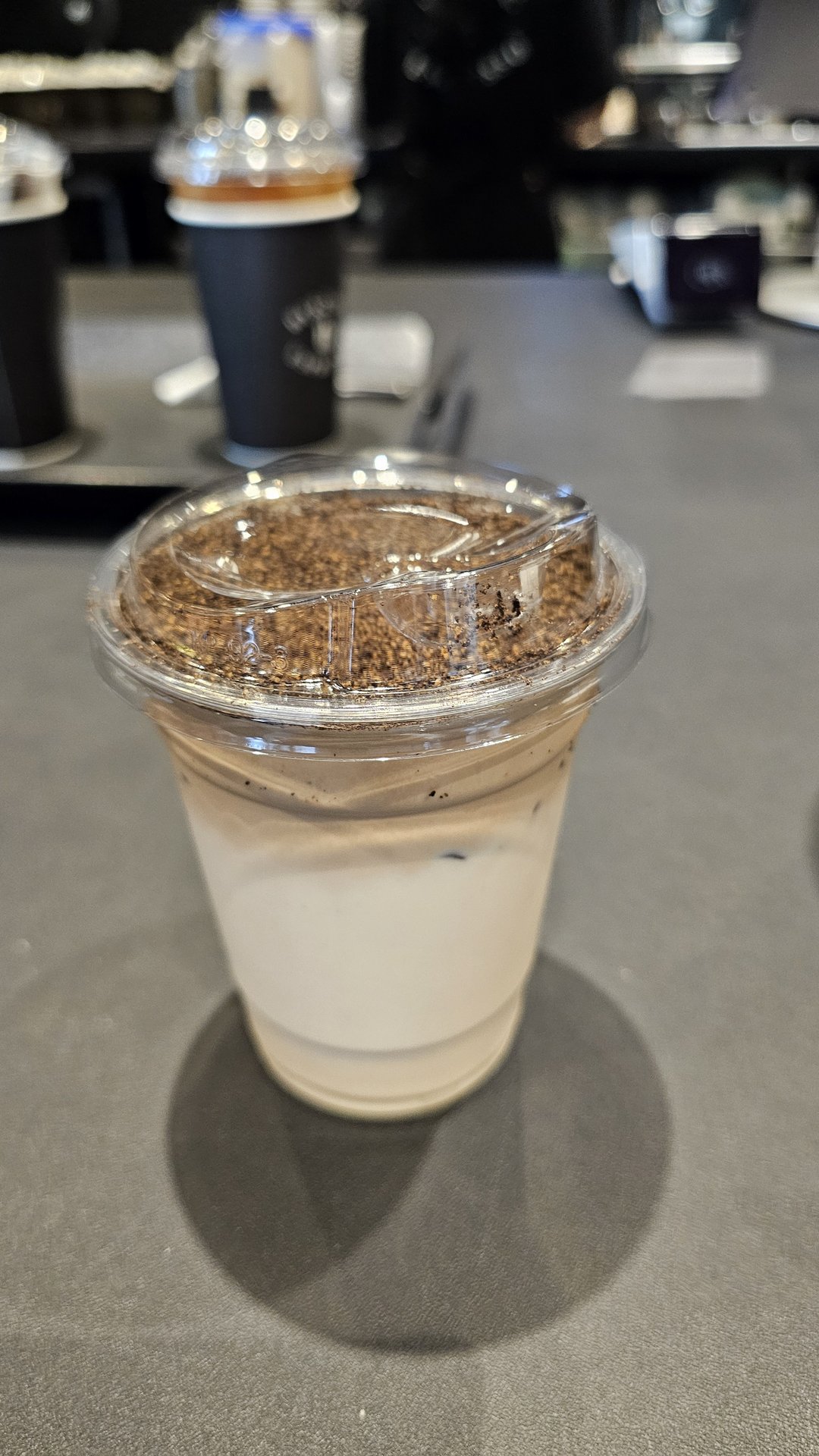
Overhead view of two signature iced drinks at Byronic Espresso with coffee crumble grounds covering black cup lidsClose-up of Byronic Espresso signature iced latte with white milk layer topped with coffee crumble crust
6,500 KRW per cup (~$4.80 USD). Two of us paid 13,000 KRW total (~$9.60 USD).
Served in a matte black cup — iced. You get the layered milk base first, then espresso, then a dusting of coffee grounds on top. The grounds aren’t just decoration. They add a slightly bitter, dry finish that cuts through the milk and keeps it from getting cloying.
The taste is deep. Espresso-forward but not aggressive. The milk rounds it out without drowning the coffee. It’s a proper latte, not a sugar vehicle.
Honestly? This is one of those drinks I keep coming back to without overthinking it. The consistency is good. Every time I’ve been here, it tastes the same. That matters more than most people admit.
For comparison: a latte at a generic Korean chain (like Mega Coffee) runs 3,000–3,500 KRW. BYRONIC is about double that. You’re paying for specialty-grade espresso and a better cup. Whether that’s worth it depends on whether you care about coffee or just need caffeine.
I care. It’s worth it.
What Else Is on the Menu
The sign outside lists:
– Americano: 4,500 KRW (~$3.30 USD)
– Macadamia Latte: 6,500 KRW (~$4.80 USD)
– Whiskey Latte: 6,500 KRW (~$4.80 USD)
– Pudding: 6,000 KRW (~$4.40 USD)
There’s also a seasonal sparkling drink (grapefruit lemon was being promoted when I visited) and a small dessert display with muffins, cupcakes, and cakes.
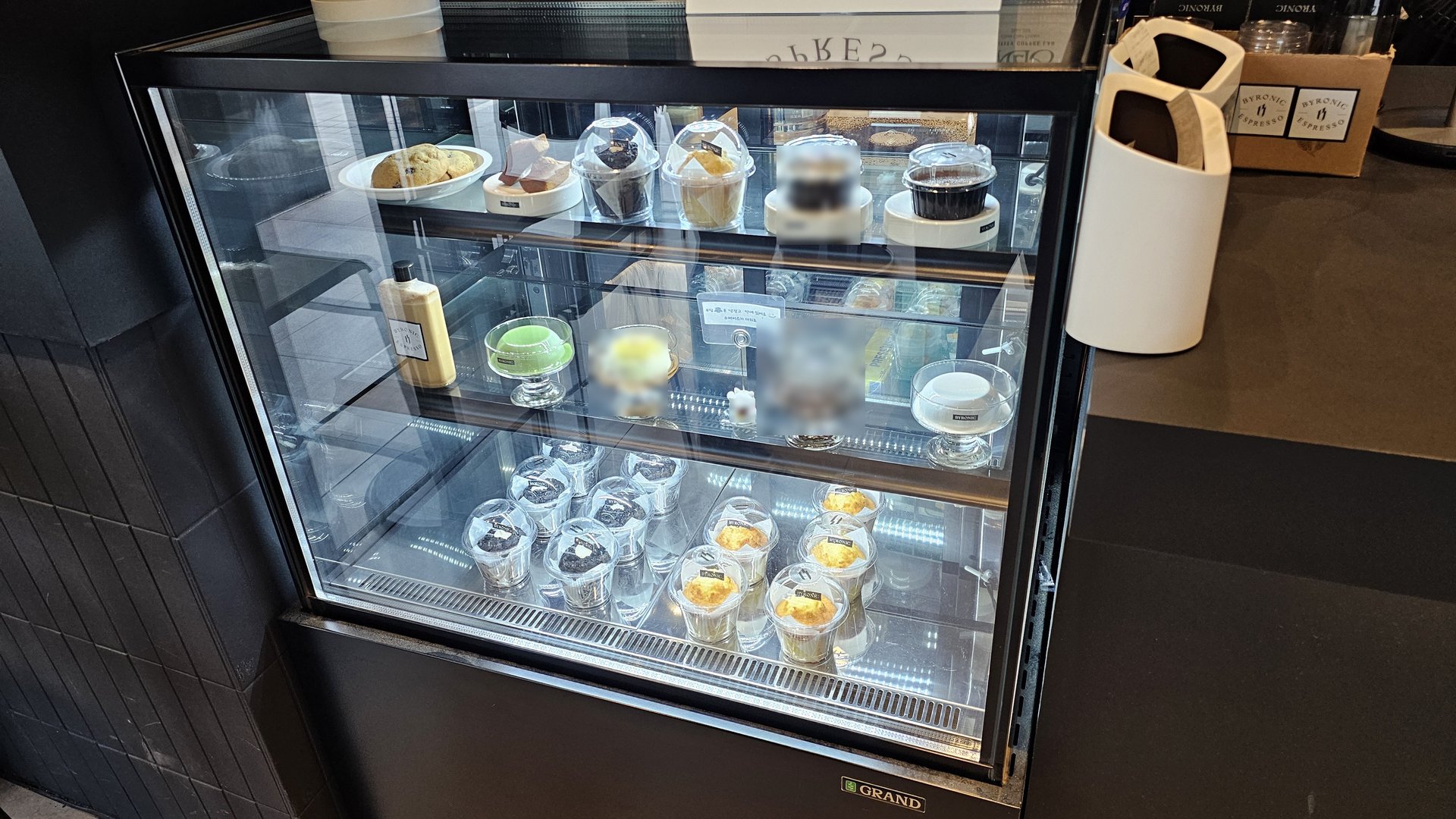
Three-tier glass pastry showcase at Byronic Espresso Yeouido displaying cupcakes, muffins, macarons, and egg tarts
I haven’t tried the Whiskey Latte yet. Curious about it. The Macadamia Latte looks similar to the Yeouido Latte based on the kiosk photo — probably worth trying if macadamia is your thing.
The desserts look solid but I’ve never ordered one. Can’t comment on them.
Stuff Tourists Should Know
Takeout is fast. Even during the lunch rush, drinks come out quickly. Office workers don’t have time to wait.
No vegetarian or vegan issues — it’s a coffee bar. Milk alternatives may or may not be available; worth checking the kiosk.
Seating is there but don’t expect it during peak hours. Tuesday at noon, most tables are taken. If you’re planning to sit and linger, avoid 12–1:30 PM on weekdays.
The neighborhood itself: Yeouido has the 63 Building (a gold skyscraper with an observation deck and aquarium), Yeouido Hangang Park right along the river, and the IFC Mall if you need shopping or a food court. BYRONIC is a good pre-park coffee stop.
For solo travelers: completely fine. Kiosk, grab your drink, go.
For groups: the space can handle it, but the vibe is not group-hang. More of a grab-and-go or work-solo kind of place.
The Verdict
Should you go?
If you’re in Yeouido — yes. It’s one of the better coffee stops in the area and the Yeouido Latte is genuinely a good drink. 6,500 KRW for this quality is fair.
If you’re a tourist with three days in Seoul — tbh, this isn’t a must. Yeouido isn’t the first stop for most visitors. But if you find yourself near the Han River park, it’s worth the detour.
If you take coffee seriously and want to see what Seoul’s specialty espresso scene looks like — yes. BYRONIC is a clean example of what a Korean espresso bar does well.
I’ll keep going back. The Yeouido Latte stays on the regular rotation.
FAQ
What is the Yeouido Latte?
It’s BYRONIC’s signature house latte, named after the Yeouido neighborhood. Iced, served in a black cup, with a coffee grounds topping. Espresso-forward, not too sweet. 6,500 KRW (~$4.80 USD).
Is there English on the menu?
The kiosk is mostly in Korean, but photos and prices make it navigable. Staff speak minimal English, but kiosk ordering means you don’t really need to talk to anyone.
Can I pay with a foreign credit card?
Yes, card payments work at the kiosk. No cash required.
Is there seating?
Yes, on two levels. But avoid weekday lunch hours (12–1:30 PM) if you want a guaranteed seat.
What’s the price range?
Coffee runs 4,500–6,500 KRW (~$3.30–$4.80 USD). Desserts around 6,000 KRW (~$4.40 USD). Reasonable for a specialty espresso bar.
Is it close to the Han River?
Yeouido Hangang Park is about a 10-minute walk. Good pre-walk coffee stop.
Quick honest review of Bricksand Coffee in Yeouido — a Seoul cafe chain built around their signature product: cream-filled sandwich cookies they call “bricks.” If you need a Seoul souvenir that people will actually want to eat, read on.
Short version: I bought two 24-piece gift boxes. This is a re-purchase — the last person I gave these to texted me asking for more. That doesn’t happen with most souvenir food.
What Is Bricksand?
Bricksand (브릭샌드) is a Korean cafe brand that made one bet: build the whole identity around a premium sandwich cookie. The name is literally Brick + Sandwich. Their red brick tile interiors, their logo, their packaging — all of it follows the concept.
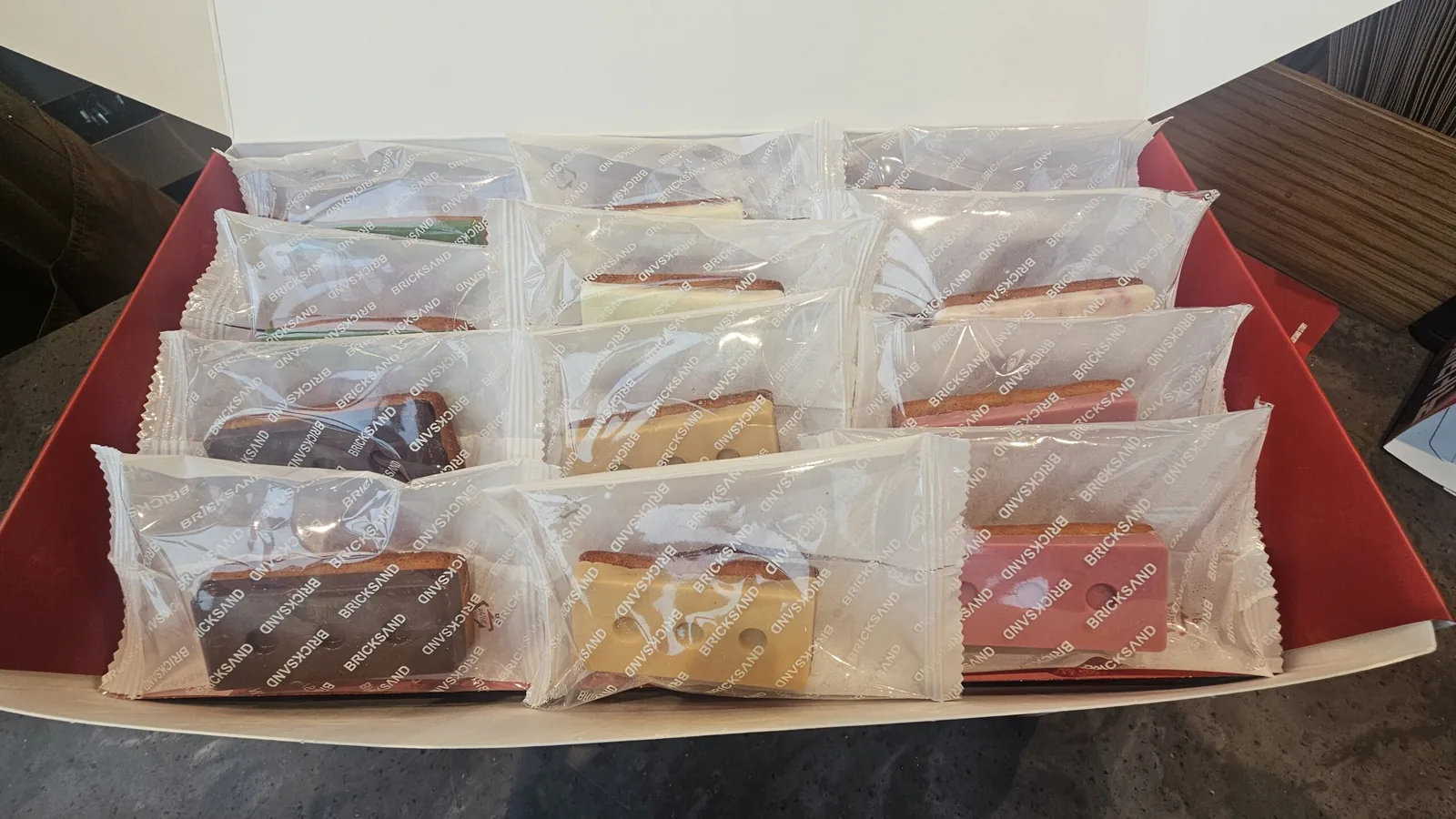
A “brick” here is a cream-filled sandwich cookie. Two thin, crispy biscuit layers with flavored cream in the middle. Roughly the size of a large Oreo, but square-ish and thicker. The biscuit is more like a butter cracker than a chocolate wafer — genuinely crispy, not hollow or stale-tasting. The cream is dense and actually flavored.
They also serve coffee and drinks. Fine, but unremarkable. The bricks are the reason to come.
This isn’t a street food snack or a trendy dessert cafe. It’s closer to a Korean version of a biscuit boutique — think premium cookie shop that also happens to serve lattes.
The Yeouido Location
Yeouido is Seoul’s financial district. The Han River runs along the south edge, and the island is packed with office towers — major broadcast networks (KBS, MBC), financial companies, the National Assembly. Very busy on weekday mornings and lunches; mid-afternoon it quiets down considerably.
I showed up on a Tuesday around 4 PM. The place was calm — maybe 2-3 other customers in the whole space. No wait, no noise. Weekday afternoon is the move if you don’t like crowds.
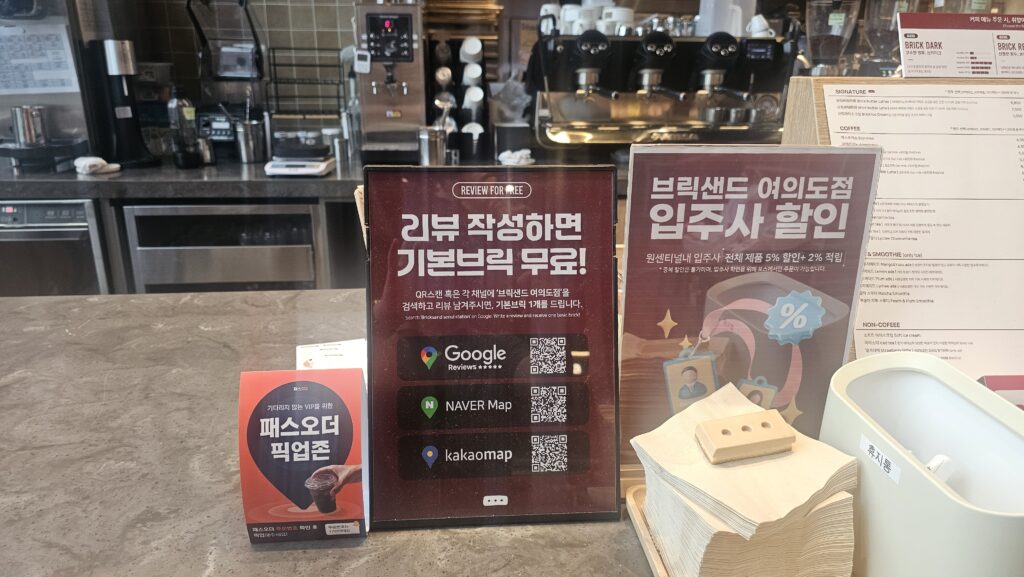
One thing to know: the Yeouido branch partly operates as a building-tenant cafe. Office workers in nearby buildings get a discount. If you’re a tourist, you don’t get that rate. The gift boxes are the same price regardless.
Getting There
Yeouido Station, Line 5 or Line 9. Exit 4 or 5, then about 5-10 minutes on foot.
From main tourist areas:
– Myeongdong → roughly 20-25 min by subway
– Hongdae → 15-20 min
– Gangnam → about 20 min
It’s not in the center of the tourist circuit. But if you’re in Yeouido for any reason — IFC Mall, Han River parks, 63 Building, Yeouinaru Ferry Terminal — adding this stop makes sense.
The Interior
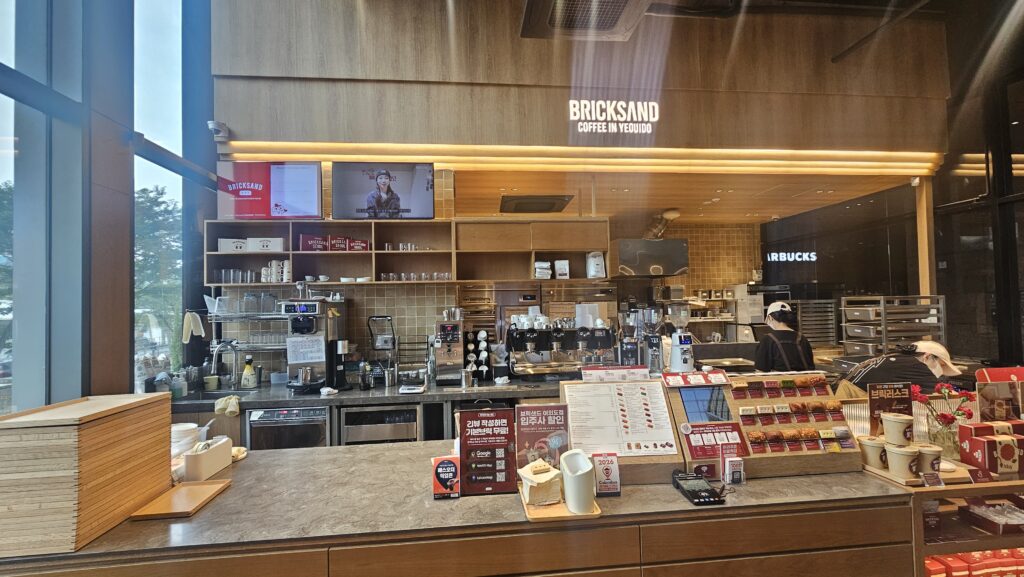
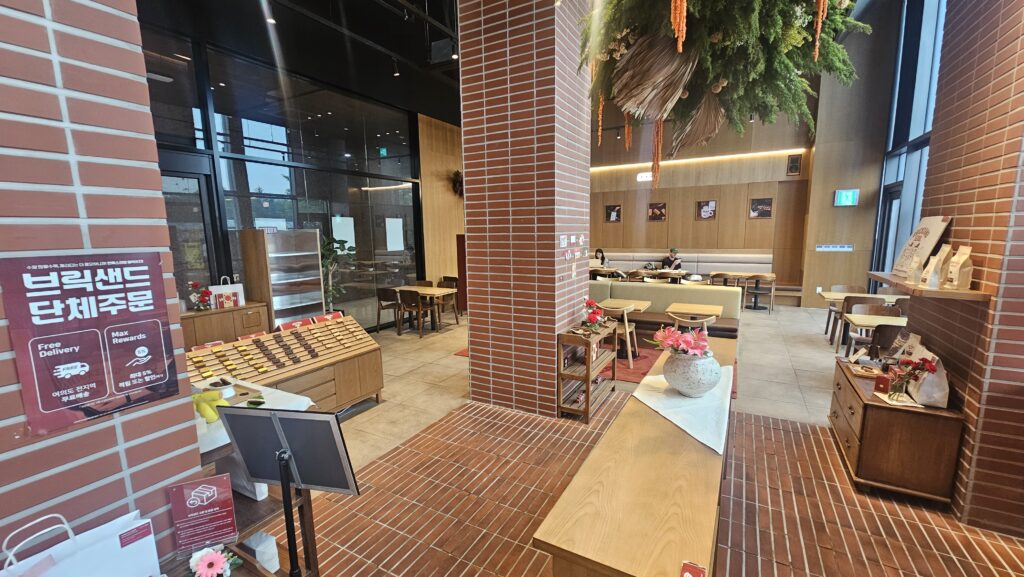
Red brick tile walls. Wood tables. Open kitchen behind the counter. Ceiling with hanging plant decorations.
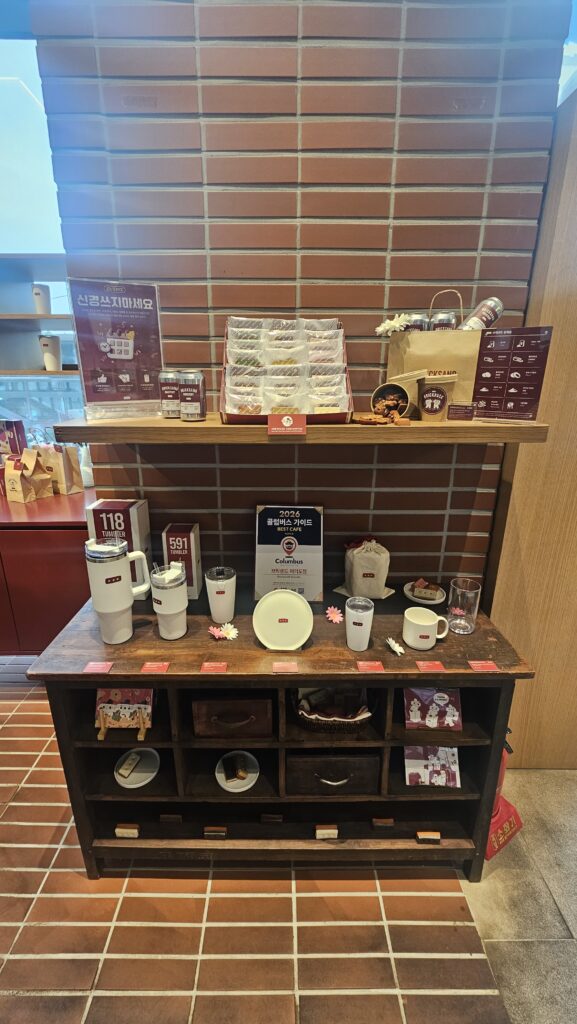
Medium-sized space. Clean, comfortable, not trying too hard. The brick aesthetic is strong but it doesn’t feel like a theme park. Near the entrance there’s a merchandise display with branded tumblers, mugs, and other goods.
Functional and well-designed. Nothing that’ll surprise you, nothing that’ll disappoint.
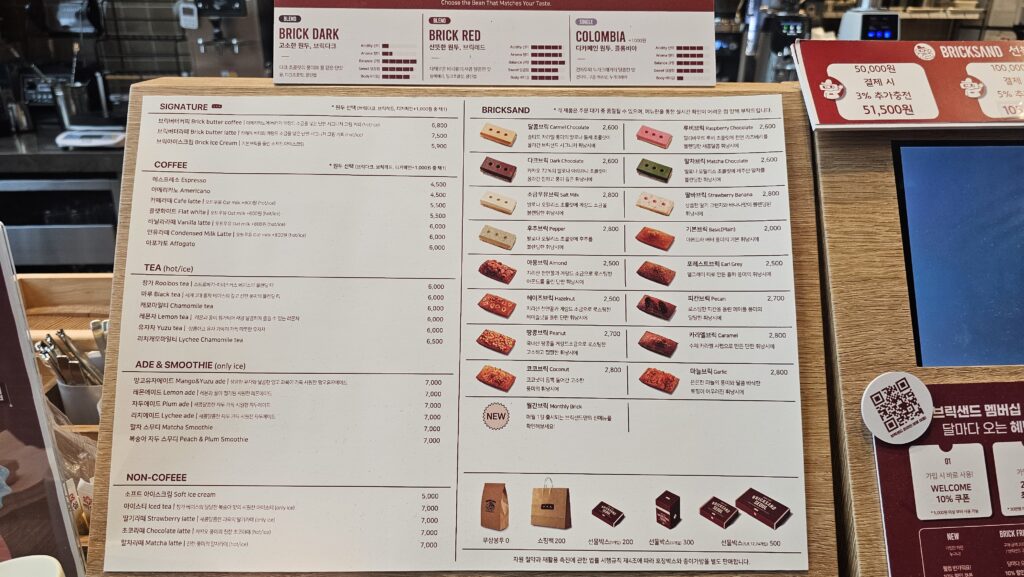
The Bricks: Flavor Breakdown
My 24-piece mixed box came with a range of flavors. Honest takes:
Caramel — Rich, buttery, slight salt edge. One of the better ones. Caramel can go cloyingly sweet done badly. This doesn’t.
Dark Chocolate — Bitter-leaning, not overly sweet. Good if you prefer dark over milk chocolate.
Matcha Banana — Sounds like it shouldn’t work. It does. The matcha cuts the banana sweetness and keeps it from tasting like fake banana candy. This one and caramel are the top two.
Raspberry Chocolate — Tart and sharp. More adult-tasting than the others. Not for everyone, but worth trying.
Strawberry Banana — The most dessert-forward one. Very sweet, very fruity. The pick for people who lean that direction.
Basic (Plain) — Buttery vanilla cream. Underrated. Don’t skip it. This is the clearest example of what the brick actually is without distractions.
If someone handed you one without the packaging, you’d think it was from a real bakery. Not a cafe chain. That’s the baseline here.
The Gift Box
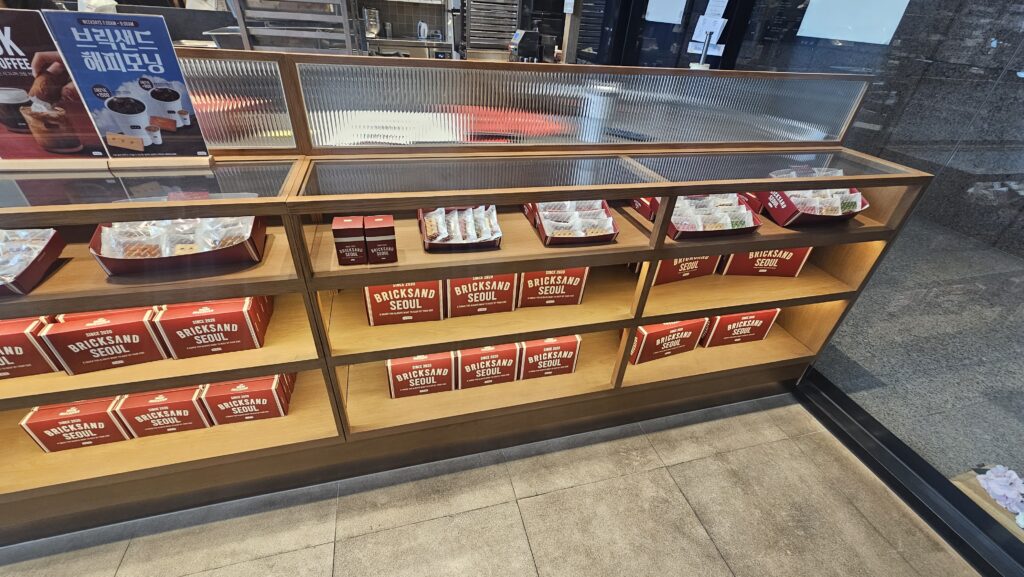
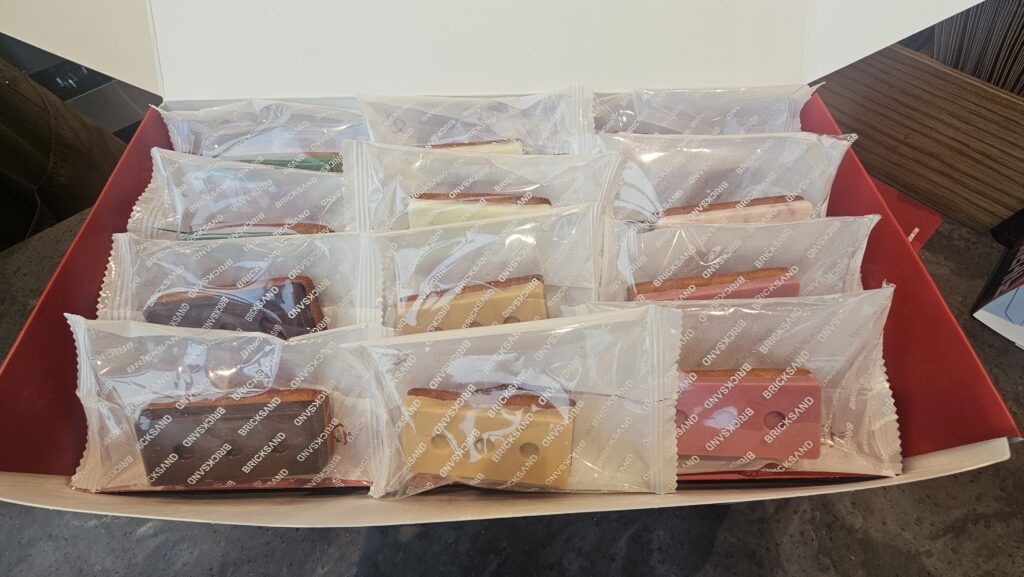
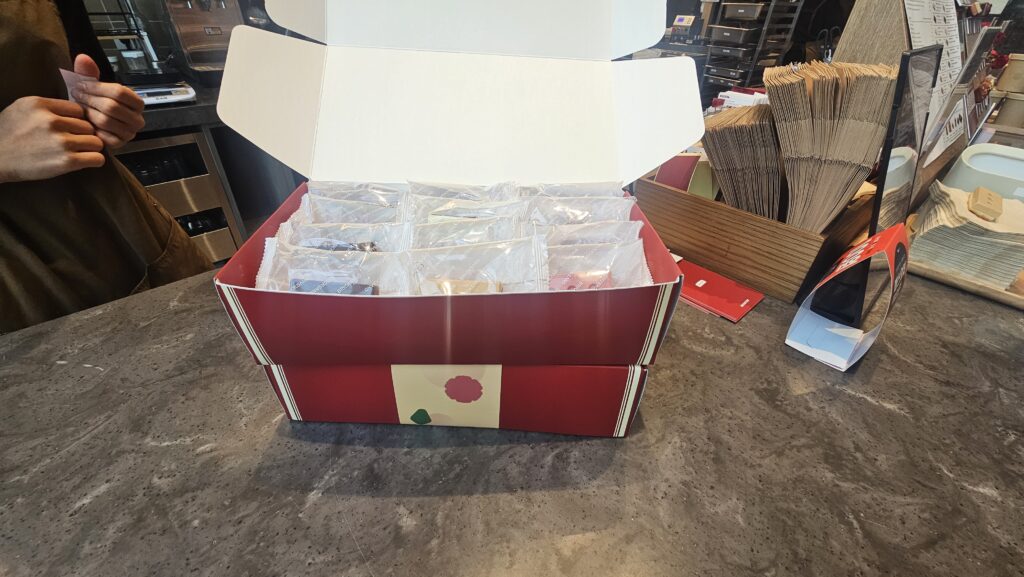
The gift box is the point for souvenir purposes. Red box, ribbon, individually wrapped bricks inside. The 24-piece version fills the box without looking sparse. Each brick wrapped separately keeps them from crumbling into each other.
The packaging is actually good. Not “good for a cafe chain” good — genuinely presentable as a real gift. The box opens cleanly, photographs well, and looks like thought went into it. That last part matters when you’re giving it to someone.
Prices are posted on the in-store menu board — check there for current gift box sizes and rates.
Why I Re-Bought
I don’t usually re-buy souvenir food. Most of it tastes like the packaging it comes in. You give it to someone, they say thanks, and it sits on a desk for two weeks until someone eats it out of obligation.
This was different. The person I gave Bricksand to last time texted me specifically asking if I could get more. That was the entire reason for this visit — an unprompted re-buy request. When someone asks for a second round without being nudged, the product is doing its job.
Their favorites were the matcha banana and dark chocolate. That tracks with what I think too. Those two have a slightly firmer cream and more defined flavor than the others.
Stuff Tourists Should Know
English: Limited at this branch. Menu boards and packaging have English labels. Pointing works fine.
Card payments: Korean cafes generally accept foreign cards (Visa, Mastercard). Should be fine here — confirm before ordering if you’re unsure.
No tipping: Korea doesn’t tip. Don’t leave coins on the counter.
Shelf life: The bricks are shelf-stable for several weeks. Fine for carrying home from a trip. Check individual packaging for exact dates.
As a souvenir: Genuinely one of the better Seoul food gift options. Better than airport candy or convenience store snacks. The packaging looks intentional without being over-engineered.
Dietary restrictions: The bricks contain dairy and wheat. No halal or vegetarian-specific labeling I noticed. Check individual packaging for allergen details if you’re buying for someone with restrictions.
Pass Order: They use a Korean mobile pre-order app. Not worth setting up for a one-time visit.
Tenant discount: Applies to workers in nearby office buildings. Tourists don’t qualify.
The Verdict
Go out of your way for this? Only if you specifically need a solid Seoul food gift.
But if you’re in Yeouido for any reason — IFC Mall, the Han River parks, 63 Building — stopping here is worth it. The gift box is the real deal. The bricks taste like what they’re supposed to taste like. Rarer than it sounds for souvenir food.
– Already in Yeouido: Yes. Stop here.
– Need a Seoul souvenir gift: A dedicated trip is reasonable. Not a long one.
– Just want coffee: Fine, but this isn’t a coffee destination. Come for the bricks.
– Tight on luggage space: The 24-piece box is bigger than it sounds. Plan ahead.
FAQ
Are these just fancy Oreos?
Not really. The biscuit is closer to a thin butter cracker than a chocolate wafer. The cream flavors are distinct and not just sweet filler. Similar format to an Oreo — everything else is different.
How long do the bricks last?
Check the packaging, but shelf-stable for a few weeks at room temperature. Fine for carrying home.
Is the cafe worth visiting just for coffee?
Probably not. Coffee is fine but not a reason to make the trip. Come for the bricks.
Can I customize the gift box flavors?
You can try individual pieces at the counter before committing to a box. Ask about custom assortment options — may depend on the day’s stock.
What are the best flavors?
Matcha banana and dark chocolate are the standouts. Caramel is also strong. The plain one is underrated. Strawberry banana is for people who like things very sweet.
Is it comfortable for solo visitors?
Fine. Quick purchase, no awkwardness. Order, pay, leave with a red box.
Do they ship internationally?
Not sure about current options. Buying in person is the most reliable. Ask at the counter.
 Close-up of Byronic Espresso signature iced latte with white milk layer topped with coffee crumble crust