Tag: yeouido

  • Guigui Yeouido: Honest Review of Korean Grilled Mackerel

    Guigui Yeouido: Honest Review of Korean Grilled Mackerel

    Quick honest review of Guigui (구이구이) in Yeouido. Short version: it’s a place I keep coming back to. The grilled mackerel is solid, the side dish spread is generous, the al-tang warms you up properly, and there’s an eggplant tempura hiding in the banchan that’s quietly the best thing on the table.

    Went with one other person. Ordered one grilled mackerel and one al-tang. Shared everything.

    What Is Guigui?

    Guigui (구이구이) literally means “grill grill” in Korean. The name is exactly what it is: a grilled fish restaurant. Not a fusion concept, not a themed dining experience. Fish, grilled, served with rice and a table full of side dishes.

    In Korea, this kind of meal works on a set format. You order one main dish — in this case, a whole grilled fish — and the restaurant brings out banchan (반찬), a spread of small complimentary side dishes. Could be 8, could be 12. You don’t order them. They just show up. No extra charge.

    For anyone used to à la carte dining: the side dishes are included. You’re welcome.

    Where It Is

    Yeouido. Seoul’s financial district — think Canary Wharf in London or the lower Manhattan area in New York, but the lunch spots are genuinely better. It’s home to the National Assembly, KBS and MBC broadcasting headquarters, and a dense cluster of office towers.

    Getting there:

    – From Myeongdong: ~25 minutes by subway (Line 5)

    – From Hongdae: ~20 minutes (Line 2 transfer to Line 5)

    – From Gangnam: ~30 minutes (Line 9)

    Yeouido Station exits on both Line 5 and Line 9. The restaurant is an easy walk from there.

    This is not a tourist-heavy area. You’re eating where Seoul office workers eat, which is most of the appeal.

    The Interior
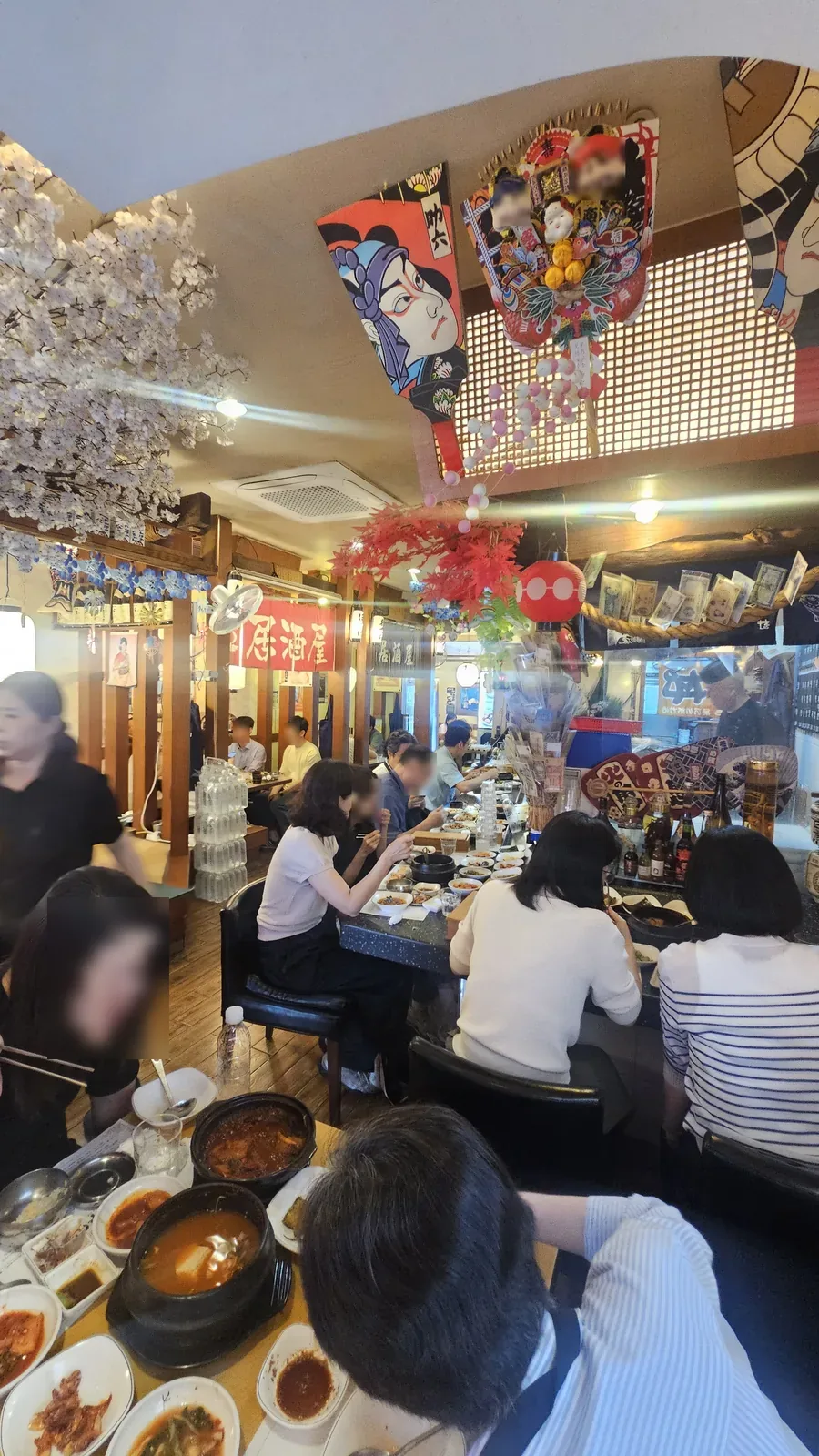
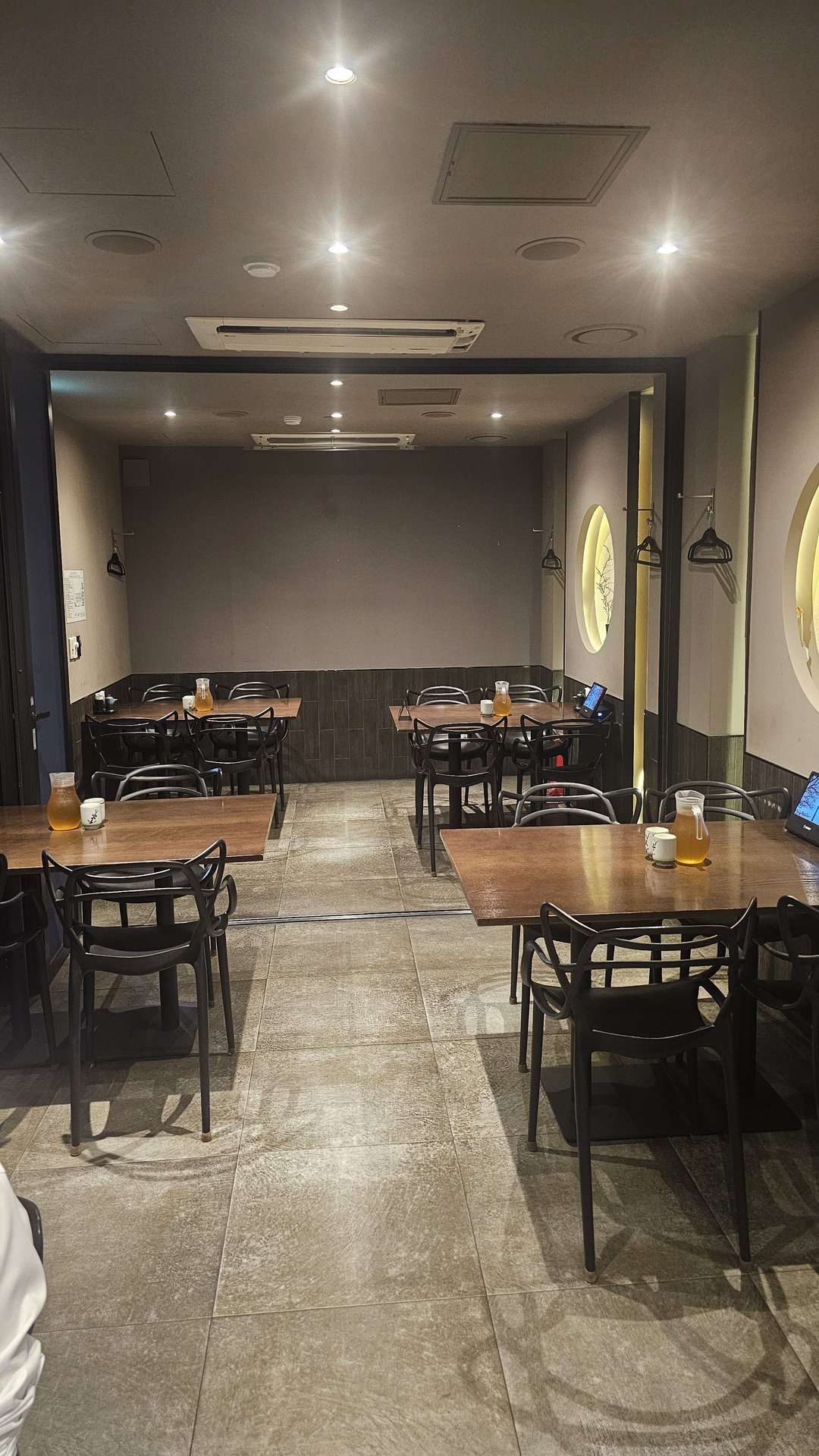
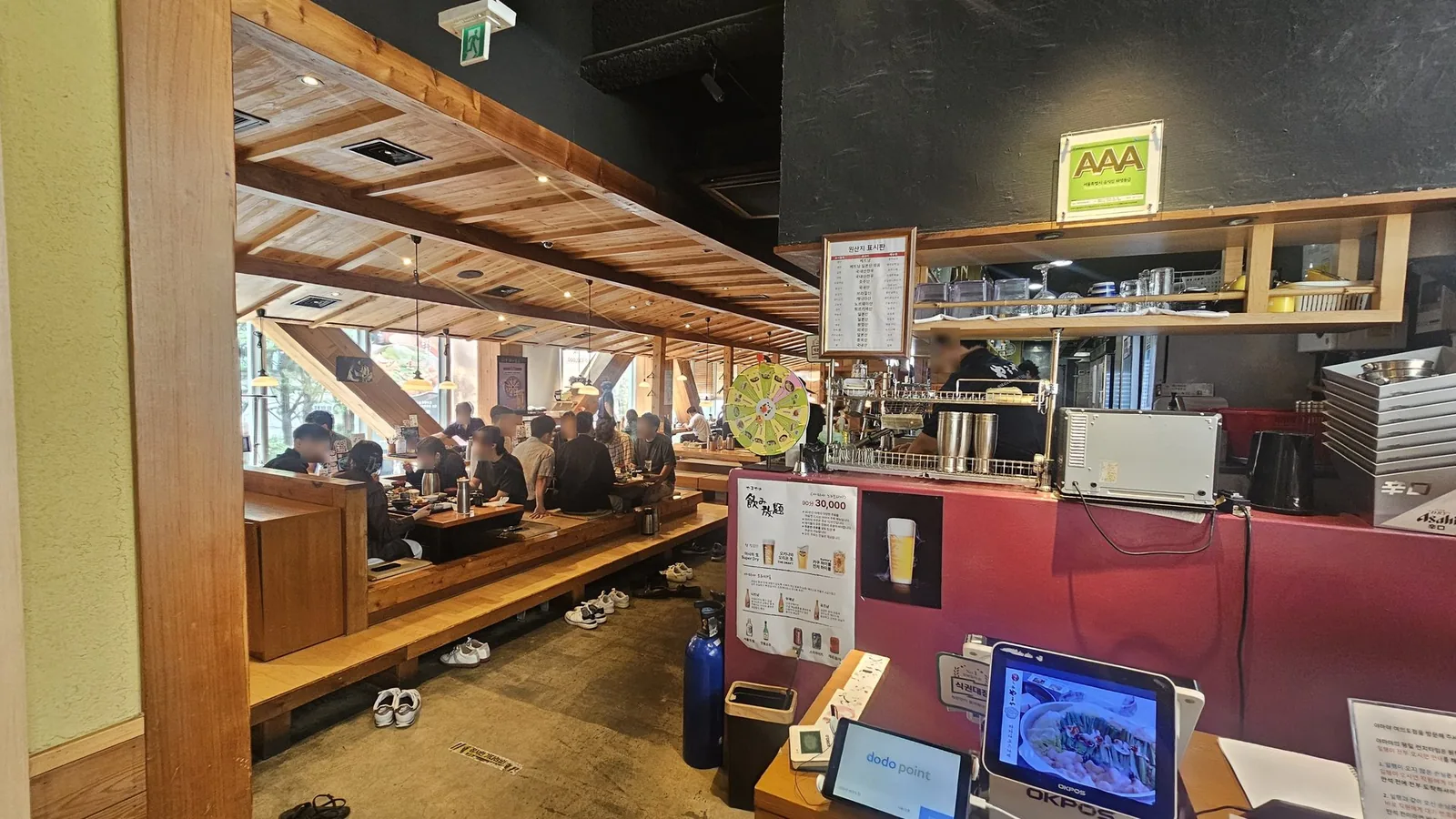
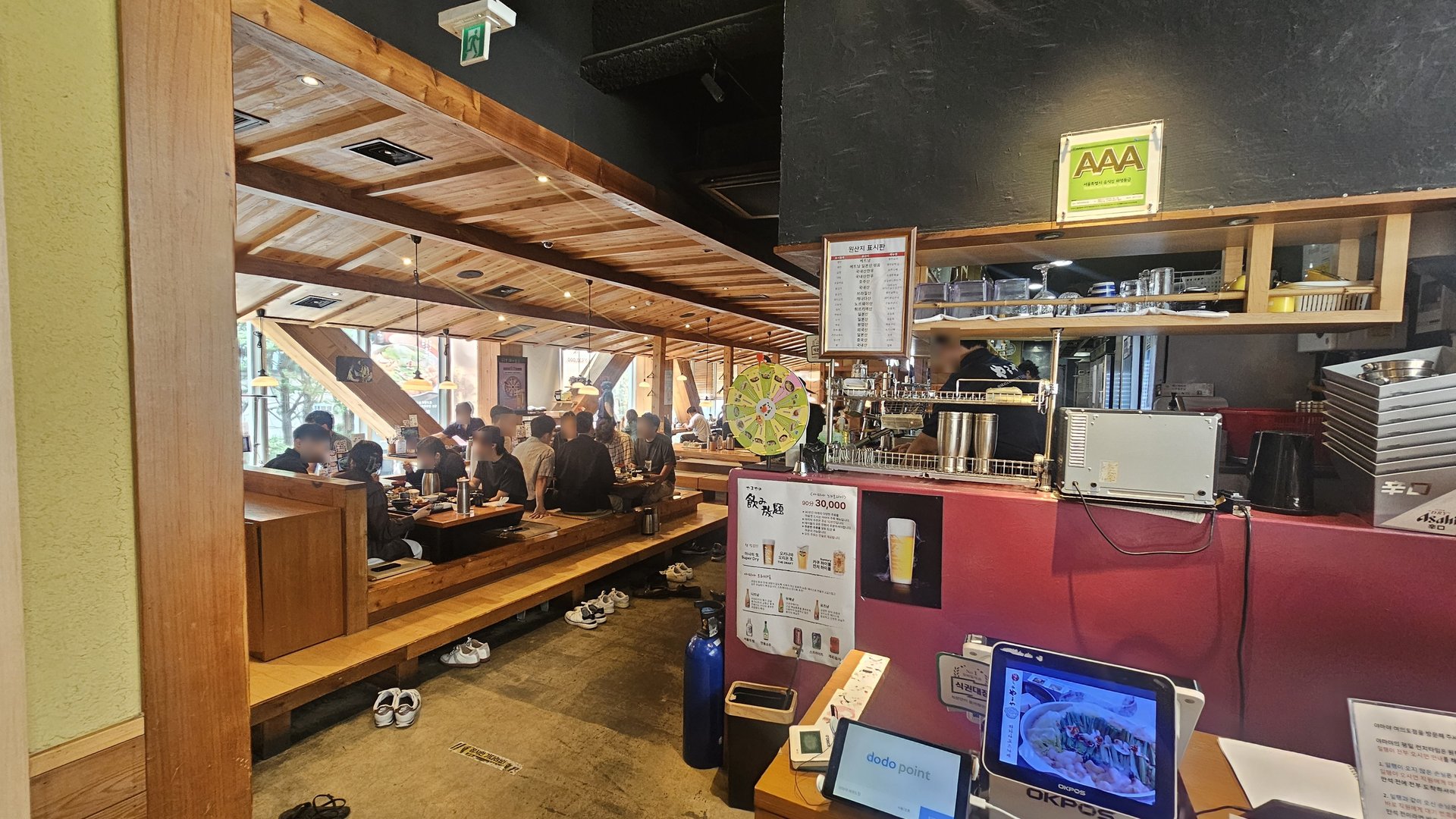
    Busy lunch crowd inside Guigui Yeouido with izakaya-style interior decor fully packed
    Busy lunch crowd inside Guigui Yeouido with izakaya-style interior decor fully packed
    Interior wall of Guigui Yeouido decorated with cherry blossom branches, paper lanterns, and retro TUNA advertising poster
    Interior wall of Guigui Yeouido decorated with cherry blossom branches, paper lanterns, and retro TUNA advertising poster
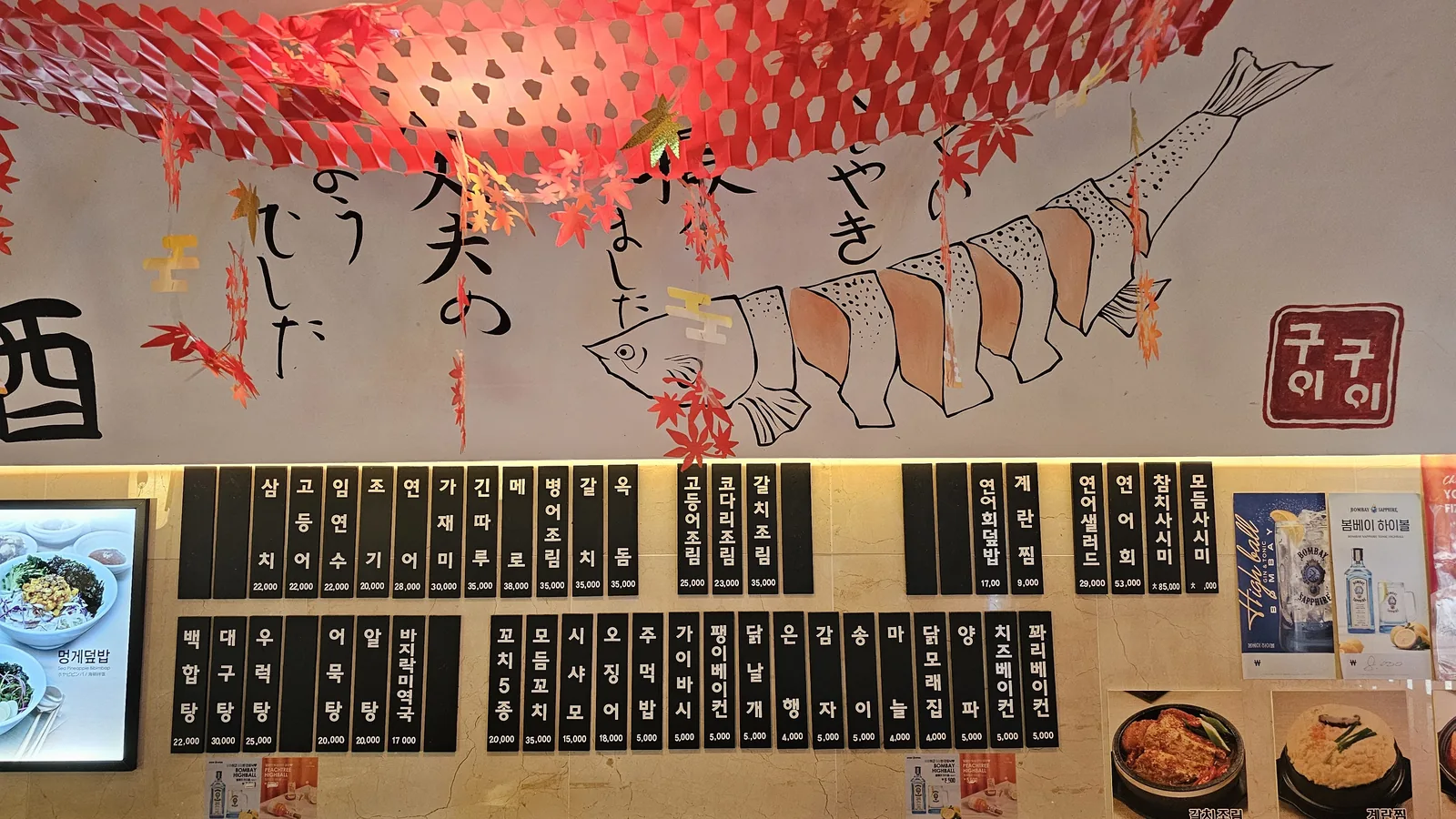
    Chalk menu board on ceiling at Guigui Yeouido with autumn leaf and fish motif decorations
    Chalk menu board on ceiling at Guigui Yeouido with autumn leaf and fish motif decorations

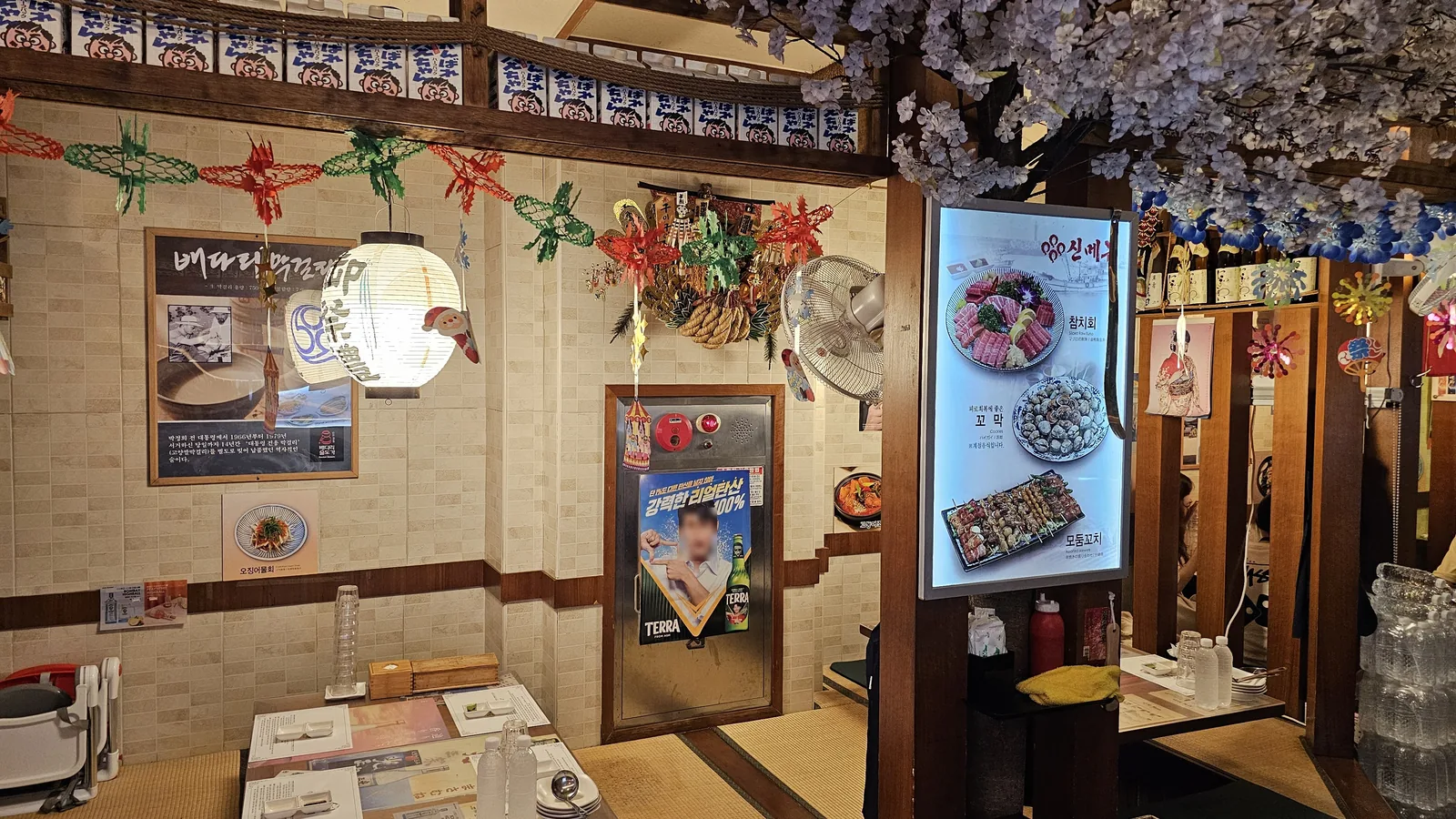
    Not what you’d expect from a grilled fish restaurant. There are paper lanterns hanging from the ceiling, cherry blossom branches on the walls, chalk menus written on wooden boards up top, and retro-style advertising posters — one reads “TUNA” in old-school graphics. Some tables have digital display boards. It reads like an izakaya (Japanese pub) that got reimagined by someone who really loves Korean fish markets.

    A lot of character. Chaotic in a good way.

    We visited at lunch and it was completely packed. Every table taken, steady noise level, quick turnover. This is not a lingering-over-coffee type of place.
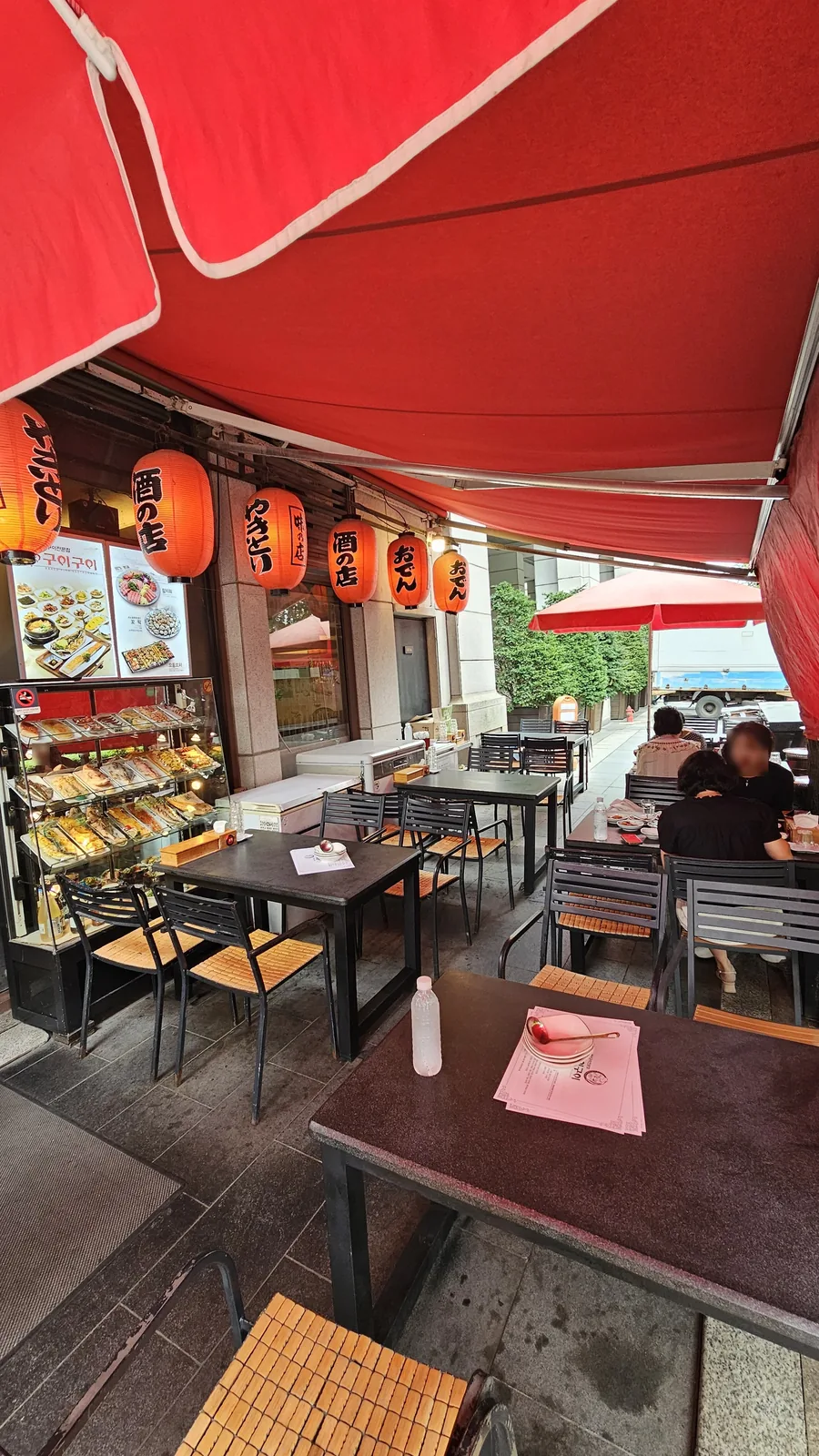
    Outdoor terrace seating at Guigui Yeouido with red awnings and orange paper lanterns
    Outdoor terrace seating at Guigui Yeouido with red awnings and orange paper lanterns
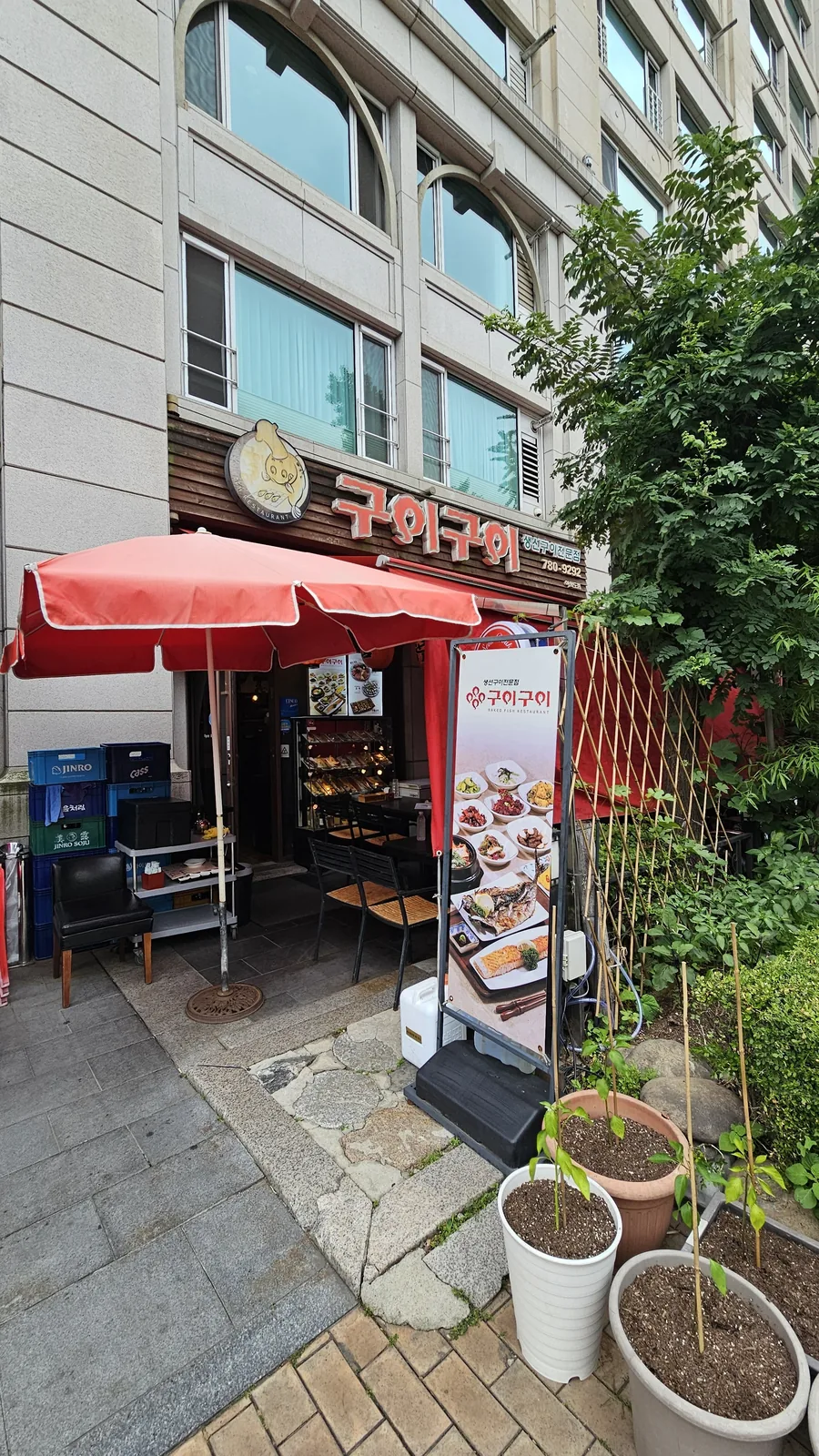
    Exterior facade of Guigui Yeouido in Yeouido Seoul showing red awning and terrace seating during daytime
    Exterior facade of Guigui Yeouido in Yeouido Seoul showing red awning and terrace seating during daytime

    Outside there’s a terrace with bar-style seating along the building face, red awnings, and orange paper lanterns. On a decent weather day, worth grabbing a spot out there.

    The Menu
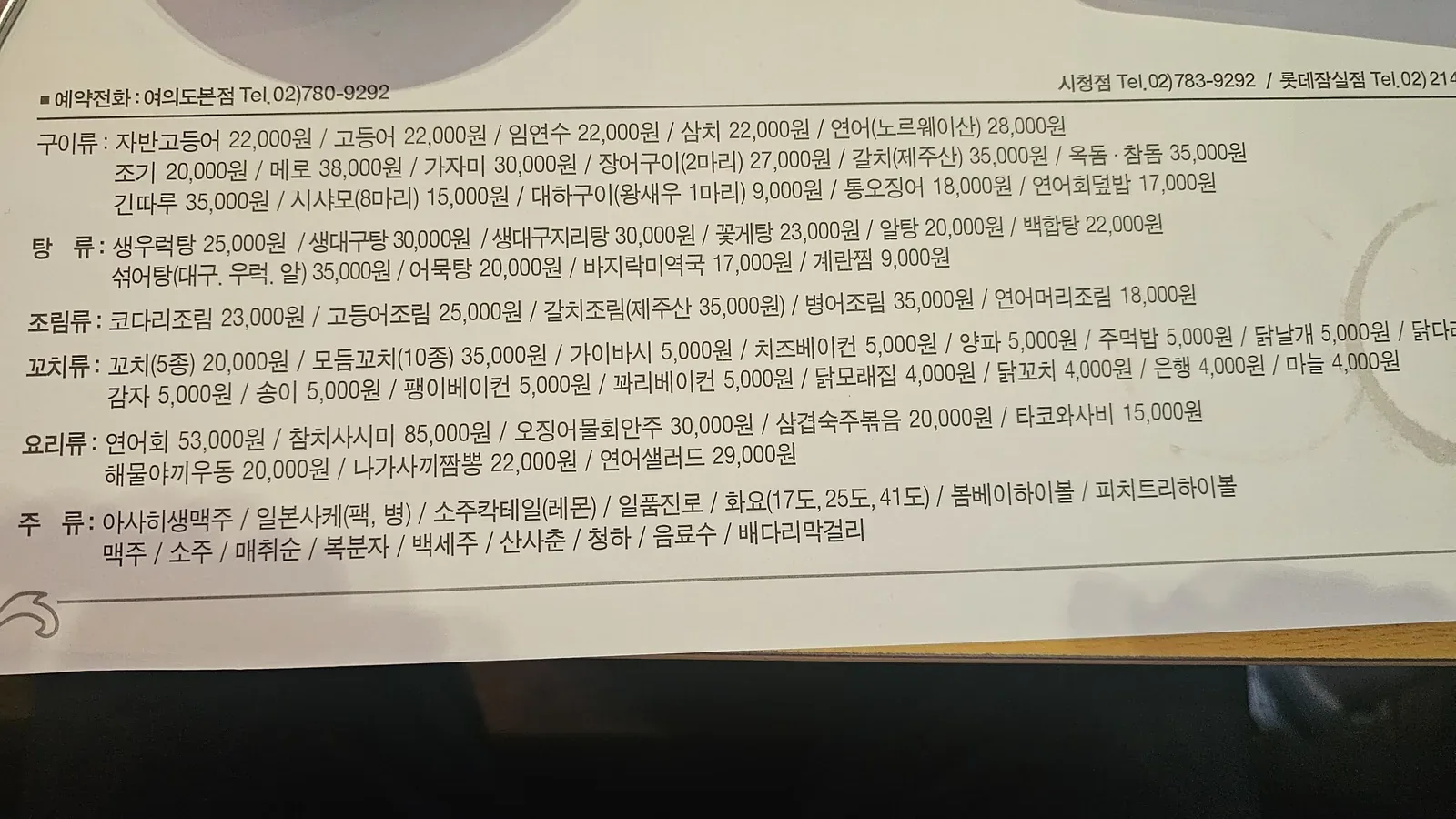
    Main items on the grilled fish side:

    – 고등어구이 (Grilled mackerel): 22,000 KRW (~$16)

    – 자반고등어 (Salt-cured mackerel): 22,000 KRW (~$16)

    – 장어구이 (Grilled eel): 27,000 KRW (~$20)

    – Plus salmon, cutlassfish, and others depending on availability

    There are also stews (탕류) and skewers. We went with the mackerel and al-tang.

    What We Ordered
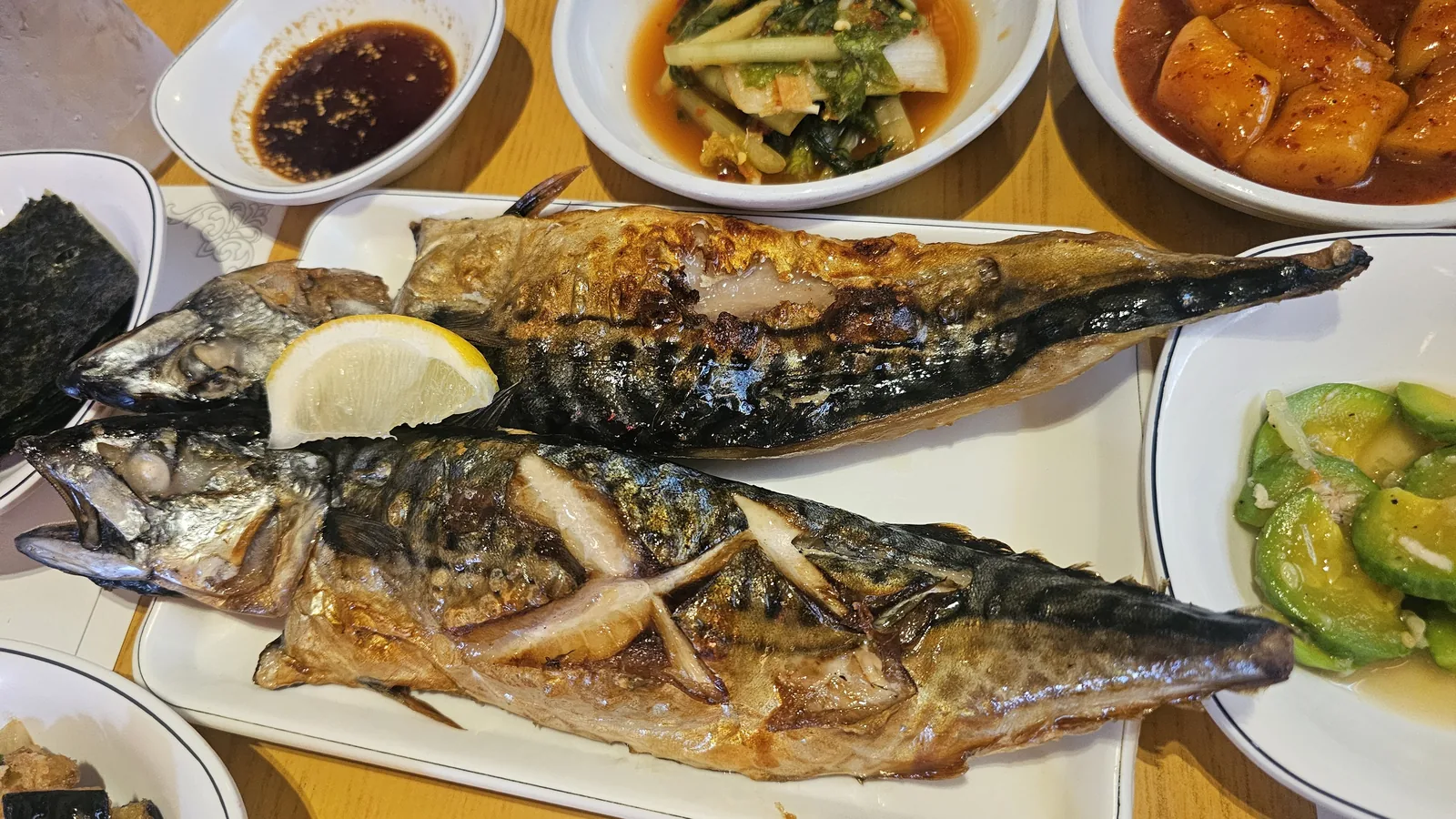
    Two whole grilled mackerel with lemon slices at Guigui Yeouido, crispy golden skin close-up
    Two whole grilled mackerel with lemon slices at Guigui Yeouido, crispy golden skin close-up

    Grilled mackerel (고등어구이) — 22,000 KRW (~$16)

    The mackerel comes whole. Two fish, skin-on, grilled until the surface blisters and the skin tightens up. Lemon wedge on top. That’s it.

    Mackerel has a stronger, oilier flavor than white fish. If you’ve had grilled fish at a Korean home or a neighborhood diner, you know the taste. Guigui’s version is well-executed — the skin is properly crispy without being dry, the flesh pulls apart in clean flakes, and the fat stays in the fish where it belongs.

    It’s not a fancy plate. It doesn’t need to be.

    If you’ve never had whole grilled mackerel before: the bones run through the center of the fish. Use your chopsticks or a spoon to pull the flesh from the spine and ribs. Slightly fiddly, completely worth it.
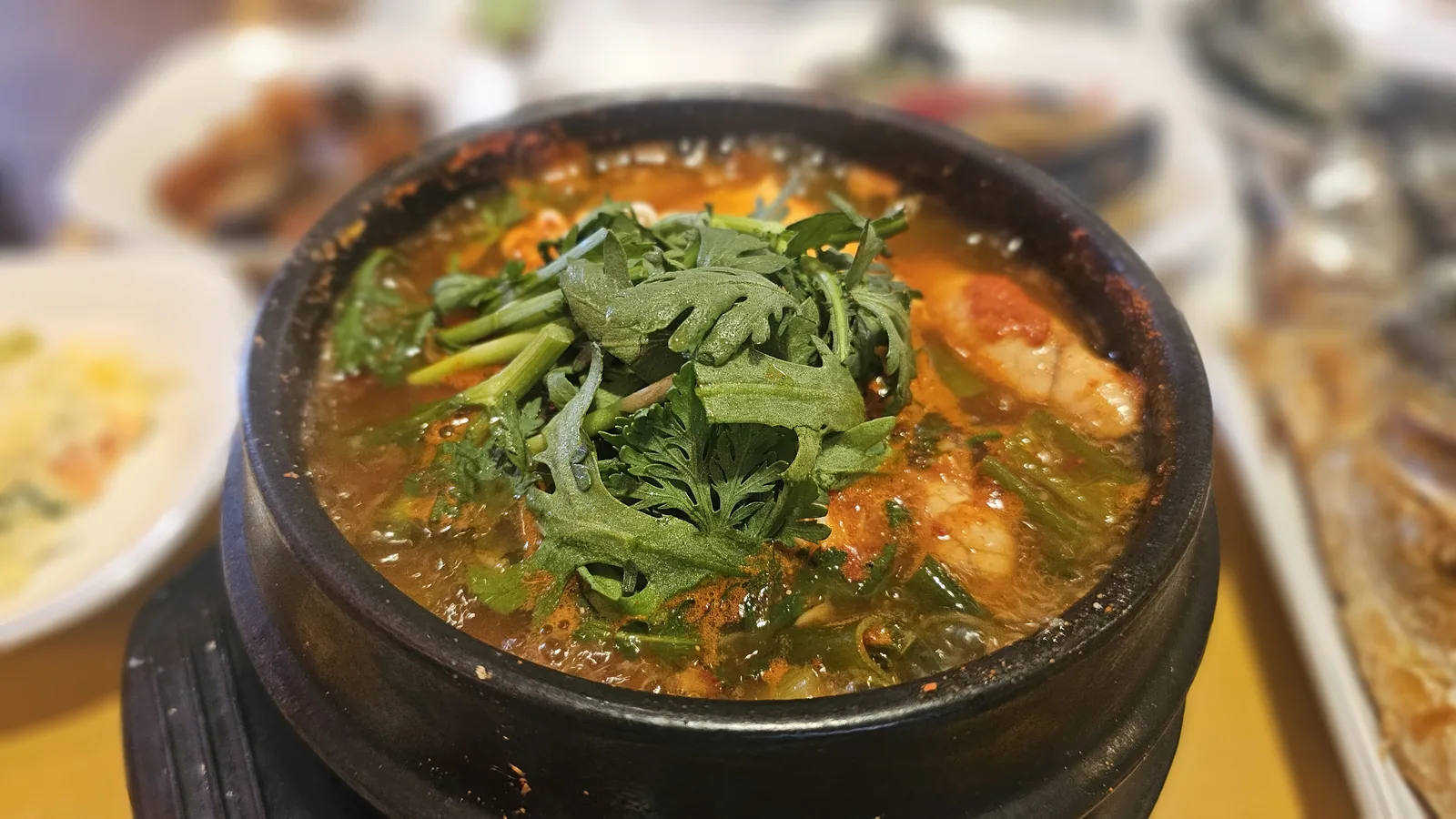
    Spicy fish stew in earthenware pot at Guigui Yeouido garnished with green onions and water parsley
    Spicy fish stew in earthenware pot at Guigui Yeouido garnished with green onions and water parsley

    Al-tang (알탕) — roughly 15,000–18,000 KRW (~$11–$13)

    Al-tang is a spicy stew made with fish roe — typically pollock roe. Red broth, heavy on the heat, piled with water parsley (미나리) and green onions. It comes in an earthenware pot (뚝배기) that holds the heat for a long time.

    If spicy food is not your thing, skip this and order a milder stew. If it is your thing — this is exactly the kind of Korean stew that makes you want to keep scooping more rice into it. The roe has a slightly firm texture, not mushy. The broth is deep and rich from the seafood base.

    Good call. Would order again.

    The Side Dishes
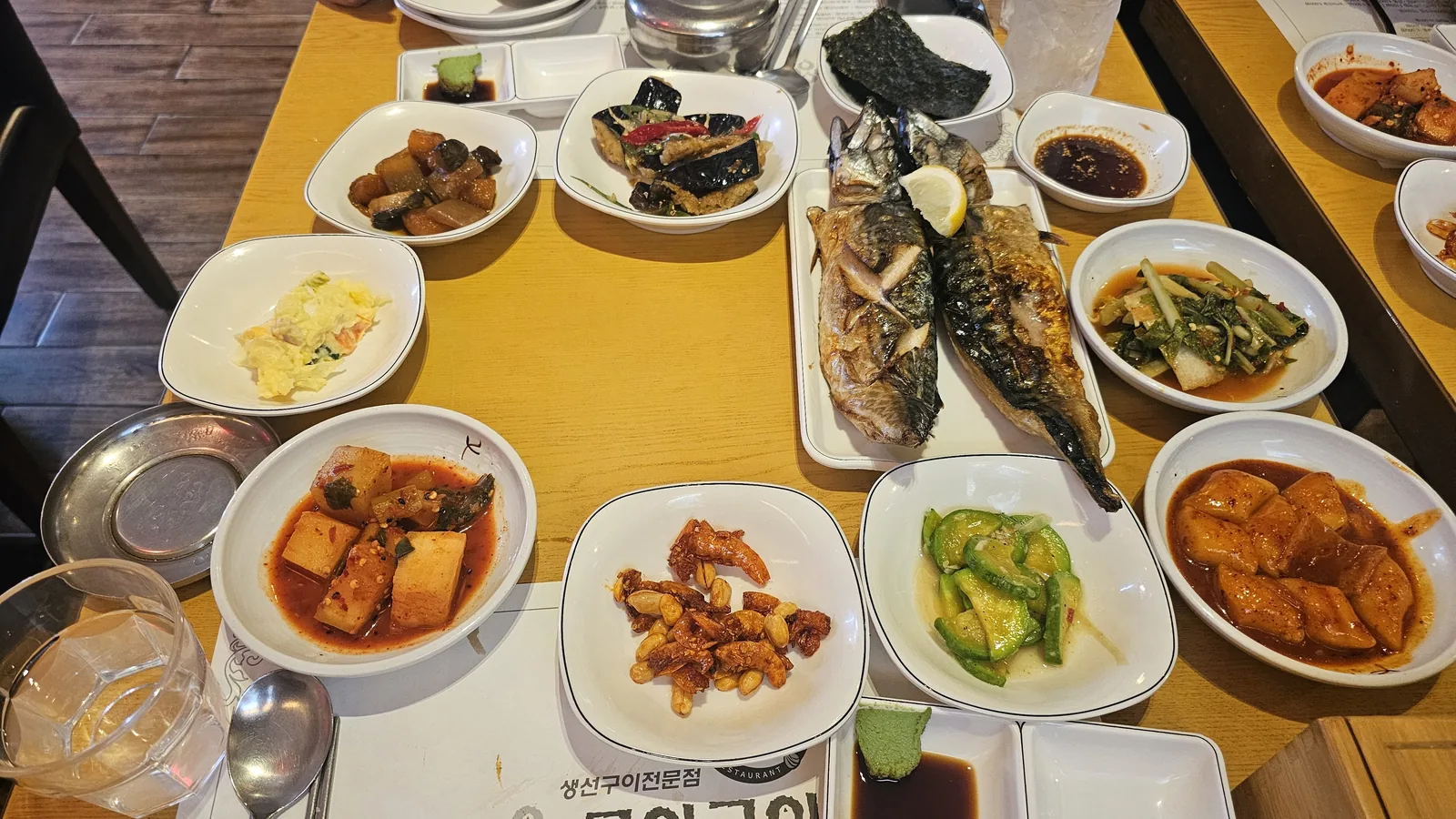
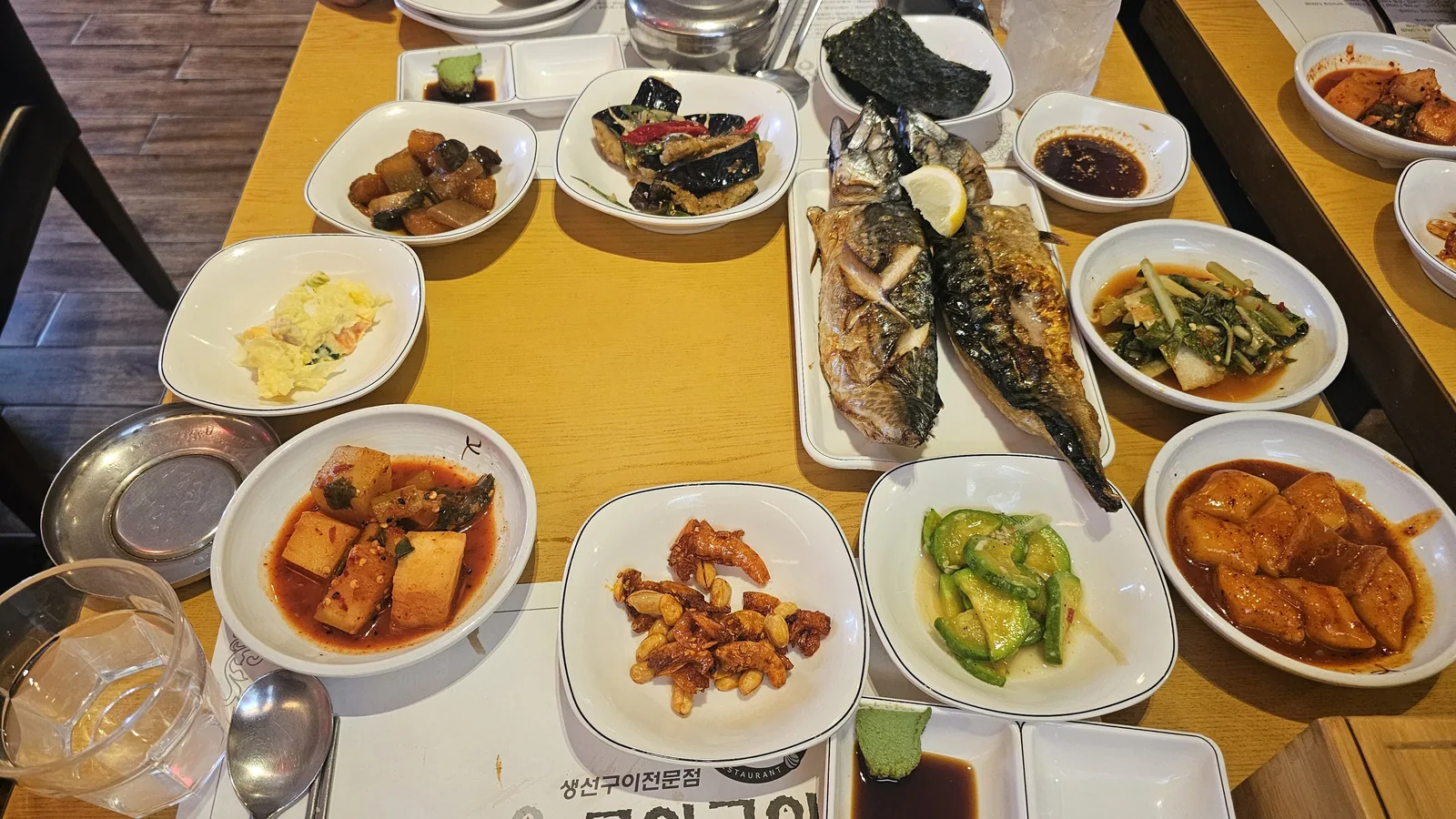
    Full Korean grilled fish set at Guigui Yeouido with two whole mackerel and over ten side dishes covering the table
    Full Korean grilled fish set at Guigui Yeouido with two whole mackerel and over ten side dishes covering the table

    This is honestly where Guigui earns its regulars.

    When the main arrived, the table filled up fast. We counted well over ten side dishes: roasted seaweed, egg roll (계란말이), acorn jelly (도토리묵), radish kimchi (깍두기), cucumber salad, braised tofu, anchovy stir-fry, something tteokbokki-adjacent, avocado salad, and a few others I didn’t catch the names of.

    Standard lineup for this style of restaurant. But then there was the eggplant tempura (가지튀김).

    I wasn’t expecting much from it. It’s one small plate among a dozen others. But — eggplant, battered lightly, fried without getting greasy, soft on the inside. I ate most of it before even getting to the mackerel.

    If you’re at Guigui and the eggplant tempura shows up on your table, don’t ignore it.
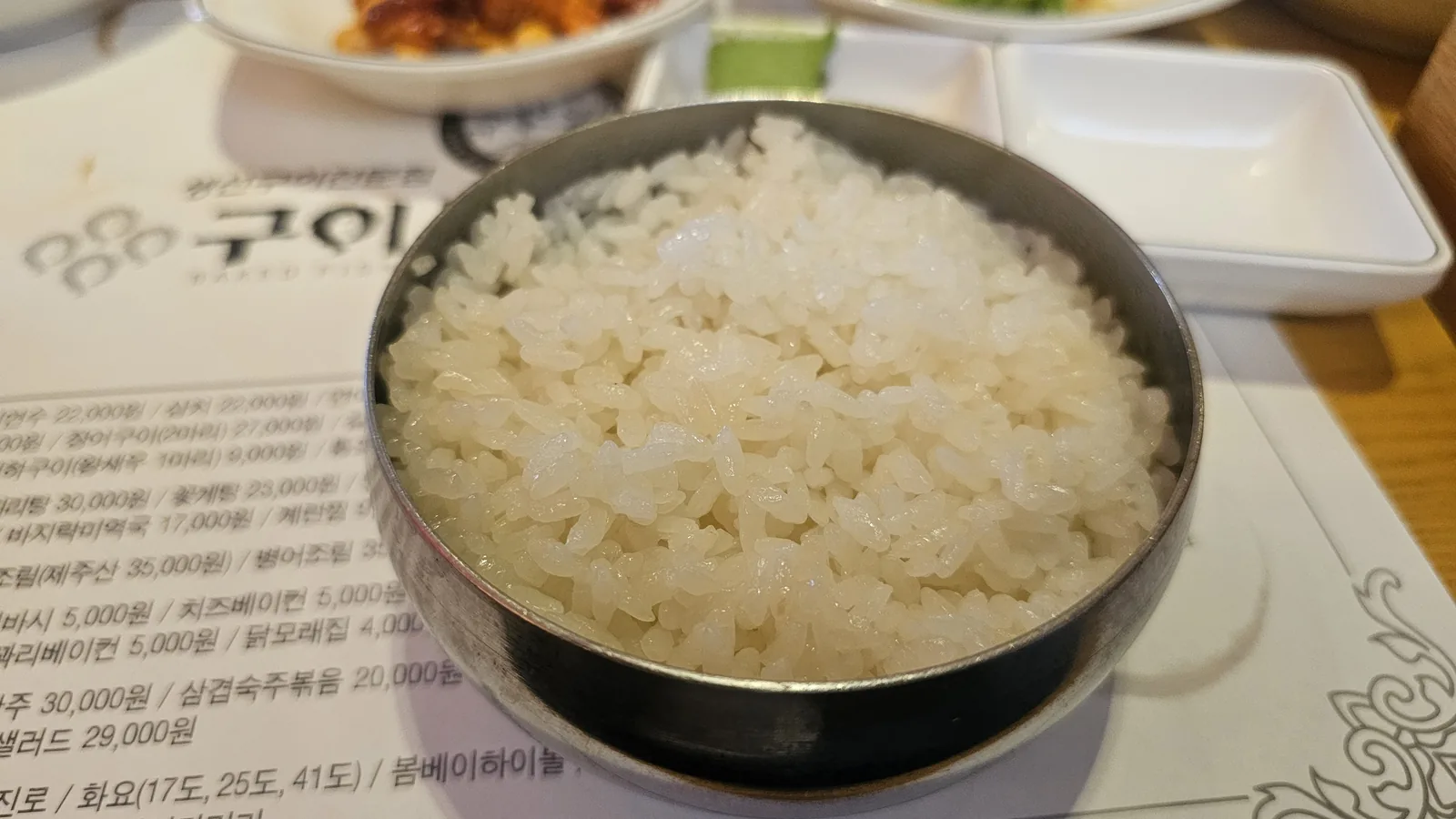
    Steel bowl of white rice at Guigui Yeouido with menu board visible in the background
    Steel bowl of white rice at Guigui Yeouido with menu board visible in the background

    Rice comes in the standard steel bowl. At most Korean restaurants of this type, you can ask for refills — just flag down the staff and point at the bowl.

    Stuff Tourists Should Know

    Language: Menu boards are in Korean only. The photo menus on the wall help significantly — pointing and holding up fingers gets the order done. Don’t stress it.

    Payment: Card payment is standard across Yeouido. Foreign Visa and Mastercard cards generally work at Korean terminals. Keep a little cash on hand as backup.

    Tipping: There is no tipping culture in Korea. Don’t leave money on the table expecting it to be kept as a tip — it may just create confusion.

    Spice: Grilled mackerel is not spicy. Al-tang is spicy. If you want a milder stew option, ask about 대구지리탕 (daegu jiri-tang, mild cod stew) if it’s available. Or just skip the stew and focus on the fish.

    Vegetarian options: Minimal. This is a fish-forward restaurant. Most banchan contain anchovy broth, dried fish, or small seafood. Not a good pick for vegetarians.

    Halal: Not halal-certified.

    Timing: Lunch rush is serious. Arrive before 11:30 AM or after 1:30 PM if you want to walk in without a wait.

    Who this is for: People who eat at the same place more than once. Office workers, Yeouido regulars, anyone building a mental list of reliable Seoul lunch spots. Not a special occasion restaurant. A very good everyday restaurant.

    The Verdict

    Should you go?

    If you’re in Yeouido for any reason — yes. The grilled mackerel is properly done, the banchan spread is more generous than most, the al-tang delivers, and the eggplant tempura is a genuine bonus. Prices land around 18,000–25,000 KRW (~$13–$19) per person, which is fair for what you get.

    If you’re a tourist with three days in Seoul — probably not your first stop. Yeouido isn’t on the typical tourist circuit, and good grilled fish exists across Seoul. But if you’re already heading to Yeouido — Han River Park is nearby, IFC Mall is close, 63 Building is a short distance — it’s worth making Guigui your lunch plan.

    It’s the kind of place you eat at once, remember, and come back to. That’s a good sign.

    FAQ

    What is the must-order dish at Guigui Yeouido?

    The grilled mackerel (고등어구이, 22,000 KRW / ~$16). It comes whole, skin-on, with rice and 10+ complimentary side dishes included. Also check if eggplant tempura shows up in your banchan — it’s genuinely good.

    How much does a meal at Guigui Yeouido cost per person?

    Around 18,000–25,000 KRW (~$13–$19 USD) per person depending on what you order. Grilled mackerel is 22,000 KRW, eel is 27,000 KRW.

    Is Guigui packed at lunch? Should I make a reservation?

    Yes, very packed on weekdays. Aim to arrive before 11:30 AM or after 1:30 PM. Check their official social media for reservation options — walk-ins work but you may wait.

    Does Guigui Yeouido have an English menu?

    The main menu boards are in Korean. The photo menus on the walls help a lot — pointing and holding up fingers gets the job done. Staff won’t speak much English but orders go through fine.

    Is the food at Guigui spicy?

    The grilled fish itself is not spicy. The al-tang (fish roe stew) is spicy. If spice is a concern, stick to grilled fish and plain rice.

    Can I pay by card at Guigui Yeouido?

    Most restaurants in Yeouido accept card including foreign Visa and Mastercard. Keep a bit of cash as backup just in case.
    You might also like

    📍 Location

  • Yamaya Yeouido: Honest Review of the Mentaiko Lunch Sets

    Yamaya Yeouido: Honest Review of the Mentaiko Lunch Sets

    Yamaya Yeouido: Honest Review of the Mentaiko Lunch Sets

    Quick honest review of Yamaya Yeouido — a Japanese mentaiko chain doing teishoku lunch sets in the middle of Seoul’s financial district. Skip to the verdict if you’re short on time, but the short version: the food is solid Japanese comfort fare, nothing mind-blowing, and the unlimited mentaiko refills are genuinely the highlight of the meal.

    We went on a Tuesday at noon, two people, walked in without reservations. Ordered the chicken nanbanzuke set and the menchikatsu set. Total came to 33,800 KRW (~$25 USD) for two.

    What Is Yamaya?

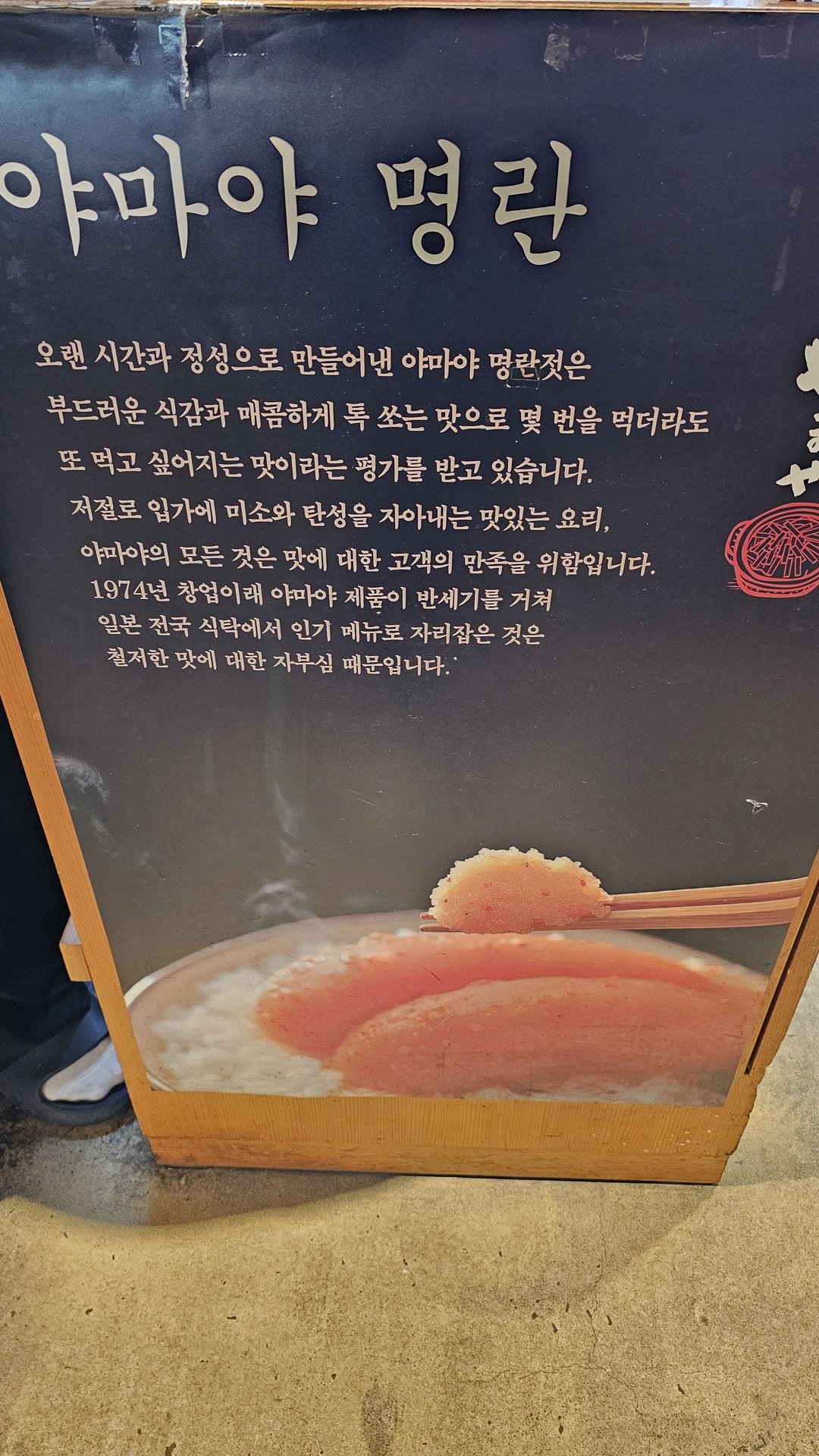
    Yamaya (야마야) is a Japanese specialty chain from Fukuoka, Kyushu — founded in 1974. Their thing is mentaiko, which is spicy cured pollock roe. If you’ve eaten at a Japanese restaurant and seen that pink, slightly grainy paste served with rice or on pasta, that’s mentaiko.

    Yamaya brand history board — mentaiko specialist founded in Fukuoka Japan in 1974
    Yamaya brand history board — mentaiko specialist founded in Fukuoka Japan in 1974

    In Japan, Yamaya runs mentaiko retail shops and restaurants. In Korea, the restaurant format leans into Japanese teishoku — set meals with a main dish, rice, miso soup, and side dishes. The twist here is that mentaiko comes as a side dish and you can refill it as many times as you want.

    That last part is the actual selling point.

    Getting There

    Yamaya Yeouido is in Yeouido — Seoul’s financial district, think Wall Street but with more convenience stores. The area is packed with office towers, a few large malls, and plenty of lunch spots targeting the nine-to-five crowd.

    Nearest subway: Yeouido Station (Line 5 and Line 9). From the station it’s a short walk. Taxis from central Gangnam take about 15 minutes outside rush hour. From Incheon Airport, roughly 50–60 minutes via the AREX express train to Gimpo then a subway transfer, or around 40 minutes by taxi.

    If you’re staying near Yeouido — IFC Residence, 63 Building area hotels — you can easily walk here for lunch.

    The Interior

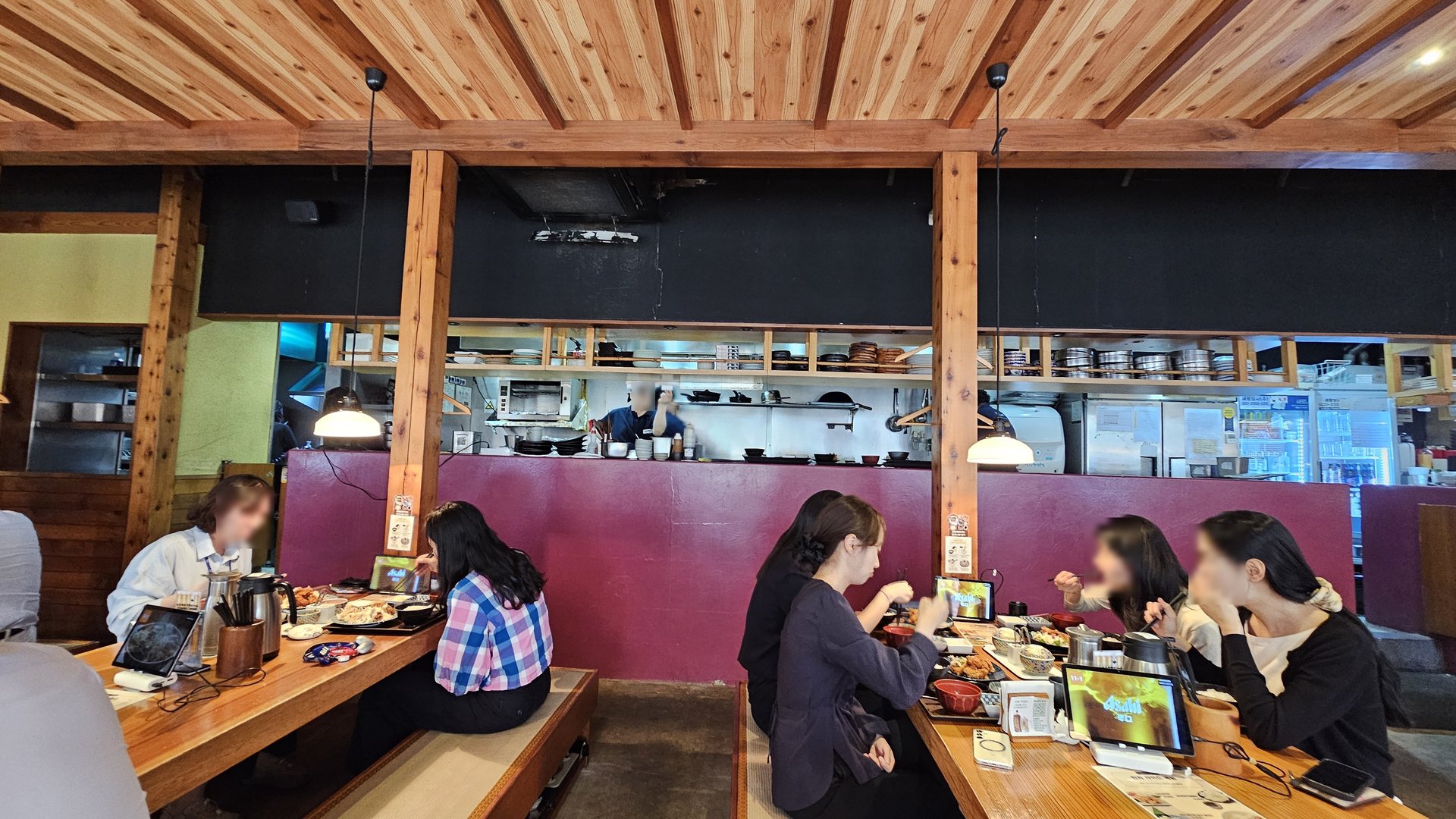
    Wooden beams, warm lighting, that slightly rustic Japanese teishoku restaurant feel. Not cramped, but not trying to be sleek either. Mixed seating — some floor-level seating (좌식) and regular table seating. Open kitchen along one side so you can see the cooking.

    Yamaya Yeouido dining hall with customers eating lunch, open kitchen visible in background with staff cooking
    Yamaya Yeouido dining hall with customers eating lunch, open kitchen visible in background with staff cooking

    At noon on a Tuesday it was essentially full. Most of the crowd was office workers, largely women. The pace felt efficient — people come in, eat, leave. Not a place you linger over coffee.

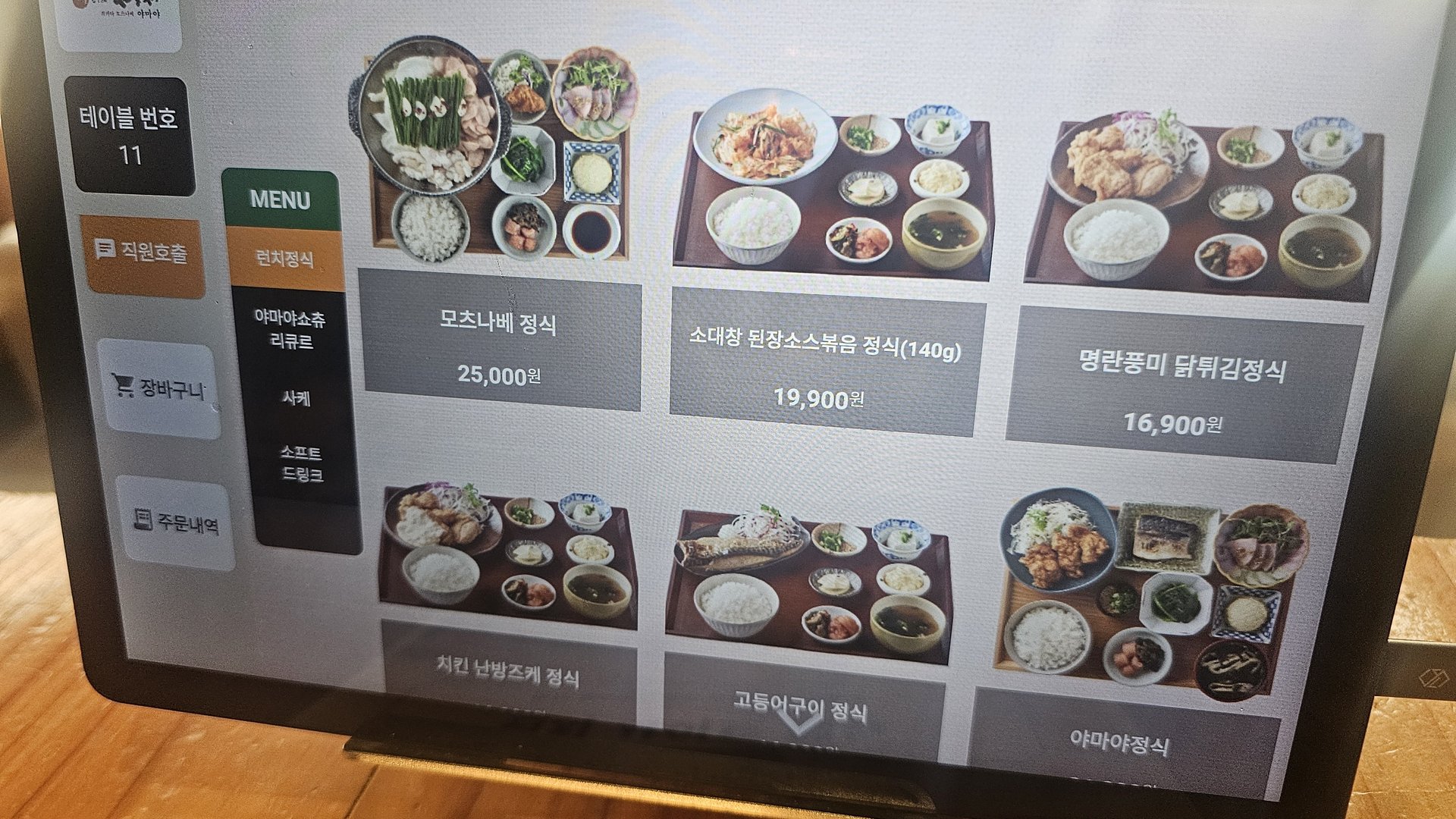
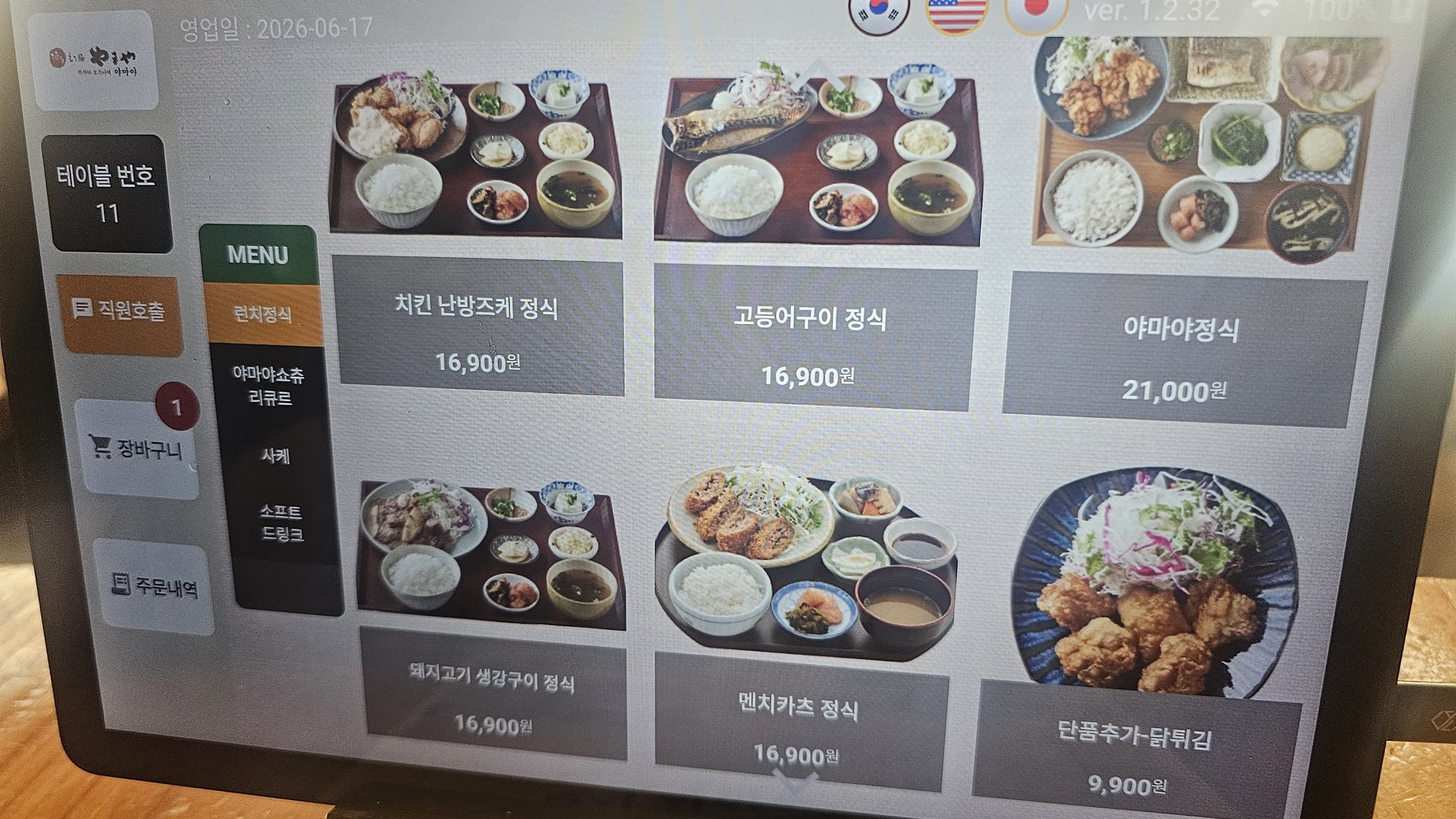
    Ordering is tablet-based (Korean only), with photos for each item. Easy enough to navigate if you point at what looks good.

    Yamaya Yeouido tablet ordering screen showing set meal options including Mochonabe and Mentaiko Chicken sets
    Yamaya Yeouido tablet ordering screen showing set meal options including Mochonabe and Mentaiko Chicken sets
    Yamaya Yeouido tablet ordering screen showing Chicken Nanbanzuke, Menchikatsu, and Pork Ginger sets with prices
    Yamaya Yeouido tablet ordering screen showing Chicken Nanbanzuke, Menchikatsu, and Pork Ginger sets with prices

    What We Ordered

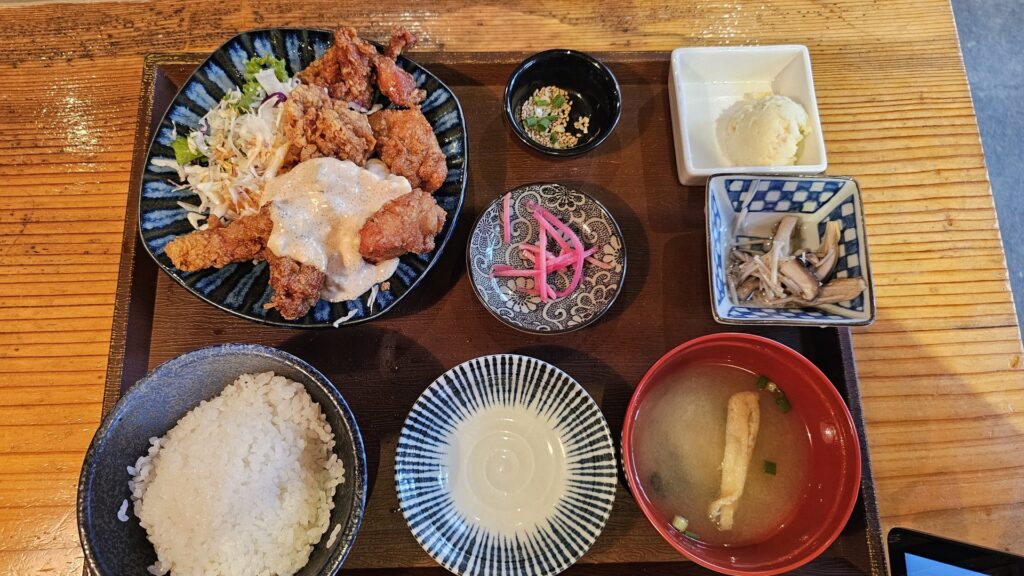
    Chicken Nanbanzuke Set — 16,900 KRW (~$12.50 USD)

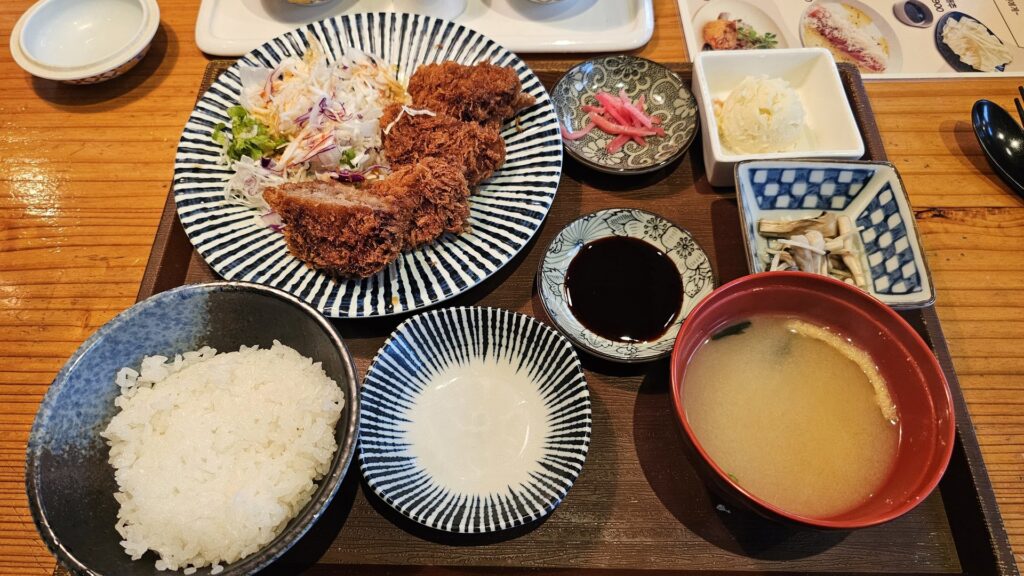
    Top-down view of Yamaya lunch set showing fried chicken main, rice, miso soup, mushroom side, and tofu

    Nanbanzuke (난방즈케) is a Japanese dish where fried chicken gets finished in a sweet vinegar marinade — it’s tangy, slightly sweet, and a bit sticky. Not the same as Korean fried chicken. Think of it as fried chicken that’s been dressed up with a sauce that’s closer to an Asian agrodolce.

    Full Yamaya teishoku lunch set with fried main dish, rice, miso soup, and side dishes on a tray
    Full Yamaya teishoku lunch set with fried main dish, rice, miso soup, and side dishes on a tray

    The chicken itself was well-fried — crispy coating, juicy inside. The nanbanzuke sauce was on the milder, sweeter side, which actually works well with a bowl of white rice. Not the most exciting dish I’ve had this year, but solid execution. You’ll finish the plate.

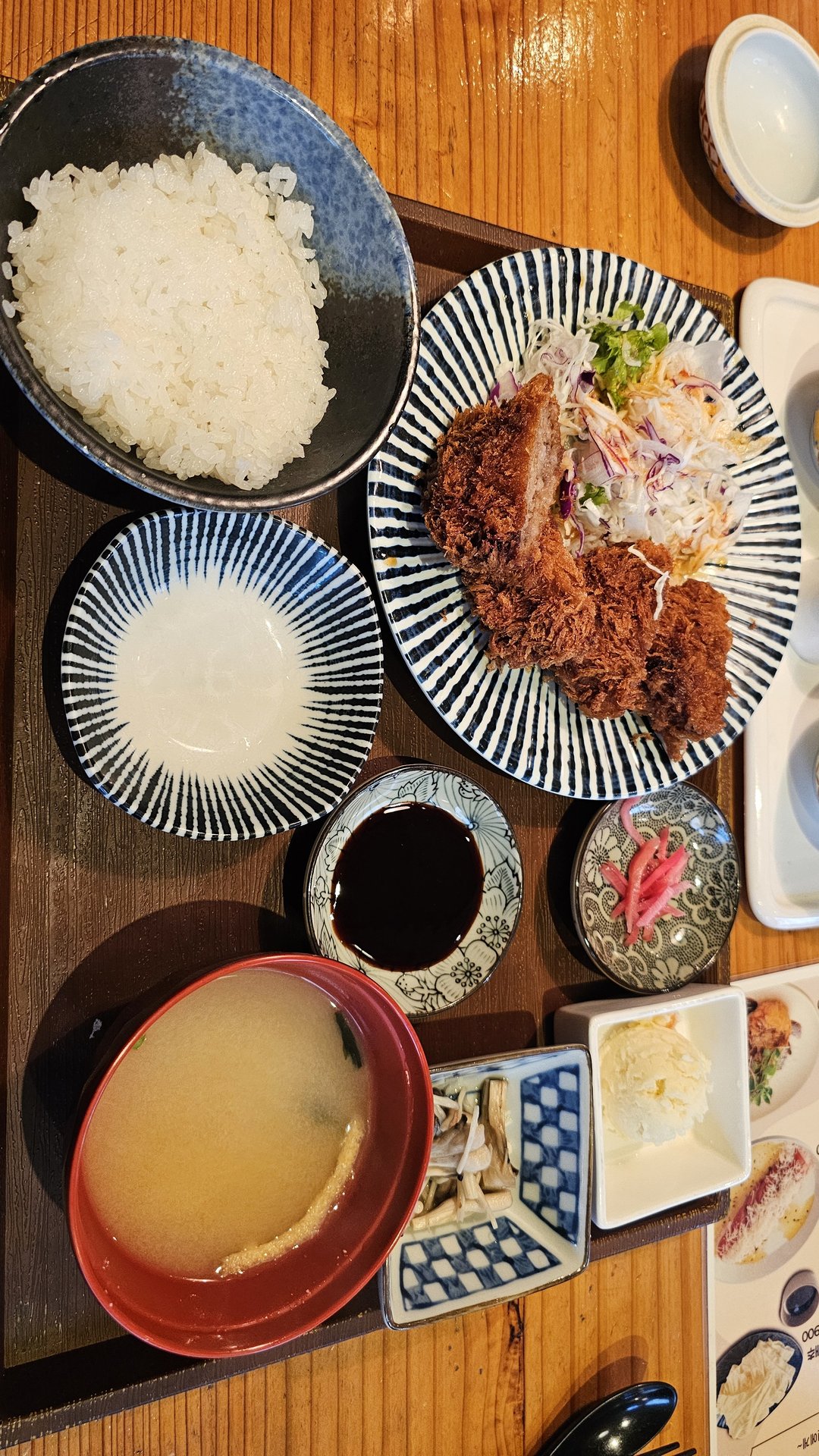
    Menchikatsu Set — 16,900 KRW (~$12.50 USD)

    Full Yamaya teishoku lunch set with fried main dish, rice, miso soup, and side dishes on a tray

    Menchikatsu (멘치카츠) is a ground meat patty — usually pork and beef mixed — shaped, breadcrumbed, and deep fried. Yoshoku (Western-influenced Japanese cooking) at its most straightforward.

    It’s honestly the simpler dish of the two. The patty was well-seasoned and the crumb coating was properly crisp. But there’s less going on compared to the nanbanzuke. Fine dish, slightly forgettable.

    If you’re picking between the two, the nanbanzuke has more personality.

    The Set Meal Structure

    Both sets came with rice, miso soup, and a couple of small sides. The miso soup was standard — nothing special. Rice was good.

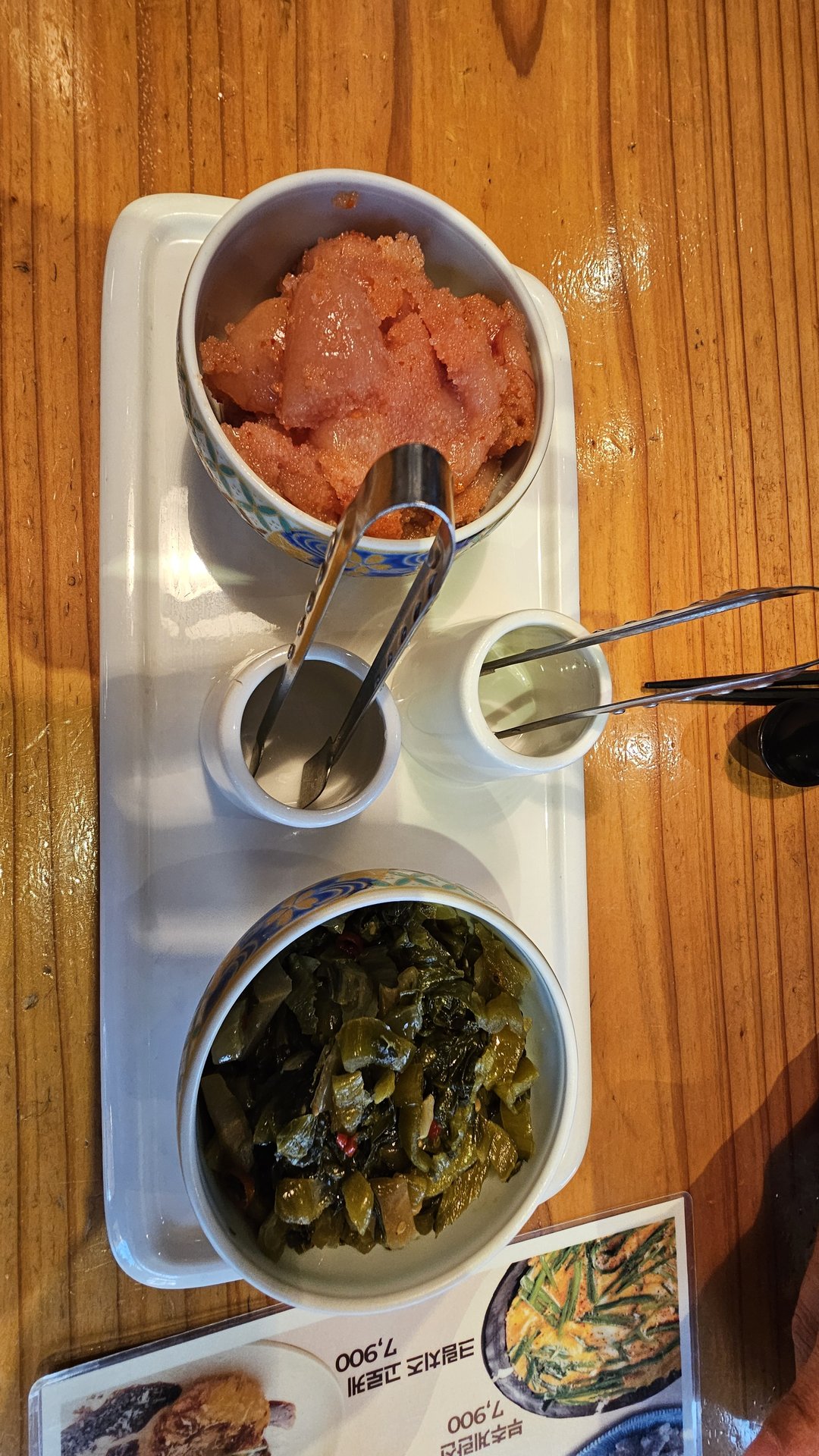
    Yamaya lunch side dish tray with mentaiko pollock roe and gochae muchim pickled greens
    Yamaya lunch side dish tray with mentaiko pollock roe and gochae muchim pickled greens

    And then there was the mentaiko.

    The Unlimited Mentaiko — Actually the Best Part

    Okay, this is what you’re coming for.

    Mentaiko and gochae muchim (고채 무침 — a pickled leafy green vegetable) come as refillable side dishes. You can ask for more as many times as you want.

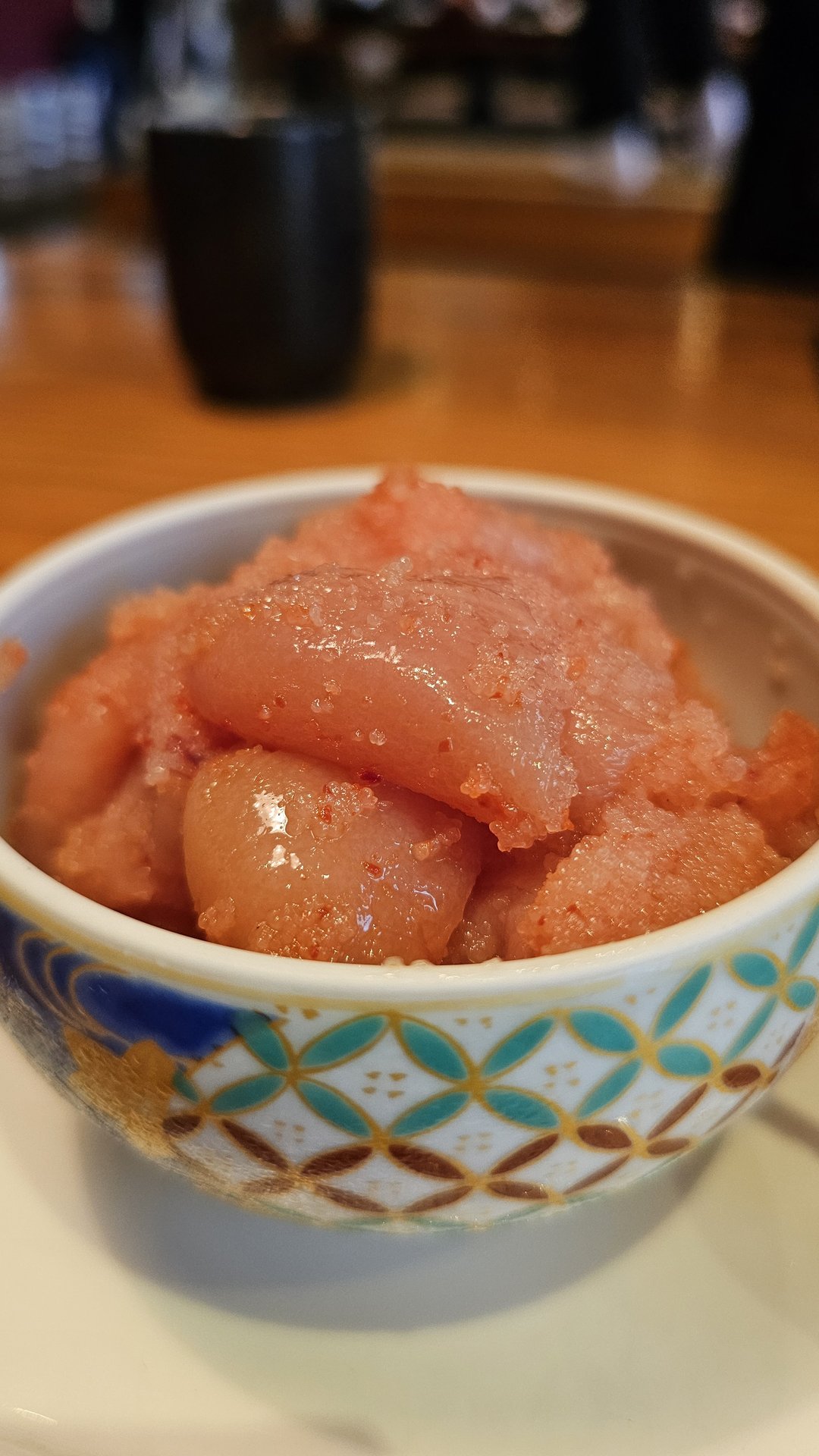
    Close-up of Yamaya mentaiko — pink spicy pollock roe in a small dish
    Close-up of Yamaya mentaiko — pink spicy pollock roe in a small dish

    The mentaiko here is properly good. It’s got that briny, slightly spicy, umami-forward flavor — the kind of thing that makes plain white rice disappear faster than you’d expect. We went through a couple of refills without even thinking about it.

    If you’ve never had mentaiko before: it’s salty, savory, and has a light heat from the chili. It pairs with rice the same way good butter pairs with bread — you just keep going back for more.

    This is genuinely Yamaya’s strongest card. The set meal food is solid but mainstream Japanese comfort food. The unlimited mentaiko is the reason to come here specifically.

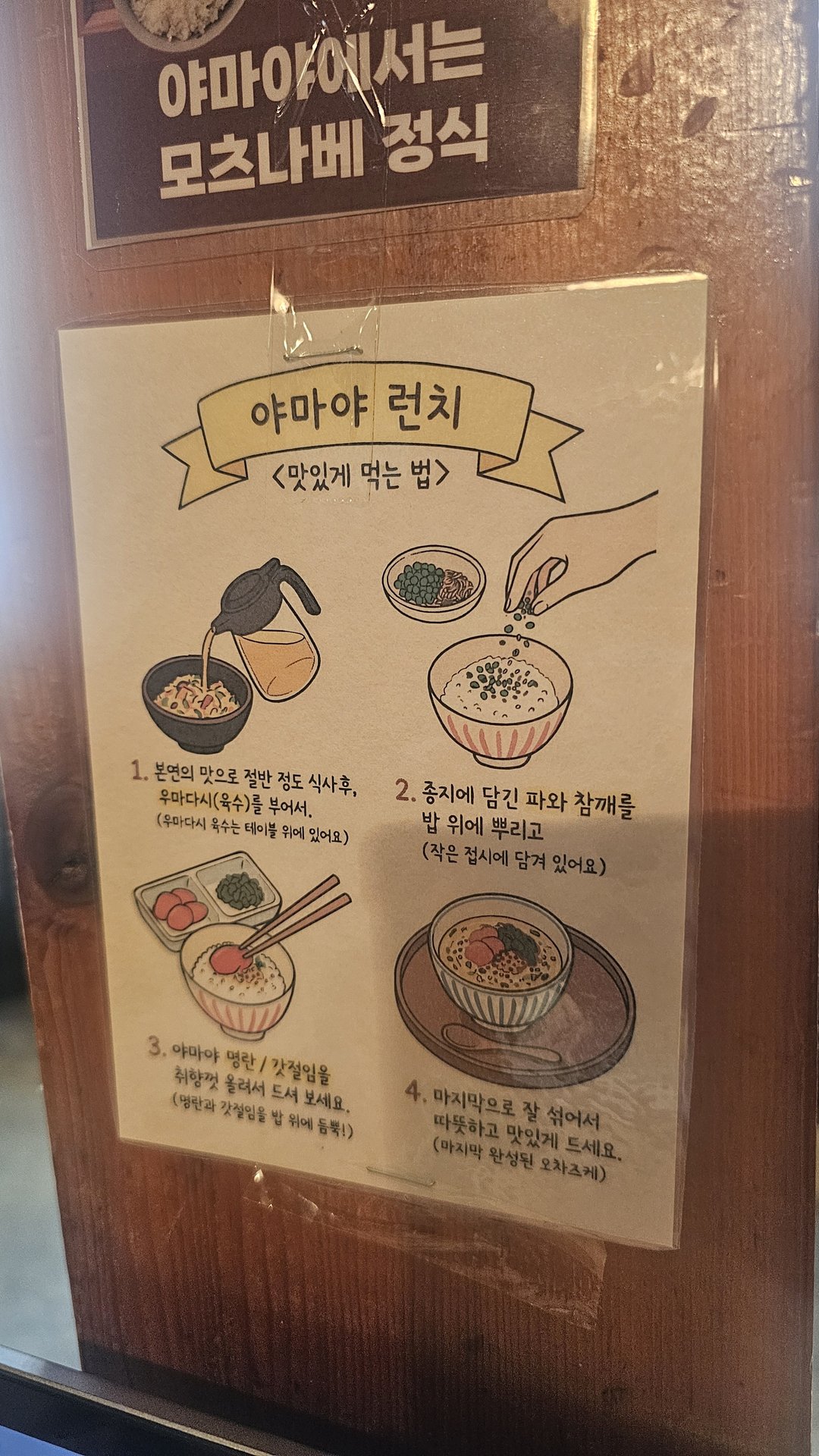
    Wall instruction guide for Yamaya Mochonabe hot pot — four-step illustrated eating guide in Korean
    Wall instruction guide for Yamaya Mochonabe hot pot — four-step illustrated eating guide in Korean

    Add-On Side Menu

    There’s a table card with optional add-ons for lunch:

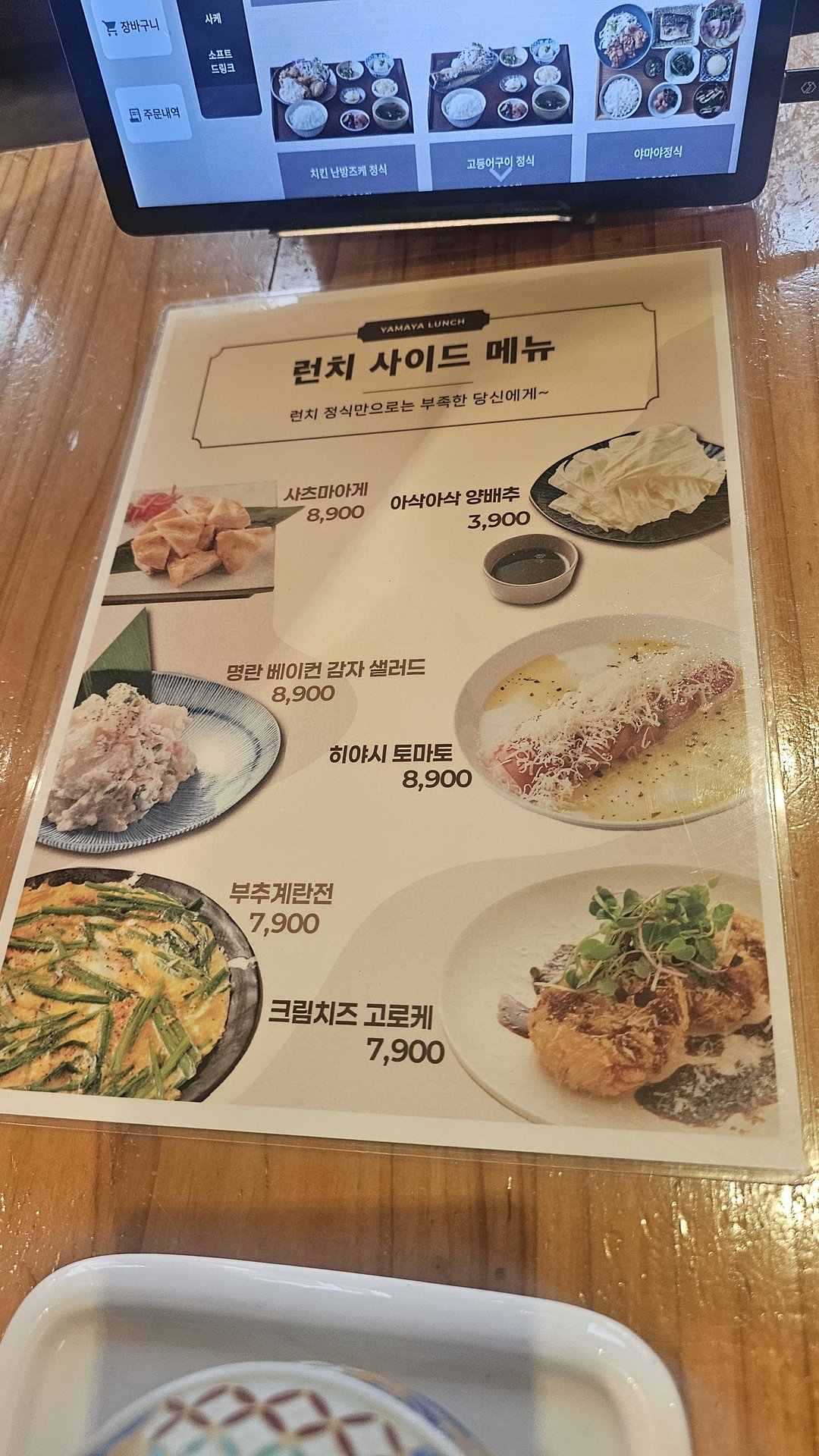
    Yamaya Yeouido table side lunch add-on menu card showing side dish options and prices
    Yamaya Yeouido table side lunch add-on menu card showing side dish options and prices

    – Cabbage — 3,900 KRW

    – Satsuma-age (Japanese fish cake) — 8,900 KRW

    – Mentaiko bacon potato salad — 8,900 KRW

    – Hiyashi tomato — 8,900 KRW

    – Chive egg jeon — 7,900 KRW

    – Cream cheese croquette — 7,900 KRW

    We skipped these — the set meals were already substantial. But the mentaiko bacon potato salad sounds interesting if you want to go deeper on the mentaiko theme.

    Stuff Tourists Should Know

    Language: Korean-only tablet ordering. Staff probably won’t speak much English. Point at the photos on the tablet — you’ll be fine.

    English menu: No, but the tablet has photos for every item.

    Payment: Cards accepted. Foreign cards should work. No tipping in Korea — don’t leave cash on the table.

    Dietary restrictions: This is a meat-focused Japanese teishoku restaurant. Vegetarian options are limited (maybe the cabbage side, the hiyashi tomato). No obvious halal options. Mentaiko contains fish roe and chili.

    Timing: Gets packed fast during the 12:00–1:00 PM window. If you want to avoid the rush, try arriving just before noon or after 1:00 PM.

    Kids: The space can accommodate families, but it’s primarily an office lunch crowd. Not a dedicated family restaurant, but not unwelcoming either.

    Solo dining: Totally fine. Counter-style seating would suit solo diners.

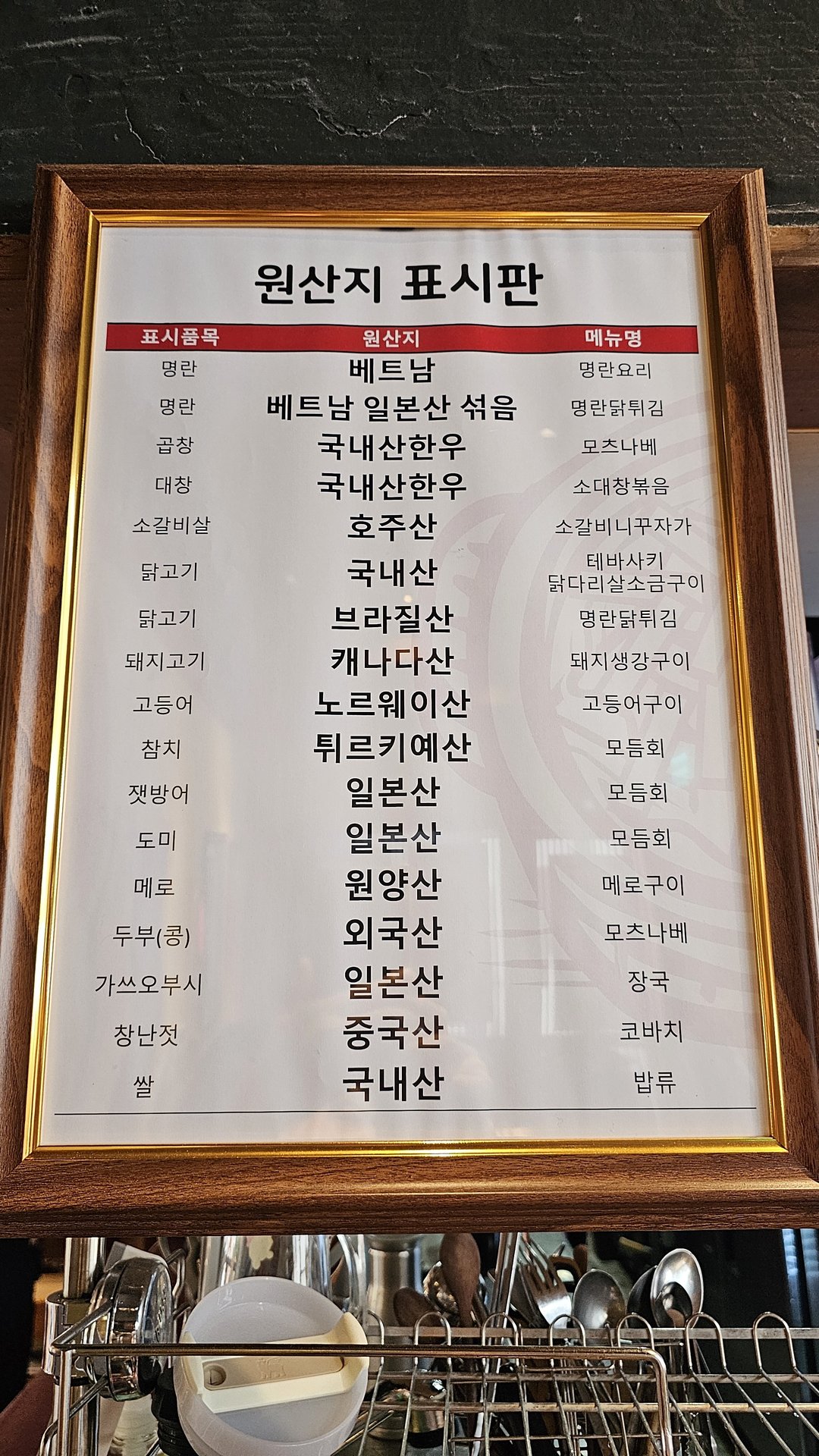
    Yamaya Yeouido ingredient origin board showing sourcing information for mentaiko, chicken, pork, and mackerel
    Yamaya Yeouido ingredient origin board showing sourcing information for mentaiko, chicken, pork, and mackerel

    The Verdict

    Should you go?

    – If you’re already in Yeouido for business or sightseeing (IFC Mall, 63 Building) — yes, this is a legit lunch option. Get the nanbanzuke set and go hard on the mentaiko refills.

    – If you only have 3–4 days in Seoul — probably not a priority. Use that meal slot for Korean food. Come back if you get more time.

    – If you’re curious about mentaiko and want to try it properly without hunting down a specialty shop — yes, this is a great intro. Unlimited refills, good quality, reasonable price.

    – If you want the most exciting meal in Seoul — no. This is reliable weekday lunch food, not a destination dinner.

    The food is good, the unlimited mentaiko is genuinely worth it, and 16,900 KRW (~$12.50) for a full lunch set is fair value for Yeouido. We’ll be back when we’re in the area.

    Yamaya Yeouido (야마야 여의도점)

    Yeouido, Seoul

    Tablet ordering (Korean only) | Card payment OK | No reservations

    FAQ

    What is Yamaya and why is it famous?

    Yamaya is a Japanese chain from Fukuoka, founded in 1974, known for mentaiko — spicy cured pollock roe. Their Korean restaurant branches serve Japanese teishoku (set meal) lunches with unlimited mentaiko on the side.

    How much does lunch cost per person at Yamaya Yeouido?

    Most lunch sets run 16,900–21,000 KRW (~$12.50–$15.50 USD) per person. The premium Mochonabe set goes up to 25,000 KRW (~$18.50 USD).

    Do I need a reservation for lunch at Yamaya Yeouido?

    No reservation system — it’s walk-in only. That said, it gets genuinely packed on weekdays around noon (office lunch crowd), so aim for 11:30 AM or after 1:00 PM if you want to walk straight in.

    Is there an English menu at Yamaya Yeouido?

    Ordering is done via tablet, which is in Korean only. The menu items are fairly visual with photos, so pointing works fine. Staff are friendly but don’t expect much English.

    Can I pay by credit card at Yamaya Yeouido?

    Yes, card payment is standard. Foreign cards (Visa, Mastercard) should work fine — the receipt shows standard Korean card terminal processing.

    Is the unlimited mentaiko actually unlimited?

    Yes. Mentaiko (pollock roe) and gochae muchim (pickled greens) come as side dishes and you can ask for refills. The mentaiko alone is worth showing up for.

    You might also like

    📍 Location

    Open in Google Maps →

  • Ginza Yeouido: Honest Review of Seoul’s 20-Year Japanese Course Restaurant

    Ginza Yeouido: Honest Review of Seoul’s 20-Year Japanese Course Restaurant

    Ginza Yeouido: Honest Review of Seoul’s 20-Year Japanese Course Restaurant

    Quick honest review of Ginza (긴자) in Yeouido — one of Seoul’s longest-running premium Japanese course restaurants. We visited on June 10, 2026, which happened to be their 20th anniversary. Four of us, full course, walked out full and slightly lighter in the wallet.

    Short version: the food is clean, refined, and well-executed. Not flashy. Not trying to impress you with trends. Just solid Japanese course cooking that’s been doing the same thing for two decades because it works. For the price, that’s actually a compliment.

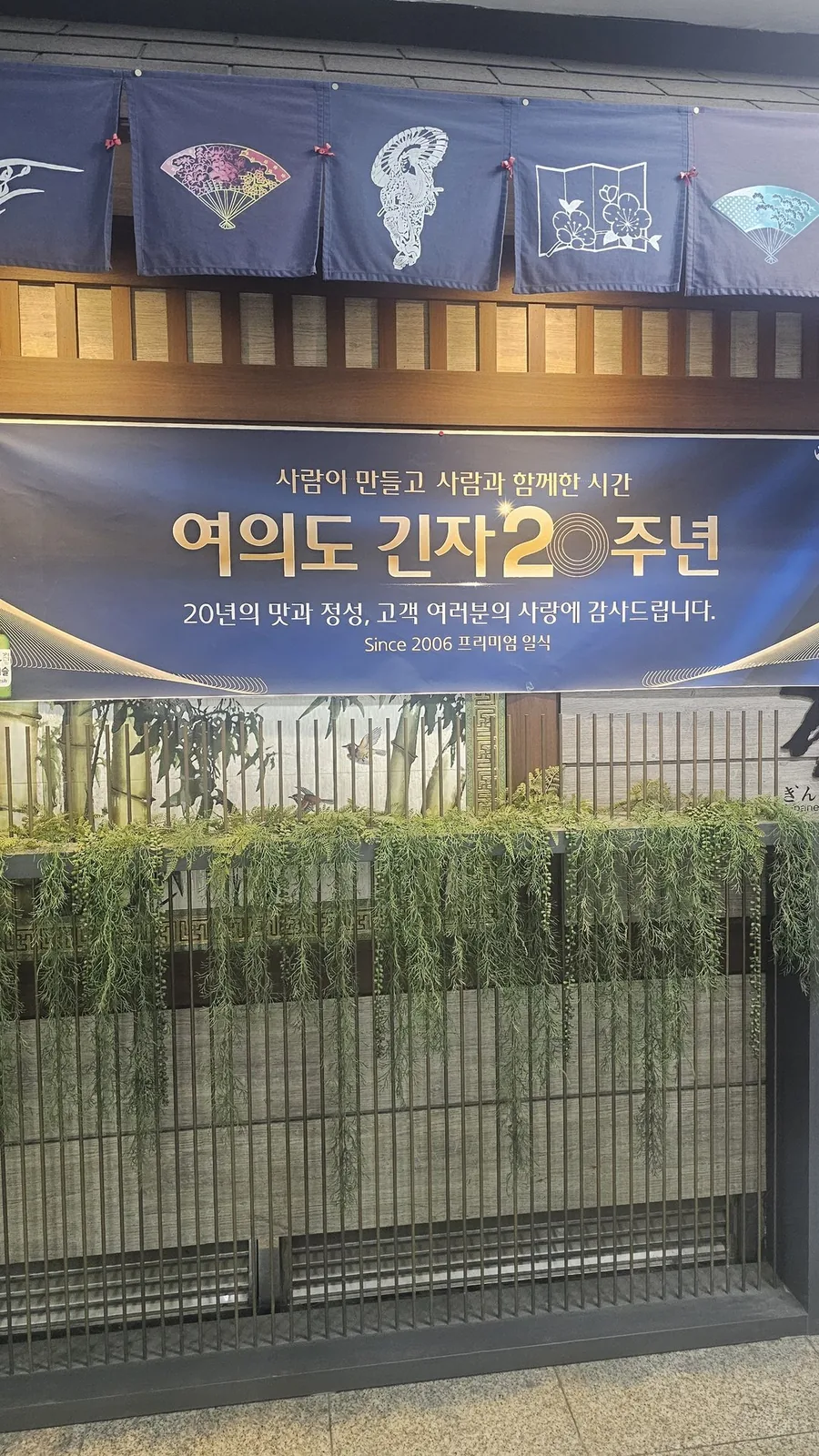
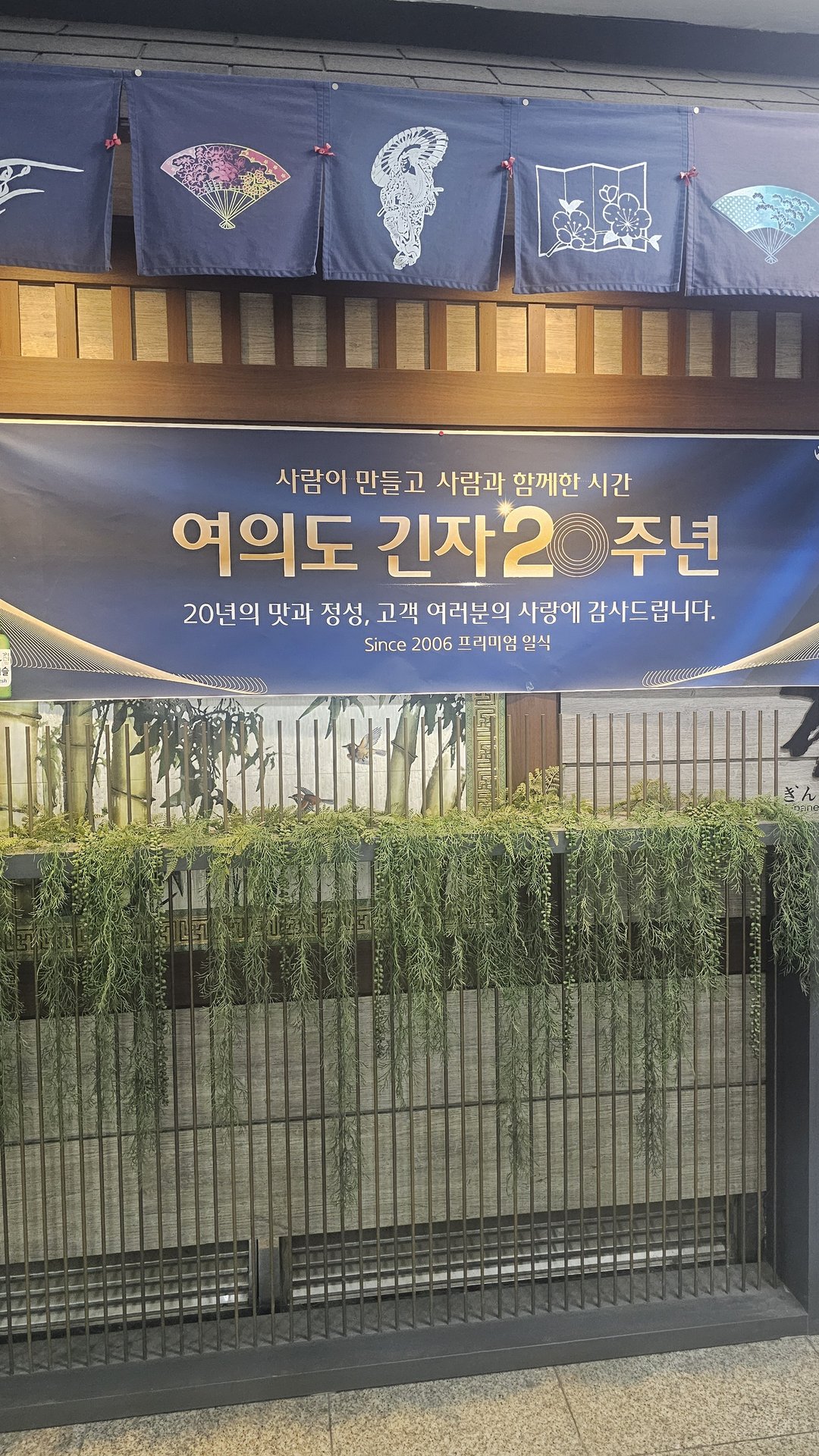
    Ginza Yeouido 20th anniversary banner on restaurant exterior
    Ginza Yeouido 20th anniversary banner on restaurant exterior

    What Is Ginza Yeouido?

    Ginza (긴자) takes its name from the famous upscale shopping and dining district in Tokyo. The Seoul version isn’t a Japanese chain — it’s a Korean-run premium Japanese restaurant that opened in Yeouido in 2006. Two decades later, it’s still one of the go-to spots for business lunches and formal meals in Seoul’s financial district.

    Yeouido, for context: think Wall Street meets Canary Wharf. This is where Korean banks, broadcast networks, and securities firms are headquartered. Lunch spots here cater to executives and client meetings, not backpackers hunting for cheap bibimbap. Ginza fits that world perfectly — formal, quiet, unhurried.

    The format is a Japanese course meal (코스 요리). You pick a tier, and dishes come out one after another over roughly 90 minutes. No à la carte scrambling, no “what should we order?” decision fatigue. Just sit down and eat.

    Getting There

    Entrance of Ginza Yeouido with traditional noren curtain and staff at the door
    Entrance of Ginza Yeouido with traditional noren curtain and staff at the door

    Yeouido is well connected by Seoul Metro:

    Line 5: Yeouido Station (여의도역), Exit 1 or 2

    Line 9: National Assembly Station (국회의사당역)

    – From Incheon Airport (ICN): about 60–70 minutes by AREX express train + subway transfer

    From the major hotels in Yeouido (Conrad Seoul, FairField by Marriott), it’s a short taxi ride — under 10 minutes, likely under 5,000 KRW.

    Drop the Korean name 긴자 여의도 into Kakao Maps or Naver Maps. Google Maps works but Korean addresses are more reliable on local apps.

    The Interior

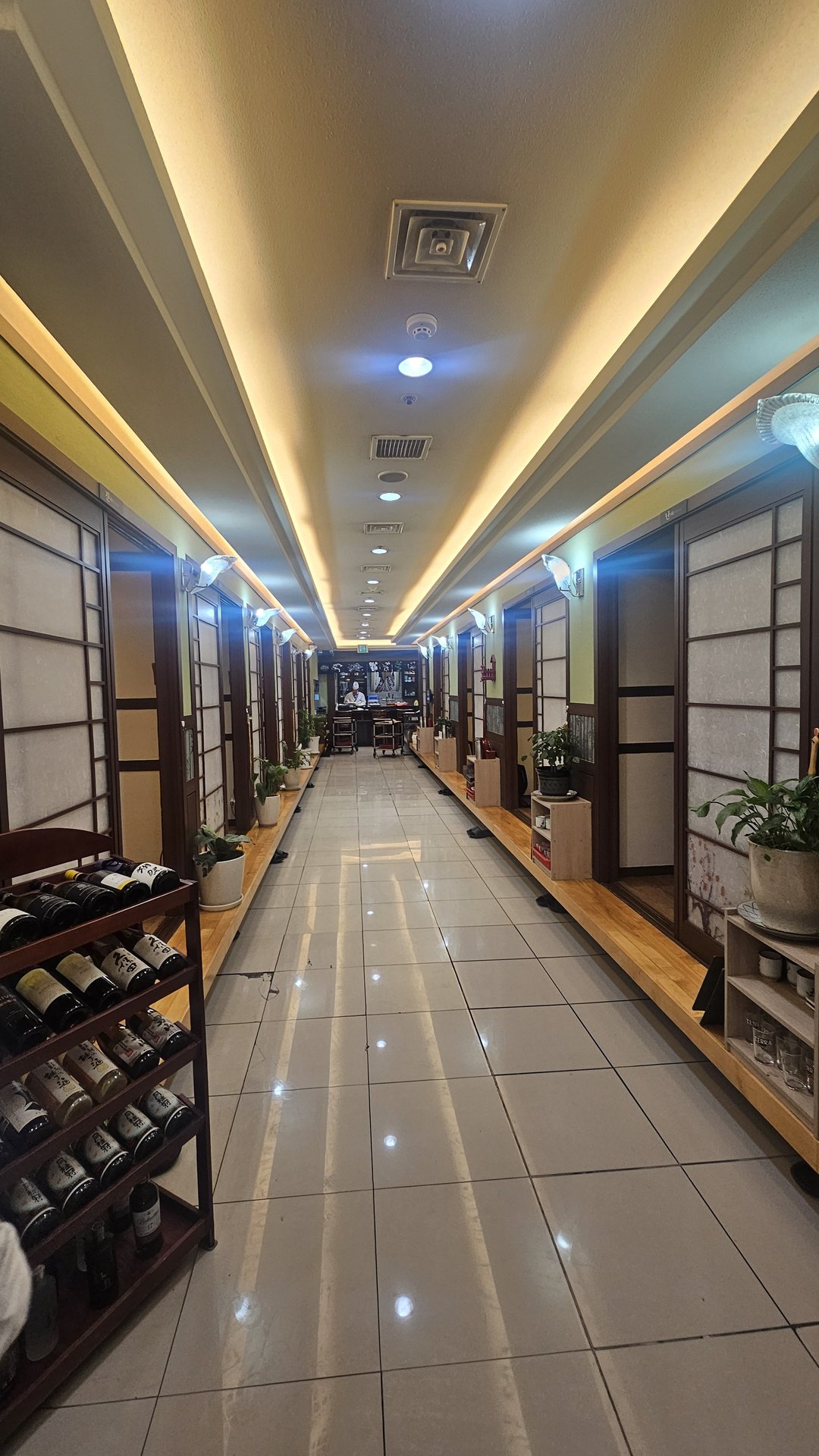
    Interior hallway of Ginza Yeouido with Japanese wood decor and private dining rooms
    Interior hallway of Ginza Yeouido with Japanese wood decor and private dining rooms

    The interior is formal Japanese — clean wood paneling, shoji-style screens, quiet lighting. Not the Instagram-bait kind of design with exposed brick and Edison bulbs. This is old-school Japanese restaurant aesthetic: calm, considered, tells you to lower your voice.

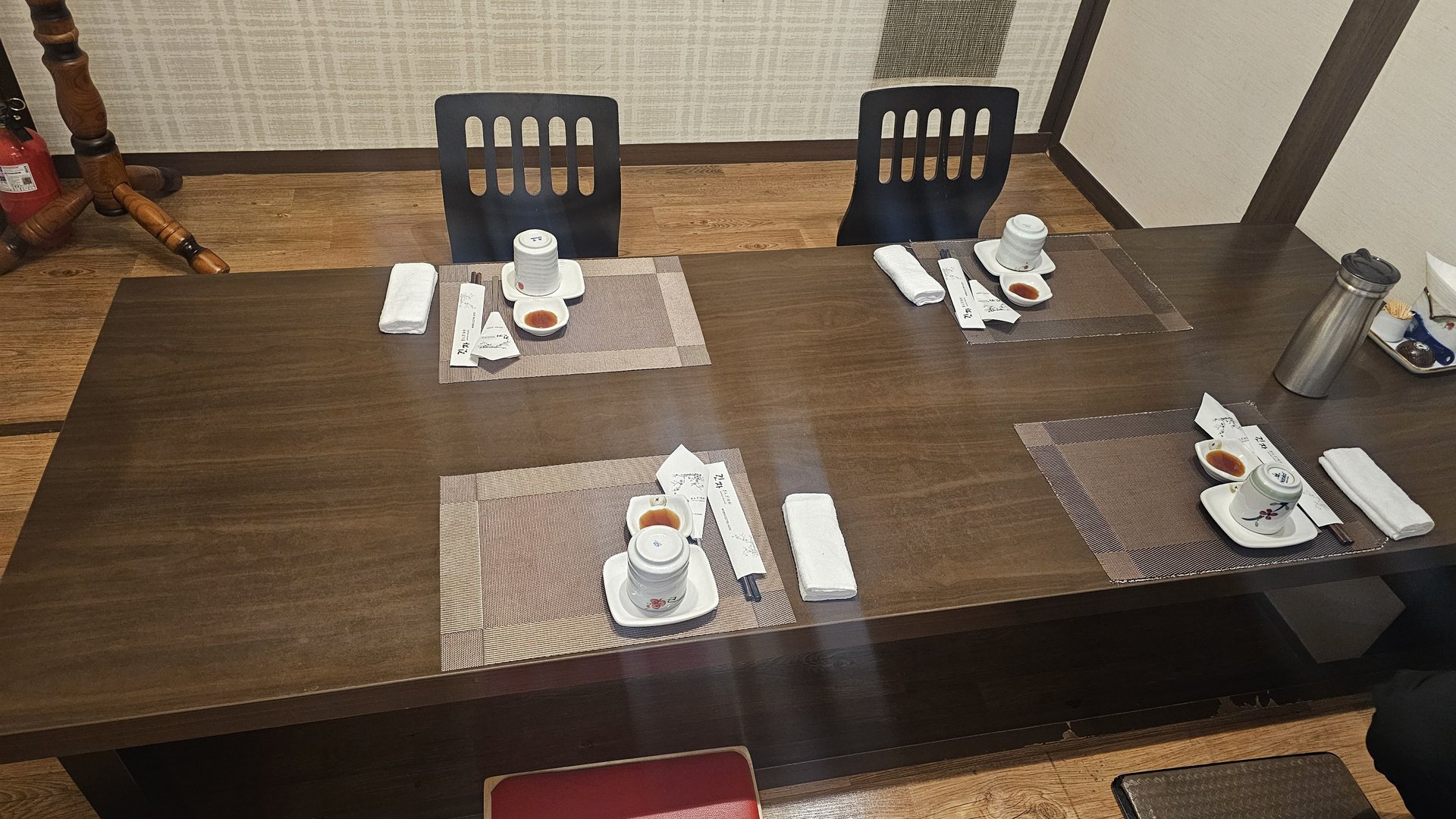
    Seating is arranged for groups. The table setting when we arrived was already fully prepared — tea poured, chopsticks laid out, napkins folded. That level of pre-set service signals what kind of restaurant you’re in before a single dish arrives.

    Four-person table setting at Ginza Yeouido with tea, chopsticks, and folded napkins
    Four-person table setting at Ginza Yeouido with tea, chopsticks, and folded napkins

    Pricing

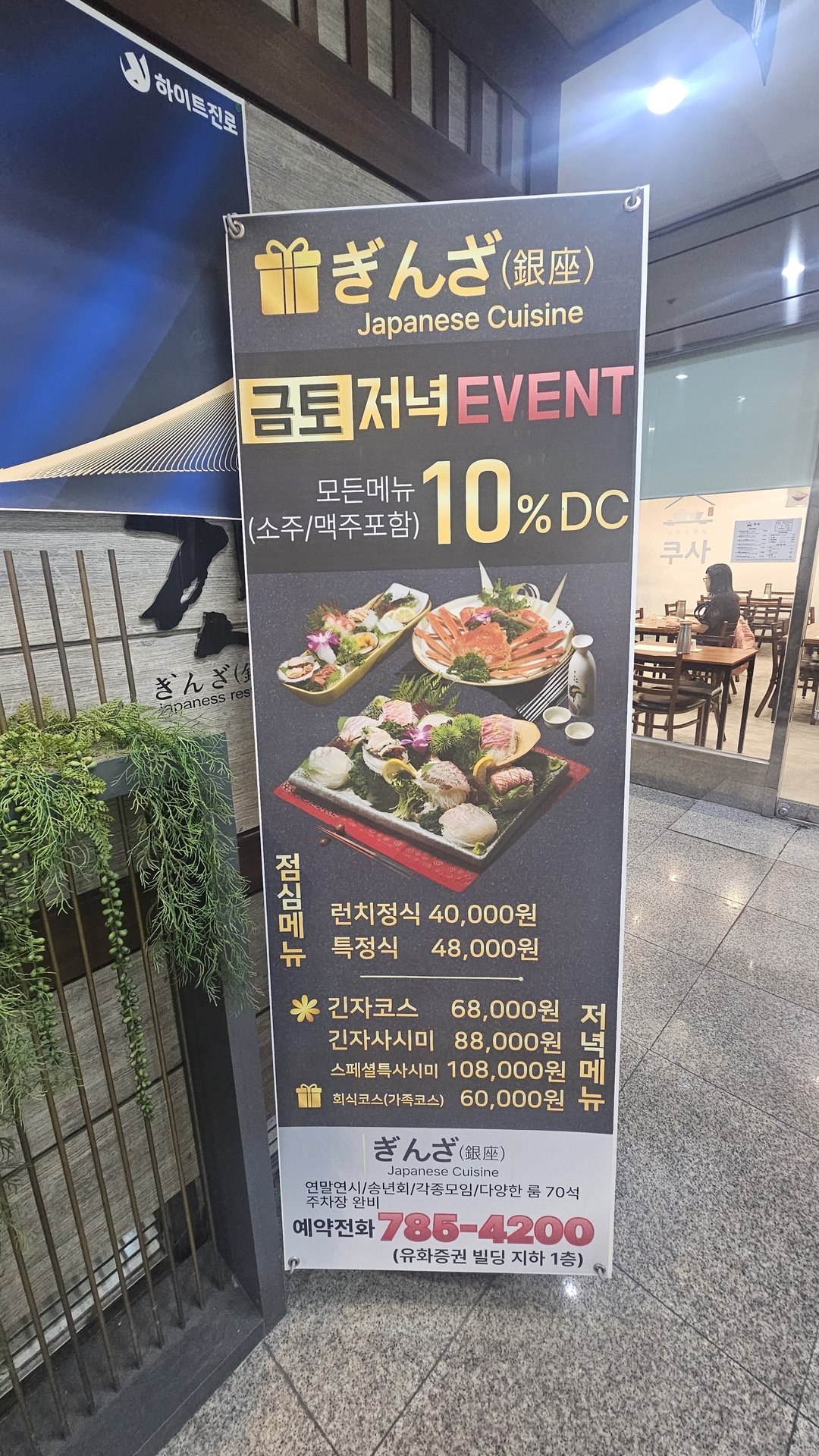
    Ginza Yeouido entrance menu board showing lunch set and Ginza course prices
    Ginza Yeouido entrance menu board showing lunch set and Ginza course prices

    This is where you need to decide before going in:

    런치정식 (Lunch Set): 40,000–48,000 KRW (~$30–36 USD per person)

    긴자코스 (Ginza Course): 68,000–108,000 KRW (~$50–80 USD per person)

    For 4 people on the full Ginza course, budget 272,000–432,000 KRW (~$200–320 USD total) before drinks.

    There’s also a Friday evening discount event — 10% off, which at this price level is actually meaningful.

    Is it expensive? Yes, for Seoul. But not for what you’re getting — a full multi-stage Japanese course that runs 90+ minutes. Comparable quality in Tokyo would cost similar or more.

    The Meal, Course by Course

    The Starters

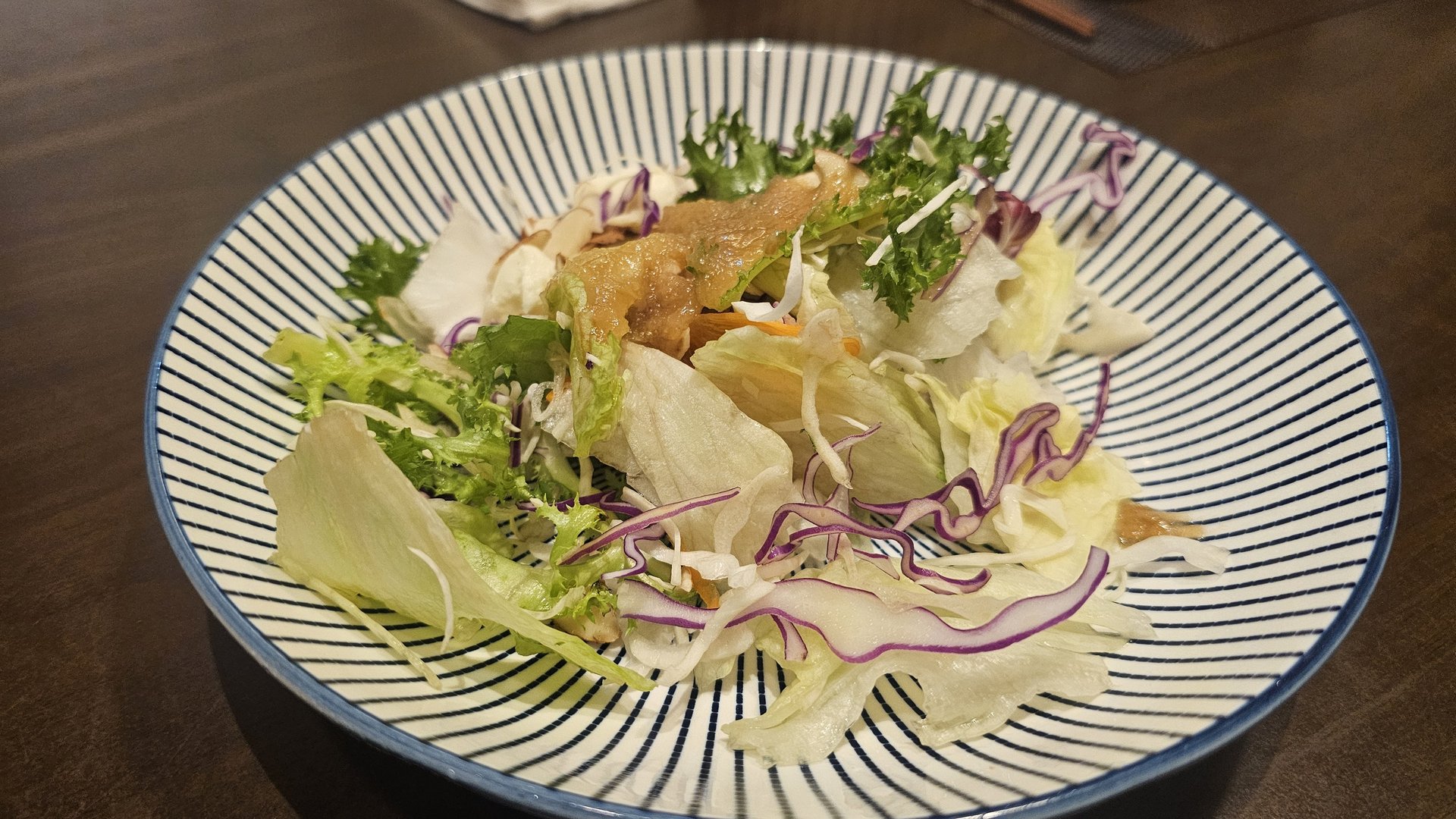
    Mixed green salad with shredded red cabbage and dressing at Ginza Yeouido
    Mixed green salad with shredded red cabbage and dressing at Ginza Yeouido
    Three dipping sauces at Ginza Yeouido including soy vinegar, ponzu, and spicy sauce
    Three dipping sauces at Ginza Yeouido including soy vinegar, ponzu, and spicy sauce
    Appetizer tray with pickled radish, fresh vegetables, and four sauce cups at Ginza Yeouido
    Appetizer tray with pickled radish, fresh vegetables, and four sauce cups at Ginza Yeouido
    Ssam wrapping ingredients tray with perilla leaves, salted greens, green chili, and whole garlic at Ginza Yeouido
    Ssam wrapping ingredients tray with perilla leaves, salted greens, green chili, and whole garlic at Ginza Yeouido
    Ssam wrapping tray with perilla leaves and condiments from alternate angle at Ginza Yeouido
    Ssam wrapping tray with perilla leaves and condiments from alternate angle at Ginza Yeouido

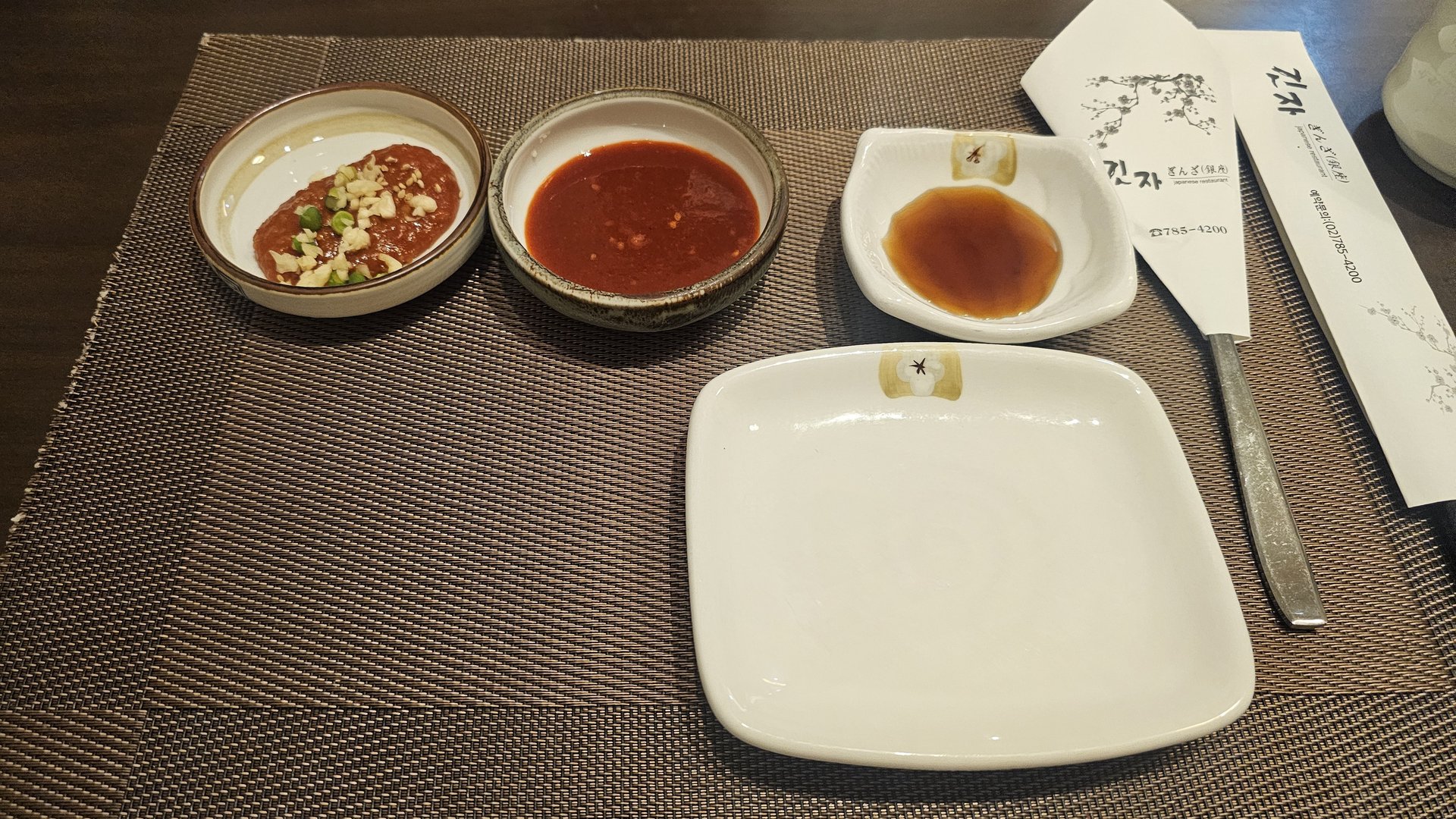
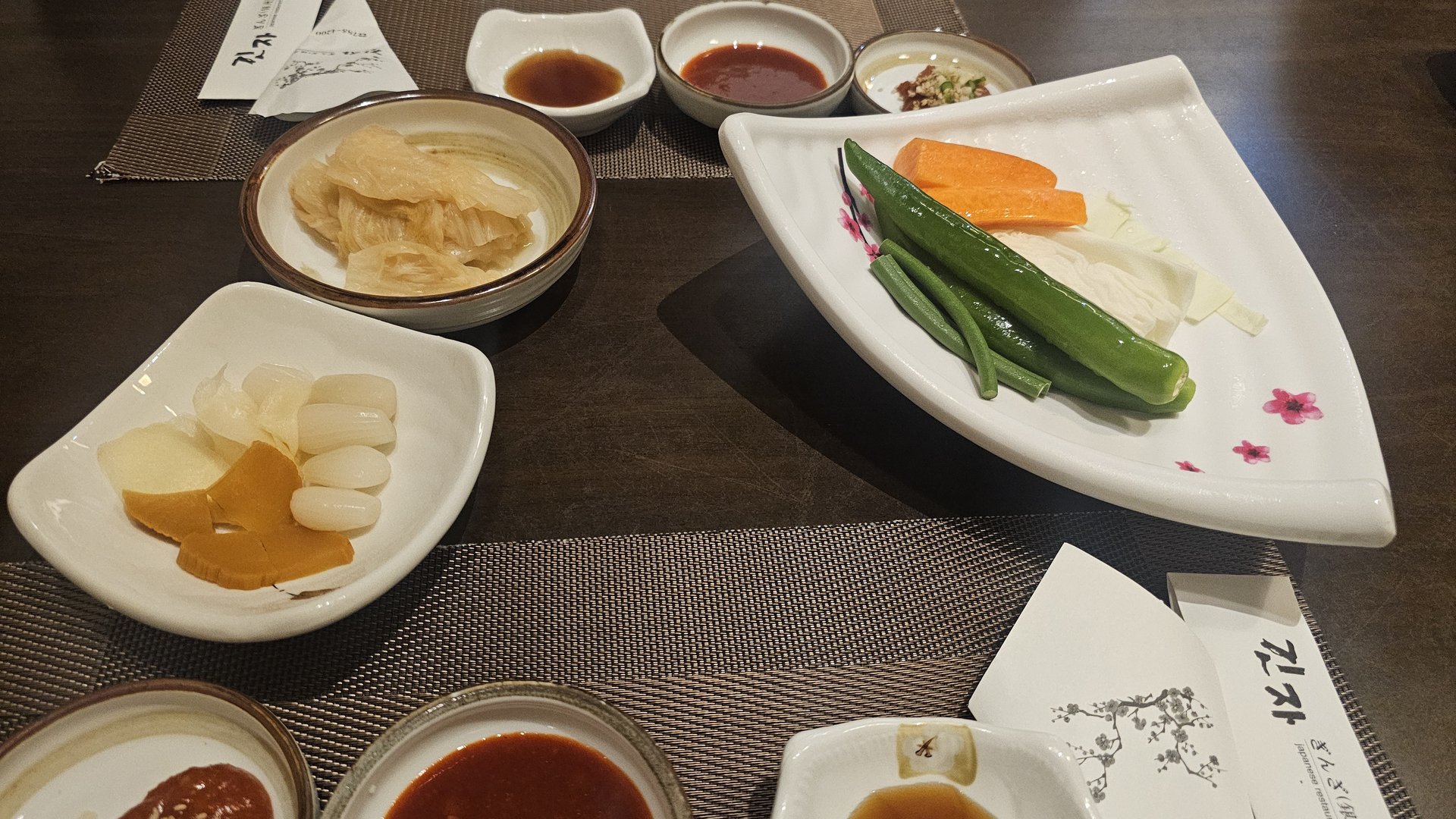
    Courses started with a mixed green salad and a small assortment of pickled radish, fresh vegetables for ssam (wrapping), and multiple dipping sauces — soy vinegar, ponzu, a spicy sauce, and a couple of others.

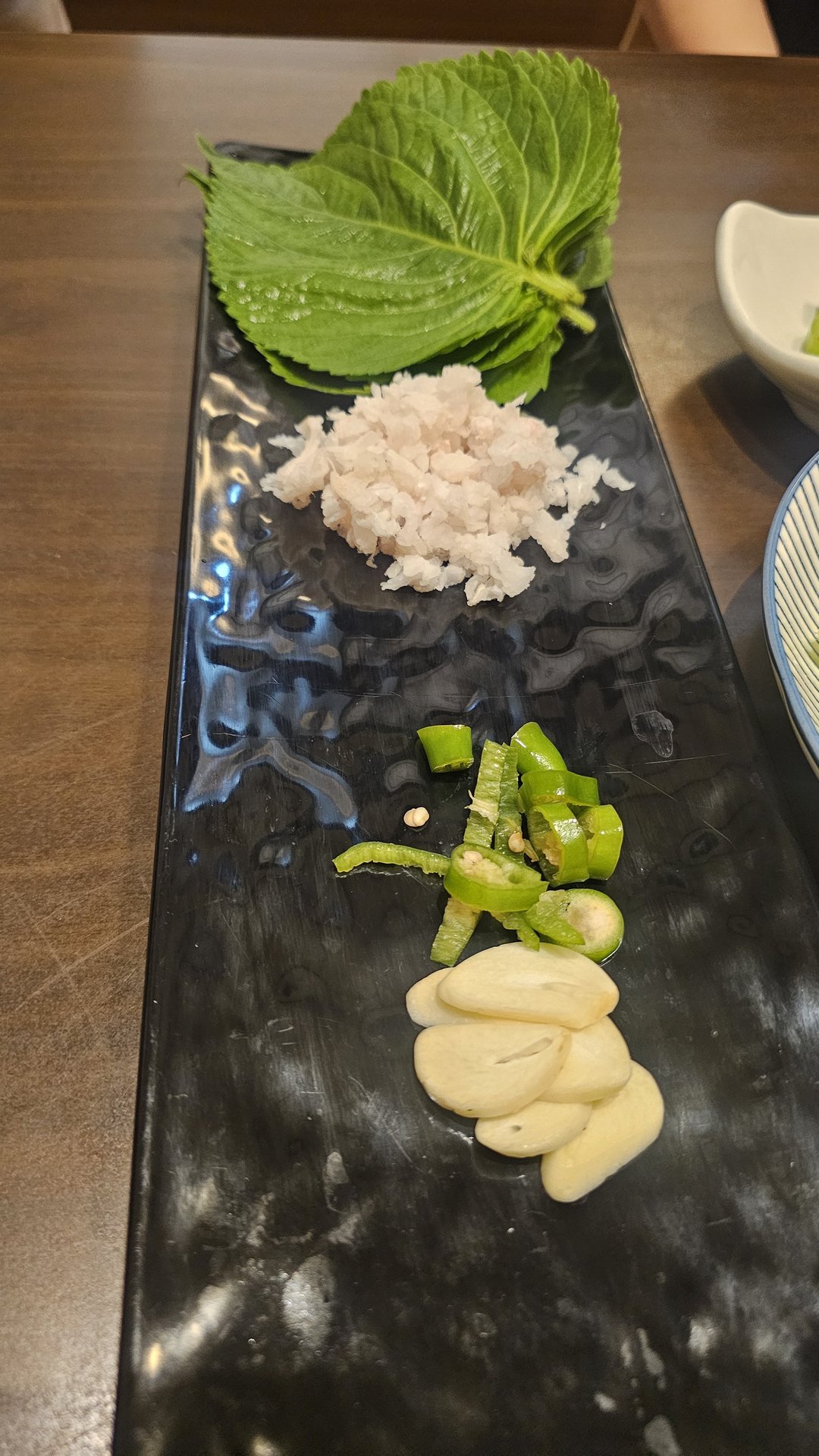
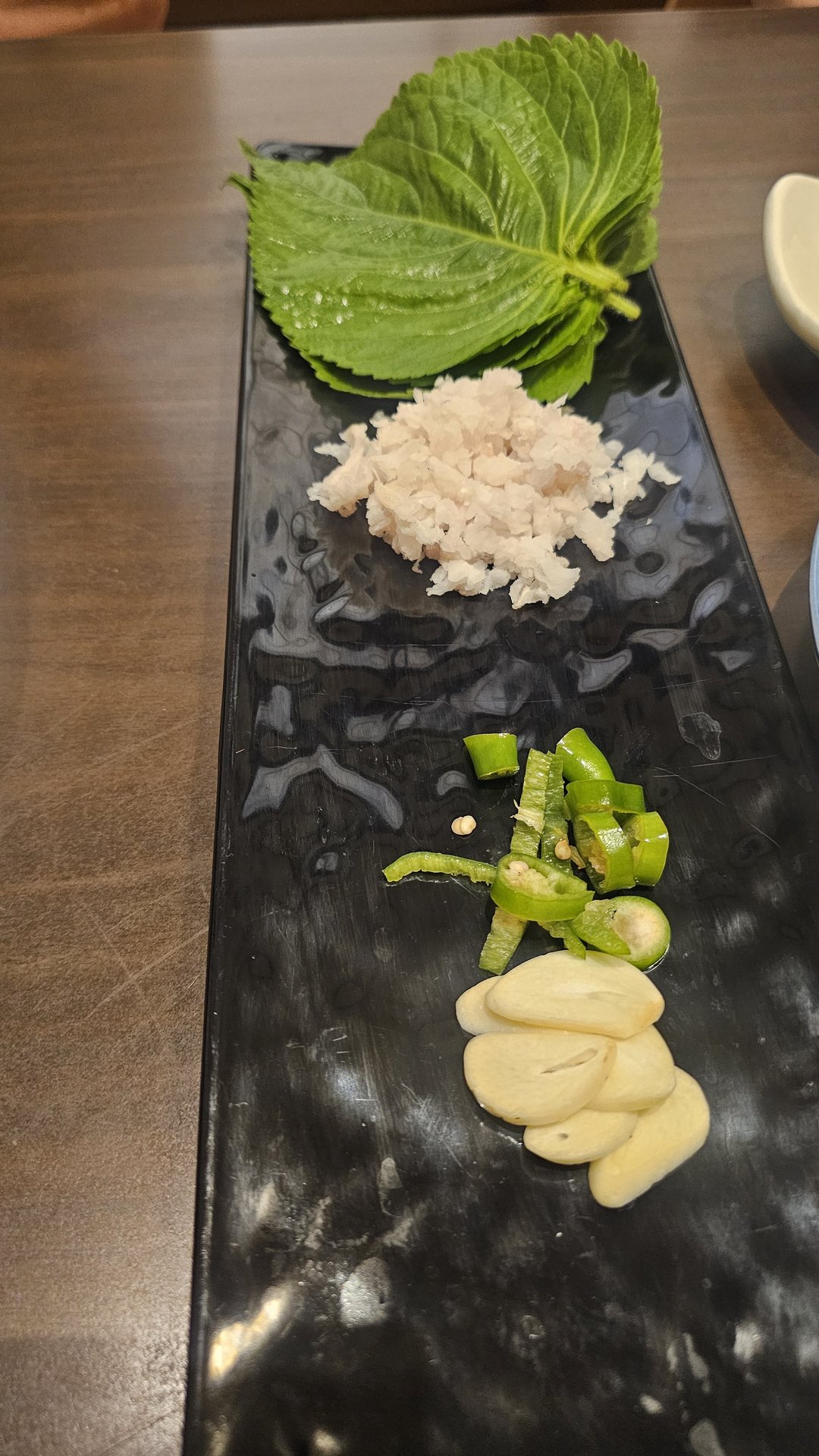
    Ssam (쌈) is the Korean practice of wrapping bites of meat or fish in leafy greens like perilla leaves. The tray came with perilla, salted greens, sliced green chili, and whole garlic. For the uninitiated: you grab a leaf, place whatever you want inside, add a bit of garlic or chili, fold it up, eat in one bite. You don’t need instructions — it’s intuitive once you see the tray.

    Three dipping sauces alongside: standard setup for Japanese-Korean course dining.

    Sashimi

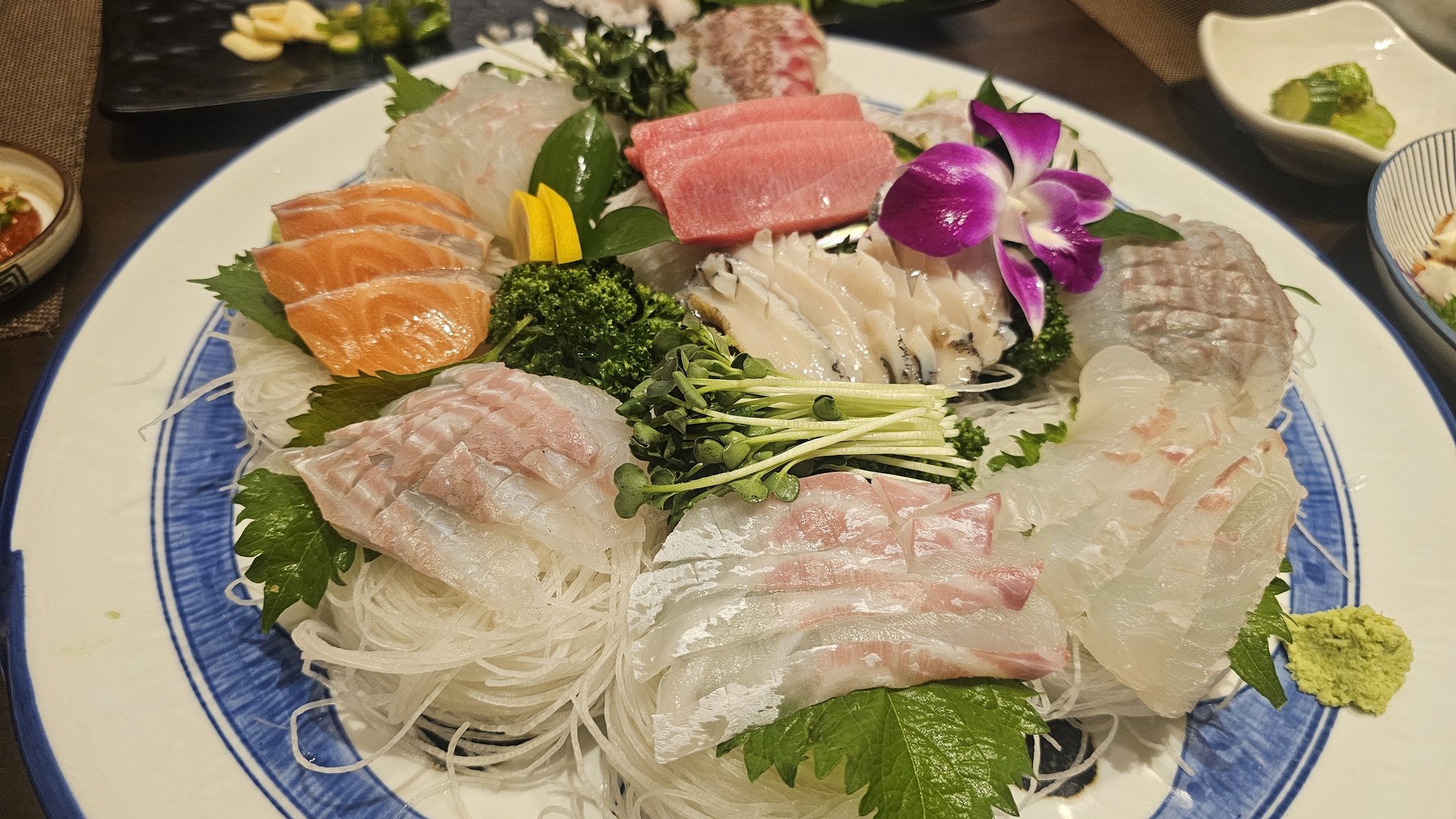
    Assorted sashimi platter with salmon, tuna belly, flounder, and sea bream at Ginza Yeouido
    Assorted sashimi platter with salmon, tuna belly, flounder, and sea bream at Ginza Yeouido

    The sashimi platter was the first real showstopper. Salmon, tuna belly (중뱃살), flounder (광어), sea bream (도미) — a wide range, all sliced thick and arranged properly on a large platter. Not a few thin slices on a corner of a plate. This was a full spread.

    The fish tasted clean. That’s the honest summary. Fresh, properly handled, no off notes. For a 20-year restaurant, you’d expect the fish sourcing to be consistent — and it was.

    Seafood Assortment

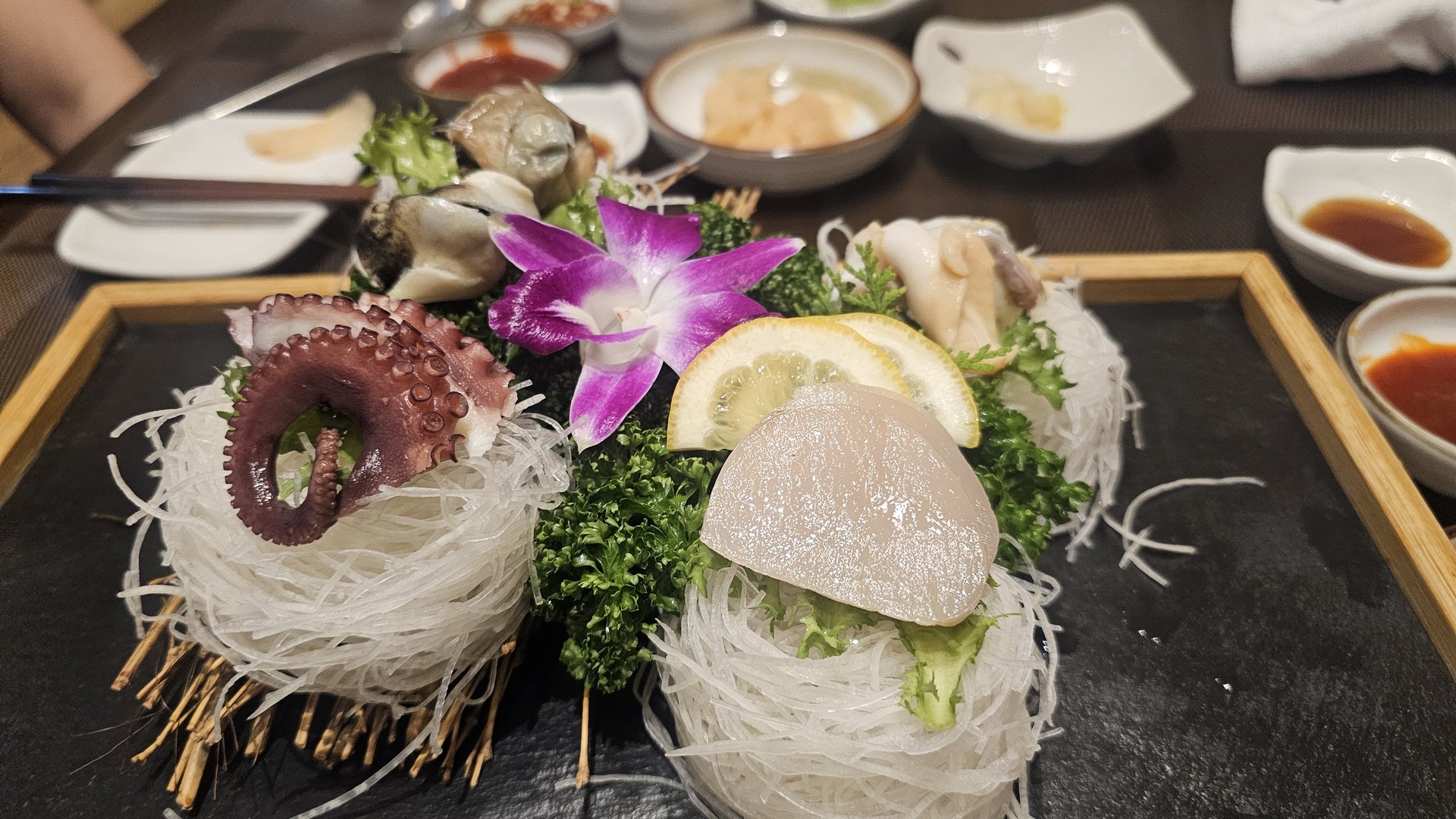
    Seafood assortment of octopus, scallop, and oyster on straw tray with sea urchin garnish at Ginza Yeouido
    Seafood assortment of octopus, scallop, and oyster on straw tray with sea urchin garnish at Ginza Yeouido

    This course included octopus (문어), scallop/gwanja (관자), oyster (굴), and what appeared to be sea urchin (성게) as a garnish on a straw tray. Presentation was genuinely good — the straw tray and careful arrangement made it look more like an omakase counter than a lunch restaurant.

    Octopus was tender, scallop was clean and sweet, oyster was fresh. No complaints on this course.

    Sushi

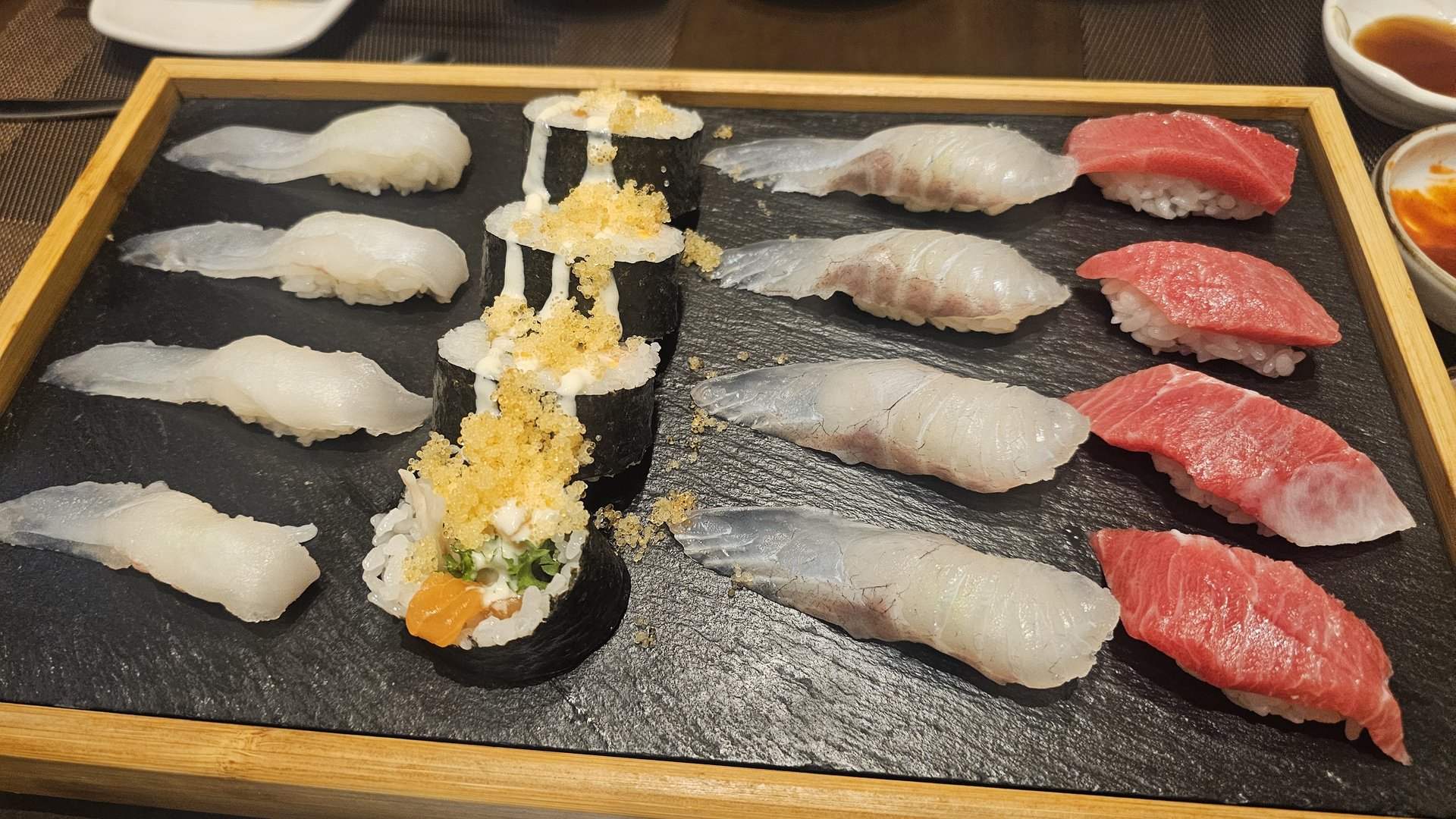
    Assorted sushi on slate board including flounder, otoro tuna, and gunkan rolls at Ginza Yeouido
    Assorted sushi on slate board including flounder, otoro tuna, and gunkan rolls at Ginza Yeouido

    Around 15 pieces of assorted nigiri and gunkan maki served on a slate board: flounder, sea bream, otoro (fatty tuna belly), and a few gunkan-style pieces. The rice was well-seasoned — this is where a lot of Korean Japanese restaurants fall short, but Ginza’s rice temperature and vinegar balance were right.

    Otoro (大トロ) is the fattiest cut of bluefin tuna — melt-on-your-tongue texture, slightly sweet, rich. If you see it on a sushi course in Seoul, it’s a good indicator of the restaurant’s quality ceiling. Theirs was solid.

    Tempura

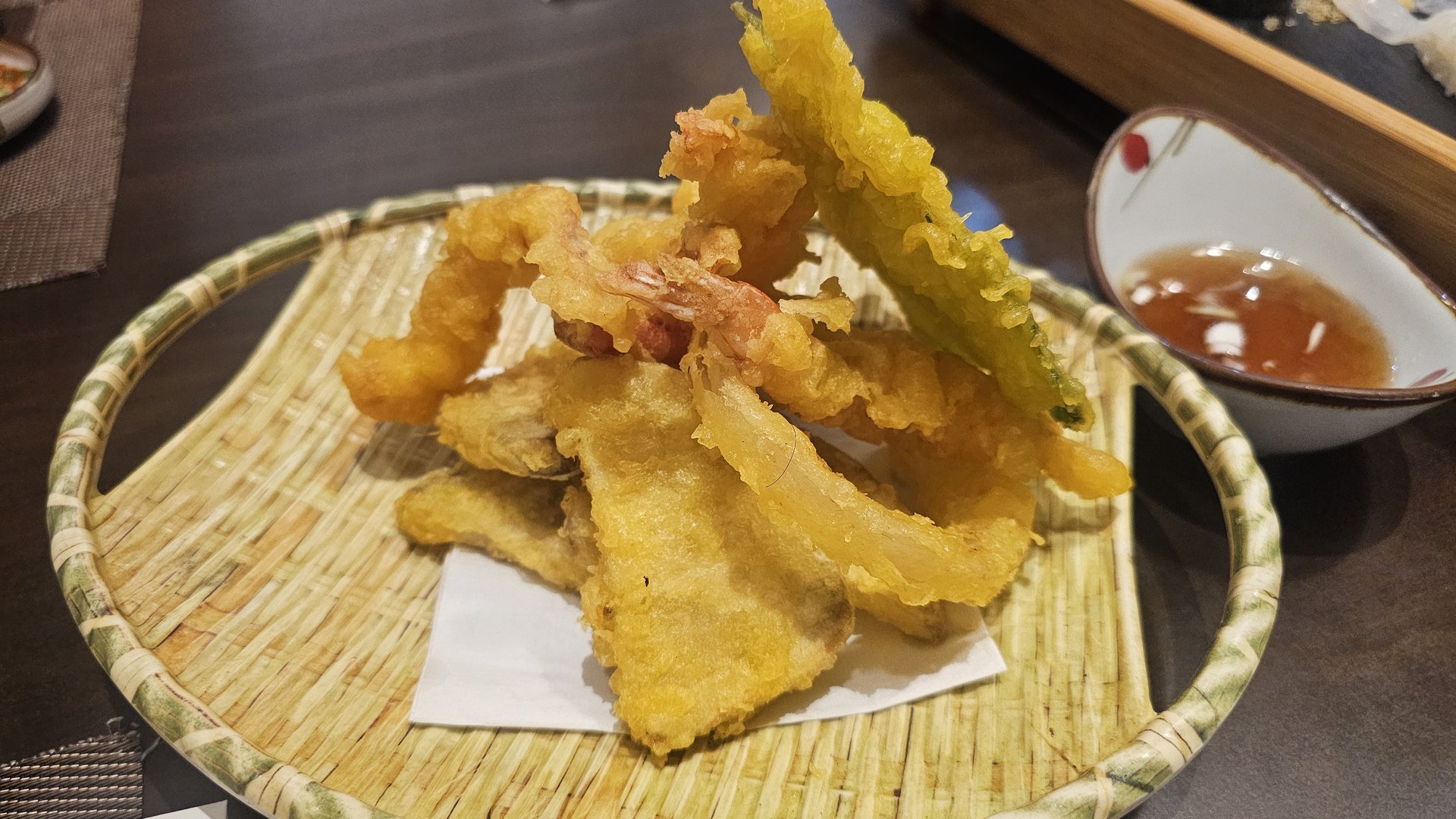
    Tempura assortment of shrimp, fish, and vegetables in bamboo basket with tentsuyu dipping sauce at Ginza Yeouido
    Tempura assortment of shrimp, fish, and vegetables in bamboo basket with tentsuyu dipping sauce at Ginza Yeouido

    Shrimp, fish, and vegetables in a bamboo basket, served with tentsuyu dipping sauce. Batter was light — the right kind of transparent, barely-there crunch. No greasiness. The tentsuyu (天つゆ — a dashi-based dipping broth) was mild and clean.

    Tempura is easy to do poorly. Heavy batter, overcooked shrimp, oil that isn’t hot enough. Ginza’s version had none of those problems.

    Grilled Fish

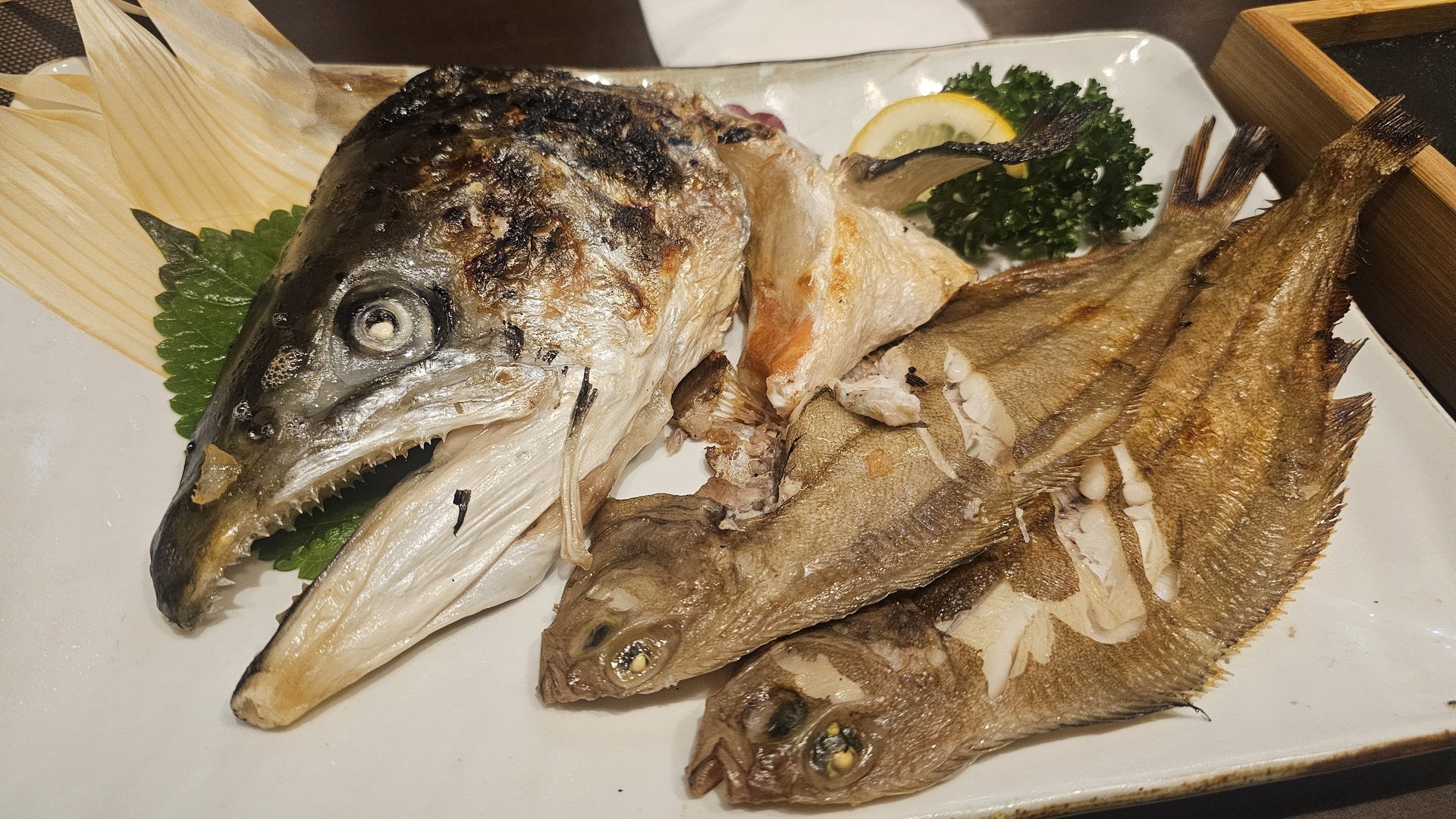
    Grilled fish course with large whole fish head and small grilled fish at Ginza Yeouido
    Grilled fish course with large whole fish head and small grilled fish at Ginza Yeouido

    A large whole fish head plus a couple of smaller whole grilled fish. Visually impressive in the way only a whole grilled fish can be. Skin properly charred, flesh flaky and moist.

    For foreign visitors: eating around a whole fish head is normal at this kind of Korean-Japanese restaurant. Staff can help if you’re not sure how to work through it.

    Noodles and Rice to Finish

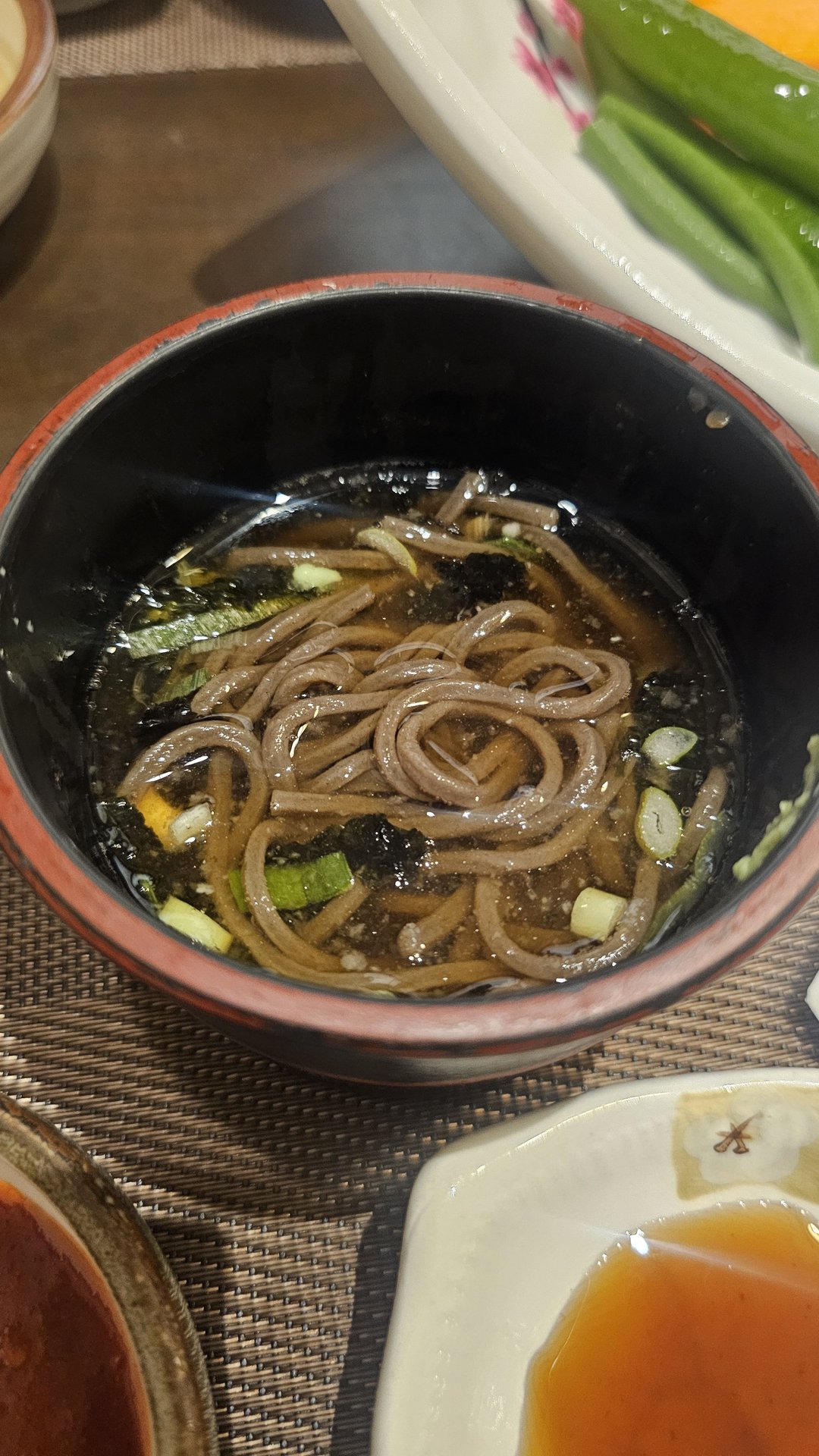
    Hot soba noodles in black lacquer bowl topped with scallions and seaweed at Ginza Yeouido
    Hot soba noodles in black lacquer bowl topped with scallions and seaweed at Ginza Yeouido
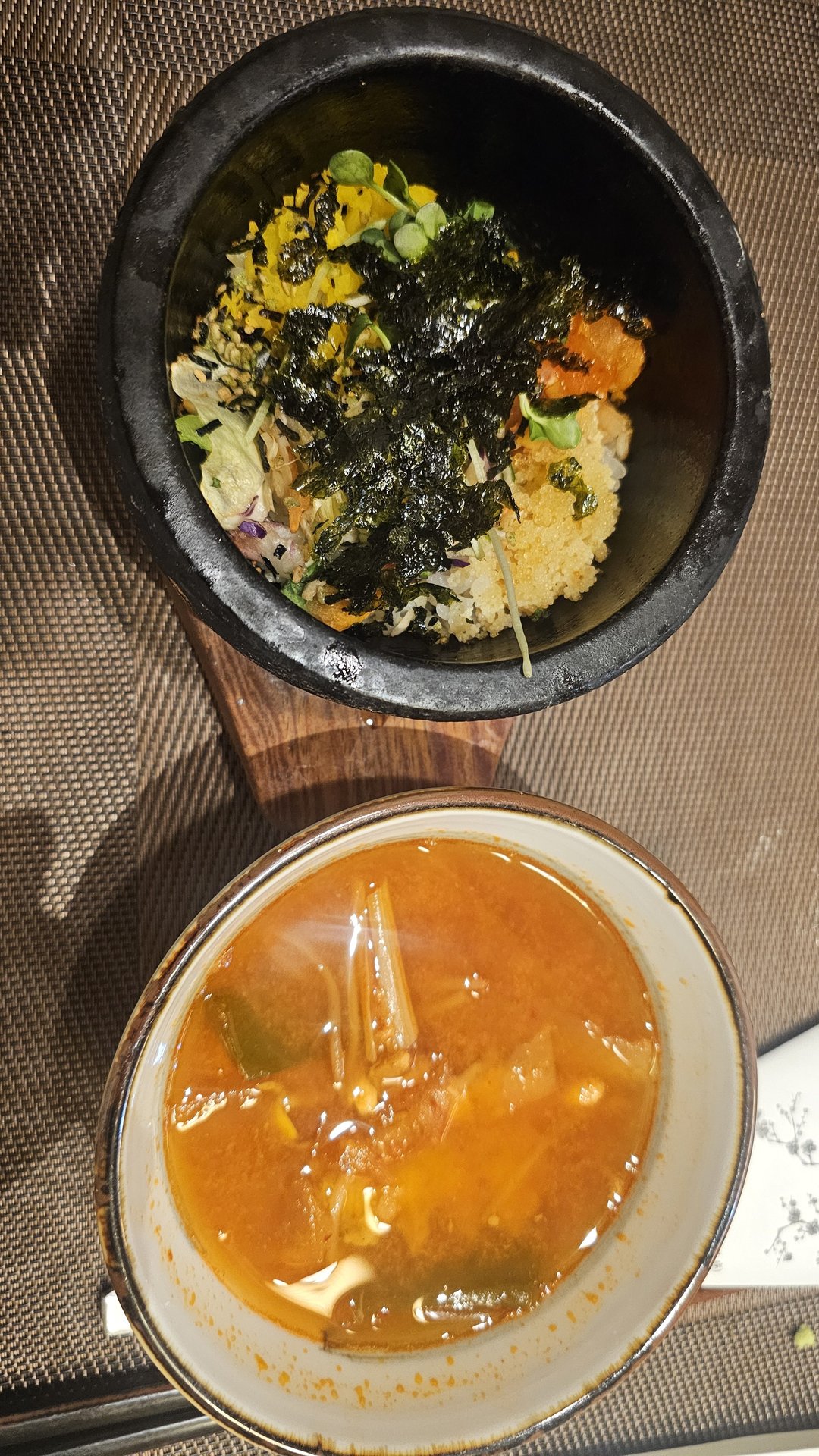
    Stone pot rice and Japanese miso soup finishing course at Ginza Yeouido
    Stone pot rice and Japanese miso soup finishing course at Ginza Yeouido

    Hot soba (温そば — buckwheat noodles in hot dashi broth) with scallions and seaweed, served in a black lacquer bowl. Then stone pot rice (돌솥밥) with Japanese-style miso soup to close the savory courses. The stone pot rice arrived with a slight crunch on the bottom — the scorched rice layer is intentional and considered good by Korean standards.

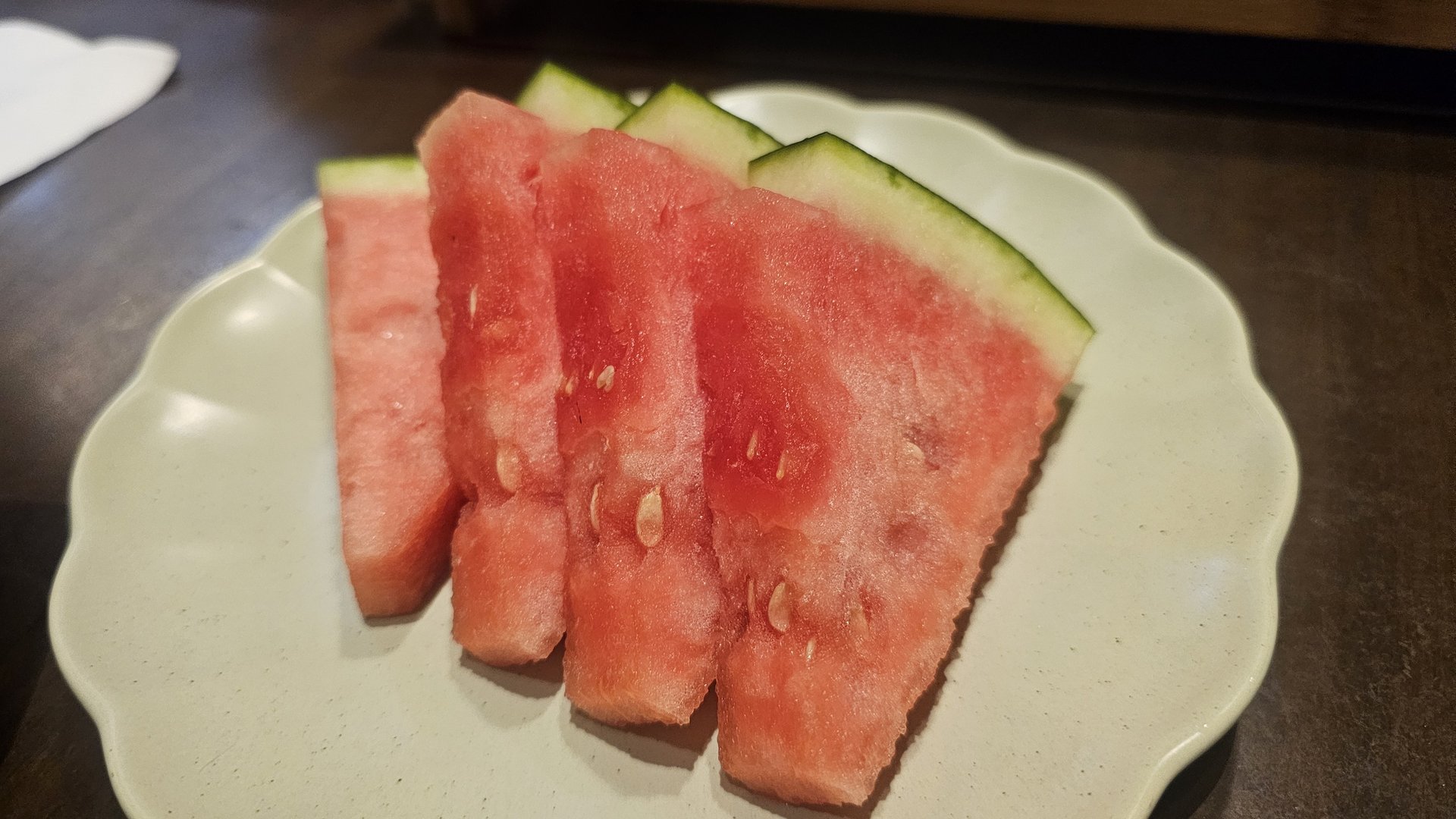
    Dessert watermelon sliced into four triangular pieces on white plate at Ginza Yeouido
    Dessert watermelon sliced into four triangular pieces on white plate at Ginza Yeouido
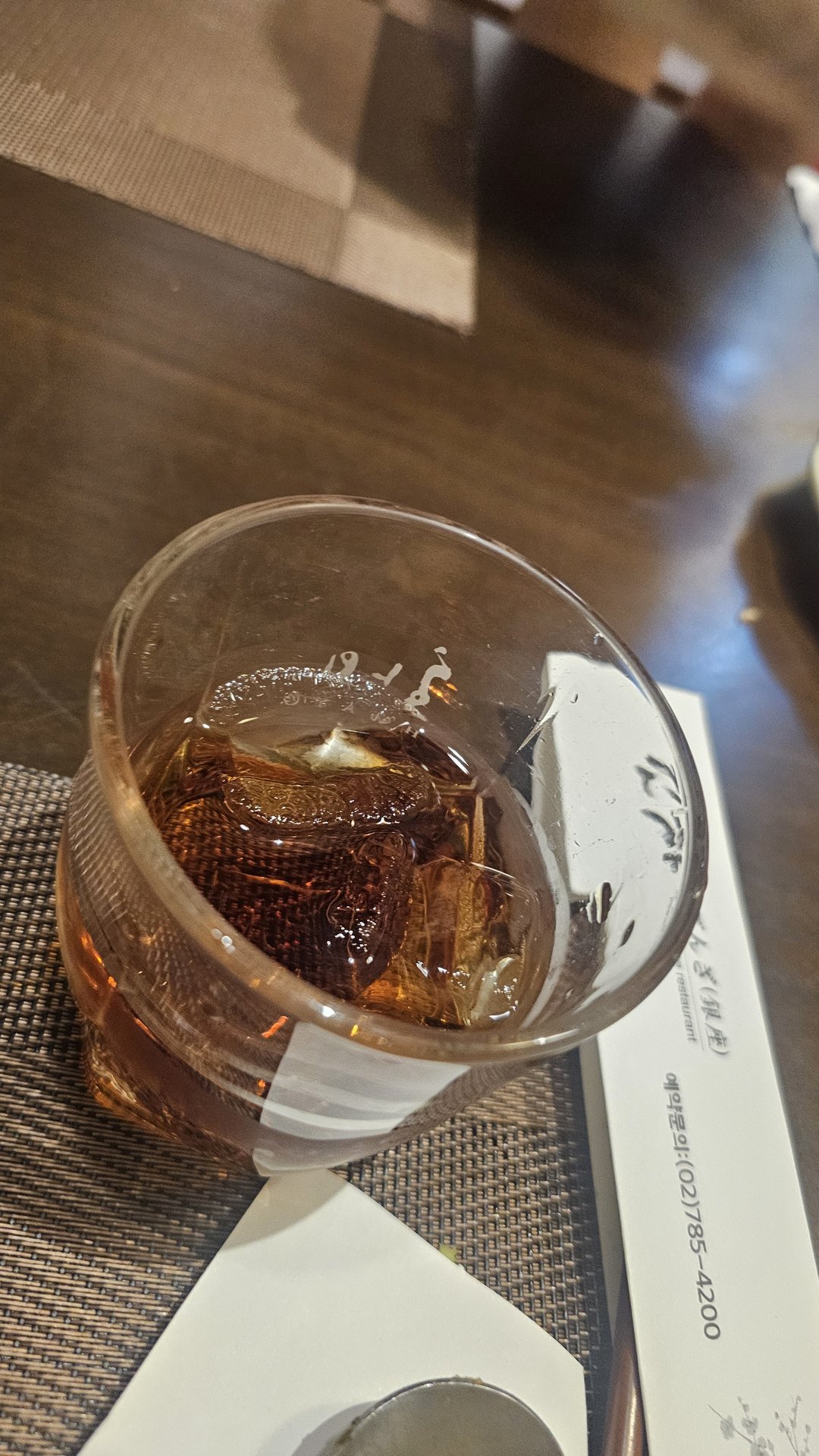
    Iced barley tea on the rocks next to Ginza Yeouido menu booklet
    Iced barley tea on the rocks next to Ginza Yeouido menu booklet

    Dessert was simple: four triangular slices of watermelon on a white plate. Classic light finish after a long meal. Iced barley tea on the side throughout.

    Stuff Tourists Should Know

    Language: The menu is Korean and Japanese. Don’t expect English menus. That said, the course format means you don’t really need to read anything — you pick a price tier, and the kitchen handles the rest. Pointing works.

    Payment: Card payment should be fine at a restaurant at this level. Foreign cards (Visa/Mastercard) are widely accepted in Seoul. Worth confirming at the door.

    Tipping: No tipping in Korea. Don’t tip.

    Dietary restrictions: This is a seafood-heavy Japanese course. Not suitable for vegetarians, vegans, shellfish allergies, or halal requirements. The course structure makes substitutions difficult.

    Groups: Tables are set up for groups of 4+. Solo dining would feel odd here. This is a group meal format.

    Reservation: Strongly recommended, especially at lunch. Yeouido business crowd fills up popular spots.

    Dress code: No strict policy, but the vibe is business casual. You’ll see suits and smart casual. Beach shorts would be out of place.

    The Verdict

    Should you go?

    Depends on what you’re doing in Seoul.

    Business meal or formal occasion in Yeouido — yes, this is the answer. Reliable, quiet, handles the pacing for you.

    Budget is real money to you — the lunch set (40,000–48,000 KRW / ~$30–36 USD) is the smarter entry point. Full Ginza course adds up fast for 4 people.

    You have 5 days in Seoul and want to try everything Korean — probably skip. Spend that money on Korean BBQ, raw crab, or a proper Korean hanjeonsik course. Come back to Japanese cuisine on a longer trip.

    You’ve visited Japan and want to compare — interesting to see the Seoul interpretation. Ginza serves a Korean-inflected Japanese course. The ssam tray and some of the sauce pairings are distinctly Korean. Not pure Japanese omakase, and not trying to be.

    The food was clean. That’s the honest take. Everything was properly cooked, well-presented, and tasted like what it was supposed to taste like. For a 20-year-old restaurant hitting its anniversary, that consistency is the whole point.

    Four of us left satisfied. Nobody had complaints. Nobody had a revelation either. Clean, solid, expensive. Worth it if you’re already in Yeouido and looking for a proper sit-down meal.

    FAQ

    How much does a meal at Ginza Yeouido cost per person?

    Lunch sets run 40,000–48,000 KRW (~$30–36 USD). The full Ginza course goes 68,000–108,000 KRW (~$50–80 USD) per person depending on the tier you choose.

    Do I need a reservation at Ginza Yeouido?

    Strongly recommended, especially for groups of 4 or more. This is a popular business-lunch spot in Seoul’s financial district — walk-ins are hit or miss. Check their official channels or call ahead.

    Is there an English menu at Ginza Yeouido?

    It’s a Korean-run Japanese restaurant, so the menu is primarily in Korean and Japanese. Staff can assist with orders, but don’t expect full English service. Pointing at the course price tiers on the entrance board gets you far.

    What’s included in the Ginza course menu?

    A typical Ginza course runs through multiple stages — sashimi platter, assorted seafood (octopus, scallop, oyster), sushi, tempura, grilled fish, soba, stone pot rice with miso soup, and a light dessert like watermelon. It’s a full meal.

    Is Ginza Yeouido good for a business lunch in Seoul?

    Yes, this is exactly the kind of place Seoul’s financial district crowd uses for client lunches. Private or semi-private table settings, formal Japanese service, and a course format that takes care of the conversation pacing for you.

    Does Ginza Yeouido have any discounts or promotions?

    At time of visit, they had a Friday evening event offering 10% off. Worth checking their current promotions before you go, especially if visiting on a weekday evening.

    You might also like

    📍 Location

    Open in Google Maps →

  • Keep That Coffee in Yeouido: Honest Cafe Review (Seoul)

    Keep That Coffee in Yeouido: Honest Cafe Review (Seoul)

    Quick honest review of Keep That Coffee House in Yeouido. I’m a regular here, so take this as a long-term opinion, not a one-time visit verdict. Short version: one of the better specialty coffee spots in Seoul’s financial district. Come early. Skip the lunch hour if you value your peace.

    Keep That Coffee House Yeouido exterior with floor-to-ceiling glass facade and street trees
    Keep That Coffee House Yeouido exterior with floor-to-ceiling glass facade and street trees

    What Is Keep That Coffee House?

    Keep That (킵댓) is a specialty coffee cafe in Yeouido — Seoul’s version of a financial district, think something like Canary Wharf in London or the FiDi in New York. Office towers, wide streets, the National Assembly building nearby. Not the most touristy part of Seoul, but if you’re visiting Yeouido Hangang Park or just passing through, this is one of the better coffee stops in the area.

    It’s not a chain. The branding is clean and deliberate — logo paper cups, neon sign, wood-tone interior. The kind of place that takes coffee seriously without being pretentious about it.

    Getting There

    Yeouido station (Line 5, Line 9) or National Assembly station (Line 9) — about a 5–10 minute walk depending on which exit.

    From Myeongdong or Hongdae? About 20–30 minutes on the subway. It’s not in the tourist core of Seoul, so unless you’re doing Yeouido specifically, don’t make a special trip just for coffee. But if you’re already here, yes, absolutely stop in.

    From Incheon Airport: roughly 50–60 minutes by AREX + subway.

    Barista preparing drinks at the bar counter with wood-tone interior and neon Keep That logo sign
    Barista preparing drinks at the bar counter with wood-tone interior and neon Keep That logo sign

    The Interior

    Modern minimal. Wood tones everywhere — tables, counters, shelving. The neon Keep That logo on the wall is a good photo backdrop if you’re into that. Large floor-to-ceiling glass windows at the front let in natural light.

    Spacious and clean interior of Keep That Coffee Yeouido with round and oval wooden tables arranged in rows
    Spacious and clean interior of Keep That Coffee Yeouido with round and oval wooden tables arranged in rows

    The seating area is actually spacious for Seoul standards. Round and oval wooden tables spread across the floor — decent group seating, good for solo work too. When I visited early morning, the place was mostly empty and genuinely pleasant to sit in.

    Lunch is a different story. Yeouido office workers flood in around noon and it gets loud. Not unpleasant if you’re grabbing and going, but if you want to sit and drink quietly, the vibe completely changes.

    What I Ordered

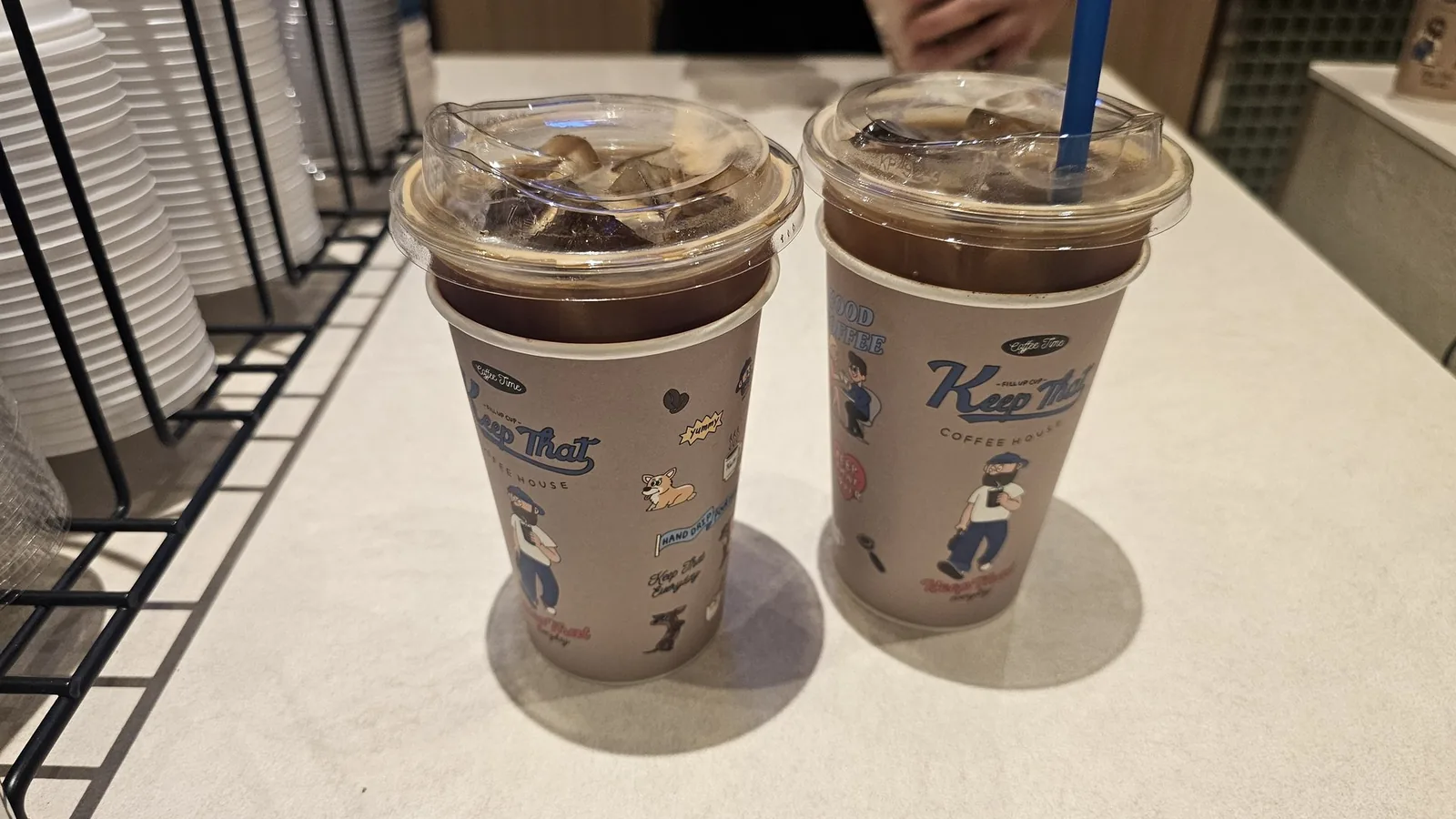
    Two iced Americanos in Keep That Coffee House logo paper cups lined up on the counter
    Two iced Americanos in Keep That Coffee House logo paper cups lined up on the counter

    Two iced Americanos. That’s it.

    Look, sometimes you just want a clean cup of coffee. This delivers. The taste is crisp — not acidic, not bitter, not watery. You can tell the beans aren’t supermarket grade. It’s the kind of Americano you come back to, which is exactly what I do. I’m a regular.

    It’s not going to blow your mind if you’ve been to Tokyo’s specialty coffee scene or Melbourne’s cafe culture. But for Yeouido, for a quick morning coffee before doing whatever you’re doing in this part of Seoul? It’s genuinely good.

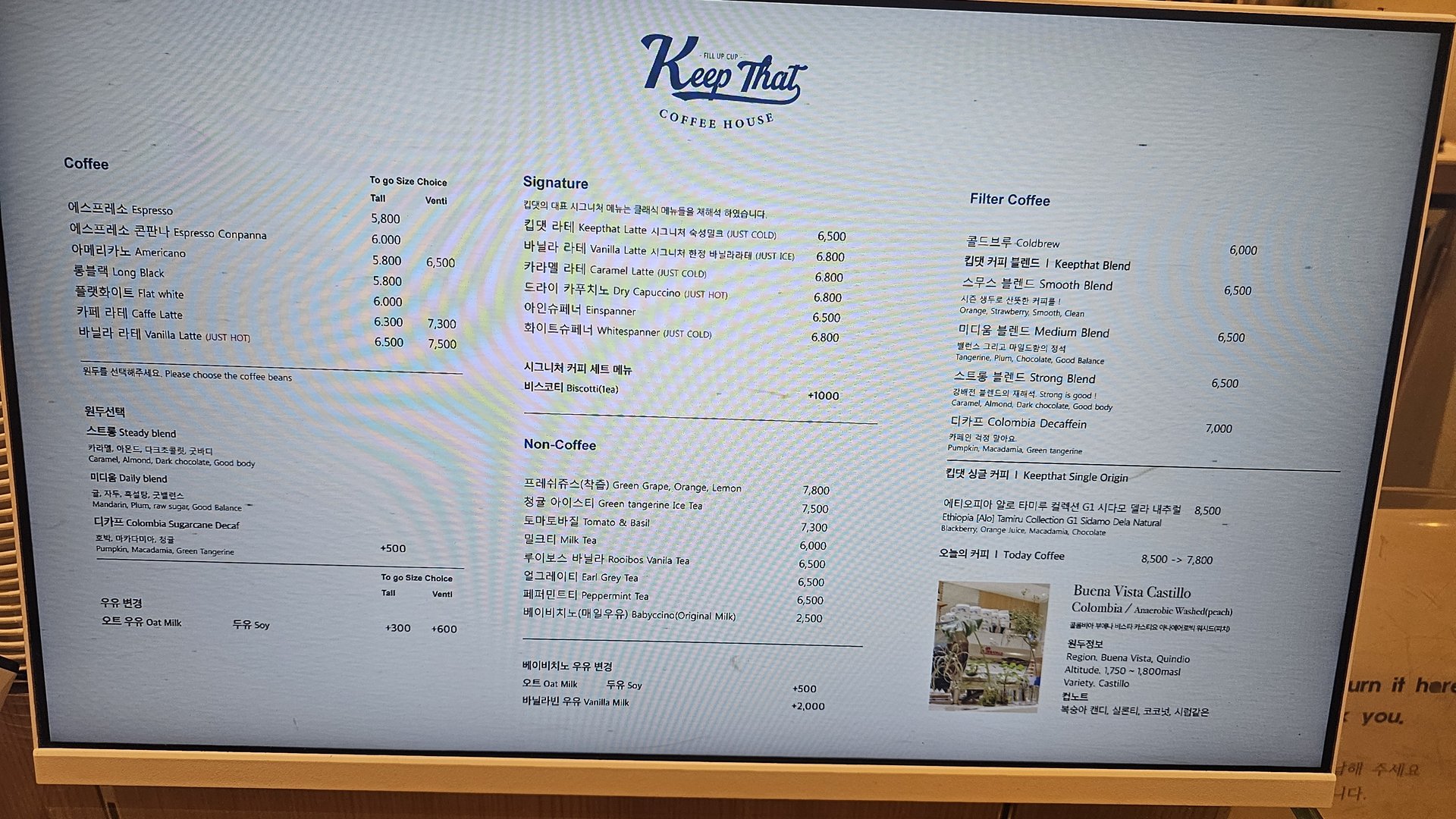
    Keep That Coffee House full menu board showing coffee, signature, non-coffee, and filter coffee with prices
    Keep That Coffee House full menu board showing coffee, signature, non-coffee, and filter coffee with prices

    The menu has more than just Americanos — signature drinks, non-coffee options, filter coffee. Prices are reasonable for the specialty coffee tier in Seoul, generally 4,500–6,000 KRW (~$3.30–$4.50 USD) range for espresso drinks.

    Stuff Tourists Should Know

    Language: Basic English is fine for ordering. The menu board is visible and self-explanatory. You can point if needed. No stress.

    Payment: Card works. Foreign cards should be fine — most Seoul cafes handle international Visa/Mastercard without issues. There’s no tipping culture in Korea, so don’t worry about that.

    Timing: Early morning is the move. The place is calm, the coffee is fresh, and you get to actually enjoy the nice interior. Lunch rush (roughly 12–1:30 PM on weekdays) is hectic. If you’re in Yeouido at that time and need coffee, fine — just grab and go rather than expecting a relaxed sit-down.

    Nearby: Yeouido Hangang Park is a short walk away. If you’re doing the park in the morning, this is a natural coffee stop before or after. The National Assembly building is also close if you’re doing a Seoul architecture/landmark tour.

    Takeaway vs. Dine-in: Both work. The paper cups with the Keep That logo are clean and well-made — takeaway is fine if you’re heading to the park.

    The Verdict

    Should you go?

    – If you’re in Yeouido for any reason — yes. One of the better coffee options in the area.

    – If you’re doing a Seoul cafe crawl specifically — probably not worth the detour from Hongdae, Ikseon, or Seongsu where the cafe density is higher.

    – Morning visit? Do it. Lunch hour? Grab and go, don’t linger.

    It’s a solid regular spot. I keep coming back, which says more than any review.

    FAQ

    What is Keep That Coffee House in Yeouido?

    It’s a specialty coffee cafe in Seoul’s Yeouido financial district, known for its clean minimal interior and well-made espresso drinks. Popular with office workers.

    Is Keep That Coffee good for tourists?

    Yes — it’s easy to order (menu board is visible, basic English works fine), and the area is near Yeouido Hangang Park if you’re already in the neighborhood.

    How crowded does it get?

    Early morning is calm and relaxed. Weekday lunch hours (12–1:30 PM) get packed and noisy with office workers. If you want a quiet coffee, come before 10 AM.

    How much does coffee cost at Keep That Coffee Yeouido?

    Expect around 4,500–6,000 KRW (~$3.30–$4.50 USD) for espresso-based drinks. Filter coffee and signature drinks may run a bit higher. Check their Instagram for the current menu.

    Where is Keep That Coffee in Yeouido and how do I get there?

    It’s in Yeouido, Seoul’s financial district. The nearest subway stations are Yeouido (Line 5 and 9) or National Assembly (Line 9). A 5–10 minute walk from either exit.

    Do they have non-coffee options?

    Yes — the menu includes non-coffee drinks alongside their espresso and filter coffee lineup.

    You might also like

    📍 Location

    Open in Google Maps →

  • Jingawa Yeouido: Honest Review of Japanese Set Lunch in Seoul

    Jingawa Yeouido: Honest Review of Japanese Set Lunch in Seoul

    Quick honest review of Jingawa (진가와) in Yeouido — a Japanese teishoku restaurant doing cold soba and warm udon sets. This is one of those places you keep coming back to when you want a clean, no-fuss lunch. Short version: the chadol miso udon is the dish to order, the full set format is genuinely good value, and the interior is nicer than most Yeouido spots. Not cheap at ~26,500 KRW (~$19.60) per person, but this is Yeouido — you’re not hunting for budget kimbap here.

    Visited on a Monday morning, right at 11 AM opening. The hall was nearly empty. Good time to go.

    What Is Teishoku? (The Format, Explained)

    If you’re not familiar with teishoku (定食) — it’s the Japanese concept of a complete set meal. You pick one main dish and everything else comes with it: sides, soup, small accompaniments. No need to order separately. One item on the menu, full meal on the table.

    At Jingawa, that means: your noodle bowl (hot udon or cold soba/somen) + a tempura plate with shrimp and vegetable tempura + two pieces of nigiri sushi + pickled radish and small condiment sides. It all arrives together.

    The Korean word for this format is 정식 (jeongshik) — you’ll see it on menus all over Korea. Jingawa does a Japanese-leaning take on it, with the noodle bowl as the centrepiece.

    About Jingawa

    Jingawa is a noodle teishoku restaurant in Yeouido — Seoul’s financial district, similar to Canary Wharf or Wall Street. The clientele is mostly office workers and business lunch crowds from nearby towers. The restaurant opens at 11 AM, which is noticeably earlier than most Seoul restaurants (most open at 11:30 or noon).

    Menu focus: cold noodles (soba and somen variations) and warm udon, each served as a full set. Prices run 25,000–31,000 KRW (~$18.52–$22.96 USD). This isn’t a cheap lunch stop, but everything is included in that price.

    Getting There

    Yeouido is one of the easier parts of Seoul to reach by subway:

    Line 5: Yeouido Station (여의도역) — Exit 1 or 2

    Line 9: National Assembly Station (국회의사당역)

    From Incheon Airport (ICN): About 60–70 minutes via Airport Railroad + Line 9, or roughly 40–50 minutes by taxi (expect 45,000–60,000 KRW / ~$33–$44)

    If you’re already in Yeouido for IFC Mall, the 63 Building, or Hangang Park — Jingawa is easy to fold in for lunch.

    The Interior

    Interior of Jingawa Yeouido with wooden tables and black iron chairs under warm lighting
    Interior of Jingawa Yeouido with wooden tables and black iron chairs under warm lighting
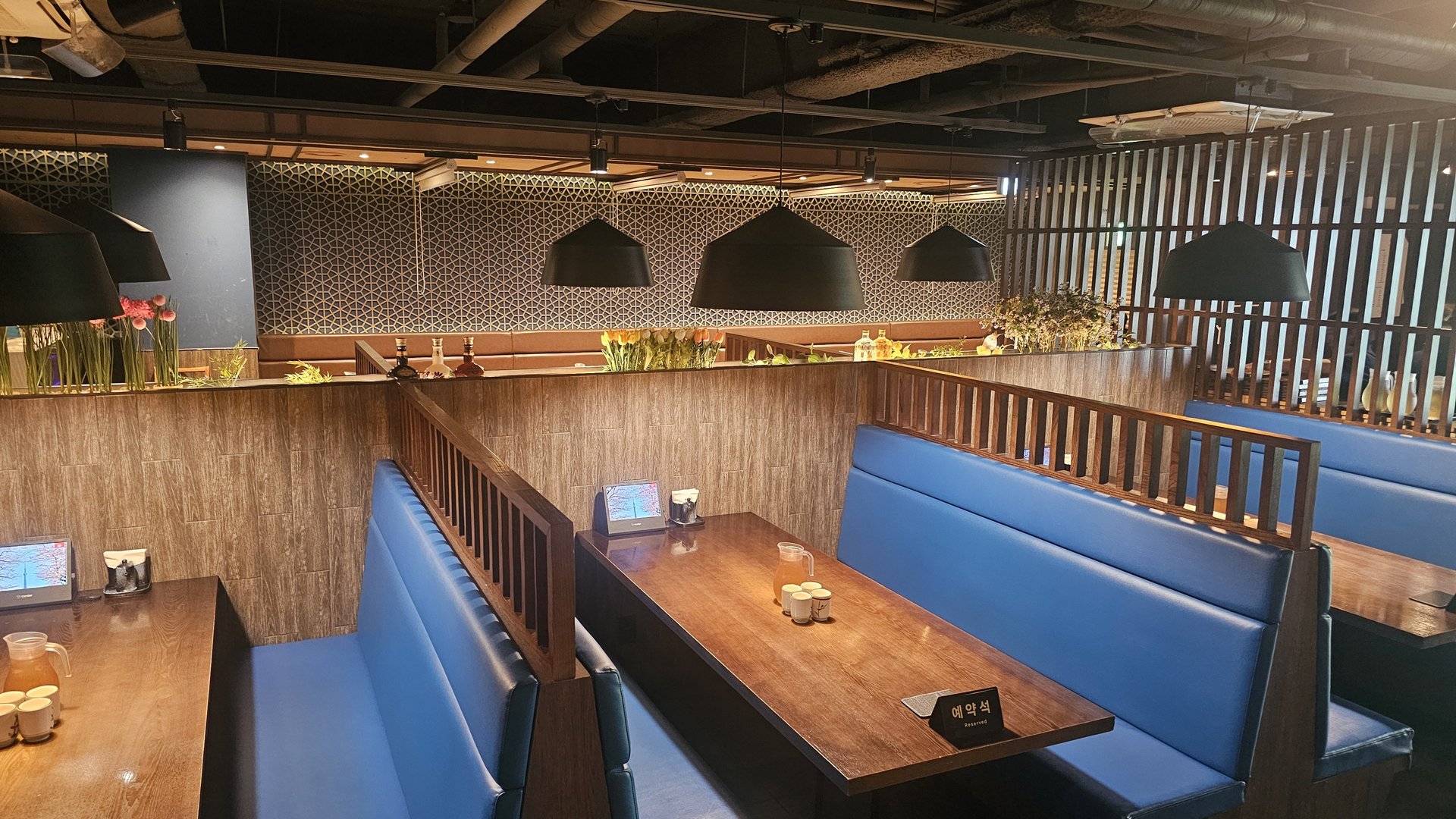
    Upper seating area at Jingawa Yeouido featuring blue fabric booth sofas and wooden partition dividers
    Upper seating area at Jingawa Yeouido featuring blue fabric booth sofas and wooden partition dividers

    Genuinely nice. Wooden tables, black iron chairs on the main floor. Upper level has booth seating with blue fabric upholstery and wooden partition panels between sections. Soft lighting throughout. Quiet — especially at opening hour.

    It doesn’t feel like a typical Seoul lunch place. No blaring K-pop, no cramped tables. The vibe is calm, a bit formal, well put-together. Good for a business-ish lunch or just when you want to eat without noise.

    The Menu

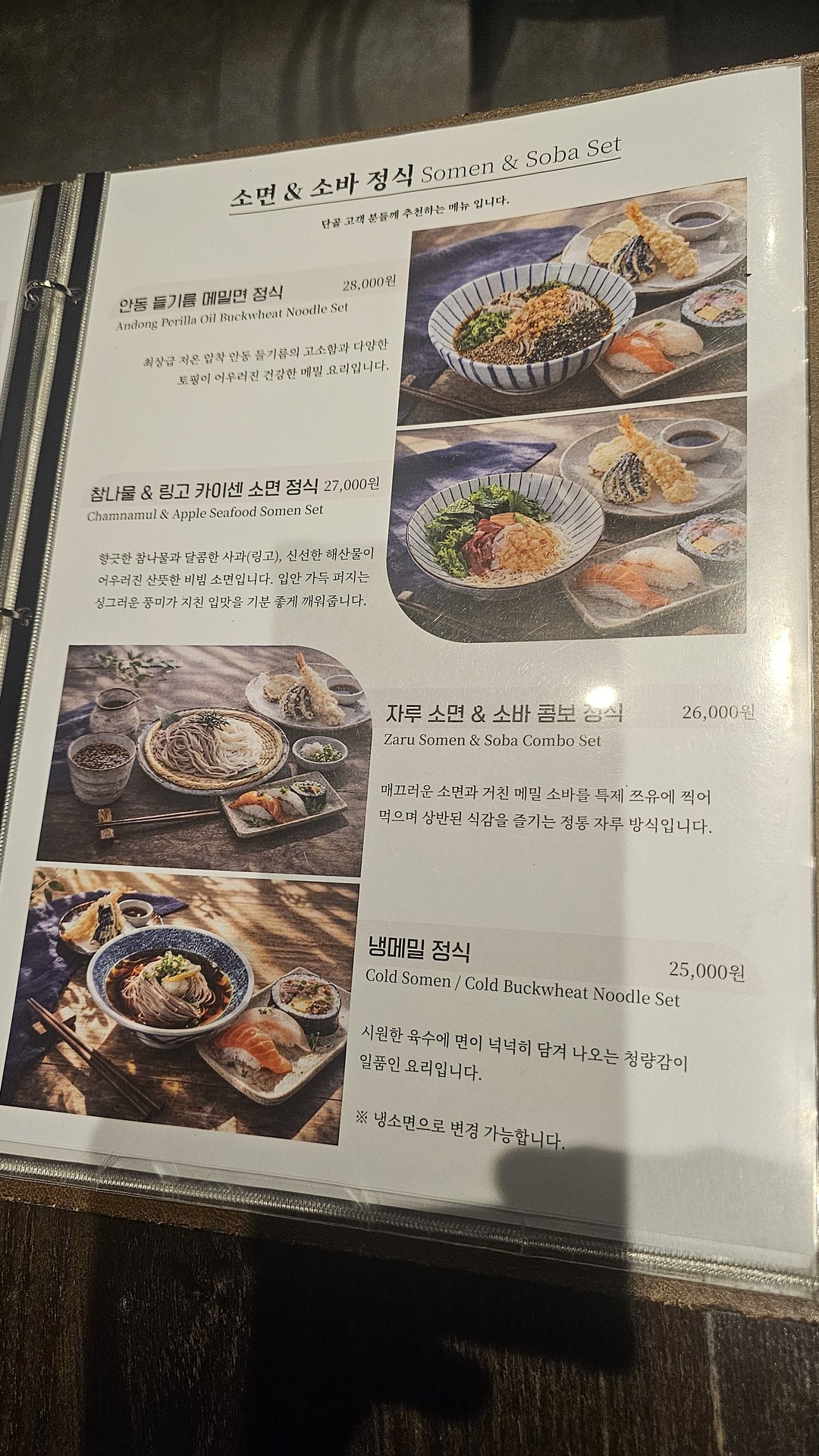
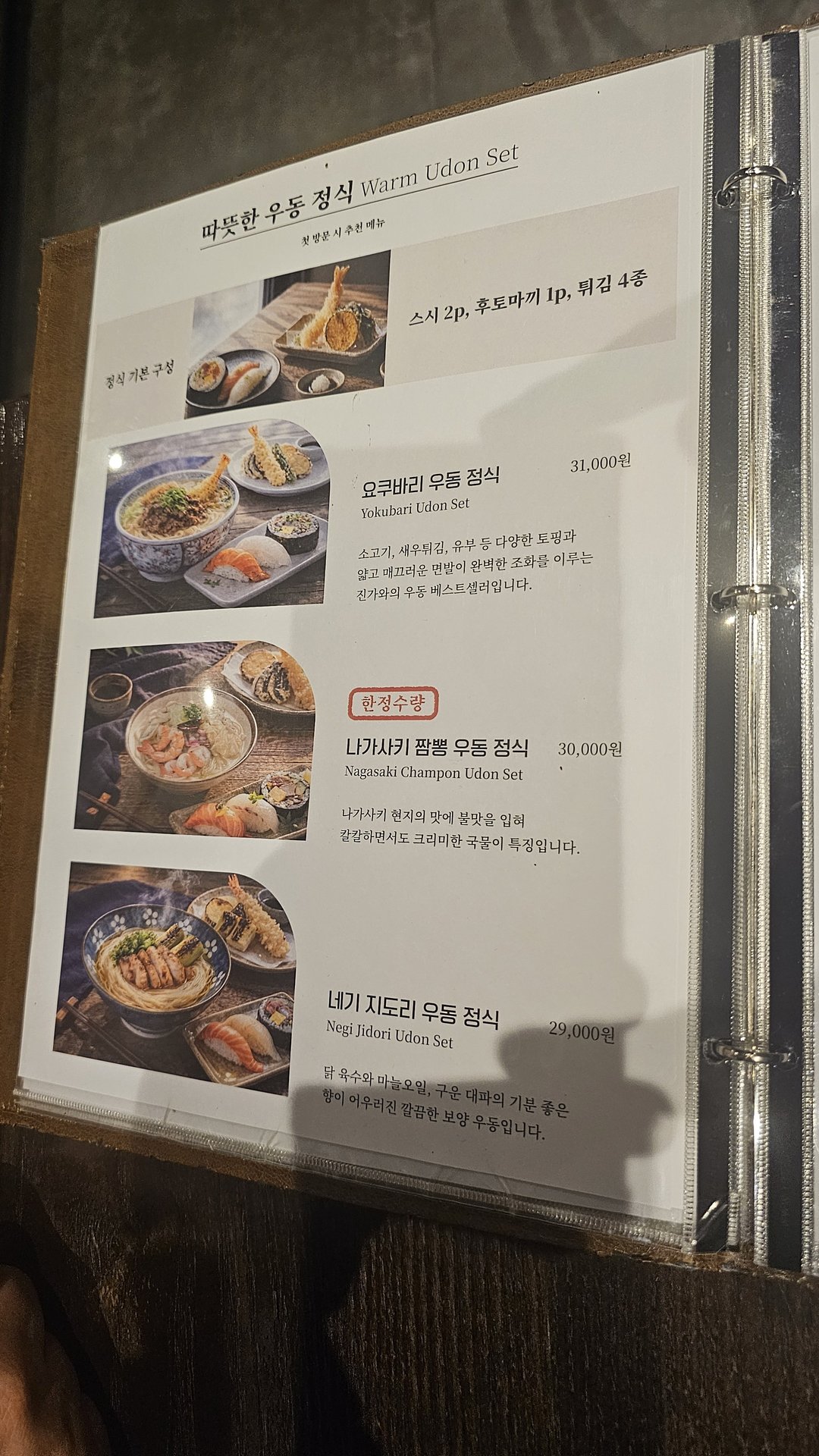
    Jingawa Yeouido cold noodle menu page showing somen and soba set meals ranging from 25,000 to 28,000 KRW
    Jingawa Yeouido cold noodle menu page showing somen and soba set meals ranging from 25,000 to 28,000 KRW
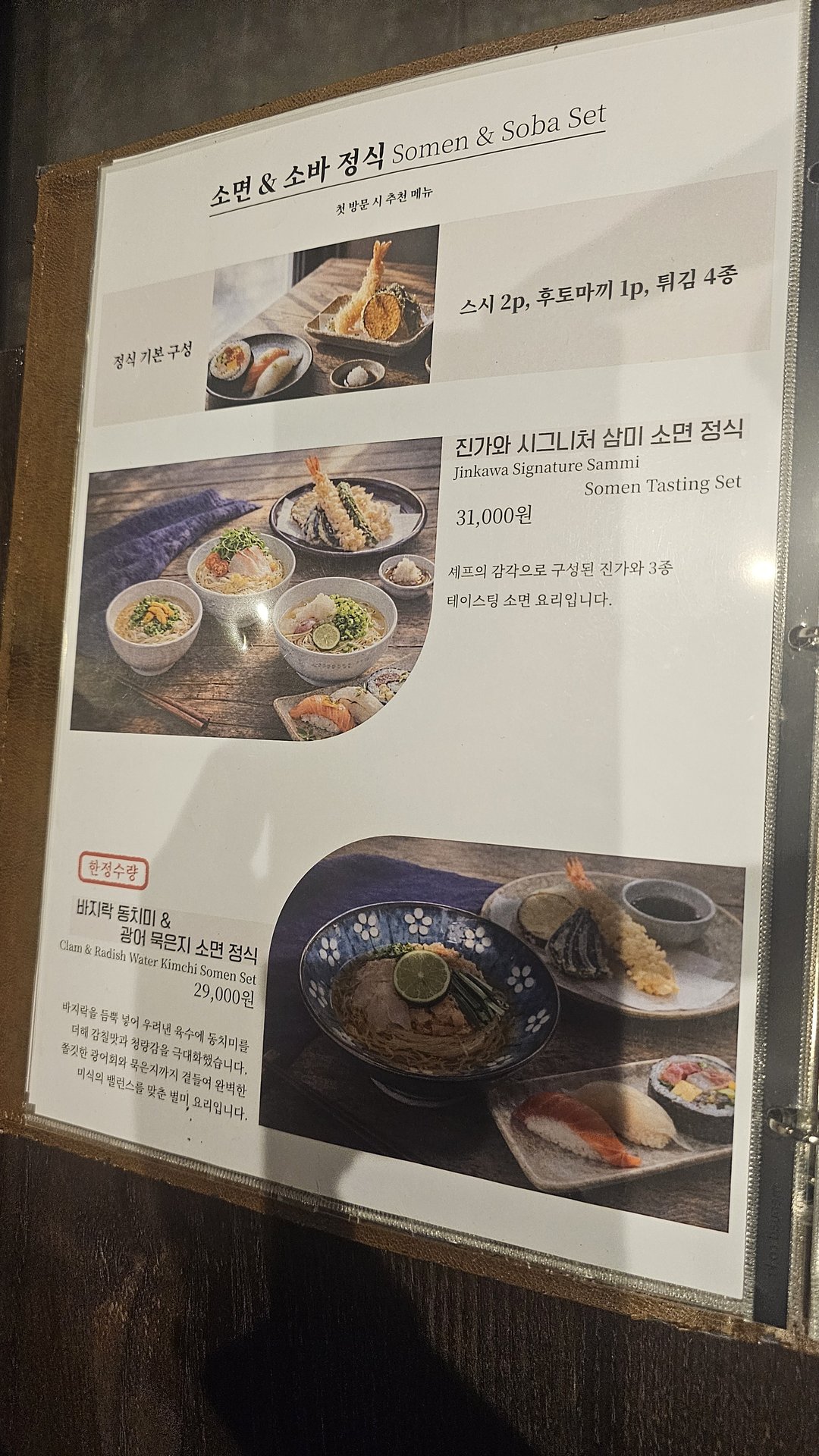
    Jingawa Yeouido signature somen menu page with Sammi somen set and clam cold noodle set priced at 29,000 to 31,000 KRW
    Jingawa Yeouido signature somen menu page with Sammi somen set and clam cold noodle set priced at 29,000 to 31,000 KRW
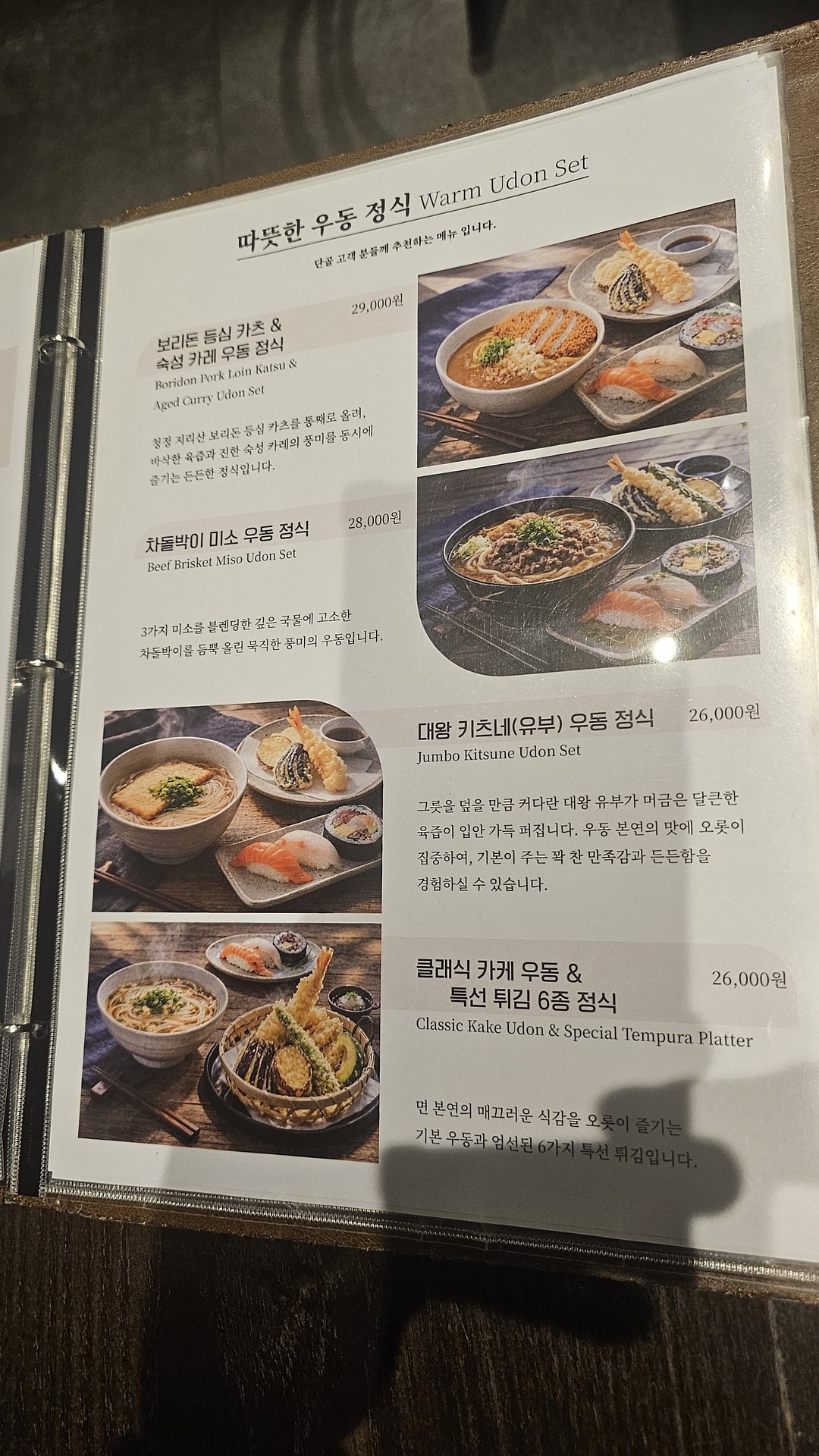
    Jingawa Yeouido warm udon menu page featuring chadol miso udon and pork katsu curry udon sets
    Jingawa Yeouido warm udon menu page featuring chadol miso udon and pork katsu curry udon sets
    Jingawa Yeouido udon menu page with yokubari udon, Nagasaki chanpon udon, and negi jidori udon sets
    Jingawa Yeouido udon menu page with yokubari udon, Nagasaki chanpon udon, and negi jidori udon sets

    Two main categories:

    Cold noodles (소면 & 소바 정식):

    – Cold Buckwheat Soba Set (냉메밀 정식): 25,000 KRW (~$18.52) — the entry point

    – Clam Cold Noodle Set (바지락 통도치미 소면 정식): 29,000 KRW (~$21.48)

    – Signature Sammi Somen Set (시그니처 삼미 소면 정식): 31,000 KRW (~$22.96) — three-part cold noodle set, most expensive in this category

    Warm udon (따뜻한 우동 정식):

    – Chadol Miso Udon Set (차돌박이 미소 우동 정식): 28,000 KRW (~$20.74)

    – Pork Katsu Curry Udon Set (보리멘 돼지카츠 카레 우동 정식): 29,000 KRW (~$21.48)

    – Classic Kake Udon with Assorted Tempura (클래식 카케 우동 & 특선 튀김 6종 정식): 26,000 KRW (~$19.26) — lowest-priced udon set

    – Nagasaki Chanpon Udon (나가사키 찬폰 우동 정식): 30,000 KRW (~$22.22)

    Honestly, if you’re going once, just get the chadol miso udon.

    What I Ordered

    Total for two: 53,000 KRW (~$39.26).

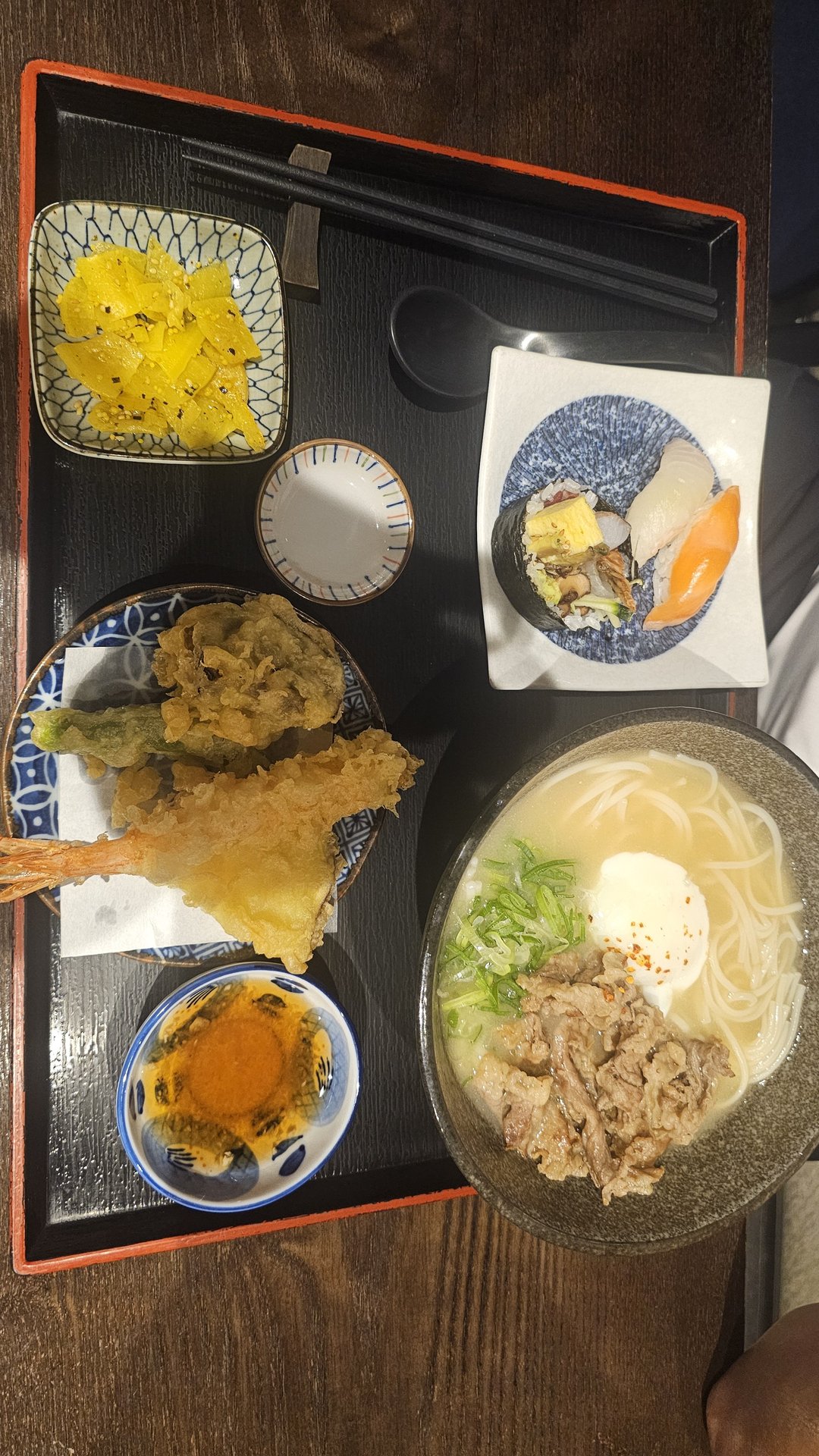
    Chadol Miso Udon Set — 28,000 KRW (~$20.74)

    Chadol (차돌박이) is thinly sliced beef brisket — the same cut you’d see on a Korean BBQ grill, but here it goes into the udon broth. The miso is white-style (shiro miso), lighter and less intense than the red miso you might know from miso soup. The broth is clean and slightly sweet.

    Chadol miso udon set meal at Jingawa Yeouido featuring thinly sliced beef brisket, soft-boiled onsen tamago egg, green onions, shrimp and vegetable tempura, and nigiri sushi
    Chadol miso udon set meal at Jingawa Yeouido featuring thinly sliced beef brisket, soft-boiled onsen tamago egg, green onions, shrimp and vegetable tempura, and nigiri sushi

    On top: onsen tamago — a slow-cooked soft egg where the white is just barely set and the yolk stays runny — and thin green onion slices. The egg breaks into the broth and rounds it out.

    The set includes a separate tempura plate (shrimp tempura plus vegetable tempura), two pieces of nigiri sushi, pickled radish, and small sauce sides. It’s a lot of food. You won’t leave hungry.

    This is the dish to order.

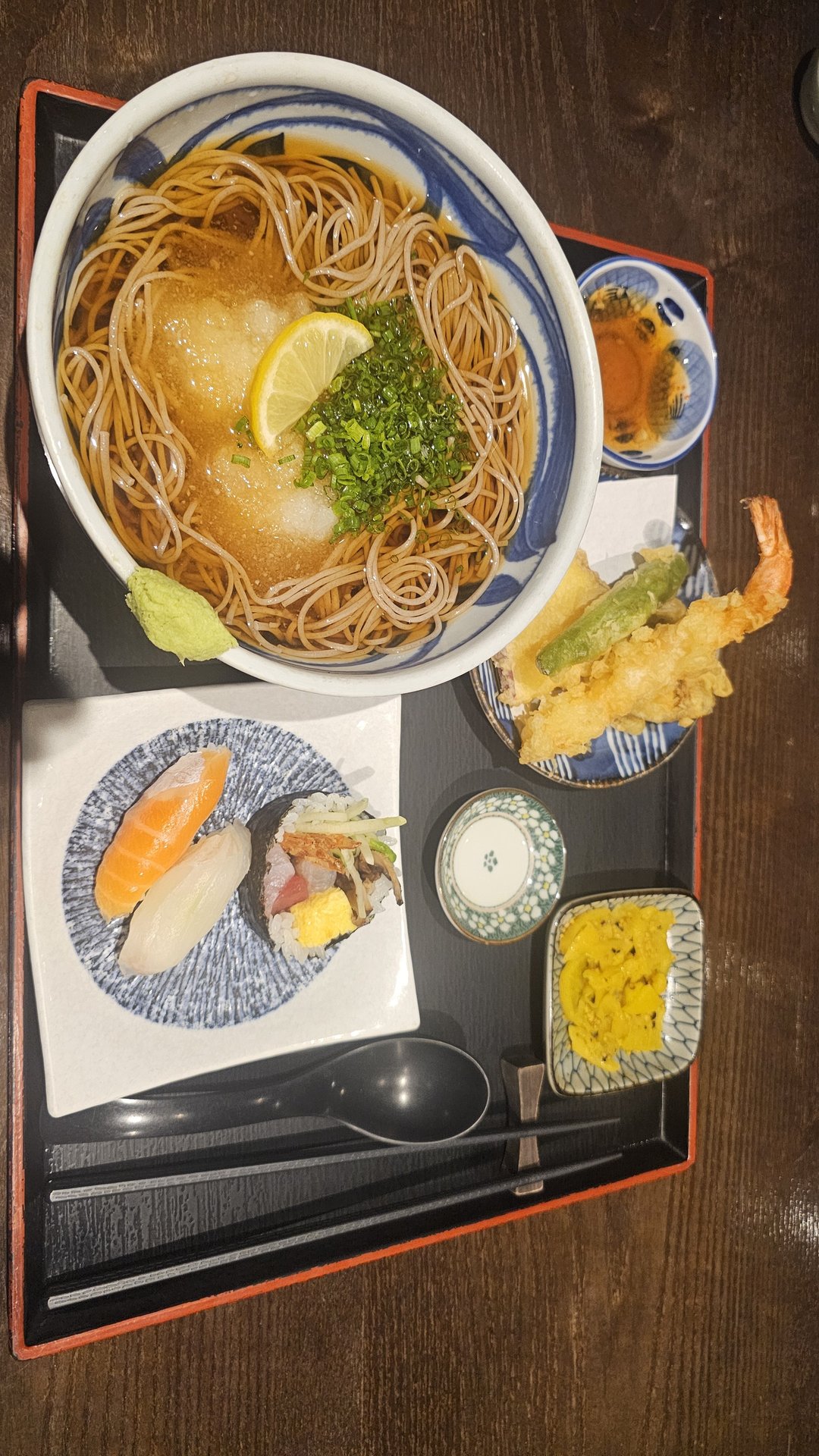
    Cold Buckwheat Soba Set — 25,000 KRW (~$18.52)

    Cold buckwheat soba set meal at Jingawa Yeouido with grated daikon radish, lemon, shrimp tempura, vegetable tempura, and two pieces of nigiri sushi
    Cold buckwheat soba set meal at Jingawa Yeouido with grated daikon radish, lemon, shrimp tempura, vegetable tempura, and two pieces of nigiri sushi

    Zarusoba style — chilled buckwheat noodles served on a bamboo tray. Grated daikon radish and a slice of lemon on top. You pour a bit of the tsuyu dipping broth into a small cup, add the daikon, and dip the noodles in as you eat.

    Same sides as the udon: tempura plate, two pieces of nigiri, pickled radish.

    It’s good. Solid cold soba, nothing to complain about. Refreshing for summer. But compared to the udon, it’s the quieter dish — simpler flavours, less going on. If you know cold soba and that’s what you want, this is a reliable version. If you’re deciding between the two: get the udon.

    Stuff Tourists Should Know

    Language: The menu is in Korean. The dish names are Japanese-influenced, which doesn’t help much if you don’t read either. That said, pointing at menu photos works fine — staff in Yeouido are used to non-Korean speakers. Basic English communication should be fine.

    Payment: Cards are standard everywhere in Yeouido. Foreign Visa and Mastercard work without issue. Cash also accepted. No tipping — it’s not done in Korea. Do not leave money on the table.

    Opening hours: They open at 11 AM. If you arrive before noon, you’ll likely walk right in. After 12:30 PM, the Yeouido office lunch rush kicks in.

    Diet restrictions: The tempura includes shrimp, and most broths are dashi-based (made from fish stock). Vegetarians and vegans will have a hard time here. No halal options. Gluten-free is not possible — noodles throughout.

    Kids: The format is calm and quiet. Kids are fine in terms of space and seating, but the menu is noodle-heavy and some younger kids might not be into cold soba. The udon is a safer bet for families.

    Solo dining: Totally fine. Counter seating or booth for one is no issue.

    Group size: Tables and booths handle 2–4 comfortably. Probably not the spot for groups of 6+, especially without a reservation.

    The Verdict

    Jingawa is a reliable, polished lunch option in Yeouido. Not trying too hard, not coasting either. The chadol miso udon delivers a complete meal — good broth, proper protein, and the full set format means you don’t need to think about ordering sides. The interior is genuinely pleasant. Early morning timing works in your favour.

    Is it worth going out of your way for? If you’re already in Yeouido, yes — it’s one of the better sit-down lunch spots. If you’re doing a tight 3-day Seoul itinerary, prioritize Korean food first. Come to Jingawa on a longer trip when you’re ready for something a bit different.

    Who should go:

    – In Yeouido for the day and want a proper sit-down lunch — yes

    – Into Japanese teishoku style and curious how Seoul does it — yes

    – Want to try Korean food while in Seoul — skip this one and go get galbi or samgyeopsal instead

    – Tight budget — the sets start at 25,000 KRW (~$18.52), which is mid-range for Seoul. Not expensive, but not cheap.

    Would I come back? Yeah. It’s already in the regular rotation.

    FAQ

    What is the average price per person at Jingawa Yeouido?

    Sets range from 25,000 to 31,000 KRW (~$18.50–$23 USD) per person, all-in. Each set includes the main noodle dish, a tempura plate, two pieces of nigiri sushi, and small sides. Budget around 26,500 KRW (~$19.60) as a realistic average.

    What should I order at Jingawa Yeouido?

    The Chadol Miso Udon Set (차돌박이 미소 우동 정식, 28,000 KRW / ~$20.74). Thinly sliced beef brisket in white miso udon broth, plus a full tempura plate and sushi. If you prefer cold noodles, the Cold Buckwheat Soba Set is the simpler, slightly cheaper pick.

    What time does Jingawa Yeouido open, and do I need a reservation?

    They open at 11 AM — earlier than most Seoul restaurants. Walk-ins work fine at opening. By 12:30 PM, Yeouido office lunch crowds show up, so arriving early is the smarter move. Check Naver Map or Kakao Map for reservations if you’re coming during peak hours.

    Is there an English menu at Jingawa Yeouido?

    The printed menu is in Korean, but the dishes are Japanese-influenced and most items have enough context to navigate by pointing. Staff in Yeouido generally handle basic English without issue.

    Is Jingawa suitable for vegetarians or people with dietary restrictions?

    Not really. Most broths are dashi-based (fish stock) and the tempura sets include shrimp. Vegetarian, vegan, and halal options are very limited here.

    Can I pay with a foreign credit card at Jingawa Yeouido?

    Yes. Card payment is standard across Yeouido. Foreign Visa and Mastercard work fine. No tipping needed — tipping is not a custom in Korea.

    You might also like

    📍 Location

    Open in Google Maps →

  • Sushi Yu in Yeouido: Honest Review of a Seoul Sushi Lunch

    Sushi Yu in Yeouido: Honest Review of a Seoul Sushi Lunch

    Quick honest review of Sushi Yu (스시유) in Yeouido — a Japanese sushi restaurant in Seoul’s financial district with a bronze plaque from Korean TV to back up its reputation. Short version: we went four people, ordered kaisendon, a 12-piece nigiri set, unaju, and tempura on the side. All of it was good. Left satisfied.

    If you’re eating lunch in Yeouido and want actual Japanese food — not a mall food court, not a chain — this is a solid choice.

    We visited on a Thursday, lunch service.

    What Is Sushi Yu?

    Sushi Yu is a mid-to-upscale Japanese restaurant focused on sushi and traditional Japanese set lunches. Think hand-formed nigiri, kaisendon (seafood sashimi rice bowls), unaju (grilled eel over rice in a lacquer box), and tempura. Sit-down service, proper tableware, the kind of place where the miso soup arrives in a lacquer bowl.

    Not a conveyor belt. Not a Korean-Japanese fusion place. Traditional Japanese, done seriously.

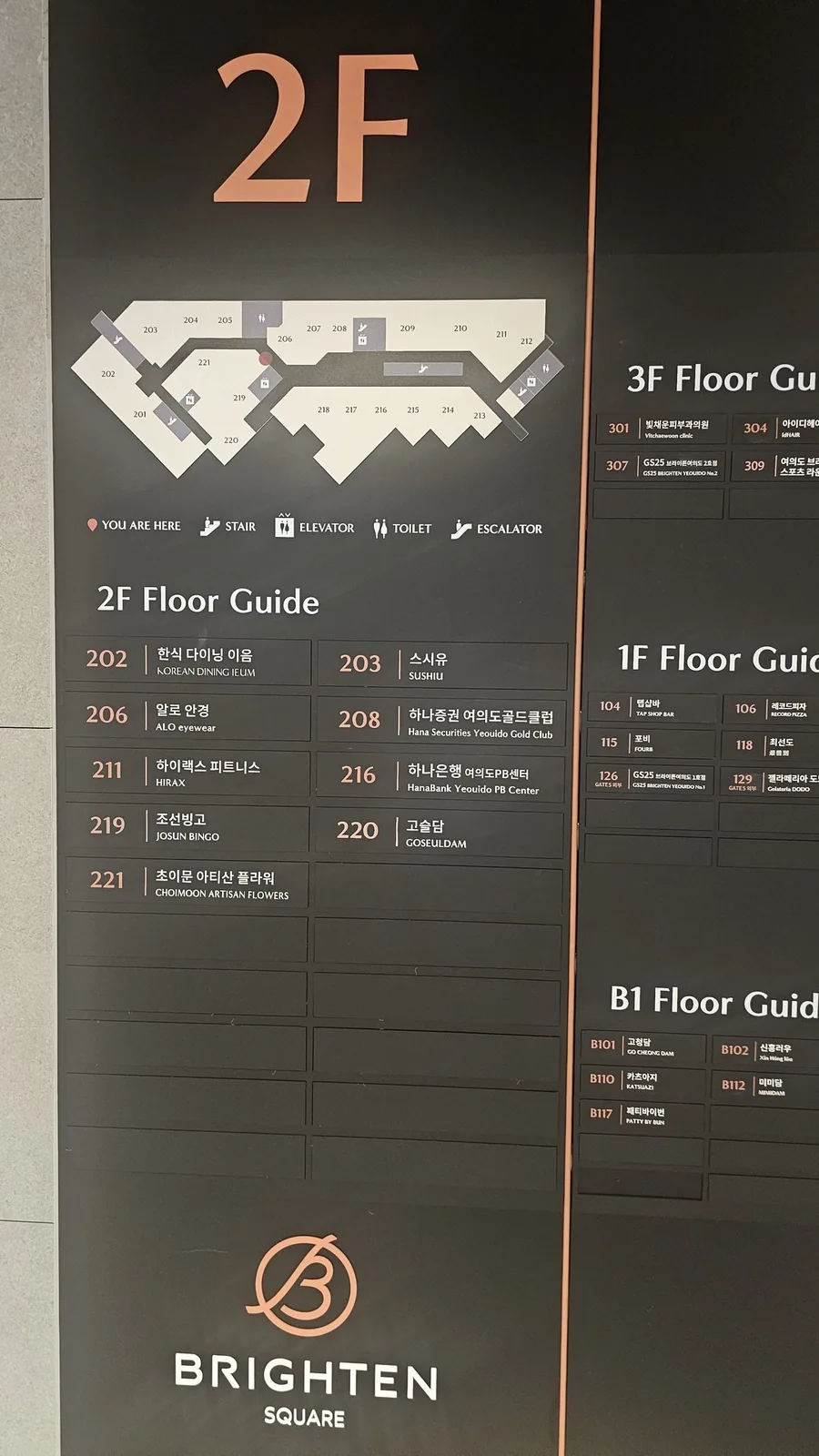
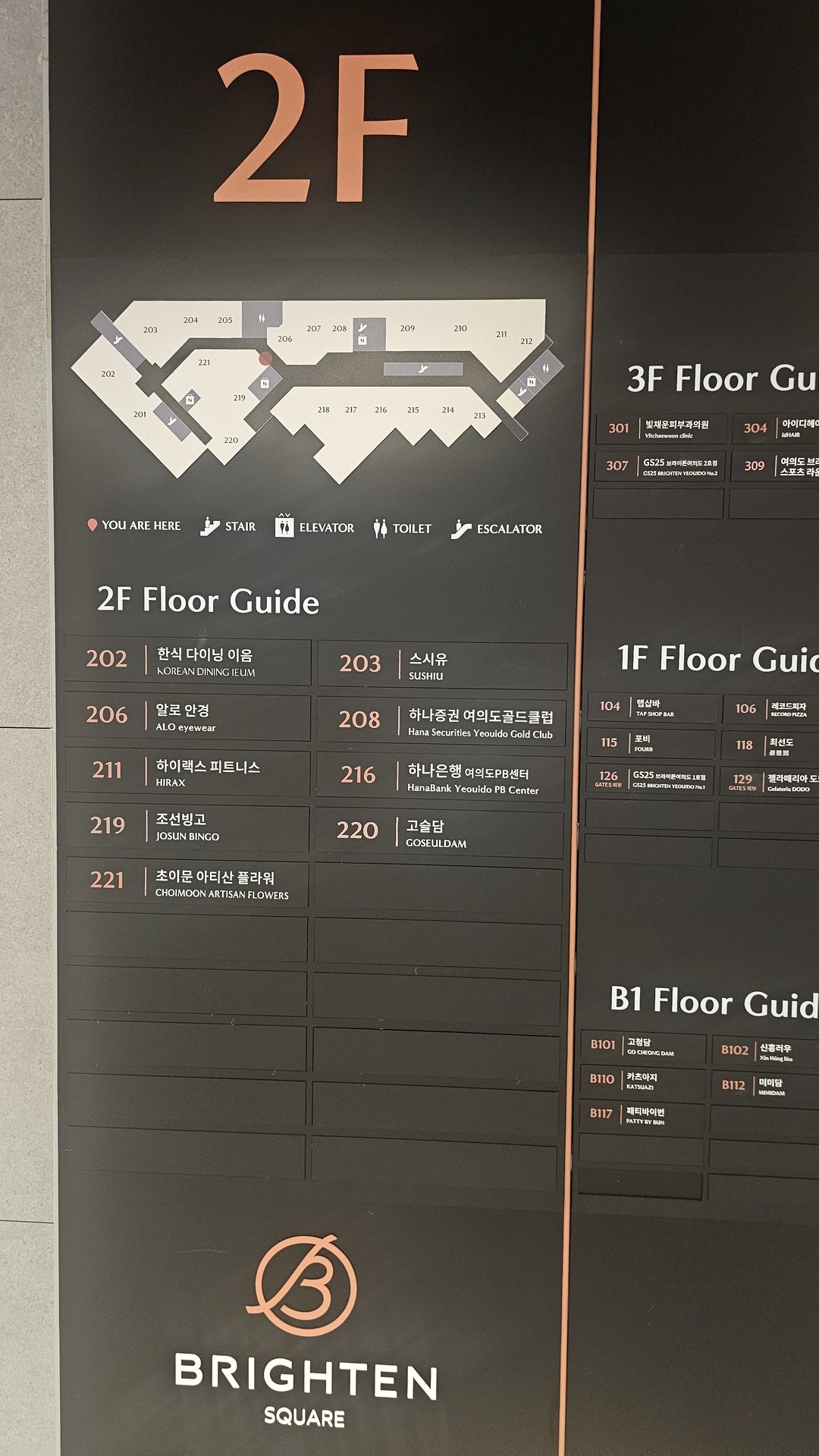
    Brighton Square Yeouido 2F directory board showing Sushi Yu at room 203
    Brighton Square Yeouido 2F directory board showing Sushi Yu at room 203

    It’s on the 2nd floor of Brighton Square Yeouido, Room 203. Yeouido is Seoul’s financial district — comparable to Wall Street or Canary Wharf. Home to the Korean parliament (여의도 국회의사당), KBS and SBS broadcasting headquarters, and a lot of corporate offices. Lunch culture here leans toward places that can handle a business crowd. Sushi Yu fits right in.

    The SBS Recognition

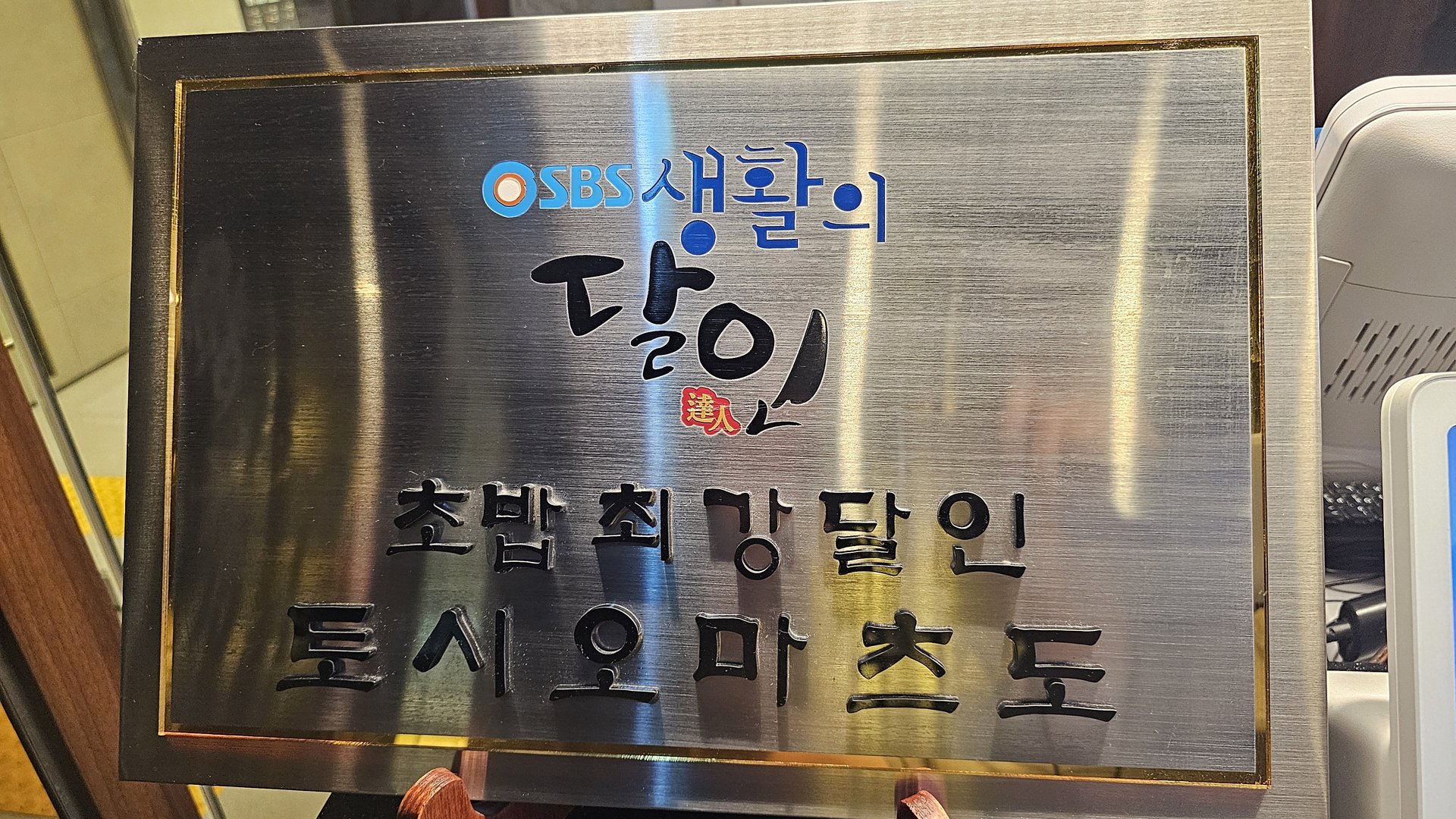
    SBS Masters of Living certified bronze plaque at Sushi Yu Yeouido entrance recognizing chef Toshio Matsudo
    SBS Masters of Living certified bronze plaque at Sushi Yu Yeouido entrance recognizing chef Toshio Matsudo

    At the entrance, there’s a bronze plaque from *SBS 생활의 달인* — a Korean TV show called “Masters of Living” that tracks down people who’ve genuinely mastered a craft. The plaque recognizes chef Toshio Matsudo as a sushi master.

    This matters. *생활의 달인* doesn’t do paid placements — it’s a production team that seeks out craft excellence and puts it on national TV. Getting featured means the chef was evaluated on actual technique. So the credentials at the door aren’t decorative.

    Getting There

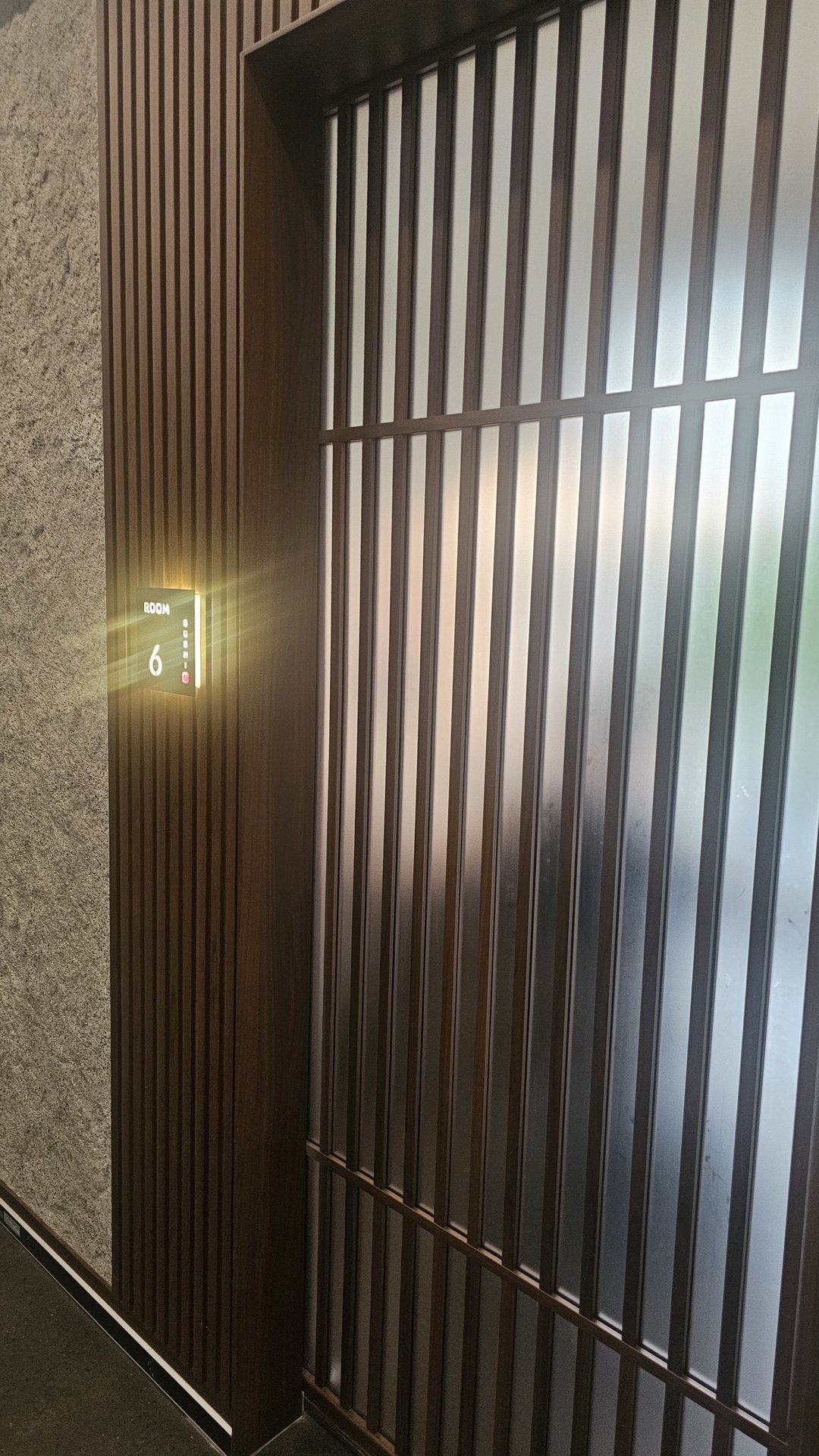
    Sushi Yu restaurant entrance with dark wood louver panel exterior at Brighton Square Yeouido
    Sushi Yu restaurant entrance with dark wood louver panel exterior at Brighton Square Yeouido

    Address: Brighton Square Yeouido, 2F, Room 203 (브라이튼스퀘어 여의도 203호)

    Subway:

    – Yeouido Station (여의도역) — Line 5 or Line 9 — about a 5–7 minute walk

    – IFC Seoul complex is nearby if you’re coming from that direction

    From Incheon Airport: Around 50–60 minutes. Take the AREX to Gimpo Airport Station, transfer to Line 9, ride to Yeouido Station. Straightforward.

    From Myeongdong or Hongdae: 20–30 minutes by subway.

    Parking is available in the Brighton Square building basement. If you’re taking a taxi, show the driver this: 여의도 브라이튼스퀘어 203호.

    The Interior

    The exterior is sharp — dark wood louver panels, illuminated signage with Japanese and Korean characters. It looks like it belongs in a boutique hotel rather than a commercial building.

    Inside: refined without being uptight. Dark tones, clean sightlines, proper tableware. The logo table mat is a detail that tells you the restaurant takes presentation seriously. Nothing over-designed. Just done right.

    The Menu

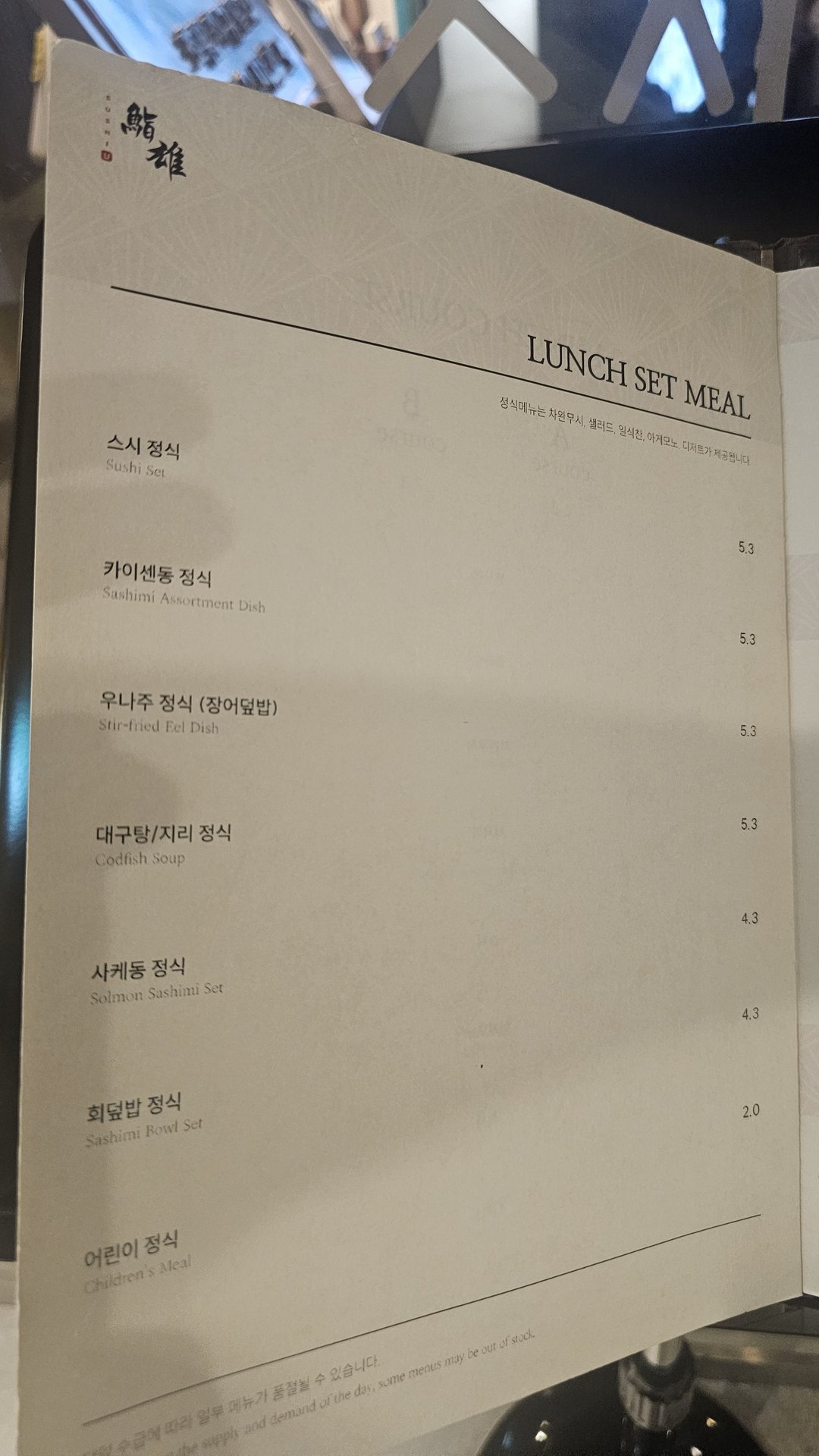
    Sushi Yu lunch set menu board showing kaisendon, sushi jeongshik, unaju, and prices in Korean won
    Sushi Yu lunch set menu board showing kaisendon, sushi jeongshik, unaju, and prices in Korean won

    Lunch sets range from about 20,000 to 53,000 KRW (~$15–$39 USD). Main options:

    Sushi Jeongshik (스시 정식) — nigiri sushi platter set

    Kaisendon Jeongshik (카이세동 정식) — kaisen sashimi rice bowl set

    Unaju Jeongshik (우나주 정식) — grilled eel rice in lacquer box set

    Hoe-deop-bap (회덮밥) — marinated sashimi over mixed rice

    Sake-don (사케동) — salmon rice bowl

    Daegu-tang (대구탕) — cod soup set

    Kids set (어린이 정식)

    Each set comes with miso soup, pickled ginger, and a starter salad. Our group of four spread across the kaisendon, sushi set, unaju, and a shared tempura side.

    What We Ordered

    Starter Salad

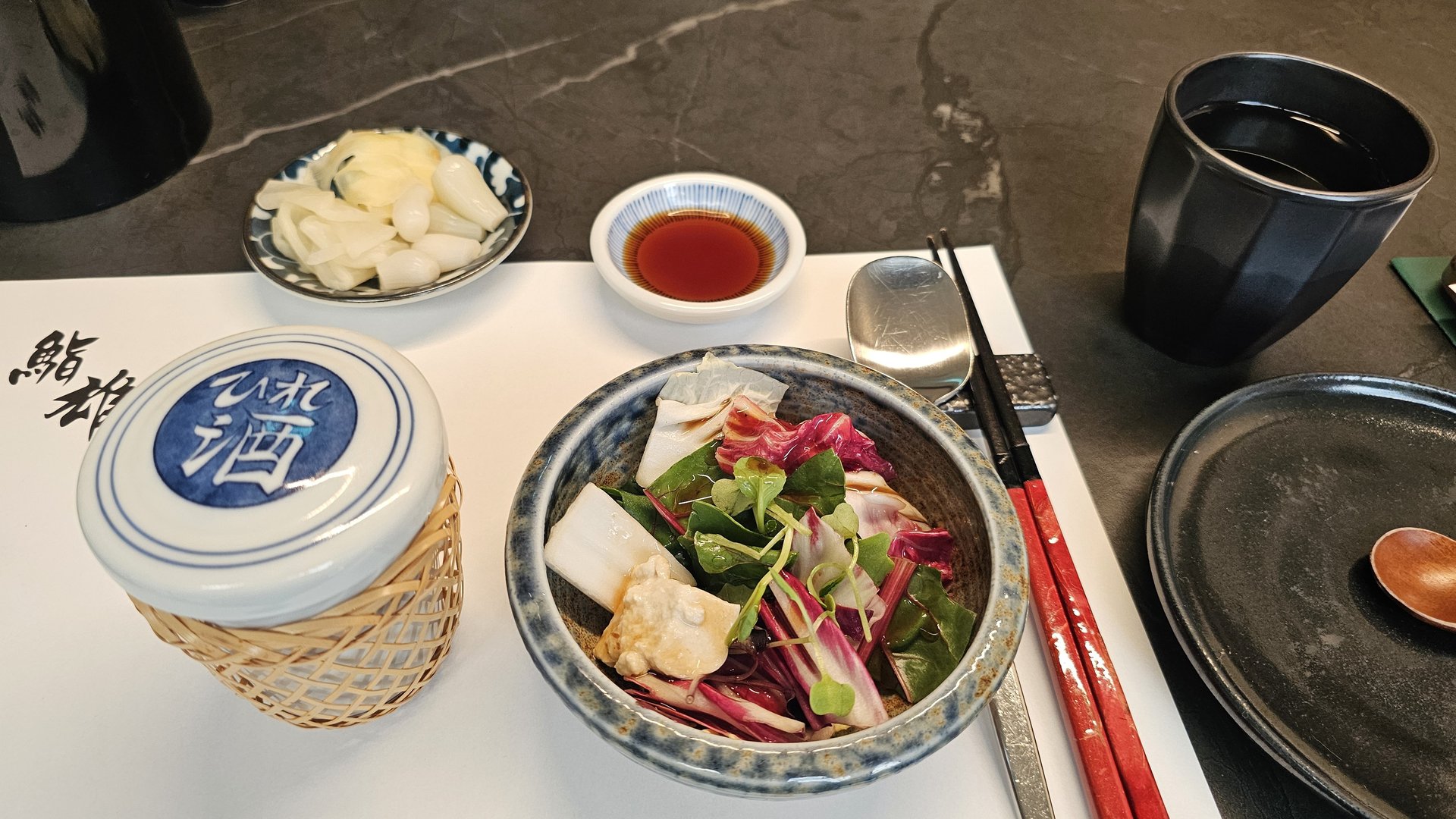
    Starter salad with seafood and vegetables at Sushi Yu, served alongside pickled ginger, soy sauce, and green tea on a logo table mat
    Starter salad with seafood and vegetables at Sushi Yu, served alongside pickled ginger, soy sauce, and green tea on a logo table mat

    Each set opens with a small seafood and vegetable salad. Nicely plated — pickled ginger on the side, green tea already poured, soy sauce set out. It’s not the reason you’re here, but it’s a proper opener and the presentation is clean.

    Fine. Does its job.

    Kaisendon Jeongshik

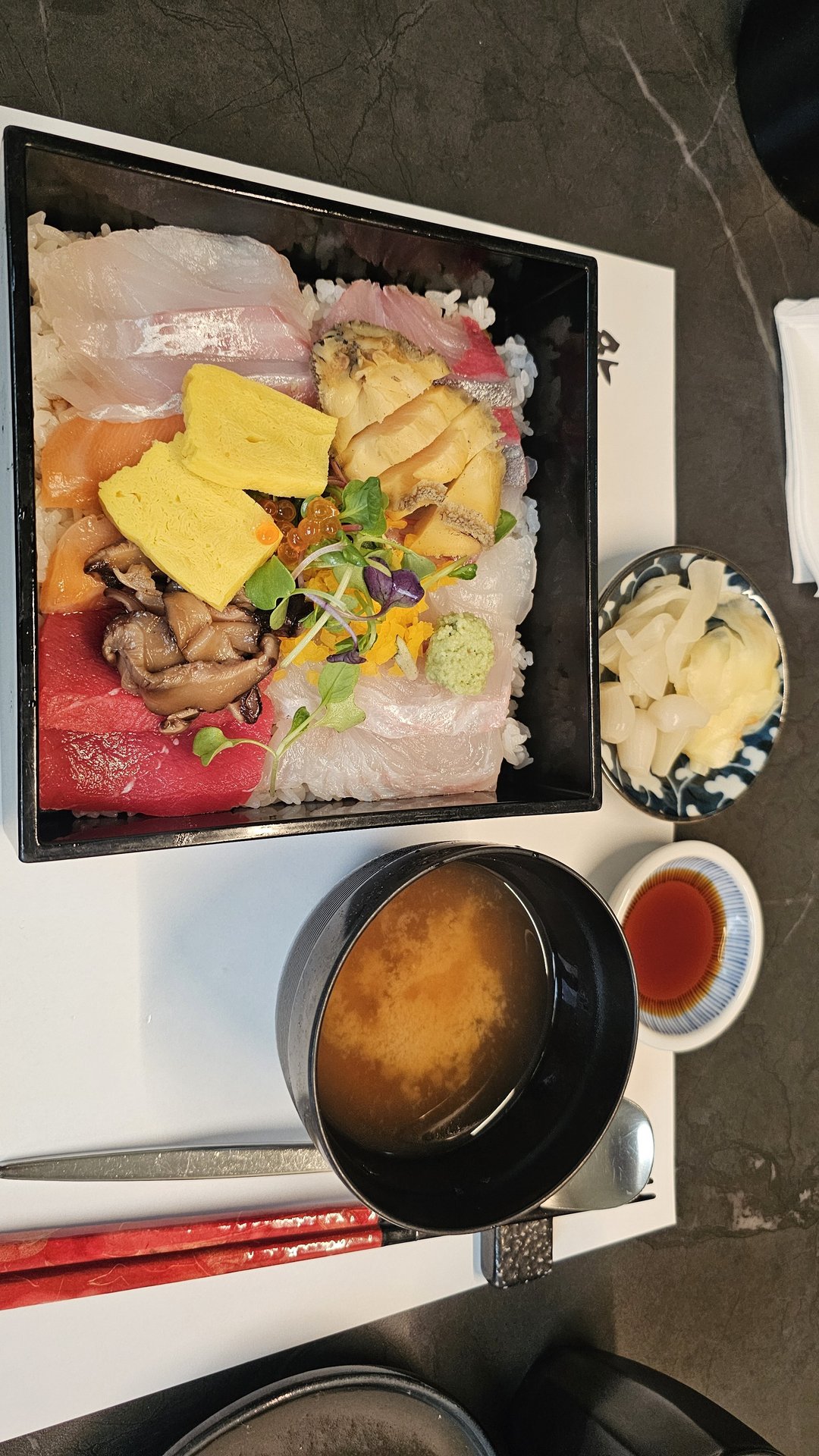
    Kaisendon set at Sushi Yu Yeouido — sashimi rice bowl topped with tuna, salmon, flatfish, uni, ikura, and tamagoyaki with miso soup
    Kaisendon set at Sushi Yu Yeouido — sashimi rice bowl topped with tuna, salmon, flatfish, uni, ikura, and tamagoyaki with miso soup

    Kaisendon (kaisen-don) is a Japanese seafood sashimi rice bowl — different cuts of sashimi layered over seasoned sushi rice. Sushi Yu’s version comes loaded: tuna, salmon, flatfish (광어/hirame), sea urchin (uni/성게), salmon roe (ikura/이크라), rolled egg (tamagoyaki), and mushrooms.

    The uni is what justifies the price point. Fresh sea urchin on a kaisendon in this range isn’t always a given — at cheaper places you either don’t get it or it’s past its prime. Here it was present and it was good.

    Sushi rice underneath is properly seasoned. Set includes miso soup.

    If you want everything in one bowl, order this.

    Sushi Jeongshik — 12-Piece Nigiri

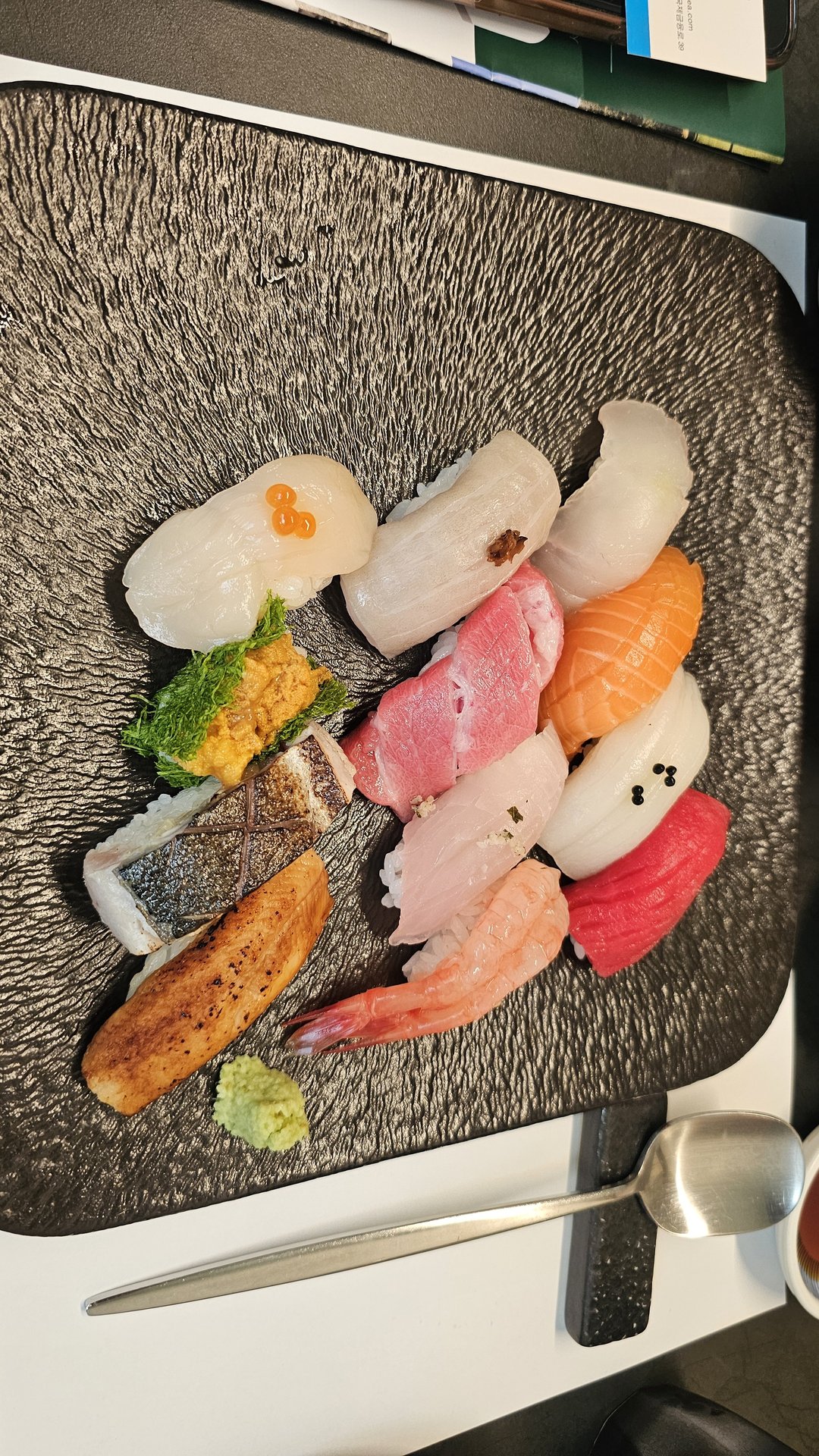
    12-piece nigiri sushi platter at Sushi Yu Yeouido featuring tuna, salmon, uni, yellowtail, and anago
    12-piece nigiri sushi platter at Sushi Yu Yeouido featuring tuna, salmon, uni, yellowtail, and anago

    Twelve pieces of nigiri: tuna, salmon, flatfish, shrimp, yellowtail (방어/buri), sea urchin, and anago (saltwater eel). The platter looks exactly like what a proper sushi set should look like.

    Each piece is hand-formed — you can tell by the shape and the way the rice holds together. The shari (sushi rice) has good texture: slightly firm, properly vinegared. Fish quality is consistent across the board.

    Best pieces: uni, anago, yellowtail. The shrimp is fine but the least interesting item on the plate. Skip obsessing over it and just eat the eel first.

    Unaju Jeongshik

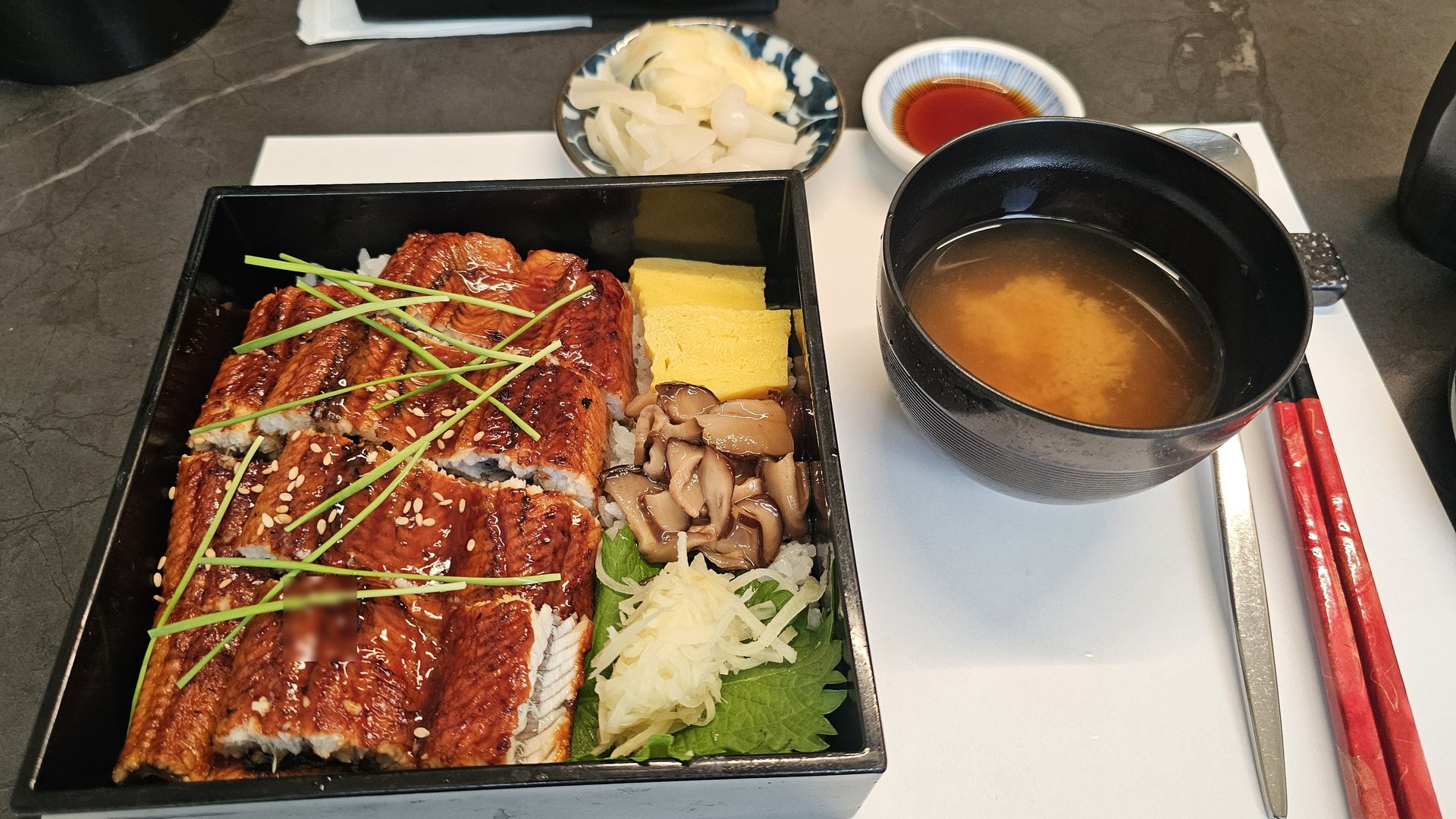
    Unaju set at Sushi Yu — thick glazed grilled eel over rice in a lacquer jubako box with miso soup
    Unaju set at Sushi Yu — thick glazed grilled eel over rice in a lacquer jubako box with miso soup

    Unaju is grilled freshwater eel (unagi/장어) over rice, served in a jubako — a lacquer box that’s kind of the Japanese equivalent of a bento box but fancier. The eel is glazed with tare sauce and grilled until caramelized on the outside.

    Okay, here’s the thing about unaju in Seoul: a lot of places get it wrong. Either the eel is undercooked and soft in a bad way, or the sauce is too sweet and cloying. Sushi Yu’s version uses thick cuts, proper caramelization on the glaze, and the sauce is balanced — not a sugar bomb.

    This is probably toward the higher end of the menu price-wise (closer to 45,000–53,000 KRW / ~$33–$39), but if eel is your thing, this is the version to order.

    Tempura

    Shrimp and asparagus tempura with tsuyu dipping sauce at Sushi Yu Yeouido
    Shrimp and asparagus tempura with tsuyu dipping sauce at Sushi Yu Yeouido

    Shrimp and asparagus tempura, served with tsuyu dipping sauce.

    The batter is light — airy rather than thick and greasy. Shrimp stays juicy inside. Asparagus is a solid choice for tempura; it holds up to heat better than most vegetables and gives you something different from all the raw fish. Good shared side for the table.

    Stuff Tourists Should Know

    English menu? The menu is in Korean and Japanese. Menu boards have photos — pointing works. Translation apps handle the rest without issue. Staff English is limited.

    Card payment? Cards accepted. Foreign Visa/Mastercard should work, but having a small amount of cash on hand doesn’t hurt.

    Tipping? No. Korea has no tipping culture. Don’t leave extra money on the table — it can actually cause awkwardness.

    Vegetarian options? Limited. This is a seafood-focused restaurant. Vegetable tempura might be available — confirm with staff. Not the right spot if you don’t eat seafood.

    Halal/Kosher? Not certified.

    Kids welcome? Yes — there’s a dedicated kids’ set on the lunch menu. Relaxed atmosphere during lunch hours.

    Solo dining? Should be fine for the counter or smaller tables.

    Date spot? Yes. Interior quality and food level make it work for a nicer lunch.

    Reservations? Recommended for groups of 3 or more. Yeouido has a big lunch crowd on weekdays — don’t assume walk-in availability.

    The Verdict

    Should you go?

    Depends on what you’re doing in Seoul.

    If you’re in Yeouido for business or just passing through the area — yes, this is one of the better lunch options around. Get the unaju or the sushi set.

    If you only have 3–4 days in Seoul and haven’t eaten Korean food yet — hold off. Do Korean BBQ, bibimbap, or samgyetang first. Come back to Japanese on a longer visit.

    If you’re a sushi person and want to benchmark Seoul’s Japanese food scene — yes, Sushi Yu is worth it. The SBS recognition isn’t decorative.

    If budget is a concern — it’s not cheap. Lunch runs 35,000–50,000 KRW per person (~$26–$37). Worth it, but not a casual drop-in.

    Four people, four different sets, all good. No weak links across the table. The food matched the credentials on the wall.

    FAQ

    Where exactly is Sushi Yu in Yeouido?

    It’s on the 2nd floor of Brighton Square Yeouido, Room 203. The nearest subway is Yeouido Station (Line 5 or Line 9), about a 5–7 minute walk.

    How much does lunch cost at Sushi Yu Yeouido?

    Lunch sets range from about 20,000 to 53,000 KRW (~$15–$39 USD) per person. Budget around 35,000–50,000 KRW for a solid set with nigiri, kaisendon, or unaju.

    Do I need a reservation at Sushi Yu?

    Recommended for groups of 3 or more. Walk-ins for 1–2 people may work on weekdays, but it’s a popular lunch spot in Yeouido so don’t count on it.

    Is there an English menu at Sushi Yu?

    The menu is in Korean and Japanese. Some menu boards have photos — point and order works fine. Translation apps handle the rest. Staff English is limited.

    Is Sushi Yu good for families or kids?

    Yes — there’s a kids’ set on the lunch menu, and the vibe is relaxed enough for a family meal during lunch hours.

    What is the SBS 생활의 달인 recognition at Sushi Yu?

    It’s a certification from SBS “Masters of Living,” a Korean TV show that features artisans who’ve mastered their craft. The plaque recognizes chef Toshio Matsudo as a sushi master — it’s editorial recognition, not advertising.

    You might also like

    📍 Location

    Open in Google Maps →

  • Cheil Jemyunso Yeouido: Honest Review of the Shabu Shabu Hot Pot

    Cheil Jemyunso Yeouido: Honest Review of the Shabu Shabu Hot Pot

    Quick honest review of Cheil Jemyunso at Yeouido IFC — a Korean chain known for cold noodles that somehow makes its shabu shabu hot pot the main reason to show up. Skip to the verdict if you’re pressed for time, but here’s the short version: the beef is thicker and better quality than the price suggests, the setup is clean, and if you’re already in Yeouido this is one of the better lunch calls you can make.

    Three of us went on a Tuesday. Walked in at 12:15 PM, no reservation, seated immediately.

    What Is Cheil Jemyunso?

    Cheil Jemyunso (제일제면소) is a Korean restaurant chain. The name translates roughly to “Number One Noodle Shop” — 제일 means “first” or “best,” 제면소 means a place that makes noodles. The menu does include naengmyeon (Korean cold noodles), warm noodles, and rice dishes.

    But the Jeil Shabu hot pot is what keeps people coming back. The Yeouido branch sits inside IFC Mall (국제금융센터 — the financial district’s main shopping complex), which means it feeds a lot of office workers on tight lunch windows. They’ve got the operation dialed in.

    What Is Shabu Shabu?

    If you haven’t done this before: shabu shabu (샤브샤브) is a hot pot style where you cook thin slices of beef and vegetables yourself by swishing them through simmering broth at your table. The name comes from the Japanese sound of the meat moving through liquid. Korea picked it up and made it their own.

    Cheil Jemyunso’s version — the Jeil Shabu Jeongol (제일 샤브 전골) — comes as a full ingredient platter: beef, mushrooms, bean sprouts, bok choy, lotus root, green chili, perilla leaves. The pot of broth sits on an induction burner built into the table. You heat it up, cook the ingredients at your own pace, and the broth gets better as the meal goes on.

    This is not a fast lunch. Plan for 45–60 minutes minimum.

    Getting There

    Subway: Yeouido Station (여의도역), Line 5 (purple line) or Line 9 (gold line). Follow IFC Mall signs from the station — you can walk the whole way underground without going outside, which matters in Seoul’s summers and winters.

    From Myeongdong: About 20 minutes by subway.

    From Hongdae/Sinchon area: About 15 minutes.

    From Gangnam: About 20 minutes via Line 9.

    From Incheon Airport: Around 50–60 minutes via Airport Railroad + subway transfer at Gimpo Airport Station.

    Yeouido is Seoul’s financial district — think Canary Wharf in London or La Défense in Paris. It’s not a typical tourist neighborhood, but plenty of visitors end up here for the Han River Park, the spring cherry blossoms along Yeouiseo-ro, or catching something at the KBS or MBC broadcast centers. If Yeouido is already on your itinerary, Cheil Jemyunso is easy to slot in.

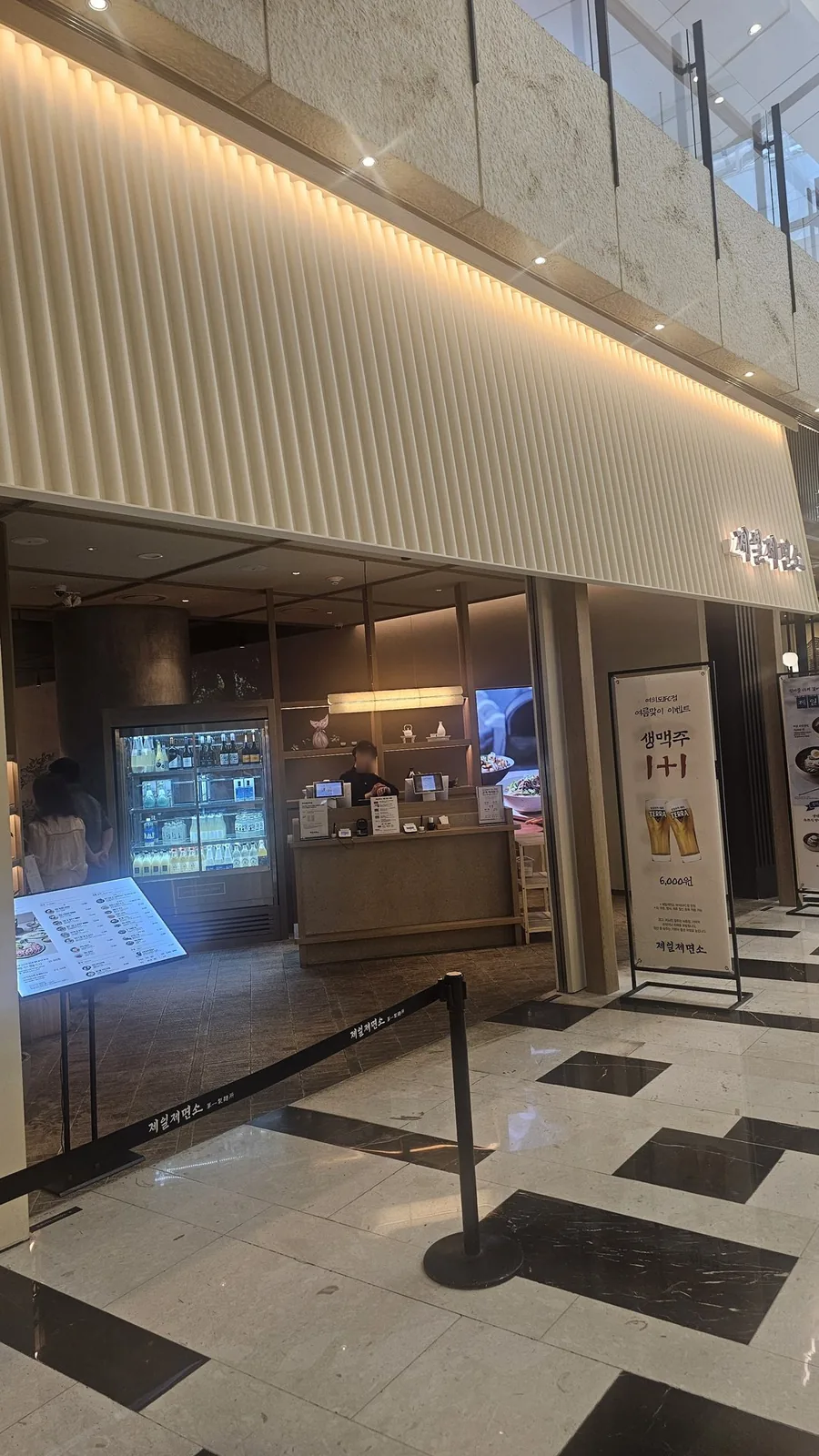
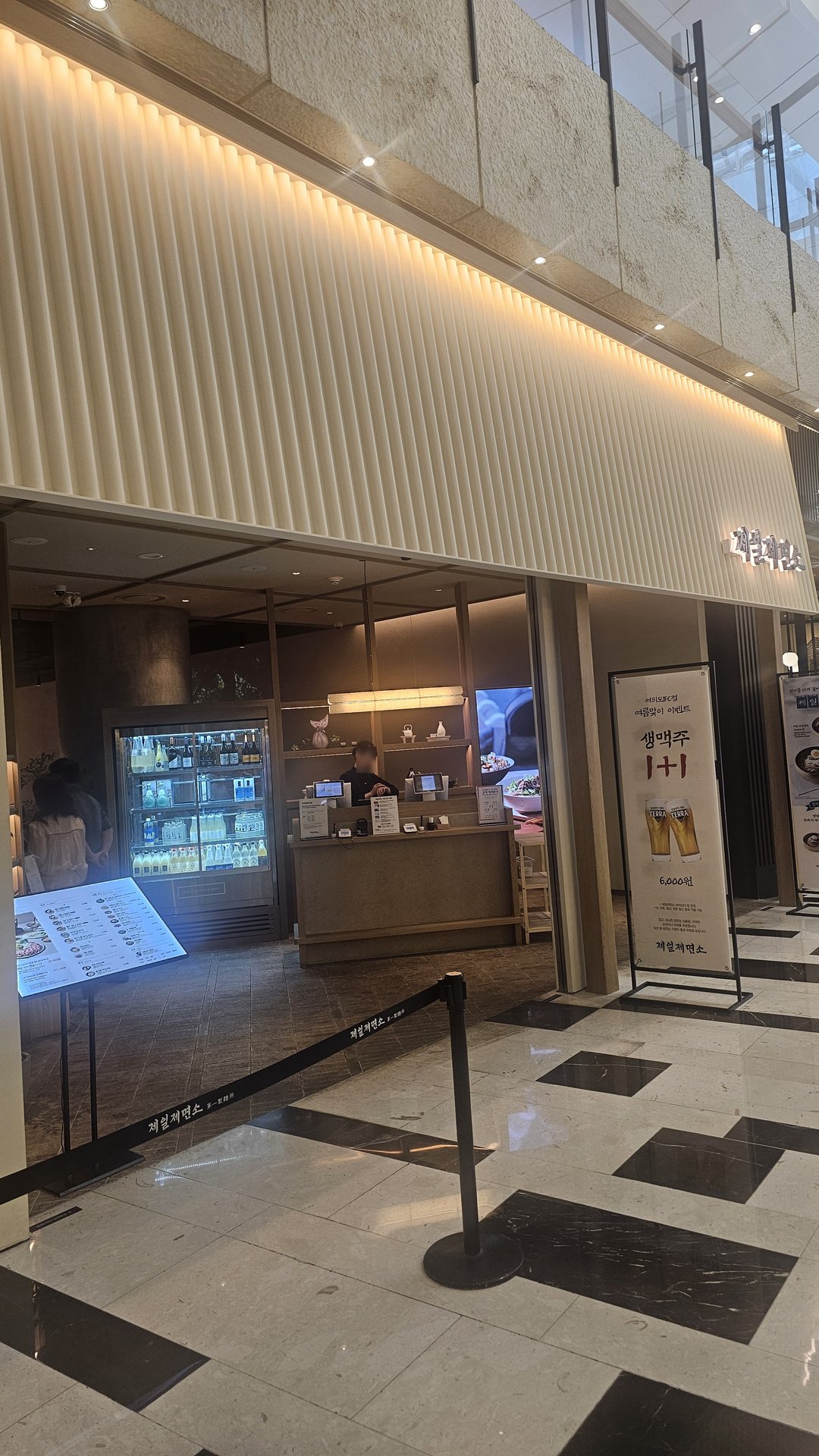
    Jeil Myeonso Yeouido IFC branch entrance inside the shopping mall
    Cheil Jemyunso Yeouido IFC branch entrance inside the shopping mall

    The Interior

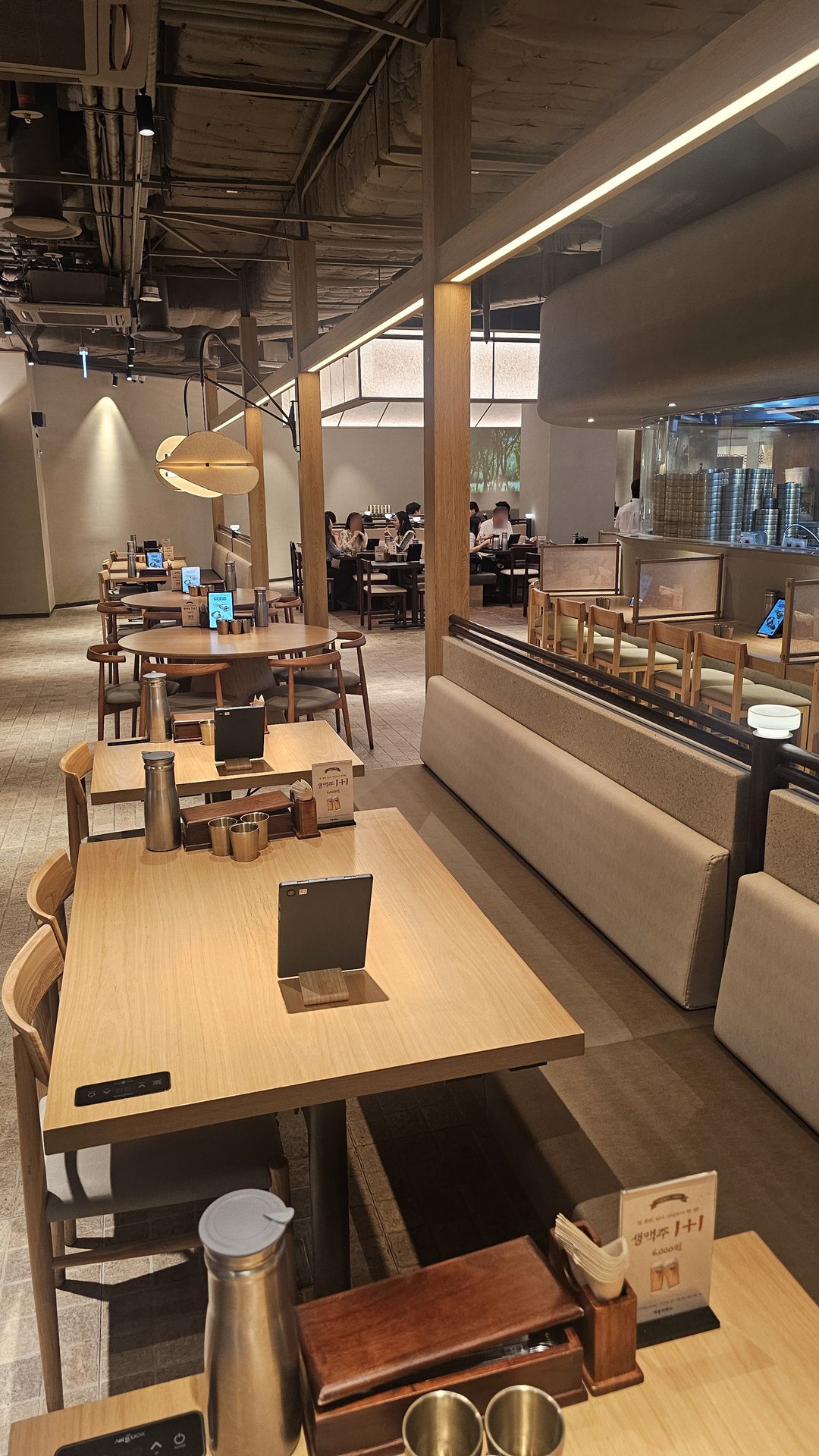
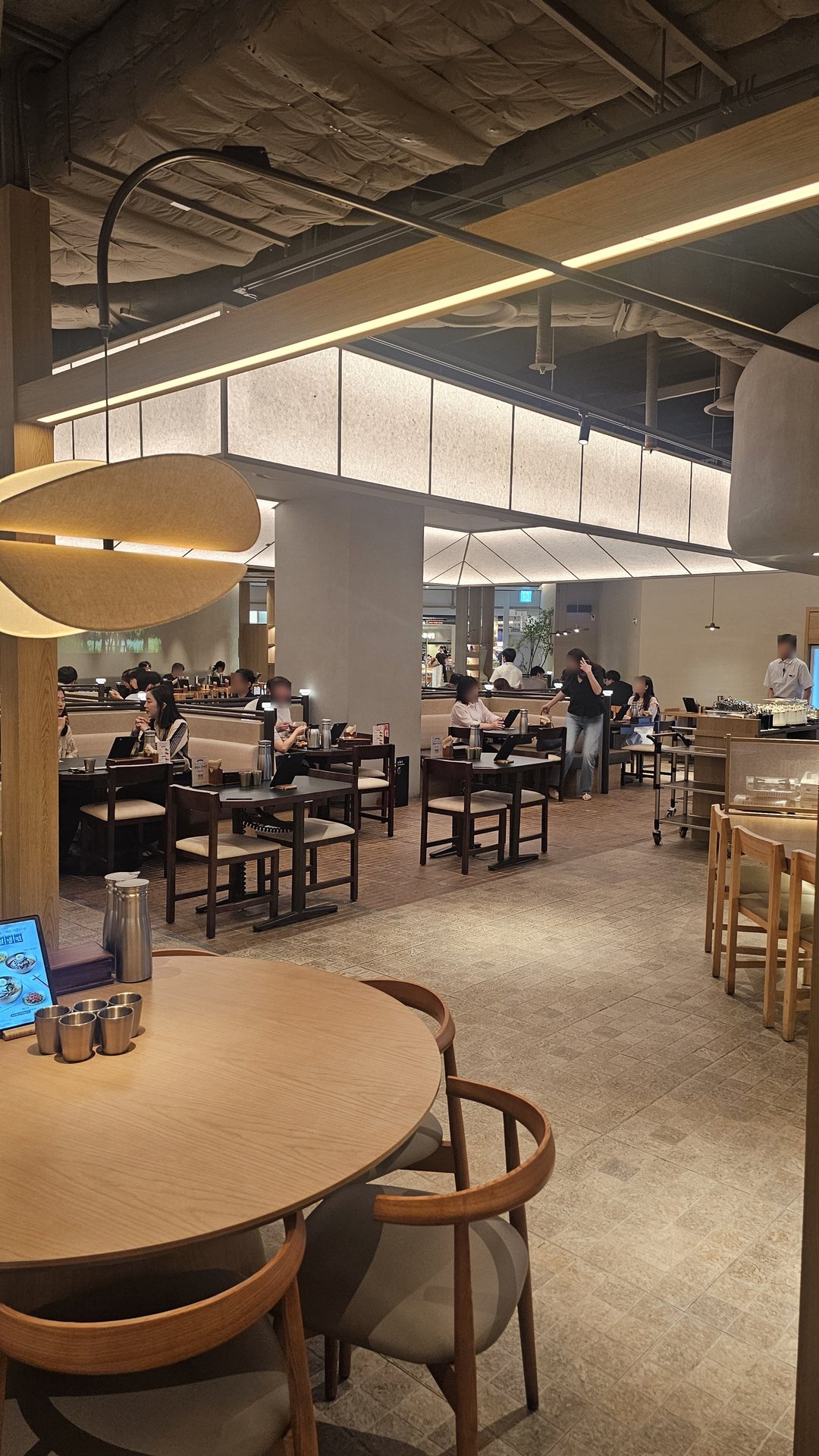
    Clean, modern, well-organized. Wooden table tops, warm lighting, and an open kitchen running along one side of the space. It reads like a polished chain — not a trendy independent restaurant, but not the soul-crushing corporate cafeteria version either.

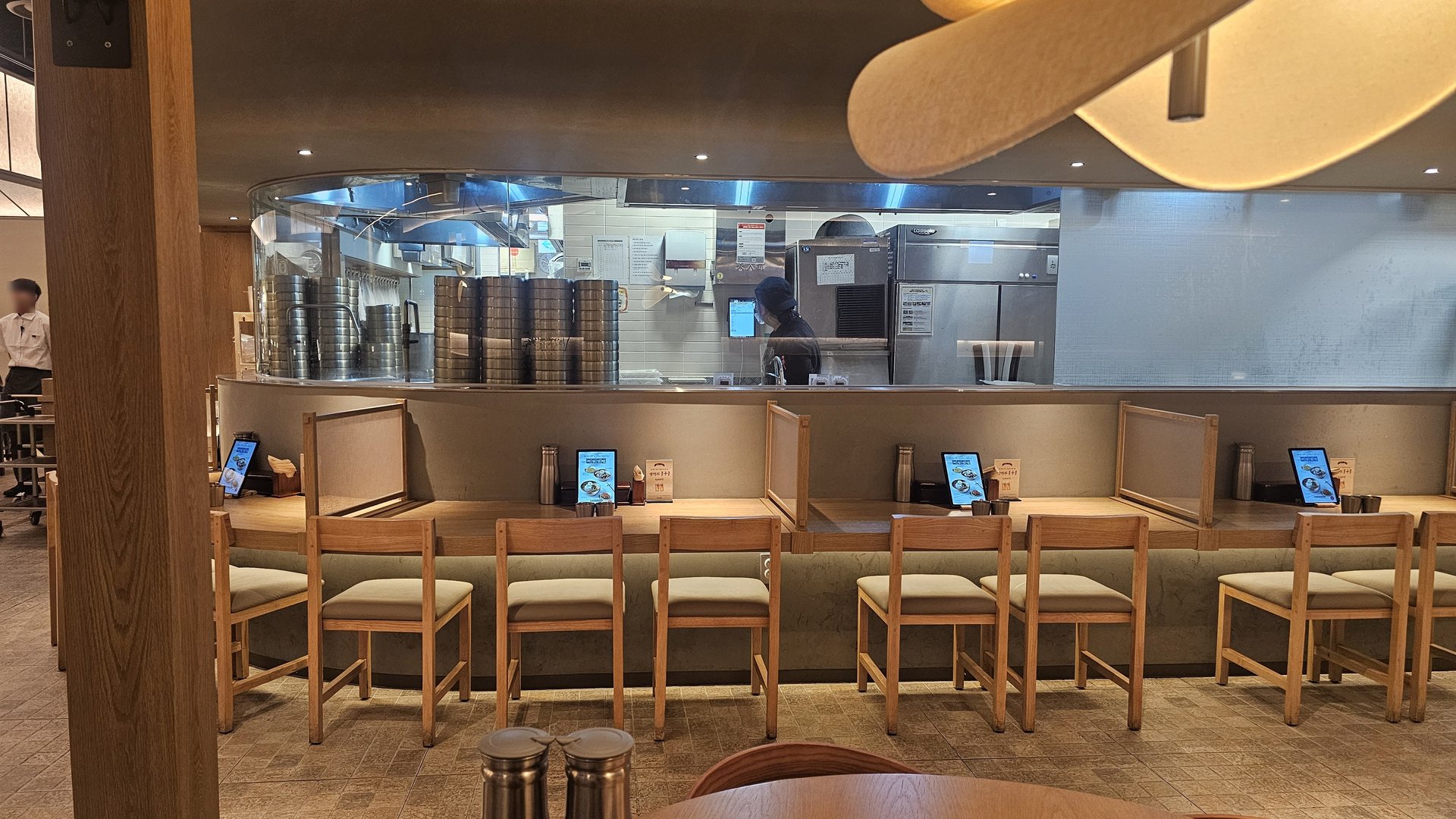
    The counter seats facing the open kitchen are the highlight for solo diners. Real counter space, proper stools, direct view of the kitchen. Solo dining at a hot pot place can feel weird, but not here.

    Lunch crowd was busy. Staffed well, tables turned over efficiently.

    Spacious interior of Jeil Myeonso Yeouido with wooden tables and open kitchen visible in the background
    Spacious interior ofCheil Jemyunso Yeouido with wooden tables and open kitchen visible in the background
    Busy weekday lunch service at Jeil Myeonso Yeouido with customers seated and staff in motion
    Busy weekday lunch service at Cheil Jemyunso Yeouido with customers seated and staff in motion
    Open kitchen counter with single-seat bar stools at Jeil Myeonso Yeouido IFC
    Open kitchen counter with single-seat bar stools at Cheil Jemyunso Yeouido IFC

    The Menu

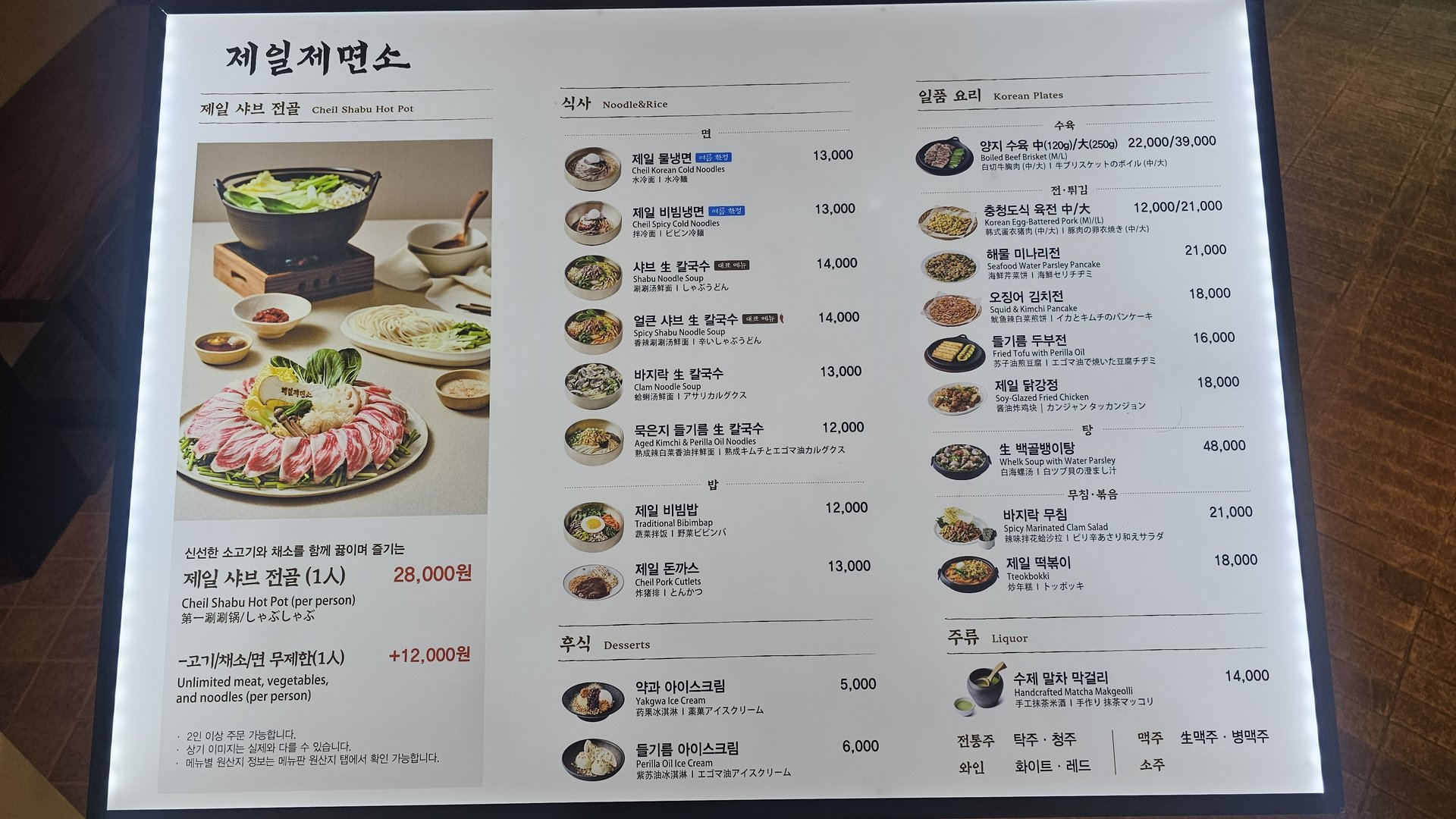
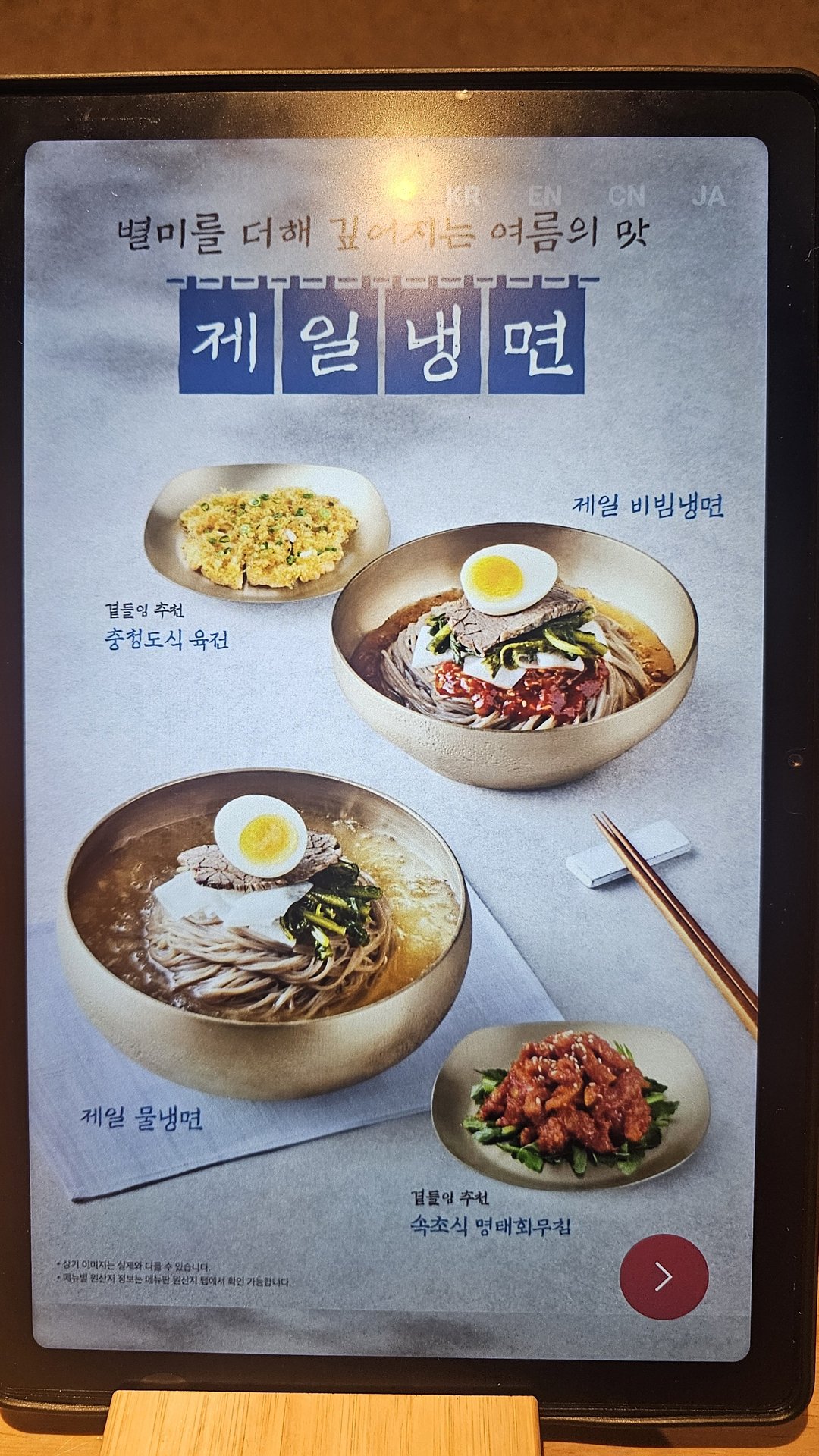
    Tablet ordering with photos. Even with zero Korean, you can mostly figure out what’s what by looking at the pictures. The main categories: cold noodles, warm noodles, rice dishes, the shabu shabu hot pot, drinks and alcohol.

    Full paper menu at Jeil Myeonso Yeouido showing noodles, rice dishes, hot pot, and drinks with prices in Korean won
    Full paper menu at Cheil Jemyunso Yeouido showing noodles, rice dishes, hot pot, and drinks with prices in Korean won
    Tablet menu at Jeil Myeonso showing naengmyeon cold noodle options — mul naengmyeon and bibim naengmyeon
    Tablet menu at Cheil Jemyunso showing naengmyeon cold noodle options — mul naengmyeon and bibim naengmyeon
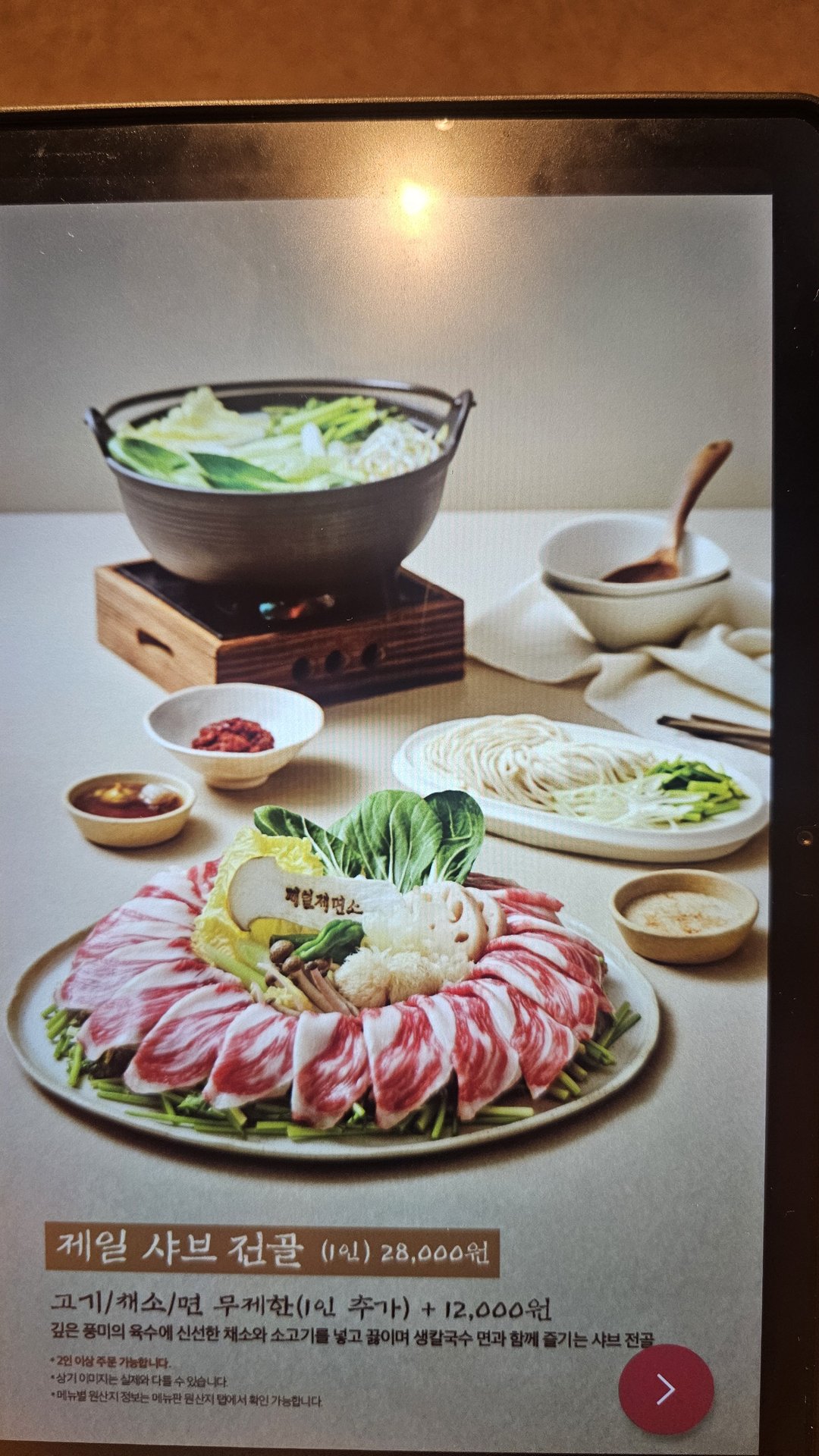
    Tablet menu at Jeil Myeonso showing the Jeil Shabu hot pot priced at 28,000 KRW per person
    Tablet menu at Cheil Jemyunso showing the Jeil Shabu hot pot priced at 28,000 KRW per person

    The shabu shabu at 28,000 KRW (~$21) per person is the most expensive thing on the menu. If you’re doing lunch on a tighter budget, the noodle and rice dishes come in cheaper. But honestly, coming to Cheil Jemyunso and ordering the noodles when the hot pot is there feels like going to a steakhouse for the salad.

    What We Ordered

    Three orders of the Jeil Shabu. 84,000 KRW (~$62) total for three people.

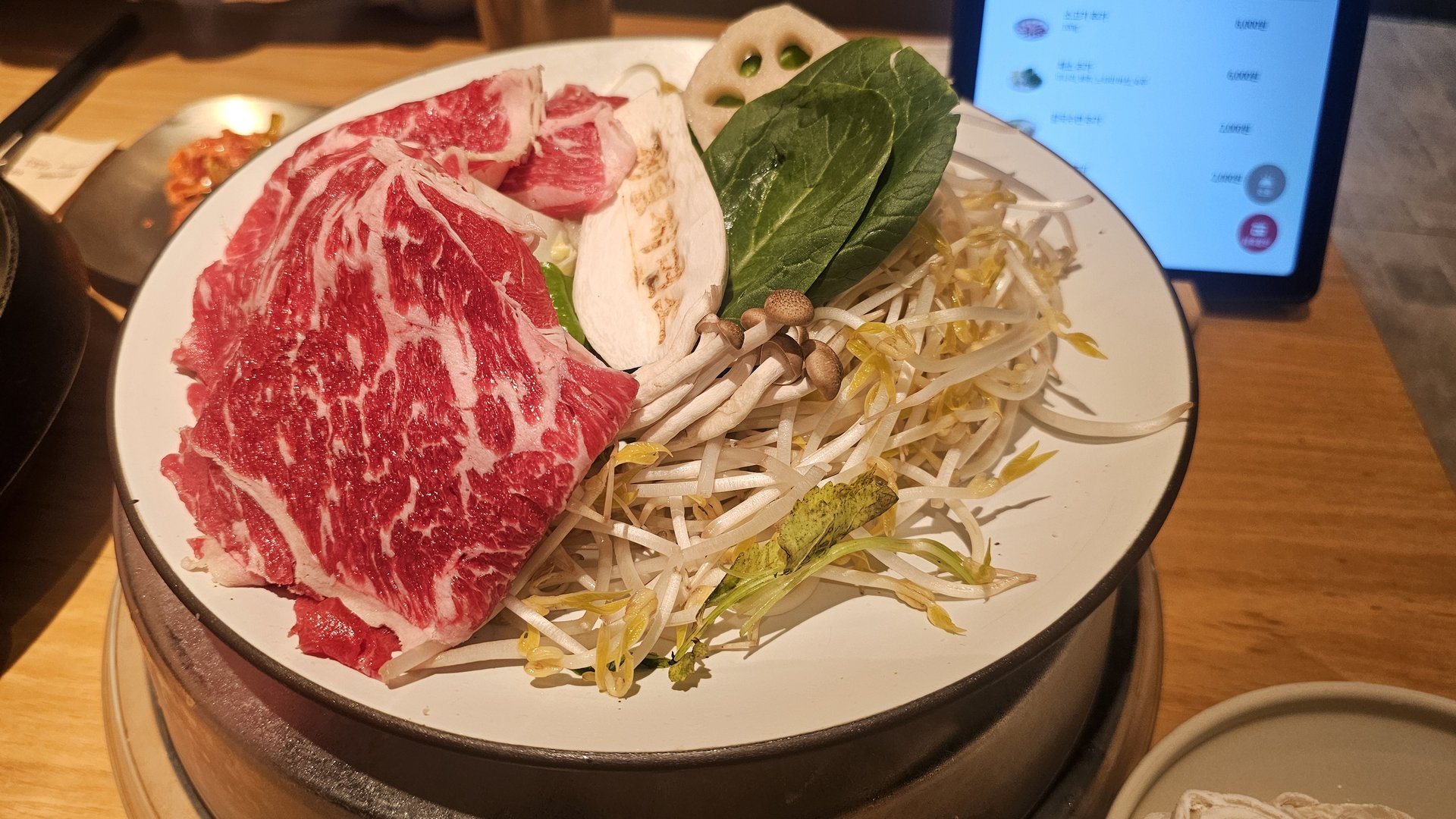
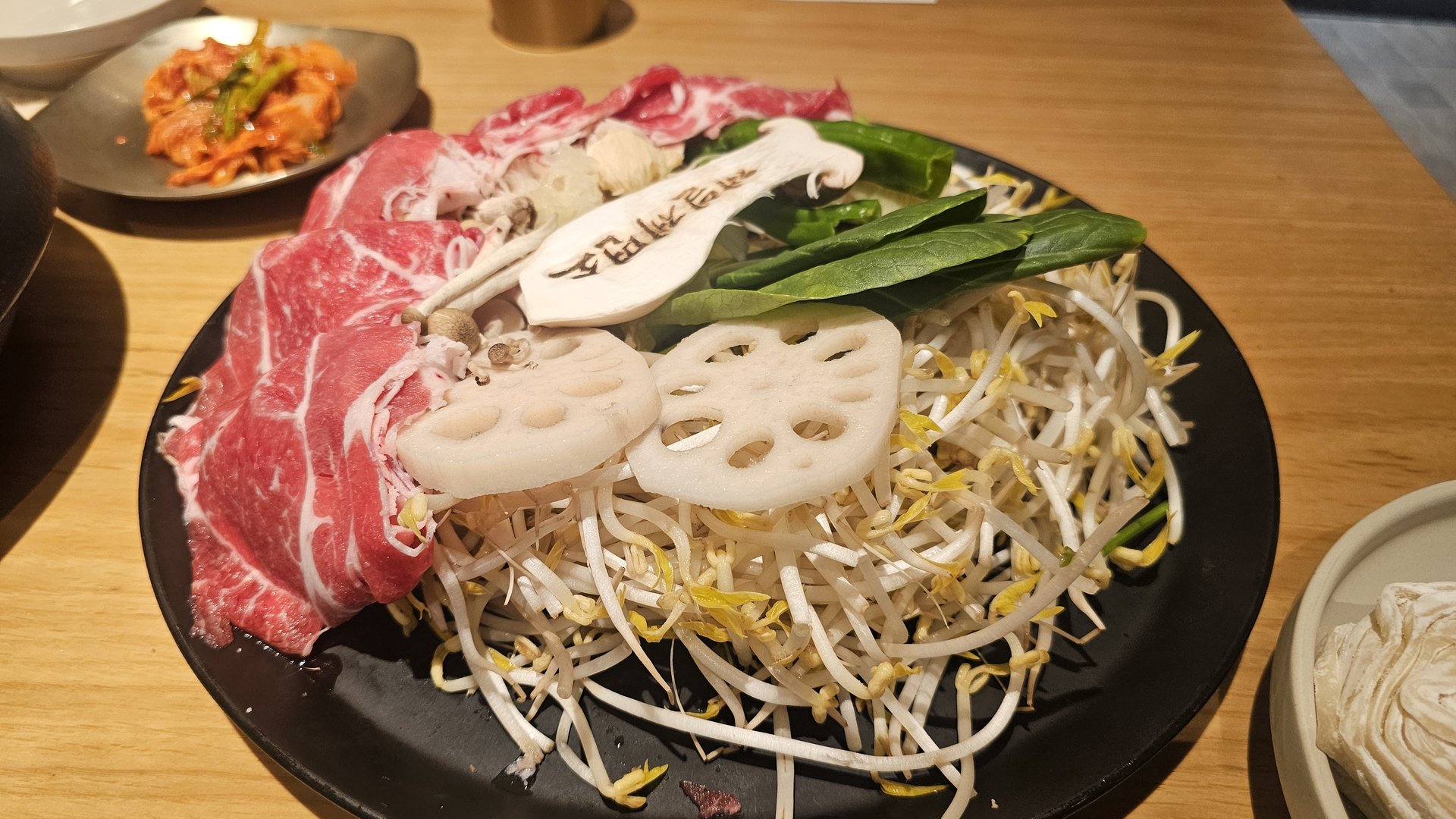
    The ingredients come out on a black platter with the restaurant’s logo pick pressed into the beef. It looks good.

    Shabu shabu ingredient plate at Jeil Myeonso with marbled beef slices, mushrooms, bean sprouts, bok choy, and lotus root
    Shabu shabu ingredient plate at Cheil Jemyunso with marbled beef slices, mushrooms, bean sprouts, bok choy, and lotus root
    Black ingredient plate at Jeil Myeonso with the restaurant logo pick in the beef, showing beef, bean sprouts, lotus root, green chili, and perilla leaves
    Black ingredient plate at Cheil Jemyunso with the restaurant logo pick in the beef, showing beef, bean sprouts, lotus root, green chili, and perilla leaves

    The beef is the thing worth talking about. Most shabu shabu places cut the beef so thin it’s almost translucent — swish it in the broth for ten seconds and it’s done. That style is fine, but it’s not exciting. The beef here is noticeably thicker. You can actually feel the texture when you eat it. The marbling is solid. You’re getting real meat, not just something that absorbs broth flavor.

    This is the reason this spot gets return visits. The beef quality punches above the price.

    The vegetables: Mushrooms, bean sprouts (숙주), bok choy (청경채), lotus root (연근), green chili (청양고추), perilla leaves (깻잎). A full spread. The lotus root holds its texture even after time in the broth — it gives a crunch that the other vegetables don’t. Perilla leaves (깻잎) are a staple Korean herb — slightly minty, a little like basil. Worth trying in the broth even if you haven’t had them before.

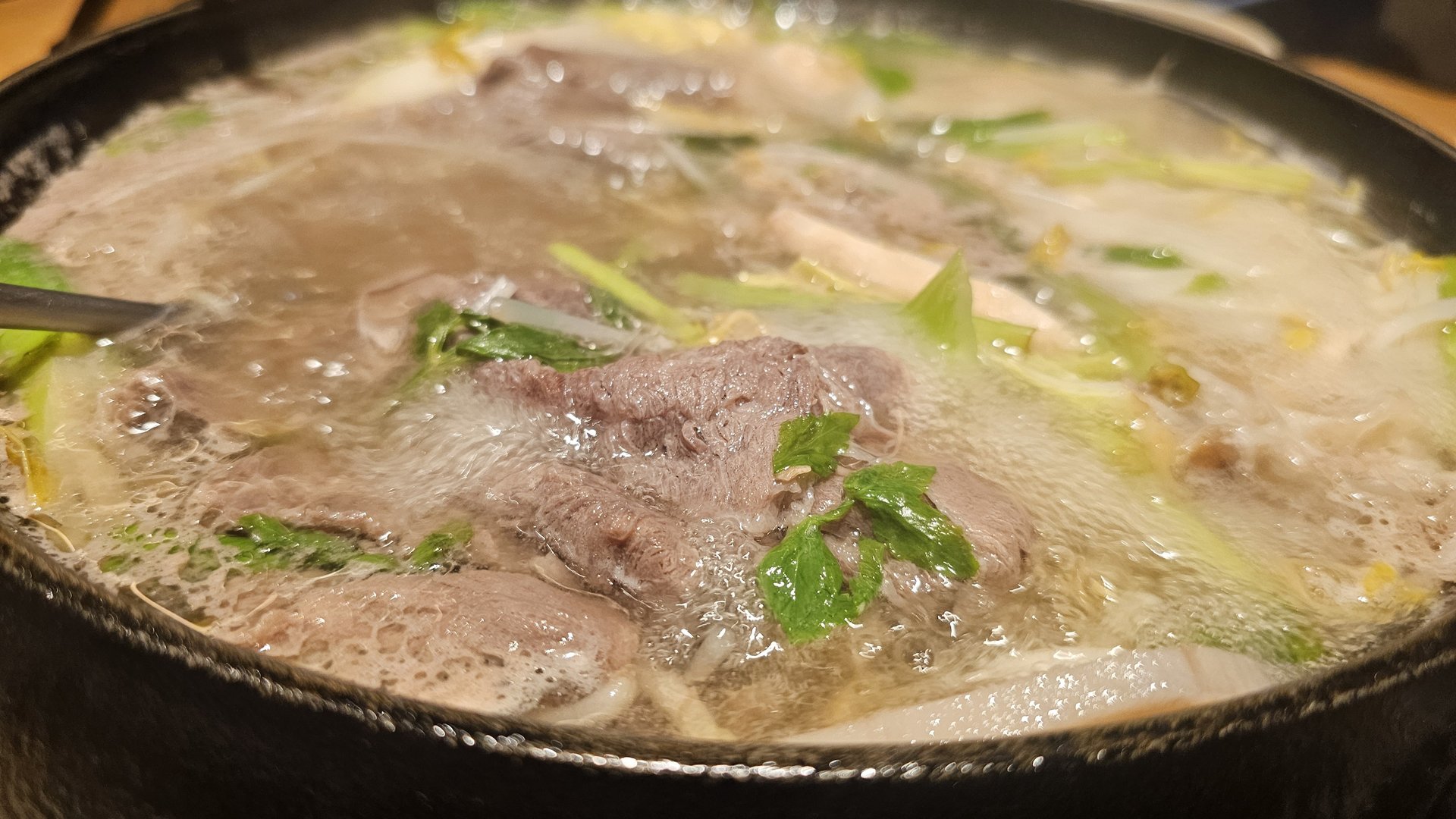
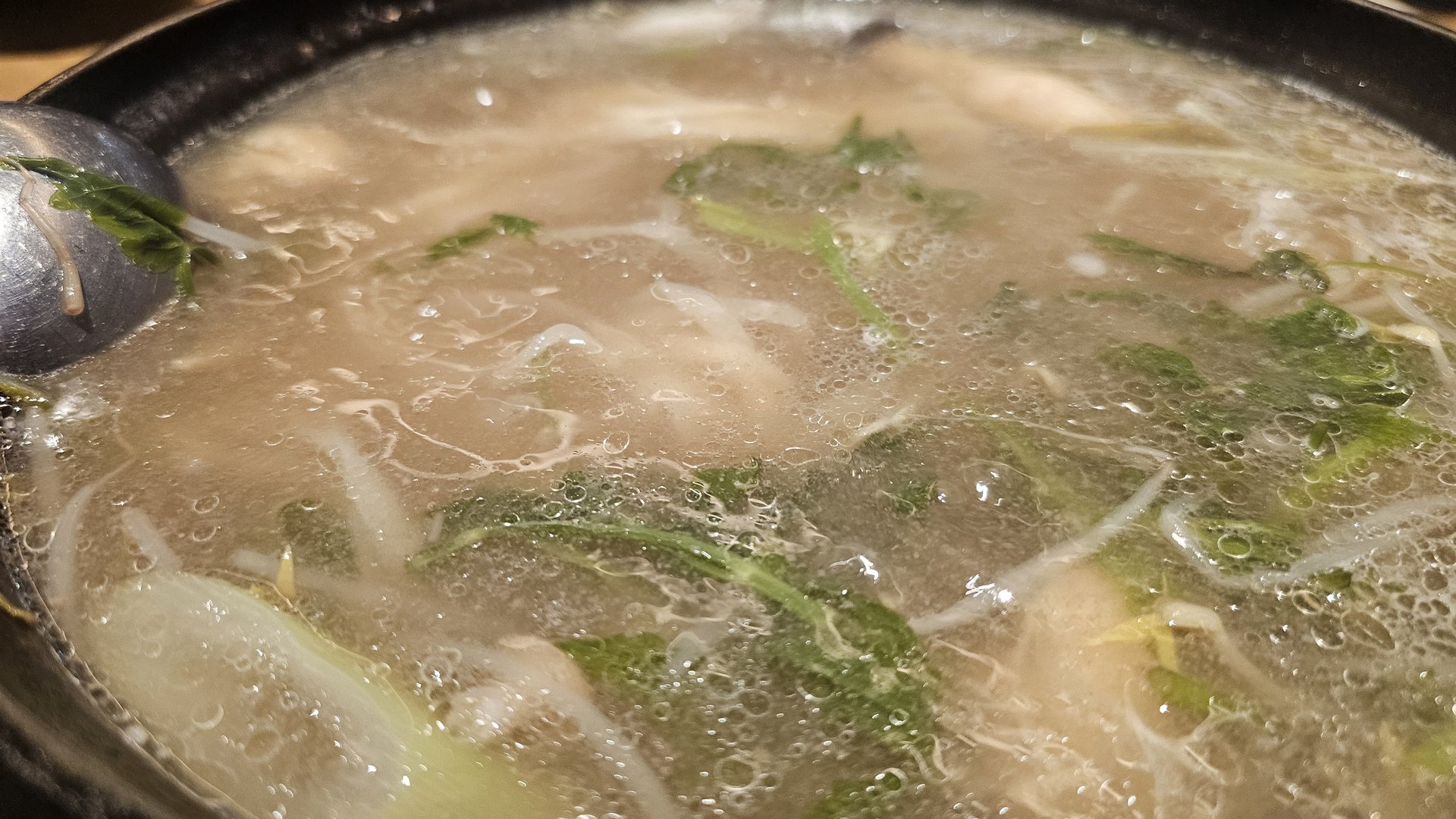
    The broth: Clear at the start. As the meat and vegetables cook through, it picks up depth, goes slightly cloudy, and gets genuinely good. By the time the ingredients are mostly done, the leftover broth is something you want to finish. Adding noodles at this point to soak up the broth is an easy yes.

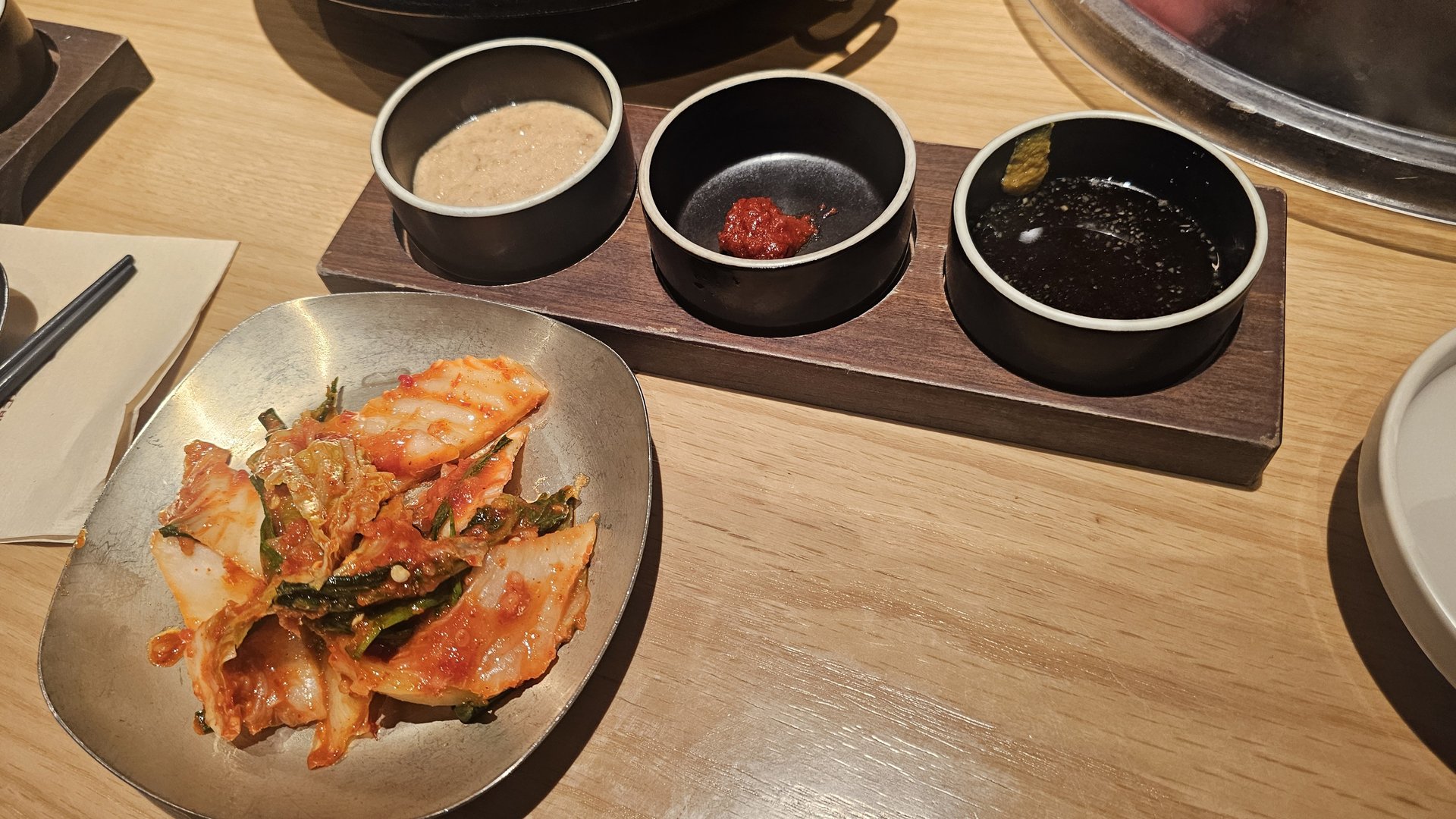
    Side dishes at Jeil Myeonso — kimchi and three dipping sauces including sesame, gochujang, and soy sauce
    Side dishes at Cheil Jemyunso — kimchi and three dipping sauces including sesame, gochujang, and soy sauce
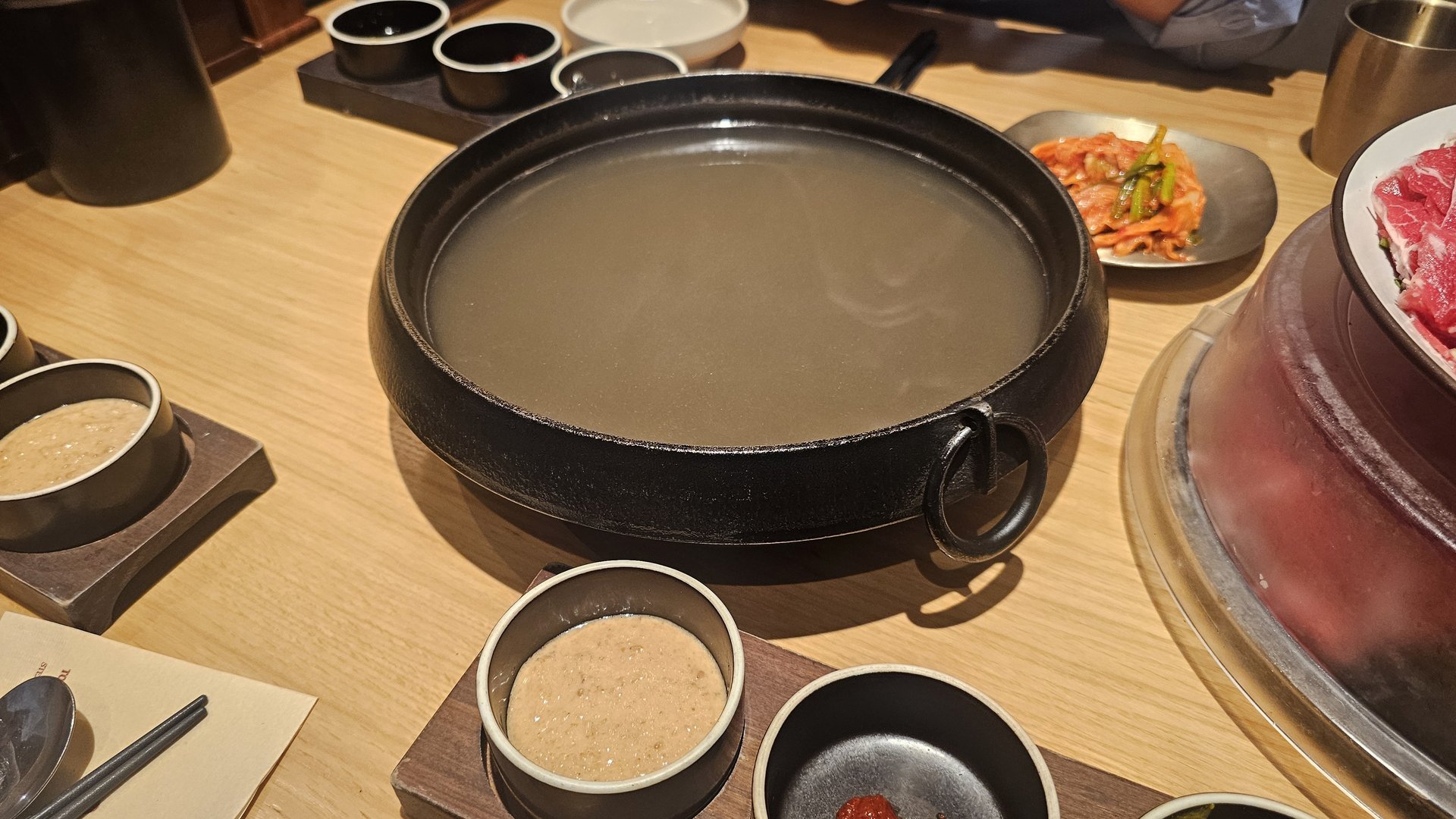
    Initial hot pot setup at Jeil Myeonso with clear broth in the pot and raw beef and kimchi waiting on the side
    Initial hot pot setup at Cheil Jemyunso with clear broth in the pot and raw beef and kimchi waiting on the side
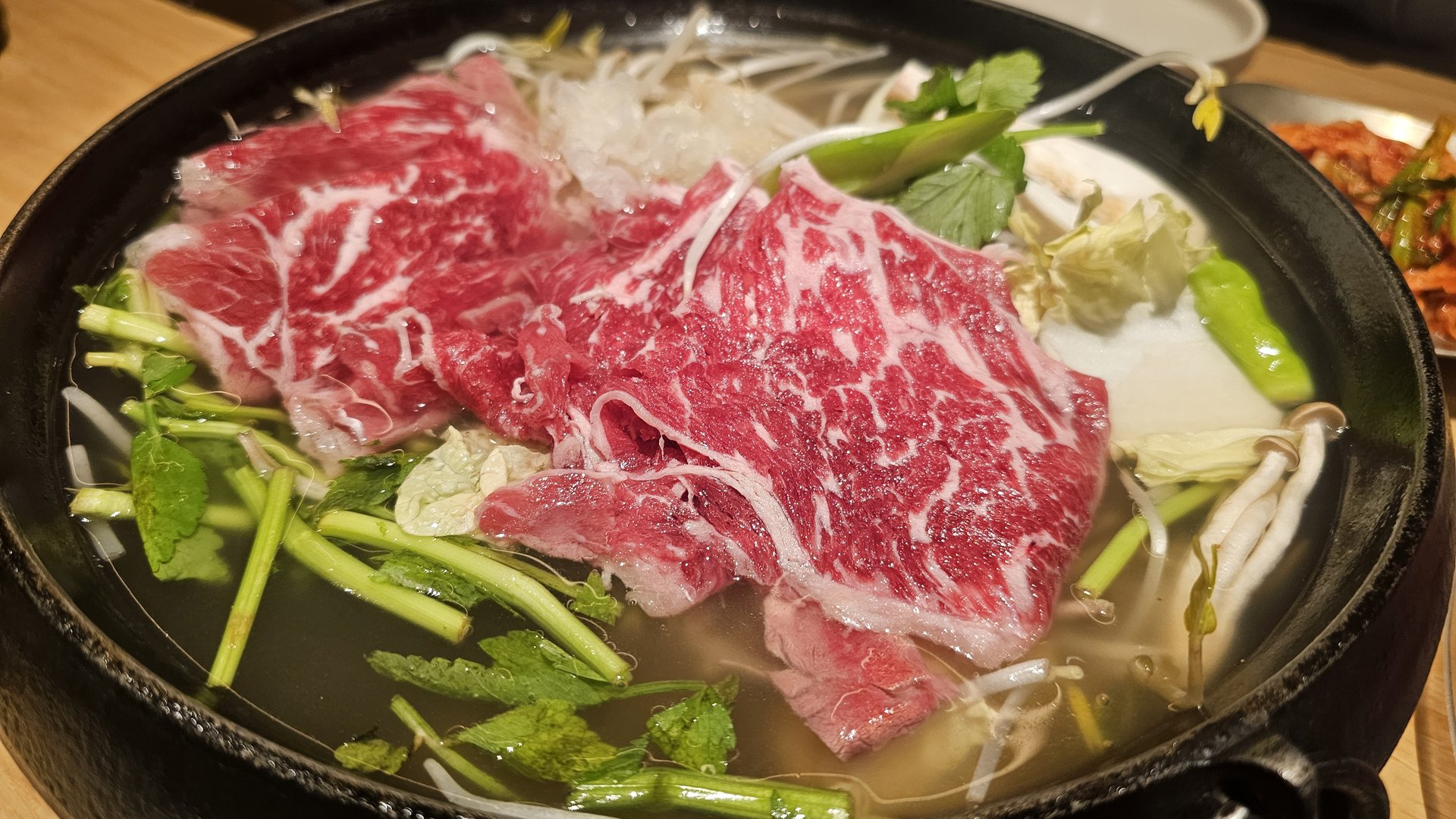
    Beef and vegetables cooking in the shabu shabu broth at Jeil Myeonso Yeouido
    Beef and vegetables cooking in the shabu shabu broth at Cheil Jemyunso Yeouido
    Jeil Myeonso shabu shabu hot pot boiling with cooked meat and vegetables, broth turning rich and cloudy
    Cheil Jemyunso shabu shabu hot pot boiling with cooked meat and vegetables, broth turning rich and cloudy
    Final stage of the Jeil Myeonso shabu shabu with reduced broth and fully cooked ingredients
    Final stage of the Cheil Jemyunso shabu shabu with reduced broth and fully cooked ingredients

    The dipping sauces: Three options on the table — sesame sauce (참깨소스), gochujang (고추장, Korean fermented red pepper paste — spicy and slightly sweet), and soy sauce (간장). Most people default to the sesame sauce and it’s the right call. Go gochujang if you want heat, soy sauce if you want something clean and simple.

    Kimchi comes as a side dish. Use it as a palate break between rounds of hot pot. Technically you can throw it into the broth but that’s not the intended move.

    The Cooking Process

    No formal instruction given — you figure it out quickly. Drop the beef in, swish it around until it changes color, pull it out. Vegetables need a bit longer. The induction burner keeps the broth at a steady simmer. Don’t crank it to full boil — medium heat is enough and keeps the broth from getting murky too fast.

    Staff will check in and help if you look genuinely lost. No pressure, no hovering.

    Stuff Tourists Should Know

    Price per person: 28,000 KRW (~$21). Budget for a drink if you want one — total per person comes to around 30,000–35,000 KRW (~$22–26) with sides included.

    Payment: Cards accepted, including most foreign cards (Visa/Mastercard work fine). Cash is fine too.

    Tipping: None. Korea doesn’t have a tipping culture. Do not leave money on the table — it will confuse the staff.

    English: Basic English from staff, photo-based tablet menus. You’ll be fine without Korean.

    Dietary restrictions: Not vegetarian or vegan friendly — the whole point is the beef, and the broth is meat-based. Halal not certified. If you have a shellfish or pork allergy you’re in okay shape here since neither is in the standard hot pot, but confirm with staff for your specific allergy.

    Kids: The induction burner at the table means you’d need to watch young children. The restaurant itself is family-friendly in setup — booths and regular tables have enough space.

    Solo dining: Fully comfortable. Counter section is designed for it.

    The Verdict

    This is the kind of place that earns regular visits precisely because it doesn’t try to be more than it is.

    The shabu shabu is well-executed, the beef is better than the price requires, and the IFC Mall location means it’s accessible without going out of your way if you’re already in Yeouido. It’s not going to be the most memorable meal of a Seoul trip — Korean BBQ, pojangmacha street food, or a proper naengmyeon in summer will all compete harder for that slot. But as a reliable, quality hot pot lunch in a clean comfortable space, it delivers every time.

    Go if:

    – You’re in Yeouido for the Han River, a work meeting, or IFC shopping

    – You’re 2–3 people looking for a shared, interactive lunch

    – You want to try shabu shabu without hunting down a specialty spot

    Skip if:

    – This is your first or second day in Seoul — eat Korean food first, hot pot later

    – Budget is tight — the noodle dishes elsewhere in IFC food hall are cheaper

    – You need vegetarian or halal options

    Worth coming back to. Already have.

    FAQ

    How much does the shabu shabu cost at Cheil Jemyunso Yeouido?

    The Jeil Shabu hot pot is 28,000 KRW (~$21) per person. There’s no minimum group size — you can order it solo.

    Where exactly is Cheil Jemyunso in Yeouido?

    Inside IFC Mall (국제금융센터) in Yeouido. Take subway Line 5 or Line 9 to Yeouido Station and follow signs for IFC Mall — you can walk there underground without going outside.

    Is there an English menu at Cheil Jemyunso?

    They use tablet menus with photos, so even without Korean you can navigate it. Staff speaks basic English and will help if you look stuck.

    Can you add noodles to the hot pot at the end?

    Yes — Cheil Jemyunso is primarily a noodle restaurant, so finishing your hot pot broth with naengmyeon (cold noodles) or noodles is an option. Check the tablet for add-ons.

    Do I need a reservation for lunch at Cheil Jemyunso Yeouido?

    We walked in on a weekday at 12:15 PM with no reservation and got seated right away. Peak lunch hour (noon to 1 PM) fills up, so arriving just before noon or after 1 PM is the safer move.

    Is Cheil Jemyunso good for solo dining?

    Yes. There’s a dedicated counter section facing the open kitchen built specifically for solo diners. It doesn’t feel like an afterthought — proper seats, comfortable setup.

    You might also like

    📍 Location

    Open in Google Maps →

  • Downtowner Yeouido: Honest Review of Seoul’s Smash Burger Chain

    Downtowner Yeouido: Honest Review of Seoul’s Smash Burger Chain

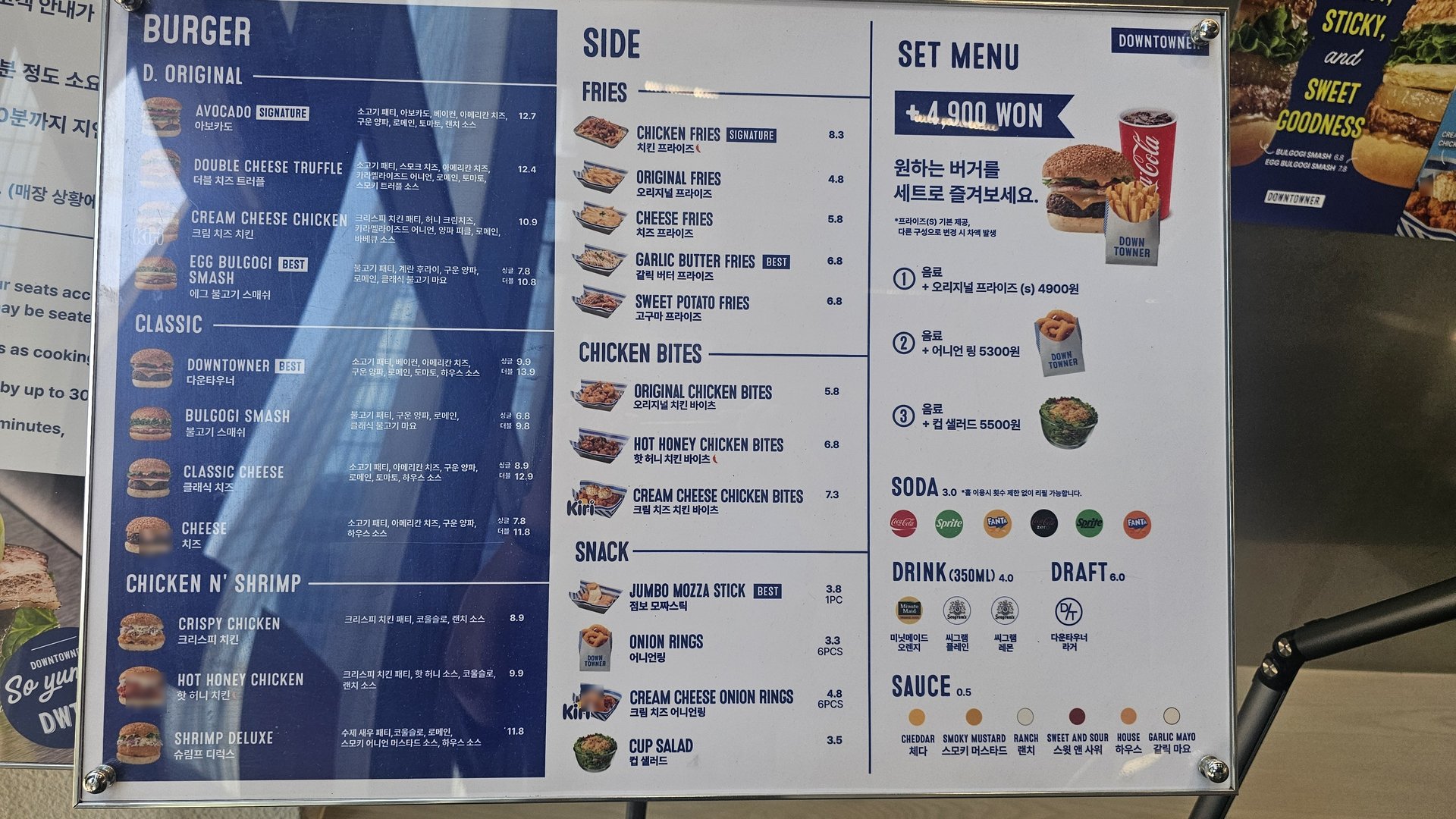
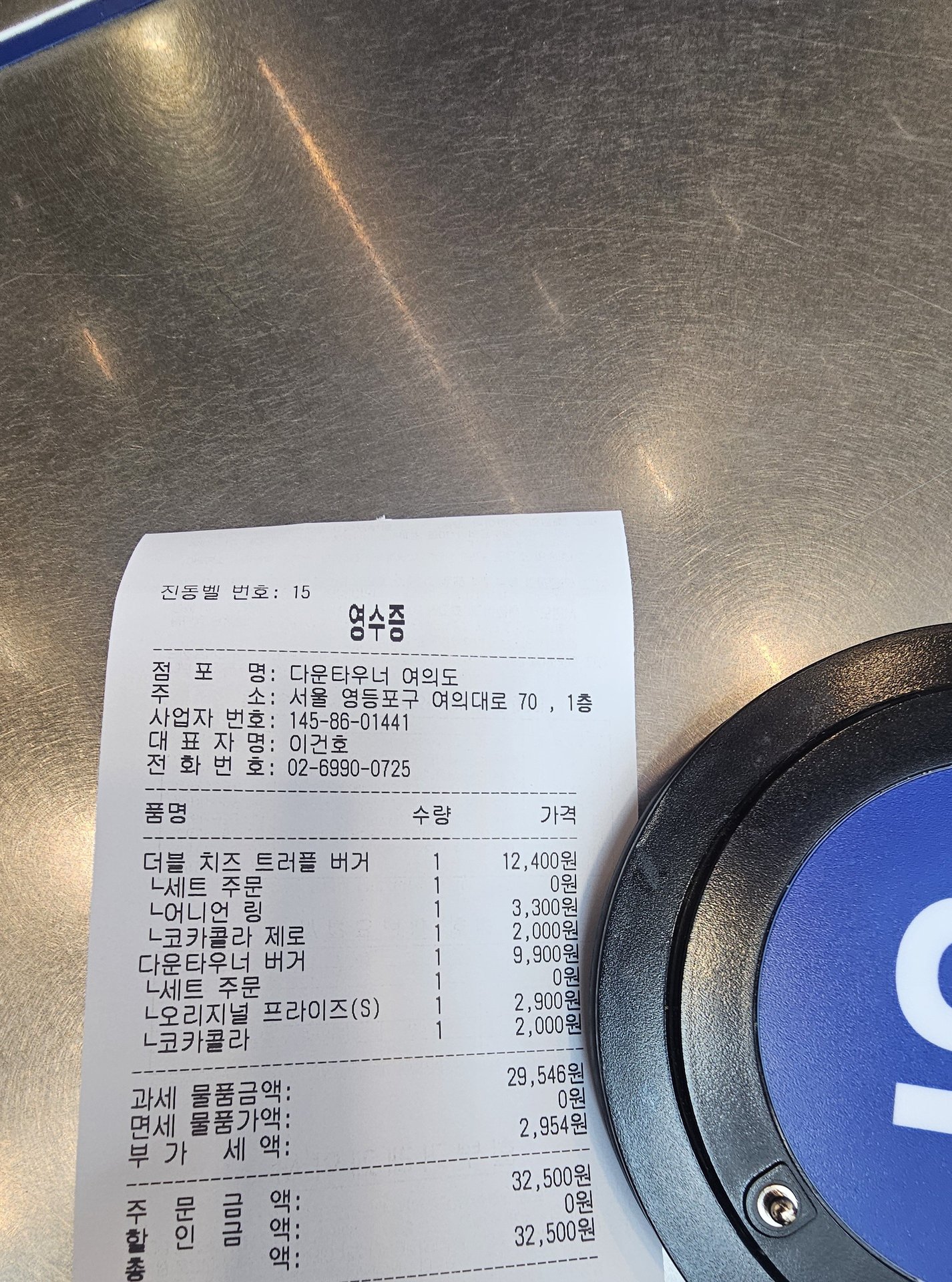
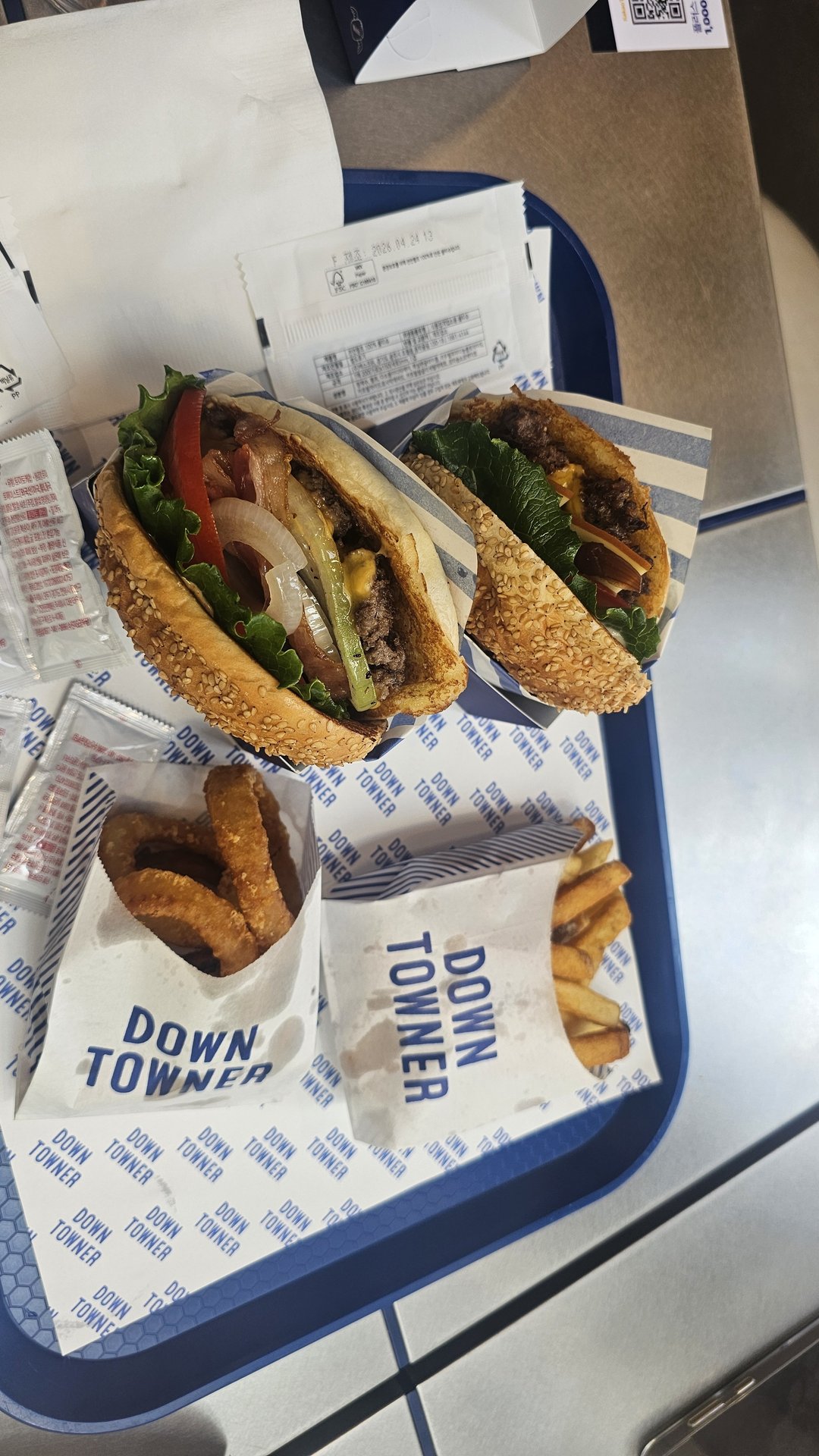
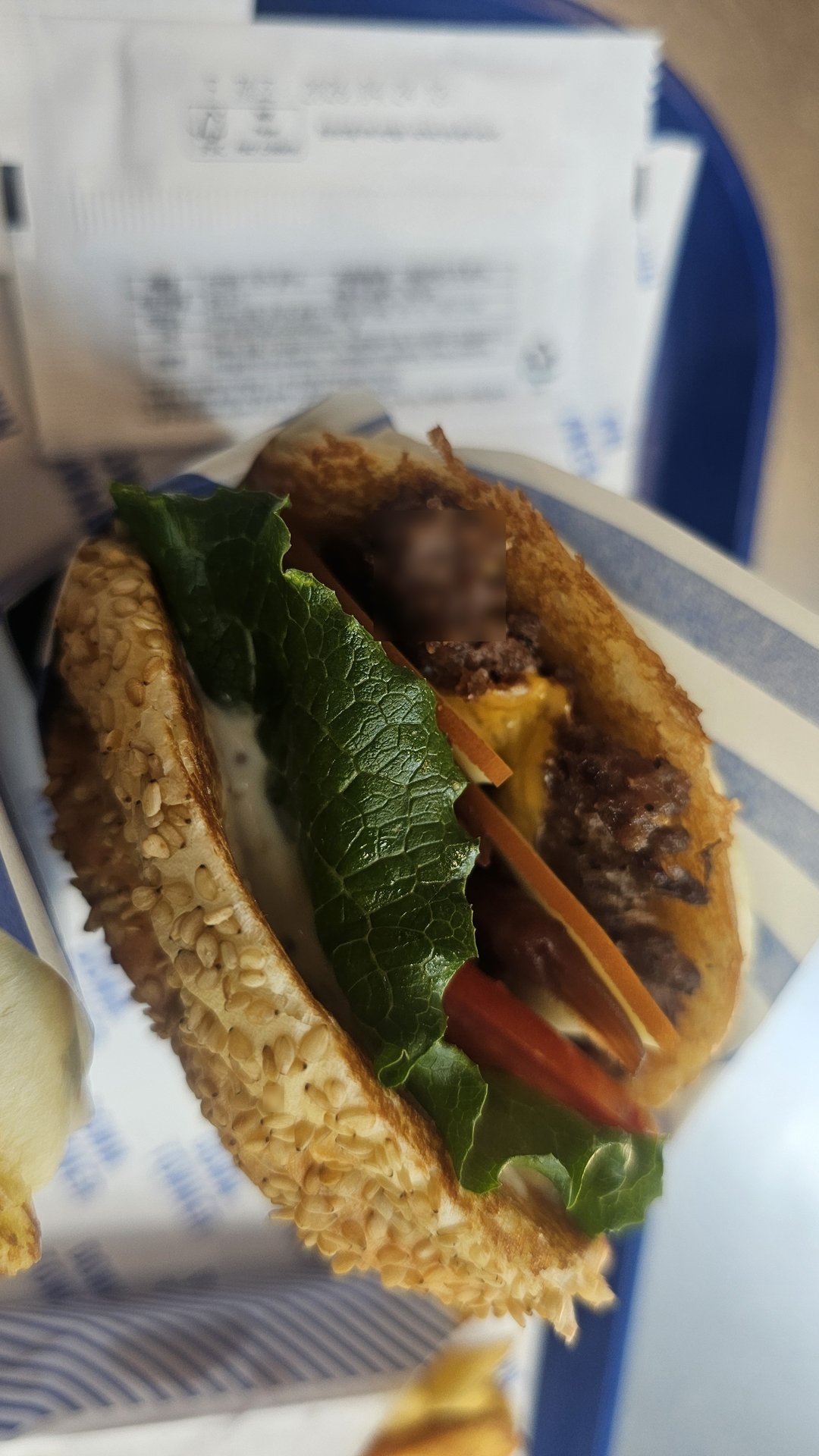
    Quick honest review of Downtowner (다운타우너) Yeouido — Seoul’s most popular homegrown smash burger chain, with a branch wedged into the ground floor of a Yeouido office tower. Short version: genuinely good burgers, fair price, zero hassle for foreign visitors. We’re already planning a return trip.

    Visited on a Monday, around 12:50 PM. Two people. Walked in, hit a kiosk, done.

    What Is Downtowner?

    Downtowner is a Korean burger chain built around smash-style patties — thin beef portions pressed hard onto a screaming-hot griddle, which creates crispy lacy edges and a dense caramelized crust.

    If you haven’t had a smash burger before: the technique extracts more flavor per bite than a traditional thick patty. Less juice dripping everywhere, more deep savory punch. The style blew up globally in the last five years. Downtowner was doing it in Korea before it became a trend everywhere else.

    They have multiple locations across Seoul now. The Yeouido spot is one of their newer additions, and it fits the neighborhood — quick, efficient, slightly above fast food without being precious about it.

    Location — Yeouido

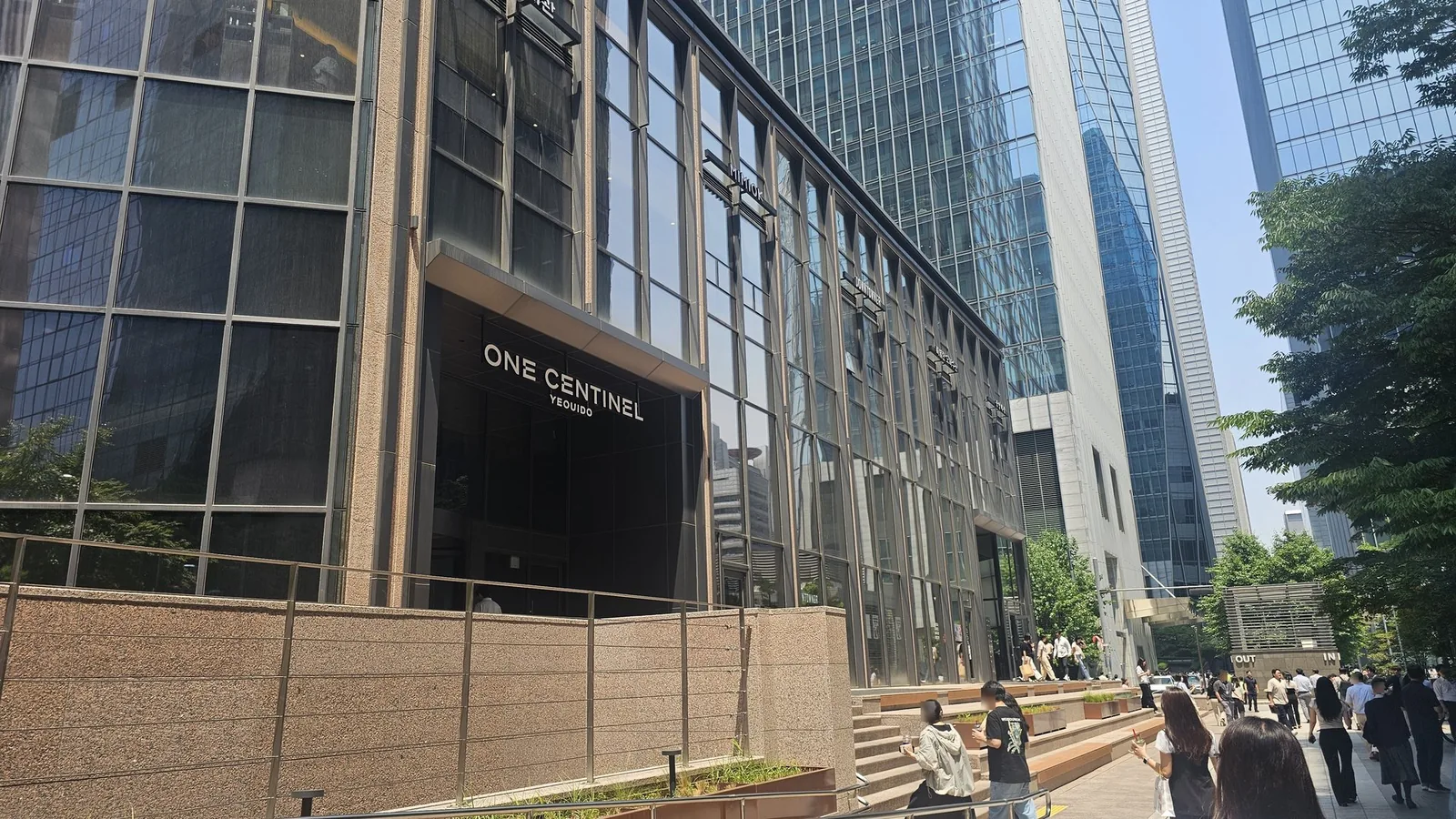
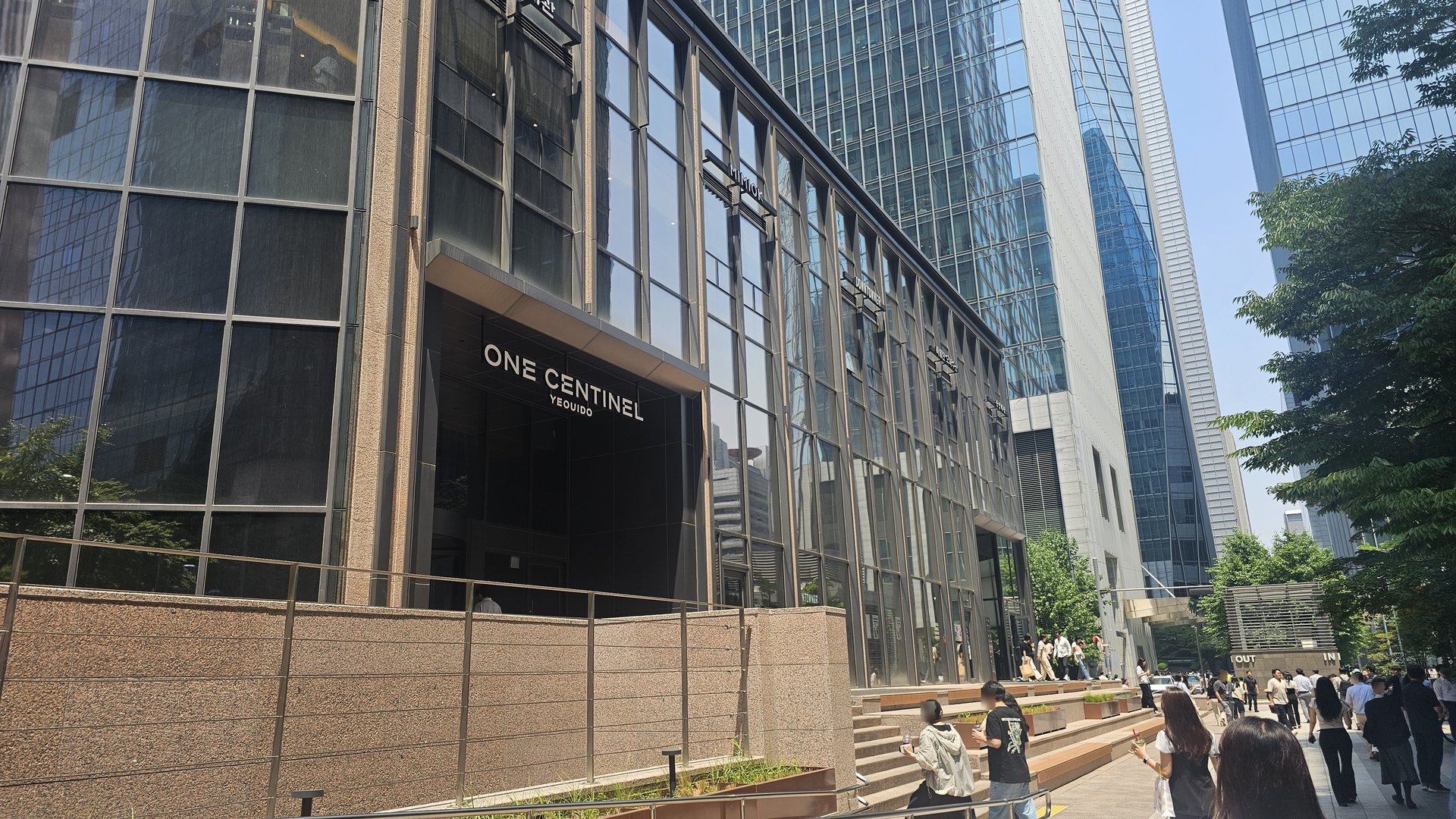
    ONE CENTINEL YEOUIDO office building exterior on Yeouido financial district street
    ONE CENTINEL YEOUIDO office building exterior on Yeouido financial district street

    Yeouido is Seoul’s financial district — comparable to Canary Wharf in London or the Wall Street area in New York, but more compact. Korea’s major banks, brokerage firms, broadcasting networks (KBS, MBC), and the National Assembly all sit here. On weekday lunchtimes it fills with office workers. Weekends it goes quiet fast.

    The Downtowner branch is on the ground floor of ONE CENTINEL YEOUIDO, a commercial tower right in the thick of the business strip.

    Downtowner Yeouido branch exterior with glass facade and DOWNTOWNER logo sign
    Downtowner Yeouido branch exterior with glass facade and DOWNTOWNER logo sign

    Glass facade, DOWNTOWNER logo, looks exactly like what it is. Hard to miss.

    Getting There

    Subway: Yeouido Station (Line 5 and Line 9 both stop here). Exit 3 or 4, roughly 5 minutes on foot to the building.

    From Hongdae: about 20–25 minutes by subway

    From Gangnam: about 25–30 minutes by subway

    From Incheon Airport: Take the AREX express to Seoul Station, transfer to Line 5, and ride to Yeouido — around 70–80 minutes total.

    Yeouido isn’t in the tourist core, but it’s on the Han River. If you’re already doing the Han River Park (about a 10-minute walk from here), this is a completely logical lunch stop.

    The Interior

    Downtowner Yeouido interior with blue accent decor, bar stools, and DOWNTOWNER neon sign above counter
    Downtowner Yeouido interior with blue accent decor, bar stools, and DOWNTOWNER neon sign above counter

    Metal, blue accents, grey surfaces. Industrial-leaning fast-casual. Clean and functional — you come here to eat, not to linger over the decor.

    Bar-style counter seating along the windows. A few small tables inside. During weekday lunch, the seats fill up quickly with office workers. Turnover is fast though — people eat and leave. You’ll get a spot.

    Downtowner Yeouido interior counter and pickup area with DOWNTOWNER sign and customers seated to the right
    Downtowner Yeouido interior counter and pickup area with DOWNTOWNER sign and customers seated to the right

    Pickup counter at the back. Order at the kiosk, get a number, collect your tray when they call it out. Self-service from there.

    Ordering — Kiosk Only

    No cashier at this location. All orders go through the kiosk.

    Downtowner Yeouido NOTICE board with kiosk ordering instructions in both Korean and English
    Downtowner Yeouido NOTICE board with kiosk ordering instructions in both Korean and English

    The NOTICE sign near the entrance has both Korean and English instructions. The kiosk itself has English as a language option. This is about as foreigner-accessible as a non-English-speaking restaurant gets — you genuinely don’t need to talk to anyone from arrival to pickup.

    Downtowner kiosk screen showing DOWNTOWNER x Kiri cream collab promotion and order waiting screen
    Downtowner kiosk screen showing DOWNTOWNER x Kiri cream collab promotion and order waiting screen
    Downtowner kiosk menu screen showing Welch's collab tab and D.ORIGINAL category with Double Cheese Truffle Burger at 12,400 KRW
    Downtowner kiosk menu screen showing Welch’s collab tab and D.ORIGINAL category with Double Cheese Truffle Burger at 12,400 KRW
    Downtowner kiosk full menu price list showing D.ORIGINAL, CLASSIC, and CHICKEN N' SHRIMP categories
    Downtowner kiosk full menu price list showing D.ORIGINAL, CLASSIC, and CHICKEN N’ SHRIMP categories
    Downtowner kiosk menu screen showing SNACK category with onion rings and jumbo mozzarella sticks, plus SODA and DRINK categories
    Downtowner kiosk menu screen showing SNACK category with onion rings and jumbo mozzarella sticks, plus SODA and DRINK categories
    Downtowner kiosk menu showing CHICKEN N' SHRIMP, DOUBLE, and FRIES categories with Downtowner Double at 13,900 KRW
    Downtowner kiosk menu showing CHICKEN N’ SHRIMP, DOUBLE, and FRIES categories with Downtowner Double at 13,900 KRW
    Downtowner kiosk menu showing DOUBLE, FRIES, and CHICKEN BITES categories with detailed pricing
    Downtowner kiosk menu showing DOUBLE, FRIES, and CHICKEN BITES categories with detailed pricing
    Downtowner Yeouido wall menu board showing full burger, side, chicken, and set meal prices including 4,900 KRW set options
    Downtowner Yeouido wall menu board showing full burger, side, chicken, and set meal prices including 4,900 KRW set options

    The menu is organized into categories: D.ORIGINAL (their signature lineup), CLASSIC, CHICKEN N’ SHRIMP, DOUBLE, and sides. There are also set options that bundle fries and a drink if you want to save a bit.

    What We Ordered

    Downtowner Yeouido receipt showing Double Cheese Truffle Burger, Downtowner Burger, onion rings, original fries, Coke Zero, and Coke totaling 32,500 KRW
    Downtowner Yeouido receipt showing Double Cheese Truffle Burger, Downtowner Burger, onion rings, original fries, Coke Zero, and Coke totaling 32,500 KRW

    Two people. Here’s what we got:

    더블 치즈 트러플 버거 (Double Cheese Truffle Burger) — 12,400 KRW (~$9.20 USD)

    다운타우너 버거 (Downtowner Burger, their original)

    오리지널 프라이즈 S (Original Fries, small)

    어니언링 (Onion Rings)

    – Coke + Coke Zero

    Total: 32,500 KRW (~$24 USD) for two

    Full tray at Downtowner Yeouido with two burgers, original fries, and onion rings
    Full tray at Downtowner Yeouido with two burgers, original fries, and onion rings

    Double Cheese Truffle Burger

    Double Cheese Truffle Burger cross-section showing thick smash patties, melted cheese, lettuce, and tomato on sesame bun
    Double Cheese Truffle Burger cross-section showing thick smash patties, melted cheese, lettuce, and tomato on sesame bun

    This is the one to order.

    Two smash patties, double cheese, truffle sauce, lettuce, tomato, sesame bun. The truffle here isn’t an assault — it’s a quiet richness in the background rather than an in-your-face truffle explosion. Good restraint. Too much truffle on burgers just tastes like someone spilled a fancy oil.

    The two patties fuse together with the melted cheese into what basically feels like one substantial layer — thin individually, but the stack gives you real density. Crispy edges all around from the griddle press. Savory, slightly charred, deeply satisfying.

    12,400 KRW (~$9.20) is fair for this. Not cheap by Korean standards — plenty of solid Korean lunches run 8,000–10,000 KRW — but this is clearly a notch above.

    Downtowner Burger

    Downtowner Burger cross-section showing tomato, lettuce, onion, pickle, smash patty, and sesame bun
    Downtowner Burger cross-section showing tomato, lettuce, onion, pickle, smash patty, and sesame bun

    The original. Simpler: smash patty, cheese, tomato, lettuce, onion, pickle, sesame bun.

    Honestly, this one might be my favorite of the two. The truffle version has more going on, but the Downtowner Burger just eats clean. Every ingredient proportioned correctly, nothing fighting for attention, classic burger flavor done well.

    The bun is soft without falling apart. The patty-to-bun ratio is right — you’re not mostly eating bread. If you’ve been to Five Guys or Shake Shack, this is that caliber of burger, but leaning crispier and slightly less sweet.

    Original Fries + Onion Rings

    Onion rings and original fries close-up with ketchup dipping sauce at Downtowner Yeouido
    Onion rings and original fries close-up with ketchup dipping sauce at Downtowner Yeouido

    Fries are thin, crispy, lightly salted. Standard smash burger joint fries. Fine, not remarkable. Eat them while hot.

    Onion rings are better than I expected. Properly battered — not that thick doughy coating some places use — decent crunch, actual onion inside. Add ketchup. Eat before they cool, same as any onion ring anywhere.

    Neither side is the reason you come here. Get them to round out the meal.

    Drinks — Self-Serve Fountain

    Self-serve Coca-Cola fountain dispenser at Downtowner Yeouido with Coke, Coke Zero, Sprite, and Fanta options
    Self-serve Coca-Cola fountain dispenser at Downtowner Yeouido with Coke, Coke Zero, Sprite, and Fanta options

    Coca-Cola fountain machine at the back of the restaurant. Fill your own cup. Coke, Coke Zero, Sprite, Fanta. Standard. Works fine.

    Stuff Tourists Should Know

    Language and ordering: Kiosk has English. No Korean needed at any point during the meal. Staff interaction is minimal by design — you order by screen, collect by number. Easy.

    Payment: Cards accepted. Tap payment (Visa, Mastercard) works. Cash also works. No issues with foreign cards here.

    No tipping. Korea doesn’t have a tipping culture. Don’t tip — it’s not expected and can create confusion.

    When to go: Weekday lunch from 12:00–13:00 is packed with office workers. If you hit that window, expect to wait briefly for a kiosk and possibly for seating. Before noon or after 1 PM is noticeably calmer.

    Vegetarian options: Limited. No dedicated veggie patty that I saw. If you’re vegetarian, the sides (fries, onion rings) are your options, but the main event is beef. This is not a vegetarian-friendly spot.

    Allergens: No visible English allergen breakdown on the kiosk. If you have serious food allergies, communicating with staff could be difficult given the language gap. Factor that in before ordering.

    Family-friendly: Yes. Kiosk ordering is slightly slower if you have kids who want to look at everything, but nothing here is complicated. Seating fits families fine.

    Solo dining: Works well. Counter seating is normal for solo visitors and there’s no awkward table situation.

    Date spot: Not really. The vibe is lunch-on-the-go energy. Come here, eat well, go somewhere else for the actual date.

    The Verdict

    Yeah, go.

    Downtowner Yeouido does exactly what it sets out to do — solid smash burgers, efficient ordering, no nonsense. The Double Cheese Truffle Burger earns its spot on the menu. The original Downtowner Burger is quietly excellent. Sides are decent. Price is reasonable.

    32,500 KRW (~$24 USD) for two burgers, two sides, and two drinks is a fair lunch tab, even by Yeouido office district standards. We came back for more.

    Go if:

    – You’re in Yeouido anyway — for work, the Han River, or the National Assembly area

    – You want a no-fuss burger that actually delivers

    – You’ve been eating Korean food all week and want something in your comfort zone without giving up quality

    Skip if:

    – You only have 3–4 days in Seoul. Prioritize Korean food. Burgers can wait for a longer trip.

    – You’re coming from a different neighborhood specifically for this. It’s good, but not a pilgrimage burger.

    FAQ

    Is Downtowner Yeouido foreigner-friendly?

    Very. English kiosk, no speaking required, card payment works, clear pickup system. One of the easier spots in Seoul for non-Korean speakers.

    What should I order at Downtowner Yeouido?

    Start with the Double Cheese Truffle Burger. Add the Downtowner Burger if you’re two people. Get the onion rings over the fries if you’re picking one side.

    How much does Downtowner Yeouido cost?

    Burgers range from about 11,000 to 14,000 KRW (~$8–10 USD) each. Two people with burgers, sides, and drinks runs around 30,000–35,000 KRW (~$22–26 USD).

    Is there an English menu at Downtowner?

    The kiosk has English. The wall menu is Korean-only, but the kiosk is the main ordering method and has everything on it.

    Do I need a reservation?

    No reservations — walk in and order at the kiosk. Peak lunch hour (12:00–13:00 weekdays) can have a short wait for a kiosk machine, but nothing major.

    Where exactly is it?

    Ground floor of ONE CENTINEL YEOUIDO building, Yeouido. Closest subway: Yeouido Station (Line 5 / Line 9), Exit 3 or 4, about 5 minutes on foot.

    Is there a smash burger trend in Korea?

    Yes — smash burgers have become very popular in Seoul over the last few years, and Downtowner is one of the chains that helped start that wave. You’ll find similar spots across the city now, but Downtowner remains one of the more consistent ones.

    📍 Location

    Open in Google Maps →

  • Shindosegi, Yeouido: a beautiful room and a perfectly fine kimchi jjigae

    Shindosegi, Yeouido: a beautiful room and a perfectly fine kimchi jjigae

    I should say upfront that we did this restaurant wrong. Shindosegi is built around aged beef, and we walked in, sat down, and ordered kimchi jjigae for lunch. So this isn’t really a review of what the place is for. It’s a review of what we actually ate, which was a 13,000 KRW (~$9.60) hot pot in a room that looked like it cost more than the food.

    What this place actually is

    Shindosegi (신도세기) is a chain whose whole pitch is an aging method they call SCA — Super Cold Aging, or 수빙숙성 in Korean. The short version: they age beef at near-freezing temperatures, colder than ordinary dry aging, which is supposed to firm up the texture, cut the gaminess, and push the flavor up. You don’t have to take their word for it either — the aging fridges are right there in the dining room, rows of vacuum-packed beef sitting behind glass while you eat. That’s the draw. Grilled aged beef, done Korean-BBQ style at your table.

    We ordered none of that. Keep that in mind for everything below.

    Getting there

    The Yeouido branch is on the 2nd floor of BNK Finance Tower, in the middle of Seoul’s financial district — think Wall Street or Canary Wharf, lots of suits at noon and tumbleweeds by nine. Yeouido Station on Line 5 or 9 puts you about 5–10 minutes away on foot depending on which exit you climb out of.

    If you’re staying somewhere central — Myeongdong, Gangnam, Hongdae — it’s a 20–30 minute subway ride, and honestly not worth the trip for the hot pot alone. From Incheon Airport you’re looking at the better part of an hour on the AREX plus a transfer, which would be a genuinely unhinged amount of effort for a bowl of kimchi jjigae. Go if you’re already in the neighborhood. Otherwise don’t reorganize your day around it.

    Shindosegi (신도세기) is a Korean restaurant chain built around a specific aging concept called SCA — Super Cold Aging (수빙숙성, su-bing-suk-seong in Korean). The idea is that beef is aged at near-freezing temperatures over an extended period. It’s supposed to tighten the texture, reduce any gamey smell, and concentrate flavor. You can actually see the meat sitting in refrigerated showcases when you walk in.

    The restaurant’s main draw is grilled aged beef, served Korean BBQ-style at the table. That’s the thing people come here for.

    We did not order that. We ordered kimchi jjigae.

    So consider this a review of the hot pot lunch option, not the BBQ. Two different experiences.

    Getting There

    Shindosegi Yeouido is on the 2nd floor of BNK Finance Tower in Yeouido — Seoul’s financial district, roughly equivalent to New York’s Wall Street or London’s Canary Wharf. If you’re staying near Yeouido or have business in the area, this is easy to reach.

    Nearest subway: Yeouido Station (Line 5 or 9), about a 5–10 minute walk depending on your exit.

    From central Seoul (Myeongdong, Gangnam, Hongdae), you’re looking at 20–30 minutes by subway. Not a destination worth a dedicated trip for the hot pot. Worth considering if you’re already in Yeouido.

    From Incheon Airport: roughly 50–60 minutes on the AREX express + subway transfer. Way too far to specifically come here just for kimchi jjigae.

    Shindosegi Yeouido exterior entrance with standing sign board showing BNK Finance Tower 2F location
    Shindosegi Yeouido exterior entrance with standing sign board showing BNK Finance Tower 2F location
    Shindosegi Yeouido front entrance with neon sign, navy and gold door, and blackboard menu
    Shindosegi Yeouido front entrance with neon sign, navy and gold door, and blackboard menu

    The room

    Credit where it’s due: the interior is the best thing here. Navy and gold, and not in the gaudy way that combination usually goes — it’s restrained, more wine bar than gukbap joint. Wine glasses hang upside down over the floor, the kitchen is open, and those SCA fridges I mentioned do a lot of the visual work. For a place where lunch tops out around ten bucks, it punches well above its weight on atmosphere. There’s a tablet on each table for ordering, which quietly solves most of the language problem before it starts.

    Shindosegi Yeouido interior with navy and gold decor, SCA Super Cold Aging refrigerators, and dining seating area
    Shindosegi Yeouido interior with navy and gold decor, SCA Super Cold Aging refrigerators, and dining seating area
    SCA aged meat showcase refrigerator and wine glass rack inside Shindosegi Yeouido open kitchen
    SCA aged meat showcase refrigerator and wine glass rack inside Shindosegi Yeouido open kitchen

    .

    What we ate

    황제 김치전골 (Emperor Kimchi Jjigae), 13,000 KRW. If you’ve never had it: kimchi jjigae is a hot pot built on fermented kimchi, with tofu, pork, and a broth that lands somewhere between spicy and deeply savory. It’s a national comfort food — every household has its own version, every restaurant too. The “Emperor” (황제) tag implies the upgraded one: more of everything, richer.

    It came out in a stone pot, not yet boiling, everything still arranged neatly — kimchi, tofu, scallion, a knob of seasoning on top — before the heat got to it. Then it bubbled up and the room started smelling like a Korean grandmother’s kitchen, which is to say great.

    Kimchi jjigae hot pot before boiling with tofu, kimchi, green onion, and seasoning at Shindosegi
    Kimchi jjigae hot pot before boiling with tofu, kimchi, green onion, and seasoning at Shindosegi

    Then it starts bubbling.

    Kimchi jjigae with ramen noodle add-on starting to boil at Shindosegi Yeouido
    Kimchi jjigae with ramen noodle add-on starting to boil at Shindosegi Yeouido
    Fully boiling kimchi jjigae with ramen noodles at Shindosegi Yeouido
    Fully boiling kimchi jjigae with ramen noodles at Shindosegi Yeouido

    The eating was less dramatic than the smell. The broth was competently spiced, the kimchi had real fermentation behind it, the tofu didn’t fall apart. All correct. But it’s the kind of jjigae any decent neighborhood spot would hand you at the same price without the “Emperor” branding, and somewhere in the middle of the pot I stopped having opinions about it and just ate. That’s not an insult exactly. It’s just not a thing I’ll remember next month.

    라면 사리 (ramen add-on), 2,000 KRW. This is the move. You drop dried ramen noodles into the broth near the end and give them a few minutes; they drink up all that red kimchi liquid and go slightly chewy. It’s the best part of the meal, and I’ll be honest about why — it’s not that Shindosegi does something special with it, it’s that ramen in kimchi broth is just one of those combinations that’s good no matter who makes it. The broth on its own was average. The noodles are what made me finish the pot.

    Close-up of lifting ramen noodles from kimchi jjigae with tongs showing rich red broth at Shindosegi
    Close-up of lifting ramen noodles from kimchi jjigae with tongs showing rich red broth at Shindosegi

    기본 반찬 (banchan). Four little dishes on a gold tray: kkakdugi, regular baechu kimchi, jeotgal, and soy-pickled jangajji. A solid spread, and the jeotgal stood out — briny and sharp without tipping into too-salty, which is a harder line to walk than it sounds.

    Four-piece banchan set on a gold tray at Shindosegi Yeouido — kkakdugi, baechu kimchi, jeotgal, and jangajji
    Four-piece banchan set on a gold tray at Shindosegi Yeouido — kkakdugi, baechu kimchi, jeotgal, and jangajji

    The practical stuff, if you’re visiting

    You can manage here with zero Korean. The tablet has photos, some items carry English labels, and even when they don’t you can point your way through it. Staff probably won’t chat with you in English, but you don’t really need conversation to get fed. Pay by card — Yeouido is an office district, so cash-only places are basically extinct around here. Don’t tip; Korea doesn’t do it, and service is built into the bill. One small thing worth knowing: the sign outside says they run on weekends and holidays, which isn’t a given in this neighborhood — plenty of Yeouido restaurants shut when the office crowd vanishes.

    On portions, the hot pot is sized for two, one pot per pair, so a solo diner will be drowning in it and a group of four needs to order in multiples. It’s fine for kids in theory, though the room skews a touch nicer than toddler-friendly. And if dietary restrictions matter to you, ask first — kimchi jjigae has pork, and even the kimchi base often carries fish sauce, so it’s neither vegetarian nor halal.

    The same hot pot logic applies to the whole lunch menu, by the way: kimchi jjigae, budae jjigae, duruchigi, all 13,000 KRW a pot. The aged beef is a completely different price bracket — figure 30,000 to 60,000+ KRW per portion, which is the real reason to come and the thing we skipped.

    So, should you go?

    If you work in Yeouido or you’re passing through, sure — it’s a pleasant, fairly priced lunch, and the room makes it feel a little more special than the food earns. If you’re a tourist with limited days in Seoul, I’d skip it without much hesitation. Nothing about this meal was something you couldn’t get at a hundred other places; spend that meal on something Seoul does that nowhere else does — a proper grill house, good naengmyeon, a sundubu spot that takes its tofu seriously.

    The kimchi jjigae gets a 6 out of 10 from me. Fine, pretty surroundings, forgettable bowl. I probably won’t come back for the hot pot. I might come back for the beef, if Yeouido pulls me in again — which, given the SCA thing is apparently the entire point of the restaurant, is the version of Shindosegi I should’ve reviewed in the first place.

  • Kustom Coffee in Yeouido: Honest Review of Their Lattes

    Kustom Coffee in Yeouido: Honest Review of Their Lattes

    Quick honest review of Kustom Coffee in Yeouido. If you’re already doing the IFC Mall or Han River park loop, this cafe is right in the neighborhood. Short version: milk tea was genuinely good, pistachio cream latte is a lot — and I mean a lot.

    Went on a Wednesday morning around 11 AM with one other person. Kiosk ordering. English menu available. Sat outside on the terrace.

    What Is Kustom Coffee?

    Kustom Coffee is a Korean specialty coffee brand — the kind that leans into the “third wave” aesthetic. Dark green palette, concrete floors, minimal signage. Very current Seoul.

    Not a Starbucks alternative. Not a mom-and-pop either. It’s a local Korean chain that takes its drinks seriously but runs with cafe-chain efficiency. The kind of place Seoul’s Yeouido office crowd hits at 10 AM between meetings.

    Kustom Coffee Yeouido exterior with green logo on glass facade and customers at entrance
    Kustom Coffee Yeouido exterior with green logo on glass facade and customers at entrance

    Getting There

    Yeouido is Seoul’s financial district — think Canary Wharf or lower Manhattan. Banks, law firms, major TV networks (KBS and MBC are both headquartered here), and the National Assembly building. A lot of the tourist stuff nearby:

    IFC Mall — large underground mall, direct subway access, CGV cinema, food hall

    Yeouinaru Hangang Park — riverside park, about 10–15 minutes walk

    63 Building — the gold skyscraper you can see from most of Yeouido

    Subway: Line 5, Yeouido Station (여의도역) or Line 9, Saetgang Station (샛강역). From Hongdae or Sinchon, take Line 2 to Dangsan, transfer to Line 9.

    From Incheon Airport: roughly 55–65 minutes by subway (Airport Railroad Express to Hongik University, then transfer). Or 40 minutes by taxi — expect around 40,000–50,000 KRW (~$30–37 USD) depending on traffic.

    The Interior

    Dark green countertop interior at Kustom Coffee Yeouido with two staff members serving customers
    Dark green countertop interior at Kustom Coffee Yeouido with two staff members serving customers

    Concrete floors. Dark green countertops. Clean pendant lighting. The interior is styled for the ‘gram and it works without feeling forced.

    The space isn’t huge, but there’s outdoor terrace seating — that’s where we sat. Wednesday morning, the terrace was quiet and easy. By lunch it was probably filling up with office workers.

    Dessert display case at Kustom Coffee Yeouido with cake slices scones and bottled drinks
    Dessert display case at Kustom Coffee Yeouido with cake slices scones and bottled drinks

    The dessert display case near the counter had cake slices, scones, bottled drinks. Looked decent. We didn’t order any so I can’t say more than that.

    How to Order

    Kiosk only. Walk in, find the kiosk near the entrance.

    Kustom Coffee kiosk ordering screen in Korean with butter cream latte promotion
    Kustom Coffee kiosk ordering screen in Korean with butter cream latte promotion
    Kustom Coffee kiosk ordering screen in English showing cafe latte hazelnut latte and mocha prices
    Kustom Coffee kiosk ordering screen in English showing cafe latte hazelnut latte and mocha prices

    The kiosk has an English option, and it’s actually usable — not the sketchy machine-translated English you see at some spots. Cafe latte, hazelnut latte, cafe mocha, all clearly listed with prices. Pay by card at the kiosk, wait for your number.

    What I Ordered

    Two drinks total: 12,100 KRW (~$9 USD)

    Milk Tea

    Close-up of iced milk tea with large ice cubes and clean milk base at Kustom Coffee Yeouido
    Close-up of iced milk tea with large ice cubes and clean milk base at Kustom Coffee Yeouido

    This one surprised me in a good way.

    Quick note for the non-Koreans: Korean cafe milk tea is not Taiwanese bubble tea. No tapioca pearls, no thick syrup base. It’s closer to iced tea with milk — lighter, cleaner, more tea-forward.
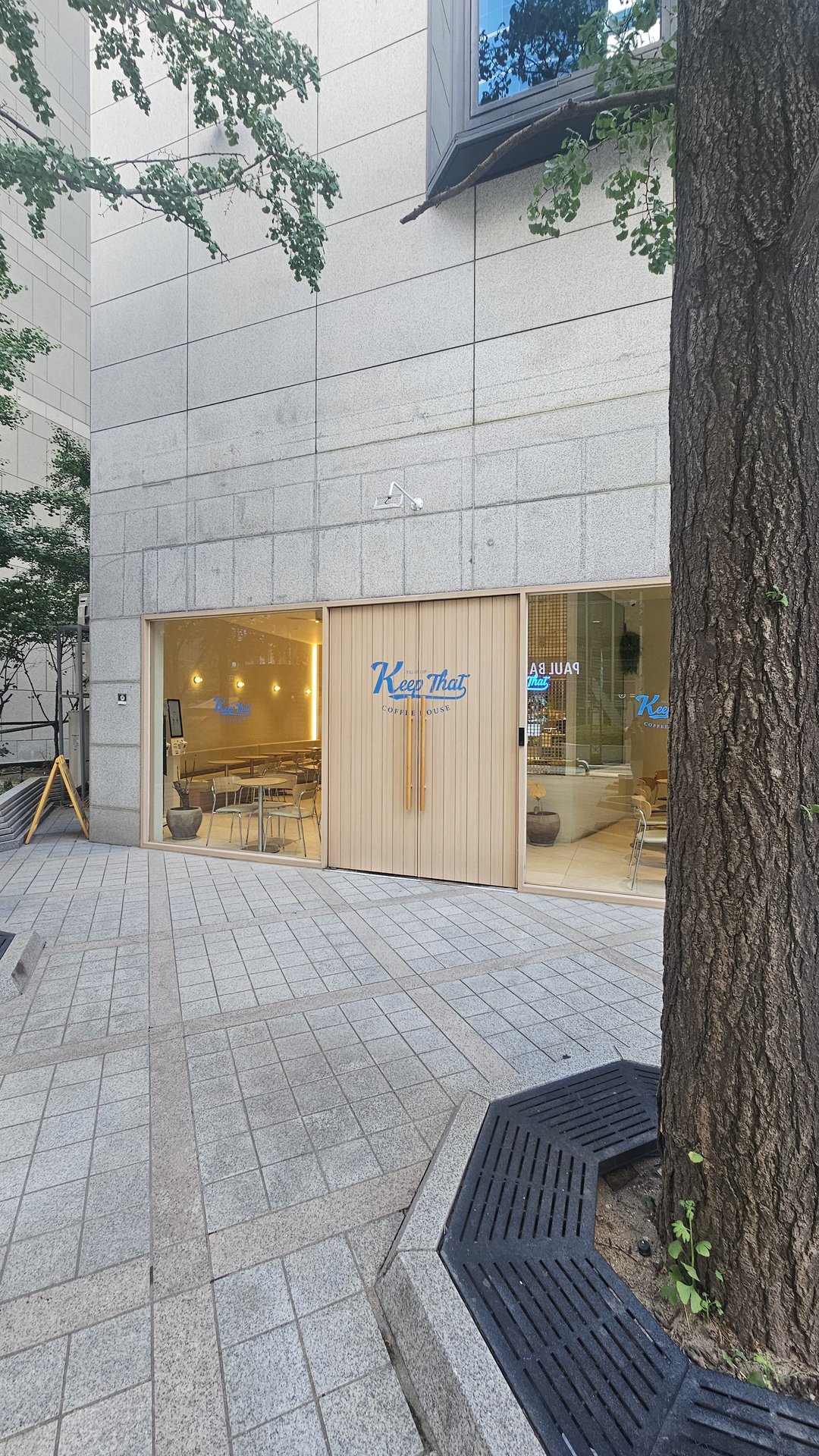
    This one delivered. The tea flavor actually comes through instead of getting buried under sweetener. Large ice cubes, slow melt, still tasted like tea at the bottom. If you want something refreshing and not too heavy — this is the call.

    Coming from a bubble tea background expecting thick pearls and syrup? Wrong spot. But as a clean, drinkable iced milk tea? Solid.

    Pistachio Cream Latte (Iced)

    Terrace tray at Kustom Coffee Yeouido with milk tea and pistachio cream latte side by side
    Terrace tray at Kustom Coffee Yeouido with milk tea and pistachio cream latte side by side
    Close-up of pistachio cream latte with thick cream layer and heavy pistachio powder at Kustom Coffee Yeouido
    Close-up of pistachio cream latte with thick cream layer and heavy pistachio powder at Kustom Coffee Yeouido

    Okay. Pistachio cream lattes are everywhere in Seoul right now. Every other specialty cafe has one. The standard formula: espresso base, milk, thick cream layer on top, pistachio powder dusted over the cream.

    Kustom went hard on the pistachio. Like, *really* hard.

    The cream layer is dense — not light foam, actual thick cream that sits heavy on top. The pistachio powder coating is generous. Layer that over the espresso base and you end up with something that’s very rich, very filling, very intense.
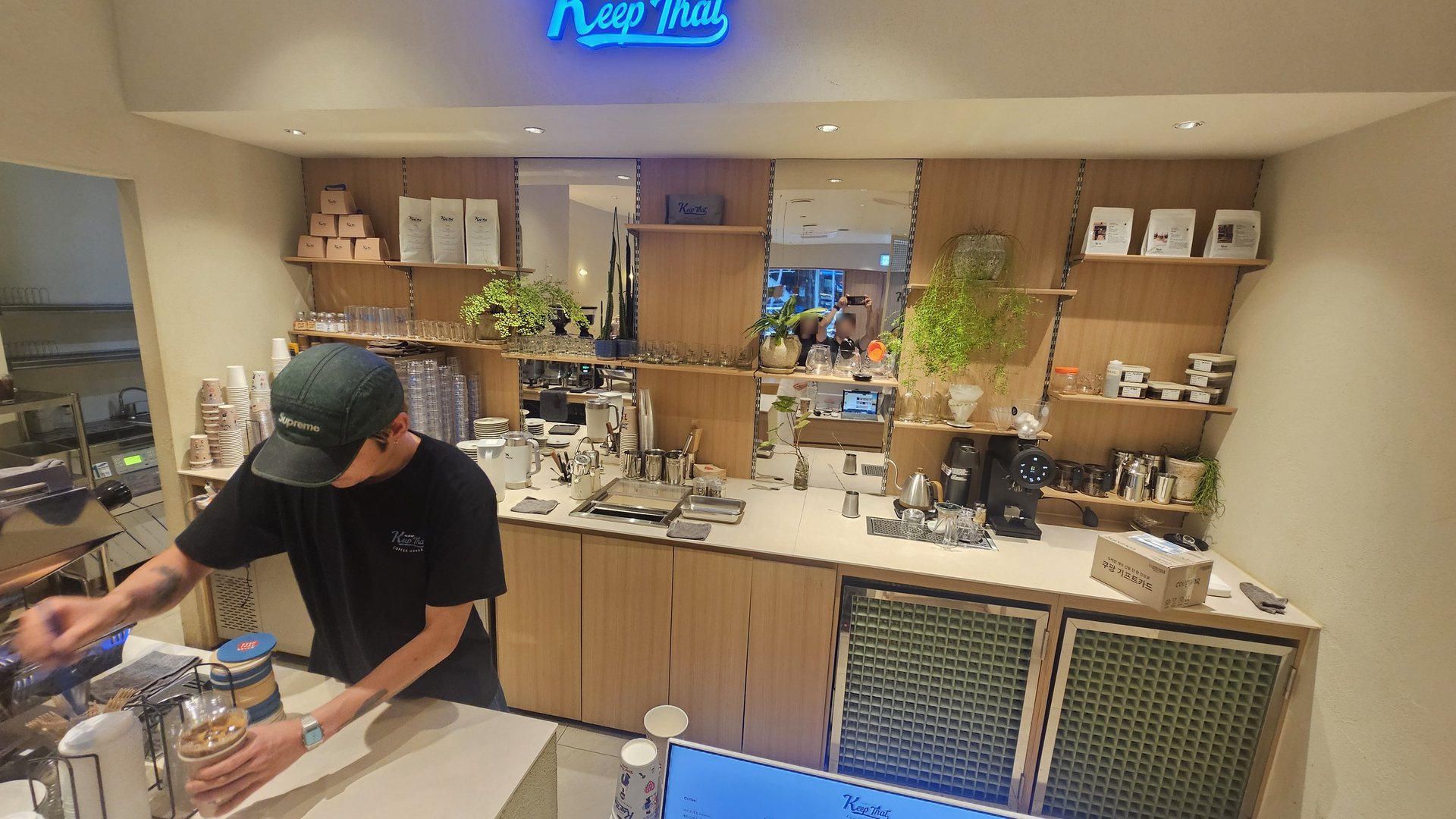
    Halfway through, the richness started stacking up on me. It’s not a “sip while scrolling your phone” drink. It’s basically a dessert in a cup.
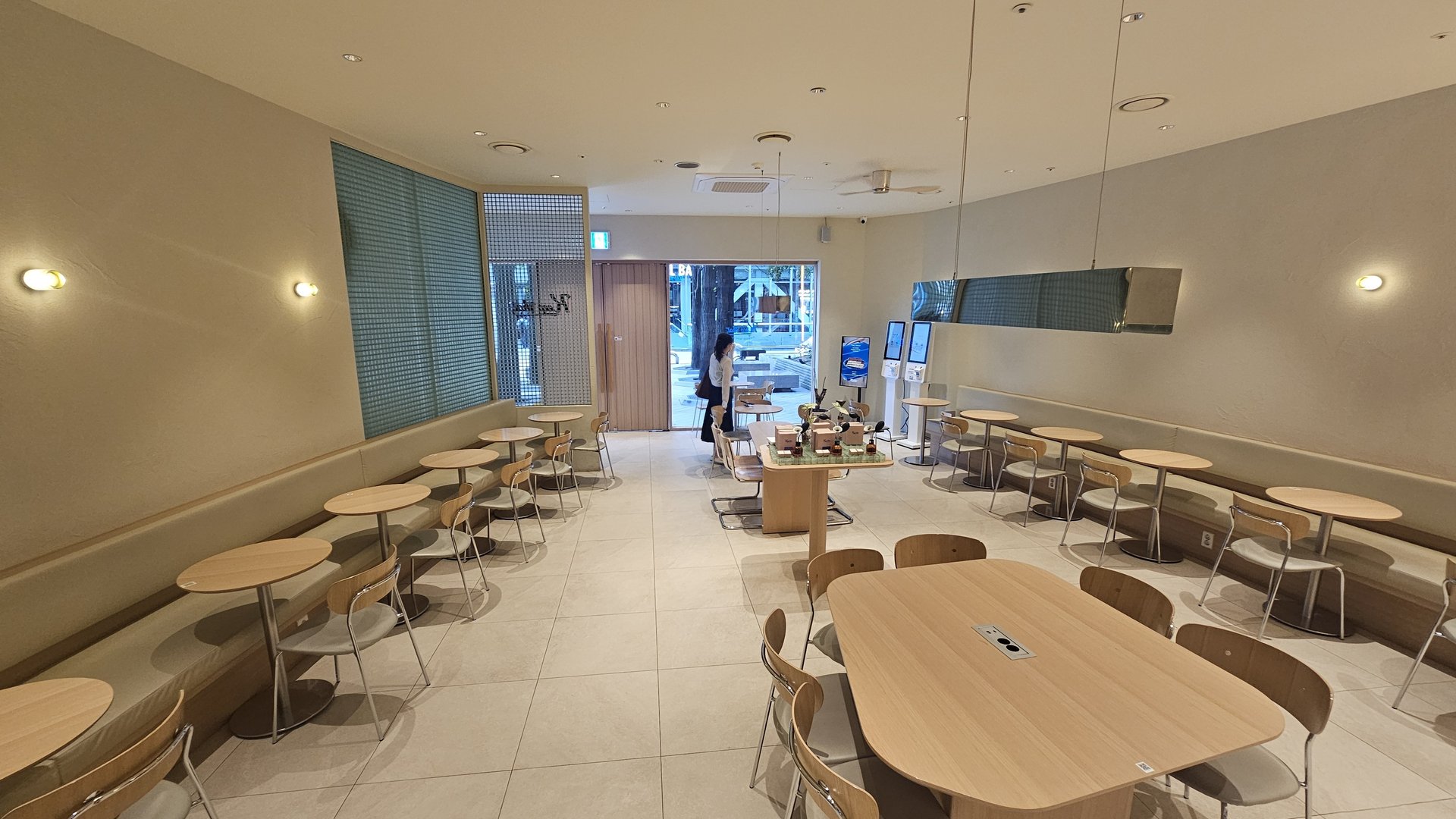
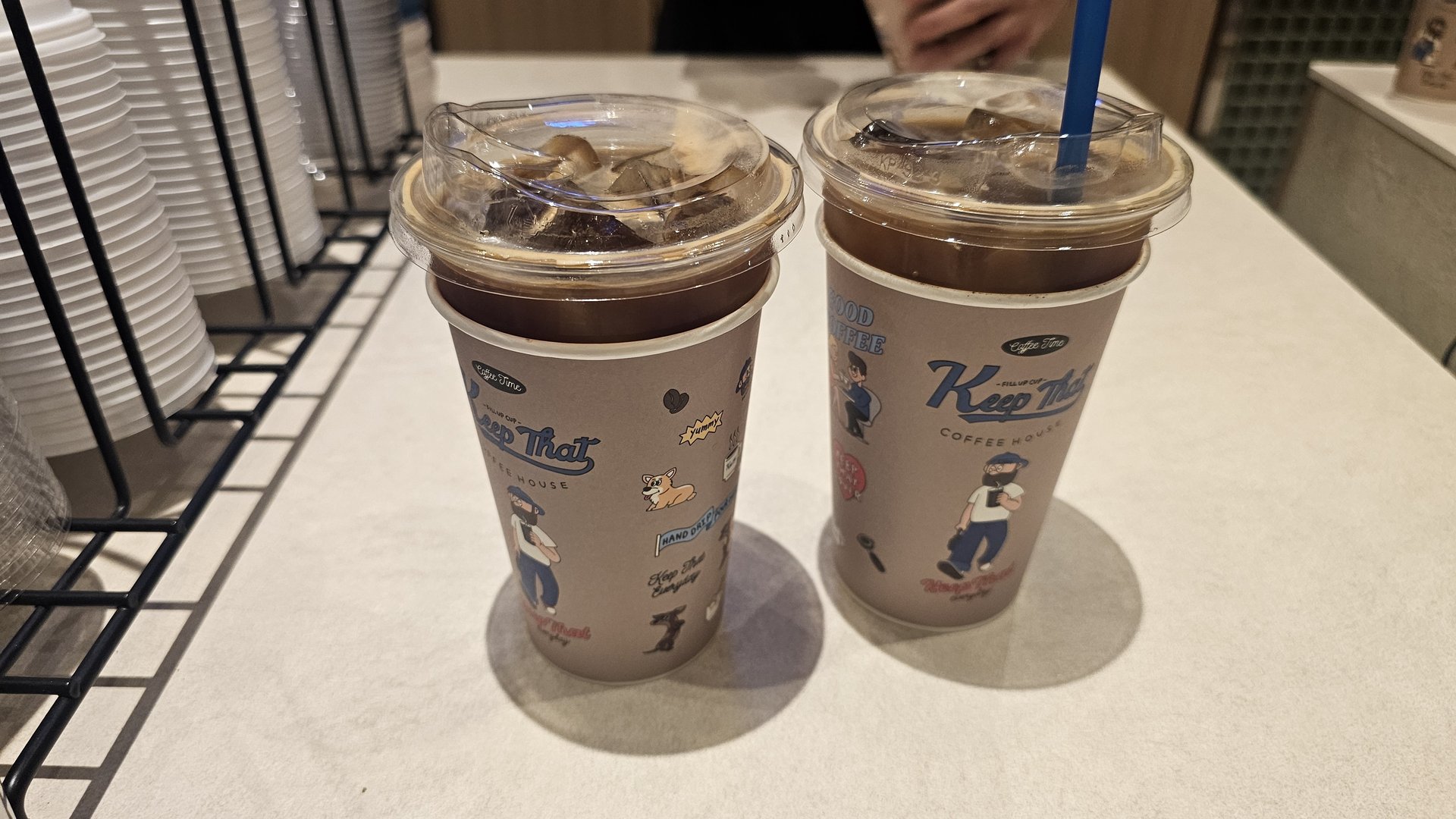
    Tbh, if pistachio desserts are your thing and you want a coffee that tastes like a pistachio confection — this delivers exactly that. If you want a drinkable, relaxed coffee — get the regular latte. Don’t say I didn’t warn you.

    Stuff Tourists Should Know

    English menu: Yes. Kiosk has a working English option.

    Foreign cards: Yes. Standard Korean kiosks take Visa and Mastercard. Contactless works fine.

    Tipping: No. Korea has no tipping culture at cafes or restaurants. Zero.

    Vegetarian/vegan: Drinks are generally fine. If you need oat milk or a dairy-free option, it’s worth asking at the counter — specialty cafes in Seoul often carry it, but I didn’t confirm for this location.

    Solo dining: Easy. Counter seating and terrace both work fine alone.

    With kids: The non-coffee menu has juice and tea options. Terrace seating is relaxed. Should be fine.

    Date spot? It’s a cafe, so — sure, if you’re doing “coffee then walk along the Han River,” this is a decent starting point. Yeouinaru park is close.
    Kustom Coffee Yeouido wall menu board showing full drink and dessert lineup
    Kustom Coffee Yeouido wall menu board showing full drink and dessert lineup

    The Verdict

    Kustom Coffee is a solid Yeouido stop if you’re already in the area. Not a cross-town destination — you wouldn’t take the subway from Hongdae specifically for this. But if Yeouido is on your itinerary (IFC, Han River, National Assembly area), worth a stop.

    Get: The milk tea. Clean, tea-forward, not sweet-heavy. Good call.

    Think twice on: Pistachio cream latte if you’re not into dessert-level richness. It’s well-executed, but it’s intense. Go in knowing that.
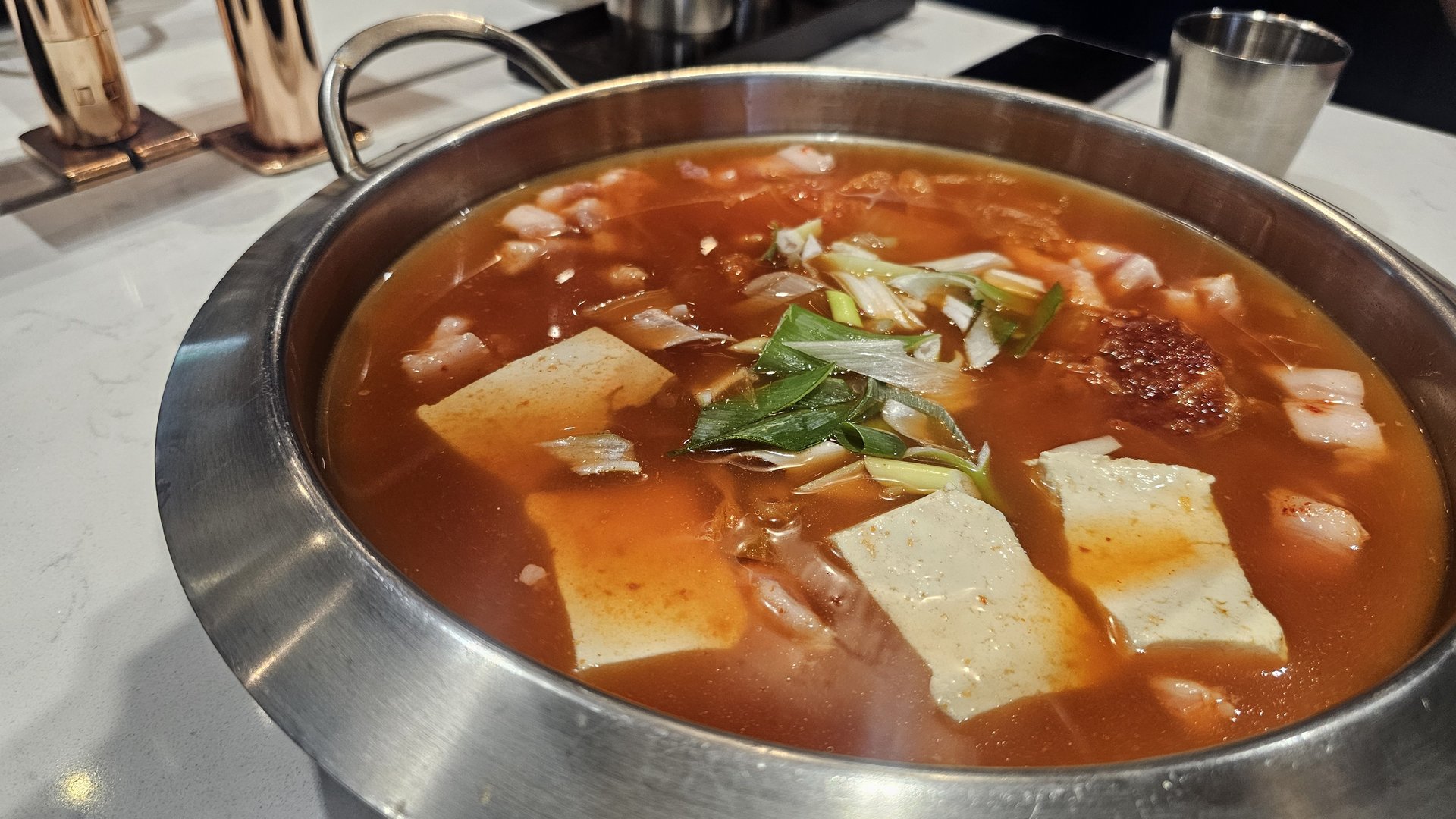
    Should you go?

    – Already doing Yeouido? Yes, stop in.

    – Want a specialty cafe with minimal tourist friction (English kiosk, card payment, terrace seating)? Yes, fits the bill.

    – Curious about the pistachio cream latte trend hitting Seoul cafes right now? This is a fair representative of the style.

    – Flying in from abroad specifically for this? No. Seoul has a lot of cafes.

    Would I go back? For the milk tea, yes. For the pistachio cream latte — I’d try something lighter next time.

    FAQ

    Does Kustom Coffee in Yeouido have an English menu?

    Yes. The kiosk ordering system has an English language option that’s clear enough to use without issues.

    What does the pistachio cream latte taste like?

    Rich and dense. Heavy pistachio cream on top of the espresso base with pistachio powder coating. It’s a dessert-style drink. If you want something lighter, go for the regular latte.

    Is Kustom Coffee Yeouido tourist-friendly?

    Pretty much. English kiosk, card payment, no Korean required. The terrace makes it easy to relax without navigating a crowded interior.

    How much does it cost?

    Two drinks (milk tea + pistachio cream latte) came to 12,100 KRW (~$9 USD total). Fair for a specialty cafe in central Seoul.

    Do I need a reservation?

    No. Walk in, order at the kiosk, done.

    Is it near IFC Mall?

    Both are in Yeouido so yes, close enough to combine in the same outing without effort.

    Is there outdoor seating?

    Yes, there’s a terrace. Comfortable in the morning. Expect it to fill up around lunch when the Yeouido office crowd comes out.