Category: Japanese Food

Japanese restaurants in Korea — sushi, soba, course meals.

  • Yamaya Yeouido: Honest Review of the Mentaiko Lunch Sets

    Yamaya Yeouido: Honest Review of the Mentaiko Lunch Sets

    🇯🇵 日本語版はこちら

    Yamaya Yeouido: Honest Review of the Mentaiko Lunch Sets

    Quick honest review of Yamaya Yeouido — a Japanese mentaiko chain doing teishoku lunch sets in the middle of Seoul’s financial district. Skip to the verdict if you’re short on time, but the short version: the food is solid Japanese comfort fare, nothing mind-blowing, and the unlimited mentaiko refills are genuinely the highlight of the meal.

    We went on a Tuesday at noon, two people, walked in without reservations. Ordered the chicken nanbanzuke set and the menchikatsu set. Total came to 33,800 KRW (~$25 USD) for two.
    What Is Yamaya?

    Yamaya (야마야) is a Japanese specialty chain from Fukuoka, Kyushu — founded in 1974. Their thing is mentaiko, which is spicy cured pollock roe. If you’ve eaten at a Japanese restaurant and seen that pink, slightly grainy paste served with rice or on pasta, that’s mentaiko.
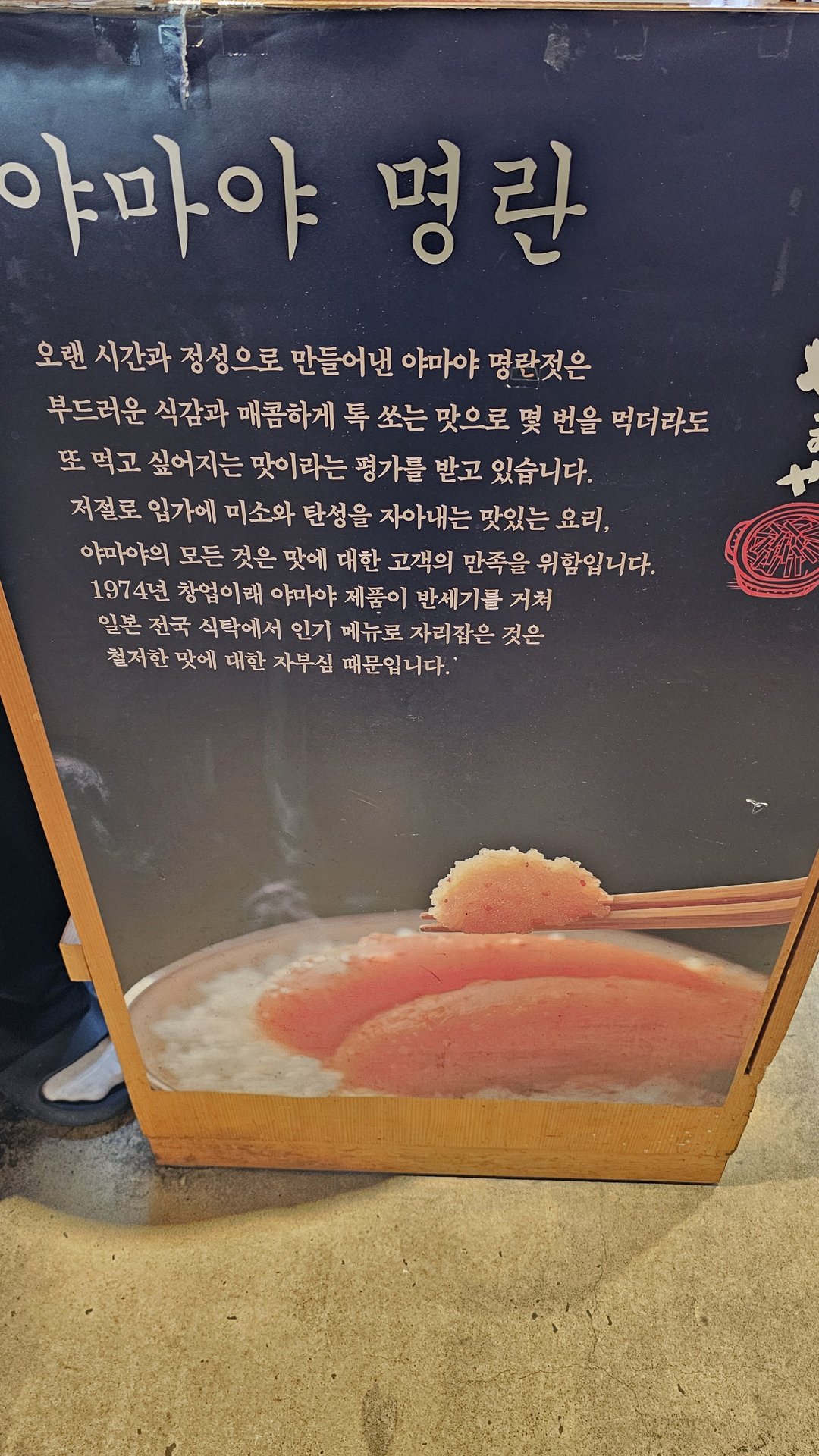
    Yamaya brand history board — mentaiko specialist founded in Fukuoka Japan in 1974
    Yamaya brand history board — mentaiko specialist founded in Fukuoka Japan in 1974

    In Japan, Yamaya runs mentaiko retail shops and restaurants. In Korea, the restaurant format leans into Japanese teishoku — set meals with a main dish, rice, miso soup, and side dishes. The twist here is that mentaiko comes as a side dish and you can refill it as many times as you want.

    That last part is the actual selling point.

    Getting There

    Yamaya Yeouido is in Yeouido — Seoul’s financial district, think Wall Street but with more convenience stores. The area is packed with office towers, a few large malls, and plenty of lunch spots targeting the nine-to-five crowd.

    Nearest subway: Yeouido Station (Line 5 and Line 9). From the station it’s a short walk. Taxis from central Gangnam take about 15 minutes outside rush hour. From Incheon Airport, roughly 50–60 minutes via the AREX express train to Gimpo then a subway transfer, or around 40 minutes by taxi.

    If you’re staying near Yeouido — IFC Residence, 63 Building area hotels — you can easily walk here for lunch.

    The Interior

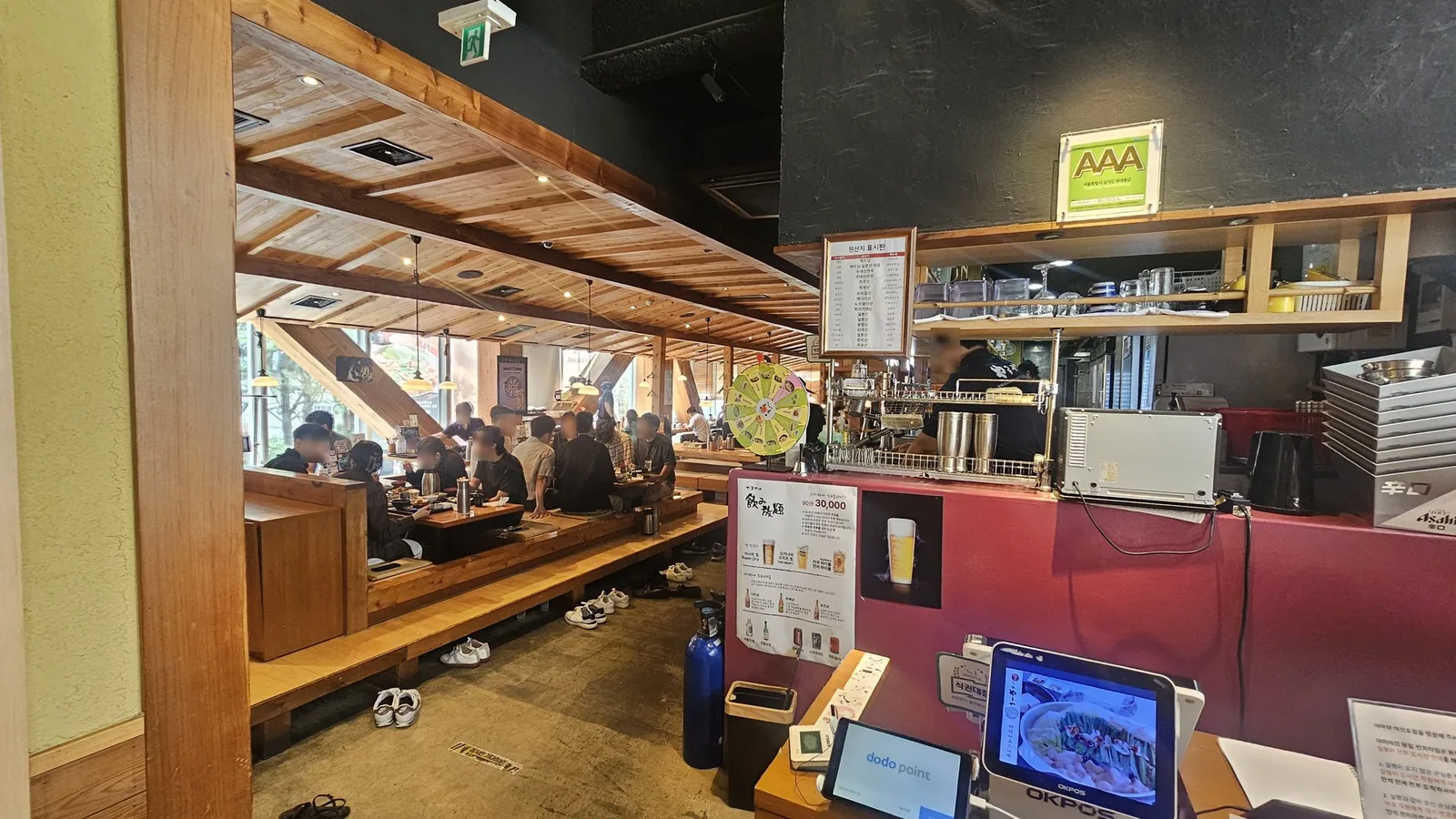
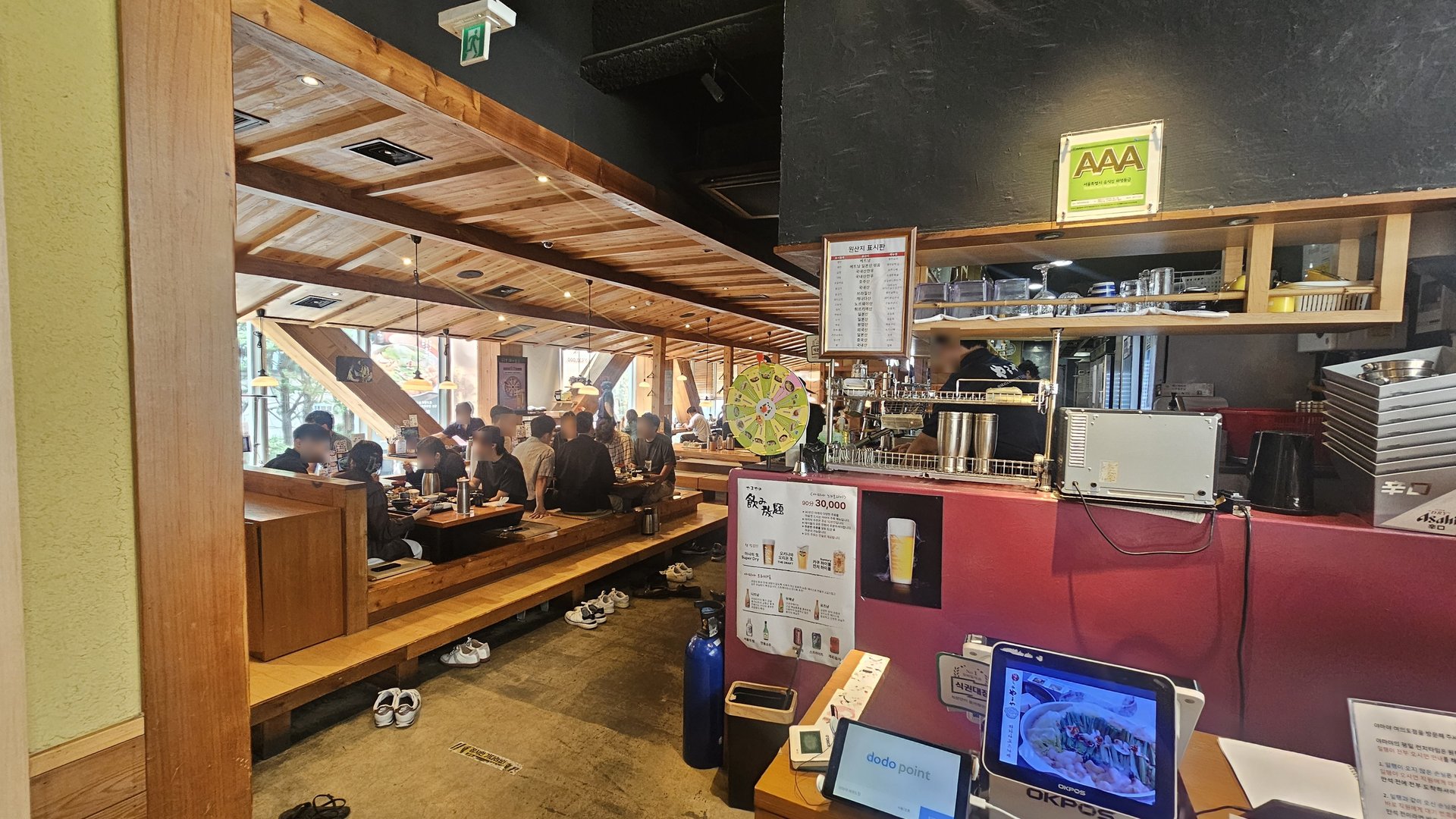
    Wooden beams, warm lighting, that slightly rustic Japanese teishoku restaurant feel. Not cramped, but not trying to be sleek either. Mixed seating — some floor-level seating (좌식) and regular table seating. Open kitchen along one side so you can see the cooking.
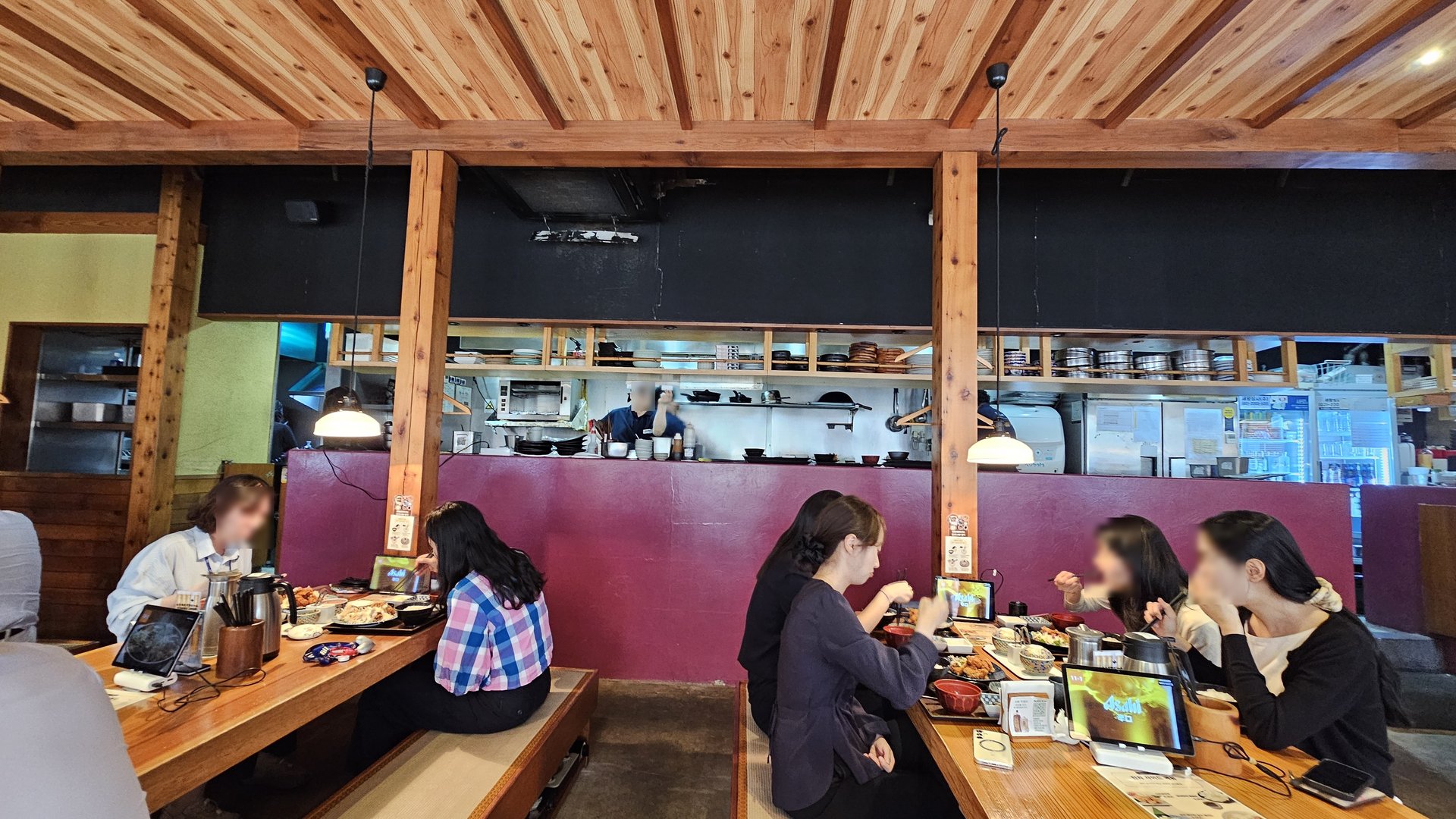
    Yamaya Yeouido dining hall with customers eating lunch, open kitchen visible in background with staff cooking
    Yamaya Yeouido dining hall with customers eating lunch, open kitchen visible in background with staff cooking

    At noon on a Tuesday it was essentially full. Most of the crowd was office workers, largely women. The pace felt efficient — people come in, eat, leave. Not a place you linger over coffee.

    Ordering is tablet-based (Korean only), with photos for each item. Easy enough to navigate if you point at what looks good.
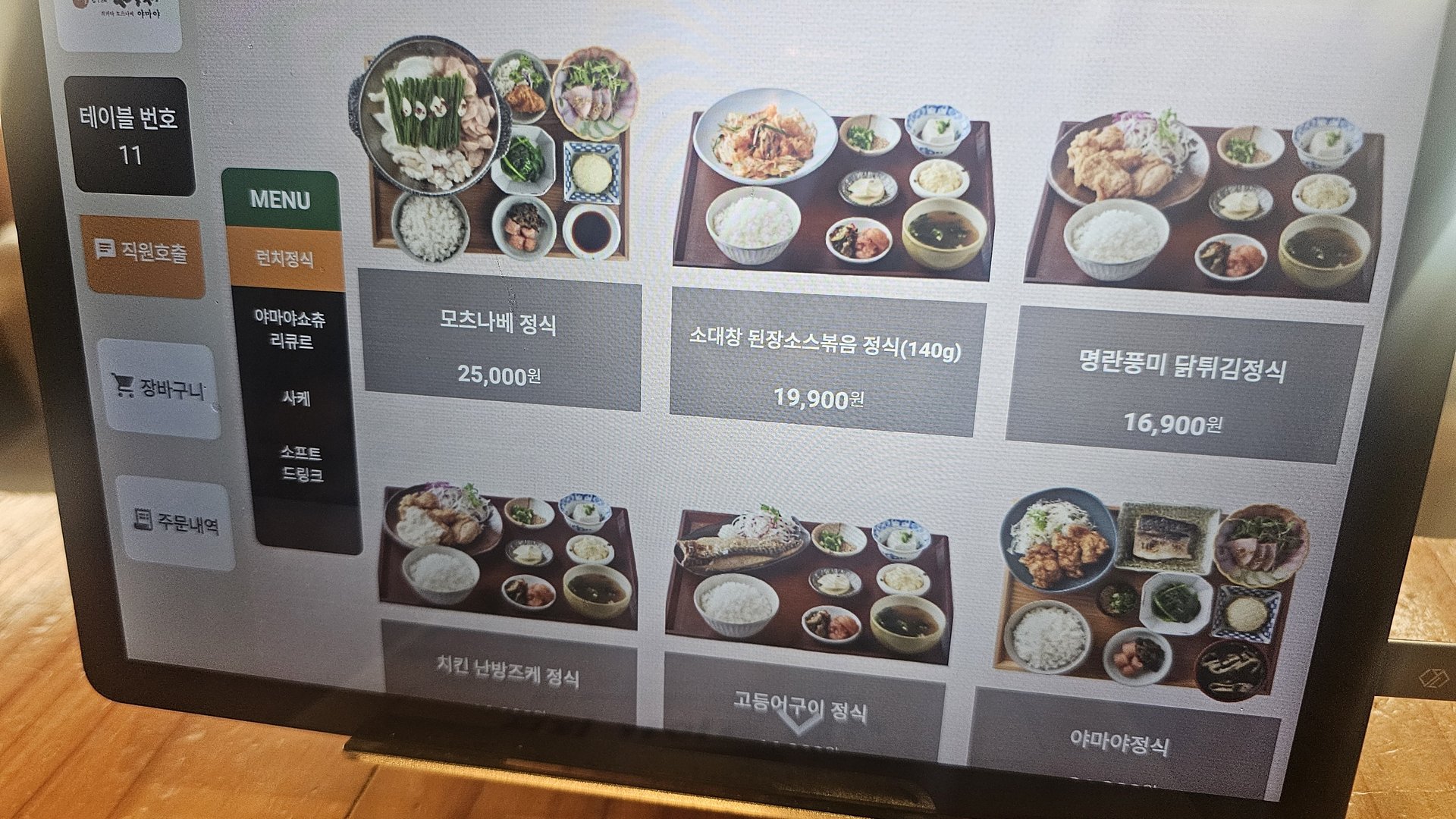
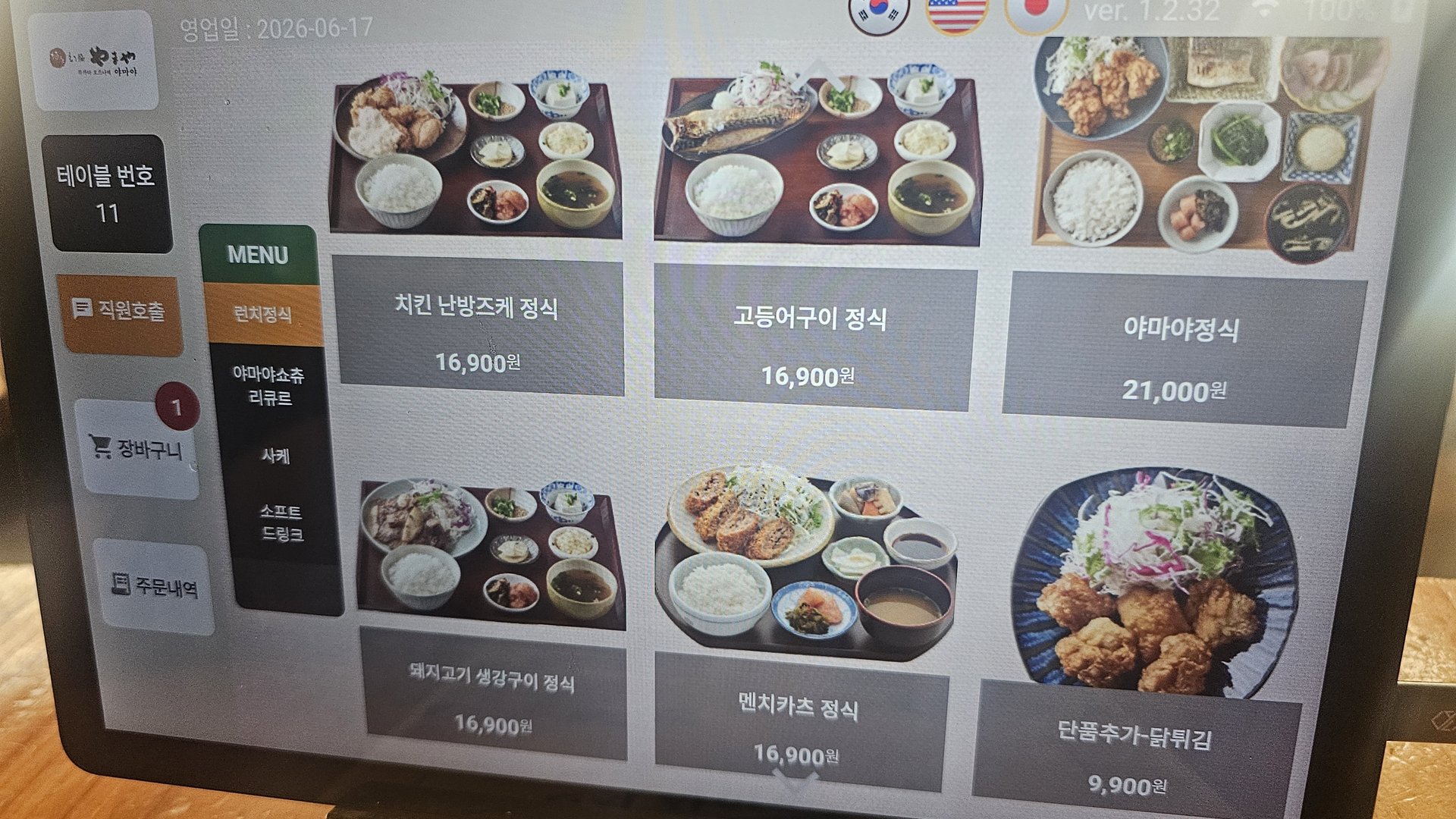
    Yamaya Yeouido tablet ordering screen showing set meal options including Mochonabe and Mentaiko Chicken sets
    Yamaya Yeouido tablet ordering screen showing set meal options including Mochonabe and Mentaiko Chicken sets
    Yamaya Yeouido tablet ordering screen showing Chicken Nanbanzuke, Menchikatsu, and Pork Ginger sets with prices
    Yamaya Yeouido tablet ordering screen showing Chicken Nanbanzuke, Menchikatsu, and Pork Ginger sets with prices

    What We Ordered

    Chicken Nanbanzuke Set — 16,900 KRW (~$12.50 USD)
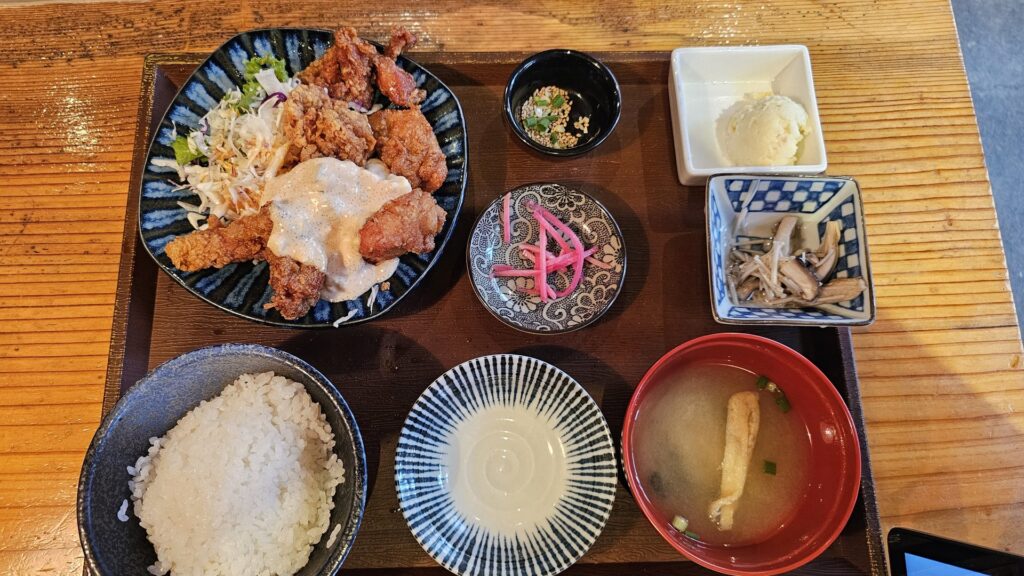
    Top-down view of Yamaya lunch set showing fried chicken main, rice, miso soup, mushroom side, and tofu

    Nanbanzuke (난방즈케) is a Japanese dish where fried chicken gets finished in a sweet vinegar marinade — it’s tangy, slightly sweet, and a bit sticky. Not the same as Korean fried chicken. Think of it as fried chicken that’s been dressed up with a sauce that’s closer to an Asian agrodolce.
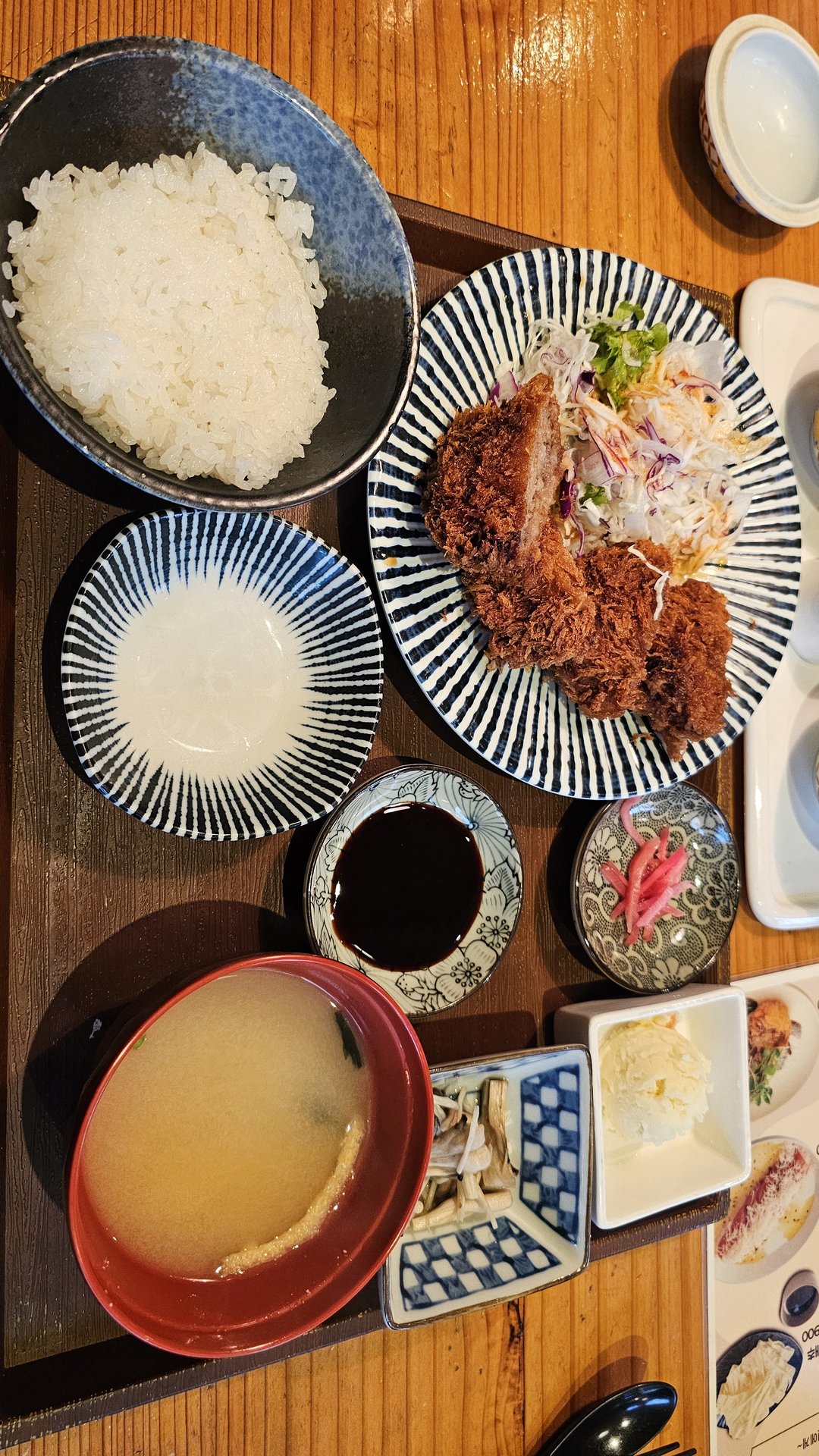
    Full Yamaya teishoku lunch set with fried main dish, rice, miso soup, and side dishes on a tray
    Full Yamaya teishoku lunch set with fried main dish, rice, miso soup, and side dishes on a tray

    The chicken itself was well-fried — crispy coating, juicy inside. The nanbanzuke sauce was on the milder, sweeter side, which actually works well with a bowl of white rice. Not the most exciting dish I’ve had this year, but solid execution. You’ll finish the plate.

    Menchikatsu Set — 16,900 KRW (~$12.50 USD)
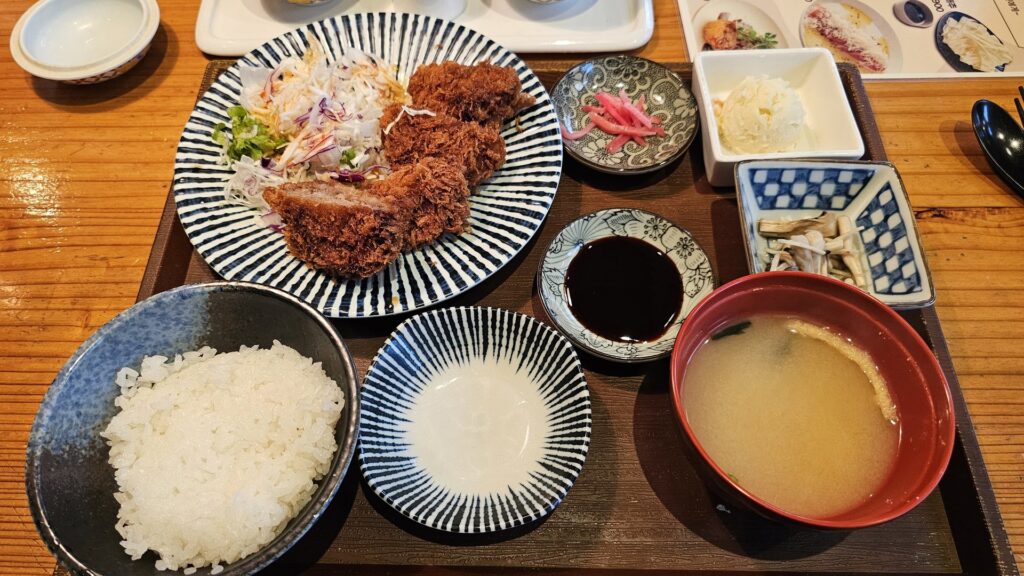
    Full Yamaya teishoku lunch set with fried main dish, rice, miso soup, and side dishes on a tray

    Menchikatsu (멘치카츠) is a ground meat patty — usually pork and beef mixed — shaped, breadcrumbed, and deep fried. Yoshoku (Western-influenced Japanese cooking) at its most straightforward.

    It’s honestly the simpler dish of the two. The patty was well-seasoned and the crumb coating was properly crisp. But there’s less going on compared to the nanbanzuke. Fine dish, slightly forgettable.

    If you’re picking between the two, the nanbanzuke has more personality.

    The Set Meal Structure

    Both sets came with rice, miso soup, and a couple of small sides. The miso soup was standard — nothing special. Rice was good.
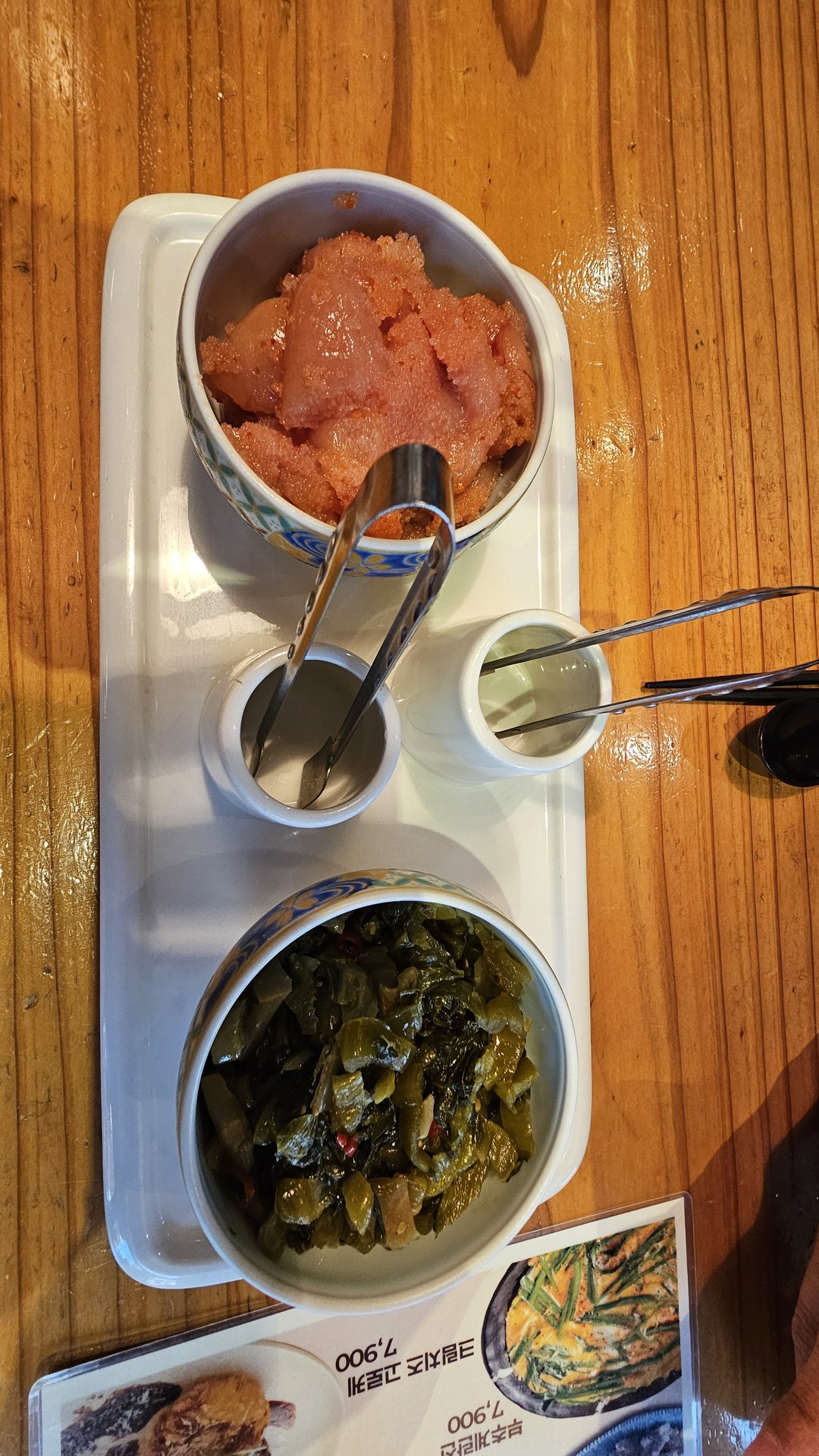
    Yamaya lunch side dish tray with mentaiko pollock roe and gochae muchim pickled greens
    Yamaya lunch side dish tray with mentaiko pollock roe and gochae muchim pickled greens

    And then there was the mentaiko.

    The Unlimited Mentaiko — Actually the Best Part

    Okay, this is what you’re coming for.

    Mentaiko and gochae muchim (고채 무침 — a pickled leafy green vegetable) come as refillable side dishes. You can ask for more as many times as you want.
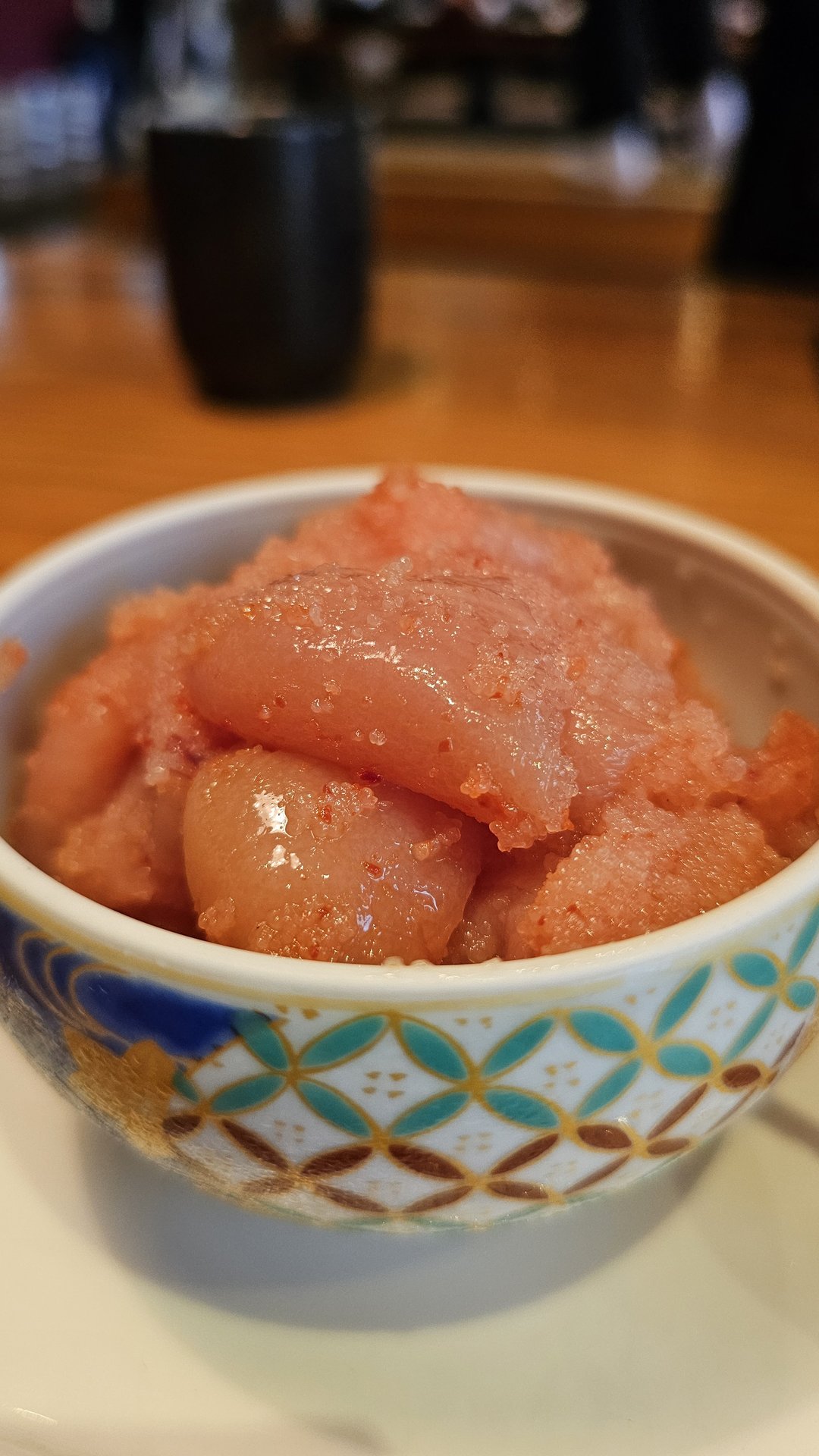
    Close-up of Yamaya mentaiko — pink spicy pollock roe in a small dish
    Close-up of Yamaya mentaiko — pink spicy pollock roe in a small dish

    The mentaiko here is properly good. It’s got that briny, slightly spicy, umami-forward flavor — the kind of thing that makes plain white rice disappear faster than you’d expect. We went through a couple of refills without even thinking about it.

    If you’ve never had mentaiko before: it’s salty, savory, and has a light heat from the chili. It pairs with rice the same way good butter pairs with bread — you just keep going back for more.

    This is genuinely Yamaya’s strongest card. The set meal food is solid but mainstream Japanese comfort food. The unlimited mentaiko is the reason to come here specifically.
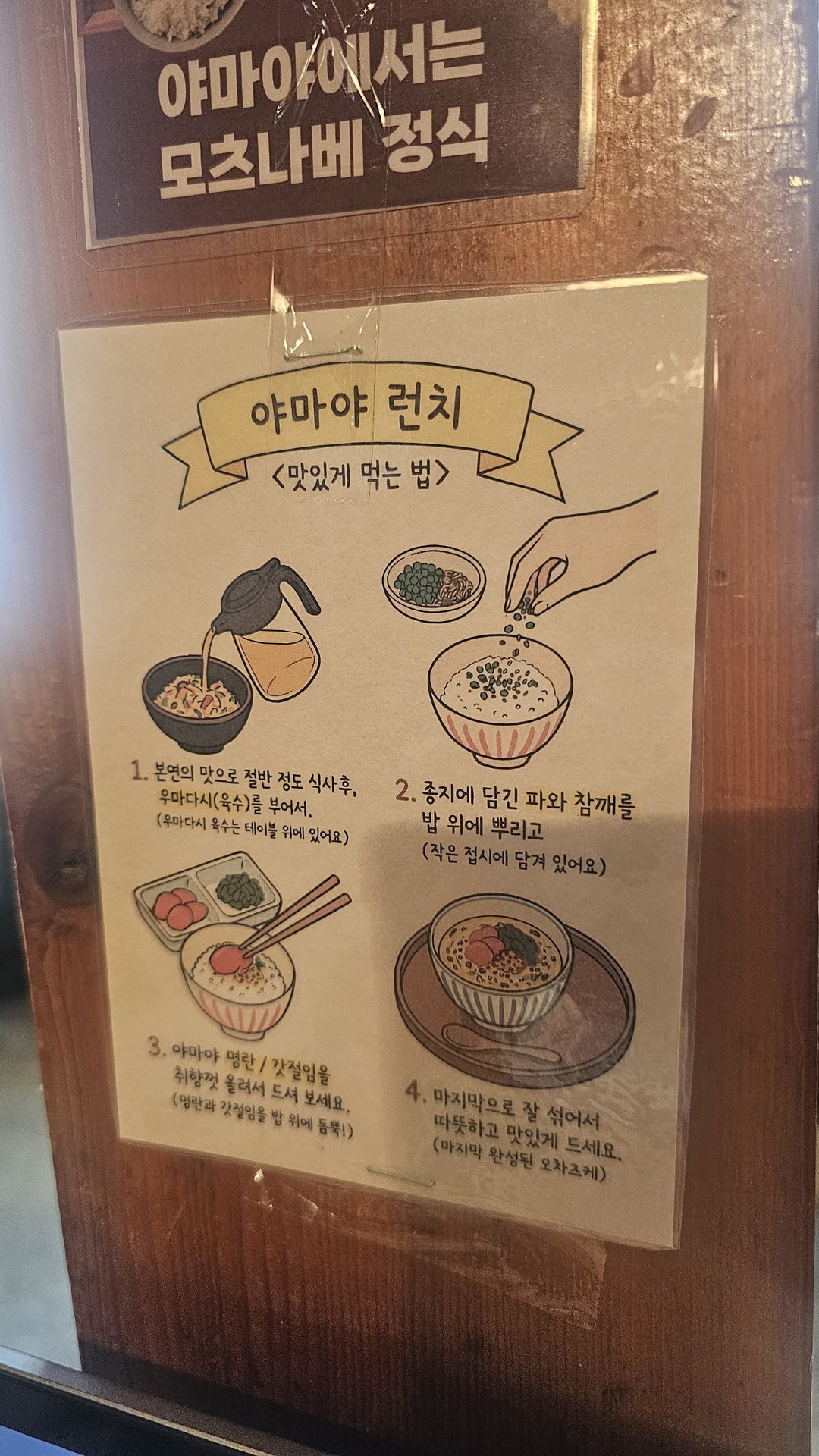
    Wall instruction guide for Yamaya Mochonabe hot pot — four-step illustrated eating guide in Korean
    Wall instruction guide for Yamaya Mochonabe hot pot — four-step illustrated eating guide in Korean

    Add-On Side Menu

    There’s a table card with optional add-ons for lunch:
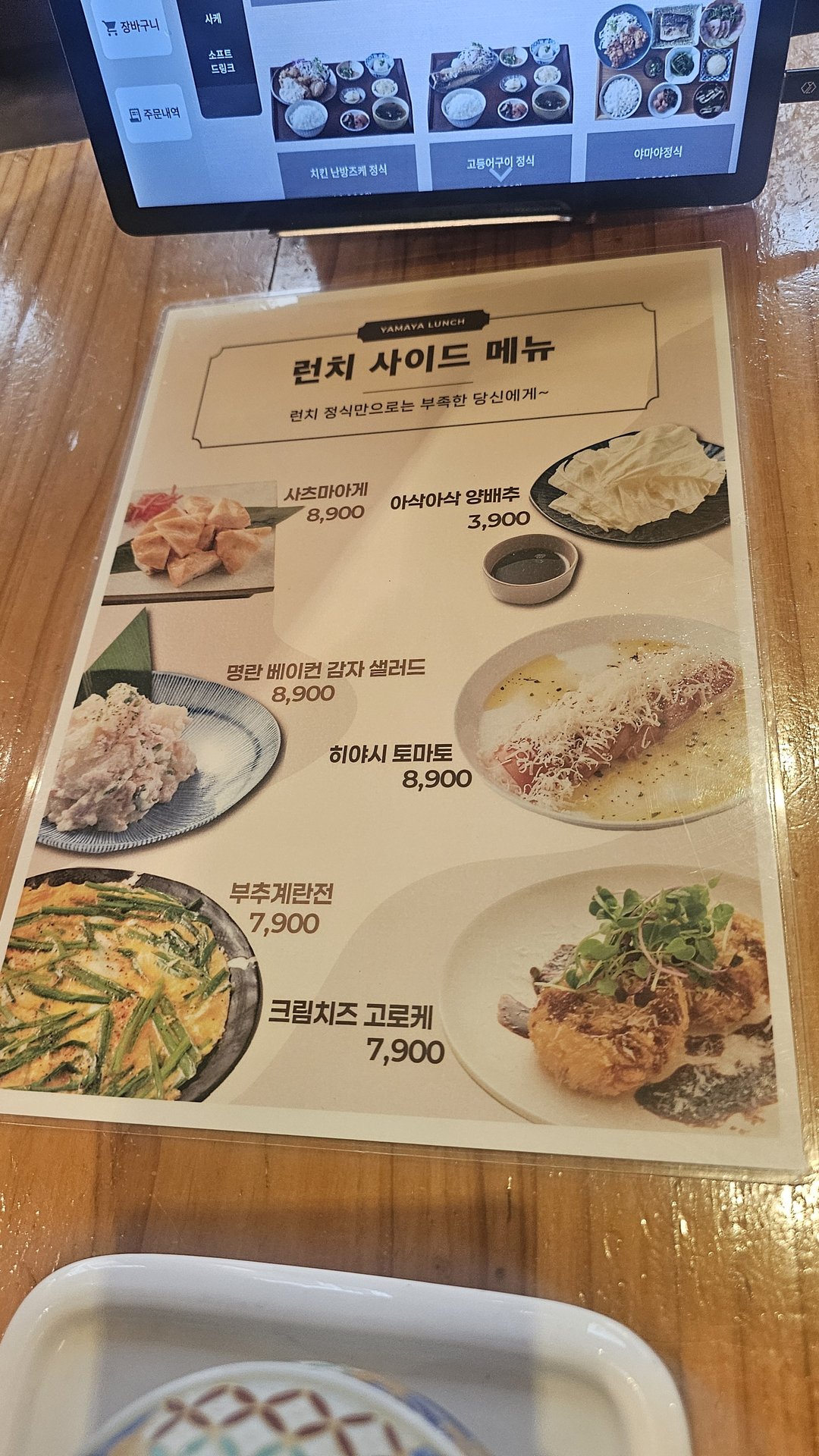
    Yamaya Yeouido table side lunch add-on menu card showing side dish options and prices
    Yamaya Yeouido table side lunch add-on menu card showing side dish options and prices

    – Cabbage — 3,900 KRW

    – Satsuma-age (Japanese fish cake) — 8,900 KRW

    – Mentaiko bacon potato salad — 8,900 KRW

    – Hiyashi tomato — 8,900 KRW

    – Chive egg jeon — 7,900 KRW

    – Cream cheese croquette — 7,900 KRW

    We skipped these — the set meals were already substantial. But the mentaiko bacon potato salad sounds interesting if you want to go deeper on the mentaiko theme.

    Stuff Tourists Should Know

    Language: Korean-only tablet ordering. Staff probably won’t speak much English. Point at the photos on the tablet — you’ll be fine.

    English menu: No, but the tablet has photos for every item.

    Payment: Cards accepted. Foreign cards should work. No tipping in Korea — don’t leave cash on the table.

    Dietary restrictions: This is a meat-focused Japanese teishoku restaurant. Vegetarian options are limited (maybe the cabbage side, the hiyashi tomato). No obvious halal options. Mentaiko contains fish roe and chili.

    Timing: Gets packed fast during the 12:00–1:00 PM window. If you want to avoid the rush, try arriving just before noon or after 1:00 PM.

    Kids: The space can accommodate families, but it’s primarily an office lunch crowd. Not a dedicated family restaurant, but not unwelcoming either.

    Solo dining: Totally fine. Counter-style seating would suit solo diners.
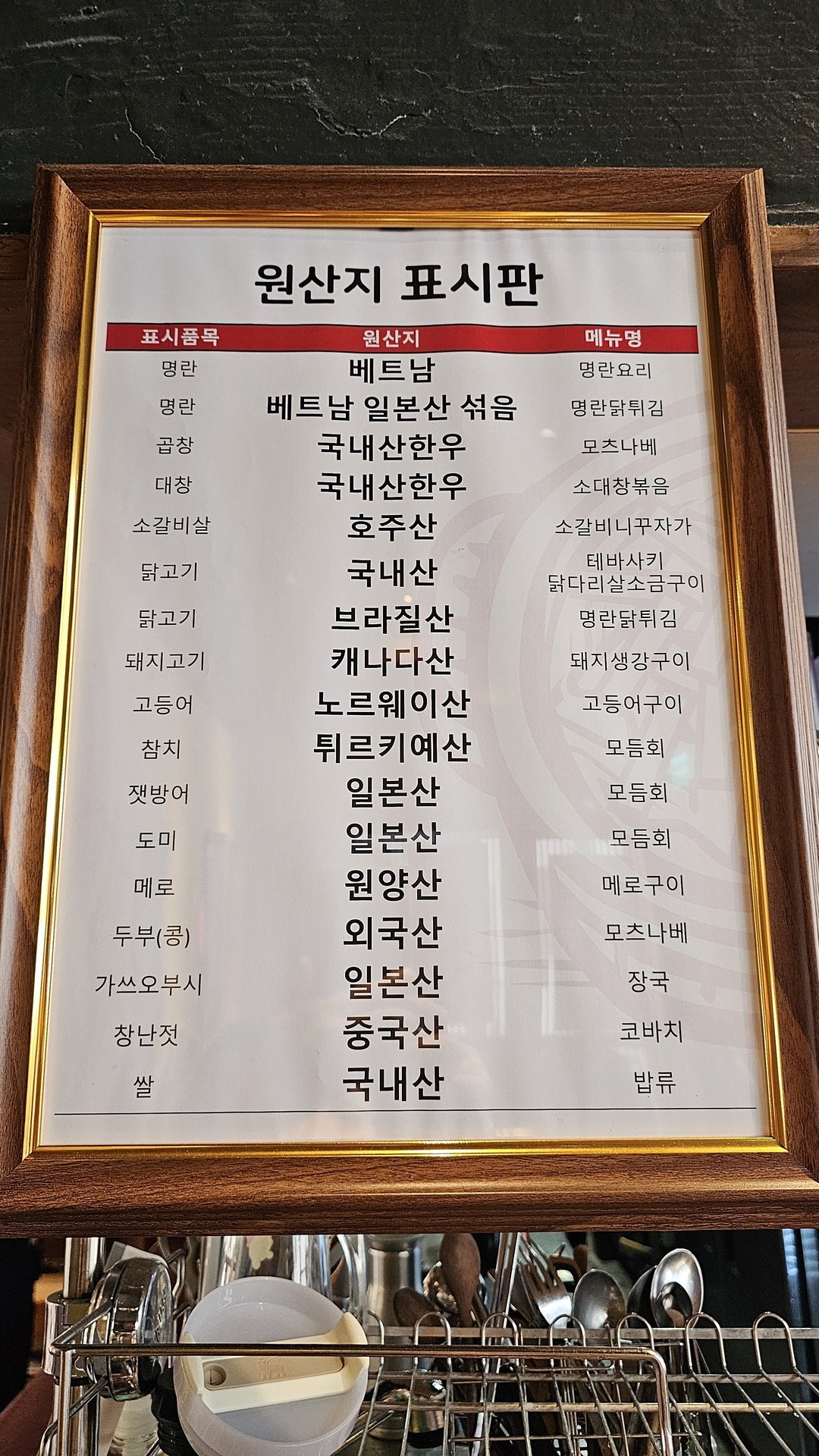
    Yamaya Yeouido ingredient origin board showing sourcing information for mentaiko, chicken, pork, and mackerel
    Yamaya Yeouido ingredient origin board showing sourcing information for mentaiko, chicken, pork, and mackerel

    The Verdict

    Should you go?

    – If you’re already in Yeouido for business or sightseeing (IFC Mall, 63 Building) — yes, this is a legit lunch option. Get the nanbanzuke set and go hard on the mentaiko refills.

    – If you only have 3–4 days in Seoul — probably not a priority. Use that meal slot for Korean food. Come back if you get more time.

    – If you’re curious about mentaiko and want to try it properly without hunting down a specialty shop — yes, this is a great intro. Unlimited refills, good quality, reasonable price.

    – If you want the most exciting meal in Seoul — no. This is reliable weekday lunch food, not a destination dinner.

    The food is good, the unlimited mentaiko is genuinely worth it, and 16,900 KRW (~$12.50) for a full lunch set is fair value for Yeouido. We’ll be back when we’re in the area.

    —

    Yamaya Yeouido (야마야 여의도점)

    Yeouido, Seoul

    Tablet ordering (Korean only) | Card payment OK | No reservations

    FAQ

    What is Yamaya and why is it famous?

    Yamaya is a Japanese chain from Fukuoka, founded in 1974, known for mentaiko — spicy cured pollock roe. Their Korean restaurant branches serve Japanese teishoku (set meal) lunches with unlimited mentaiko on the side.

    How much does lunch cost per person at Yamaya Yeouido?

    Most lunch sets run 16,900–21,000 KRW (~$12.50–$15.50 USD) per person. The premium Mochonabe set goes up to 25,000 KRW (~$18.50 USD).

    Do I need a reservation for lunch at Yamaya Yeouido?

    No reservation system — it’s walk-in only. That said, it gets genuinely packed on weekdays around noon (office lunch crowd), so aim for 11:30 AM or after 1:00 PM if you want to walk straight in.

    Is there an English menu at Yamaya Yeouido?

    Ordering is done via tablet, which is in Korean only. The menu items are fairly visual with photos, so pointing works fine. Staff are friendly but don’t expect much English.

    Can I pay by credit card at Yamaya Yeouido?

    Yes, card payment is standard. Foreign cards (Visa, Mastercard) should work fine — the receipt shows standard Korean card terminal processing.

    Is the unlimited mentaiko actually unlimited?

    Yes. Mentaiko (pollock roe) and gochae muchim (pickled greens) come as side dishes and you can ask for refills. The mentaiko alone is worth showing up for.
    You might also like

    📍 Location

    Open in Google Maps →

  • Ginza Yeouido: Honest Review of Seoul’s 20-Year Japanese Course Restaurant

    Ginza Yeouido: Honest Review of Seoul’s 20-Year Japanese Course Restaurant

    🇯🇵 日本語版はこちら

    Ginza Yeouido: Honest Review of Seoul’s 20-Year Japanese Course Restaurant

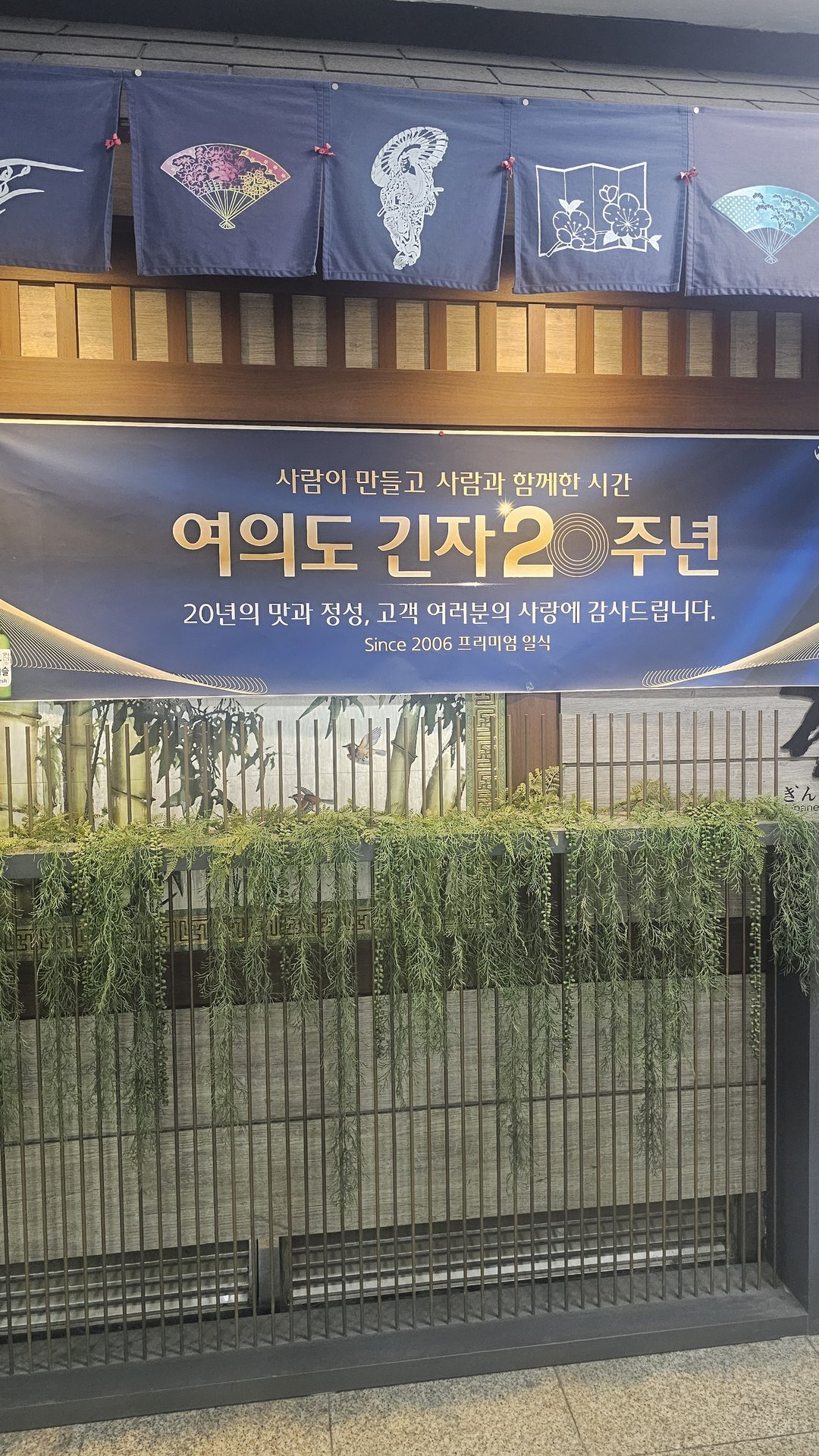
    Quick honest review of Ginza (긴자) in Yeouido — one of Seoul’s longest-running premium Japanese course restaurants. We visited on June 10, 2026, which happened to be their 20th anniversary. Four of us, full course, walked out full and slightly lighter in the wallet.

    Short version: the food is clean, refined, and well-executed. Not flashy. Not trying to impress you with trends. Just solid Japanese course cooking that’s been doing the same thing for two decades because it works. For the price, that’s actually a compliment.

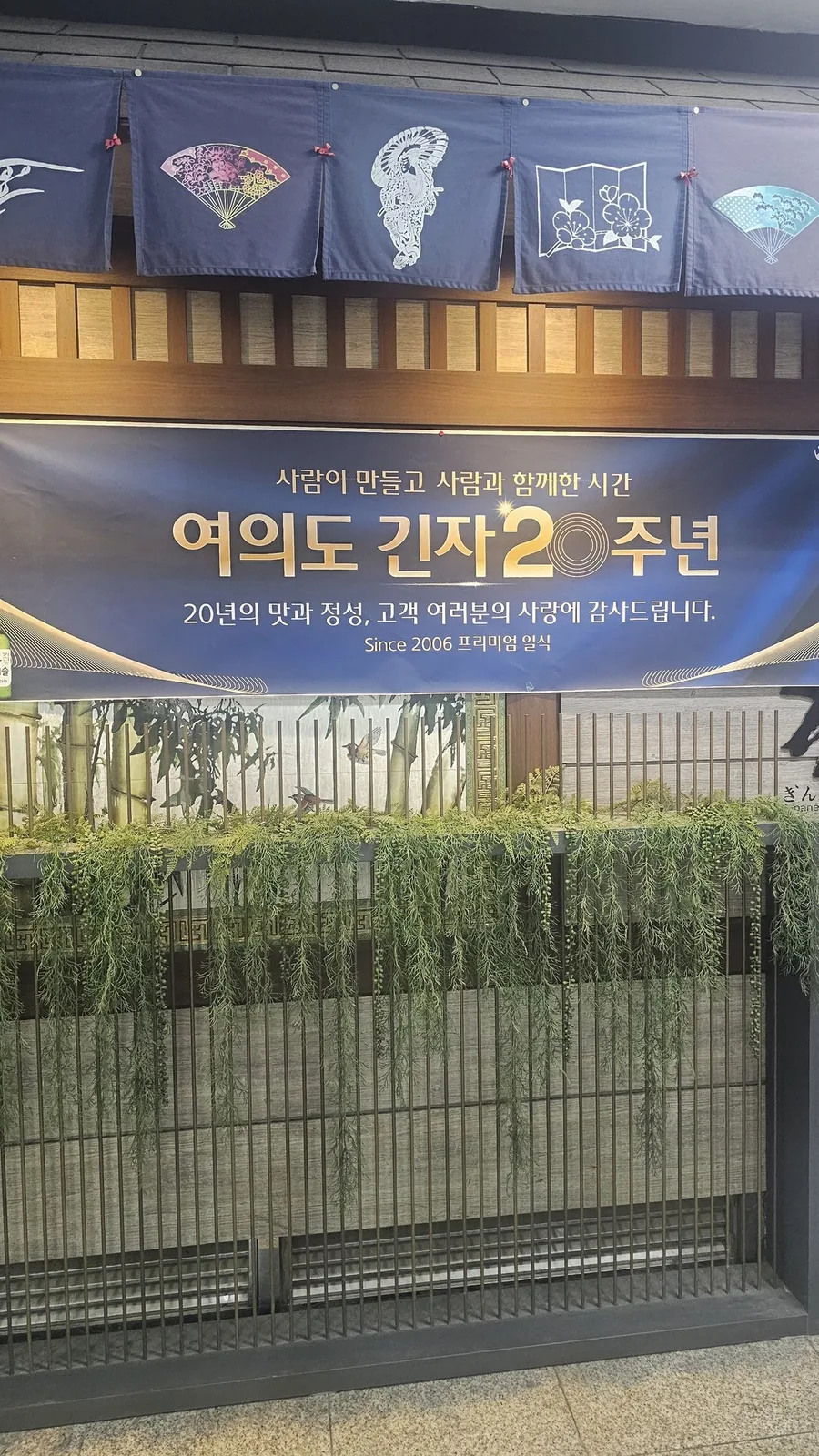
    Ginza Yeouido 20th anniversary banner on restaurant exterior
    Ginza Yeouido 20th anniversary banner on restaurant exterior

    What Is Ginza Yeouido?

    Ginza (긴자) takes its name from the famous upscale shopping and dining district in Tokyo. The Seoul version isn’t a Japanese chain — it’s a Korean-run premium Japanese restaurant that opened in Yeouido in 2006. Two decades later, it’s still one of the go-to spots for business lunches and formal meals in Seoul’s financial district.

    Yeouido, for context: think Wall Street meets Canary Wharf. This is where Korean banks, broadcast networks, and securities firms are headquartered. Lunch spots here cater to executives and client meetings, not backpackers hunting for cheap bibimbap. Ginza fits that world perfectly — formal, quiet, unhurried.

    The format is a Japanese course meal (코스 요리). You pick a tier, and dishes come out one after another over roughly 90 minutes. No à la carte scrambling, no “what should we order?” decision fatigue. Just sit down and eat.

    Getting There

    Entrance of Ginza Yeouido with traditional noren curtain and staff at the door
    Entrance of Ginza Yeouido with traditional noren curtain and staff at the door

    Yeouido is well connected by Seoul Metro:

    – Line 5: Yeouido Station (여의도역), Exit 1 or 2

    – Line 9: National Assembly Station (국회의사당역)

    – From Incheon Airport (ICN): about 60–70 minutes by AREX express train + subway transfer

    From the major hotels in Yeouido (Conrad Seoul, FairField by Marriott), it’s a short taxi ride — under 10 minutes, likely under 5,000 KRW.

    Drop the Korean name 긴자 여의도 into Kakao Maps or Naver Maps. Google Maps works but Korean addresses are more reliable on local apps.

    The Interior

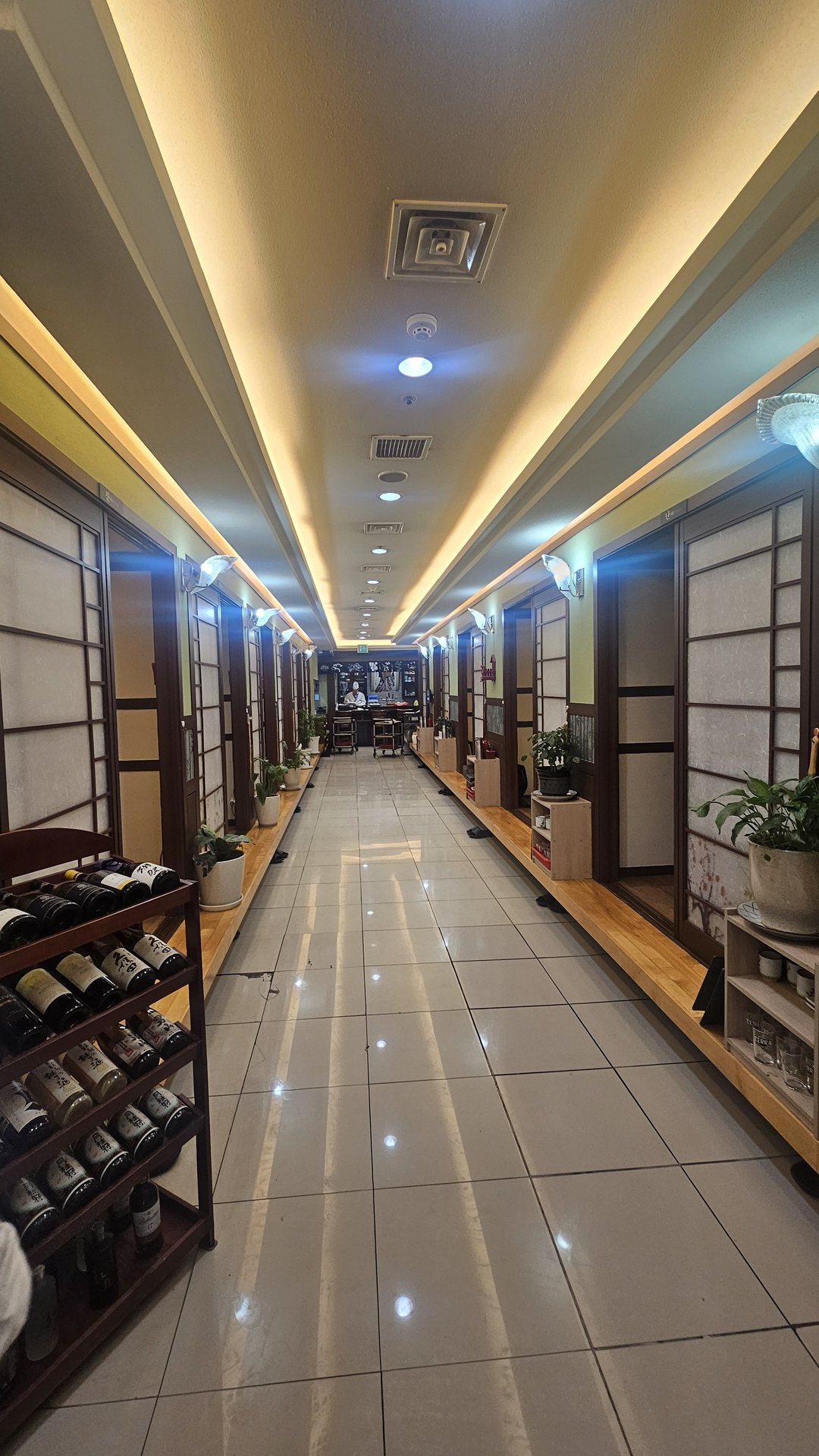
    Interior hallway of Ginza Yeouido with Japanese wood decor and private dining rooms
    Interior hallway of Ginza Yeouido with Japanese wood decor and private dining rooms

    The interior is formal Japanese — clean wood paneling, shoji-style screens, quiet lighting. Not the Instagram-bait kind of design with exposed brick and Edison bulbs. This is old-school Japanese restaurant aesthetic: calm, considered, tells you to lower your voice.

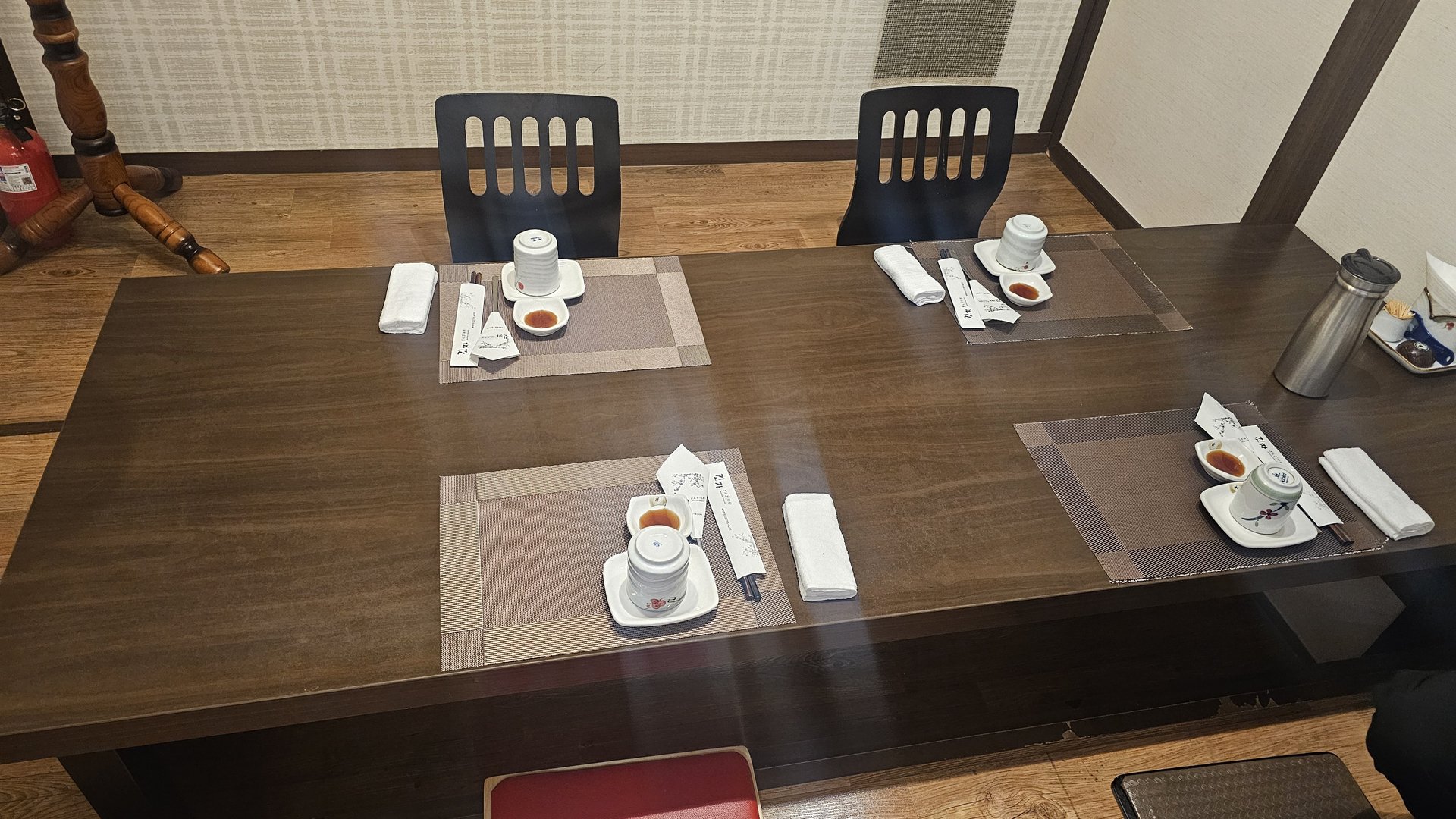
    Seating is arranged for groups. The table setting when we arrived was already fully prepared — tea poured, chopsticks laid out, napkins folded. That level of pre-set service signals what kind of restaurant you’re in before a single dish arrives.

    Four-person table setting at Ginza Yeouido with tea, chopsticks, and folded napkins
    Four-person table setting at Ginza Yeouido with tea, chopsticks, and folded napkins

    Pricing

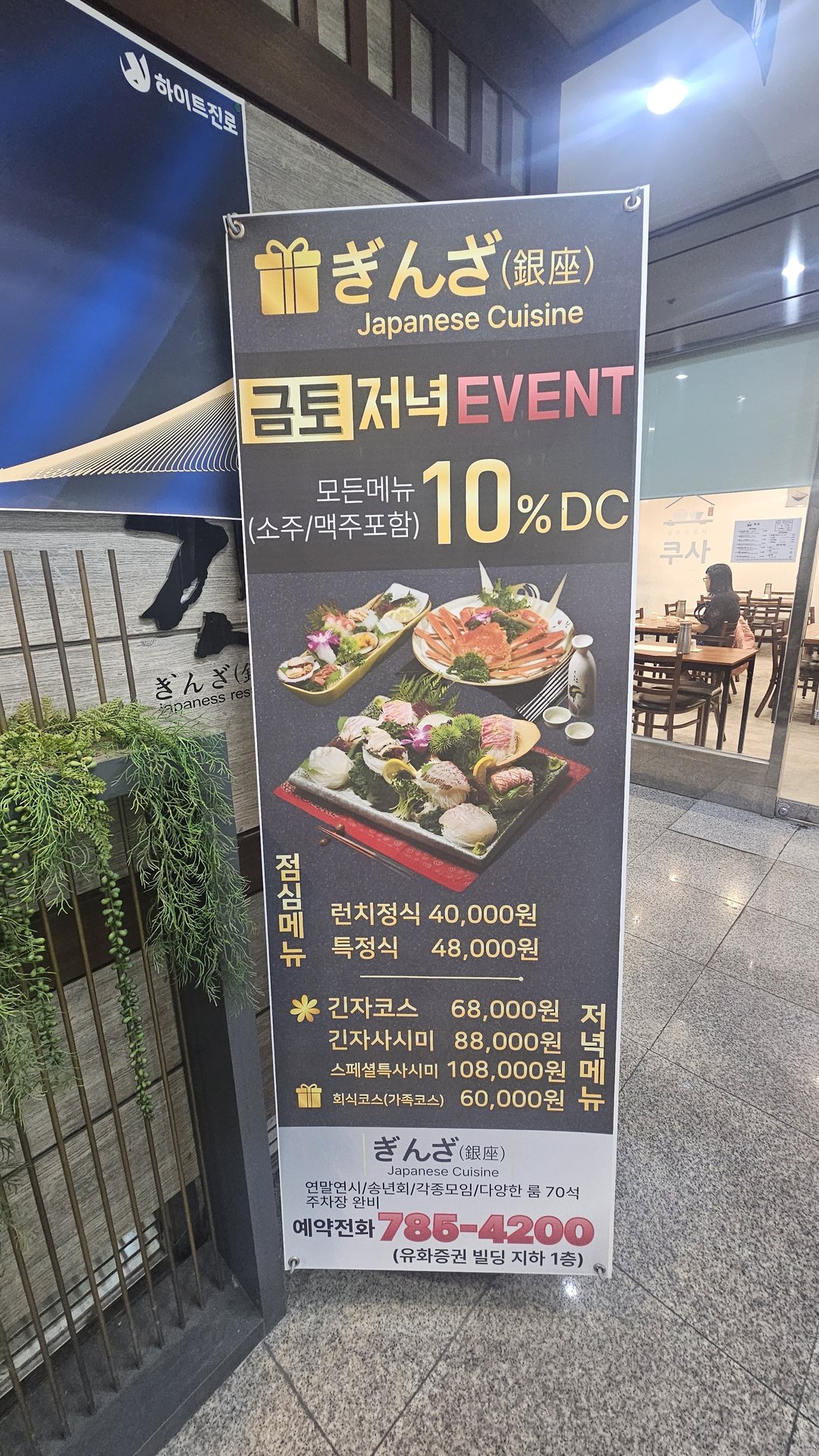
    Ginza Yeouido entrance menu board showing lunch set and Ginza course prices
    Ginza Yeouido entrance menu board showing lunch set and Ginza course prices

    This is where you need to decide before going in:

    – 런치정식 (Lunch Set): 40,000–48,000 KRW (~$30–36 USD per person)

    – 긴자코스 (Ginza Course): 68,000–108,000 KRW (~$50–80 USD per person)

    For 4 people on the full Ginza course, budget 272,000–432,000 KRW (~$200–320 USD total) before drinks.

    There’s also a Friday evening discount event — 10% off, which at this price level is actually meaningful.

    Is it expensive? Yes, for Seoul. But not for what you’re getting — a full multi-stage Japanese course that runs 90+ minutes. Comparable quality in Tokyo would cost similar or more.

    The Meal, Course by Course

    The Starters

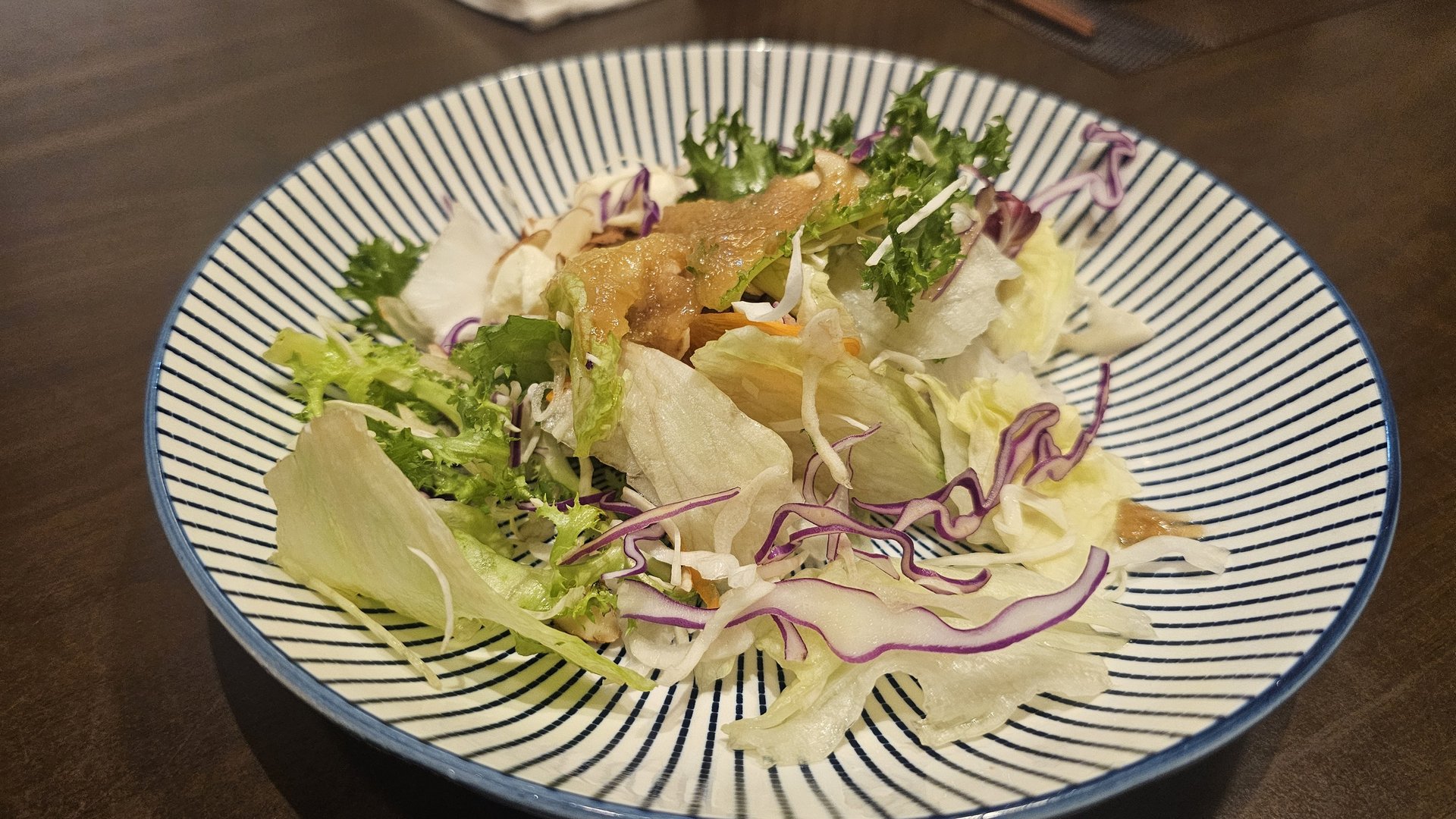
    Mixed green salad with shredded red cabbage and dressing at Ginza Yeouido
    Mixed green salad with shredded red cabbage and dressing at Ginza Yeouido
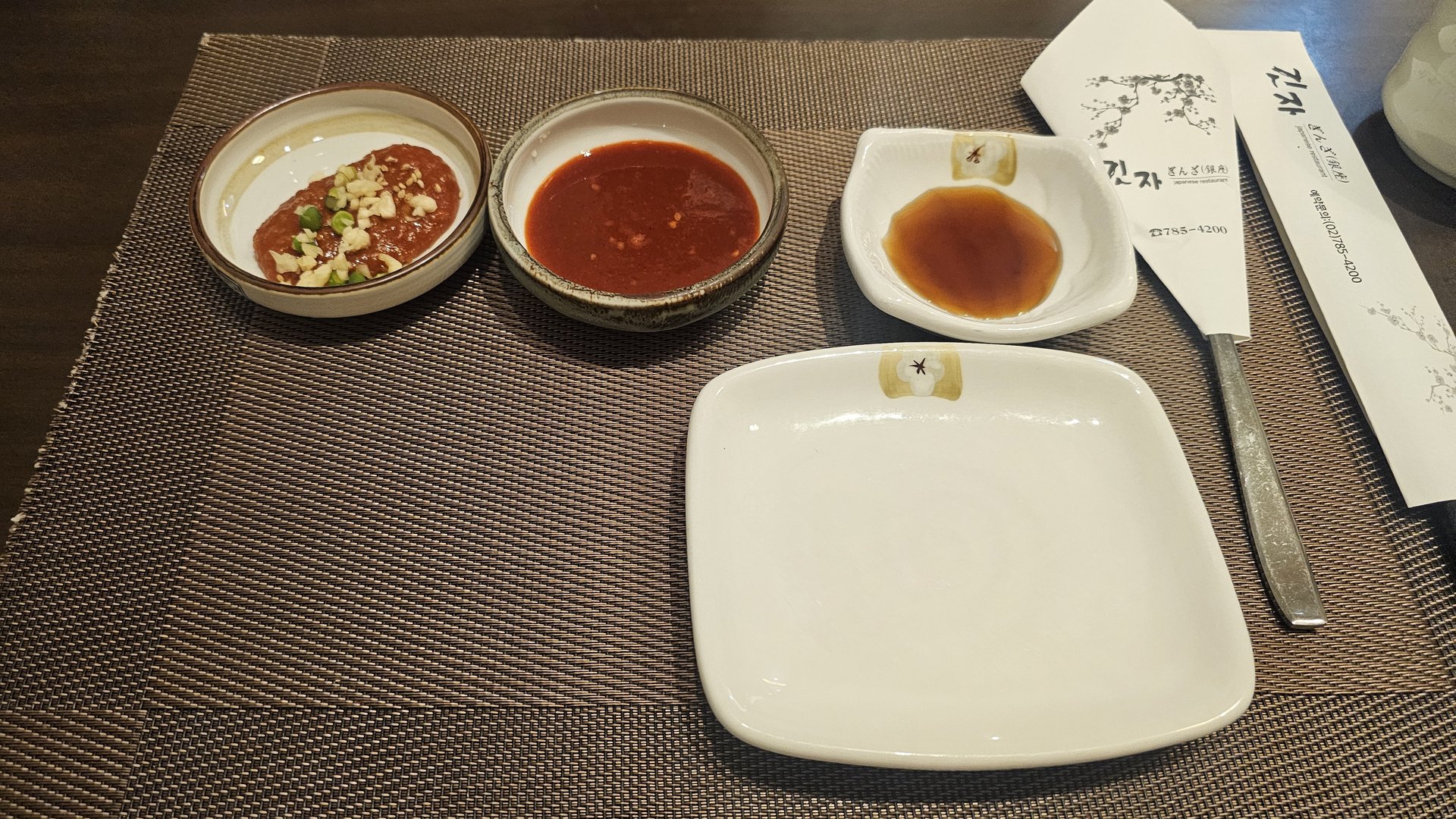
    Three dipping sauces at Ginza Yeouido including soy vinegar, ponzu, and spicy sauce
    Three dipping sauces at Ginza Yeouido including soy vinegar, ponzu, and spicy sauce
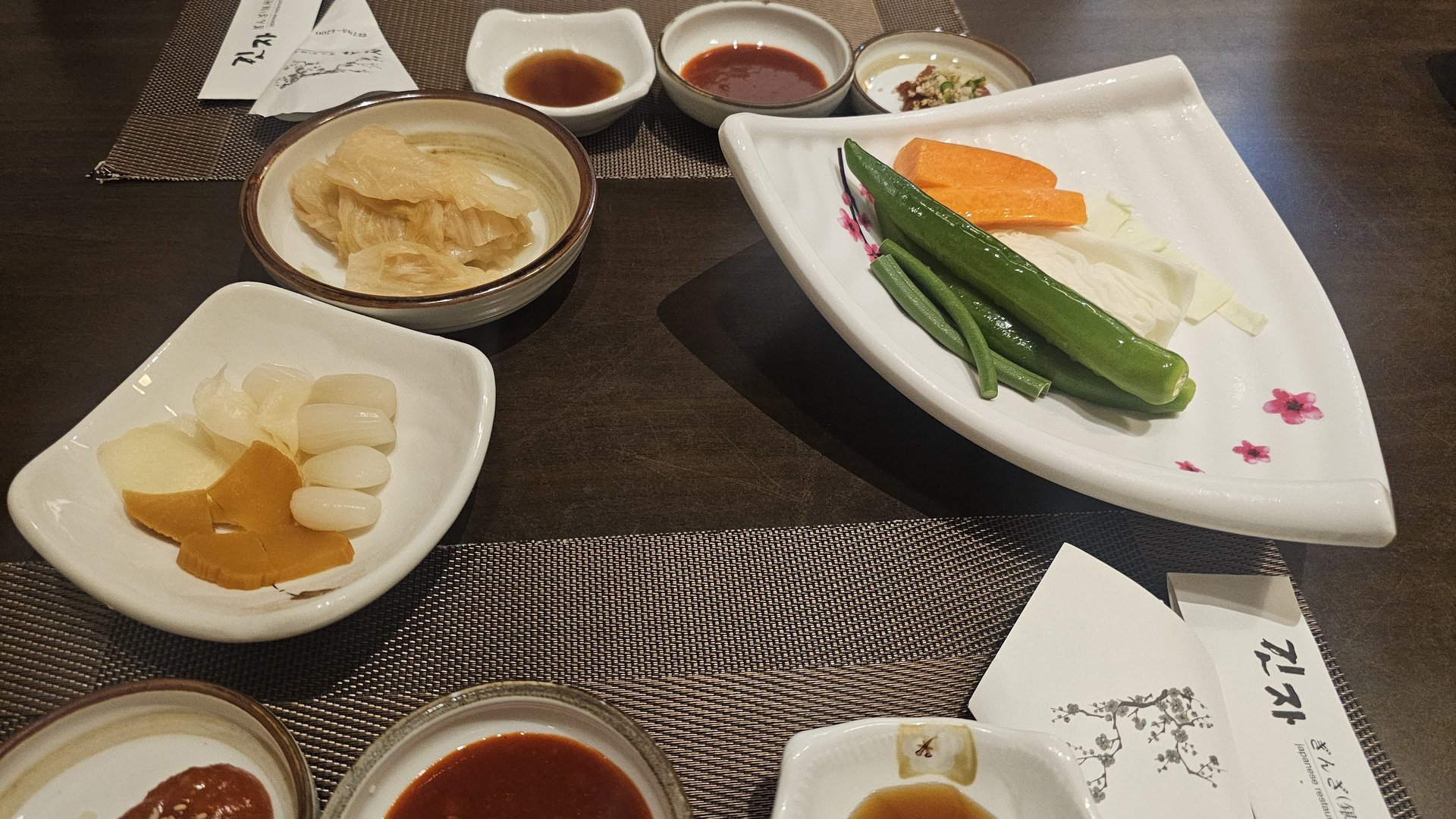
    Appetizer tray with pickled radish, fresh vegetables, and four sauce cups at Ginza Yeouido
    Appetizer tray with pickled radish, fresh vegetables, and four sauce cups at Ginza Yeouido
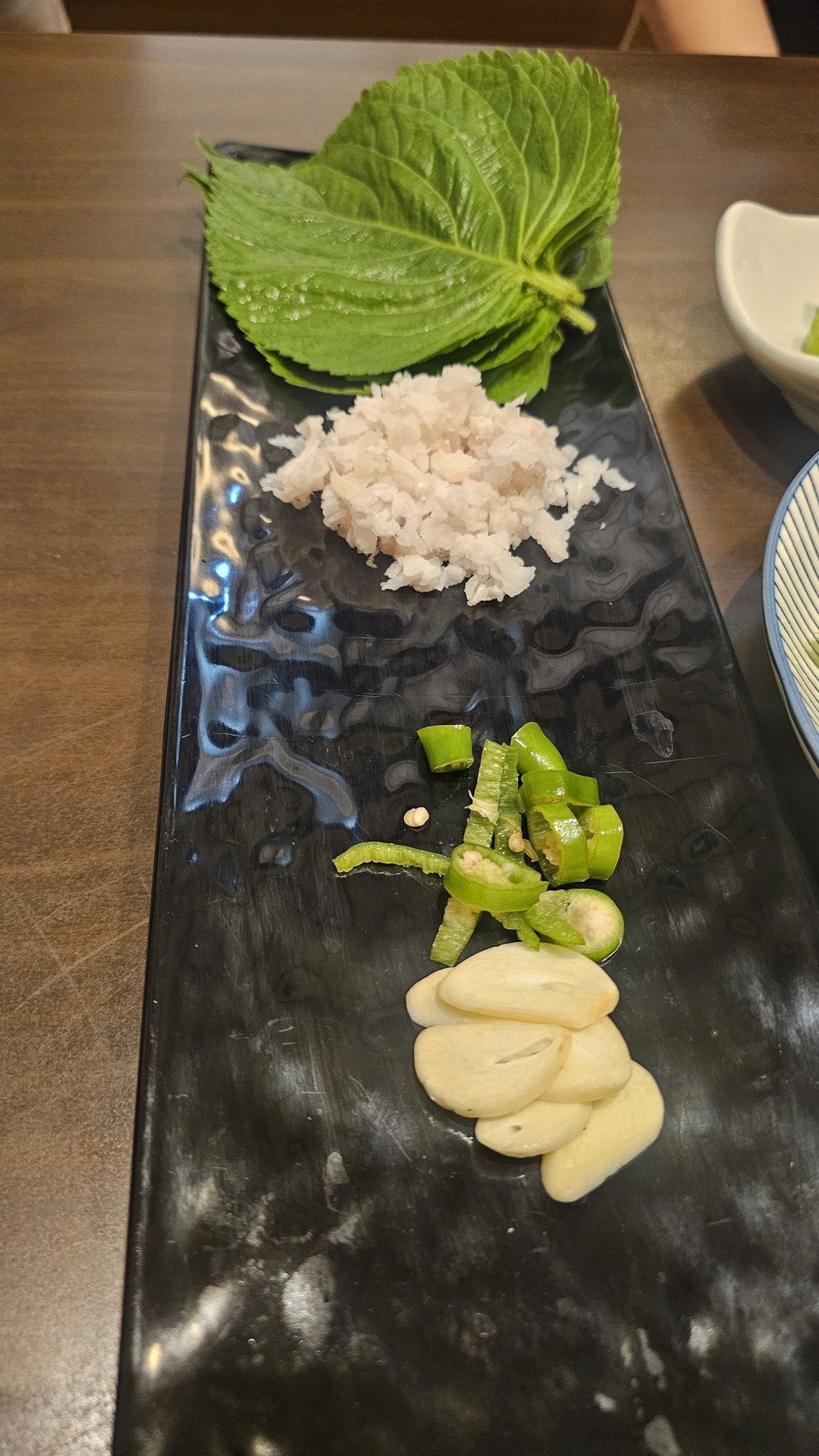
    Ssam wrapping ingredients tray with perilla leaves, salted greens, green chili, and whole garlic at Ginza Yeouido
    Ssam wrapping ingredients tray with perilla leaves, salted greens, green chili, and whole garlic at Ginza Yeouido
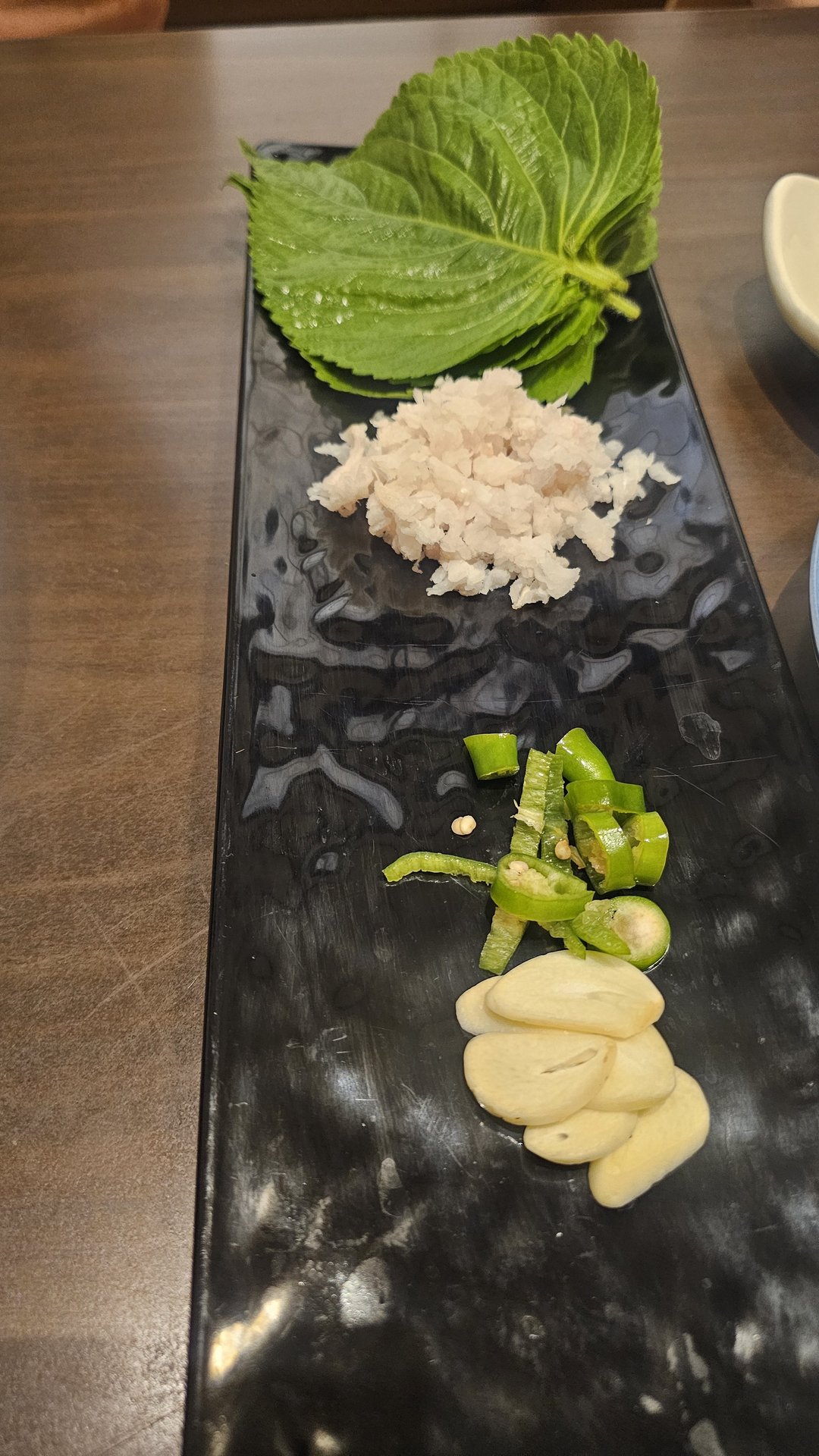
    Ssam wrapping tray with perilla leaves and condiments from alternate angle at Ginza Yeouido
    Ssam wrapping tray with perilla leaves and condiments from alternate angle at Ginza Yeouido

    Courses started with a mixed green salad and a small assortment of pickled radish, fresh vegetables for ssam (wrapping), and multiple dipping sauces — soy vinegar, ponzu, a spicy sauce, and a couple of others.

    Ssam (쌈) is the Korean practice of wrapping bites of meat or fish in leafy greens like perilla leaves. The tray came with perilla, salted greens, sliced green chili, and whole garlic. For the uninitiated: you grab a leaf, place whatever you want inside, add a bit of garlic or chili, fold it up, eat in one bite. You don’t need instructions — it’s intuitive once you see the tray.

    Three dipping sauces alongside: standard setup for Japanese-Korean course dining.

    Sashimi

    Assorted sashimi platter with salmon, tuna belly, flounder, and sea bream at Ginza Yeouido
    Assorted sashimi platter with salmon, tuna belly, flounder, and sea bream at Ginza Yeouido

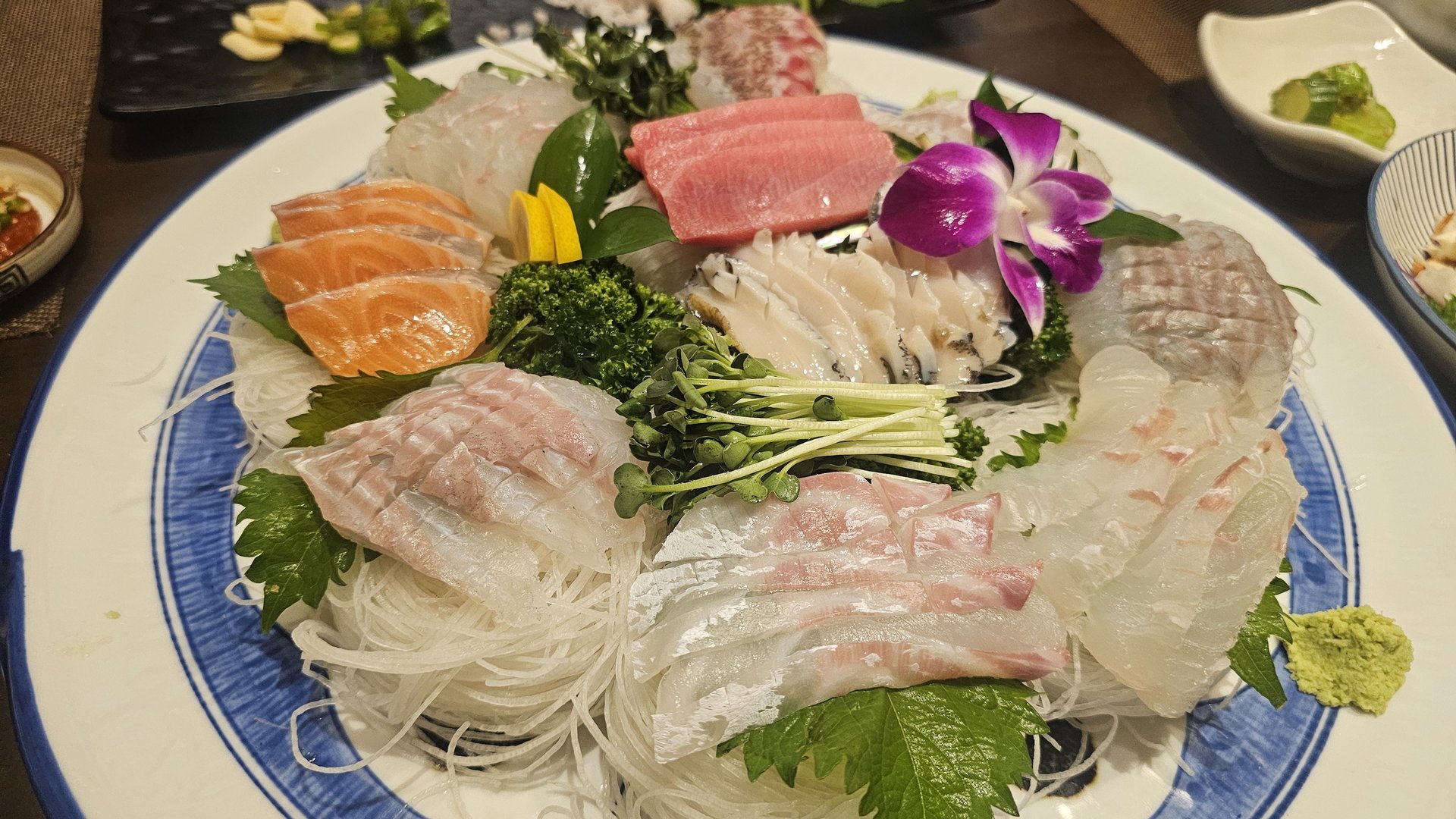
    The sashimi platter was the first real showstopper. Salmon, tuna belly (중뱃살), flounder (광어), sea bream (도미) — a wide range, all sliced thick and arranged properly on a large platter. Not a few thin slices on a corner of a plate. This was a full spread.

    The fish tasted clean. That’s the honest summary. Fresh, properly handled, no off notes. For a 20-year restaurant, you’d expect the fish sourcing to be consistent — and it was.

    Seafood Assortment

    Seafood assortment of octopus, scallop, and oyster on straw tray with sea urchin garnish at Ginza Yeouido
    Seafood assortment of octopus, scallop, and oyster on straw tray with sea urchin garnish at Ginza Yeouido

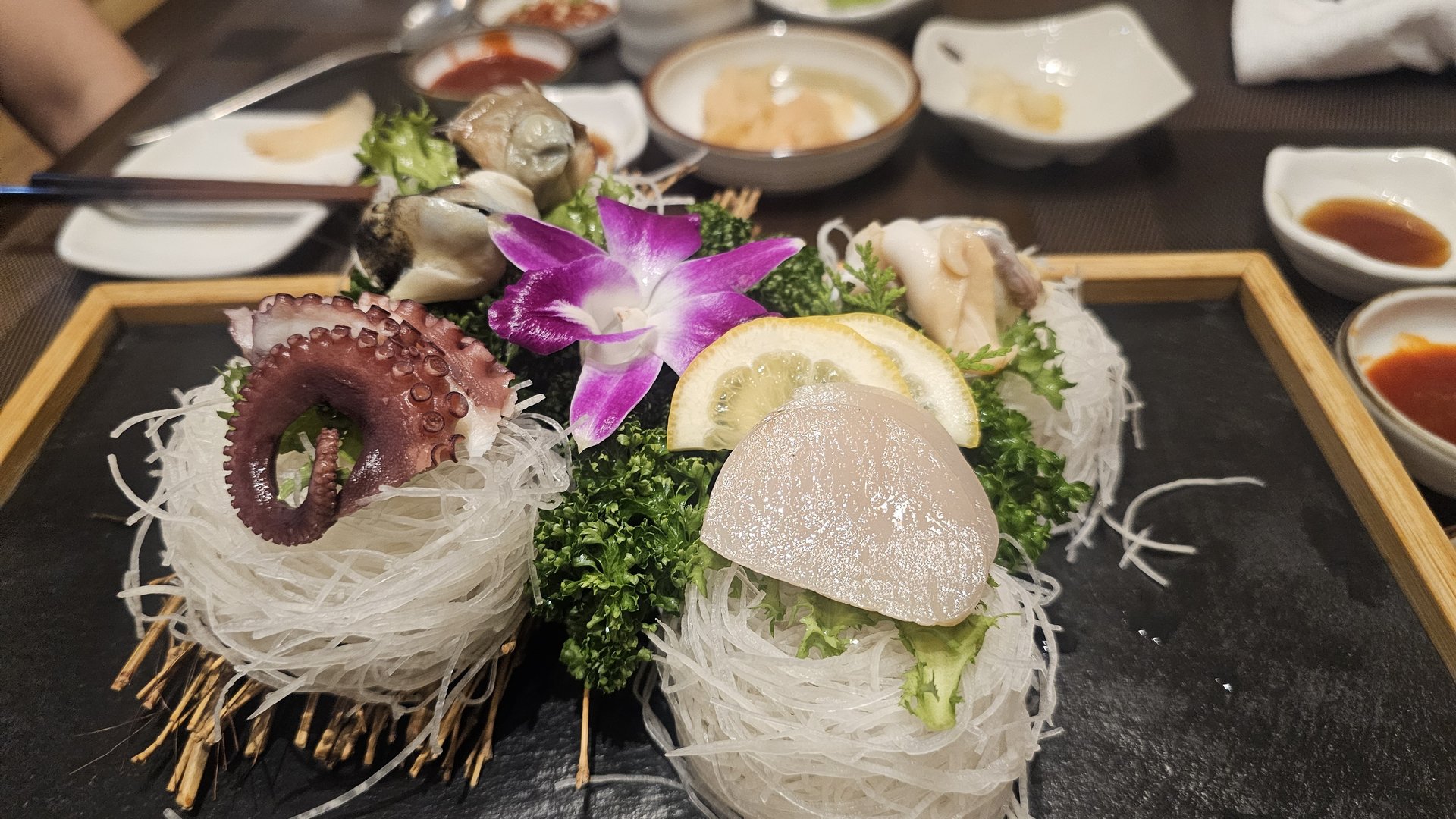
    This course included octopus (문어), scallop/gwanja (관자), oyster (굴), and what appeared to be sea urchin (성게) as a garnish on a straw tray. Presentation was genuinely good — the straw tray and careful arrangement made it look more like an omakase counter than a lunch restaurant.

    Octopus was tender, scallop was clean and sweet, oyster was fresh. No complaints on this course.

    Sushi

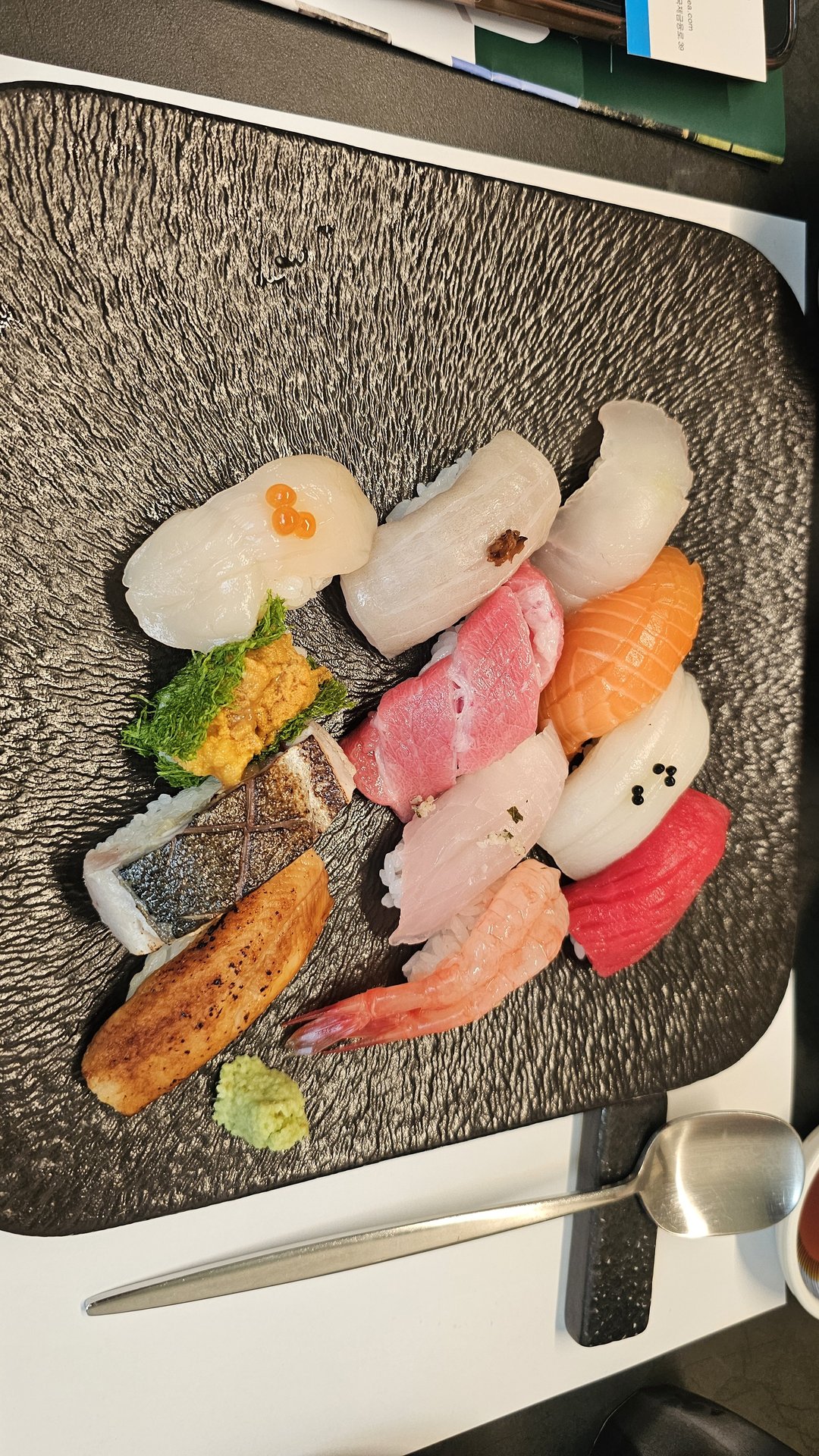
    Assorted sushi on slate board including flounder, otoro tuna, and gunkan rolls at Ginza Yeouido
    Assorted sushi on slate board including flounder, otoro tuna, and gunkan rolls at Ginza Yeouido

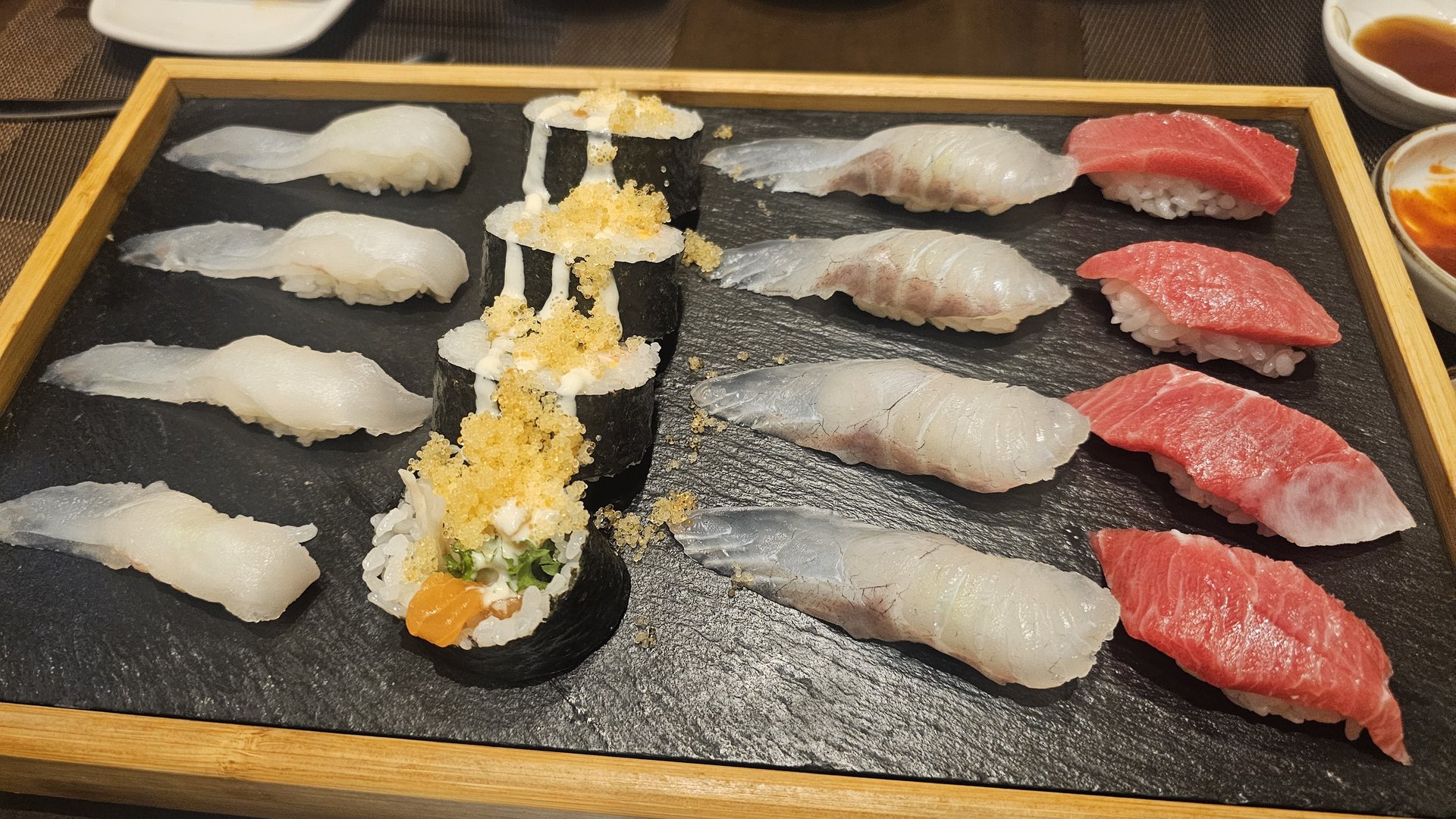
    Around 15 pieces of assorted nigiri and gunkan maki served on a slate board: flounder, sea bream, otoro (fatty tuna belly), and a few gunkan-style pieces. The rice was well-seasoned — this is where a lot of Korean Japanese restaurants fall short, but Ginza’s rice temperature and vinegar balance were right.

    Otoro (大トロ) is the fattiest cut of bluefin tuna — melt-on-your-tongue texture, slightly sweet, rich. If you see it on a sushi course in Seoul, it’s a good indicator of the restaurant’s quality ceiling. Theirs was solid.

    Tempura

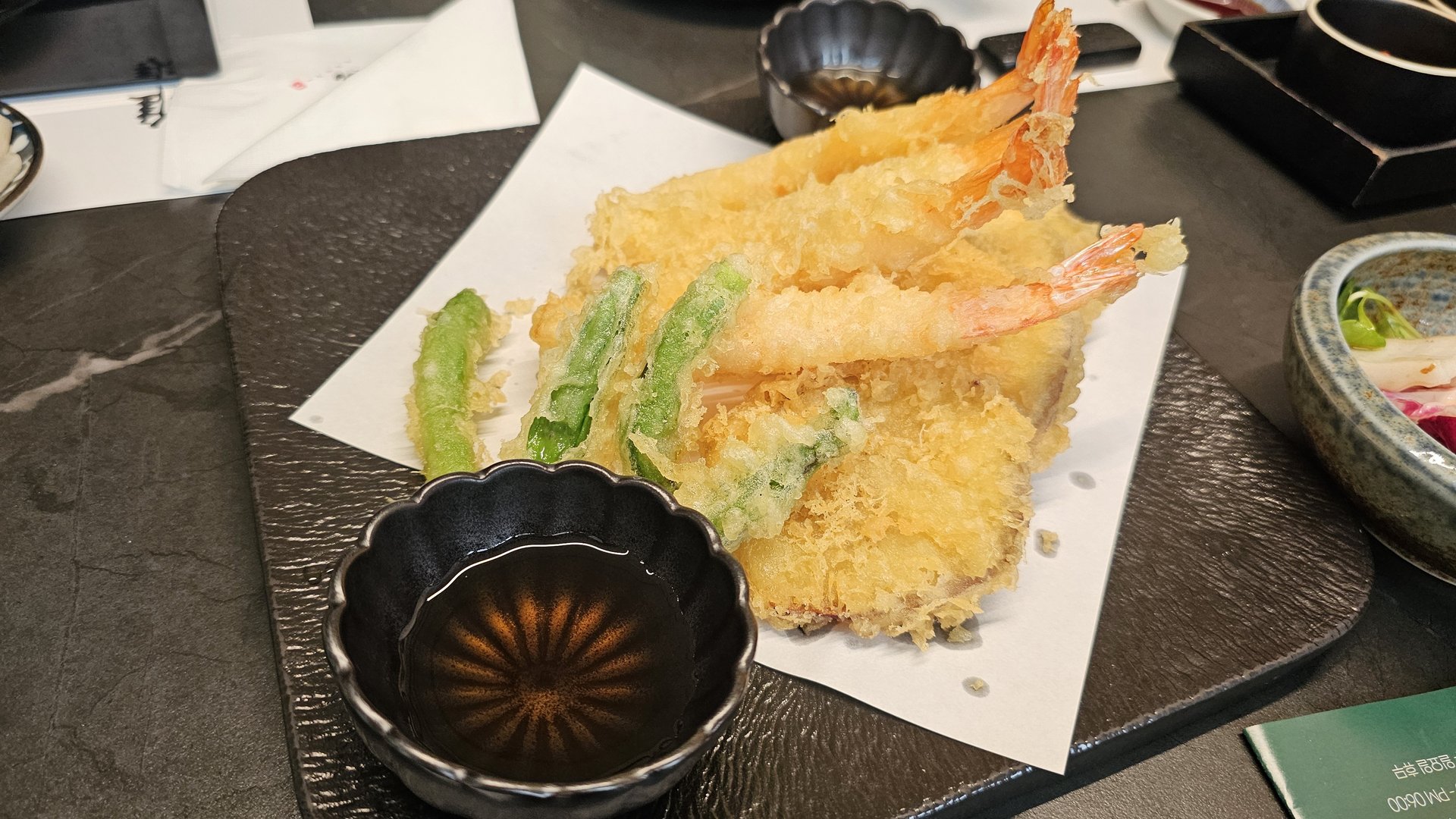
    Tempura assortment of shrimp, fish, and vegetables in bamboo basket with tentsuyu dipping sauce at Ginza Yeouido
    Tempura assortment of shrimp, fish, and vegetables in bamboo basket with tentsuyu dipping sauce at Ginza Yeouido

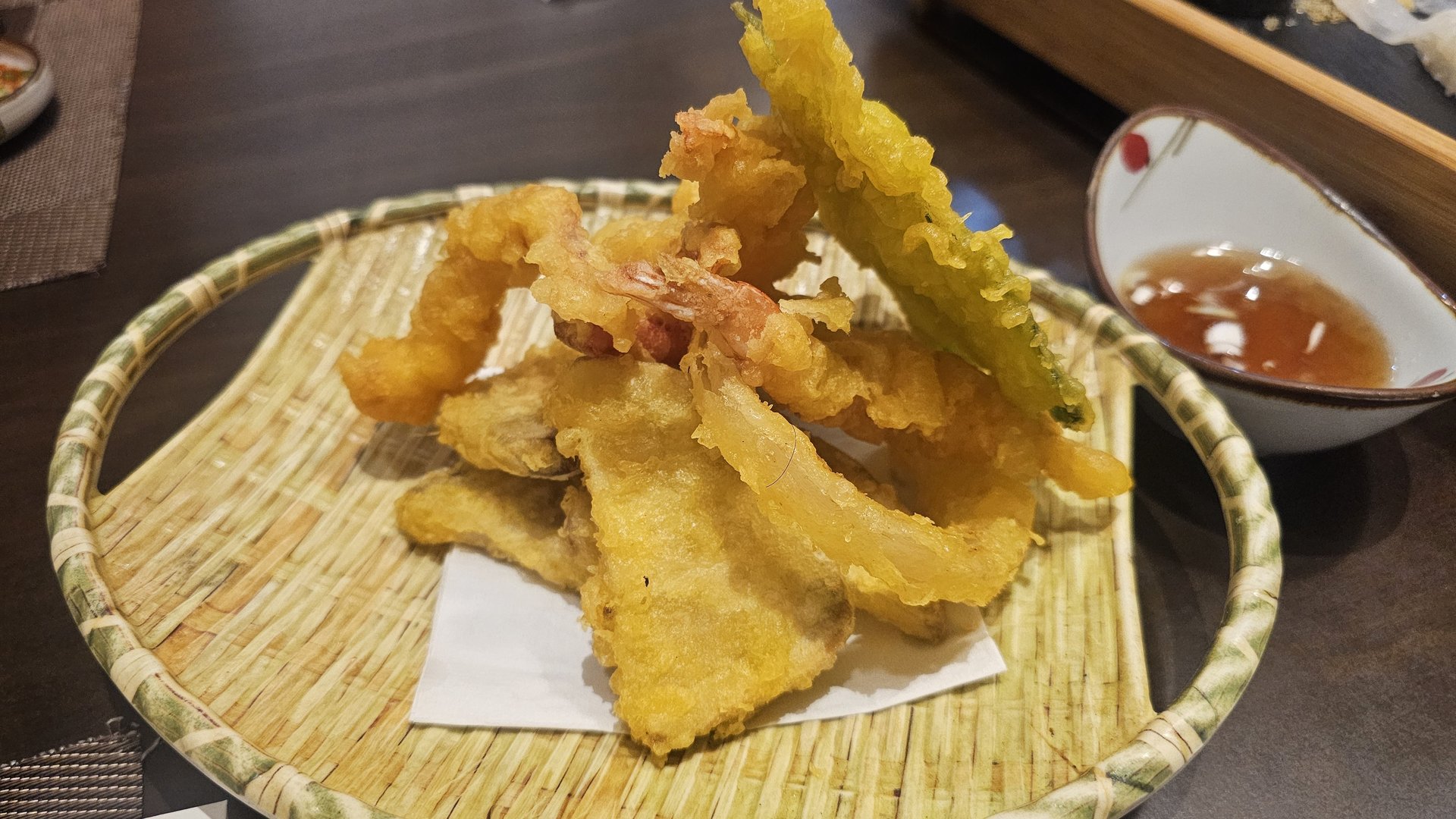
    Shrimp, fish, and vegetables in a bamboo basket, served with tentsuyu dipping sauce. Batter was light — the right kind of transparent, barely-there crunch. No greasiness. The tentsuyu (天つゆ — a dashi-based dipping broth) was mild and clean.

    Tempura is easy to do poorly. Heavy batter, overcooked shrimp, oil that isn’t hot enough. Ginza’s version had none of those problems.

    Grilled Fish

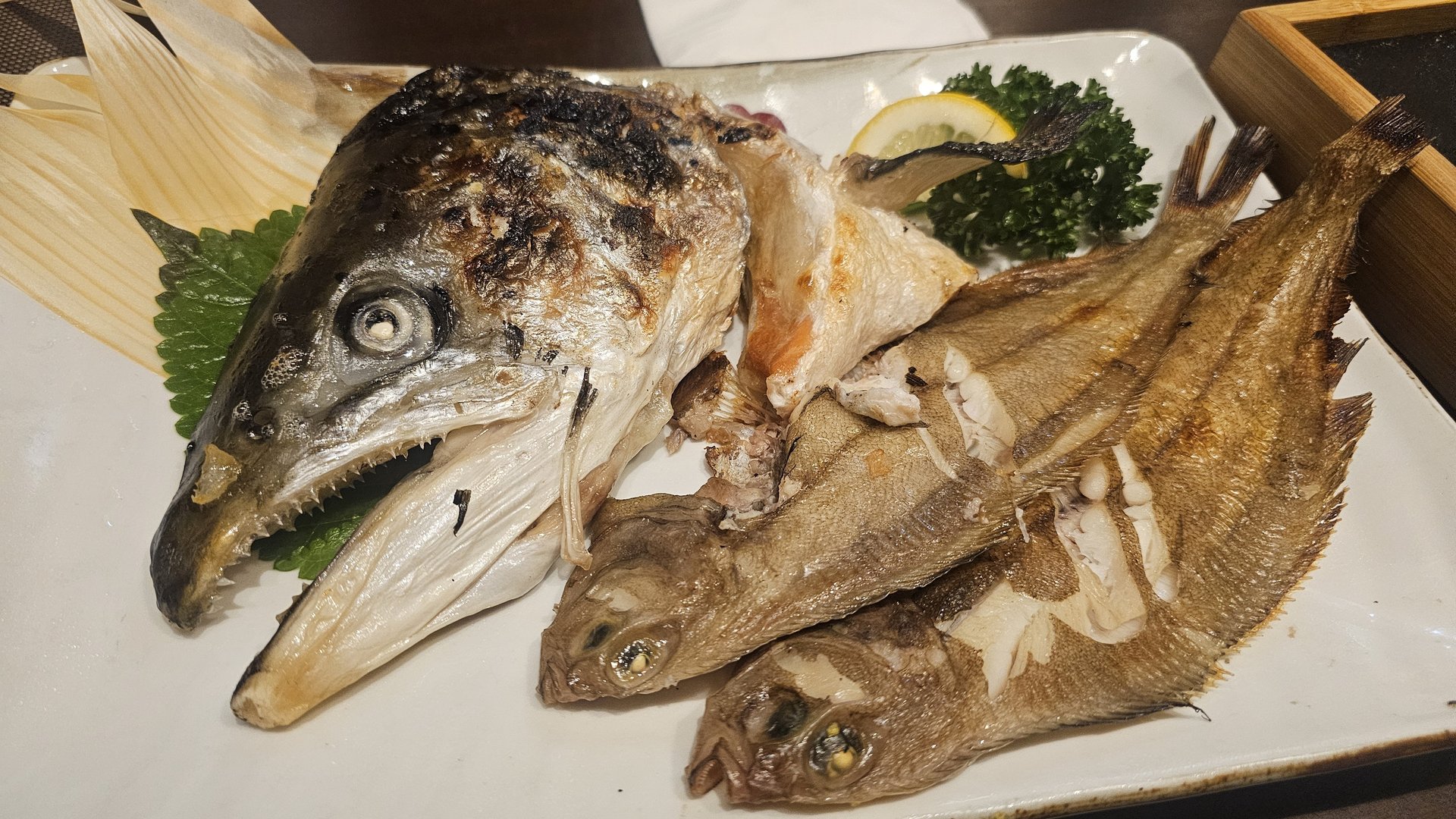
    Grilled fish course with large whole fish head and small grilled fish at Ginza Yeouido
    Grilled fish course with large whole fish head and small grilled fish at Ginza Yeouido

    A large whole fish head plus a couple of smaller whole grilled fish. Visually impressive in the way only a whole grilled fish can be. Skin properly charred, flesh flaky and moist.

    For foreign visitors: eating around a whole fish head is normal at this kind of Korean-Japanese restaurant. Staff can help if you’re not sure how to work through it.

    Noodles and Rice to Finish

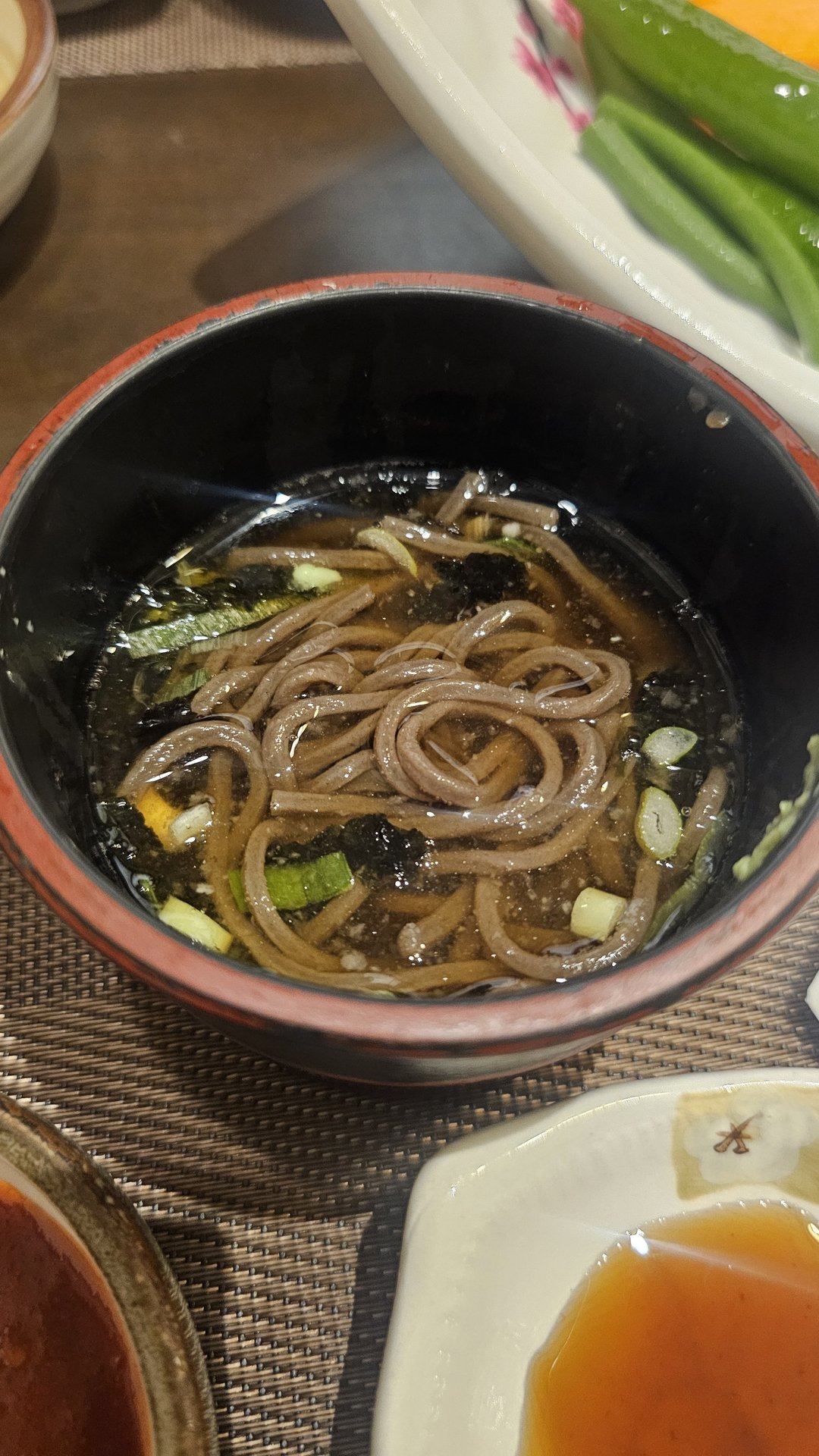
    Hot soba noodles in black lacquer bowl topped with scallions and seaweed at Ginza Yeouido
    Hot soba noodles in black lacquer bowl topped with scallions and seaweed at Ginza Yeouido
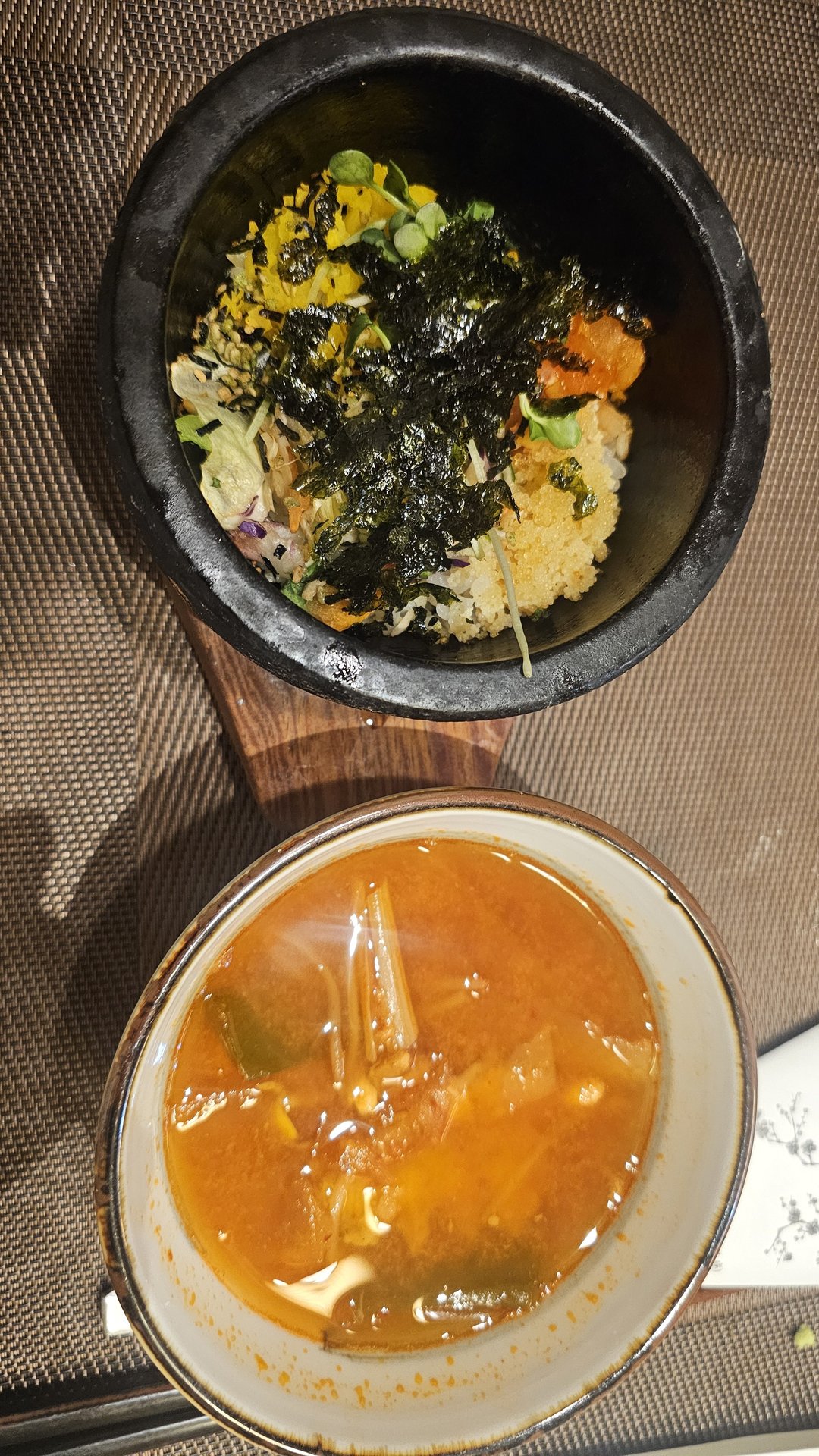
    Stone pot rice and Japanese miso soup finishing course at Ginza Yeouido
    Stone pot rice and Japanese miso soup finishing course at Ginza Yeouido

    Hot soba (温そば — buckwheat noodles in hot dashi broth) with scallions and seaweed, served in a black lacquer bowl. Then stone pot rice (돌솥밥) with Japanese-style miso soup to close the savory courses. The stone pot rice arrived with a slight crunch on the bottom — the scorched rice layer is intentional and considered good by Korean standards.

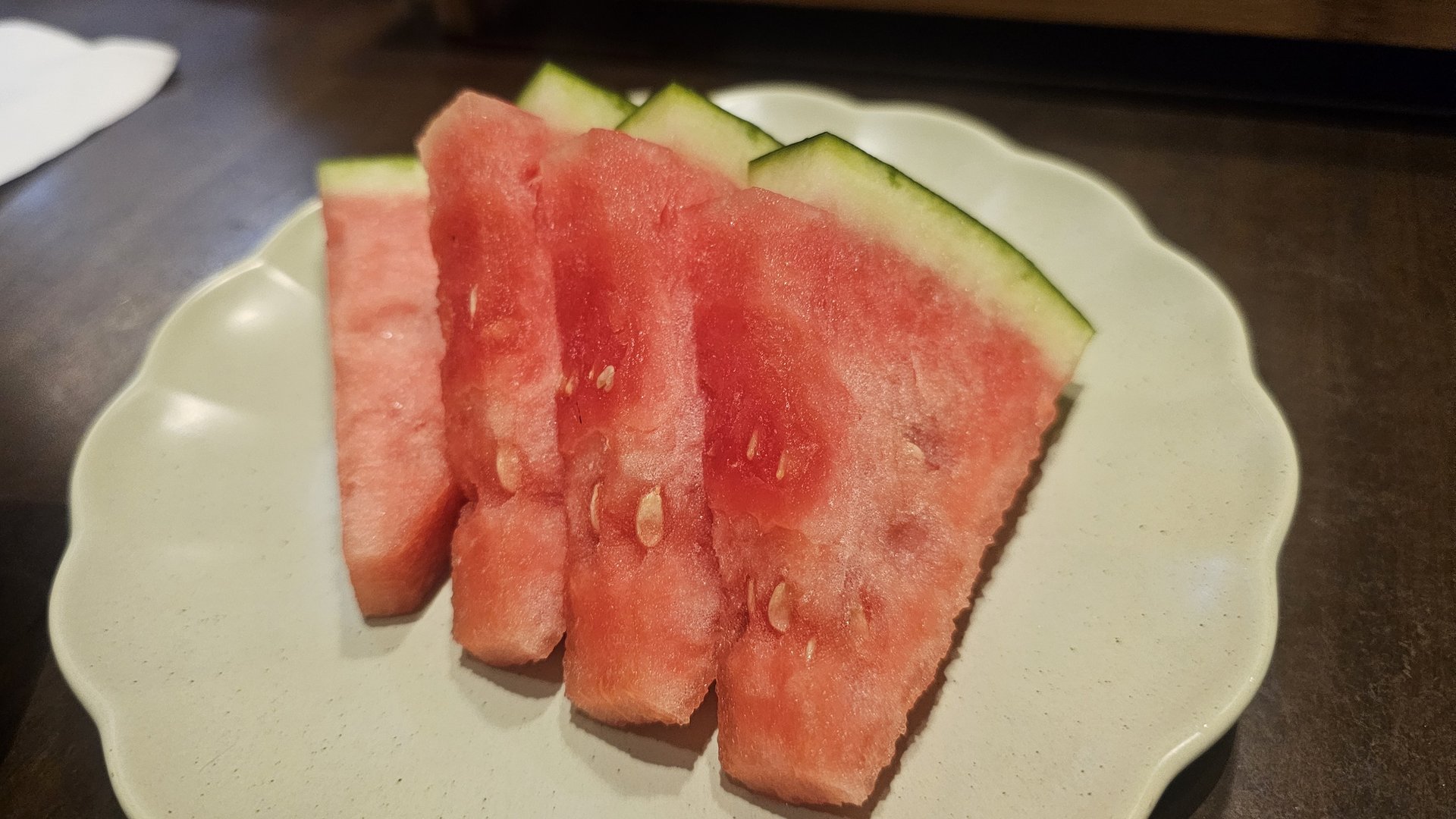
    Dessert watermelon sliced into four triangular pieces on white plate at Ginza Yeouido
    Dessert watermelon sliced into four triangular pieces on white plate at Ginza Yeouido
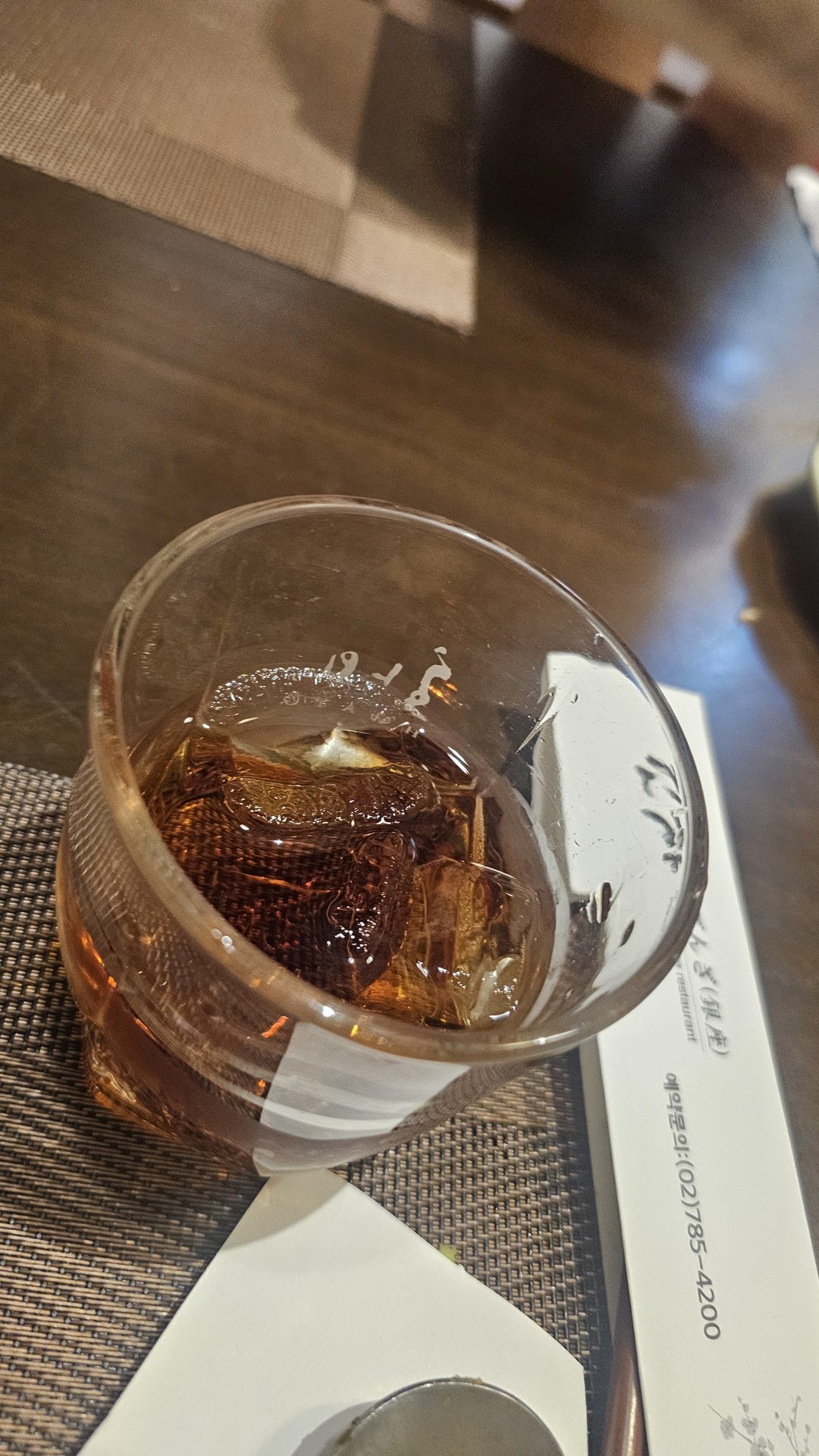
    Iced barley tea on the rocks next to Ginza Yeouido menu booklet
    Iced barley tea on the rocks next to Ginza Yeouido menu booklet

    Dessert was simple: four triangular slices of watermelon on a white plate. Classic light finish after a long meal. Iced barley tea on the side throughout.

    Stuff Tourists Should Know

    Language: The menu is Korean and Japanese. Don’t expect English menus. That said, the course format means you don’t really need to read anything — you pick a price tier, and the kitchen handles the rest. Pointing works.

    Payment: Card payment should be fine at a restaurant at this level. Foreign cards (Visa/Mastercard) are widely accepted in Seoul. Worth confirming at the door.
    Tipping: No tipping in Korea. Don’t tip.

    Dietary restrictions: This is a seafood-heavy Japanese course. Not suitable for vegetarians, vegans, shellfish allergies, or halal requirements. The course structure makes substitutions difficult.

    Groups: Tables are set up for groups of 4+. Solo dining would feel odd here. This is a group meal format.

    Reservation: Strongly recommended, especially at lunch. Yeouido business crowd fills up popular spots.

    Dress code: No strict policy, but the vibe is business casual. You’ll see suits and smart casual. Beach shorts would be out of place.

    The Verdict

    Should you go?

    Depends on what you’re doing in Seoul.

    – Business meal or formal occasion in Yeouido — yes, this is the answer. Reliable, quiet, handles the pacing for you.
    – Budget is real money to you — the lunch set (40,000–48,000 KRW / ~$30–36 USD) is the smarter entry point. Full Ginza course adds up fast for 4 people.

    – You have 5 days in Seoul and want to try everything Korean — probably skip. Spend that money on Korean BBQ, raw crab, or a proper Korean hanjeonsik course. Come back to Japanese cuisine on a longer trip.

    – You’ve visited Japan and want to compare — interesting to see the Seoul interpretation. Ginza serves a Korean-inflected Japanese course. The ssam tray and some of the sauce pairings are distinctly Korean. Not pure Japanese omakase, and not trying to be.

    The food was clean. That’s the honest take. Everything was properly cooked, well-presented, and tasted like what it was supposed to taste like. For a 20-year-old restaurant hitting its anniversary, that consistency is the whole point.

    Four of us left satisfied. Nobody had complaints. Nobody had a revelation either. Clean, solid, expensive. Worth it if you’re already in Yeouido and looking for a proper sit-down meal.

    FAQ

    How much does a meal at Ginza Yeouido cost per person?

    Lunch sets run 40,000–48,000 KRW (~$30–36 USD). The full Ginza course goes 68,000–108,000 KRW (~$50–80 USD) per person depending on the tier you choose.

    Do I need a reservation at Ginza Yeouido?

    Strongly recommended, especially for groups of 4 or more. This is a popular business-lunch spot in Seoul’s financial district — walk-ins are hit or miss. Check their official channels or call ahead.

    Is there an English menu at Ginza Yeouido?

    It’s a Korean-run Japanese restaurant, so the menu is primarily in Korean and Japanese. Staff can assist with orders, but don’t expect full English service. Pointing at the course price tiers on the entrance board gets you far.

    What’s included in the Ginza course menu?

    A typical Ginza course runs through multiple stages — sashimi platter, assorted seafood (octopus, scallop, oyster), sushi, tempura, grilled fish, soba, stone pot rice with miso soup, and a light dessert like watermelon. It’s a full meal.

    Is Ginza Yeouido good for a business lunch in Seoul?

    Yes, this is exactly the kind of place Seoul’s financial district crowd uses for client lunches. Private or semi-private table settings, formal Japanese service, and a course format that takes care of the conversation pacing for you.

    Does Ginza Yeouido have any discounts or promotions?

    At time of visit, they had a Friday evening event offering 10% off. Worth checking their current promotions before you go, especially if visiting on a weekday evening.

    You might also like

    📍 Location

    Open in Google Maps →

  • Jingawa Yeouido: Honest Review of Japanese Set Lunch in Seoul

    Jingawa Yeouido: Honest Review of Japanese Set Lunch in Seoul

    🇯🇵 日本語版はこちら

    Quick honest review of Jingawa (진가와) in Yeouido — a Japanese teishoku restaurant doing cold soba and warm udon sets. This is one of those places you keep coming back to when you want a clean, no-fuss lunch. Short version: the chadol miso udon is the dish to order, the full set format is genuinely good value, and the interior is nicer than most Yeouido spots. Not cheap at ~26,500 KRW (~$19.60) per person, but this is Yeouido — you’re not hunting for budget kimbap here.

    Visited on a Monday morning, right at 11 AM opening. The hall was nearly empty. Good time to go.

    What Is Teishoku? (The Format, Explained)

    If you’re not familiar with teishoku (定食) — it’s the Japanese concept of a complete set meal. You pick one main dish and everything else comes with it: sides, soup, small accompaniments. No need to order separately. One item on the menu, full meal on the table.

    At Jingawa, that means: your noodle bowl (hot udon or cold soba/somen) + a tempura plate with shrimp and vegetable tempura + two pieces of nigiri sushi + pickled radish and small condiment sides. It all arrives together.

    The Korean word for this format is 정식 (jeongshik) — you’ll see it on menus all over Korea. Jingawa does a Japanese-leaning take on it, with the noodle bowl as the centrepiece.

    About Jingawa

    Jingawa is a noodle teishoku restaurant in Yeouido — Seoul’s financial district, similar to Canary Wharf or Wall Street. The clientele is mostly office workers and business lunch crowds from nearby towers. The restaurant opens at 11 AM, which is noticeably earlier than most Seoul restaurants (most open at 11:30 or noon).

    Menu focus: cold noodles (soba and somen variations) and warm udon, each served as a full set. Prices run 25,000–31,000 KRW (~$18.52–$22.96 USD). This isn’t a cheap lunch stop, but everything is included in that price.

    Getting There

    Yeouido is one of the easier parts of Seoul to reach by subway:

    – Line 5: Yeouido Station (여의도역) — Exit 1 or 2

    – Line 9: National Assembly Station (국회의사당역)

    – From Incheon Airport (ICN): About 60–70 minutes via Airport Railroad + Line 9, or roughly 40–50 minutes by taxi (expect 45,000–60,000 KRW / ~$33–$44)

    If you’re already in Yeouido for IFC Mall, the 63 Building, or Hangang Park — Jingawa is easy to fold in for lunch.

    The Interior

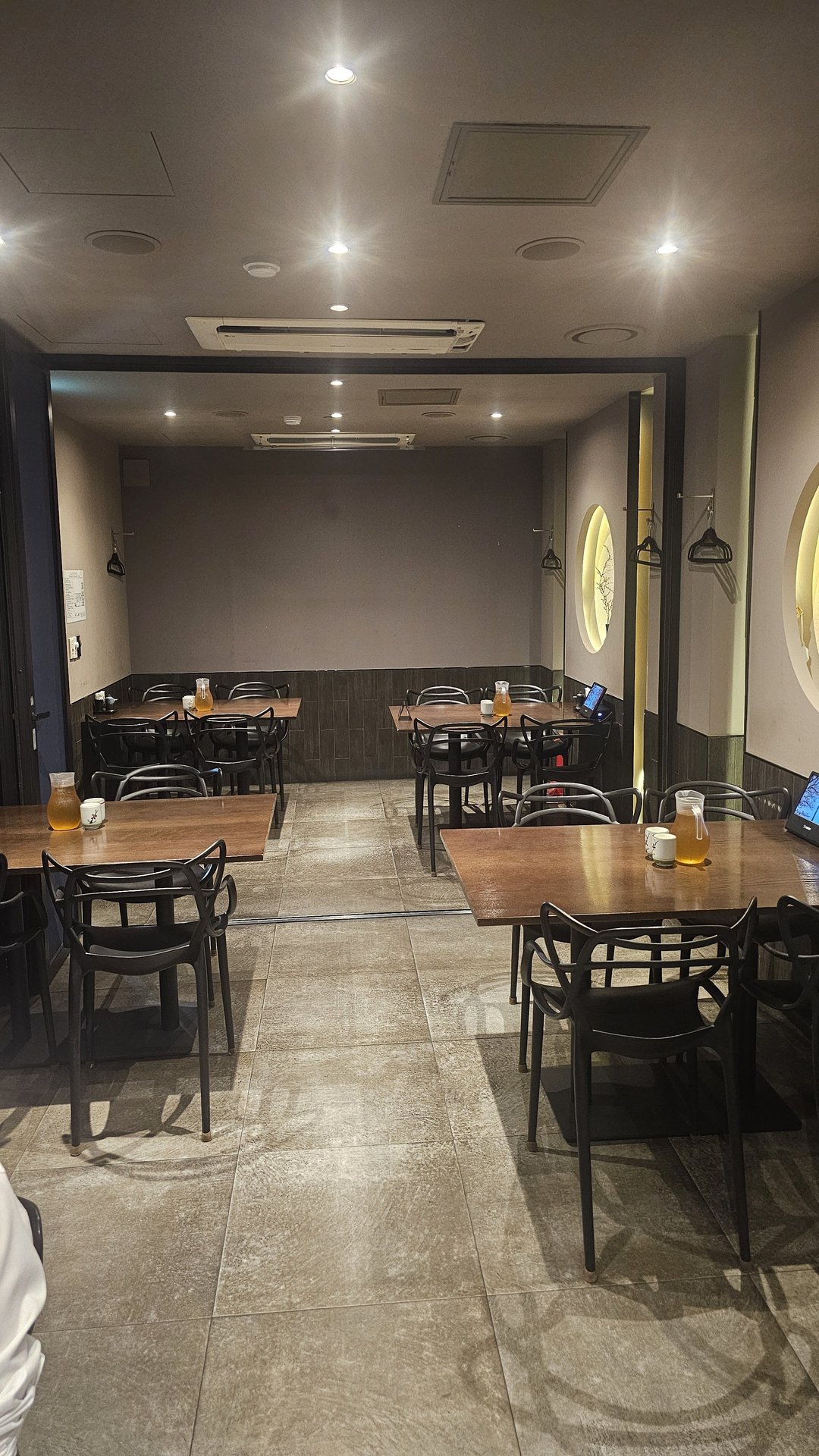
    Interior of Jingawa Yeouido with wooden tables and black iron chairs under warm lighting
    Interior of Jingawa Yeouido with wooden tables and black iron chairs under warm lighting
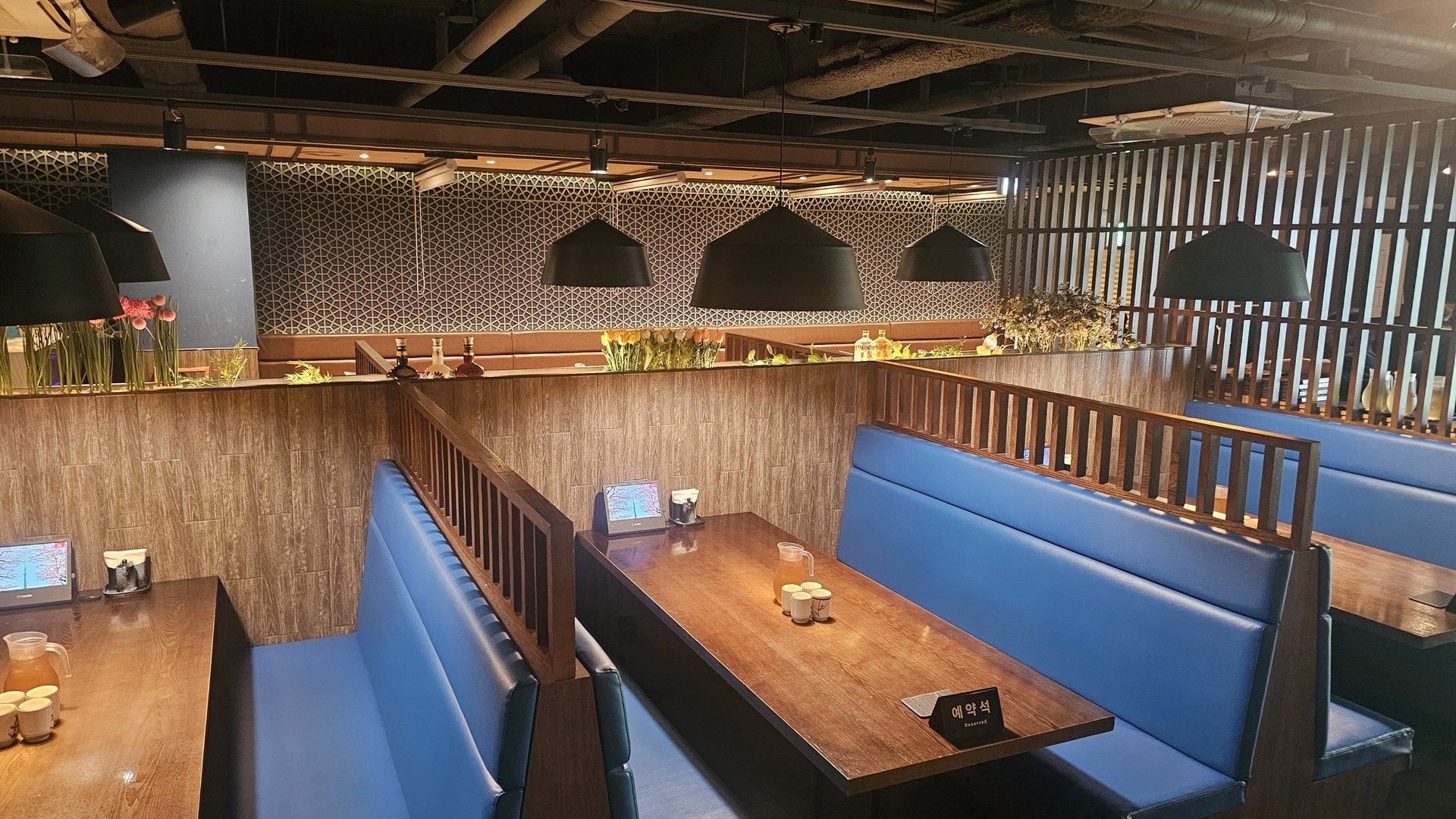
    Upper seating area at Jingawa Yeouido featuring blue fabric booth sofas and wooden partition dividers
    Upper seating area at Jingawa Yeouido featuring blue fabric booth sofas and wooden partition dividers

    Genuinely nice. Wooden tables, black iron chairs on the main floor. Upper level has booth seating with blue fabric upholstery and wooden partition panels between sections. Soft lighting throughout. Quiet — especially at opening hour.

    It doesn’t feel like a typical Seoul lunch place. No blaring K-pop, no cramped tables. The vibe is calm, a bit formal, well put-together. Good for a business-ish lunch or just when you want to eat without noise.

    The Menu

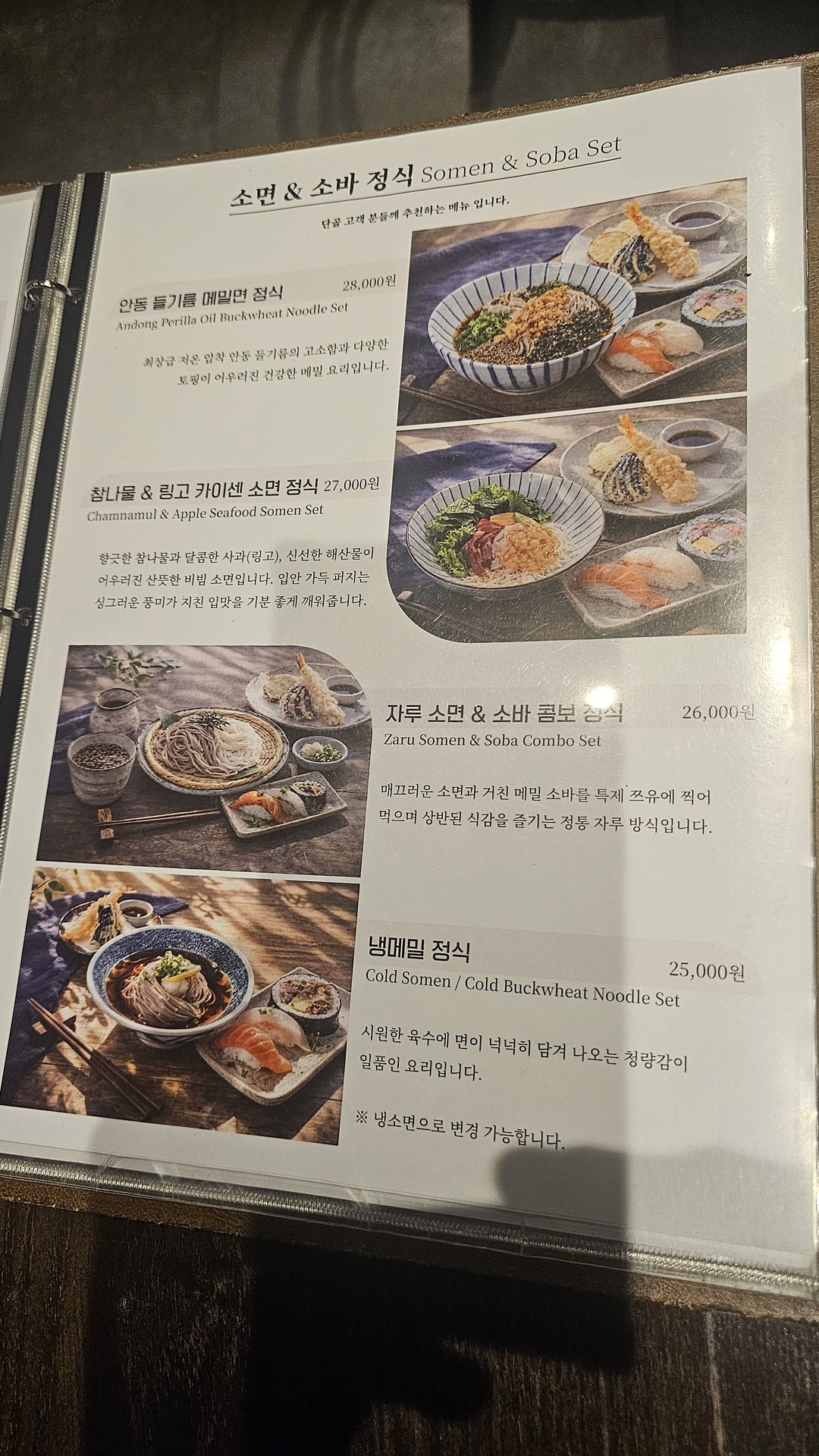
    Jingawa Yeouido cold noodle menu page showing somen and soba set meals ranging from 25,000 to 28,000 KRW
    Jingawa Yeouido cold noodle menu page showing somen and soba set meals ranging from 25,000 to 28,000 KRW
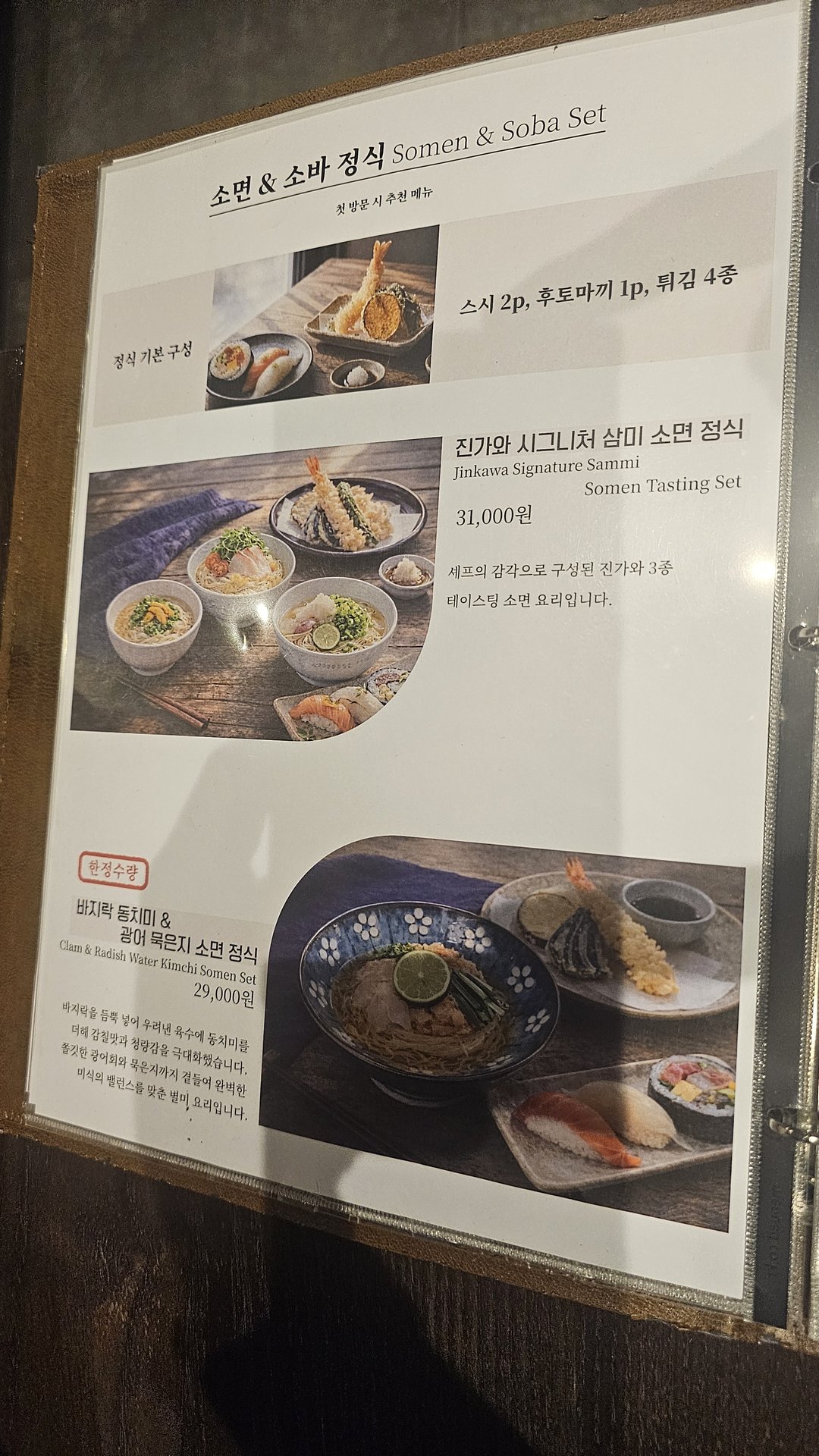
    Jingawa Yeouido signature somen menu page with Sammi somen set and clam cold noodle set priced at 29,000 to 31,000 KRW
    Jingawa Yeouido signature somen menu page with Sammi somen set and clam cold noodle set priced at 29,000 to 31,000 KRW
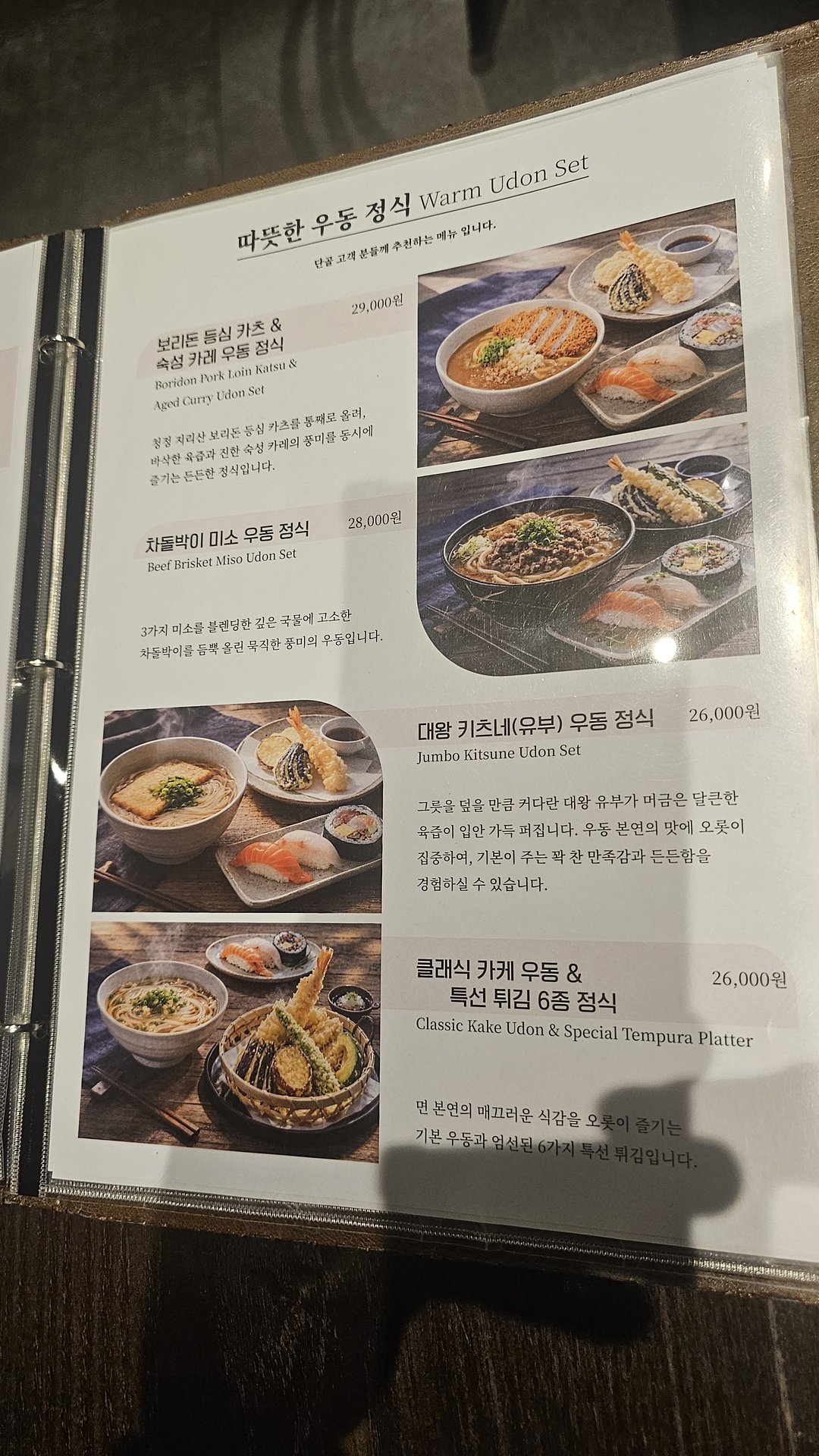
    Jingawa Yeouido warm udon menu page featuring chadol miso udon and pork katsu curry udon sets
    Jingawa Yeouido warm udon menu page featuring chadol miso udon and pork katsu curry udon sets
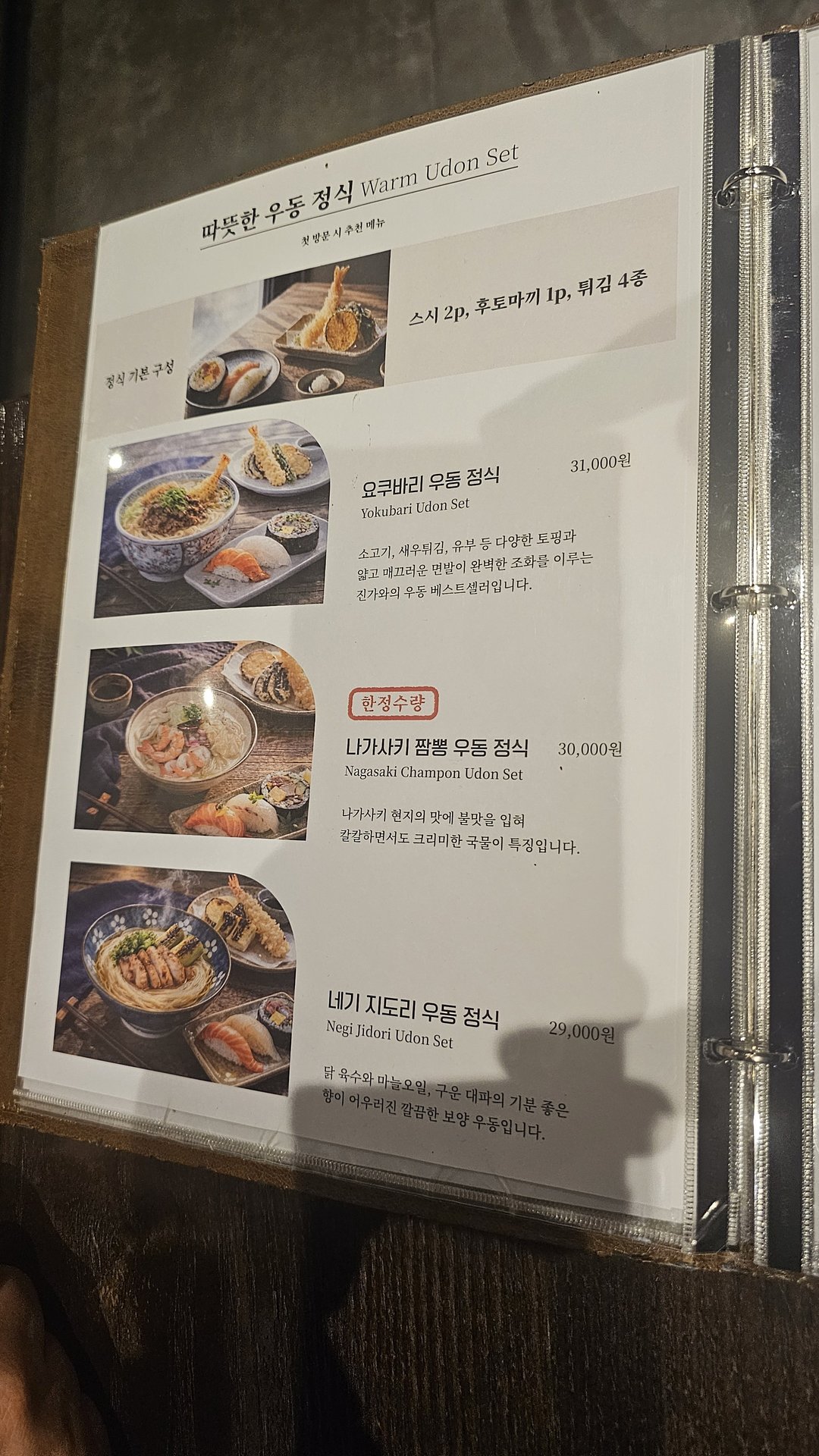
    Jingawa Yeouido udon menu page with yokubari udon, Nagasaki chanpon udon, and negi jidori udon sets
    Jingawa Yeouido udon menu page with yokubari udon, Nagasaki chanpon udon, and negi jidori udon sets

    Two main categories:

    Cold noodles (소면 & 소바 정식):

    – Cold Buckwheat Soba Set (냉메밀 정식): 25,000 KRW (~$18.52) — the entry point

    – Clam Cold Noodle Set (바지락 통도치미 소면 정식): 29,000 KRW (~$21.48)

    – Signature Sammi Somen Set (시그니처 삼미 소면 정식): 31,000 KRW (~$22.96) — three-part cold noodle set, most expensive in this category

    Warm udon (따뜻한 우동 정식):

    – Chadol Miso Udon Set (차돌박이 미소 우동 정식): 28,000 KRW (~$20.74)

    – Pork Katsu Curry Udon Set (보리멘 돼지카츠 카레 우동 정식): 29,000 KRW (~$21.48)

    – Classic Kake Udon with Assorted Tempura (클래식 카케 우동 & 특선 튀김 6종 정식): 26,000 KRW (~$19.26) — lowest-priced udon set

    – Nagasaki Chanpon Udon (나가사키 찬폰 우동 정식): 30,000 KRW (~$22.22)

    Honestly, if you’re going once, just get the chadol miso udon.

    What I Ordered

    Total for two: 53,000 KRW (~$39.26).

    Chadol Miso Udon Set — 28,000 KRW (~$20.74)

    Chadol (차돌박이) is thinly sliced beef brisket — the same cut you’d see on a Korean BBQ grill, but here it goes into the udon broth. The miso is white-style (shiro miso), lighter and less intense than the red miso you might know from miso soup. The broth is clean and slightly sweet.

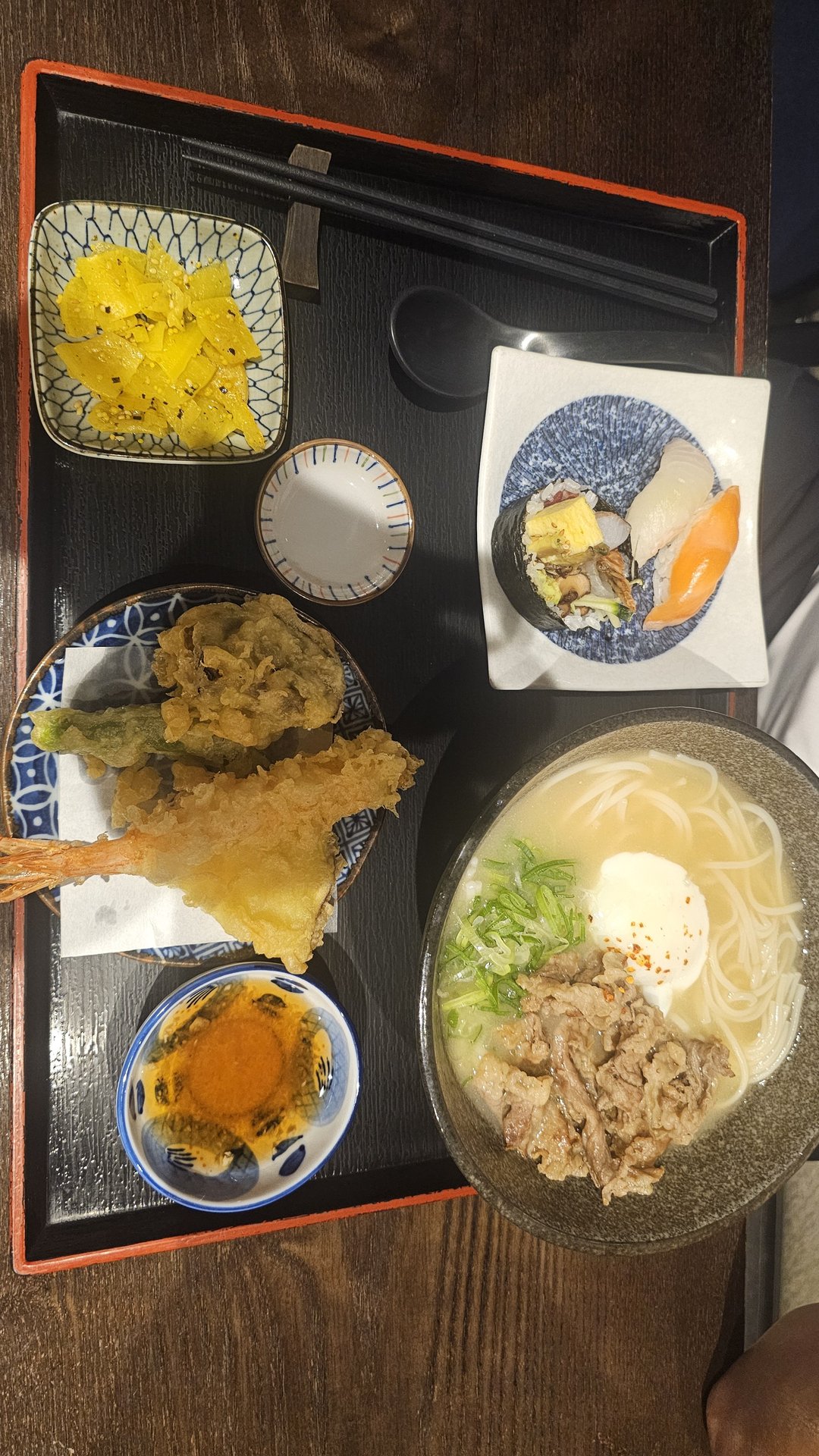
    Chadol miso udon set meal at Jingawa Yeouido featuring thinly sliced beef brisket, soft-boiled onsen tamago egg, green onions, shrimp and vegetable tempura, and nigiri sushi
    Chadol miso udon set meal at Jingawa Yeouido featuring thinly sliced beef brisket, soft-boiled onsen tamago egg, green onions, shrimp and vegetable tempura, and nigiri sushi

    On top: onsen tamago — a slow-cooked soft egg where the white is just barely set and the yolk stays runny — and thin green onion slices. The egg breaks into the broth and rounds it out.

    The set includes a separate tempura plate (shrimp tempura plus vegetable tempura), two pieces of nigiri sushi, pickled radish, and small sauce sides. It’s a lot of food. You won’t leave hungry.

    This is the dish to order.

    Cold Buckwheat Soba Set — 25,000 KRW (~$18.52)

    Cold buckwheat soba set meal at Jingawa Yeouido with grated daikon radish, lemon, shrimp tempura, vegetable tempura, and two pieces of nigiri sushi
    Cold buckwheat soba set meal at Jingawa Yeouido with grated daikon radish, lemon, shrimp tempura, vegetable tempura, and two pieces of nigiri sushi

    Zarusoba style — chilled buckwheat noodles served on a bamboo tray. Grated daikon radish and a slice of lemon on top. You pour a bit of the tsuyu dipping broth into a small cup, add the daikon, and dip the noodles in as you eat.

    Same sides as the udon: tempura plate, two pieces of nigiri, pickled radish.

    It’s good. Solid cold soba, nothing to complain about. Refreshing for summer. But compared to the udon, it’s the quieter dish — simpler flavours, less going on. If you know cold soba and that’s what you want, this is a reliable version. If you’re deciding between the two: get the udon.

    Stuff Tourists Should Know

    Language: The menu is in Korean. The dish names are Japanese-influenced, which doesn’t help much if you don’t read either. That said, pointing at menu photos works fine — staff in Yeouido are used to non-Korean speakers. Basic English communication should be fine.

    Payment: Cards are standard everywhere in Yeouido. Foreign Visa and Mastercard work without issue. Cash also accepted. No tipping — it’s not done in Korea. Do not leave money on the table.

    Opening hours: They open at 11 AM. If you arrive before noon, you’ll likely walk right in. After 12:30 PM, the Yeouido office lunch rush kicks in.

    Diet restrictions: The tempura includes shrimp, and most broths are dashi-based (made from fish stock). Vegetarians and vegans will have a hard time here. No halal options. Gluten-free is not possible — noodles throughout.

    Kids: The format is calm and quiet. Kids are fine in terms of space and seating, but the menu is noodle-heavy and some younger kids might not be into cold soba. The udon is a safer bet for families.

    Solo dining: Totally fine. Counter seating or booth for one is no issue.

    Group size: Tables and booths handle 2–4 comfortably. Probably not the spot for groups of 6+, especially without a reservation.

    The Verdict

    Jingawa is a reliable, polished lunch option in Yeouido. Not trying too hard, not coasting either. The chadol miso udon delivers a complete meal — good broth, proper protein, and the full set format means you don’t need to think about ordering sides. The interior is genuinely pleasant. Early morning timing works in your favour.

    Is it worth going out of your way for? If you’re already in Yeouido, yes — it’s one of the better sit-down lunch spots. If you’re doing a tight 3-day Seoul itinerary, prioritize Korean food first. Come to Jingawa on a longer trip when you’re ready for something a bit different.

    Who should go:

    – In Yeouido for the day and want a proper sit-down lunch — yes

    – Into Japanese teishoku style and curious how Seoul does it — yes

    – Want to try Korean food while in Seoul — skip this one and go get galbi or samgyeopsal instead

    – Tight budget — the sets start at 25,000 KRW (~$18.52), which is mid-range for Seoul. Not expensive, but not cheap.

    Would I come back? Yeah. It’s already in the regular rotation.

    FAQ

    What is the average price per person at Jingawa Yeouido?

    Sets range from 25,000 to 31,000 KRW (~$18.50–$23 USD) per person, all-in. Each set includes the main noodle dish, a tempura plate, two pieces of nigiri sushi, and small sides. Budget around 26,500 KRW (~$19.60) as a realistic average.

    What should I order at Jingawa Yeouido?

    The Chadol Miso Udon Set (차돌박이 미소 우동 정식, 28,000 KRW / ~$20.74). Thinly sliced beef brisket in white miso udon broth, plus a full tempura plate and sushi. If you prefer cold noodles, the Cold Buckwheat Soba Set is the simpler, slightly cheaper pick.

    What time does Jingawa Yeouido open, and do I need a reservation?

    They open at 11 AM — earlier than most Seoul restaurants. Walk-ins work fine at opening. By 12:30 PM, Yeouido office lunch crowds show up, so arriving early is the smarter move. Check Naver Map or Kakao Map for reservations if you’re coming during peak hours.

    Is there an English menu at Jingawa Yeouido?

    The printed menu is in Korean, but the dishes are Japanese-influenced and most items have enough context to navigate by pointing. Staff in Yeouido generally handle basic English without issue.

    Is Jingawa suitable for vegetarians or people with dietary restrictions?

    Not really. Most broths are dashi-based (fish stock) and the tempura sets include shrimp. Vegetarian, vegan, and halal options are very limited here.

    Can I pay with a foreign credit card at Jingawa Yeouido?

    Yes. Card payment is standard across Yeouido. Foreign Visa and Mastercard work fine. No tipping needed — tipping is not a custom in Korea.

    You might also like

    📍 Location

    Open in Google Maps →

  • Sushi Yu in Yeouido: Honest Review of a Seoul Sushi Lunch

    Sushi Yu in Yeouido: Honest Review of a Seoul Sushi Lunch

    🇯🇵 日本語版はこちら

    Quick honest review of Sushi Yu (스시유) in Yeouido — a Japanese sushi restaurant in Seoul’s financial district with a bronze plaque from Korean TV to back up its reputation. Short version: we went four people, ordered kaisendon, a 12-piece nigiri set, unaju, and tempura on the side. All of it was good. Left satisfied.

    If you’re eating lunch in Yeouido and want actual Japanese food — not a mall food court, not a chain — this is a solid choice.

    We visited on a Thursday, lunch service.

    What Is Sushi Yu?

    Sushi Yu is a mid-to-upscale Japanese restaurant focused on sushi and traditional Japanese set lunches. Think hand-formed nigiri, kaisendon (seafood sashimi rice bowls), unaju (grilled eel over rice in a lacquer box), and tempura. Sit-down service, proper tableware, the kind of place where the miso soup arrives in a lacquer bowl.

    Not a conveyor belt. Not a Korean-Japanese fusion place. Traditional Japanese, done seriously.

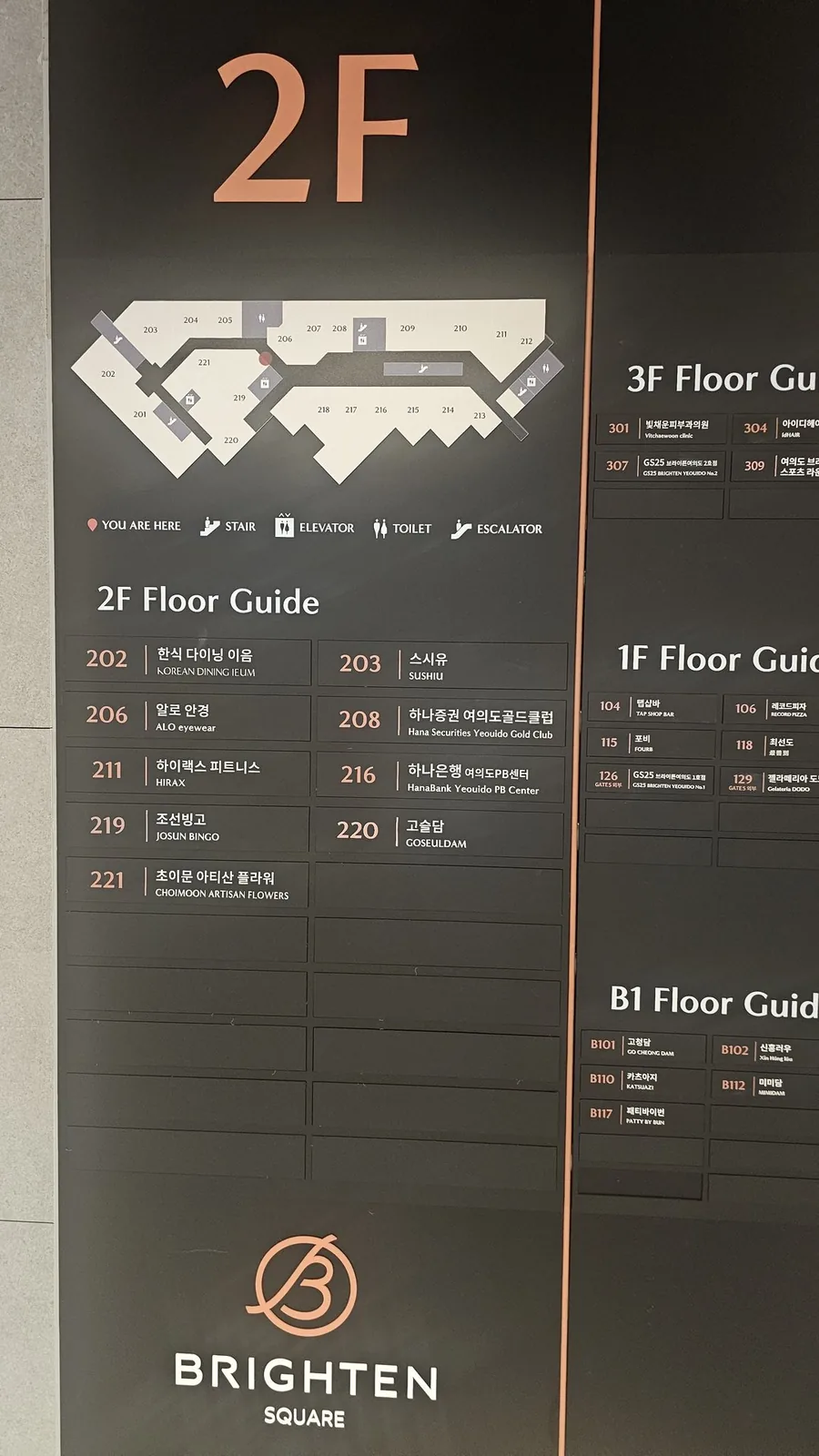
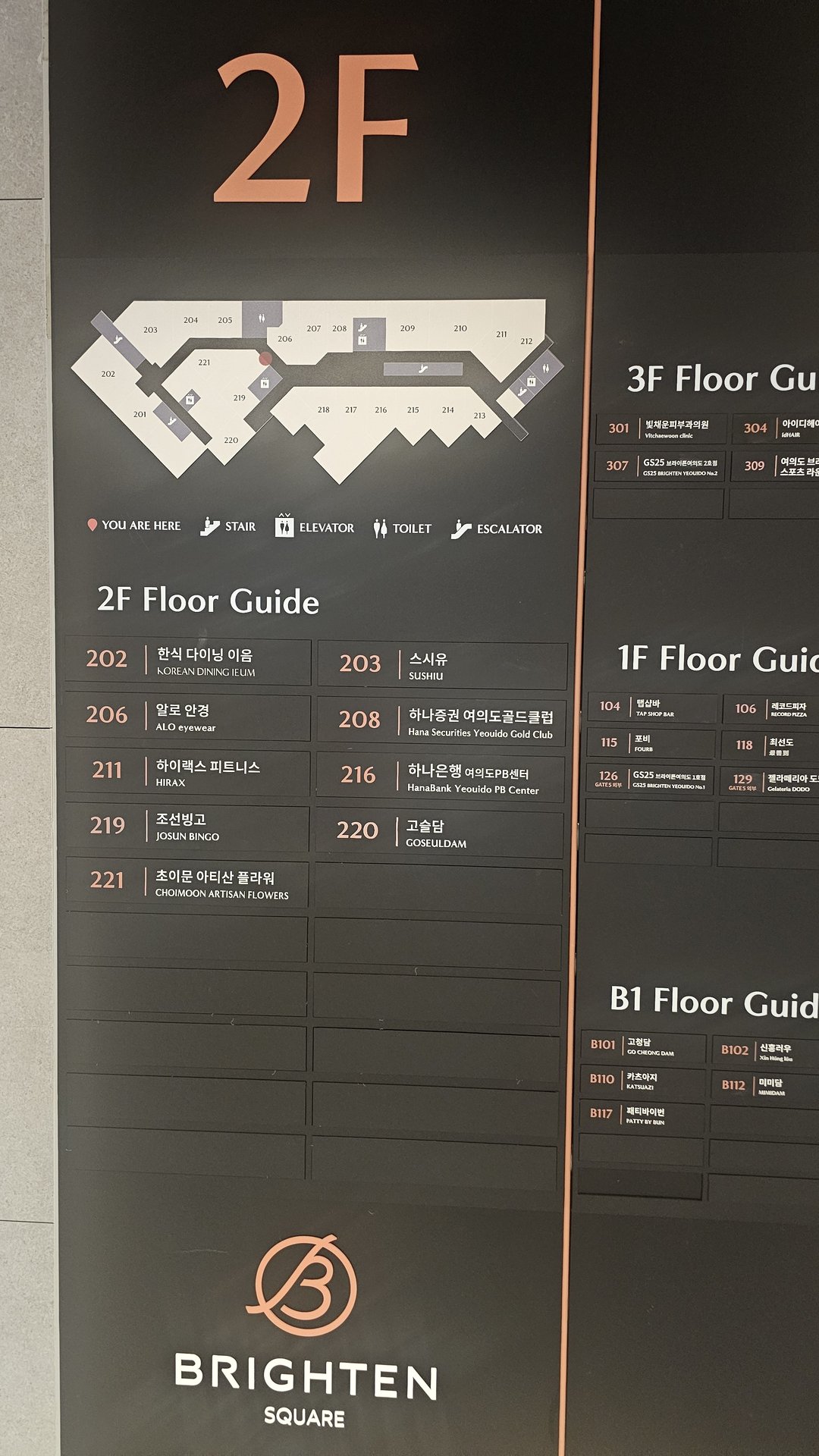
    Brighton Square Yeouido 2F directory board showing Sushi Yu at room 203
    Brighton Square Yeouido 2F directory board showing Sushi Yu at room 203

    It’s on the 2nd floor of Brighton Square Yeouido, Room 203. Yeouido is Seoul’s financial district — comparable to Wall Street or Canary Wharf. Home to the Korean parliament (여의도 국회의사당), KBS and SBS broadcasting headquarters, and a lot of corporate offices. Lunch culture here leans toward places that can handle a business crowd. Sushi Yu fits right in.

    The SBS Recognition

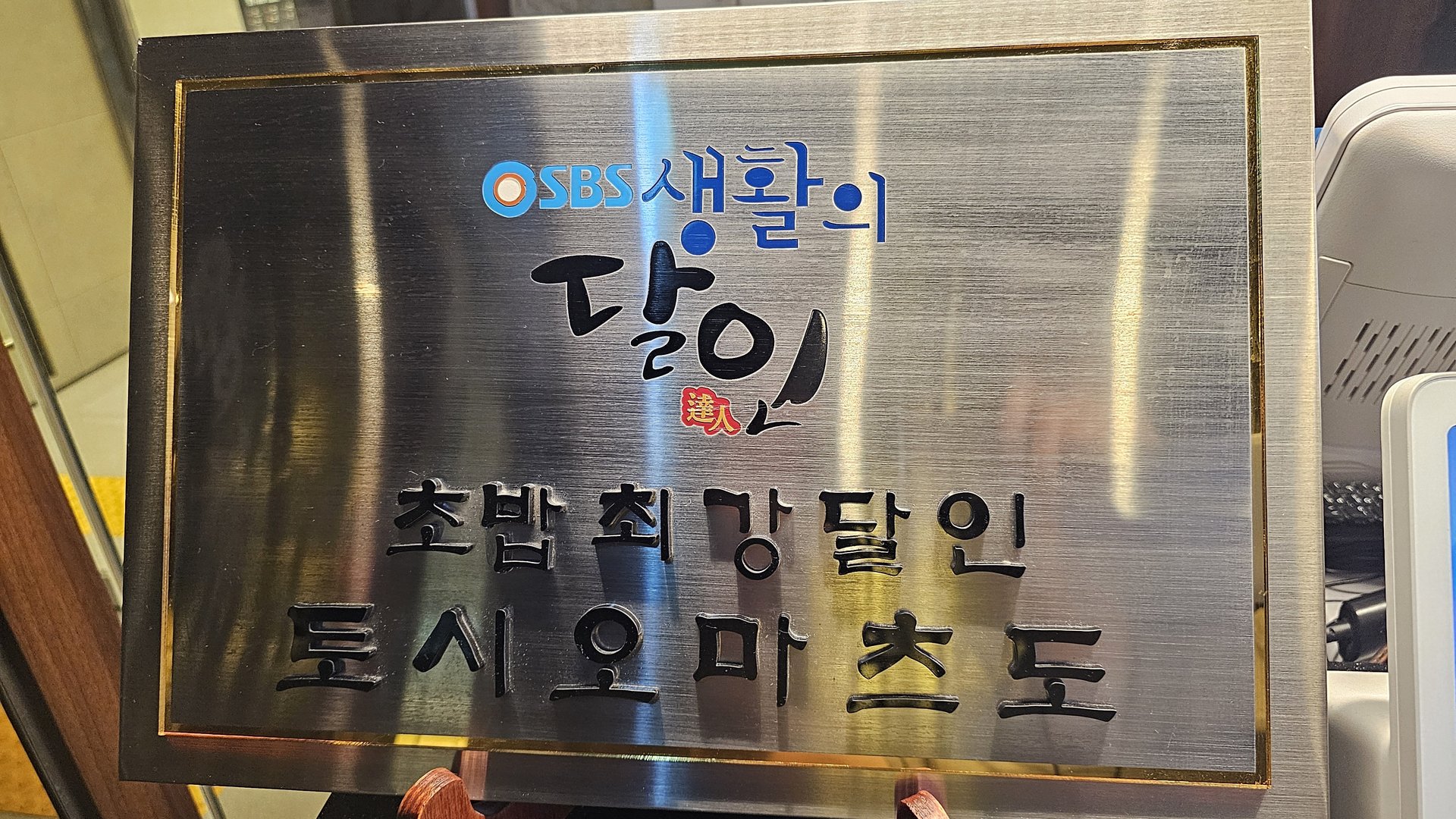
    SBS Masters of Living certified bronze plaque at Sushi Yu Yeouido entrance recognizing chef Toshio Matsudo
    SBS Masters of Living certified bronze plaque at Sushi Yu Yeouido entrance recognizing chef Toshio Matsudo

    At the entrance, there’s a bronze plaque from *SBS 생활의 달인* — a Korean TV show called “Masters of Living” that tracks down people who’ve genuinely mastered a craft. The plaque recognizes chef Toshio Matsudo as a sushi master.

    This matters. *생활의 달인* doesn’t do paid placements — it’s a production team that seeks out craft excellence and puts it on national TV. Getting featured means the chef was evaluated on actual technique. So the credentials at the door aren’t decorative.

    Getting There

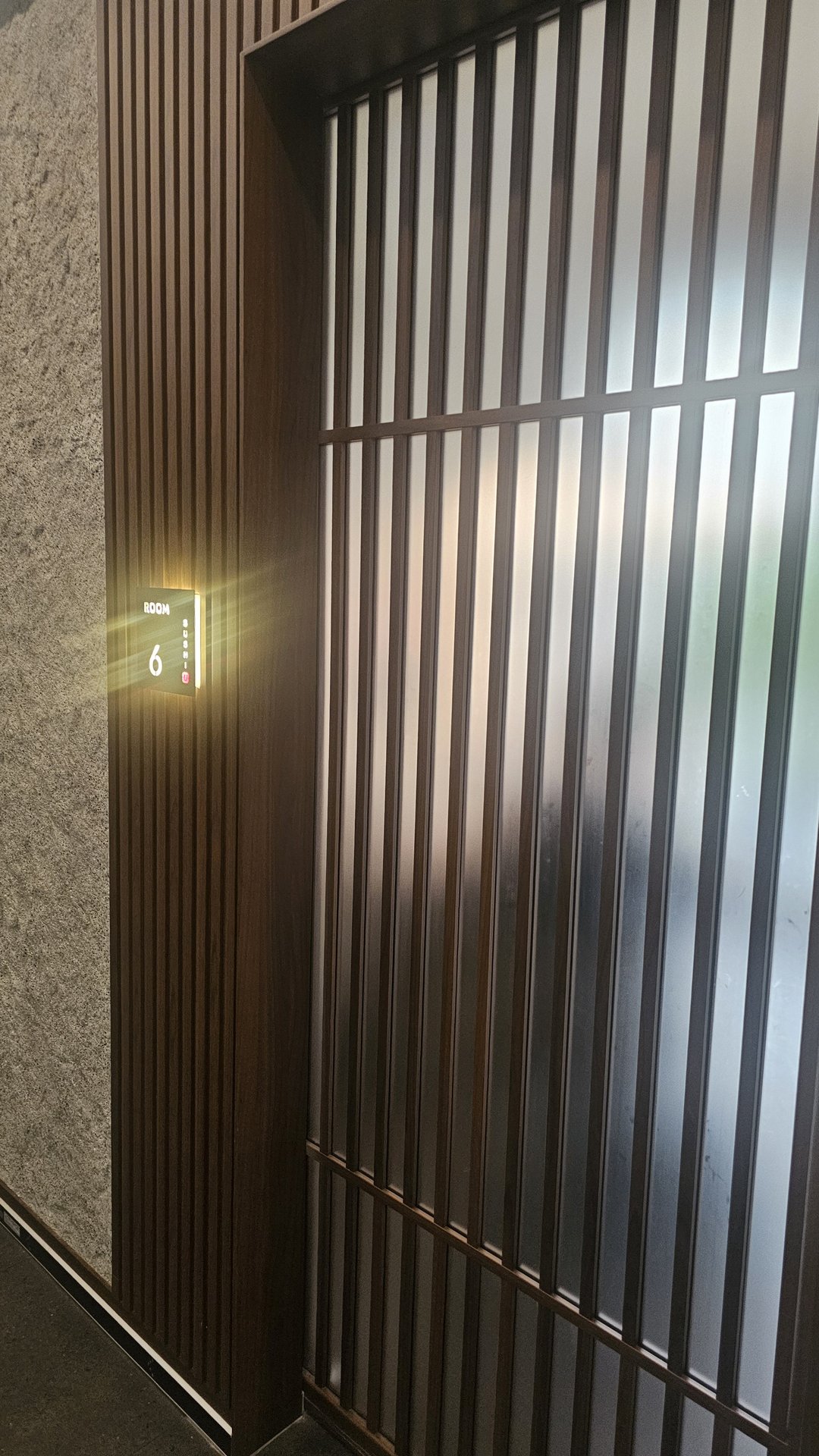
    Sushi Yu restaurant entrance with dark wood louver panel exterior at Brighton Square Yeouido
    Sushi Yu restaurant entrance with dark wood louver panel exterior at Brighton Square Yeouido

    Address: Brighton Square Yeouido, 2F, Room 203 (브라이튼스퀘어 여의도 203호)

    Subway:

    – Yeouido Station (여의도역) — Line 5 or Line 9 — about a 5–7 minute walk

    – IFC Seoul complex is nearby if you’re coming from that direction

    From Incheon Airport: Around 50–60 minutes. Take the AREX to Gimpo Airport Station, transfer to Line 9, ride to Yeouido Station. Straightforward.

    From Myeongdong or Hongdae: 20–30 minutes by subway.

    Parking is available in the Brighton Square building basement. If you’re taking a taxi, show the driver this: 여의도 브라이튼스퀘어 203호.

    The Interior

    The exterior is sharp — dark wood louver panels, illuminated signage with Japanese and Korean characters. It looks like it belongs in a boutique hotel rather than a commercial building.

    Inside: refined without being uptight. Dark tones, clean sightlines, proper tableware. The logo table mat is a detail that tells you the restaurant takes presentation seriously. Nothing over-designed. Just done right.

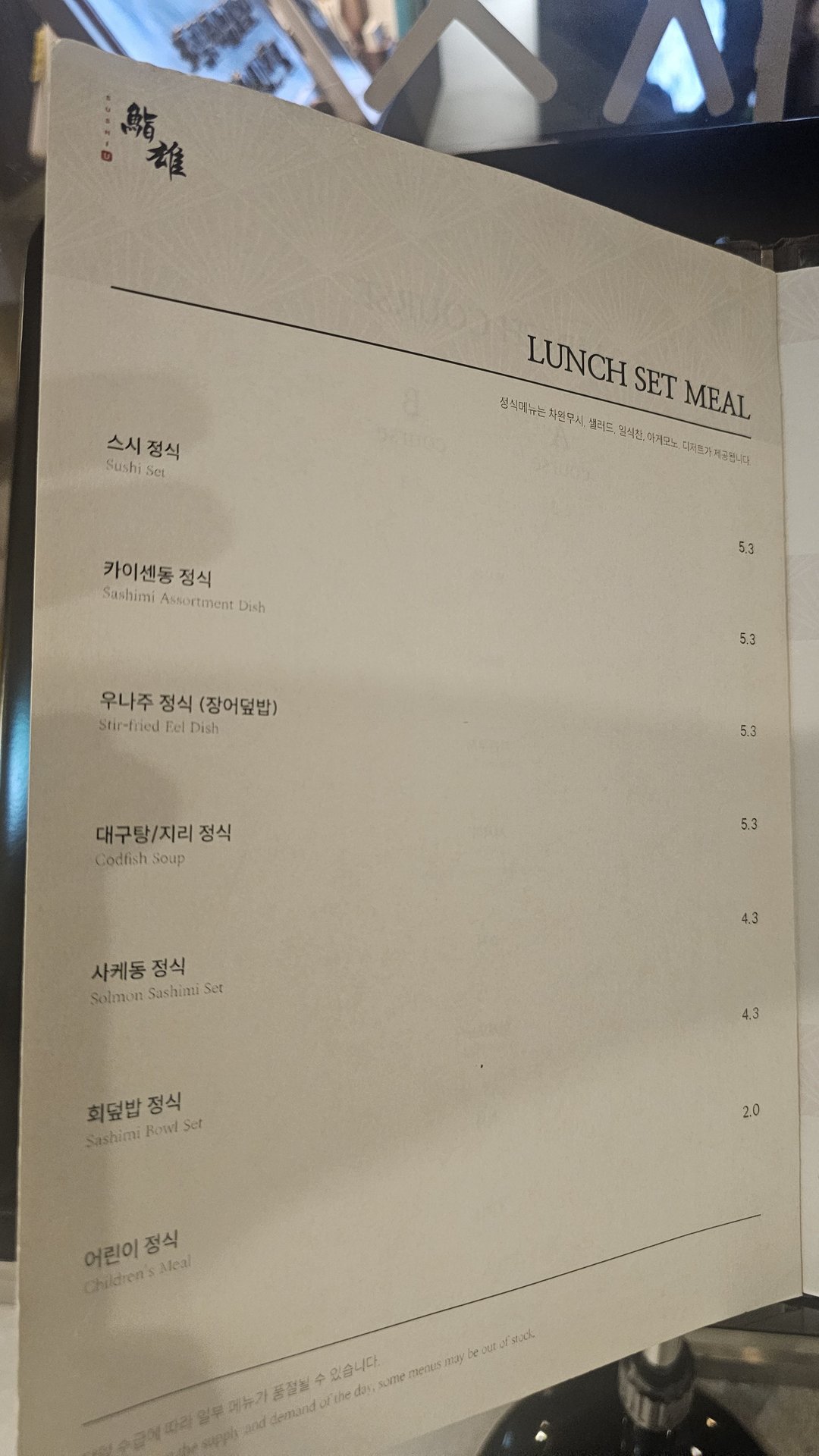
    The Menu

    Sushi Yu lunch set menu board showing kaisendon, sushi jeongshik, unaju, and prices in Korean won
    Sushi Yu lunch set menu board showing kaisendon, sushi jeongshik, unaju, and prices in Korean won

    Lunch sets range from about 20,000 to 53,000 KRW (~$15–$39 USD). Main options:

    – Sushi Jeongshik (스시 정식) — nigiri sushi platter set

    – Kaisendon Jeongshik (카이세동 정식) — kaisen sashimi rice bowl set

    – Unaju Jeongshik (우나주 정식) — grilled eel rice in lacquer box set

    – Hoe-deop-bap (회덮밥) — marinated sashimi over mixed rice

    – Sake-don (사케동) — salmon rice bowl

    – Daegu-tang (대구탕) — cod soup set

    – Kids set (어린이 정식)

    Each set comes with miso soup, pickled ginger, and a starter salad. Our group of four spread across the kaisendon, sushi set, unaju, and a shared tempura side.

    What We Ordered

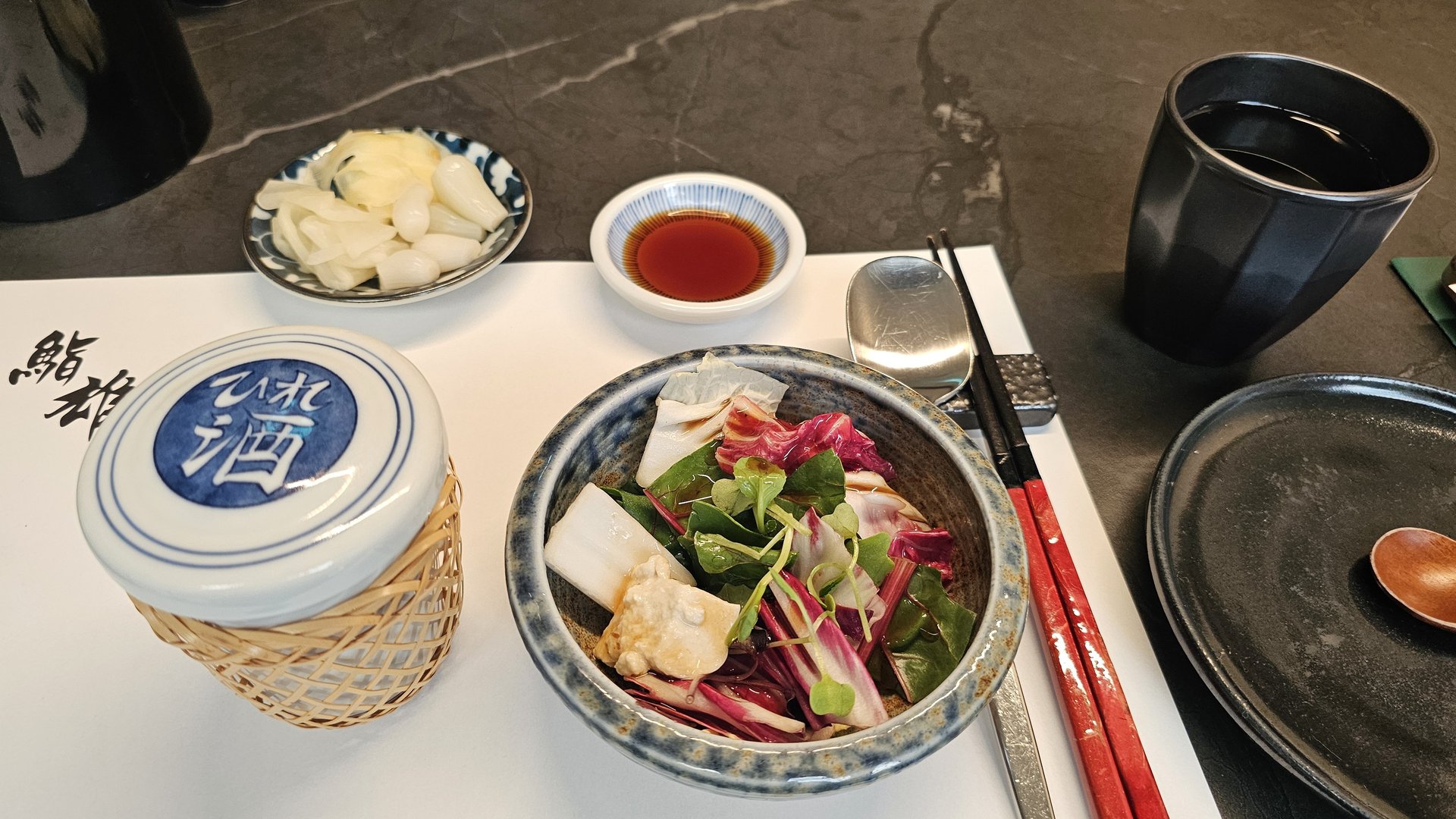
    Starter Salad

    Starter salad with seafood and vegetables at Sushi Yu, served alongside pickled ginger, soy sauce, and green tea on a logo table mat
    Starter salad with seafood and vegetables at Sushi Yu, served alongside pickled ginger, soy sauce, and green tea on a logo table mat

    Each set opens with a small seafood and vegetable salad. Nicely plated — pickled ginger on the side, green tea already poured, soy sauce set out. It’s not the reason you’re here, but it’s a proper opener and the presentation is clean.

    Fine. Does its job.

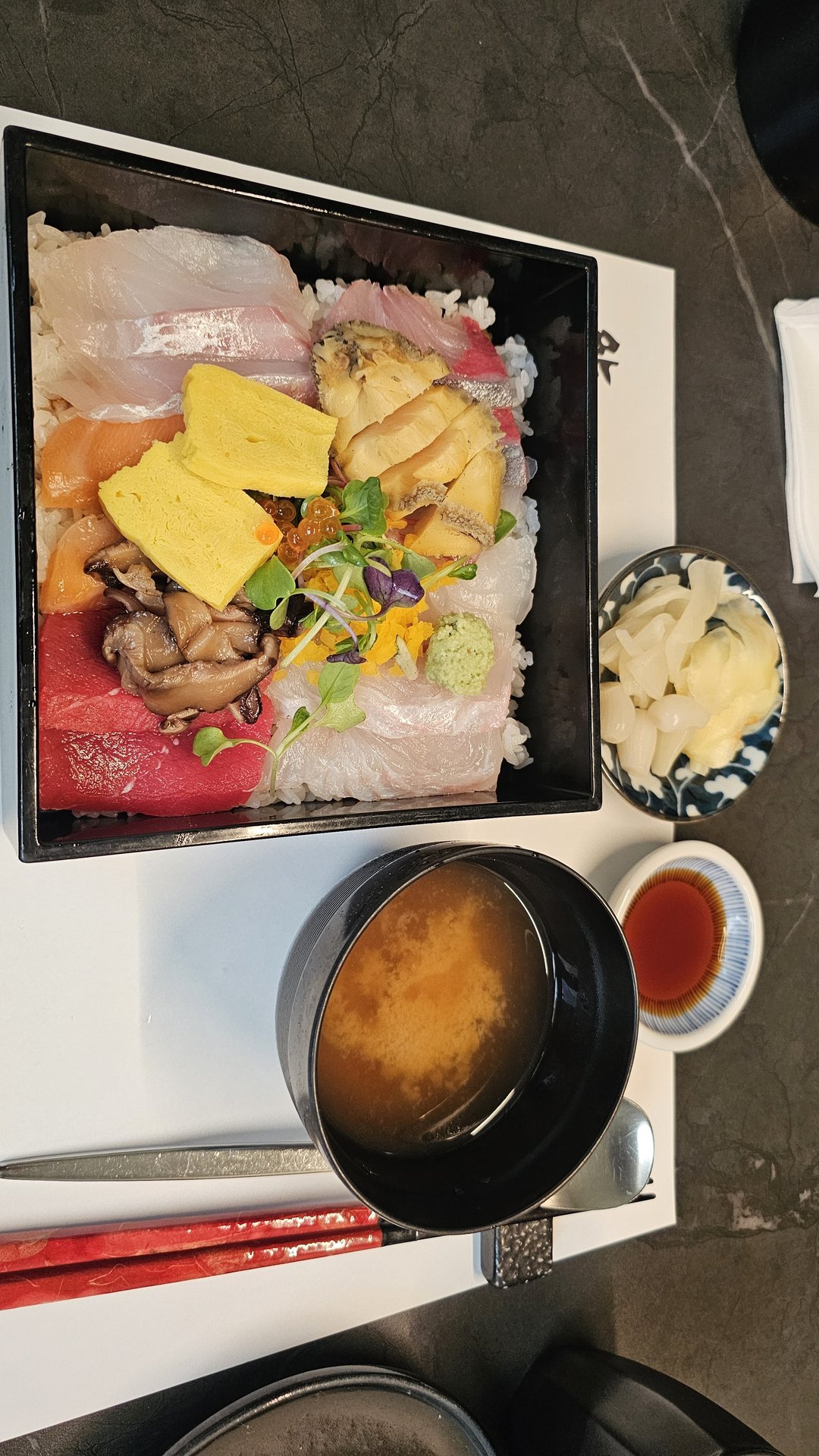
    Kaisendon Jeongshik

    Kaisendon set at Sushi Yu Yeouido — sashimi rice bowl topped with tuna, salmon, flatfish, uni, ikura, and tamagoyaki with miso soup
    Kaisendon set at Sushi Yu Yeouido — sashimi rice bowl topped with tuna, salmon, flatfish, uni, ikura, and tamagoyaki with miso soup

    Kaisendon (kaisen-don) is a Japanese seafood sashimi rice bowl — different cuts of sashimi layered over seasoned sushi rice. Sushi Yu’s version comes loaded: tuna, salmon, flatfish (광어/hirame), sea urchin (uni/성게), salmon roe (ikura/이크라), rolled egg (tamagoyaki), and mushrooms.

    The uni is what justifies the price point. Fresh sea urchin on a kaisendon in this range isn’t always a given — at cheaper places you either don’t get it or it’s past its prime. Here it was present and it was good.

    Sushi rice underneath is properly seasoned. Set includes miso soup.

    If you want everything in one bowl, order this.

    Sushi Jeongshik — 12-Piece Nigiri

    12-piece nigiri sushi platter at Sushi Yu Yeouido featuring tuna, salmon, uni, yellowtail, and anago
    12-piece nigiri sushi platter at Sushi Yu Yeouido featuring tuna, salmon, uni, yellowtail, and anago

    Twelve pieces of nigiri: tuna, salmon, flatfish, shrimp, yellowtail (방어/buri), sea urchin, and anago (saltwater eel). The platter looks exactly like what a proper sushi set should look like.

    Each piece is hand-formed — you can tell by the shape and the way the rice holds together. The shari (sushi rice) has good texture: slightly firm, properly vinegared. Fish quality is consistent across the board.

    Best pieces: uni, anago, yellowtail. The shrimp is fine but the least interesting item on the plate. Skip obsessing over it and just eat the eel first.

    Unaju Jeongshik

    Unaju set at Sushi Yu — thick glazed grilled eel over rice in a lacquer jubako box with miso soup
    Unaju set at Sushi Yu — thick glazed grilled eel over rice in a lacquer jubako box with miso soup

    Unaju is grilled freshwater eel (unagi/장어) over rice, served in a jubako — a lacquer box that’s kind of the Japanese equivalent of a bento box but fancier. The eel is glazed with tare sauce and grilled until caramelized on the outside.

    Okay, here’s the thing about unaju in Seoul: a lot of places get it wrong. Either the eel is undercooked and soft in a bad way, or the sauce is too sweet and cloying. Sushi Yu’s version uses thick cuts, proper caramelization on the glaze, and the sauce is balanced — not a sugar bomb.

    This is probably toward the higher end of the menu price-wise (closer to 45,000–53,000 KRW / ~$33–$39), but if eel is your thing, this is the version to order.

    Tempura

    Shrimp and asparagus tempura with tsuyu dipping sauce at Sushi Yu Yeouido
    Shrimp and asparagus tempura with tsuyu dipping sauce at Sushi Yu Yeouido

    Shrimp and asparagus tempura, served with tsuyu dipping sauce.

    The batter is light — airy rather than thick and greasy. Shrimp stays juicy inside. Asparagus is a solid choice for tempura; it holds up to heat better than most vegetables and gives you something different from all the raw fish. Good shared side for the table.

    Stuff Tourists Should Know

    English menu? The menu is in Korean and Japanese. Menu boards have photos — pointing works. Translation apps handle the rest without issue. Staff English is limited.

    Card payment? Cards accepted. Foreign Visa/Mastercard should work, but having a small amount of cash on hand doesn’t hurt.

    Tipping? No. Korea has no tipping culture. Don’t leave extra money on the table — it can actually cause awkwardness.

    Vegetarian options? Limited. This is a seafood-focused restaurant. Vegetable tempura might be available — confirm with staff. Not the right spot if you don’t eat seafood.

    Halal/Kosher? Not certified.

    Kids welcome? Yes — there’s a dedicated kids’ set on the lunch menu. Relaxed atmosphere during lunch hours.

    Solo dining? Should be fine for the counter or smaller tables.

    Date spot? Yes. Interior quality and food level make it work for a nicer lunch.

    Reservations? Recommended for groups of 3 or more. Yeouido has a big lunch crowd on weekdays — don’t assume walk-in availability.

    The Verdict

    Should you go?

    Depends on what you’re doing in Seoul.

    – If you’re in Yeouido for business or just passing through the area — yes, this is one of the better lunch options around. Get the unaju or the sushi set.

    – If you only have 3–4 days in Seoul and haven’t eaten Korean food yet — hold off. Do Korean BBQ, bibimbap, or samgyetang first. Come back to Japanese on a longer visit.

    – If you’re a sushi person and want to benchmark Seoul’s Japanese food scene — yes, Sushi Yu is worth it. The SBS recognition isn’t decorative.

    – If budget is a concern — it’s not cheap. Lunch runs 35,000–50,000 KRW per person (~$26–$37). Worth it, but not a casual drop-in.

    Four people, four different sets, all good. No weak links across the table. The food matched the credentials on the wall.

    FAQ

    Where exactly is Sushi Yu in Yeouido?

    It’s on the 2nd floor of Brighton Square Yeouido, Room 203. The nearest subway is Yeouido Station (Line 5 or Line 9), about a 5–7 minute walk.

    How much does lunch cost at Sushi Yu Yeouido?

    Lunch sets range from about 20,000 to 53,000 KRW (~$15–$39 USD) per person. Budget around 35,000–50,000 KRW for a solid set with nigiri, kaisendon, or unaju.

    Do I need a reservation at Sushi Yu?

    Recommended for groups of 3 or more. Walk-ins for 1–2 people may work on weekdays, but it’s a popular lunch spot in Yeouido so don’t count on it.

    Is there an English menu at Sushi Yu?

    The menu is in Korean and Japanese. Some menu boards have photos — point and order works fine. Translation apps handle the rest. Staff English is limited.

    Is Sushi Yu good for families or kids?

    Yes — there’s a kids’ set on the lunch menu, and the vibe is relaxed enough for a family meal during lunch hours.

    What is the SBS 생활의 달인 recognition at Sushi Yu?

    It’s a certification from SBS “Masters of Living,” a Korean TV show that features artisans who’ve mastered their craft. The plaque recognizes chef Toshio Matsudo as a sushi master — it’s editorial recognition, not advertising.

    You might also like

    📍 Location

    Open in Google Maps →

  • Shinhee Sushi in Yeouido: Honest Review of the Lunch Set

    Shinhee Sushi in Yeouido: Honest Review of the Lunch Set

    🇯🇵 日本語版はこちら

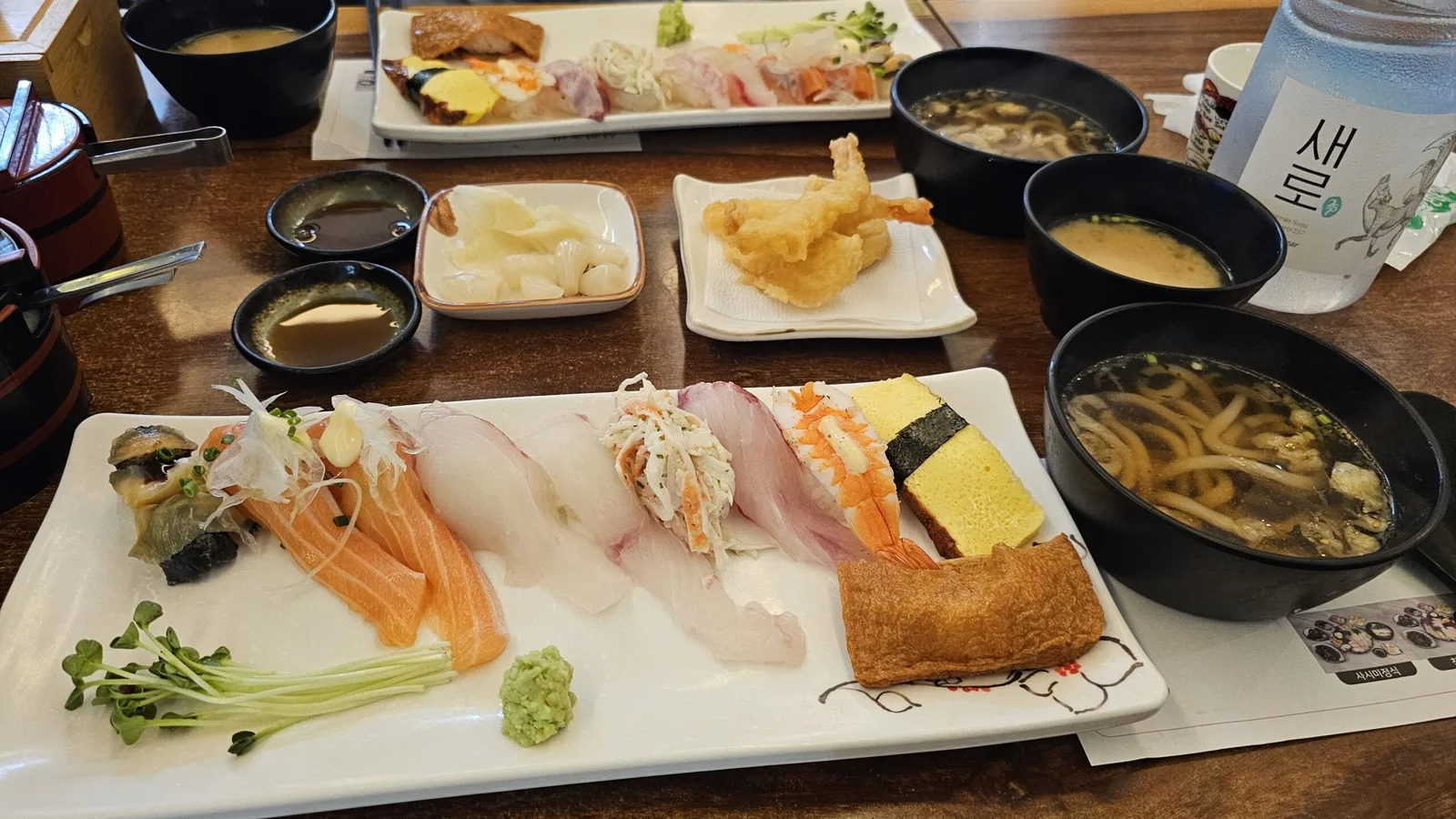
    Quick honest review of Shinhee Sushi (신희초밥) in Yeouido. Skip to the verdict if you’re in a hurry, but the short version: 14,000 KRW (~$10 USD) per person for 10 sushi pieces, shrimp tempura, and udon. That’s not a typo. It’s one of the better lunch deals in Seoul’s financial district right now.

    Went on a Tuesday with two people. No reservation. Walked right in.

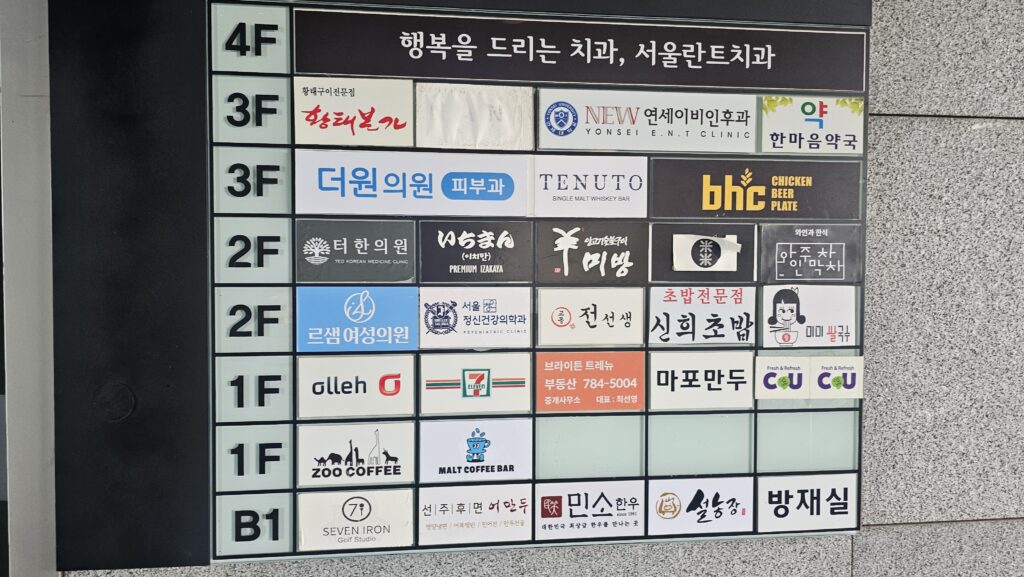
    Floor directory showing Shinhee Sushi on the second floor of a Yeouido building

    What Is a Korean Sushi Lunch Set?

    Quick context if you’ve never seen this format before.

    Korean sushi restaurants (초밥집) commonly run fixed-price lunch sets — you pay one price and get a set number of sushi pieces plus sides like miso soup, udon, or tempura. It’s the Korean version of Japan’s teishoku lunch format, but often priced more aggressively because you’re competing with nearby kimbap joints and bibimbap spots for the noon crowd.

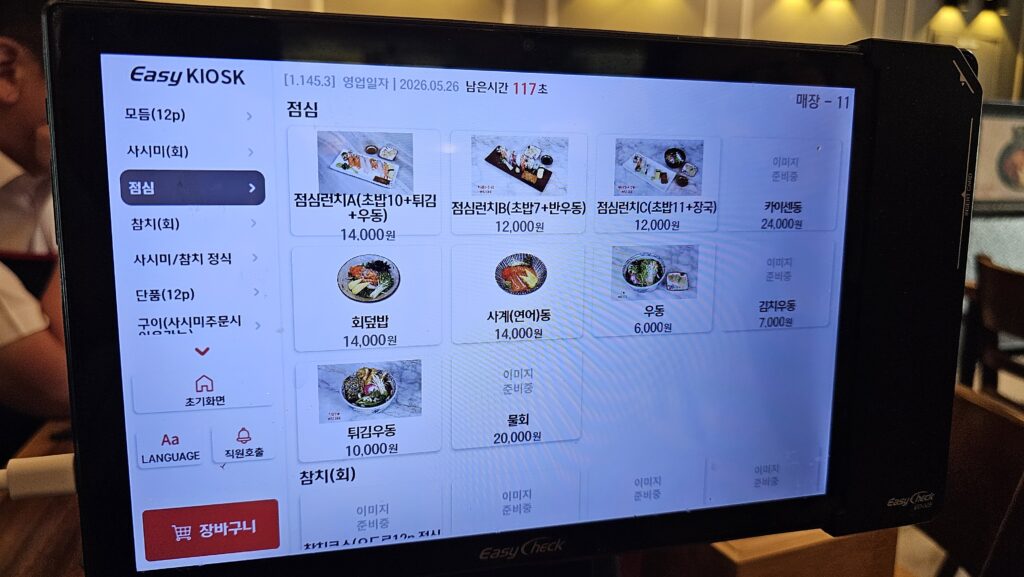
    Shinhee Sushi runs three lunch sets. Lunch Set A (점심런치A) is the one everyone orders: 10 sushi pieces + shrimp tempura + udon. 14,000 KRW (~$10 USD). That’s the move.

    About the Place

    Shinhee Sushi is a local, non-chain sushi restaurant that’s been in Yeouido a while. Not the trendy omakase-with-a-waitlist type. Not the conveyor belt type either. Just a solid sit-down sushi spot that happens to be in Seoul’s financial district, roughly equivalent to London’s Canary Wharf or New York’s Wall Street.

    The full menu is actually broader than the lunch crowd suggests — premium tuna courses, sashimi platters, kaisen-don (seafood rice bowls), live fish options, and individual nigiri. But if you show up at noon, almost every table is ordering the lunch set.

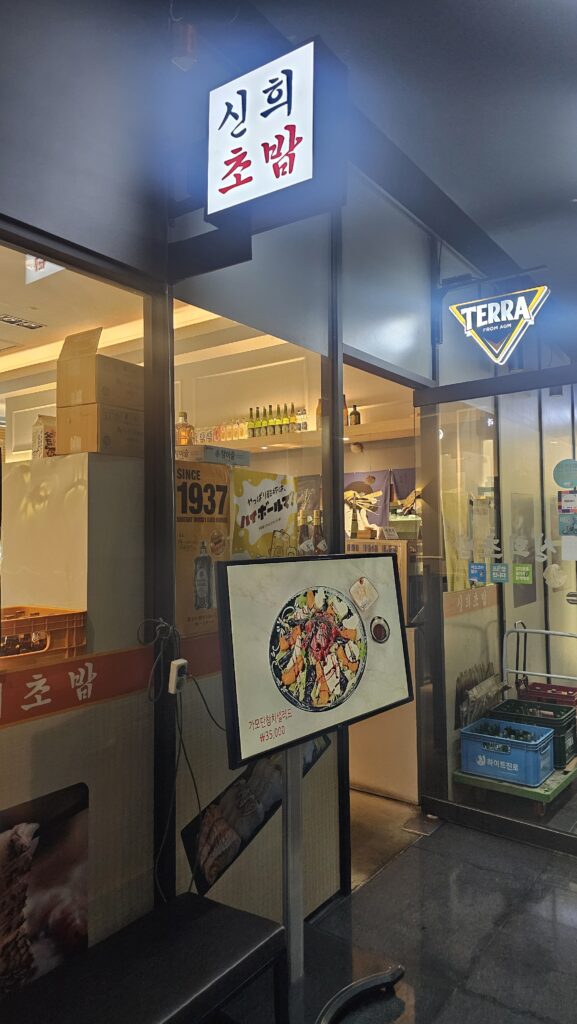
    Shinhee Sushi restaurant entrance in Yeouido with signage glass doors and menu display board

    Getting There

    Shinhee Sushi is on the 2nd floor of a building in Yeouido. The floor directory at the elevator will have 신희초밥 listed on 2F — that’s how you find it.

    Nearest subway: Yeouido Station (Line 5 or Line 9). About a 5-10 minute walk depending on which exit.

    From Incheon Airport: Roughly 45-50 minutes by subway (AREX to Hongik University Station, transfer to Line 2 toward Yeoinaru, or take Line 9 directly to Yeouido). Not a destination you’d cross Seoul for specifically, but very convenient if you’re already in the area.

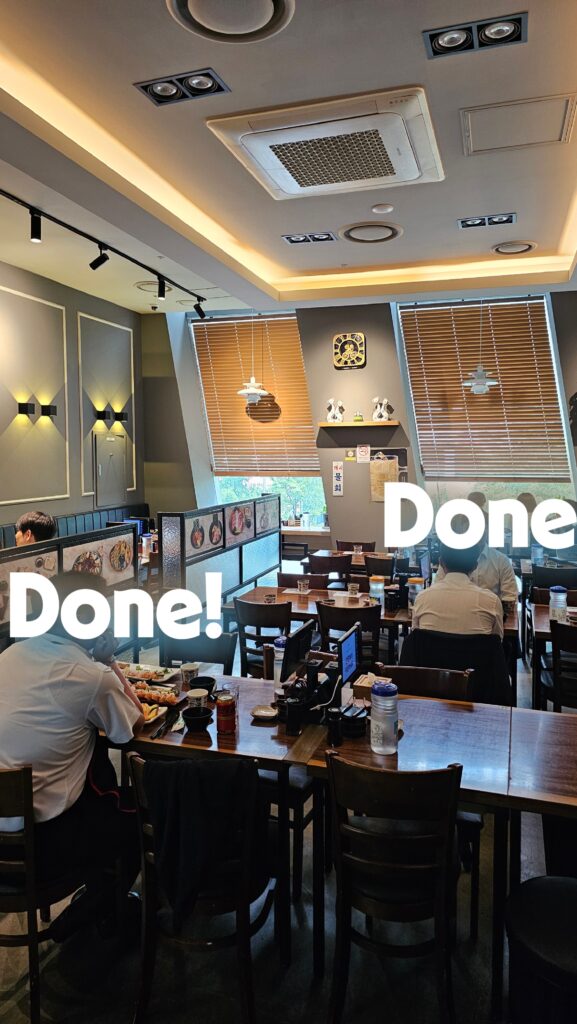
    Interior of Shinhee Sushi Yeouido with wooden tables bamboo blinds and seated lunch crowd

    The Interior

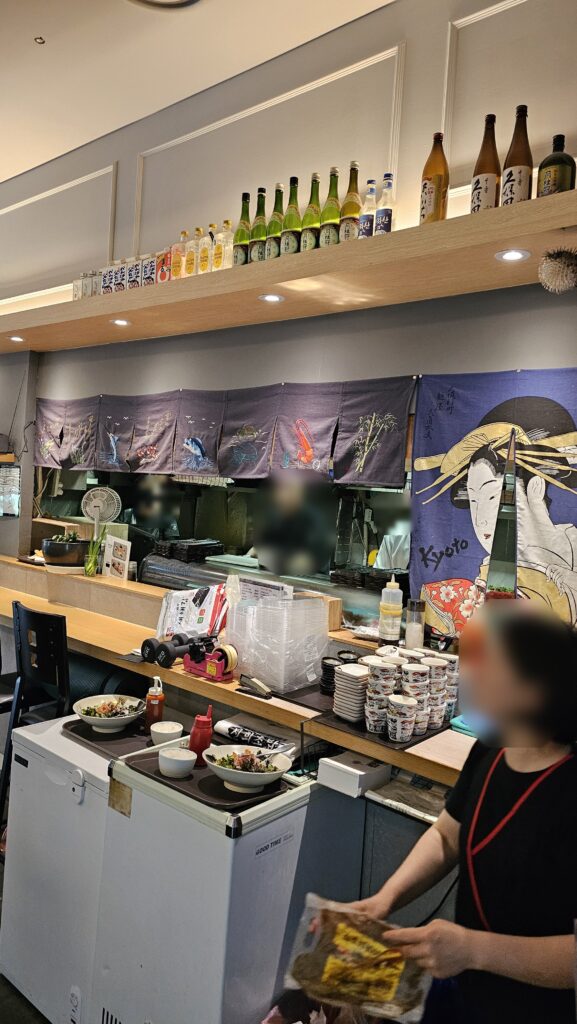
    Open sushi kitchen and bar counter at Shinhee Sushi with noren curtains and sake bottles

    Cleaner and more put-together than the lunch price suggests. Wooden tables and chairs, bamboo blind windows, noren curtains (the fabric dividers you see in Japanese restaurants) hanging over the open kitchen. You can watch the sushi chef work from your seat.

    Not fancy. No mood lighting, no elaborate presentation. But it’s a proper sit-down restaurant with a legitimate kitchen, not a grab-and-go counter. When we got there at lunchtime the place was already well-filled with office workers — this is a neighborhood regular spot, not a tourist trap.

    The Ordering System

    Kiosk ordering. Touch screen, self-service.

    Kiosk touch screen lunch menu at Shinhee Sushi showing Lunch Set A 14000 KRW with sushi tempura udon

    The kiosk is in Korean only. That’s the main friction point for non-Korean speakers. No English on screen. That said, the menu photos are clear enough to navigate by sight, or just type 점심런치A on your phone and show it to a staff member — they’ll sort you out.

    What I Ordered

    Lunch Set A — 14,000 KRW (~$10 USD) per person

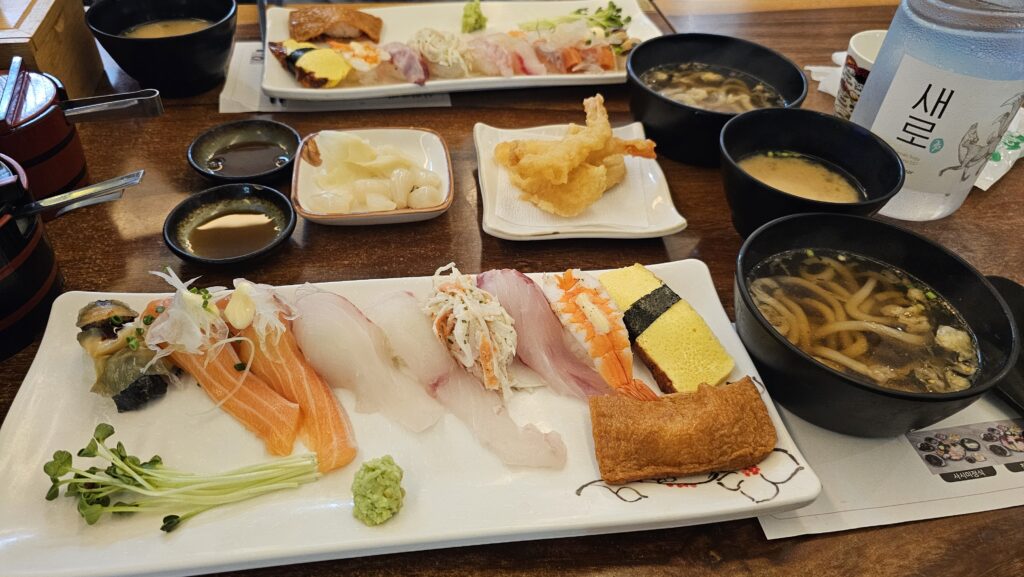
    Full table setting for two at Shinhee Sushi Yeouido with two sushi platters tempura udon and miso soup

    Here’s what landed on the table:

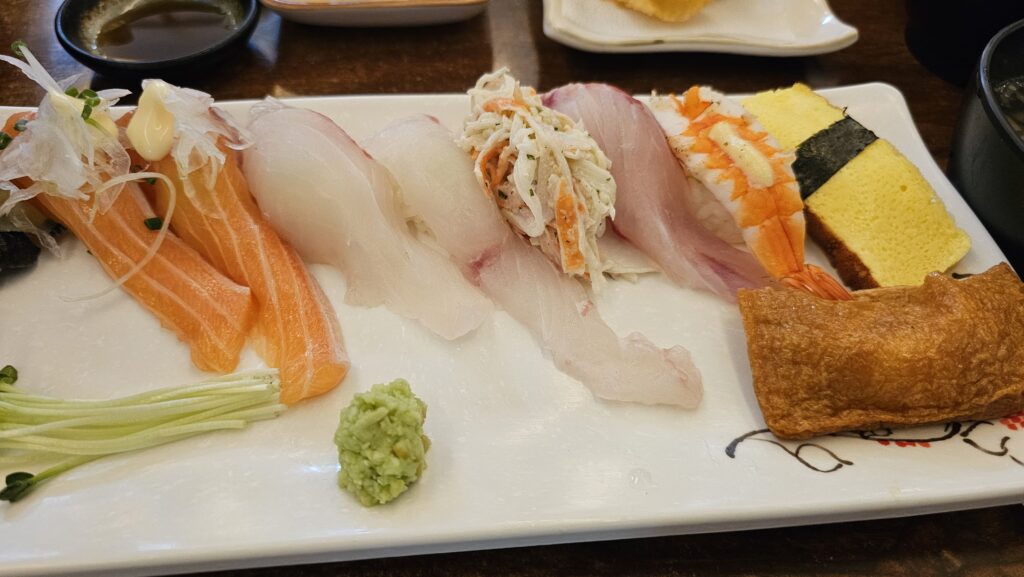
    The sushi plate: 10 pieces. Salmon, flounder (광어), squid, crab stick, yellowtail (방어), shrimp, tamagoyaki (sweetened egg), and inari (seasoned tofu pouch). Served on a white rectangular plate with wasabi and microgreens on the side.

    Close-up of Lunch Set A 10-piece sushi at Shinhee Sushi Yeouido with wasabi and microgreens

    For 14,000 KRW, this is good. The rice was served at the right temperature — slightly warm, the correct way. Salmon was fresh. Yellowtail was the best piece on the plate, noticeably better than the rest. Tamagoyaki and inari are filler pieces, but decent filler.

    Nothing here is going to rearrange your understanding of sushi. But nothing was bad. At this price point, that’s the win.

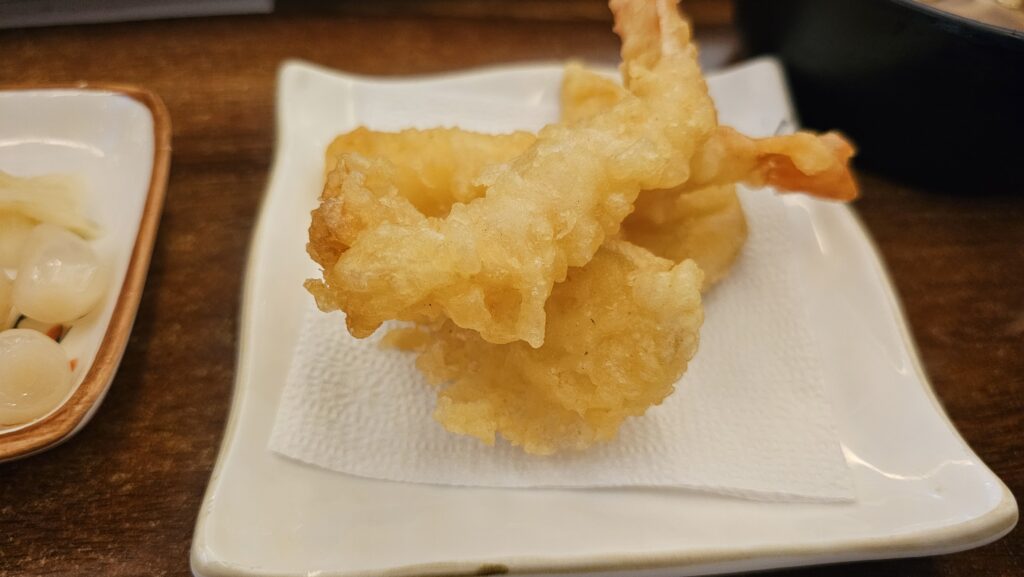
    Shrimp tempura (에비텐푸라): Two pieces, properly fried. Crispy coating, not greasy.

    Crispy shrimp tempura ebi-tempura on white plate at Shinhee Sushi Yeouido lunch set

    Udon: Standard. Mild broth, chewy noodles. It’s there to round out the meal, and it does that job fine.

    You also get miso soup, a small clam side dish, and water. Full table spread for two came to 28,000 KRW (~$21 USD). That’s $10.50 per person for a complete sushi lunch. In central Seoul.

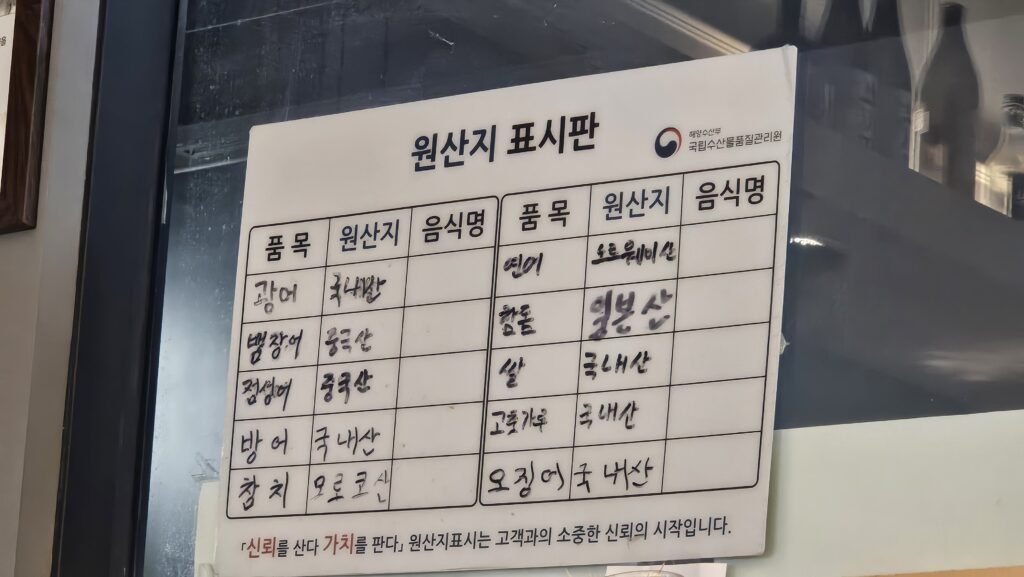
    Fish Origins

    Fish origin information board at Shinhee Sushi showing Norwegian salmon domestic flounder and Moroccan tuna

    Korean restaurants are legally required to post ingredient origins. Quick breakdown at Shinhee Sushi:

    – Salmon: Norway

    – Flounder, yellowtail, squid: Korea (domestic)

    – Tuna: Morocco

    – Eel: China

    Norwegian salmon is the standard across Korea — same fish you’d find at most sushi restaurants here. Moroccan tuna is also common in mid-range Korean sushi spots. Nothing unusual.

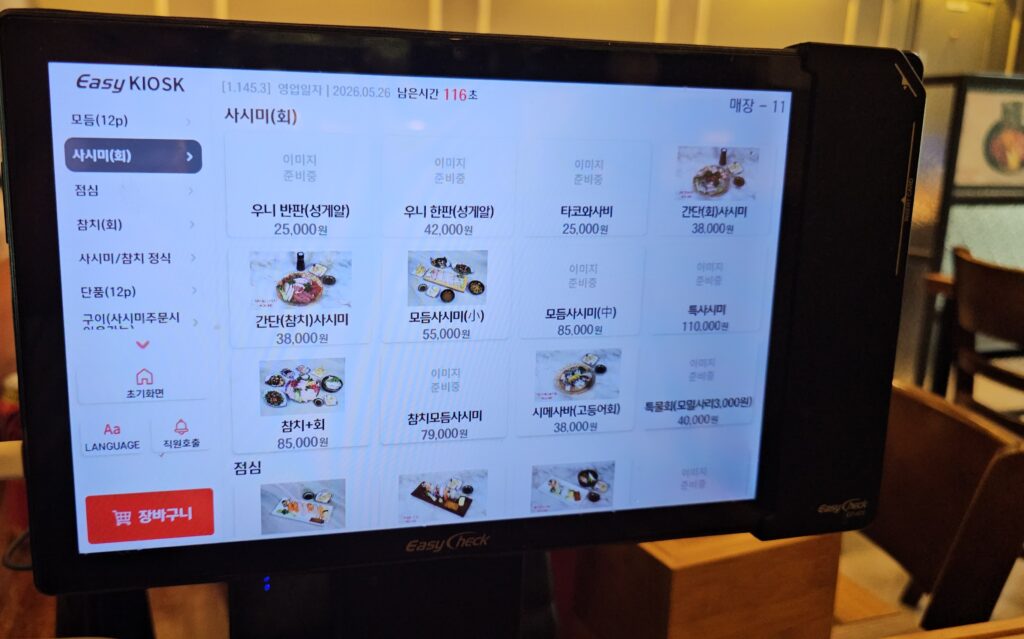
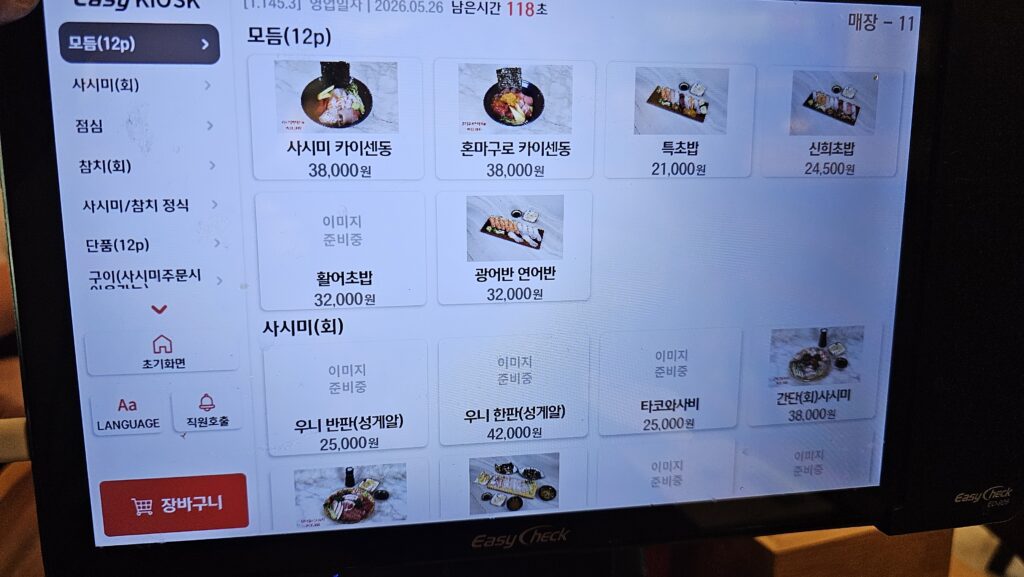
    More Menu Options

    In case you want something other than the lunch set:

    Kiosk sashimi menu at Shinhee Sushi Yeouido showing uni and assorted sashimi prices
    Kiosk assorted 12-piece sushi menu at Shinhee Sushi including kaisen-don 38000 KRW

    Kiosk premium tuna menu at Shinhee Sushi with hon-maguro bluefin tuna course options

    They run premium tuna courses (혼마구로 = bluefin tuna), sashimi sets starting around 25,000 KRW (~$18 USD), kaisen-don (seafood over rice) at 38,000 KRW (~$28 USD), and individual nigiri pieces if you want to build your own plate.

    Honestly, if you’re here at lunch, just get the set. The premium stuff exists for dinner and special occasions.

    Stuff Tourists Should Know

    English menu: The kiosk is Korean-only. Show staff 점심런치A on your phone for Lunch Set A. Staff may have limited English but will understand what you’re pointing at.

    Payment: Cards accepted. Foreign Visa and Mastercard should work fine at Korean restaurants.

    Tipping: No tipping in Korea. Seriously, don’t do it — it’ll create awkward confusion.

    Reservations: Probably not needed for lunch, but aim to arrive before 12:30 PM. The place fills up with office workers and wait times get longer after that.

    Vegetarian options: Minimal. The lunch set is entirely fish-based. If you avoid all seafood, this isn’t your spot.

    Group size: Comfortable for 2-4 people. Fine for solo dining too — plenty of people eat here alone.

    Kids: Should be fine if your kids eat sushi. No particularly child-hostile setup.

    The Verdict

    Should you go?

    If you’re in Yeouido at lunchtime — yes. This is the call.

    14,000 KRW for a 10-piece sushi set with tempura and udon is genuinely good value. The sushi isn’t life-changing, but it’s fresh, properly made, and better than what you’d get at a convenience store for half the price.

    – You’re in Yeouido for work or as part of a Seoul itinerary — yes, eat here. It’s quick, good, and cheap.

    – You only have 3 days in Seoul — maybe skip. Eat Korean BBQ, sundubu-jjigae, or naengmyeon first. Come back to sushi on a longer trip.

    – You want to eat exactly how Seoul office workers eat on a Tuesday — 100% yes, this is that experience.

    – You want a proper omakase or high-end sushi — wrong place. Head to Gangnam for that.

    Would I go back? Yeah. Already planning to.

    FAQ

    Where is Shinhee Sushi in Yeouido?

    It’s on the 2nd floor of a building in Yeouido — look for the floor directory at the elevator. Listed as 신희초밥 on 2F.

    Is there an English menu?

    The kiosk is Korean-only. Type 점심런치A on your phone and show it to staff — that’s Lunch Set A, the one to order.

    What’s included in Lunch Set A?

    10 mixed sushi pieces, shrimp tempura, udon, miso soup, and a clam side dish. 14,000 KRW (~$10 USD) per person.

    Do they take credit cards?

    Yes. Foreign Visa and Mastercard work fine.

    Is tipping expected?

    No. Korea doesn’t have a tipping culture. Don’t tip.

    Do I need a reservation for lunch?

    Not really, but get there before 12:30 PM. It gets packed.

    Is the fish fresh?

    They post origin info on the board — Norwegian salmon, domestic flounder and yellowtail, Moroccan tuna. Standard for a mid-range Korean sushi spot. Nothing to worry about.

    You might also like

  • Keebo Rock & Roll Yeouido: Honest Review of This Japanese Yoshoku Spot in Seoul

    Keebo Rock & Roll Yeouido: Honest Review of This Japanese Yoshoku Spot in Seoul

    🇯🇵 日本語版はこちら

    Quick honest review of Keebo Rock & Roll in Yeouido — a Japanese Yoshoku restaurant that’s been getting hyped up in Seoul food circles lately. Skip to the verdict at the bottom if you’re in a hurry, but here’s the short version: pork katsu is genuinely good, fish katsu is fine but forgettable, interior is gorgeous, prices are higher than typical Yeouido lunch.

    I went on a Tuesday around 12:15 PM. No reservation, walked right in.


    Wait, What’s Yoshoku?

    If you’ve never heard the term, Yoshoku (洋食) is basically Japan’s take on Western food from the late 1800s. Stuff like breaded pork cutlets, omelet over rice, hamburger steak with brown sauce. Comfort food, not fine dining.

    Koreans have been obsessed with it for the past few years. There are like five new Yoshoku places opening in Seoul every month. Keebo is one of the better-known ones.


    About Keebo (And Why It Matters)

    Keebo is one of several restaurants run by Chef Nam Joon-young. If you’ve been to Seoul before and eaten at Hyotteu (Vietnamese), Geogeo (Cantonese), or Nambak — same guy. He has a pretty solid track record, which is why people pay attention when he opens something new.

    The Yeouido location is called “Rock & Roll” for some reason. Don’t ask me why, it’s not a music-themed restaurant. Just go with it.


    Getting There

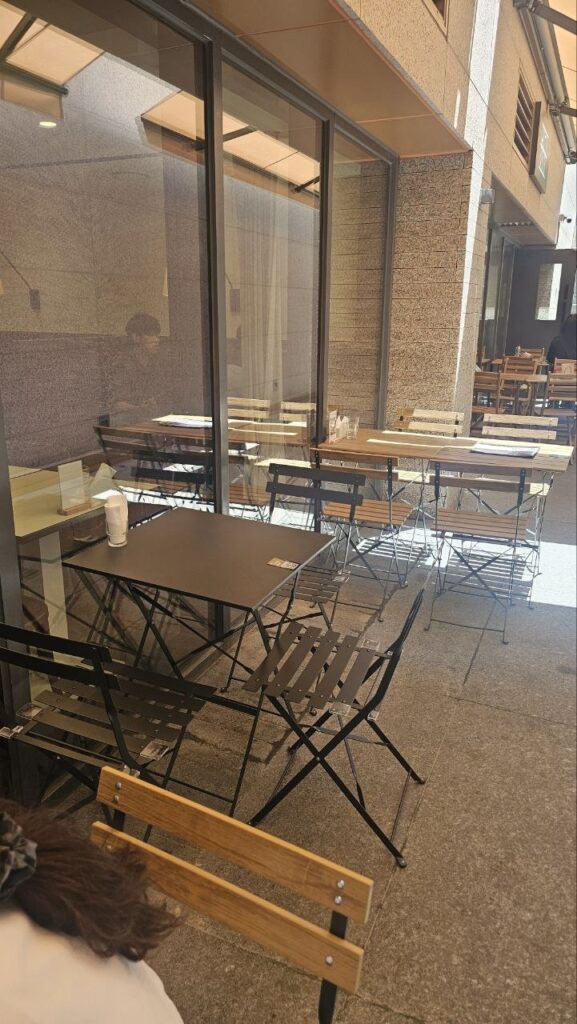
    Keebo Rock and Roll Yeouido exterior view with terrace seating

    It’s in Yeouido, which is basically Seoul’s financial district. Big office buildings, the National Assembly, banks, that kind of thing. Most people visit Yeouido for:

    • Cherry blossom festival (April)
    • Han River park
    • Fireworks festival (October)
    • IFC Mall / The Hyundai Seoul shopping
    • Conrad Seoul / Glad Hotel stays

    If you’re doing any of the above, Keebo is a reasonable lunch detour.

    Getting there: Take Subway Line 5 or 9 to Yeouido Station. Walk from there. Or just grab a cab and show them “키보 여의도” on your phone.


    The Interior

    Interior wall at Keebo Yeouido with red textile artwork, dark wood booths, and Happy Hour signage
    Interior wall at Keebo Yeouido with red textile artwork, dark wood booths, and Happy Hour signage

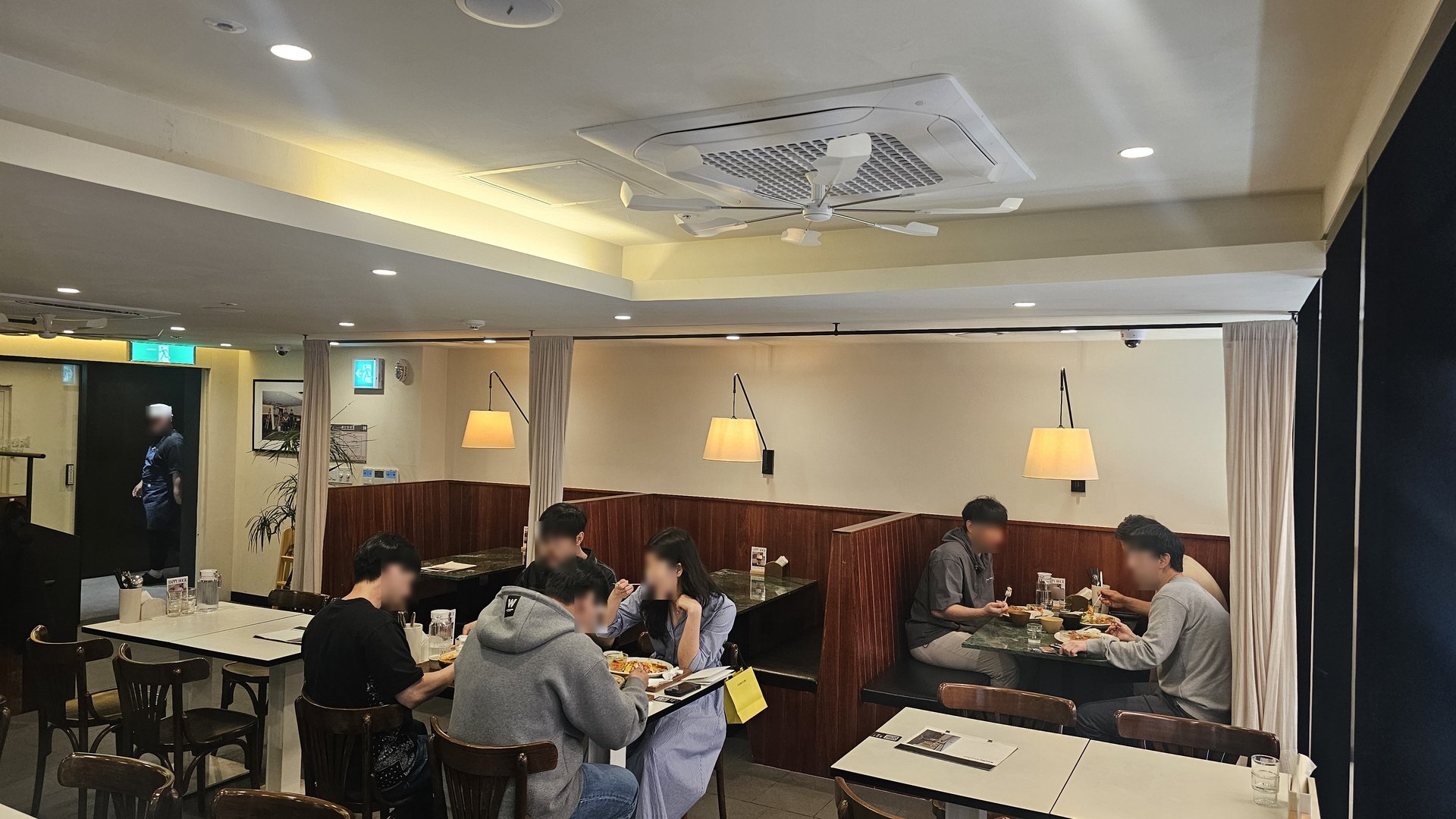
    Honestly, the interior is the strongest thing about this place. Looks like an old Tokyo bistro from the 80s — warm yellow lighting, those big red felt pendant lamps over the dining area, dark wood paneling, bentwood chairs.

    Dining room at Keebo Rock and Roll Yeouido with dark wood booths and lunch crowd
    Dining room at Keebo Rock and Roll Yeouido with dark wood booths and lunch crowd

    The staff wear matching black uniforms with traditional Japanese-style bandanas. The plates are intentional. The cutlery is intentional. Even the salt shakers are intentional. You can tell someone really thought about this place.

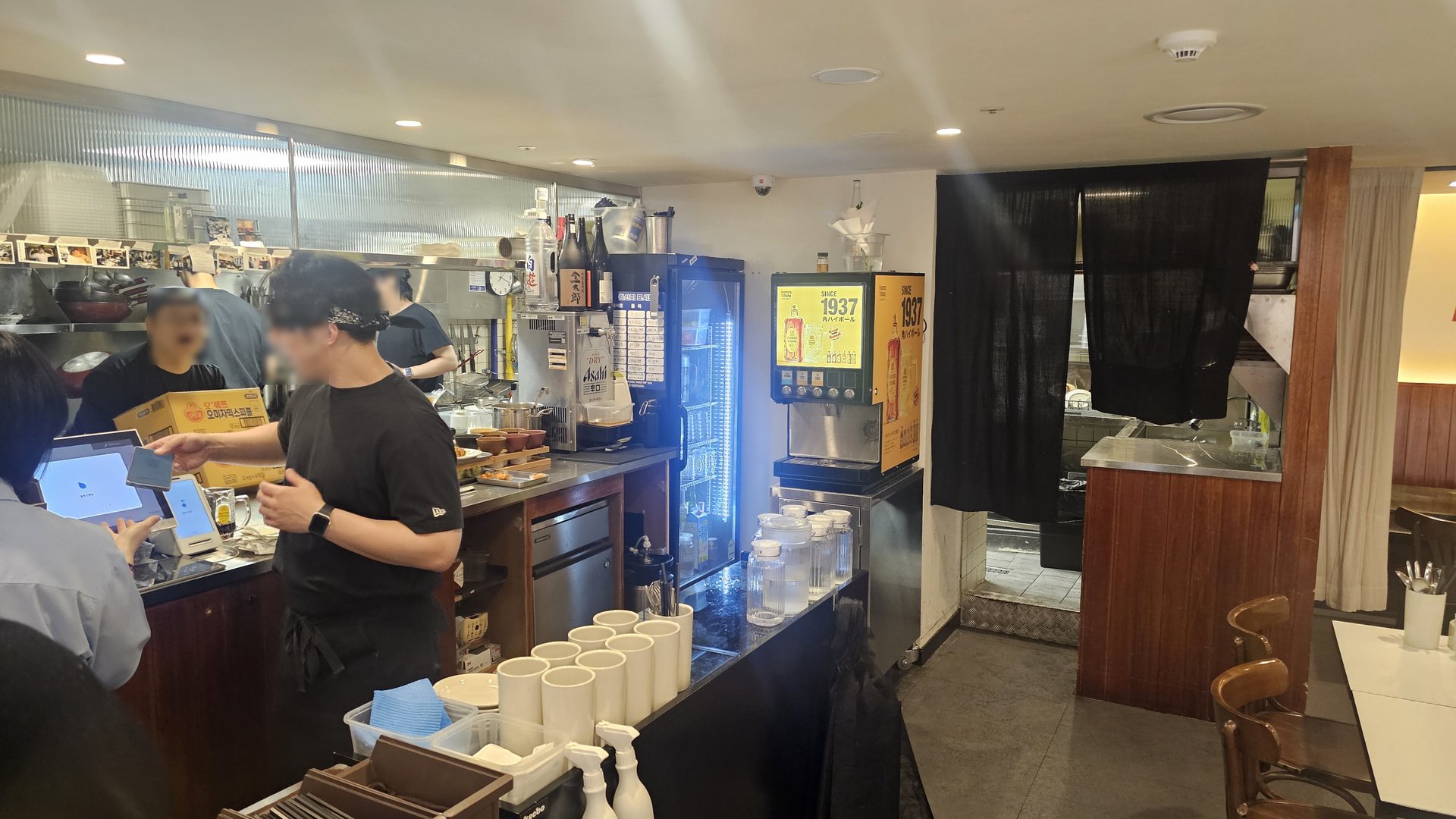
    Open kitchen counter at Keebo Rock and Roll with Asahi beer tap and 1937 drink machine
    Open kitchen counter at Keebo Rock and Roll with Asahi beer tap and 1937 drink machine

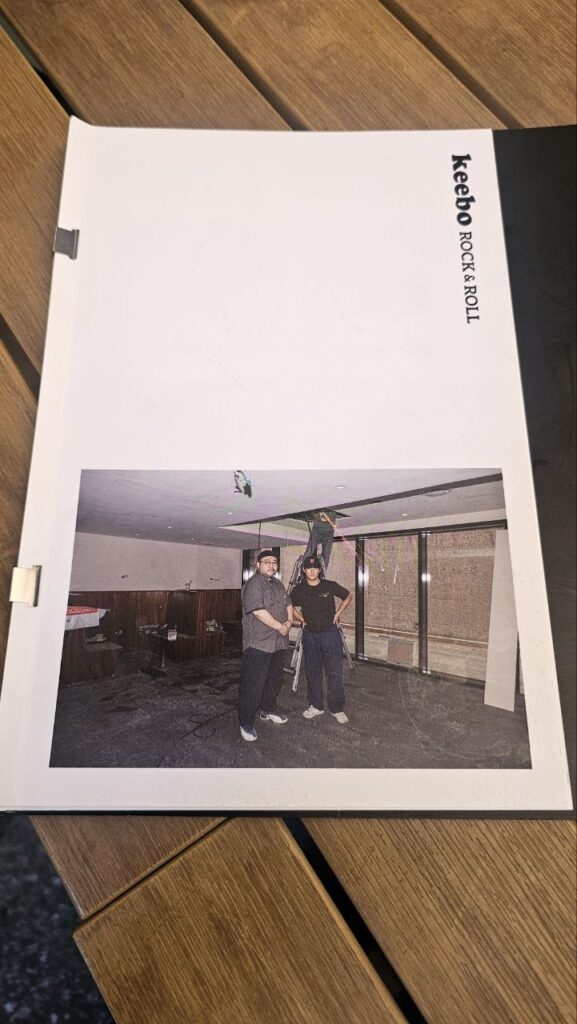
    There’s a small concept book on every table showing the renovation process. Cute touch.

    Keebo Rock and Roll concept book on table

    Vibe check: quiet enough for conversation. Mostly office workers at lunch. Not a tourist-heavy spot, which is honestly refreshing.


    What I Ordered

    I went with two people. We got the pork katsu and the fish katsu.

    Pork Katsu — 16,000 KRW (~$12)

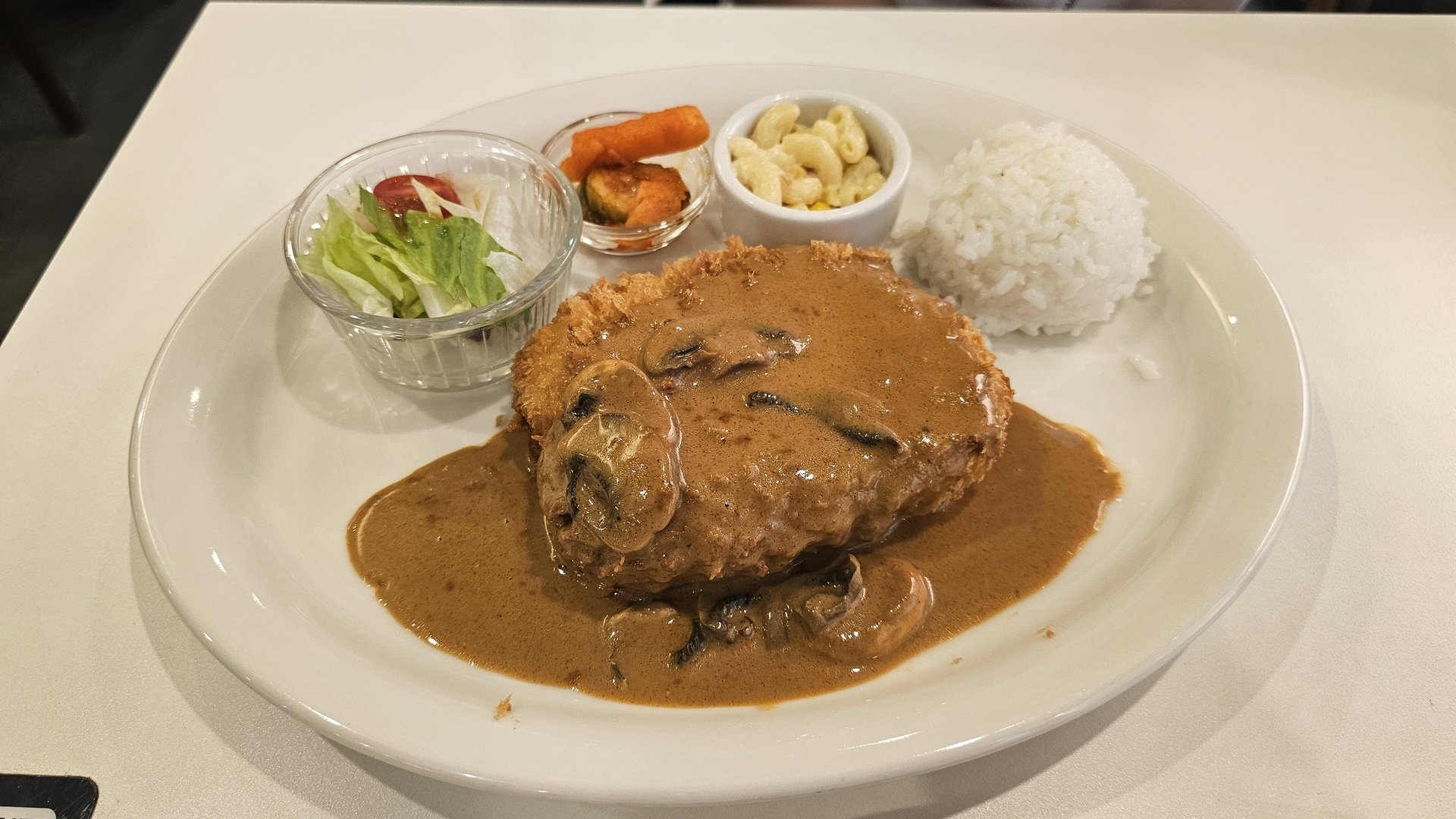
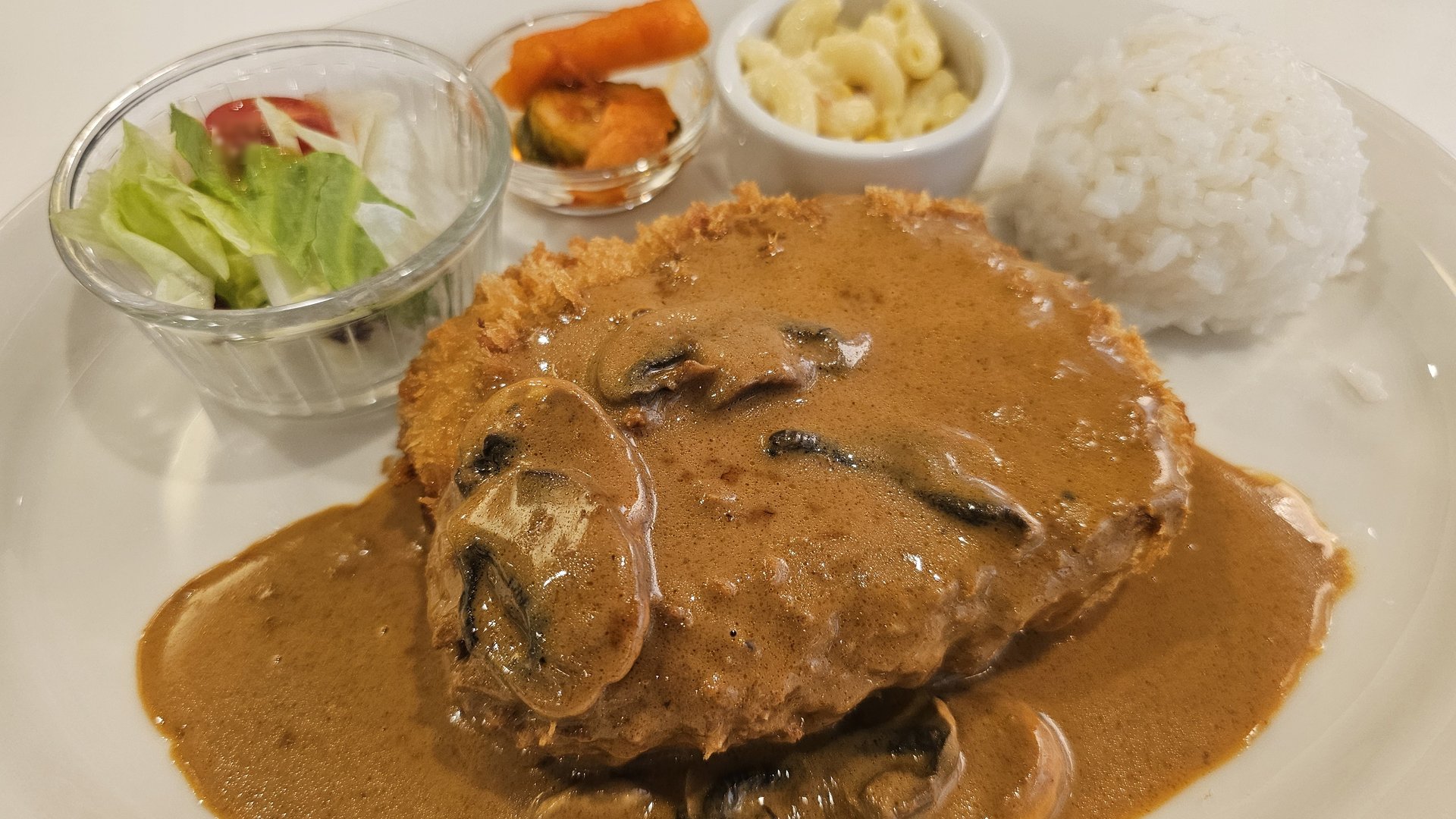
    Pork donkatsu with mushroom demi-glace sauce full plate with salad, macaroni salad, pickled vegetables and rice at Keebo
    Pork donkatsu with mushroom demi-glace sauce full plate with salad, macaroni salad, pickled vegetables and rice at Keebo

    Okay, this is the dish to order.

    Here’s the thing about katsu in Seoul right now — most places do that thin, wide cutlet style. Spread the pork out, breading does most of the work. Looks impressive on Instagram, eats like nothing.

    Keebo doesn’t do that. Their pork katsu is thick. Like, actual thick-cut pork loin you have to chew through. When you cut it, you can see the meat has structure.

    Close-up of pork donkatsu with rich mushroom demi-glace sauce at Keebo Rock and Roll Yeouido
    Close-up of pork donkatsu with rich mushroom demi-glace sauce at Keebo Rock and Roll Yeouido

    The brown sauce is made in-house. Lots of sliced mushrooms in it. Rich but not heavy. Comes with rice, salad, macaroni salad, pickle, and miso soup. Standard Yoshoku set arrangement.

    Worth the $12? Yeah, I’d say so. This is the dish that justifies the price.

    Fish Katsu — 16,000 KRW (~$12)

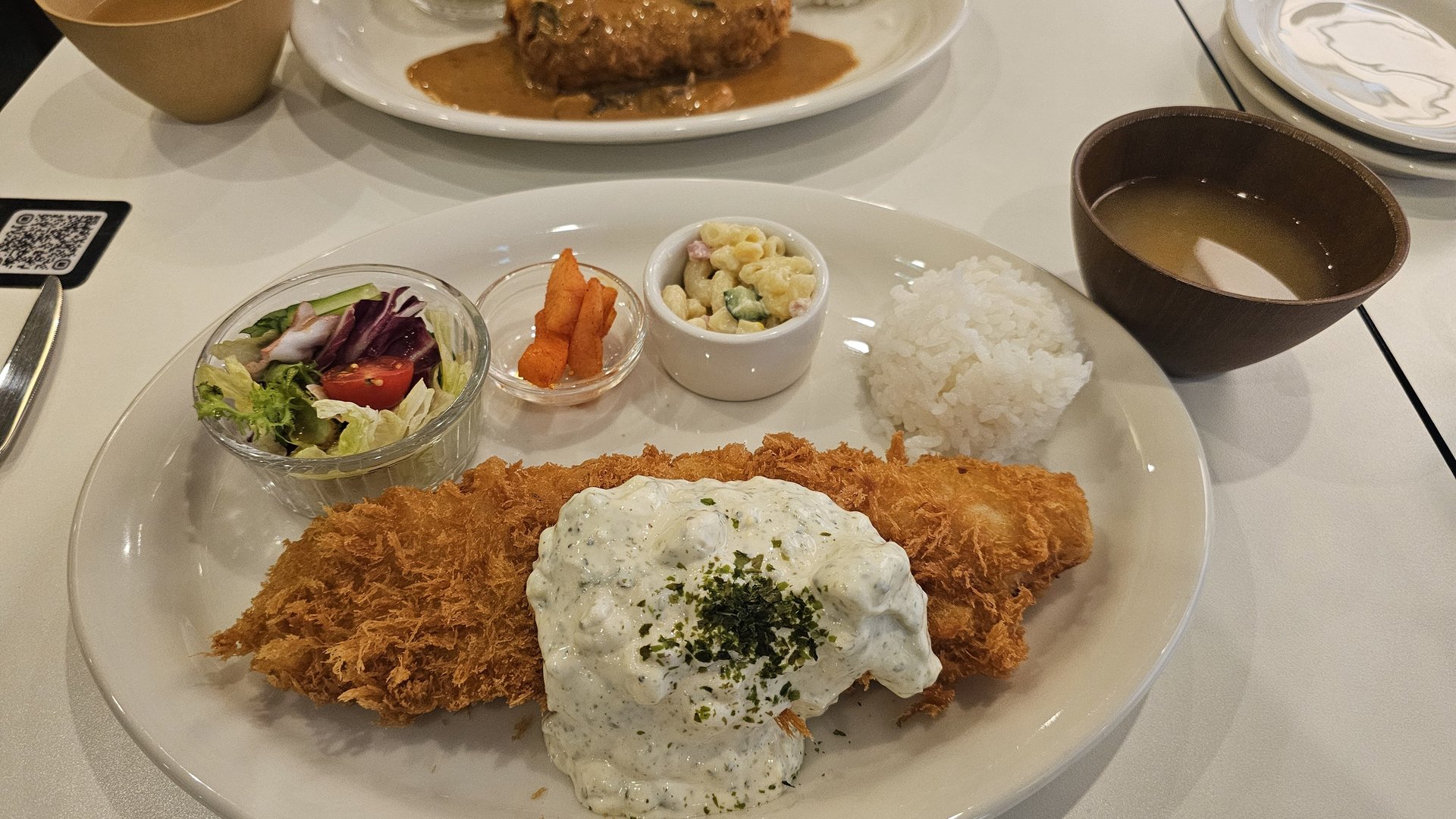
    Full plate of pork donkatsu with tartare sauce set including miso soup at Keebo Yeouido
    Full plate of pork donkatsu with tartare sauce set including miso soup at Keebo Yeouido

    Fish katsu is… fine.

    The fish itself is a thick piece of white fish (probably cod or pollock), breaded the same way as the pork. Crispy on the outside, flaky inside. Solid execution.

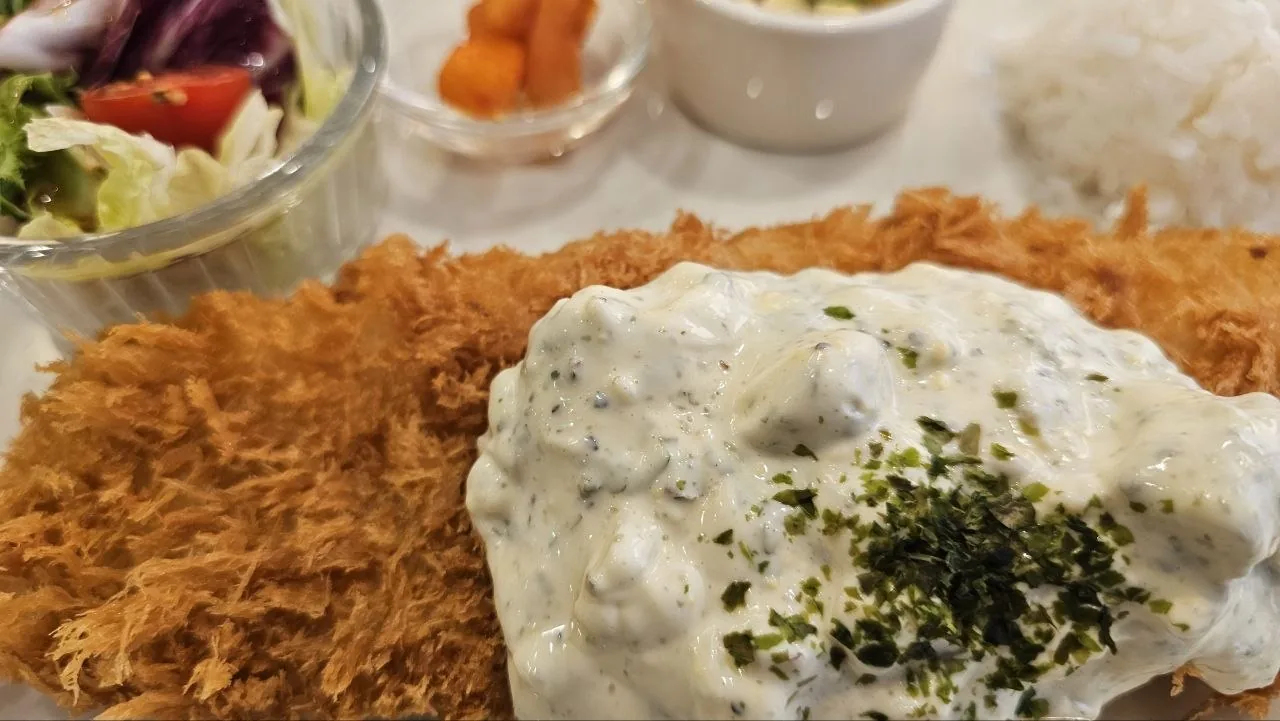
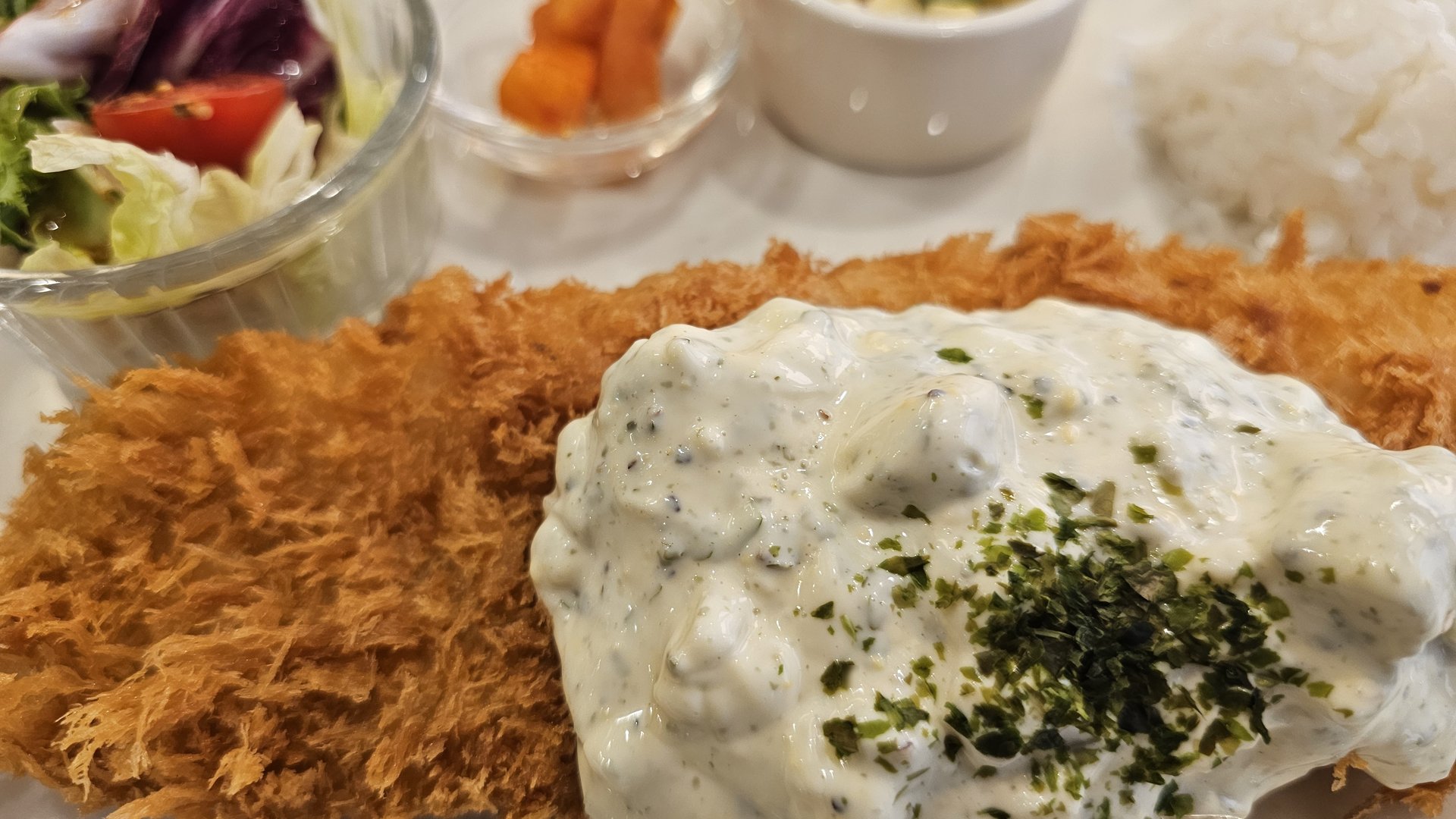
    Close-up of golden crispy pork donkatsu with creamy tartare sauce and herb garnish at Keebo
    Close-up of golden crispy pork donkatsu with creamy tartare sauce and herb garnish at Keebo

    The tartar sauce is the highlight here. It’s loaded with chopped pickles and herbs, gives it a fresh tangy kick that cuts through the fried fish. Better than the bottled tartar you’d get at most katsu chains.

    But honestly? It’s a well-made fish katsu. Nothing more. If you’re choosing between this and the pork, get the pork.

    The Omurice I Didn’t Order (But Want To)

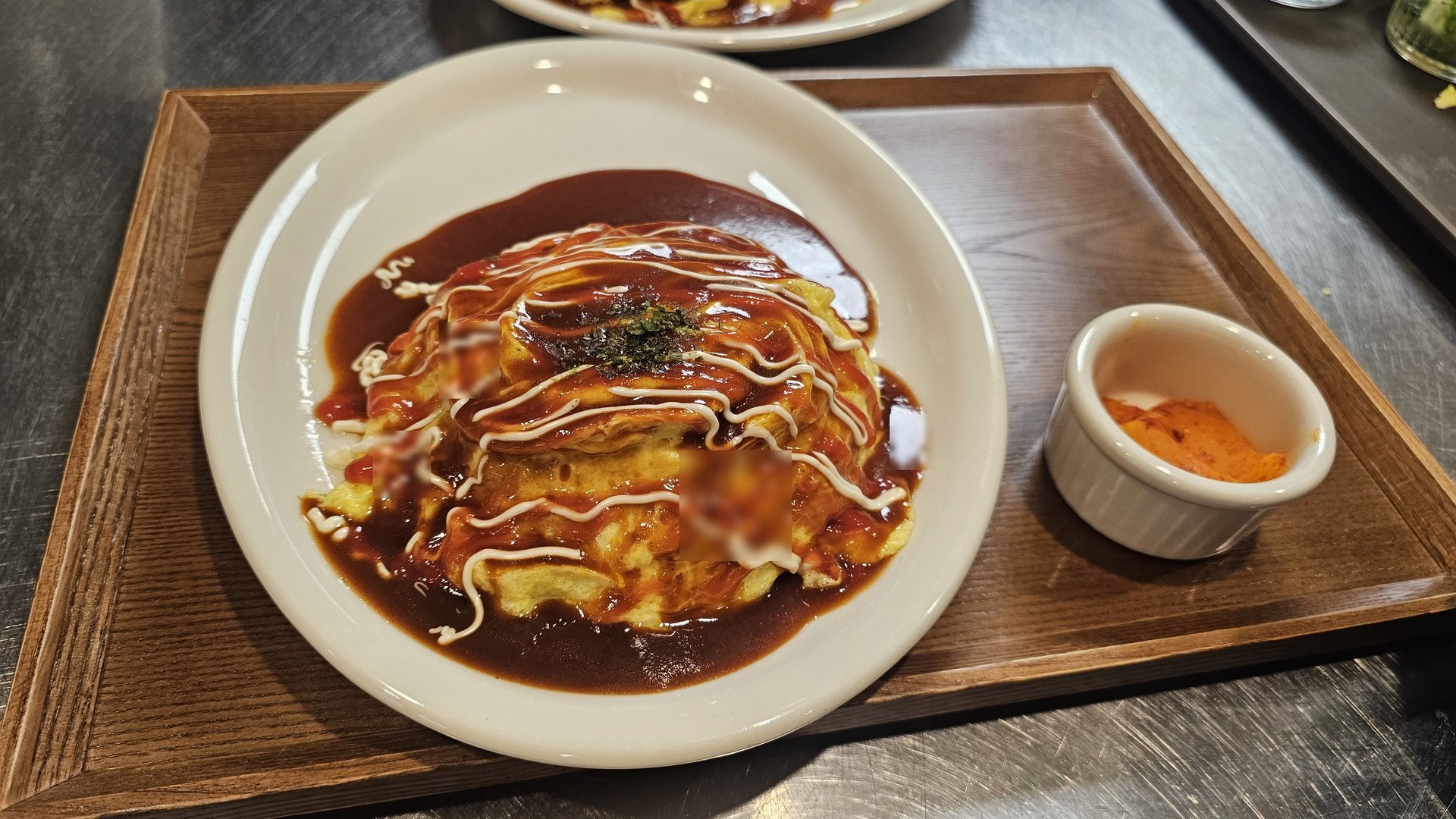
    Omurice with demi-glace sauce, mayo drizzle, and parsley topping served on wooden tray at Keebo Rock and Roll
    Omurice with demi-glace sauce, mayo drizzle, and parsley topping served on wooden tray at Keebo Rock and Roll

    Full disclosure — I didn’t actually try this. But I saw it leaving the kitchen on my way out and grabbed a photo because it looked stunning. Demi-glace sauce in those classic crosshatch patterns with mayo, a little parsley on top.

    This is their signature dish, apparently. I’ll be back specifically for this. Will update when I do.


    The Sides

    Every lunch comes with these sides on the same plate:

    • Small mixed salad (lettuce, cherry tomato, red cabbage)
    • Spicy Korean radish pickle
    • Macaroni salad (classic 80s diner style)
    • Steamed rice, dome-shaped
    • Miso soup on the side

    The macaroni salad is the giveaway that they know what they’re doing. Real Yoshoku places always have this. It’s a small thing, but if a “Japanese Yoshoku” place doesn’t serve macaroni salad with the lunch set, it’s not the real deal.


    Stuff Tourists Should Know

    How crowded?

    Weekday lunch around 12:15 PM = walked right in. Around 12:00 PM = probably a wait. Weekends = reservations recommended.

    You can book through the CatchTable app, which has English support.

    Happy Hour Tip

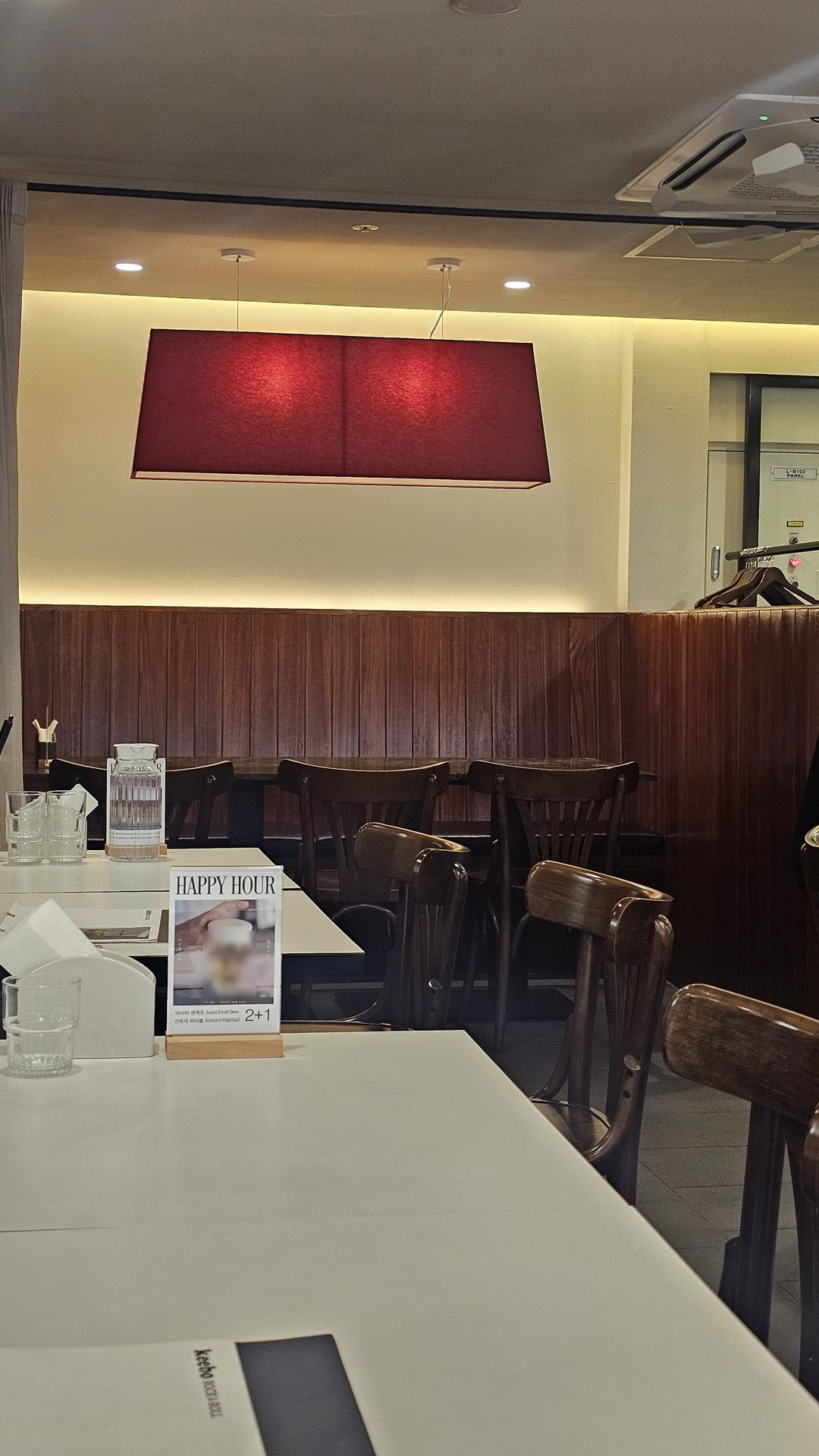
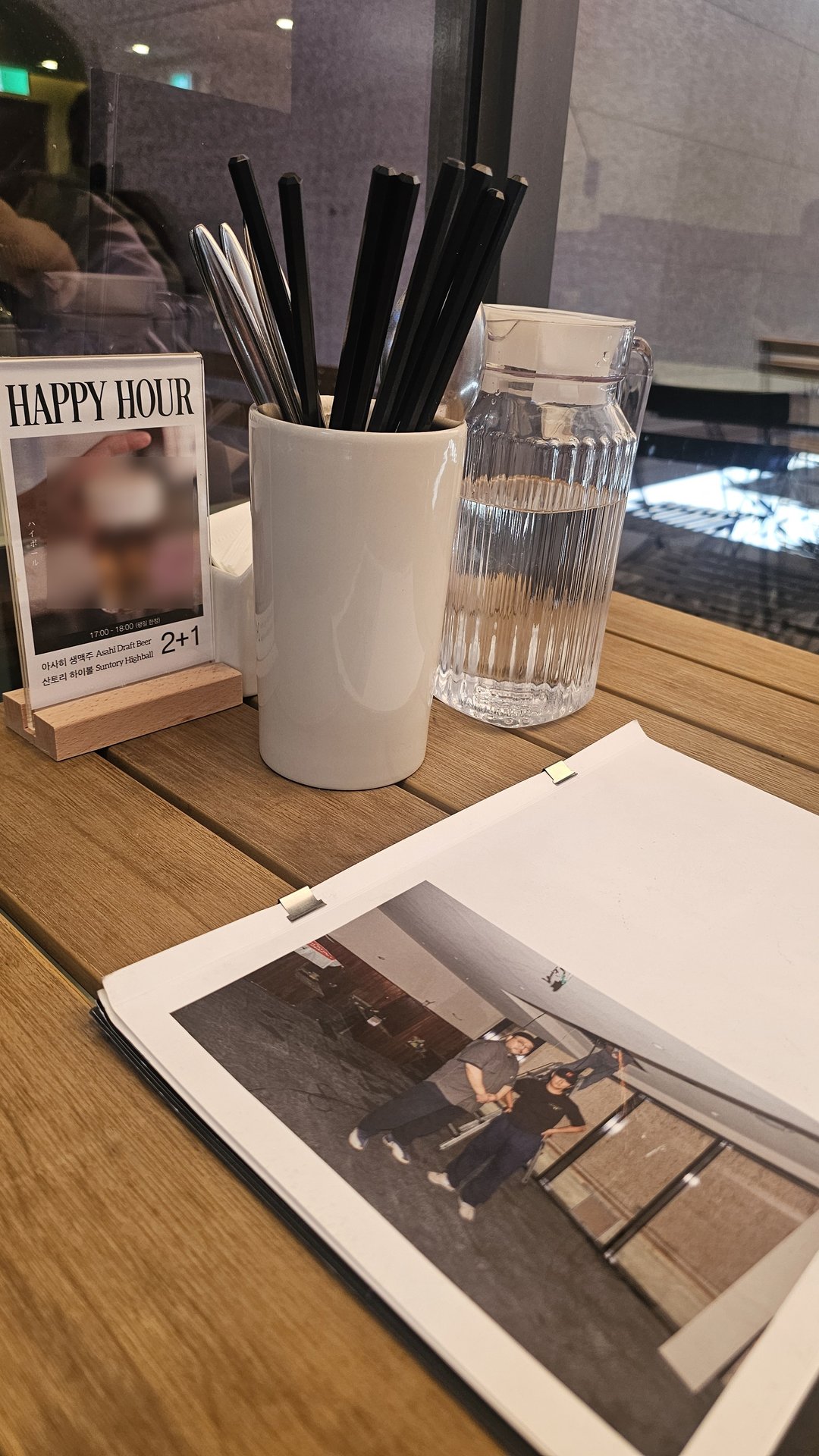
    Table setup at Keebo Yeouido with utensil holder, water glass, and Happy Hour 2+1 promotion card
    Table setup at Keebo Yeouido with utensil holder, water glass, and Happy Hour 2+1 promotion card

    Between 5–6 PM on weekdays, they do 2+1 on Asahi draft beer and Suntory highball. Solid deal if you’re in the area after a long day.

    Will the staff speak English?

    Basic English, yes. The menu has English subtitles on every item. You’ll be fine.

    Card or cash?

    All cards work, including foreign Visa/Mastercard. Korea barely uses cash anymore. No tipping.

    Dietary stuff

    • Vegetarian: Limited. Salads and a few sides only.
    • Halal: No
    • Allergies: Wheat (breading), egg (omurice, tartar). Just ask if concerned.

    Kids?

    Sure, but it’s not a kid-focused place. Adult/date/solo vibe.


    The Verdict

    Should you go?

    Depends on what you’re doing in Seoul.

    • If you’re in Yeouido anyway — yes, this is one of the better lunch options. Get the pork katsu.
    • If you have only 3 days in Seoul — probably skip. Eat Korean food. Come back to Yoshoku on a longer trip.
    • If you’ve been to Tokyo and want to see how Koreans interpret Japanese comfort food — yes, this is a good example.
    • If you’re a foodie traveler tracking down good Yoshoku in Asia — yes, worth a stop.

    The honest summary:

    Pork katsu — recommended. Fish katsu — fine but forgettable. Interior — stunning. Price — slightly high but reasonable for the quality. Will I come back? Yes, for the omurice.


    FAQ

    Is this restaurant tourist-friendly?

    Yes. English menu, card payment, English-speaking staff. About as easy as it gets in Seoul.

    How much per person?

    Plan 20,000–25,000 KRW ($15–$18 USD) for lunch with a drink. Dinner with sake or beer runs 40,000–60,000 KRW ($30–$45 USD) per person.

    Is it worth it?

    For the food alone? It’s okay. For the food plus the interior plus the location plus the experience? Yeah, I think so.

    Reservations needed?

    Lunch on weekdays — usually not. Weekends and dinner — recommended via CatchTable.

    Best time to go?

    12:15–1:30 PM on weekdays. Avoid 12:00–12:15 PM rush.

    What if I can’t read Korean?

    Menu has English. Staff speaks basic English. You’ll survive.

    Are there other Keebo locations?

    Yes, but this Yeouido one is the “Rock & Roll” flagship-style location. The others are smaller and have slightly different menus.


    Related Posts (Coming Soon)

    • Best Lunch Spots in Yeouido Under 20,000 KRW
    • Chef Nam Joon-young’s Restaurant Empire — Where to Eat
    • Tokyo vs Seoul Yoshoku: How Koreans Adapted the Style

    About this review: Visited on a weekday lunch in May 2026. All photos mine. No partnership with the restaurant — I paid for everything. If you want a less filtered take than the average travel blog, this is what I’ve got.

    One last thing: Prices and menu items change. Verify on Naver Map or CatchTable before you go.

    You might also like