Tag: myeongdong

  • Patgodang Myeongdong: Honest Red Bean Bingsu Review

    Patgodang Myeongdong: Honest Red Bean Bingsu Review

    Quick honest review of Patgodang in Myeongdong — a Korean red bean dessert cafe that makes bingsu and freshly baked red bean bread. Short version: the bingsu is solid, the bread is fine, the no-preservatives thing is a genuine selling point, and the price-to-portion ratio is a little annoying. Worth a stop if you’re already in Myeongdong. Probably not worth a special trip.

    I went on a Tuesday around 5:30 PM. Packed. Near-full capacity, small waiting line, tourists and locals mixed pretty evenly.

    What Is Patgodang?

    Patgodang (팥고당) — the name roughly translates to “red bean hall” — is a dessert cafe built entirely around 팥 (pat), Korean red bean. Think adzuki beans, the same kind you find in Japanese mochi or Chinese tang yuan, but prepared the Korean way.

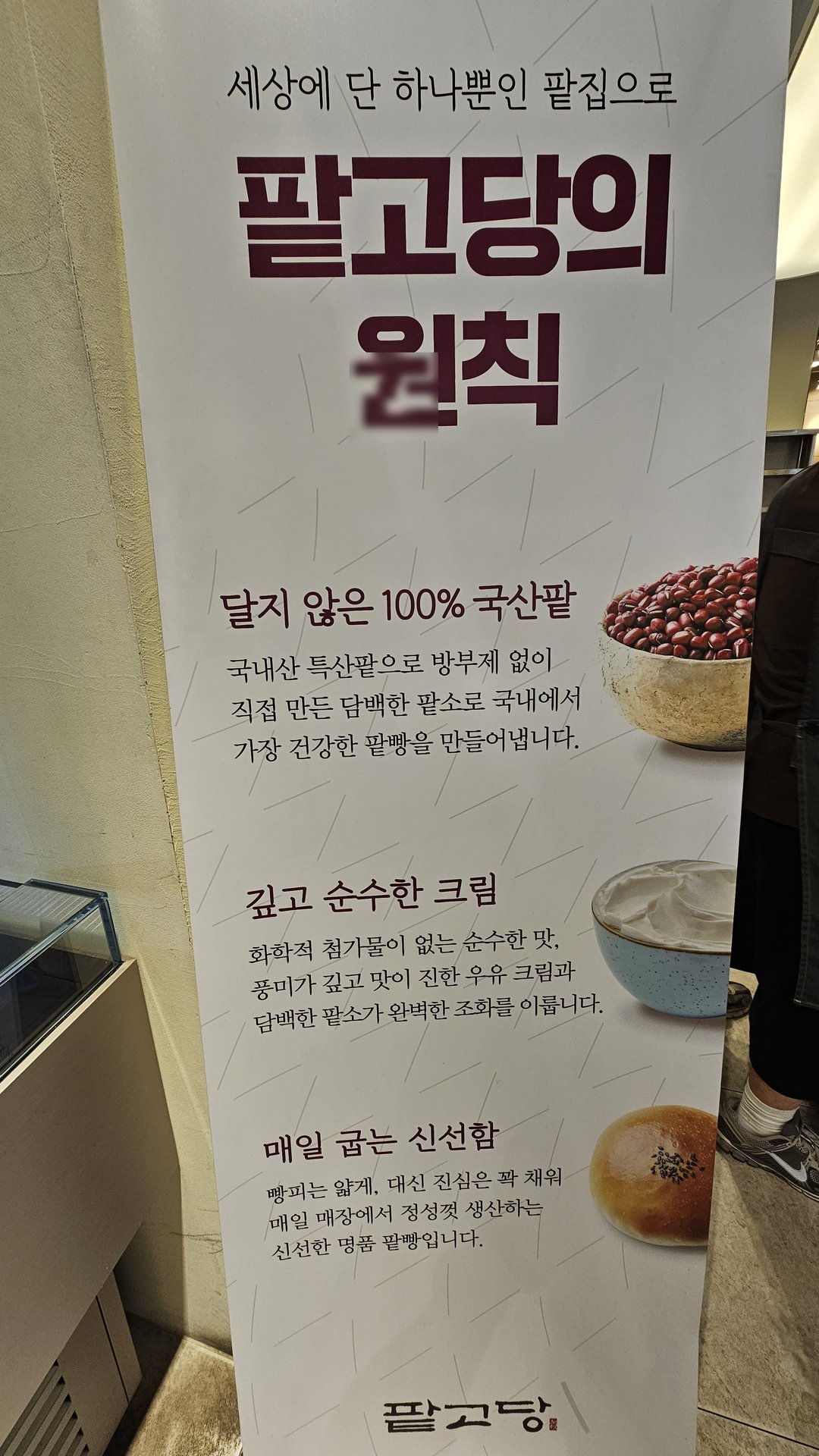
    Their pitch is simple: 100% Korean-grown red beans, baked fresh daily, no preservatives. That’s not just a sign on the wall — the bread actually has storage instructions posted (refrigerate within 2 days, freeze for longer), which backs it up.

    The main draws are bingsu and 팥빵 (red bean bread). They also do coffee, but that’s clearly not the point of coming here.

    What Is Bingsu?

    If you’ve never had bingsu before: it’s not a snow cone. Korean shaved ice is milk-based, shaved so fine it comes out like actual snow — light, soft, nothing like the crunchy ice at American street fairs. You get a pile of it topped with sweet red bean, and you eat it before it melts.

    Patgodang does the classic version, served in a brass-colored bowl that photographs well.

    Getting There

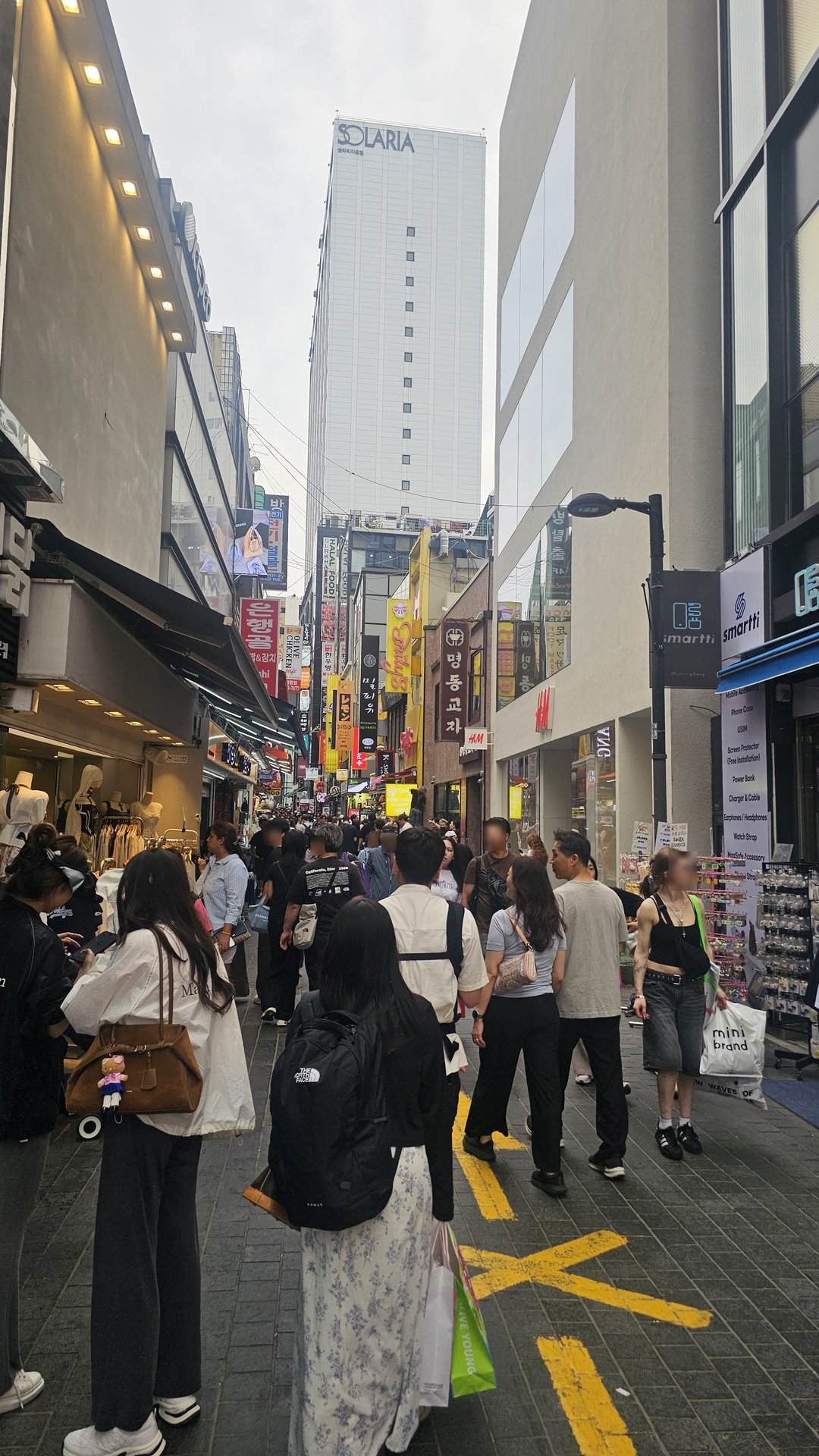
    Myeongdong is Seoul’s most tourist-dense neighborhood. If you’ve just landed at Incheon Airport, you’re about 60–70 minutes away by subway (Airport Railroad + transfer at Seoul Station, then Line 4 to Myeongdong Station). Take Exit 5 or 6.

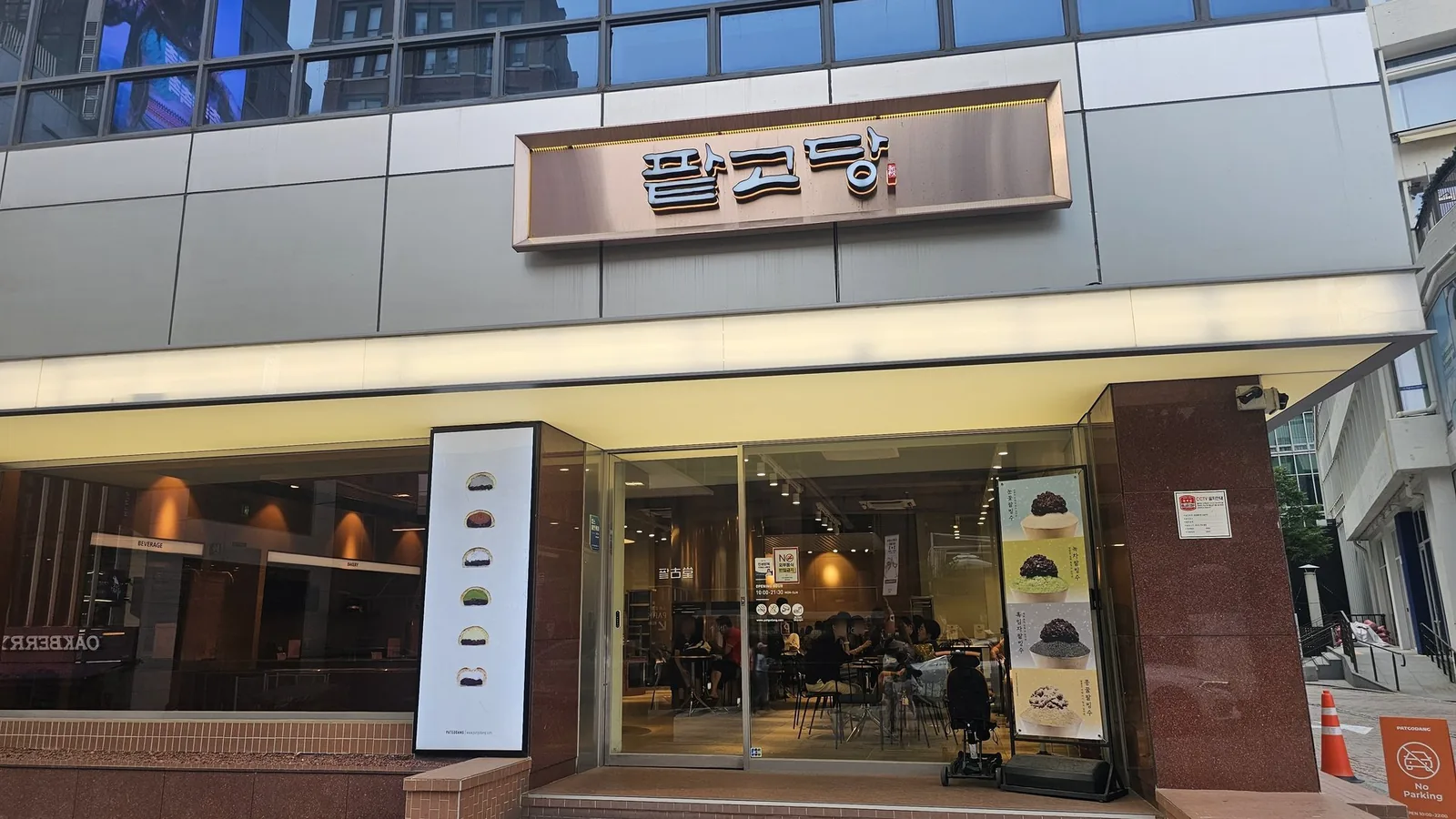
    Every major Myeongdong hotel is walkable from the station. You’ll find Patgodang without much effort — the storefront faces the main street with a clear sign, and the bingsu poster in the window is hard to miss.

    The Interior
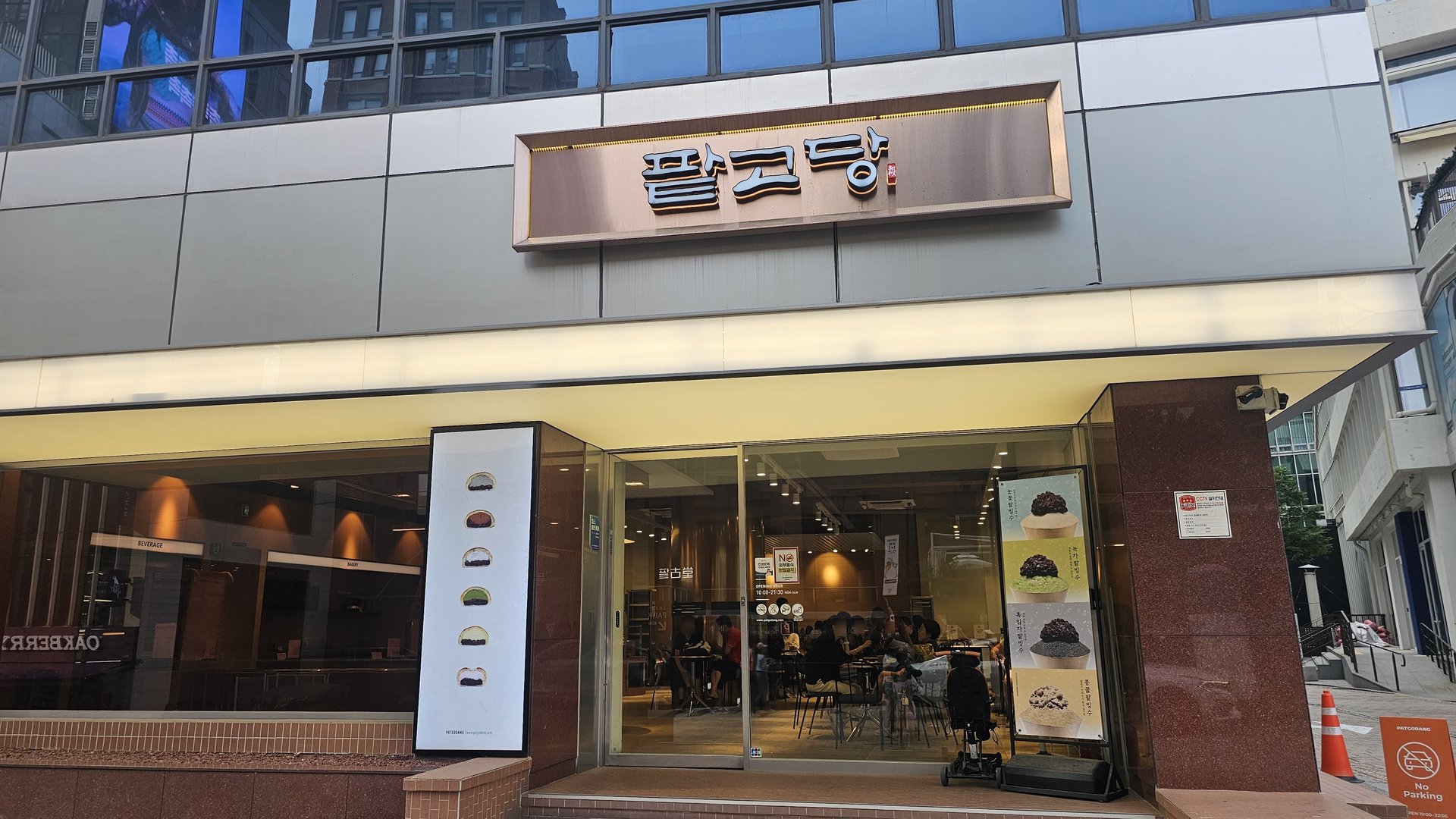
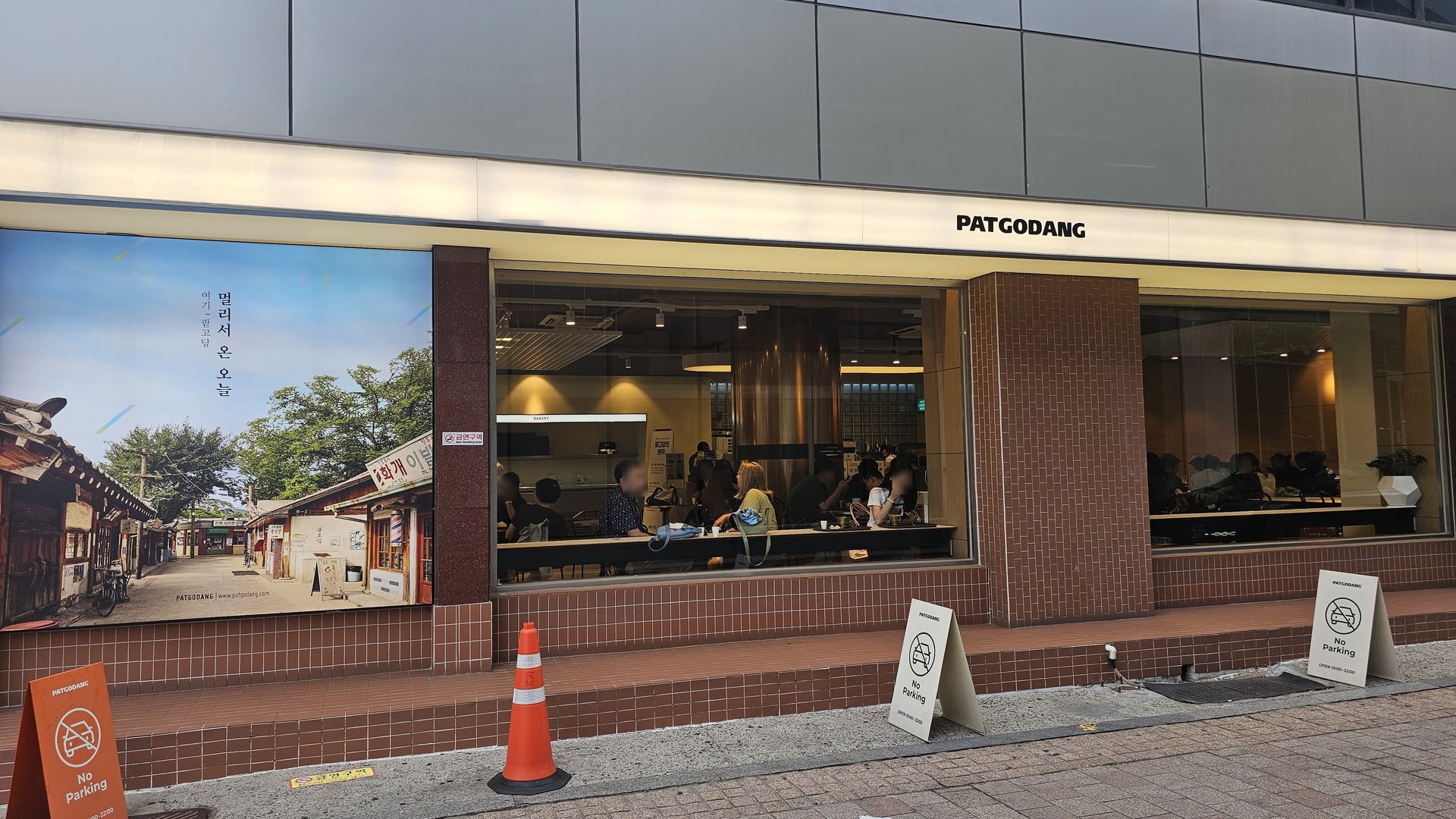
    Patgodang Myeongdong storefront exterior with bingsu poster and glass facade showing customers inside
    Patgodang Myeongdong storefront exterior with bingsu poster and glass facade showing customers inside
    Patgodang Myeongdong side exterior with PATGODANG English signage and interior seating visible through window
    Patgodang Myeongdong side exterior with PATGODANG English signage and interior seating visible through window

    Gold and beige tones, brass-colored bingsu bowls, individually wrapped breads in clean glass cases. More polished than your average bingsu spot. Not a loud Instagram cafe — more like a refined Korean dessert brand trying to look premium.
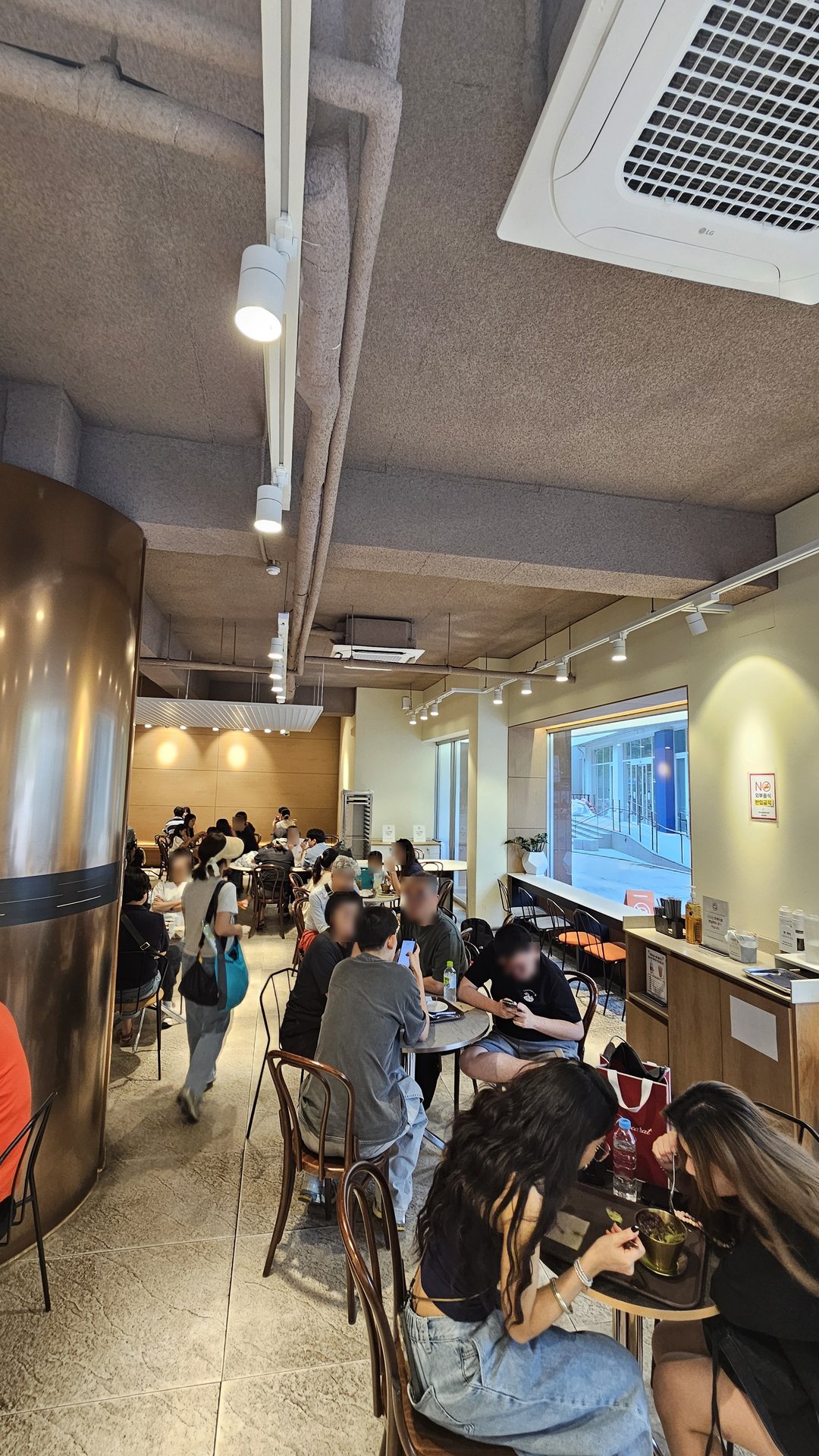
    Crowded interior of Patgodang Myeongdong with seated customers and a waiting line near the entrance
    Crowded interior of Patgodang Myeongdong with seated customers and a waiting line near the entrance

    At 5:30 PM on a weekday, it was genuinely busy. Plan for a short wait if you’re visiting during afternoon peak hours.

    What I Ordered
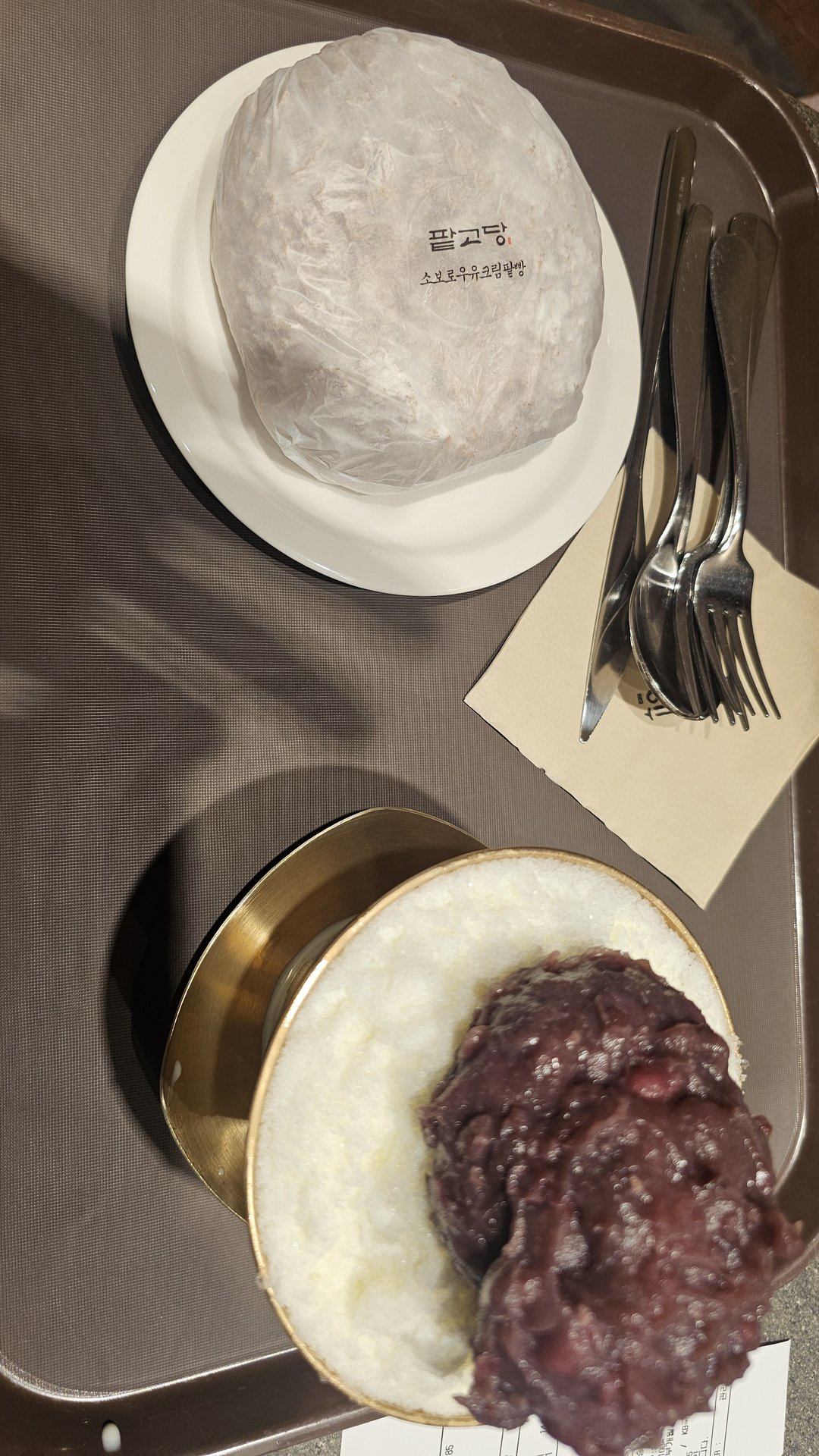
    Full tray at Patgodang with red bean bingsu in brass bowl and soboro red bean cream bread on white plate
    Full tray at Patgodang with red bean bingsu in brass bowl and soboro red bean cream bread on white plate

    팥빙수 (Red Bean Bingsu) — 14,000 KRW (~$10.40 USD)
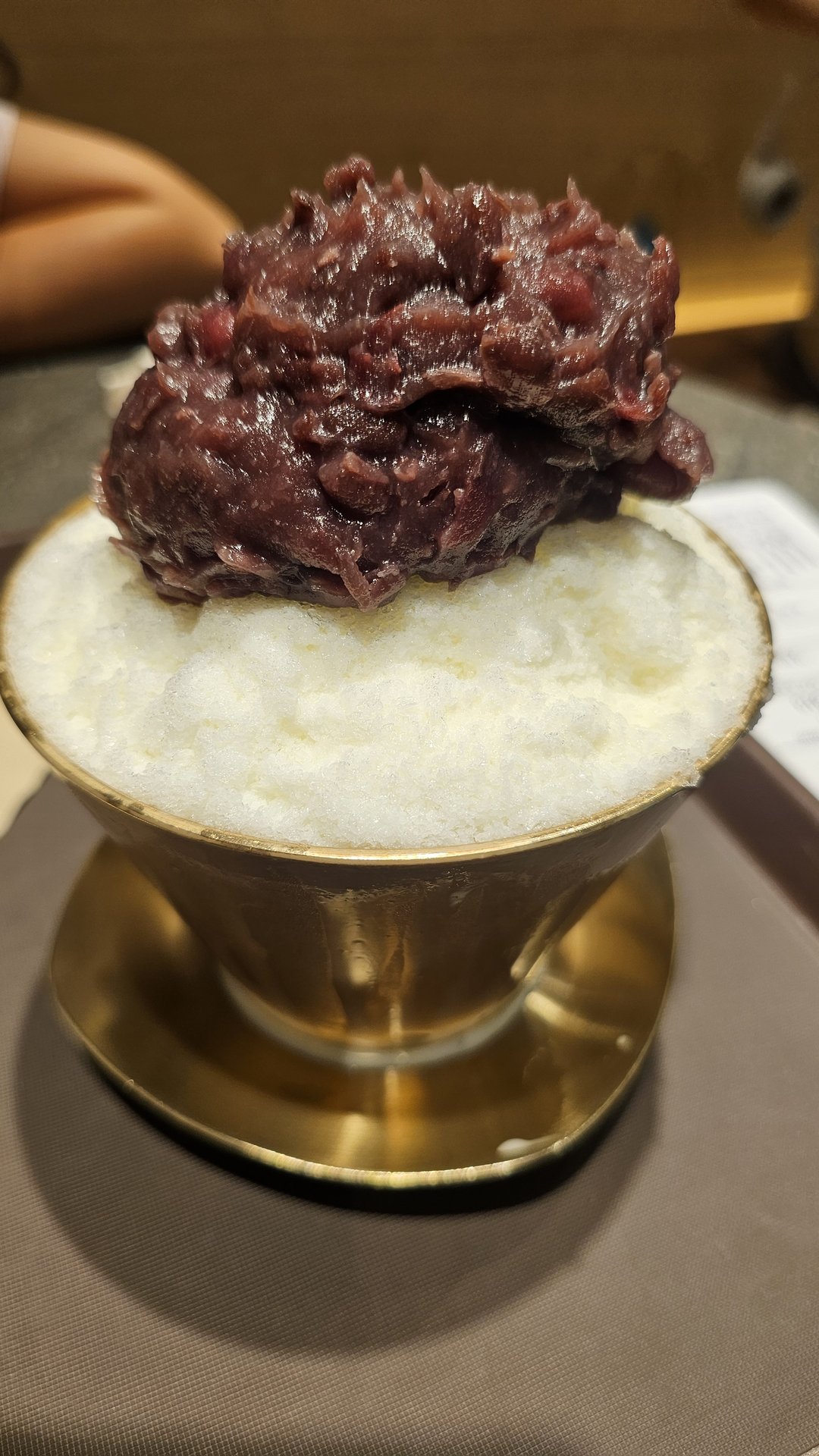
    Overhead view of red bean bingsu in brass bowl at Patgodang — snow ice topped with sweet red beans
    Overhead view of red bean bingsu in brass bowl at Patgodang — snow ice topped with sweet red beans
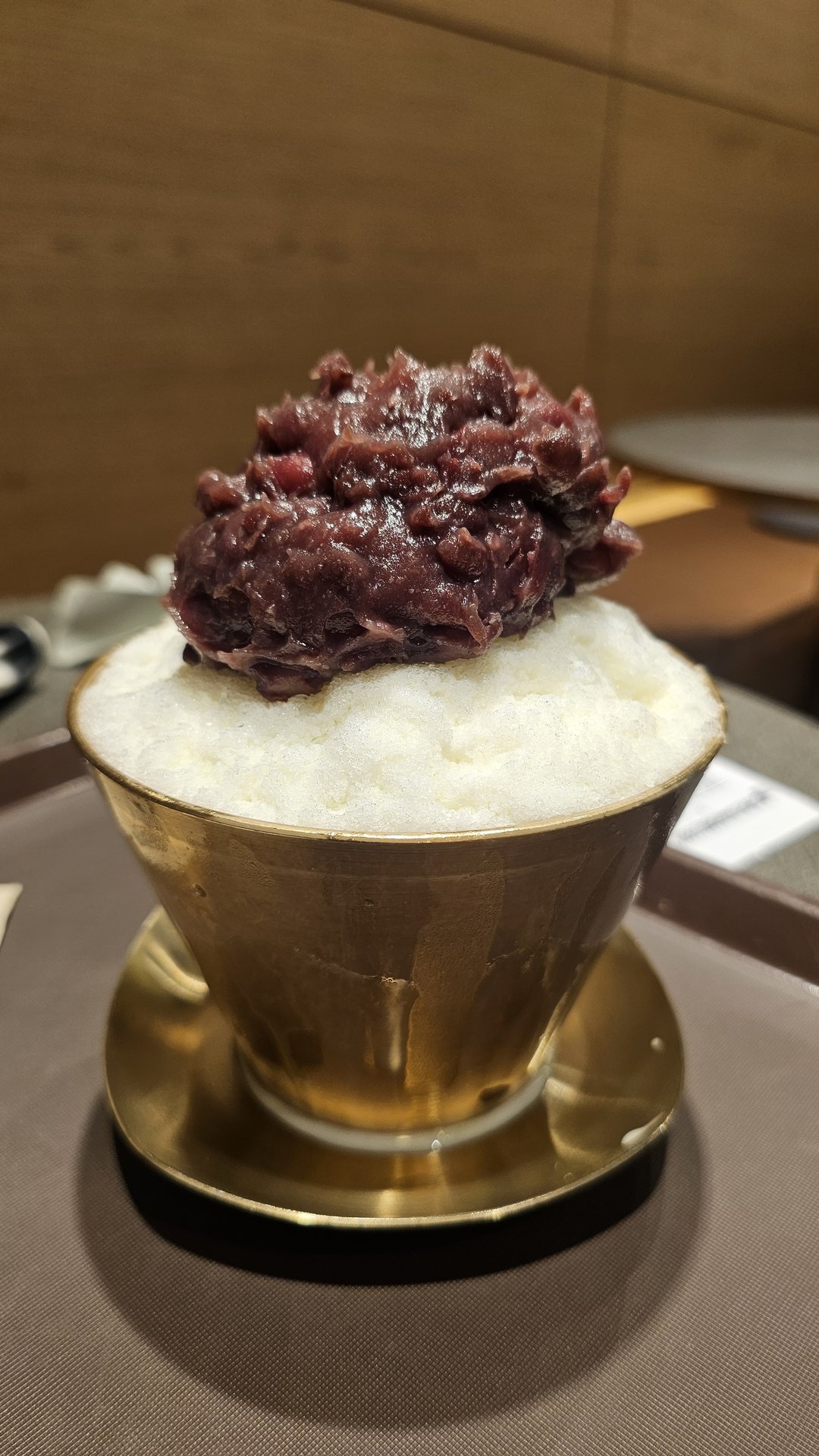
    Side view of red bean bingsu in brass bowl at Patgodang Myeongdong showing fluffy snow ice and generous red bean topping
    Side view of red bean bingsu in brass bowl at Patgodang Myeongdong showing fluffy snow ice and generous red bean topping

    The ice is finely shaved, the red bean is sweet without being cloying. Classic execution. The brass bowl looks good and gives it a bit of weight — like they put thought into the presentation, which they did.

    Here’s the honest part though: 14,000 KRW for a standard red bean bingsu is on the higher end for Seoul. You’re paying Myeongdong tourist-area pricing. A similar bingsu at a less branded spot would run 8,000–10,000 KRW. The portion isn’t huge. It’s good, but you’ll feel the gap between what you paid and what you got.

    소보로팥크림빵 (Soboro Red Bean Cream Bread) — 4,500 KRW (~$3.33 USD)
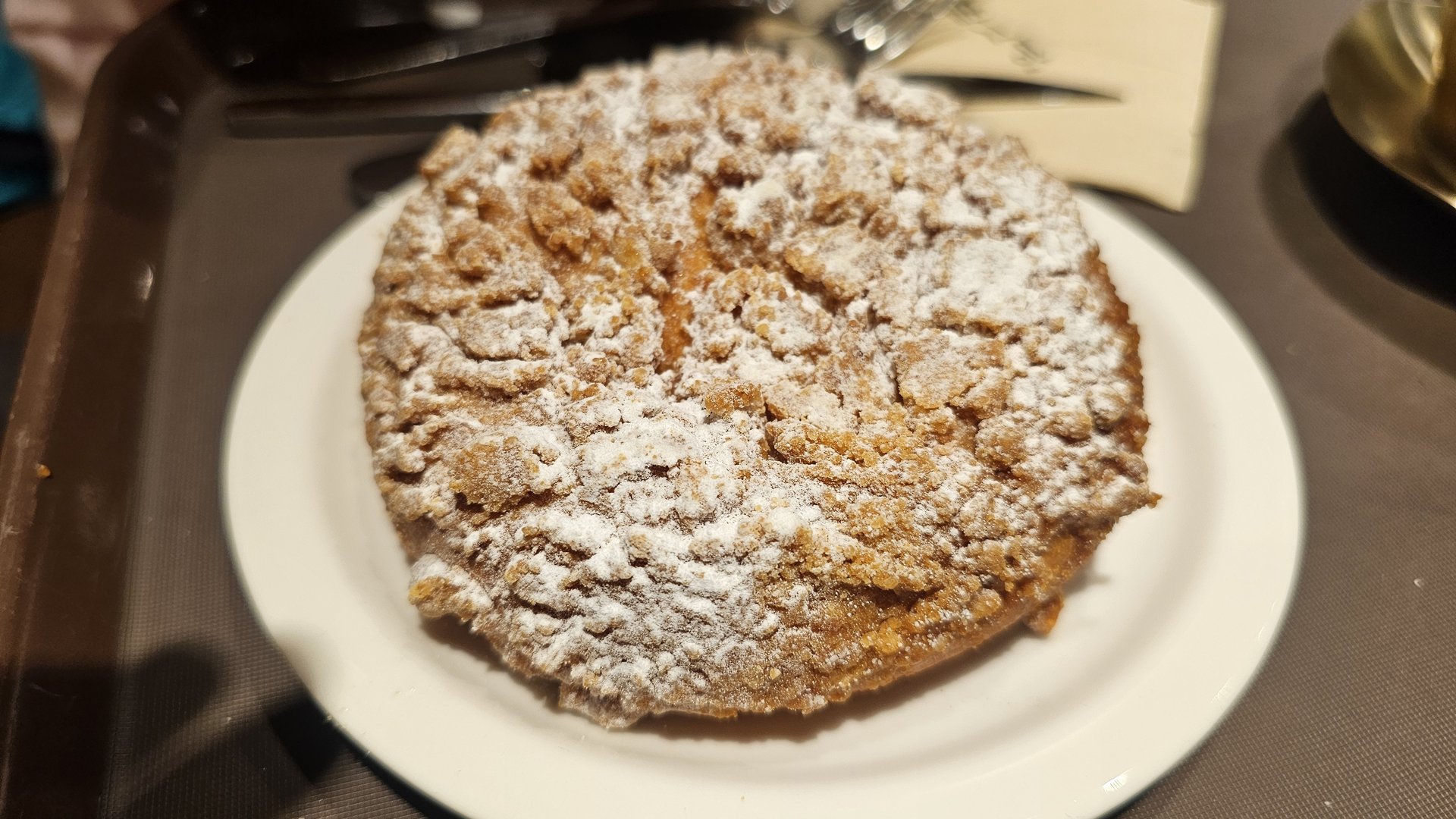
    Soboro red bean cream bread on white plate at Patgodang dusted with powdered sugar
    Soboro red bean cream bread on white plate at Patgodang dusted with powdered sugar
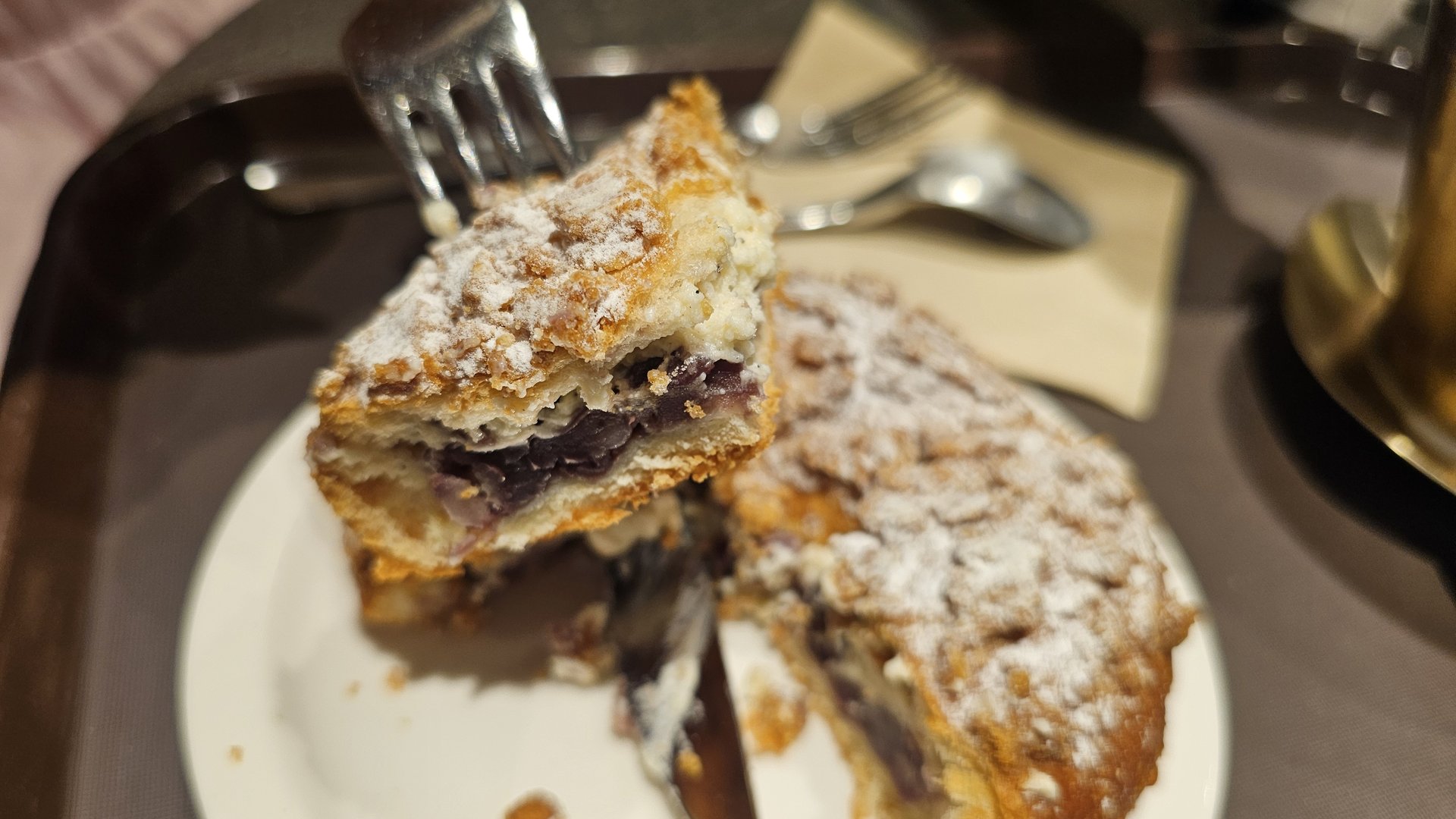
    Cross-section of soboro red bean cream bread cut open with fork revealing smooth red bean cream filling at Patgodang
    Cross-section of soboro red bean cream bread cut open with fork revealing smooth red bean cream filling at Patgodang

    Soboro (소보로) is a crumbly, streusel-like topping baked onto Korean bread — sweetened breadcrumbs that give the crust a rough, sandy texture. Patgodang’s version is filled with red bean cream inside and dusted with powdered sugar on top.

    The cream is smooth and the red bean flavor comes through without being too sweet. The soboro topping gives it a nice texture contrast. It’s a good bread.

    Small though. 4,500 KRW for a round bun you’ll finish in a few bites.
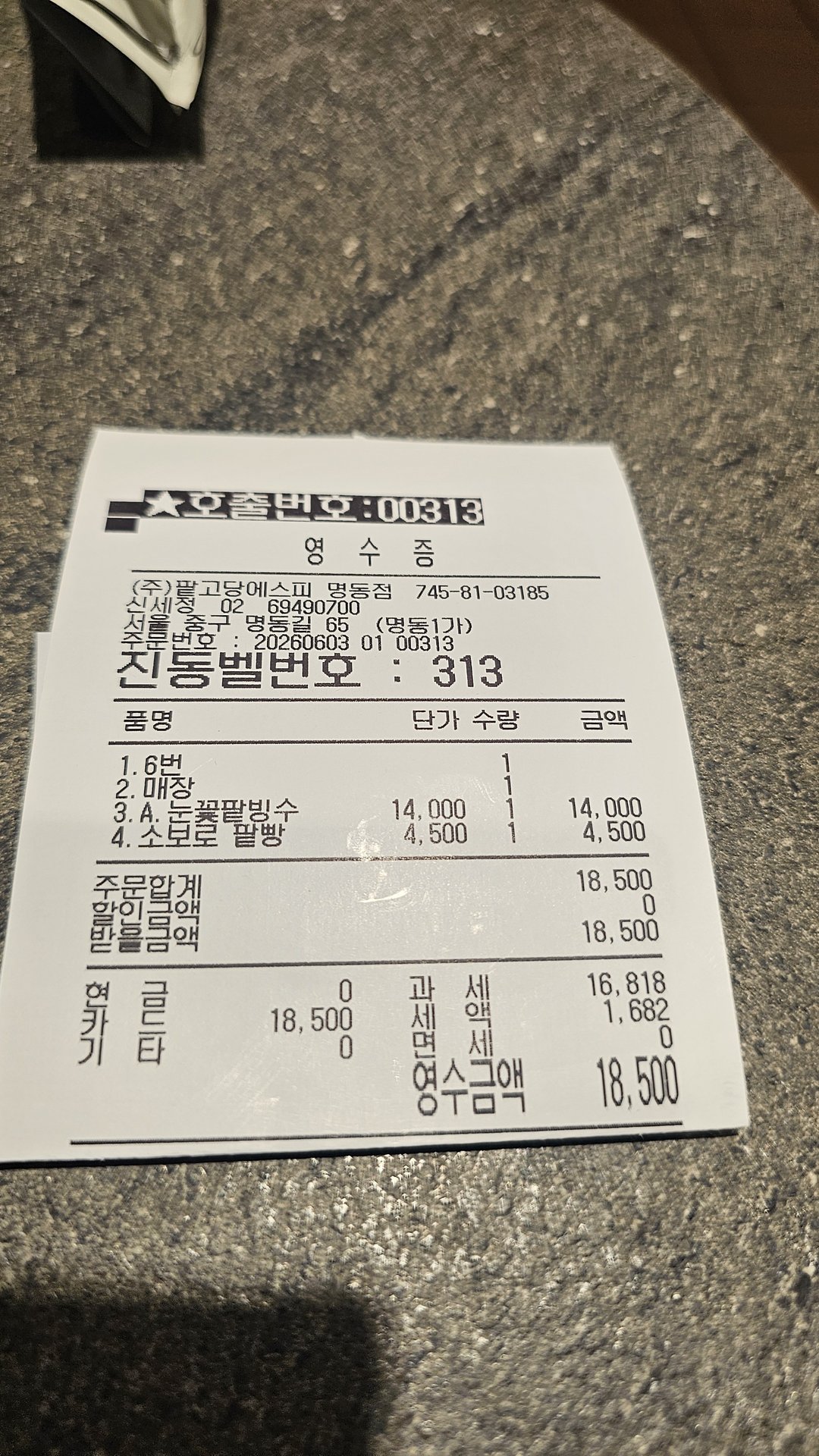
    Receipt from Patgodang showing red bean bingsu 14,000 KRW and soboro red bean cream bread 4,500 KRW totaling 18,500 KRW
    Receipt from Patgodang showing red bean bingsu 14,000 KRW and soboro red bean cream bread 4,500 KRW totaling 18,500 KRW

    Total: 18,500 KRW (~$13.70 USD)

    For two items at a dessert cafe in Myeongdong, that’s okay. Not shocking. But you won’t leave feeling like you got a lot.

    The Bread Counter
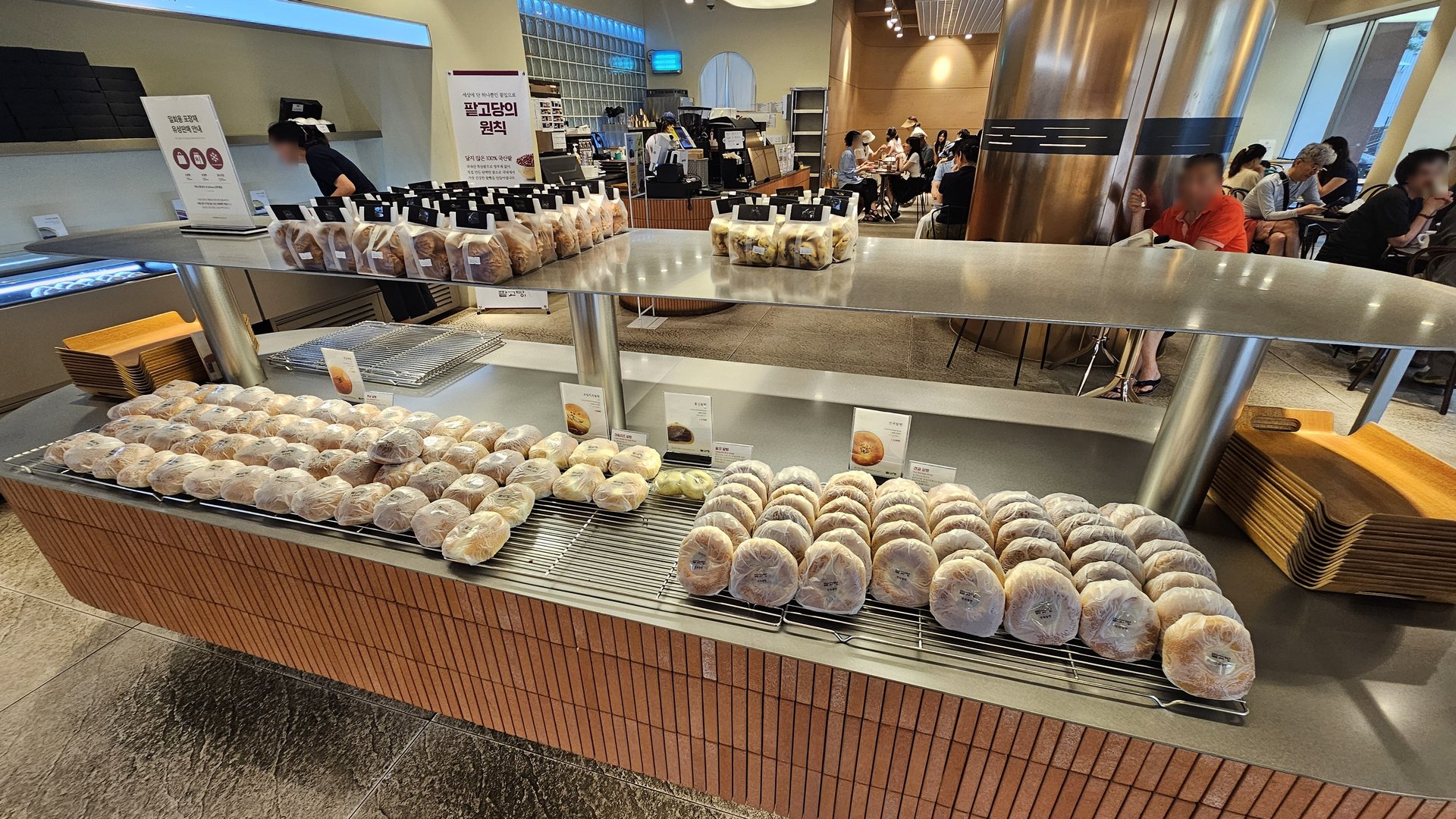
    Counter display at Patgodang Myeongdong showing assorted red bean breads with beverage shelves behind
    Counter display at Patgodang Myeongdong showing assorted red bean breads with beverage shelves behind
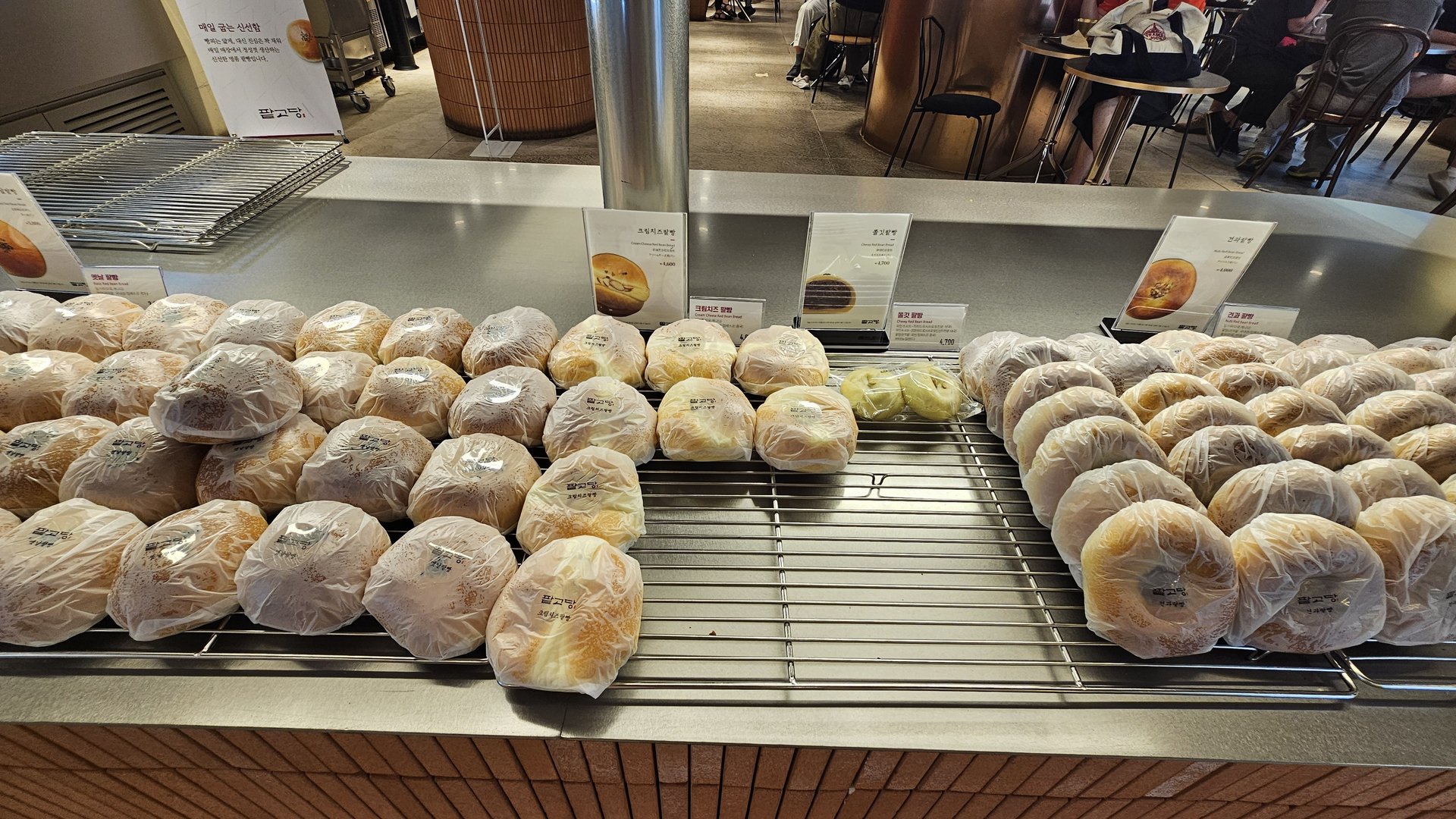
    Full display of multiple red bean bread varieties at Patgodang counter with price tags and variety labels
    Full display of multiple red bean bread varieties at Patgodang counter with price tags and variety labels
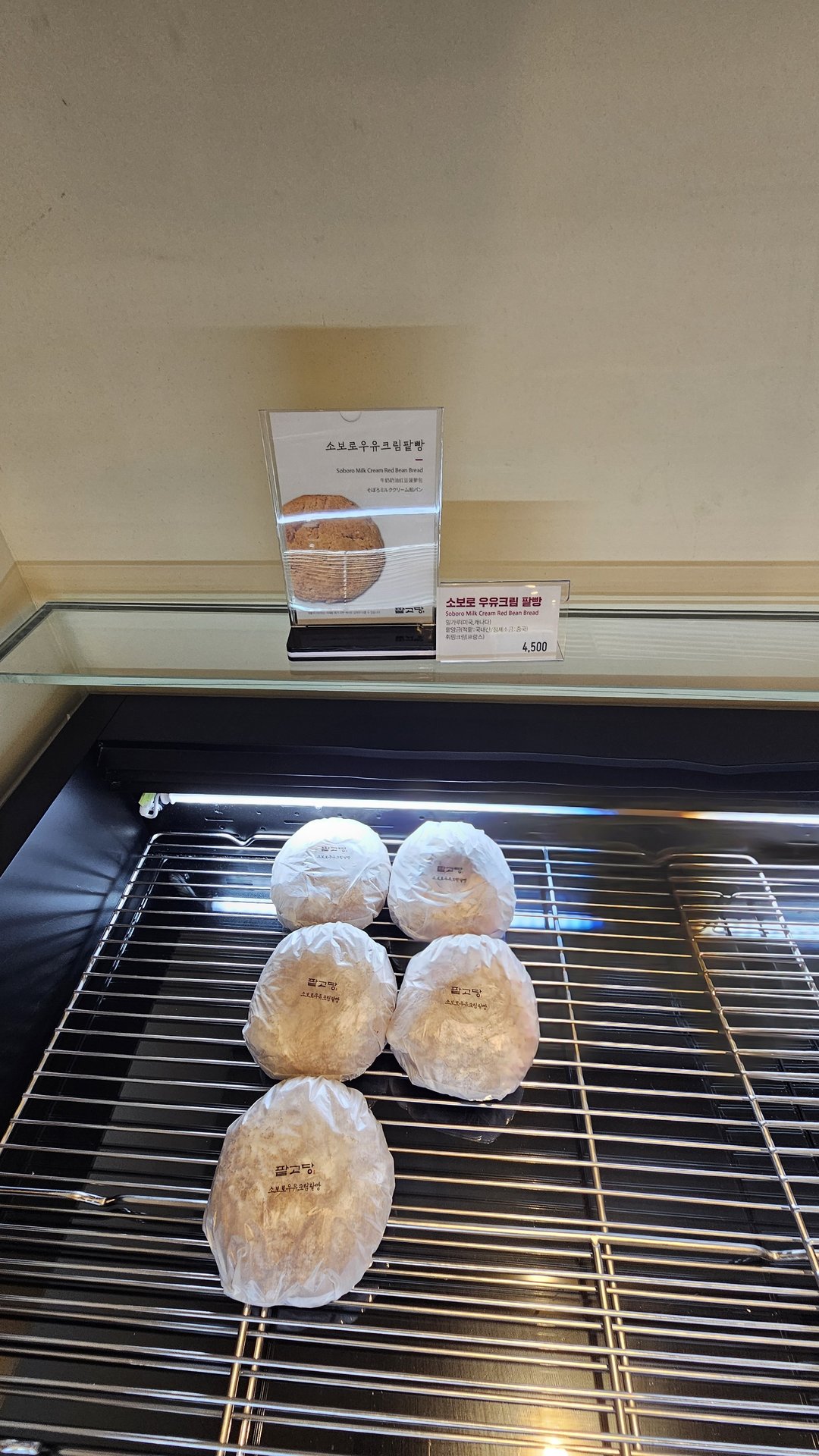
    Soboro-style red bean breads in refrigerated showcase at Patgodang with price tags attached
    Soboro-style red bean breads in refrigerated showcase at Patgodang with price tags attached
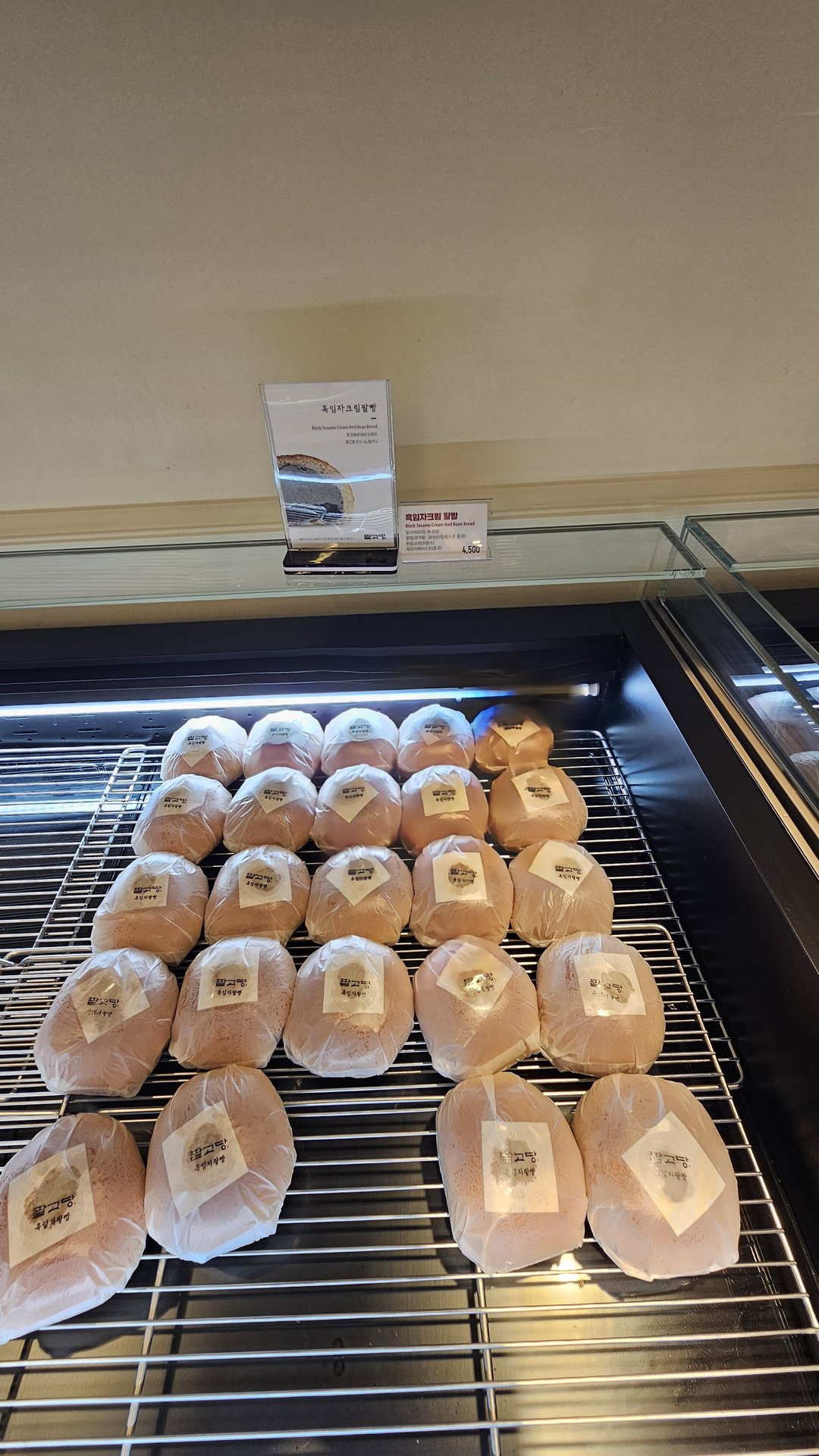
    Pink-toned red bean bread varieties in refrigerated display case at Patgodang Myeongdong
    Pink-toned red bean bread varieties in refrigerated display case at Patgodang Myeongdong
    Patgodang brand banner stating 100% Korean red beans, no preservatives, baked fresh daily
    Patgodang brand banner stating 100% Korean red beans, no preservatives, baked fresh daily

    They carry a wide range of red bean bread varieties — different shapes, fillings, and toppings. Some refrigerated, some at room temperature. All individually wrapped in plastic.

    The no-preservatives policy is legit. The storage poster makes it clear: eat within 2 days refrigerated, or freeze if you’re taking them back to your hotel for later in the trip. tbh, this is the best reason to buy bread here. Clean ingredients in a Myeongdong tourist shop isn’t a given.

    Stuff Tourists Should Know

    English menu: The bingsu board has English labels. Bread tags are mostly Korean, but staff can help.

    Card payment: Yes, cards accepted. Foreign Visa/Mastercard works fine.

    English-speaking staff: Basic English only, but enough to place an order.

    Tipping: Don’t. No tipping culture in Korea. Ever.

    Bread shelf life: 2 days refrigerated, freeze for longer. Don’t leave it in your bag in summer heat.

    Takeout: Faster than dine-in. Good option if you don’t want to wait for a seat.

    Solo dining: Fine. Counter and small table seating available.

    Vegetarian: Yes, bingsu and red bean breads are vegetarian. Check individual items if you’re avoiding dairy.

    The Verdict

    Decent. That’s the word. Not amazing, not bad — decent.

    The bingsu does what it’s supposed to do. The bread is solid. The no-preservatives thing is a real differentiator and worth caring about. But the price-to-portion ratio leaves you slightly underwhelmed, and Myeongdong has enough tourist traps that you notice when a place is charging a premium for brand and location as much as for food.

    Would I go back specifically for this? Probably not. But if I’m already in Myeongdong and want something cold and sweet? Yeah, it works.

    Should you go?

    – Already in Myeongdong and want Korean bingsu — yes, solid choice. Get the classic red bean bingsu.

    – First time trying bingsu in Seoul — decent introduction, though not the best value in the city.

    – Budget is tight — look outside the main tourist strip for cheaper bingsu options.

    – Care about clean ingredients — the no-preservative bread is worth grabbing as a snack for later.

    FAQ

    What is bingsu and what does Patgodang serve?

    Bingsu (빙수) is Korean shaved ice — milk-based ice shaved to a snow-like texture, topped with sweet red bean or other toppings. Patgodang specializes in red bean (팥) desserts including bingsu and freshly baked red bean bread with no preservatives.

    How much does it cost at Patgodang Myeongdong?

    Red bean bingsu starts at 14,000 KRW (~$10.40 USD). Red bean breads run 3,500–5,000 KRW (~$2.60–3.70 USD). Budget around 15,000–20,000 KRW per person for a bingsu and a bread.

    Do they accept foreign credit cards?

    Yes. Myeongdong is one of Seoul’s most foreigner-friendly areas — Visa and Mastercard work without issue.

    Is there an English menu at Patgodang?

    The main menu board includes English labels for the bingsu varieties. Individual bread tags are mostly in Korean, but staff can assist with basic English. You’ll manage fine without Korean.

    How long is the wait at Patgodang?

    During peak afternoon hours, expect a short wait for a seat — around 10–20 minutes in tourist season. Takeout bread is faster. Check their official Instagram for current hours before visiting.

    Are the breads vegetarian?

    Yes, the red bean bingsu and most red bean breads are vegetarian. All bread is made without preservatives and has a short shelf life — refrigerate within 2 days, or freeze for longer storage.
    You might also like

    📍 Location

    Open in Google Maps →

  • Myeongdong Gyoja in Myeongdong: Honest Kalguksu Review

    Myeongdong Gyoja in Myeongdong: Honest Kalguksu Review

    Quick honest review of Myeongdong Gyoja — a kalguksu institution that’s been feeding tourists and locals in Seoul’s most chaotic shopping district since 1966. Skip to the verdict if you’re in a hurry, but the short version: the mandu is excellent, the kalguksu broth is the real reason people keep coming back, and the garlic kimchi will wreck your breath for the rest of the afternoon.

    Worth it.

    Went on a Tuesday around 2:40 PM with two other people — well past the lunch rush. Still had to wait. Still packed inside.

    What Is Myeongdong Gyoja?

    “Gyoja” (교자) is the Korean reading of 餃子 — the same character used for gyoza in Japan and jiaozi in China. Dumplings, basically. But the dumplings aren’t even the main event here. It’s the kalguksu that built this place’s reputation.

    Kalguksu (칼국수) is a Korean knife-cut noodle soup. Thick, flat, hand-cut wheat noodles in a long-simmered broth. The noodles aren’t uniform — they’re not machine-extruded — so they have that rustic, slightly uneven texture that machine noodles can’t fake. Myeongdong Gyoja’s broth is chicken-based, cooked down until it turns pale golden and rich. Clean but deep. The kind of thing that doesn’t look like much until you taste it.

    Nearly 60 years of serving this soup. There’s a reason it’s still here while most restaurants around it rotate every two years.

    The Michelin Thing

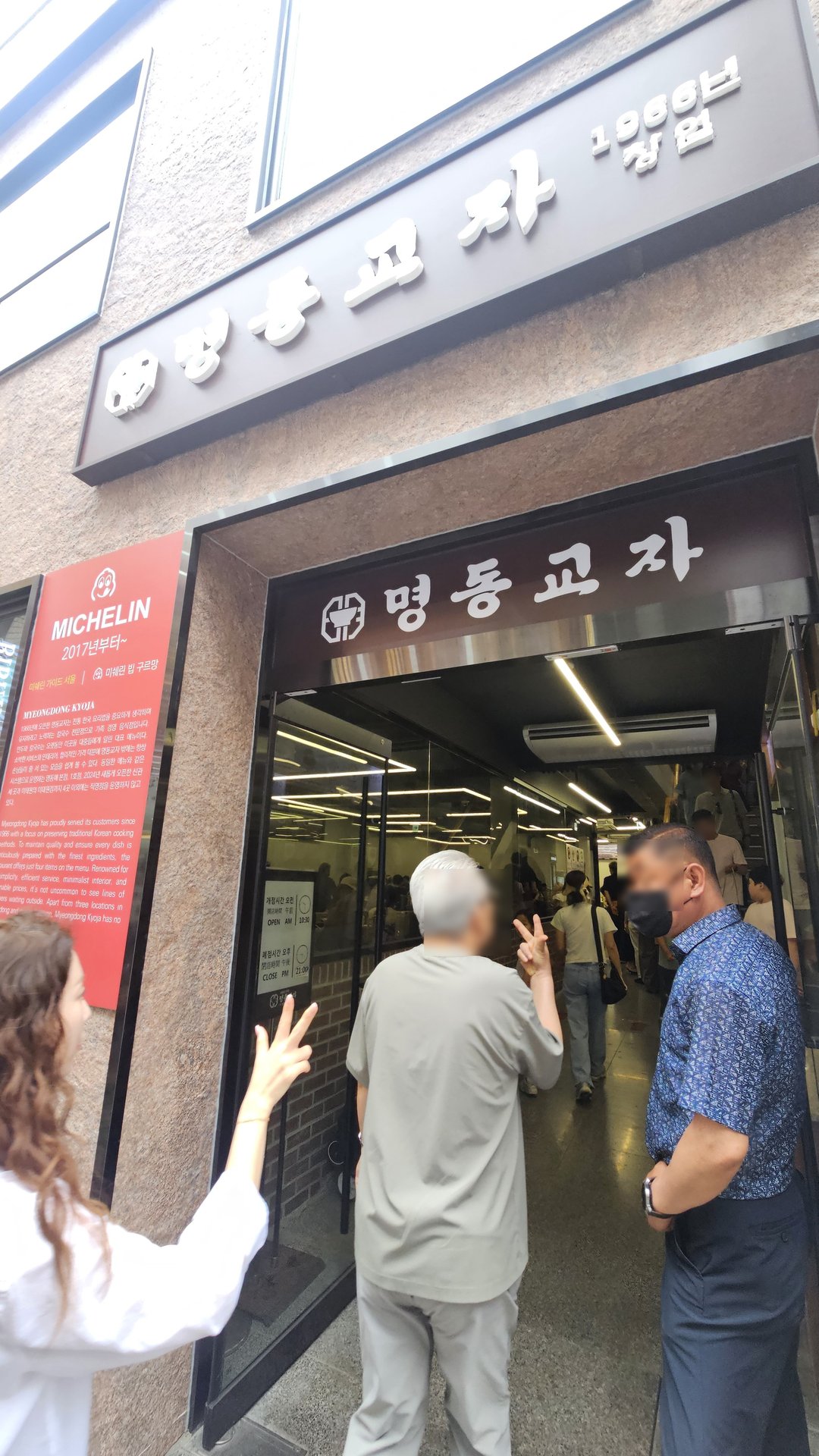
    Myeongdong Gyoja main branch entrance with Michelin Guide sign and crowd waiting outside
    Myeongdong Gyoja main branch entrance with Michelin Guide sign and crowd waiting outside

    It’s on the Michelin Bib Gourmand list. Not a star — Bib Gourmand is Michelin’s “exceptional food at honest prices” category. Still real recognition, and one of the very few noodle spots in Seoul to get it.

    Not overselling this. It’s not fine dining. It’s a canteen-style lunch spot that seats maybe 80–100 people under fluorescent lights. But that’s exactly what Bib Gourmand is supposed to flag — places that deliver consistently good food without charging you for the decor.

    Getting There

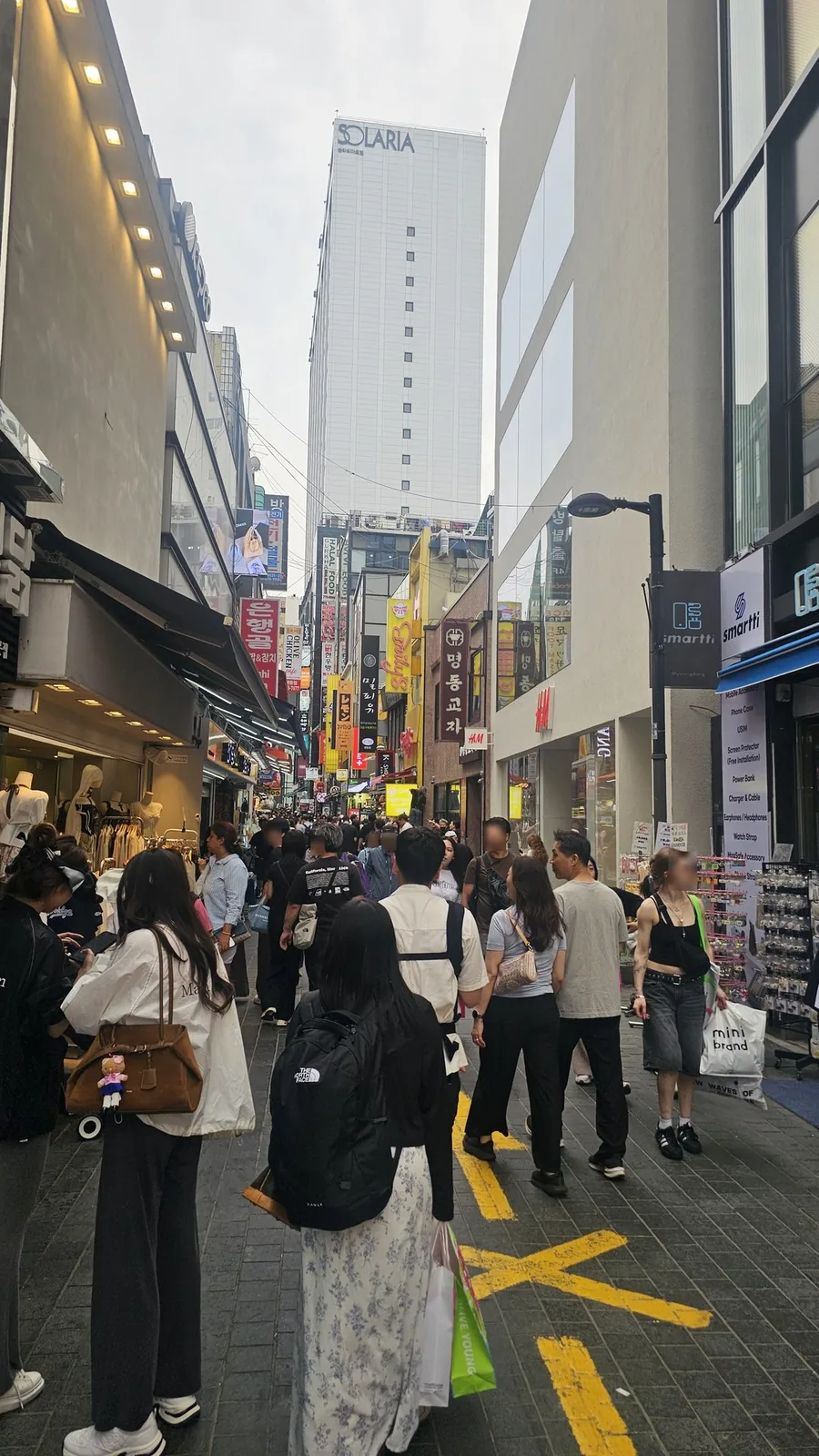
    Myeongdong main street packed with tourists and shoppers Seoul

    Myeongdong main street packed with tourists and shoppers Seoul

    Myeongdong Gyoja main branch is right in the middle of Myeongdong — Seoul’s most tourist-dense shopping street, lined with K-beauty stores, street food carts, and more international visitors per square meter than almost anywhere else in the city.

    Subway: Exit 5 or 8 from Myeongdong Station (Line 4, orange line). Walk toward the main pedestrian street and look for the line outside.

    From Incheon Airport: About 1 hour by Airport Railroad (AREX) to Seoul Station, then one stop on Line 4 to Myeongdong.

    From Hongdae or Sinchon: About 30–40 minutes by subway.

    You can’t miss Myeongdong. It feels like a weekend crowd even on a Tuesday.

    The Pre-Payment System — Read This First

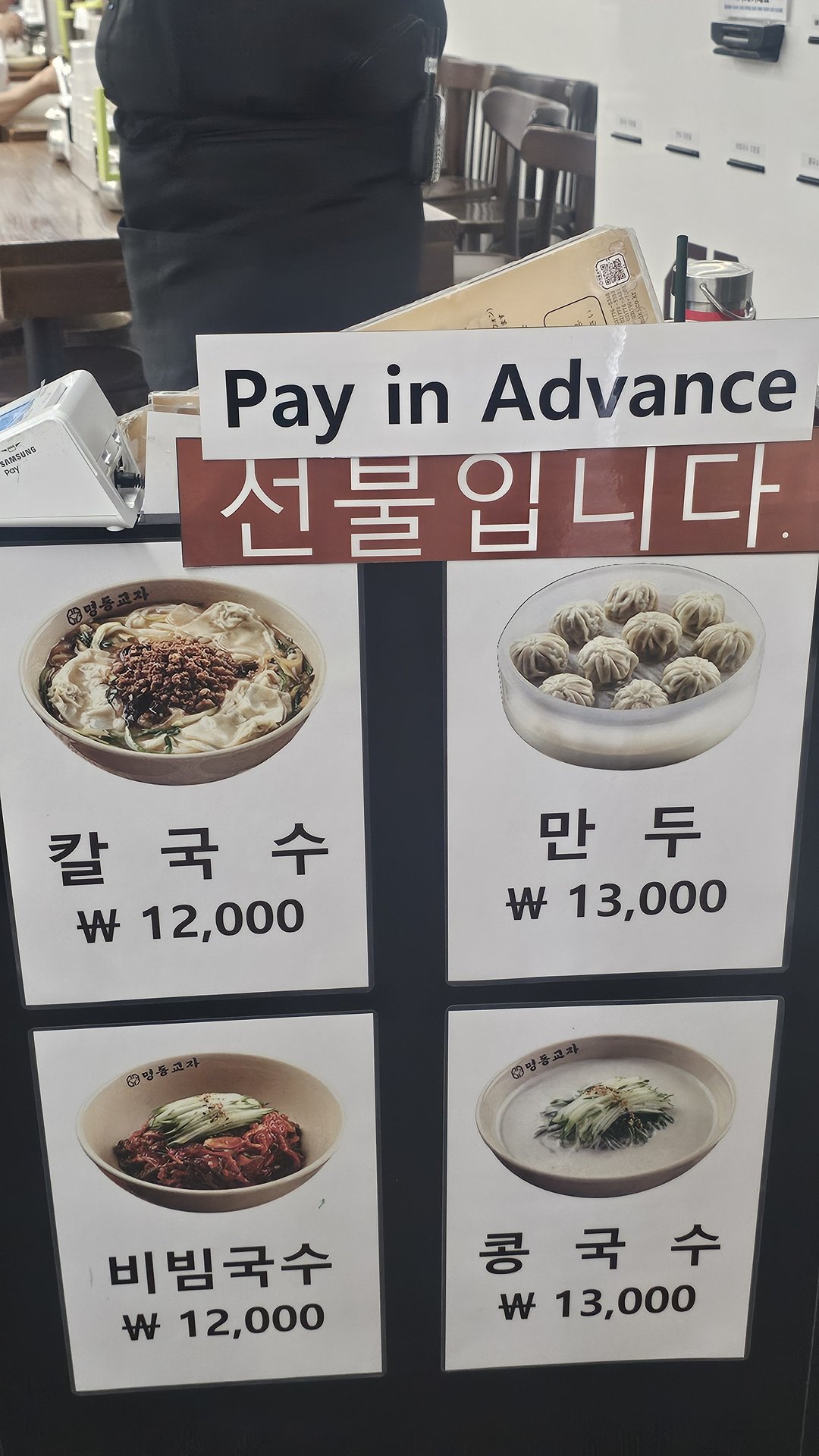
    Pre-payment menu board at Myeongdong Gyoja with Pay in Advance notice in English

    Pre-payment menu board at Myeongdong Gyoja with Pay in Advance notice in English
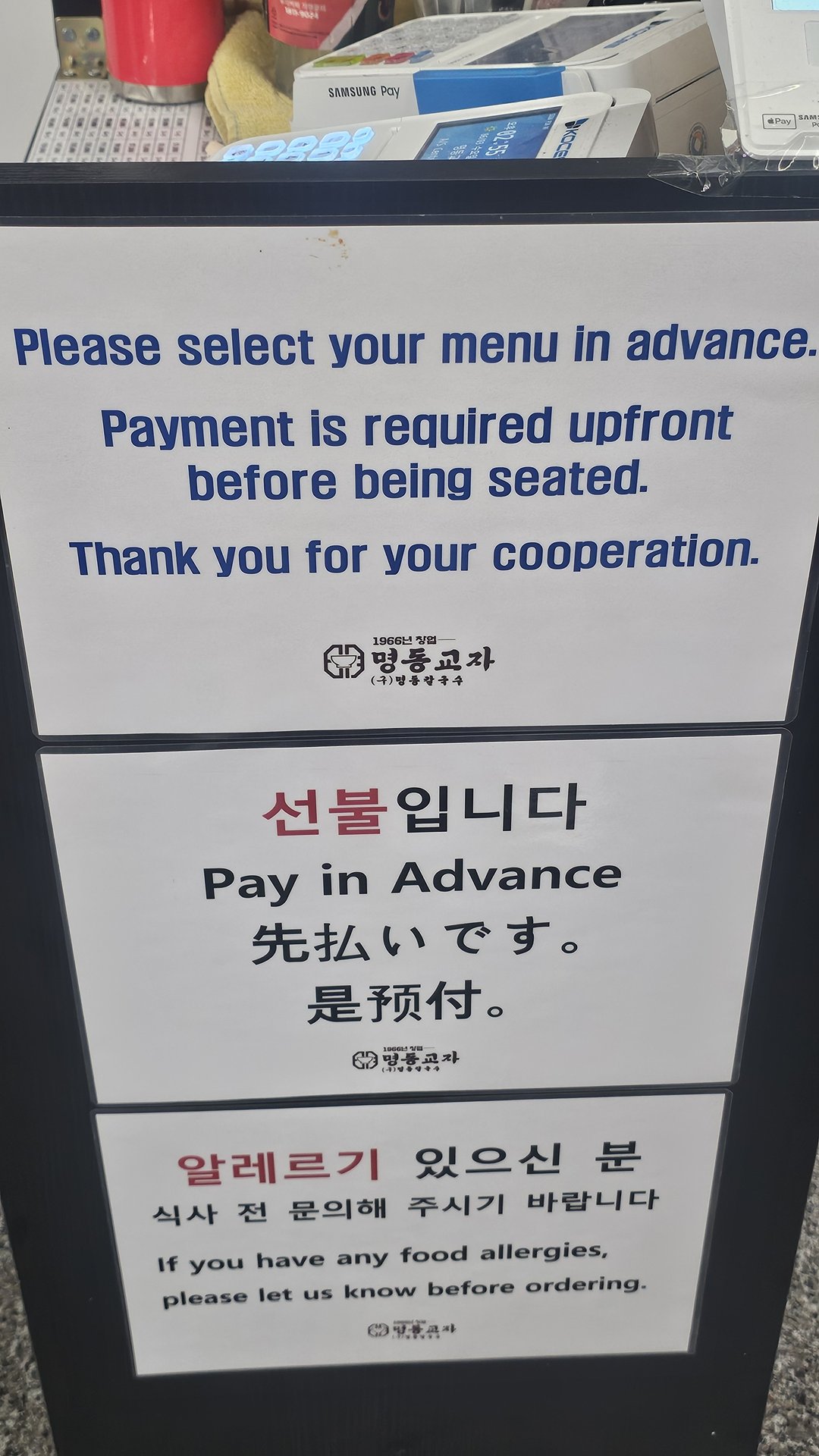
    Trilingual pre-payment policy notice in Korean English and Japanese at Myeongdong Gyoja entrance

    Trilingual pre-payment policy notice in Korean English and Japanese at Myeongdong Gyoja entrance

    You pay before you sit. This catches first-timers off guard.

    When you get to the door, they direct you to a counter where you order and pay upfront. Then you wait for a table. Signs in Korean, English, and Japanese explain the process — once you see them, it’s clear. But if you walk in expecting to sit first and pay later, just know it doesn’t work that way.

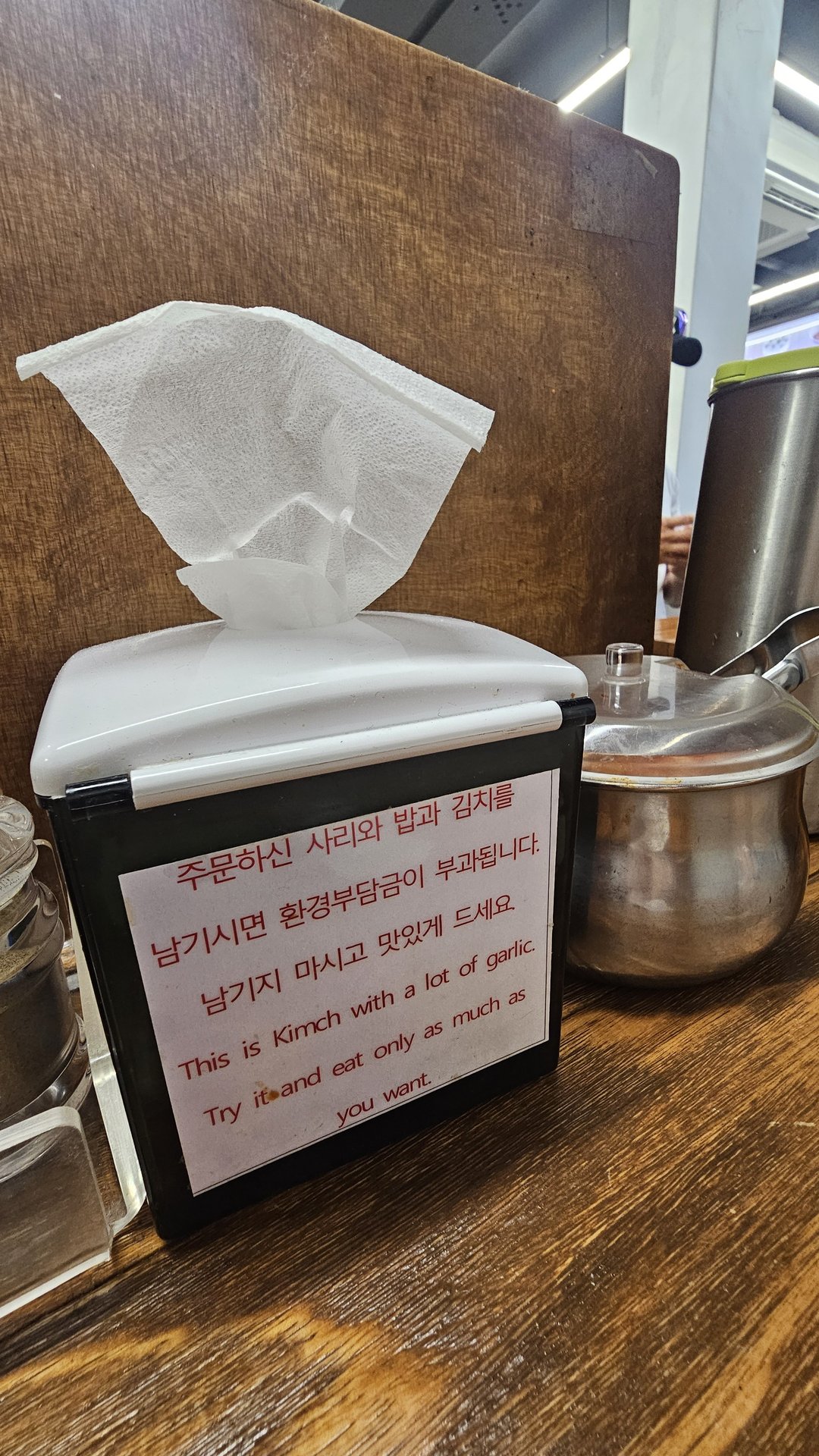
    Also: there’s a food waste notice at every table. If you don’t finish your food, there’s an environmental fee. Just eat your food.

    Inside

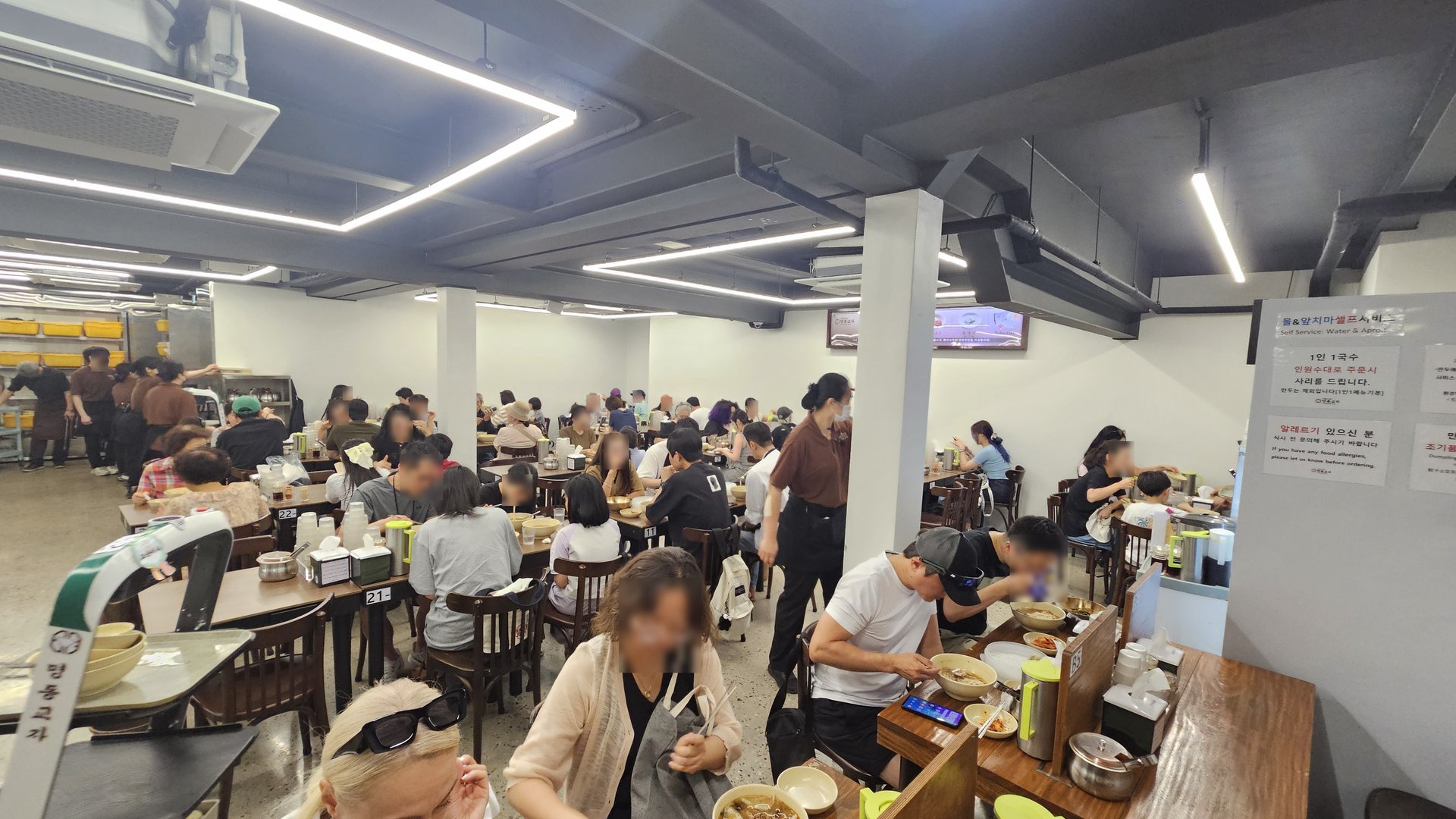
    Crowded interior dining hall of Myeongdong Gyoja with bright fluorescent lighting and packed tables

    Crowded interior dining hall of Myeongdong Gyoja with bright fluorescent lighting and packed tables

    Big, bright, functional. Rows of tables under fluorescent lights. At 2:40 PM on a Tuesday — past peak lunch — it was still nearly full.

    This is not an atmosphere place. No music, no mood lighting, no Instagram corner. It’s a room built to feed a lot of people fast. Tables turn quickly, staff moves quickly. Sit down, eat, leave. Everyone seems to understand this implicitly.

    What I Ordered

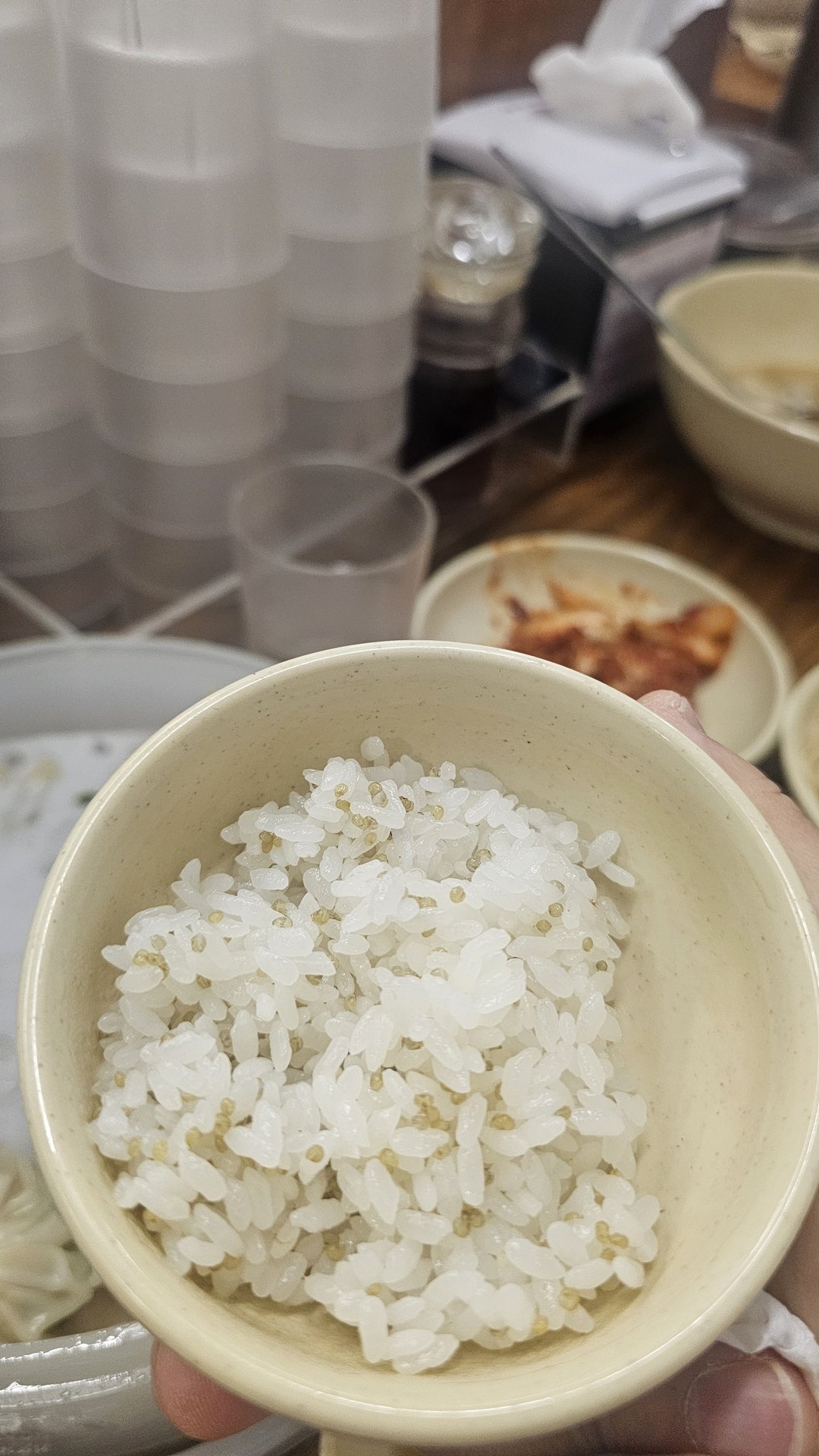
    Small white rice bowl held in hand at Myeongdong Gyoja

    Small white rice bowl held in hand at Myeongdong Gyoja

    Three people, three dishes: mandu, kalguksu, bibim guksu. Total came to 37,000 KRW (~$27 USD) for all three — about $9 per person. For Michelin-recognized food in the middle of Myeongdong, that’s genuinely fair pricing.

    Rice (공기밥) was thrown in extra at no charge.

    Mandu (Steamed Dumplings) — 13,000 KRW (~$9.60)

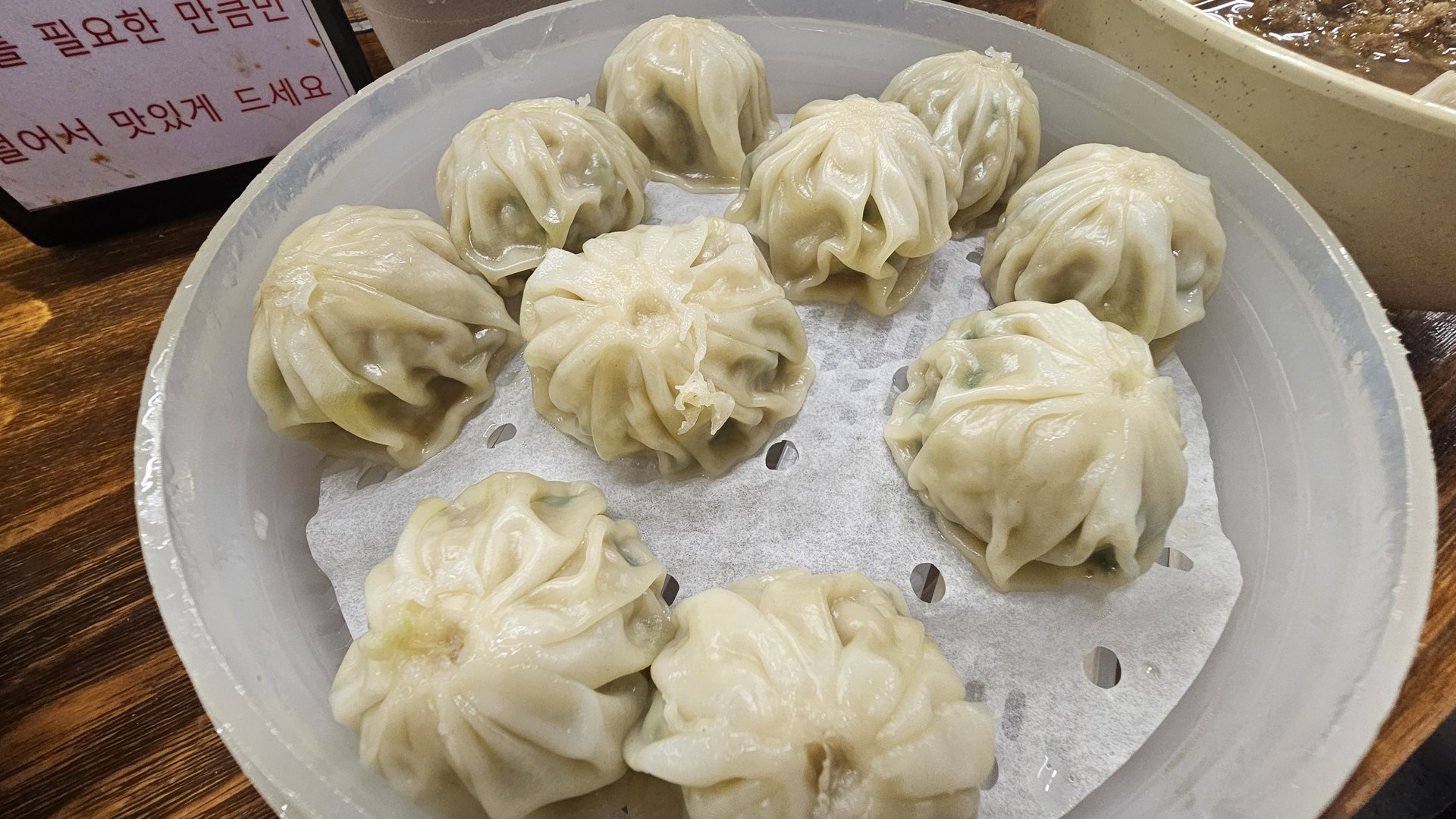
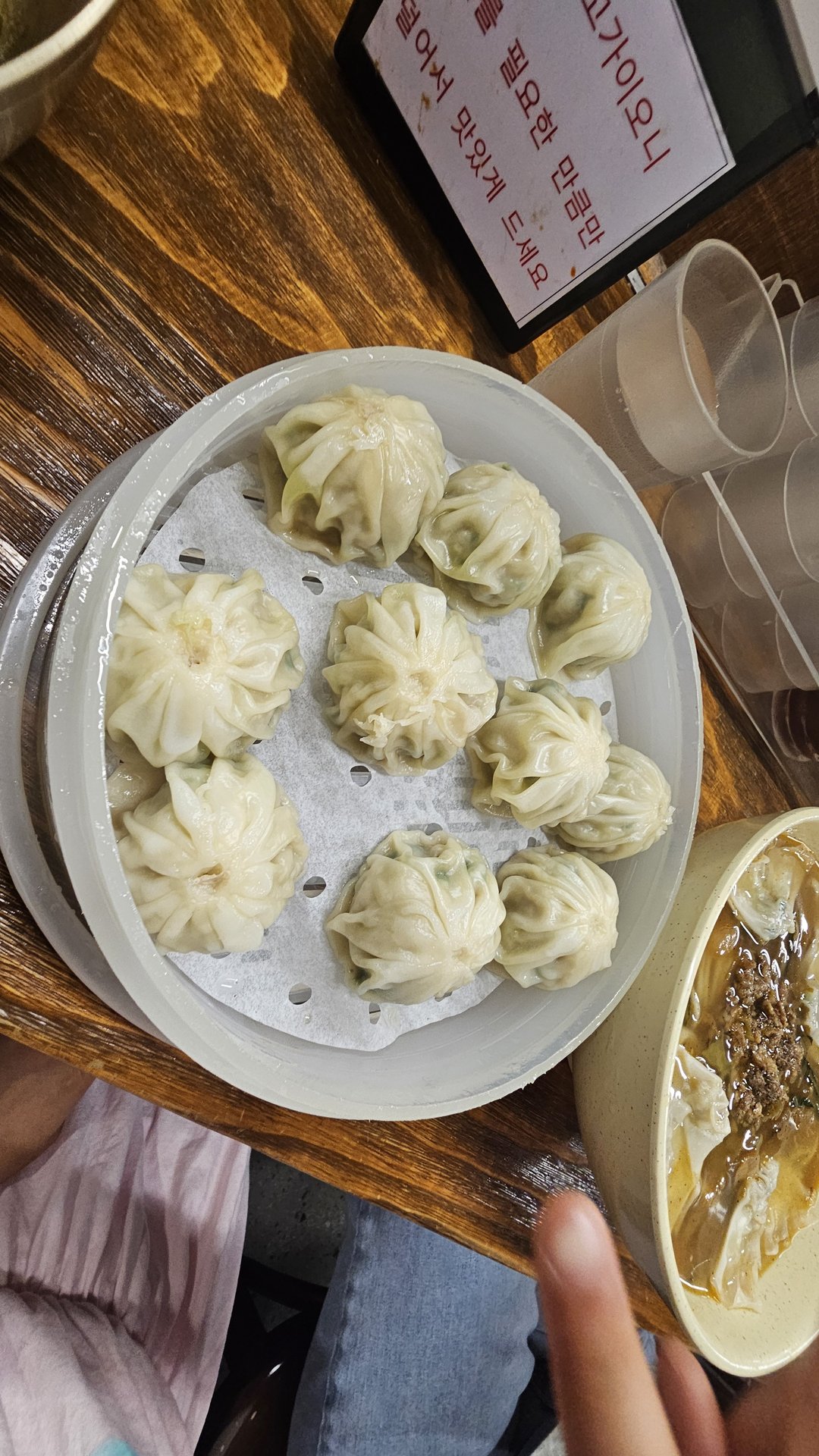
    Closeup of nine steamed mandu dumplings in bamboo steamer at Myeongdong Gyoja

    Closeup of nine steamed mandu dumplings in bamboo steamer at Myeongdong Gyoja
    Steamed mandu dumplings in bamboo steamer alongside kalguksu noodle soup at Myeongdong Gyoja

    Steamed mandu dumplings in bamboo steamer alongside kalguksu noodle soup at Myeongdong Gyoja

    The mandu is really good.

    These are large, thick-skinned Korean dumplings — not the delicate dim sum style, not pan-fried Japanese gyoza. The skin is substantial and chewy. The filling is pork and vegetables, well-seasoned and tightly packed. When you bite through, there’s good juice but not the explosive soup-dumpling situation — just proper, satisfying mandu.

    Nine dumplings per order. Solid value at 13,000 KRW.

    If your only reference point for dumplings is Japanese gyoza (thin-skinned, crispy, pan-fried), these will feel different. Heavier, more filling-forward. I prefer this style — more to actually eat.

    Kalguksu (Knife-Cut Noodle Soup) — 12,000 KRW (~$8.90)

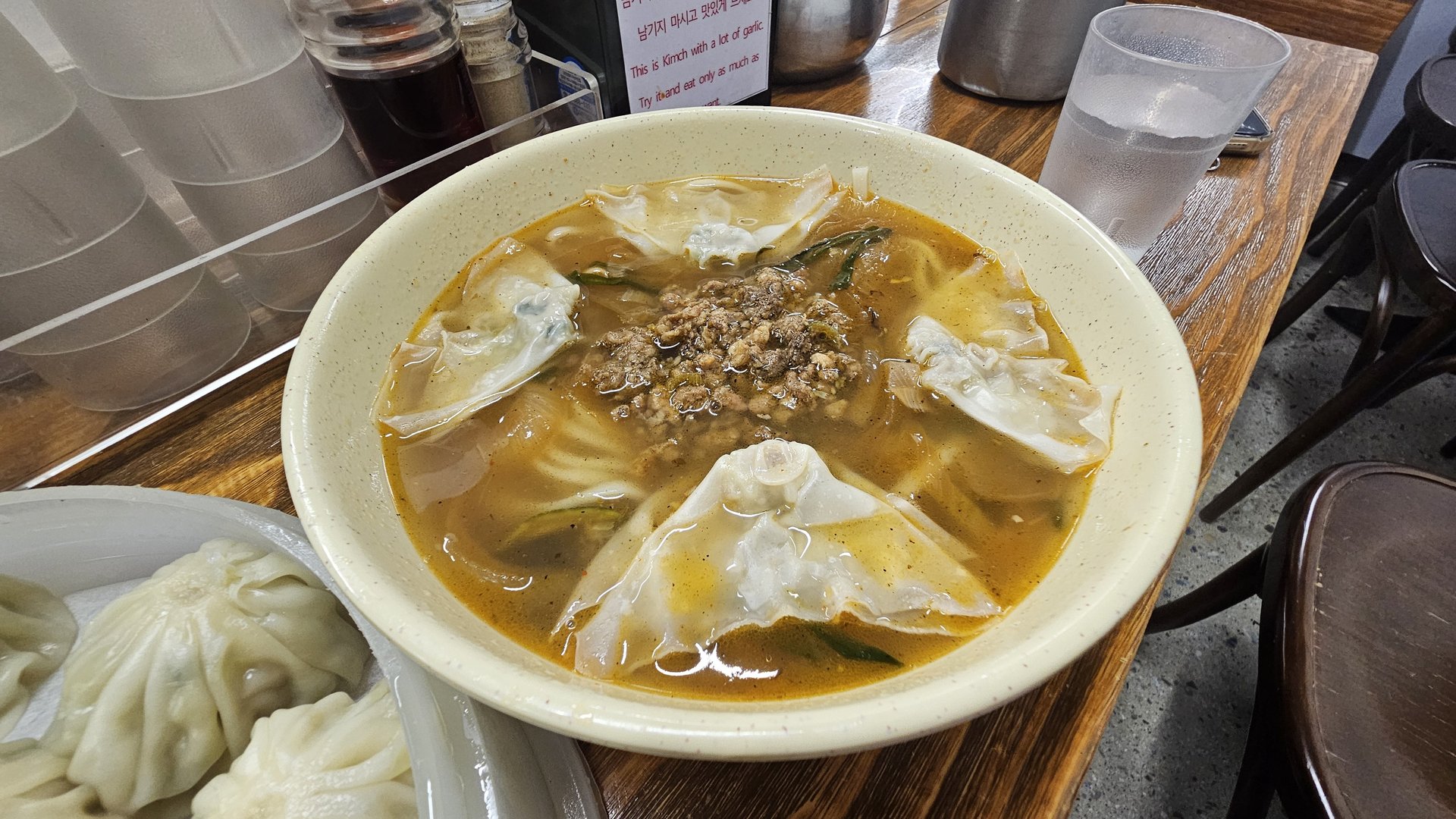
    Kalguksu knife-cut noodle soup with minced meat and thick noodles in bowl at Myeongdong Gyoja

    Kalguksu knife-cut noodle soup with minced meat and thick noodles in bowl at Myeongdong Gyoja
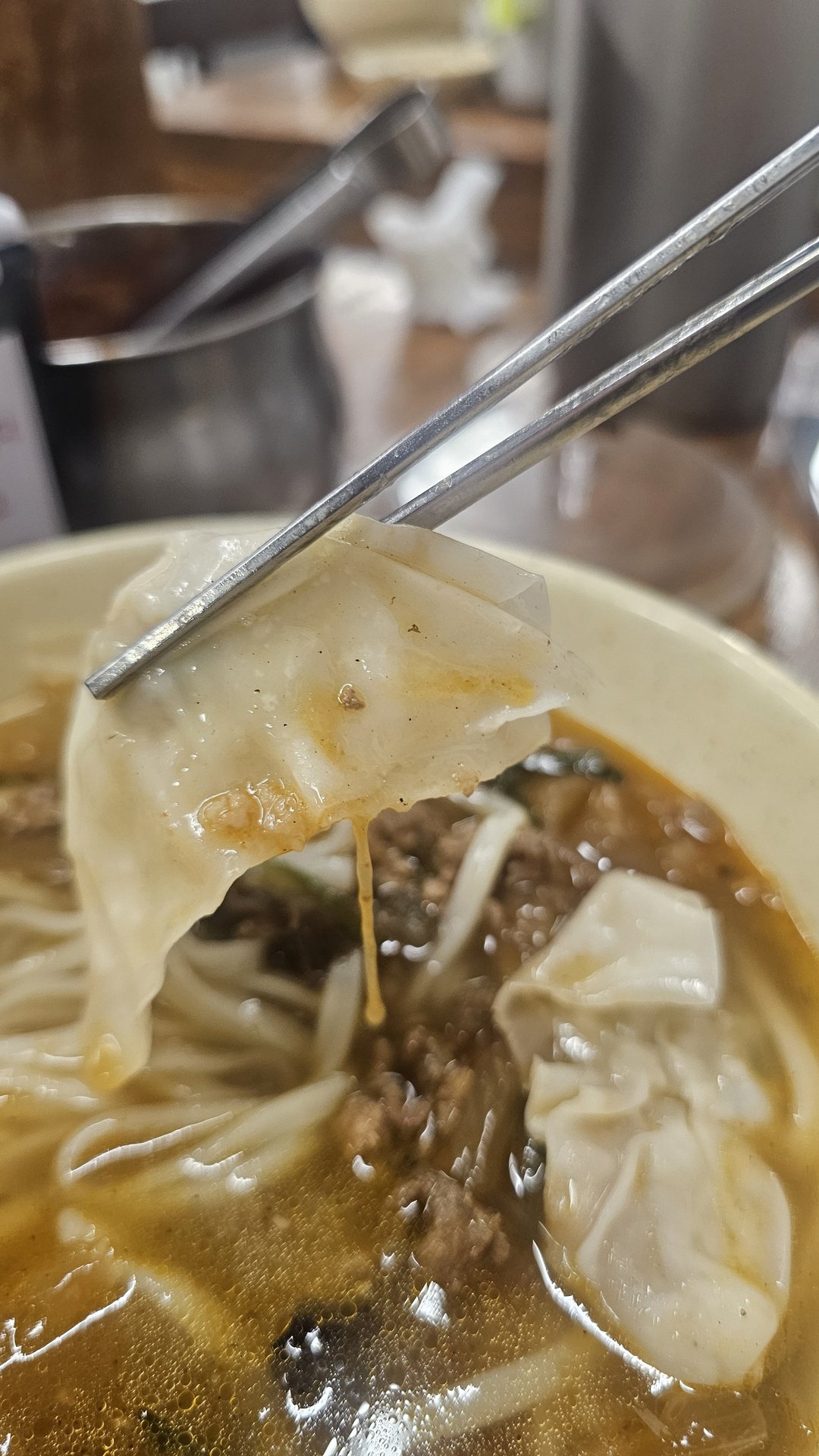
    Chopsticks lifting kalguksu knife-cut noodles from bowl at Myeongdong Gyoja

    Chopsticks lifting kalguksu knife-cut noodles from bowl at Myeongdong Gyoja

    This is the dish that made the restaurant famous. And yeah — the broth delivers.

    Chicken-based, long-simmered, pale and slightly cloudy. Clean but genuinely deep. Not salty, not spicy — just rich in a way that’s hard to pin down until you’ve had a few spoonfuls. The kind of broth that makes you want to keep drinking it even when you’re already full.

    The noodles are thick and hand-cut, so they have a slightly uneven, rustic texture — not mushy, not too chewy. They hold up in the broth without going soft. Simple toppings: a few thick pieces that look like dumpling skin, some minced meat on top. The broth does all the work.

    tbh, this is the dish to order. If you’re only getting one thing, get this.

    Bibim Guksu (Spicy Mixed Noodles) — 12,000 KRW (~$8.90)

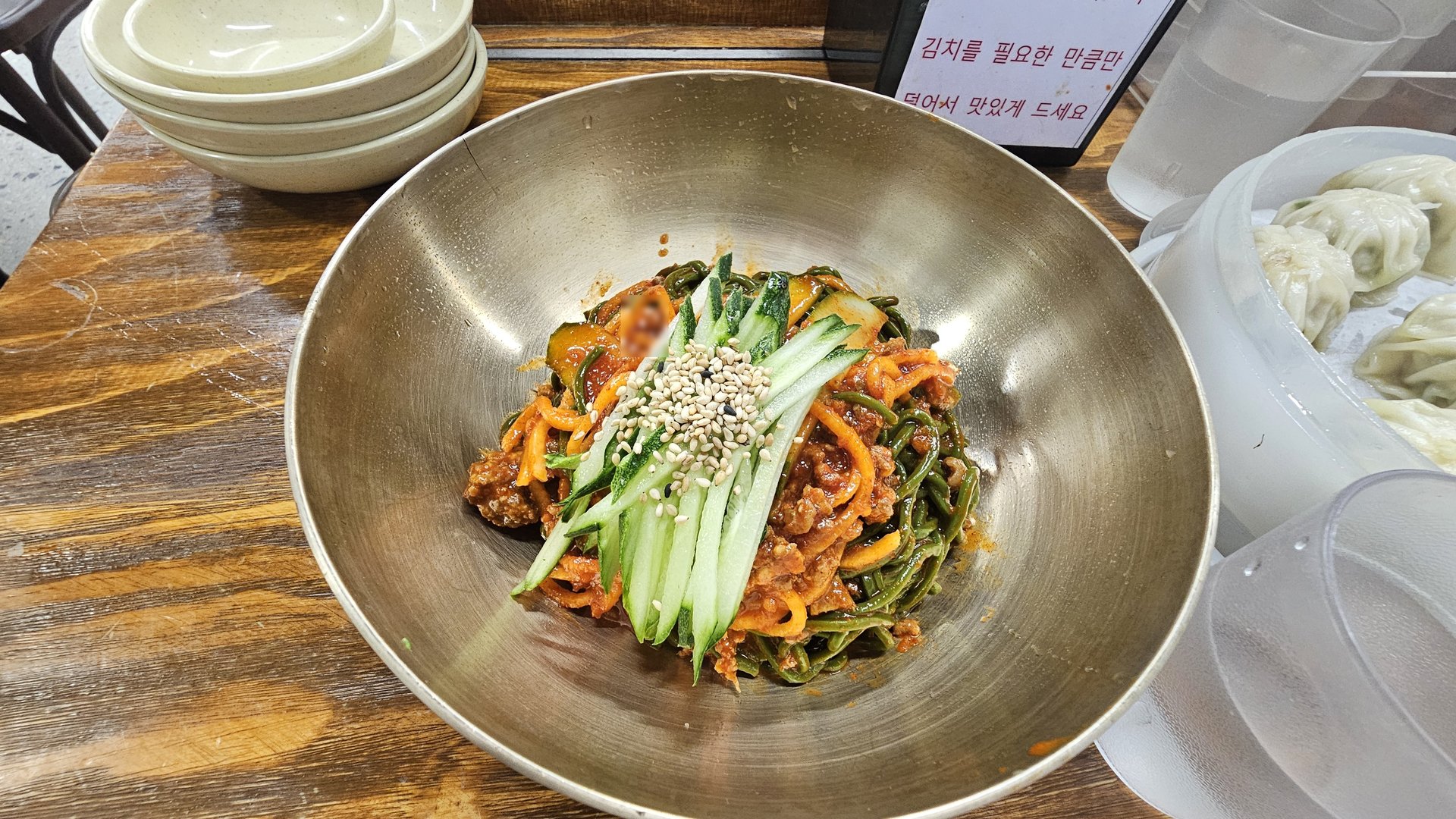
    Bibim guksu spicy cold noodles in large stainless steel bowl topped with cucumber perilla and sesame

    Bibim guksu spicy cold noodles in large stainless steel bowl topped with cucumber perilla and sesame
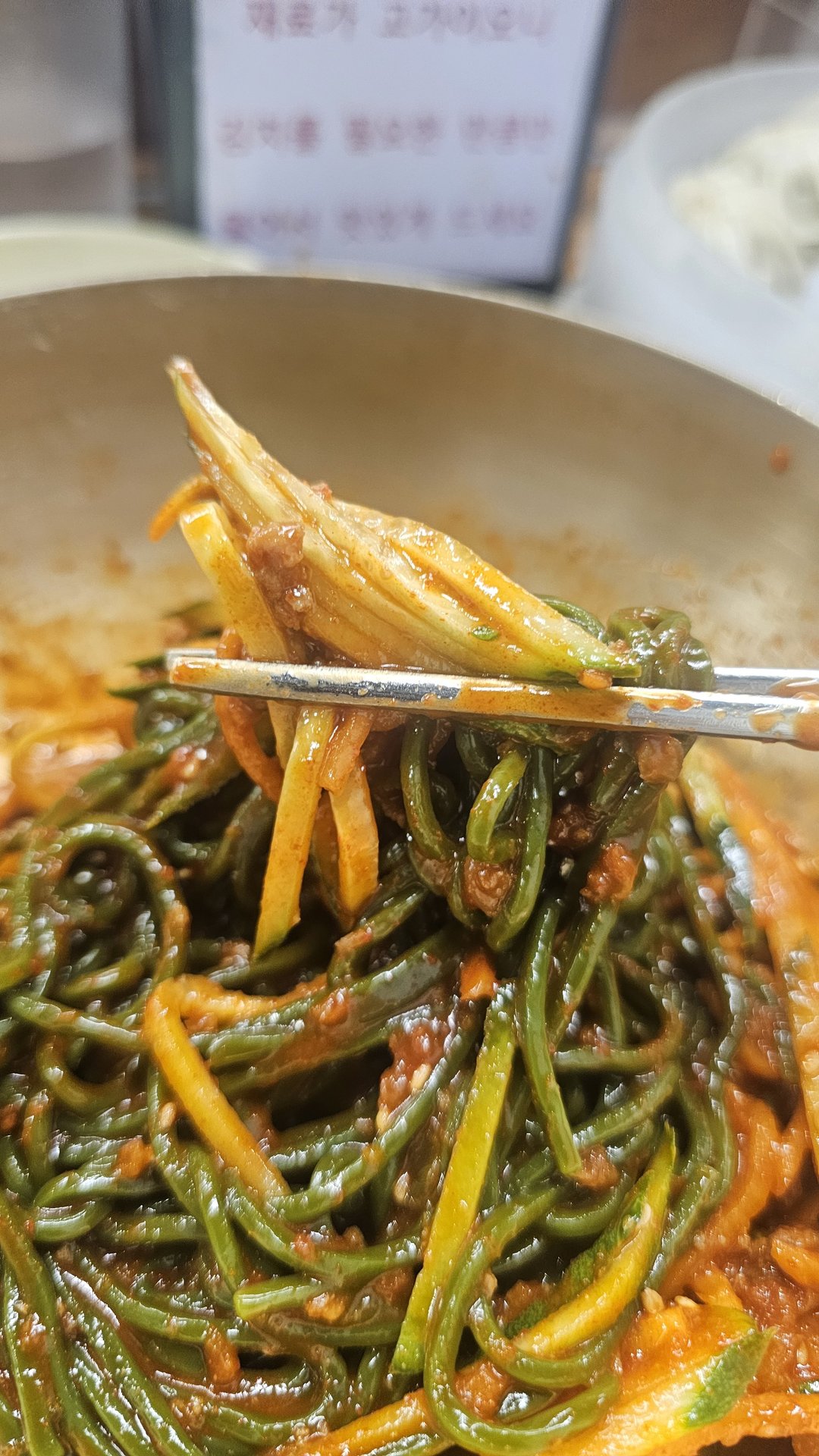
    Chopsticks lifting bibim guksu cold noodles showing green and yellow strands

    Chopsticks lifting bibim guksu cold noodles showing green and yellow strands

    Bibim guksu is cold noodles tossed in a spicy red sauce — think Korean cold noodles, more fiery than sweet. Myeongdong Gyoja’s version comes in a big stainless steel bowl with julienned cucumber, perilla leaves (깻잎), and sesame seeds on top. The noodles are thinner than the kalguksu, and the sauce has a clean kick — not brutal, but present.

    It’s good. Not as distinctive as the kalguksu, but if you’ve been eating heavy Korean food all week and want something cold and lighter, this works.

    Honestly, if it’s summer and you’re already hot and tired from walking around Myeongdong, order this.

    Kong Guksu — We Skipped It, But Worth Knowing About

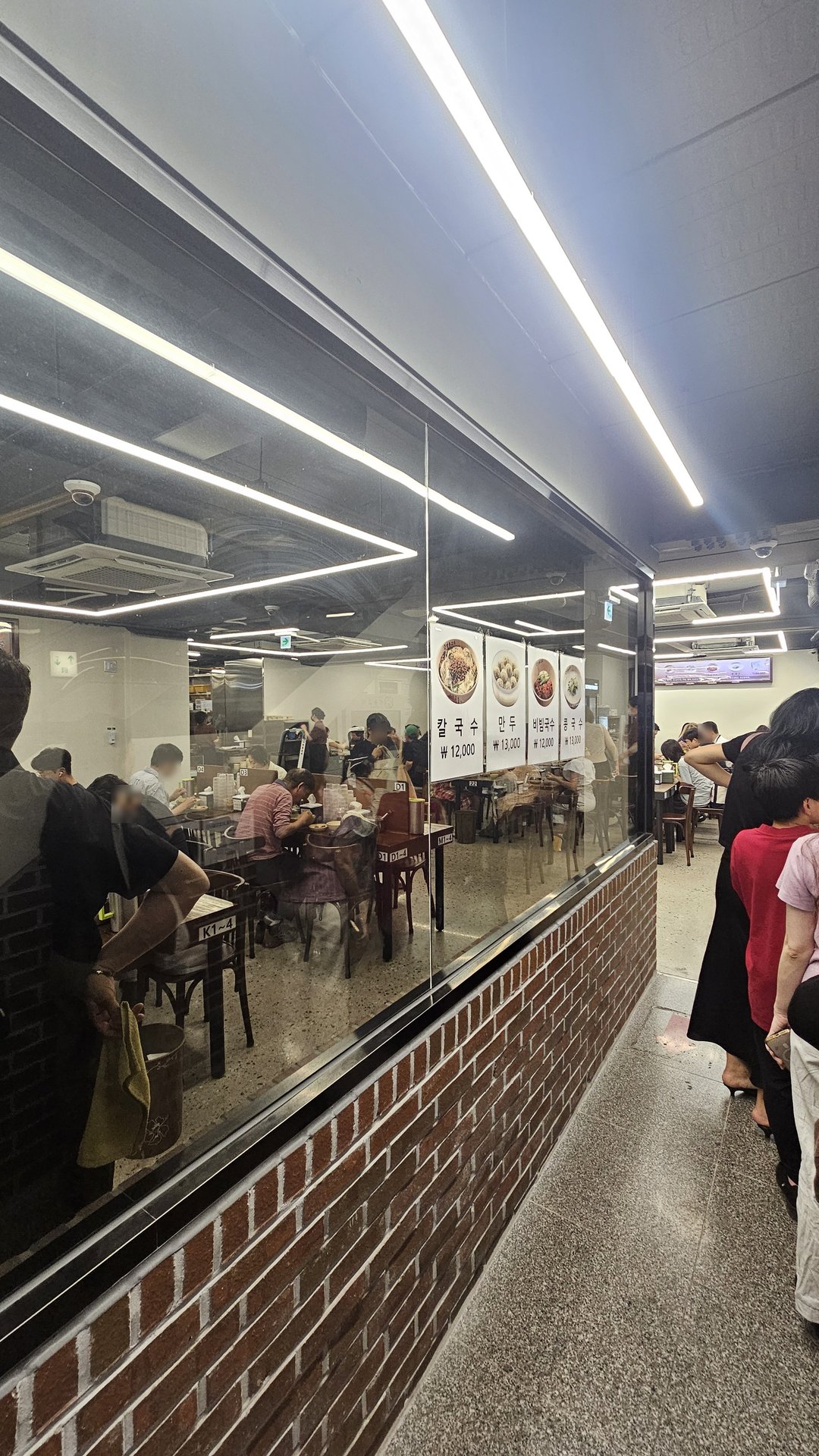
    Interior view through glass window showing queue and menu price board at Myeongdong Gyoja

    Interior view through glass window showing queue and menu price board at Myeongdong Gyoja
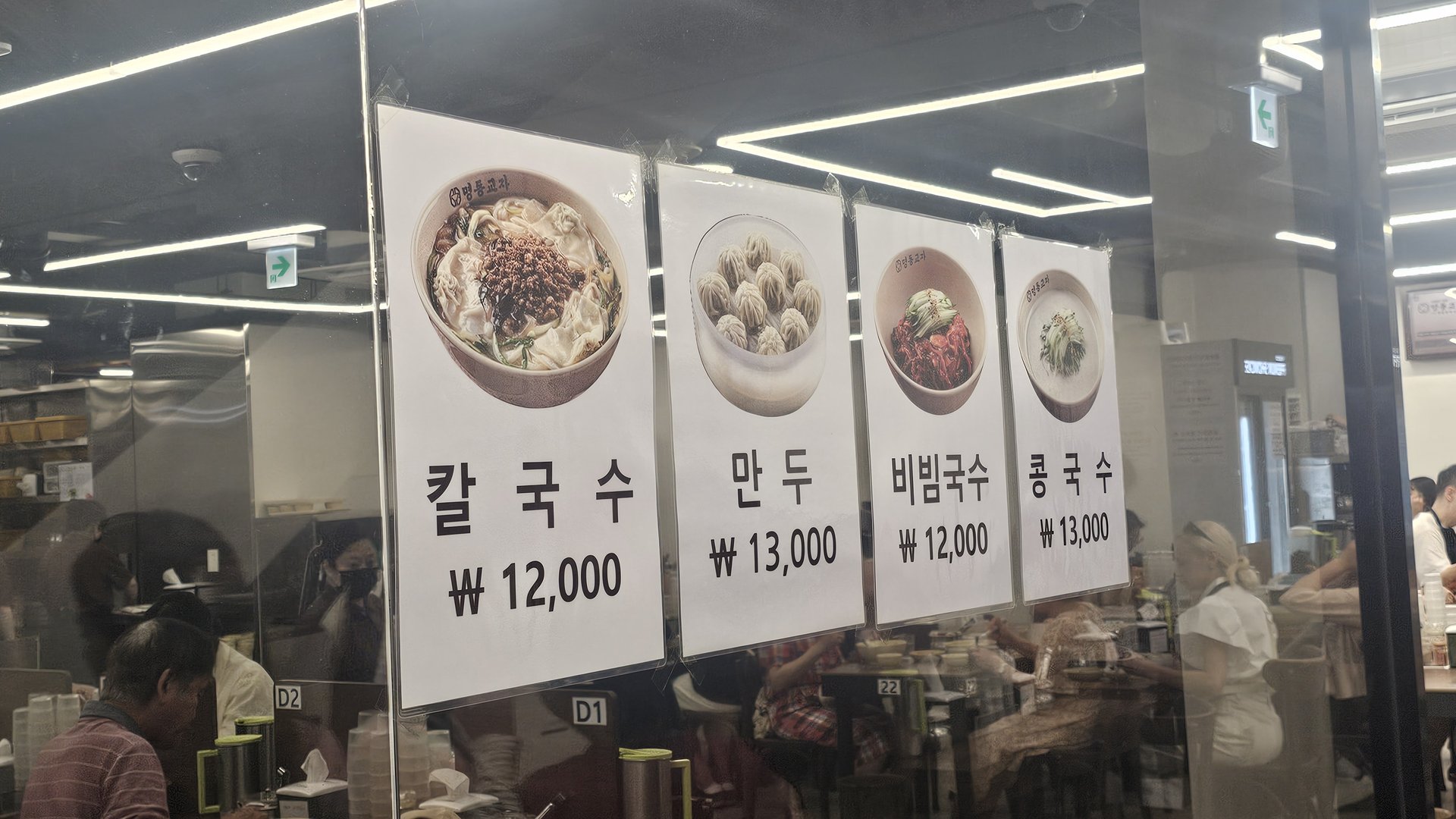
    Menu board closeup at Myeongdong Gyoja showing kalguksu 12000 won and mandu 13000 won

    Menu board closeup at Myeongdong Gyoja showing kalguksu 12000 won and mandu 13000 won

    Kong guksu (콩국수) is cold noodles in chilled soy milk broth — a summer Korean specialty that sounds stranger than it tastes. Creamy, slightly nutty, surprisingly refreshing. 13,000 KRW, and it’s seasonal. Worth trying on a hot day if you’re feeling adventurous.

    The Kimchi Situation

    Table notice at Myeongdong Gyoja warning that kimchi contains a lot of garlic in English and Korean

    Table notice at Myeongdong Gyoja warning that kimchi contains a lot of garlic in English and Korean
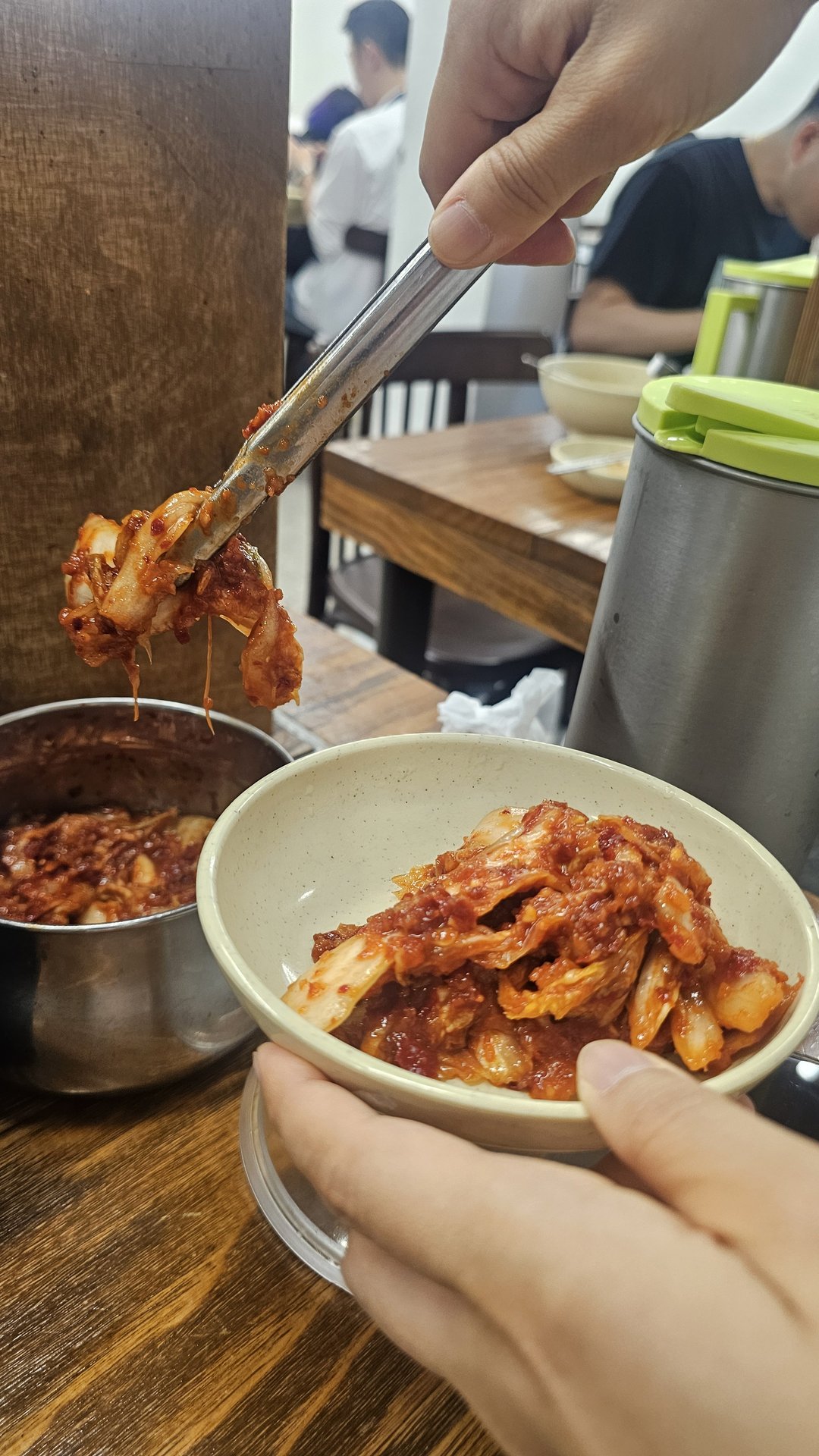
    Self-service kimchi station with tongs at Myeongdong Gyoja

    Self-service kimchi station with tongs at Myeongdong Gyoja

    Kimchi here is self-service and free to refill. There’s also a notice on every table in English that basically says: this kimchi has a lot of garlic.

    They mean it.

    It’s garlicky, fermented, and pungent in the way properly aged kimchi should be. Goes great with the kalguksu broth. If you have any afternoon meetings or close-contact plans after this, maybe exercise some restraint. If you don’t, pile it on.

    Unlimited refills. This is one of those simple Korean restaurant things that always delights visitors.

    Stuff Tourists Should Know

    Price: 12,000–13,000 KRW per dish (~$9–10 USD). For Myeongdong — Seoul’s most expensive tourist corridor — that’s a fair deal.

    Payment: Cards accepted. Foreign Visa and Mastercard generally work fine in Seoul, and this place sees enough international visitors that it shouldn’t be an issue. Remember: pay at the counter before you sit.

    English: Signs in three languages. Menu has four items. You’ll be fine.

    Reservations: None. First-come, first-served.

    Wait time: We waited about 10–15 minutes at 2:40 PM on a Tuesday. During peak lunch (12–1 PM), expect 20–30 minutes, maybe more on weekends. Tables turn fast.

    Tipping: No. Korea doesn’t tip. Don’t leave coins behind.

    Vegetarian options: Limited. The mandu filling has pork. The kalguksu broth is chicken-based. Kong guksu (soy milk) is the closest thing to a vegetarian option — verify with staff if you’re strict about it.

    Solo dining: Fine. No issues eating alone here.

    Families with kids: Kalguksu is mild, mandu is universally liked. The place is loud and busy, which works well or badly depending on your kids.

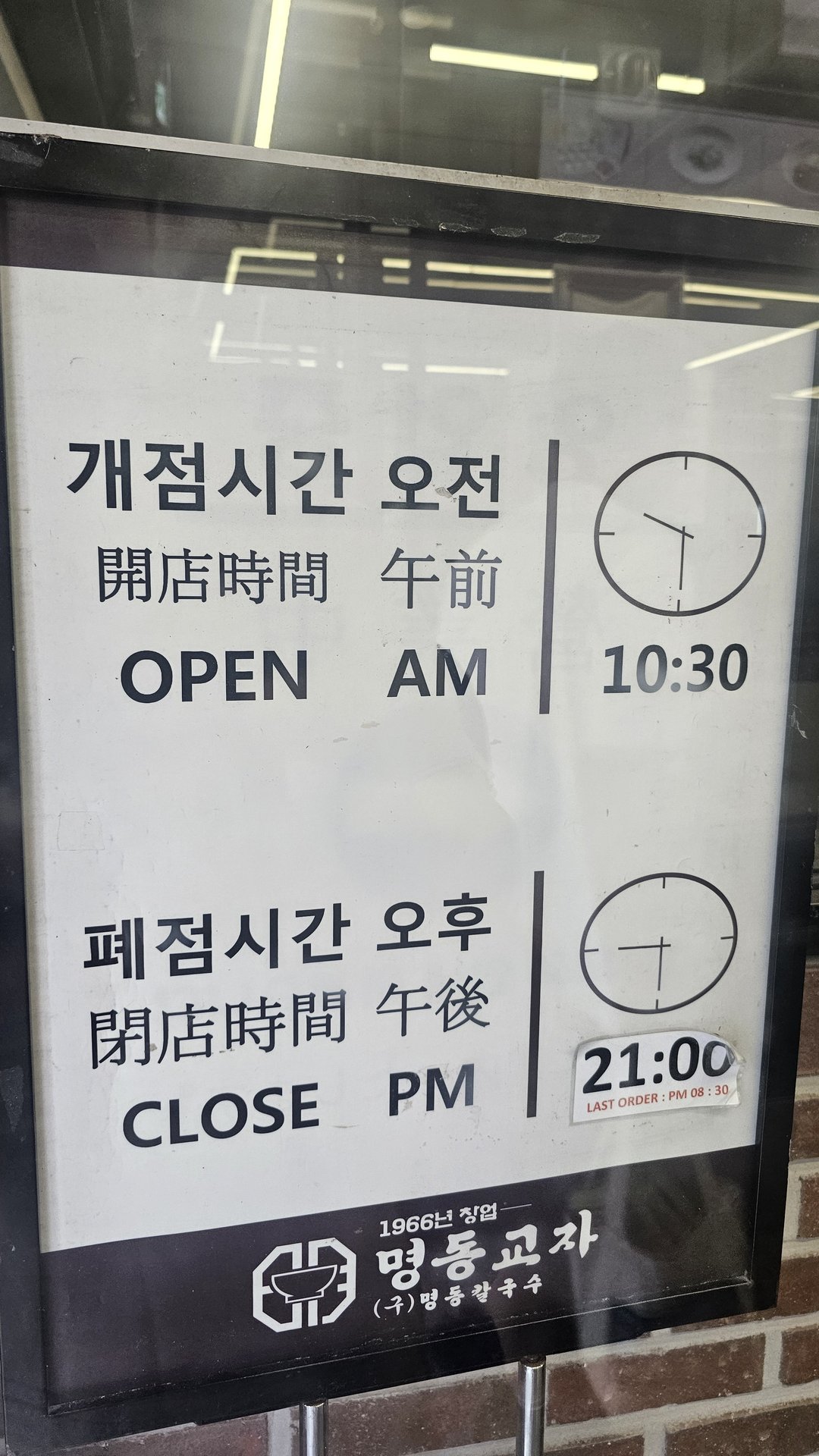
    Operating hours: 10:30 AM – 9:00 PM, last order 8:30 PM.

    Operating hours sign at Myeongdong Gyoja showing open 10:30 AM close 9:00 PM

    Operating hours sign at Myeongdong Gyoja showing open 10:30 AM close 9:00 PM

    The Verdict

    Should you go?

    Depends on your Seoul situation.

    – If you’re in Myeongdong already — yes. Get the kalguksu. Don’t overthink it.

    – If you have 3 days in Seoul and haven’t tried proper Korean noodle soup yet — yes. Kalguksu is one of those dishes every visitor should try, and this is one of the better versions in the city.

    – If you’ve done all the Korean classics and just want lunch — also yes. It’s fast, cheap for what you get, and the food is consistent.

    – If you need a calm, cozy dining experience — skip. This place is efficient, not relaxing.

    The mandu is excellent. The kalguksu broth is genuinely distinctive — that slow-cooked chicken depth isn’t something you stumble into everywhere. Prices are honest. The garlic kimchi is aggressive in the right way.

    I’ve been here multiple times over the years and it’s always the same: fast service, reliable food, zero pretension. That’s actually harder to maintain than it sounds.

    Rating: 4/5 — would edge toward a 5 if the space had any soul, but the canteen vibe is part of what keeps the prices down. Fair trade.

    FAQ

    What’s on the menu at Myeongdong Gyoja?

    Four items only — kalguksu (knife-cut noodle soup, 12,000 KRW), mandu (steamed dumplings, 13,000 KRW), bibim guksu (spicy cold noodles, 12,000 KRW), and kong guksu (cold soy milk noodles, 13,000 KRW, seasonal).

    Do you need to pay in advance at Myeongdong Gyoja?

    Yes. You order and pay at the counter before you’re seated. Signs explaining this are posted in Korean, English, and Japanese, so you won’t be caught off guard.

    Is Myeongdong Gyoja Michelin-starred?

    It’s on the Michelin Bib Gourmand list — that’s Michelin’s "great food at honest prices" category, not a star. Still real recognition, and one of the few noodle spots in Seoul to earn it.

    What are the opening hours of Myeongdong Gyoja?

    Open 10:30 AM to 9:00 PM daily, last order at 8:30 PM. No reservations — it’s first-come, first-served.

    Is Myeongdong Gyoja tourist-friendly?

    Very. Signs are in Korean, English, and Japanese. The menu has just four items, so ordering takes about ten seconds. Staff speaks enough English to get you through.

    How much does it cost per person at Myeongdong Gyoja?

    One dish runs 12,000–13,000 KRW (~$9–10 USD). Budget around that per person and you’re covered — kimchi refills are free.

    You might also like

    📍 Location

    Open in Google Maps →