Tag: yeouido restaurant

  • Xin Hong Lou in Yeouido: Honest Review of Peking Duck Seoul

    Xin Hong Lou in Yeouido: Honest Review of Peking Duck Seoul

    Quick honest review of Xin Hong Lou (鑫紅樓, 신흥러우) in Yeouido — one of Seoul’s better-known upscale Chinese restaurants, built around theatrical Peking duck service and a room that looks like a movie set. Skip to the verdict if you’re pressed for time. Short version: the duck is genuinely impressive, the room is dramatic in the best way, and this is the kind of place that turns a company dinner into an event. Not cheap. Very worth it for the right occasion.

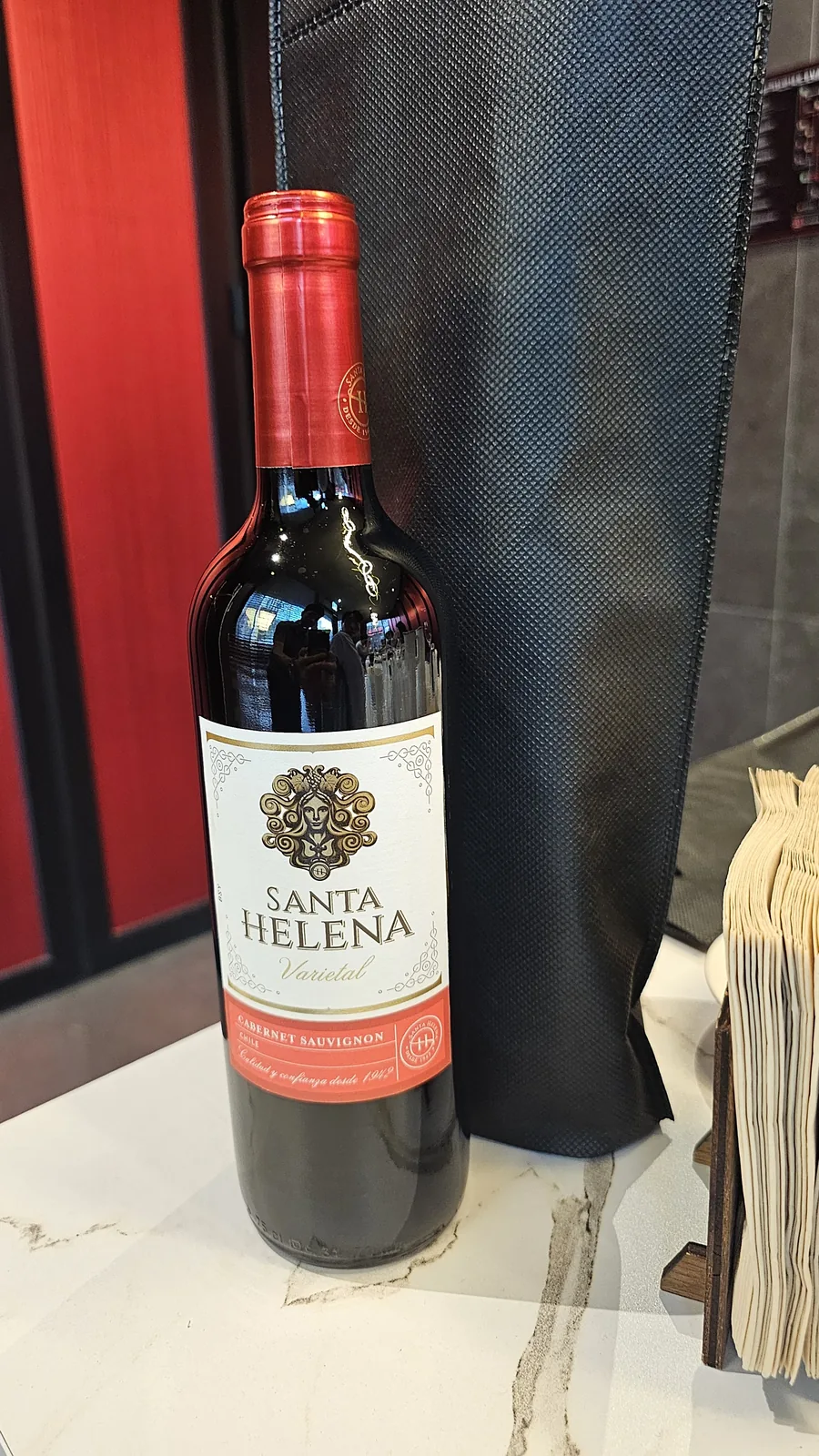
    We went for a company dinner — large group, full evening, ordered enough food to raise serious questions about our collective judgment. Three whole Peking ducks. A dozen-plus shared dishes. A bottle of The Balvenie 12 Year Single Barrel we brought ourselves, and a complimentary Santa Helena Cabernet Sauvignon the restaurant comped as part of a dining promotion. By the time the bill came, everyone was too satisfied to care what was on it.

    What is Xin Hong Lou?

    Xin Hong Lou (鑫紅樓) is a Chinese fine dining restaurant on the 9th floor of a building in Yeouido. The name translates to “Prosperous Red Building” — not subtle, but accurate.

    This is not 짜장면 (jjajangmyeon) territory. Not the Korean-Chinese takeout you’ll find on every corner. Xin Hong Lou is positioning itself as mainland Chinese fine dining — Peking duck as the anchor, supported by Sichuan-leaning preparations, premium seafood (abalone, sea cucumber, shark’s fin on the menu for serious spenders), and a service style where staff wear black gloves and lift silver cloches.

    Quick context for foreign visitors: Chinese food in Korea (called 중식, jungsik) has evolved into its own distinct cuisine over generations. The jjajangmyeon, tangsuyuk, and jjamppong you find everywhere in Korean restaurants are different from what you’d eat in Beijing or Shanghai — they’re Korean-Chinese, a hybrid that developed locally. Xin Hong Lou leans toward the mainland Chinese side. Worth knowing before you walk in and wonder why it feels different.
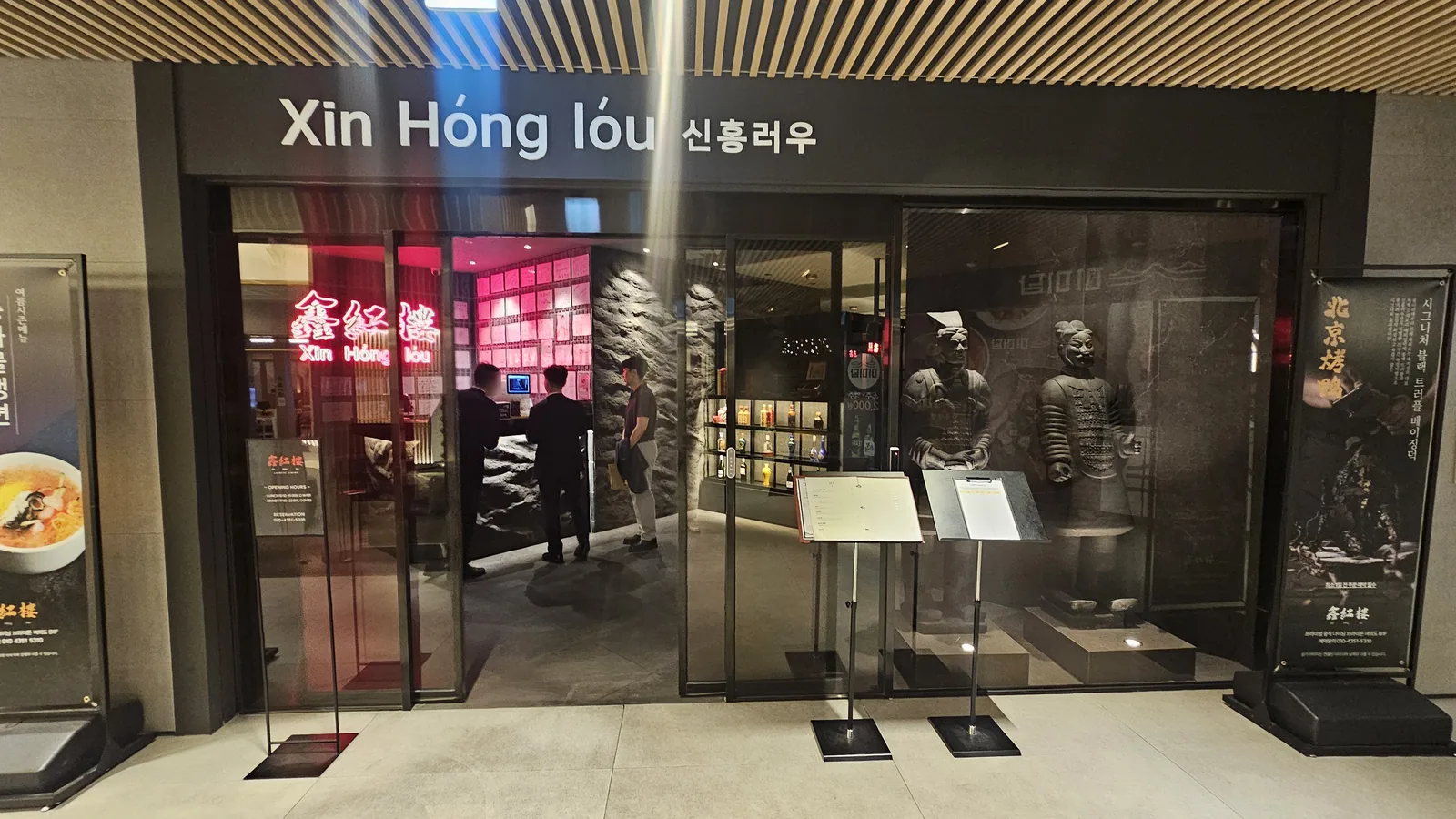
    Xin Hong Lou exterior entrance with Xin Hong Lou sign and terracotta warrior sculptures at Yeouido
    Xin Hong Lou exterior entrance with Xin Hong Lou sign and terracotta warrior sculptures at Yeouido

    The entrance sets the tone immediately. Full-scale terracotta warrior sculptures flank the door. The sign reads “Xin Hóng Lóu 신흥러우” in both English and Korean. It’s a lot. It works.

    Getting There

    Yeouido is Seoul’s financial and media district — think Canary Wharf in London or a smaller Wall Street. The national broadcaster KBS and the National Assembly are both here. It’s a 10–15 minute cab ride from Hongdae, roughly 20–25 minutes from Myeongdong.

    Subway: Yeouido Station (Line 5) or Yeouinaru Station (Line 9). About 5–10 minutes on foot from either, depending on the building entrance.

    From Incheon Airport: About 45–55 minutes by AREX express train + subway, or 40 minutes by taxi (~55,000–65,000 KRW / ~$41–$48 USD).

    Parking: Yeouido has several underground lots nearby. Confirm with the restaurant when you book if you’re driving.

    The Interior
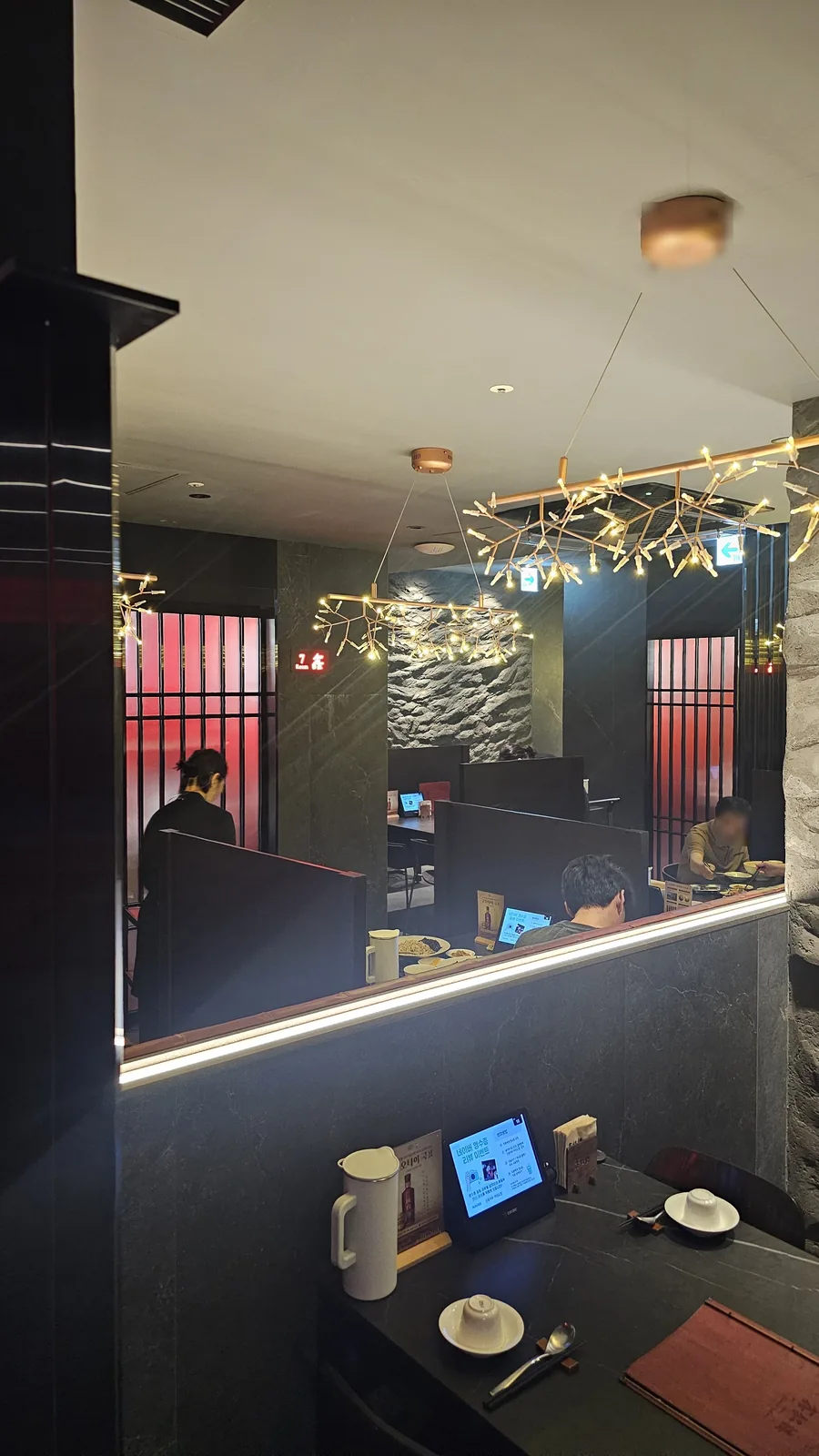
    Bird's eye view of Xin Hong Lou Yeouido interior from upper level showing red walls and branch chandeliers
    Bird’s eye view of Xin Hong Lou Yeouido interior from upper level showing red walls and branch chandeliers
    Interior wall of Xin Hong Lou Yeouido with red neon signs and celebrity autograph frames
    Interior wall of Xin Hong Lou Yeouido with red neon signs and celebrity autograph frames
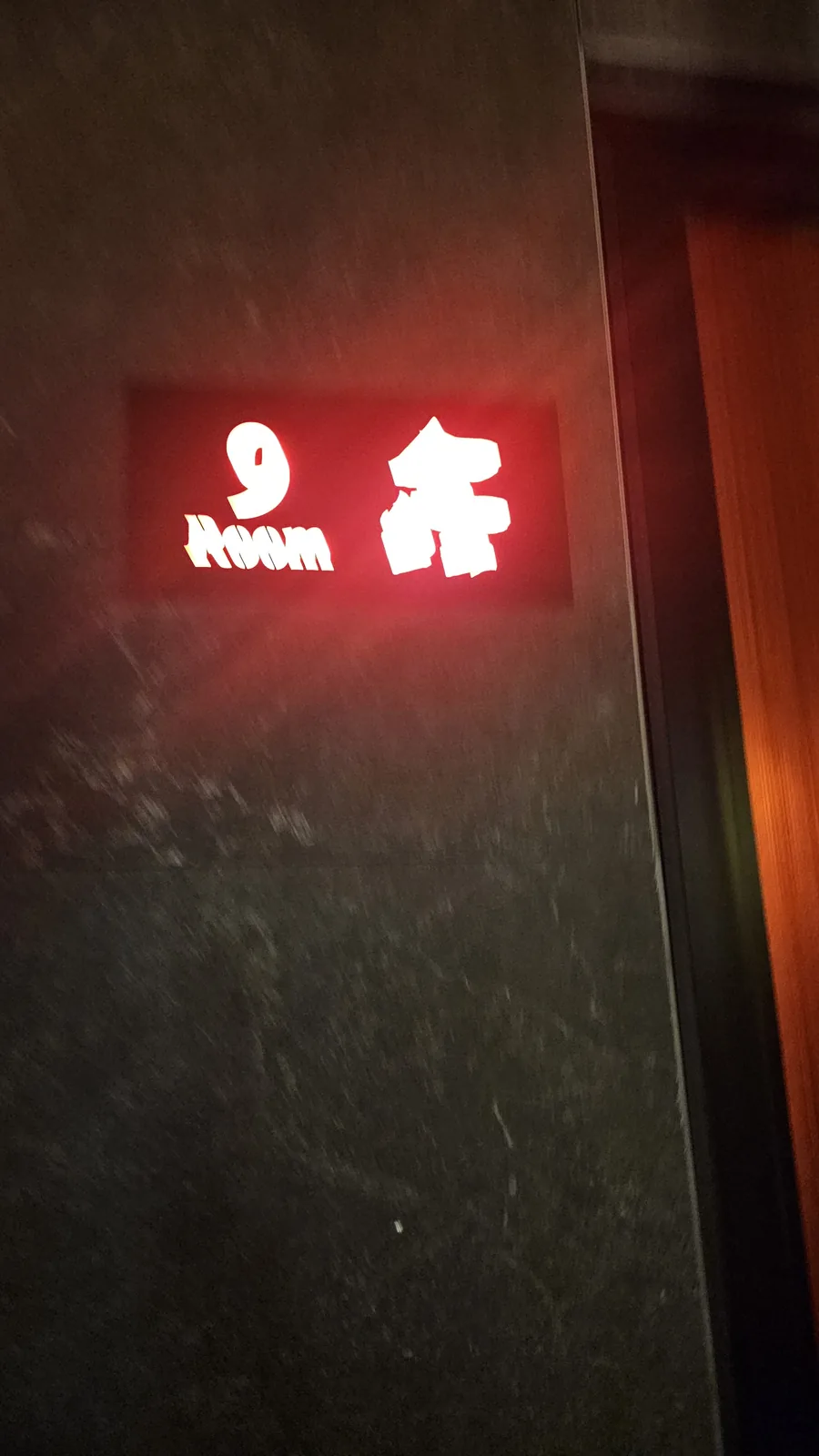
    Red neon floor sign reading Hwa 9F marking the floor level at Xin Hong Lou Yeouido
    Red neon floor sign reading Hwa 9F marking the floor level at Xin Hong Lou Yeouido

    The room is genuinely impressive. Red walls throughout. Bare branch-style chandeliers that read as architectural rather than kitschy. A dedicated wall of celebrity autographs in frames — the Korean thing where famous visitors sign and the restaurant displays them permanently. A neon sign embedded in the floor announcing “花 9F” as you arrive off the elevator.

    It’s theatrical. Deliberately, unapologetically theatrical. I mean that as a compliment. The room is designed to make dinner feel like an occasion, and it succeeds.

    Tables are large and configured for groups. If you come solo or as a pair, you’ll feel a bit swallowed by the scale of it. This is a group dining room, and it doesn’t pretend otherwise.

    The Peking Duck
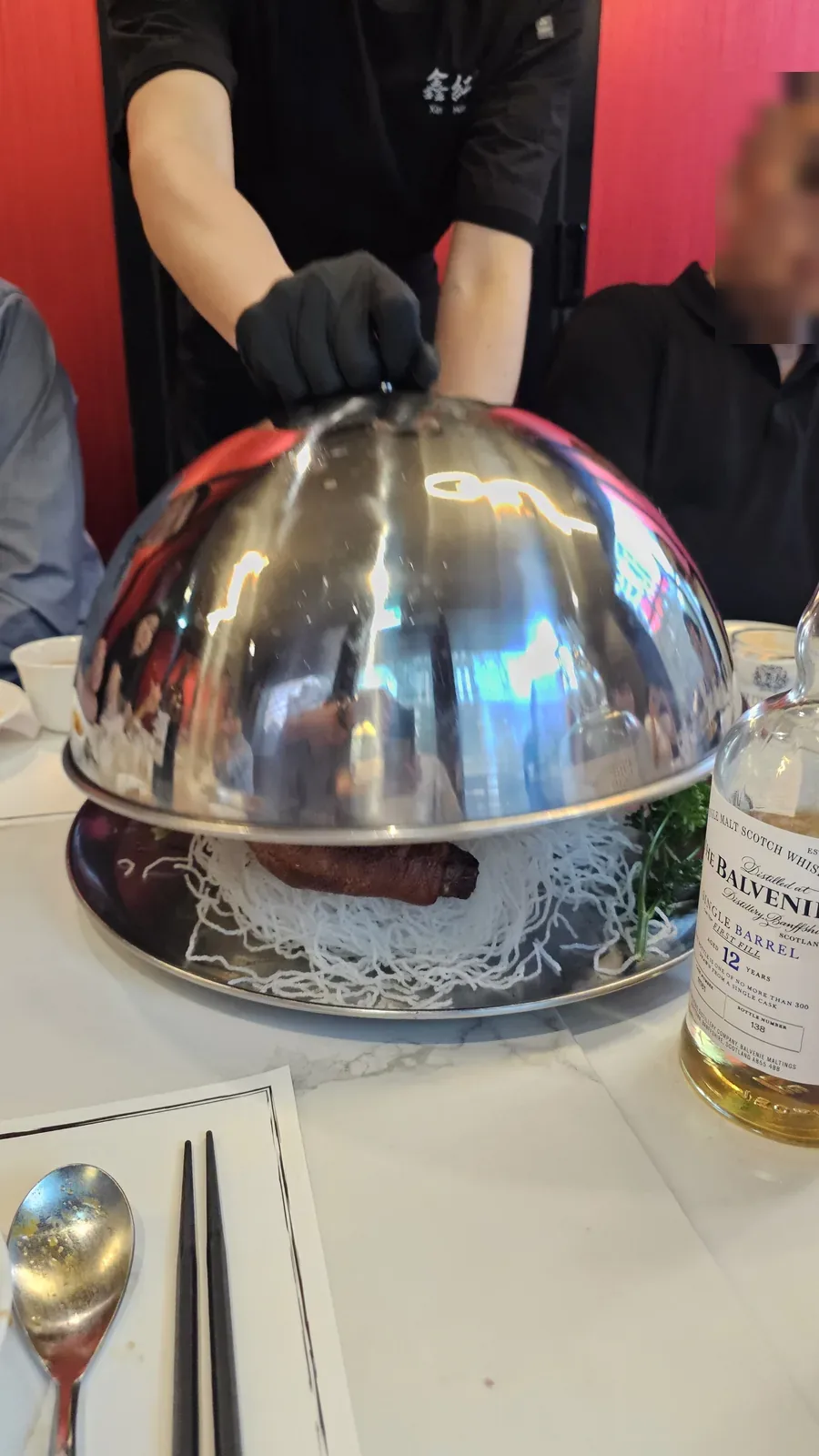
    Waiter in black gloves lifting silver cloche to reveal whole Peking duck at Xin Hong Lou Yeouido
    Waiter in black gloves lifting silver cloche to reveal whole Peking duck at Xin Hong Lou Yeouido
    Whole roasted Peking duck on silver round platter with parsley garnish at Xin Hong Lou
    Whole roasted Peking duck on silver round platter with parsley garnish at Xin Hong Lou

    A lot of restaurants in Seoul serve Peking duck. Most do it fine. Xin Hong Lou does the whole ceremony.

    The duck arrives under a silver cloche. A staff member in black gloves lifts it at the table. Whole bird, lacquered golden-brown, on a silver platter with a parsley garnish. The moment lands. People at the table actually look up from their phones.
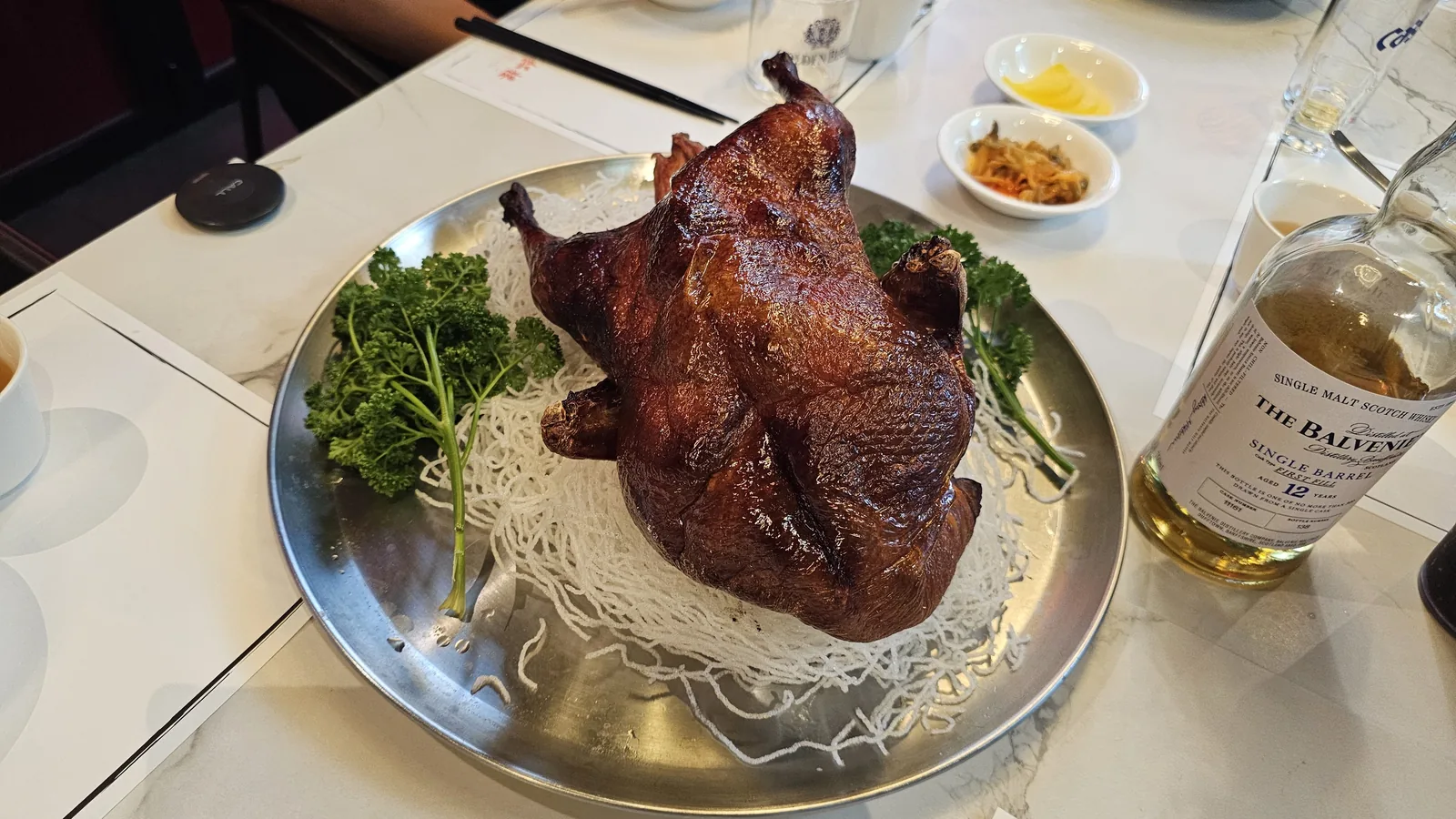
    Whole Peking duck on silver platter with chopsticks reaching in at Xin Hong Lou
    Whole Peking duck on silver platter with chopsticks reaching in at Xin Hong Lou
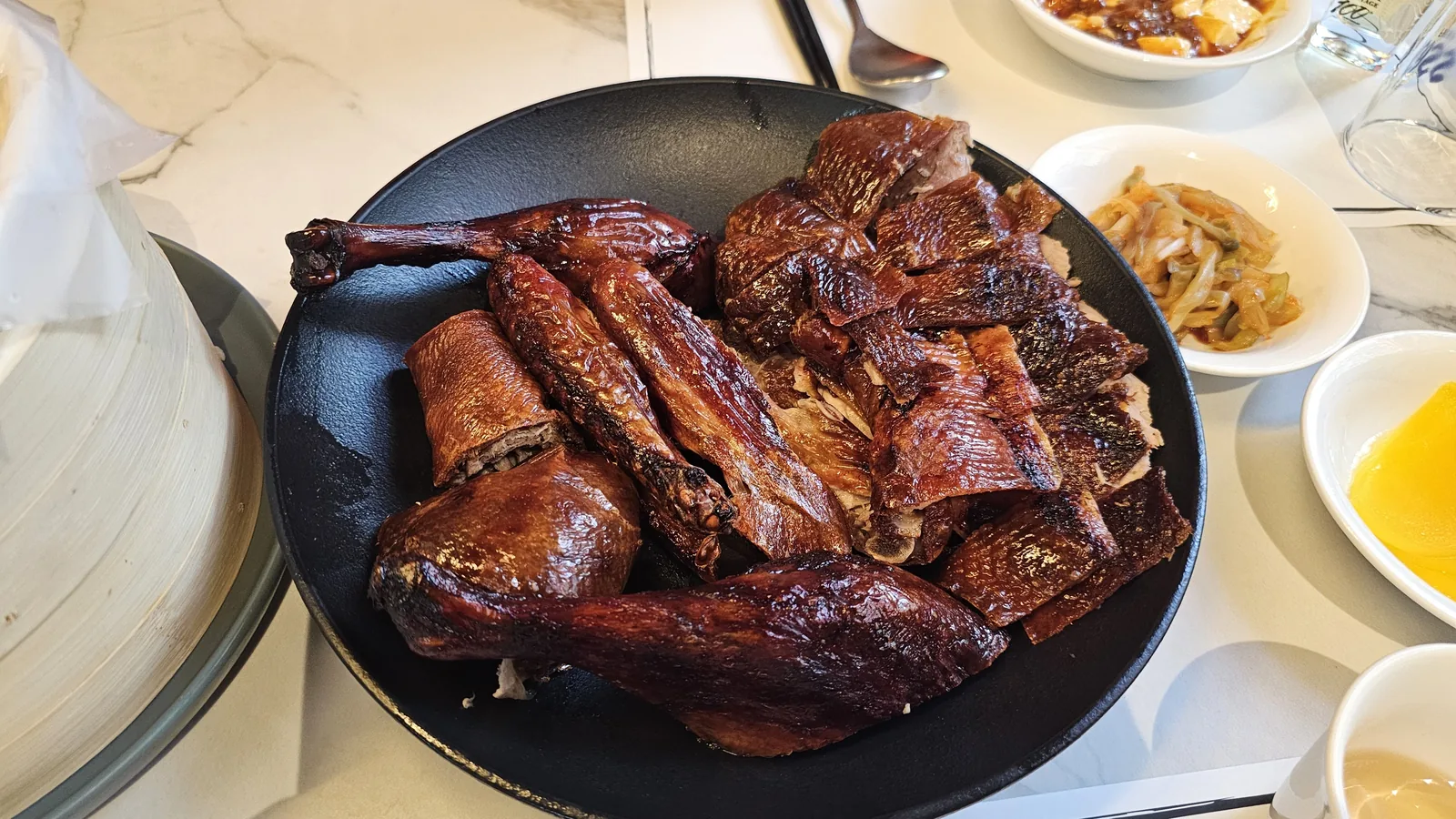
    Carved Peking duck portions arranged on black round plate at Xin Hong Lou Yeouido
    Carved Peking duck portions arranged on black round plate at Xin Hong Lou Yeouido

    Then it gets carved and portioned onto a black serving plate. The skin is where the money is — it should be crisp and separate from the fat beneath it. Here, it is. The meat itself is well-cooked: moist, not dried out. More important than people realize.
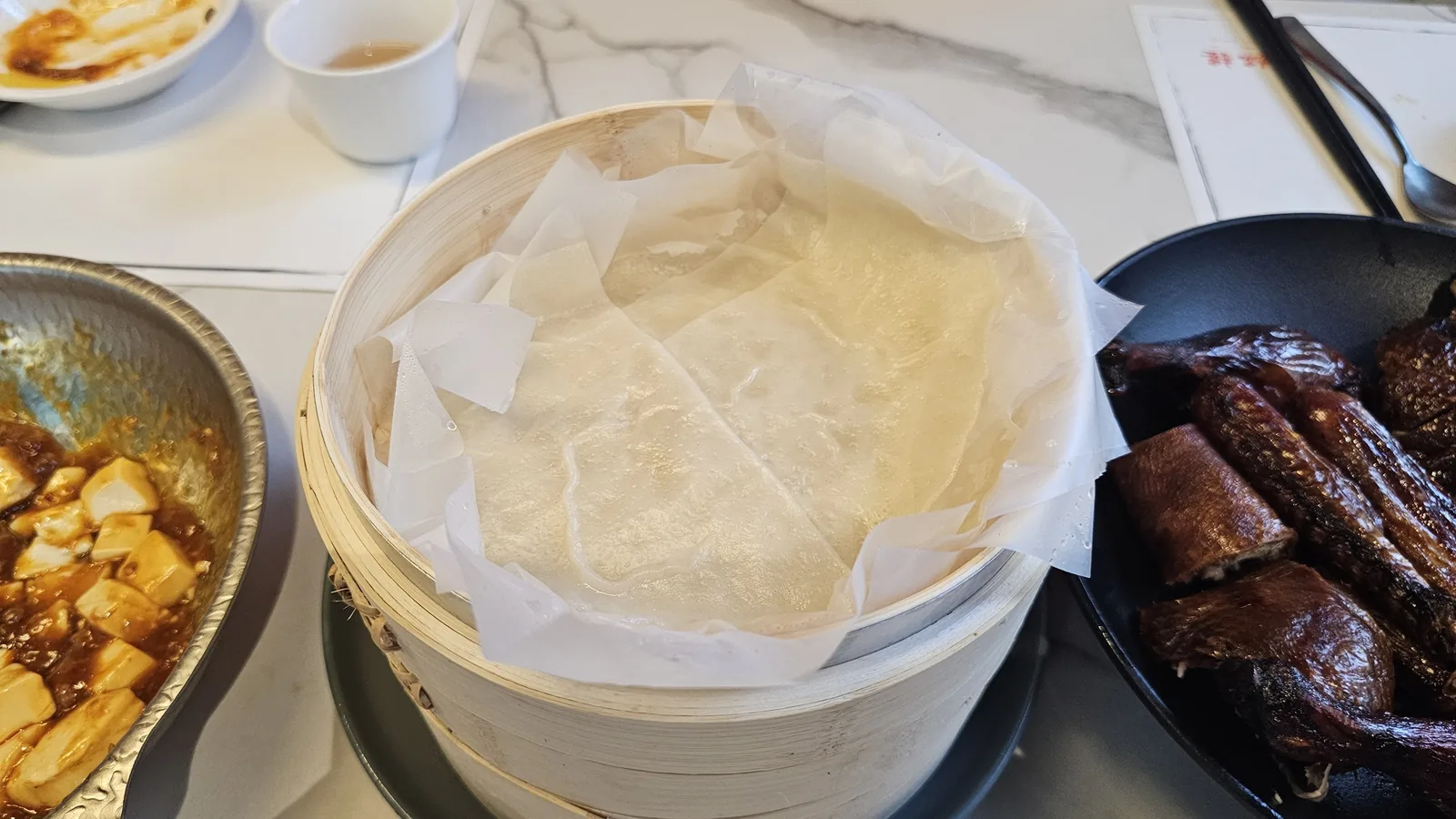
    Thin flour crepes (bingpi) in bamboo steamer for Peking duck at Xin Hong Lou
    Thin flour crepes (bingpi) in bamboo steamer for Peking duck at Xin Hong Lou
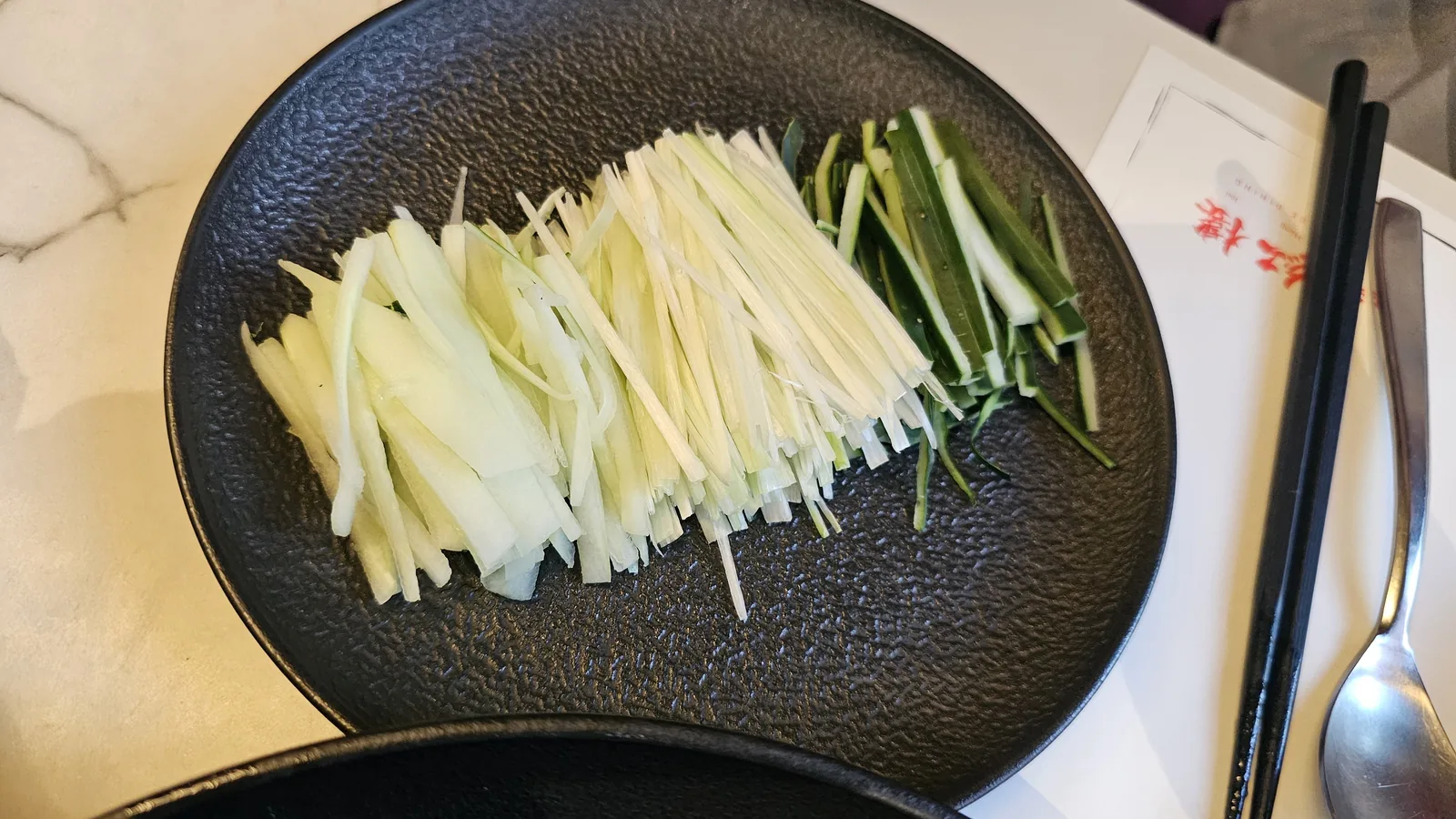
    Julienned scallions and cucumber on black plate for Peking duck wrapping at Xin Hong Lou
    Julienned scallions and cucumber on black plate for Peking duck wrapping at Xin Hong Lou
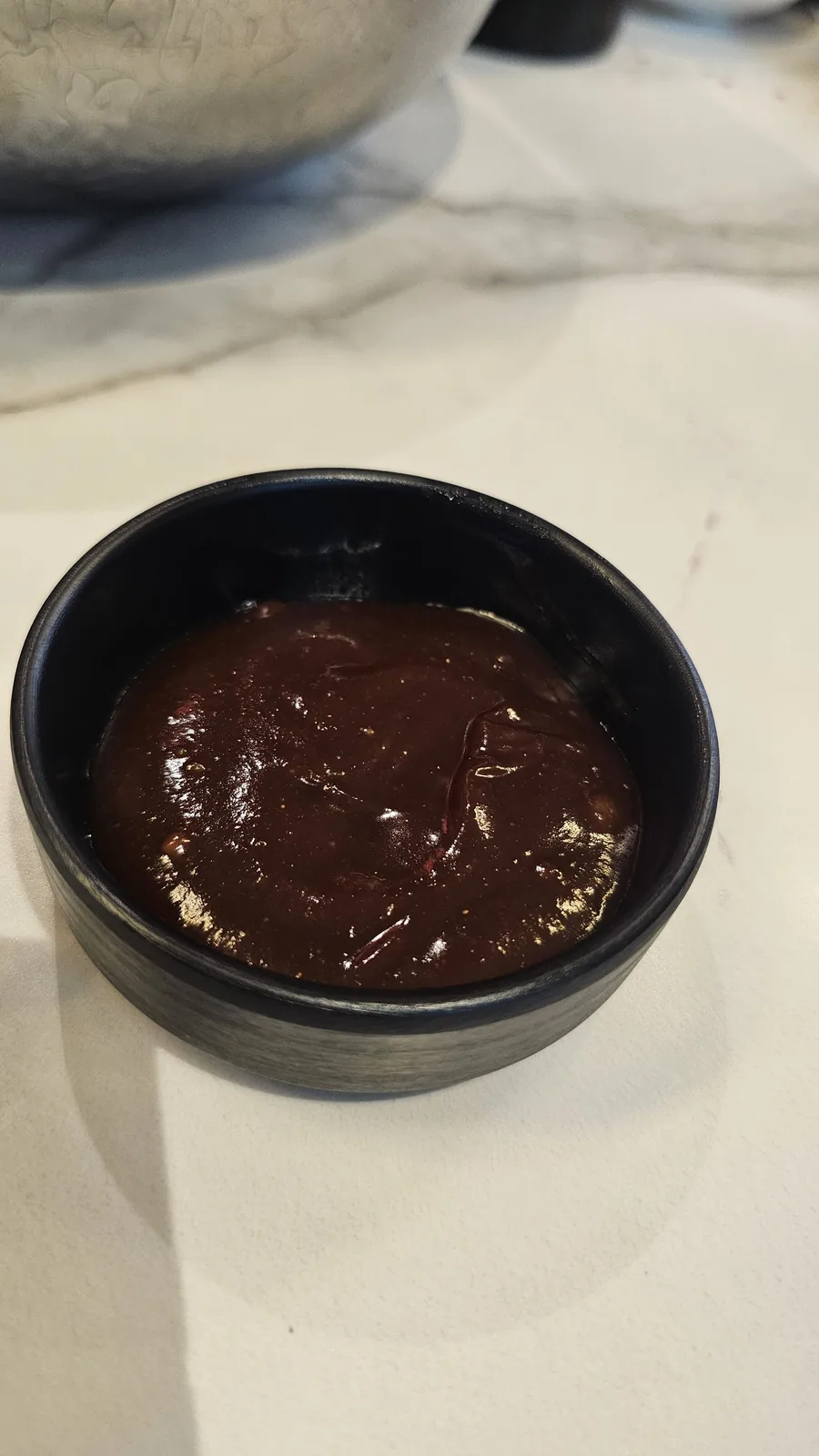
    Dark hoisin sauce (tiamianjiang) in small bowl close-up for Peking duck at Xin Hong Lou Yeouido
    Dark hoisin sauce (tiamianjiang) in small bowl close-up for Peking duck at Xin Hong Lou Yeouido
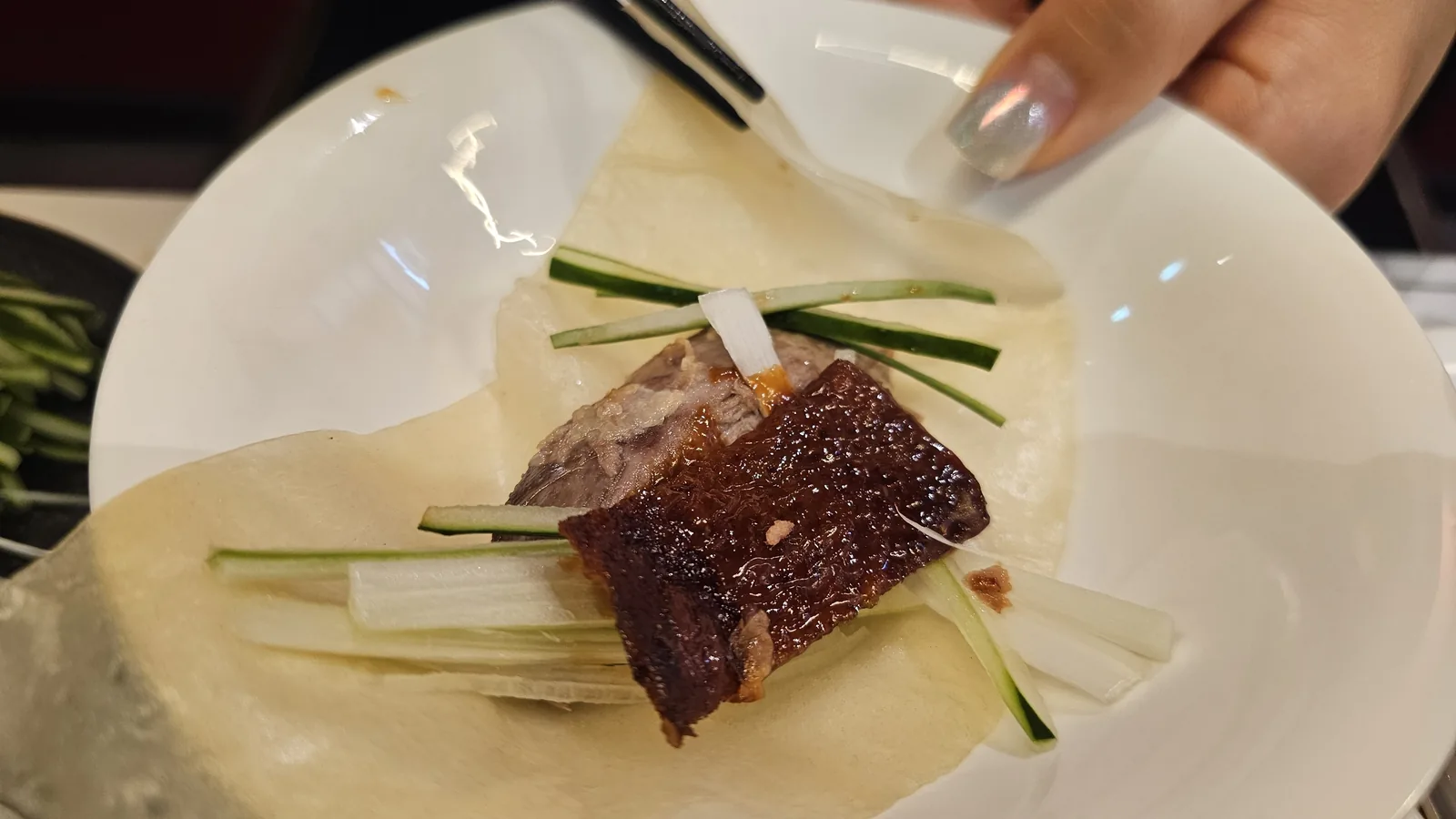
    Peking duck wrap assembled with duck slices cucumber and scallions in thin crepe close-up at Xin Hong Lou
    Peking duck wrap assembled with duck slices cucumber and scallions in thin crepe close-up at Xin Hong Lou
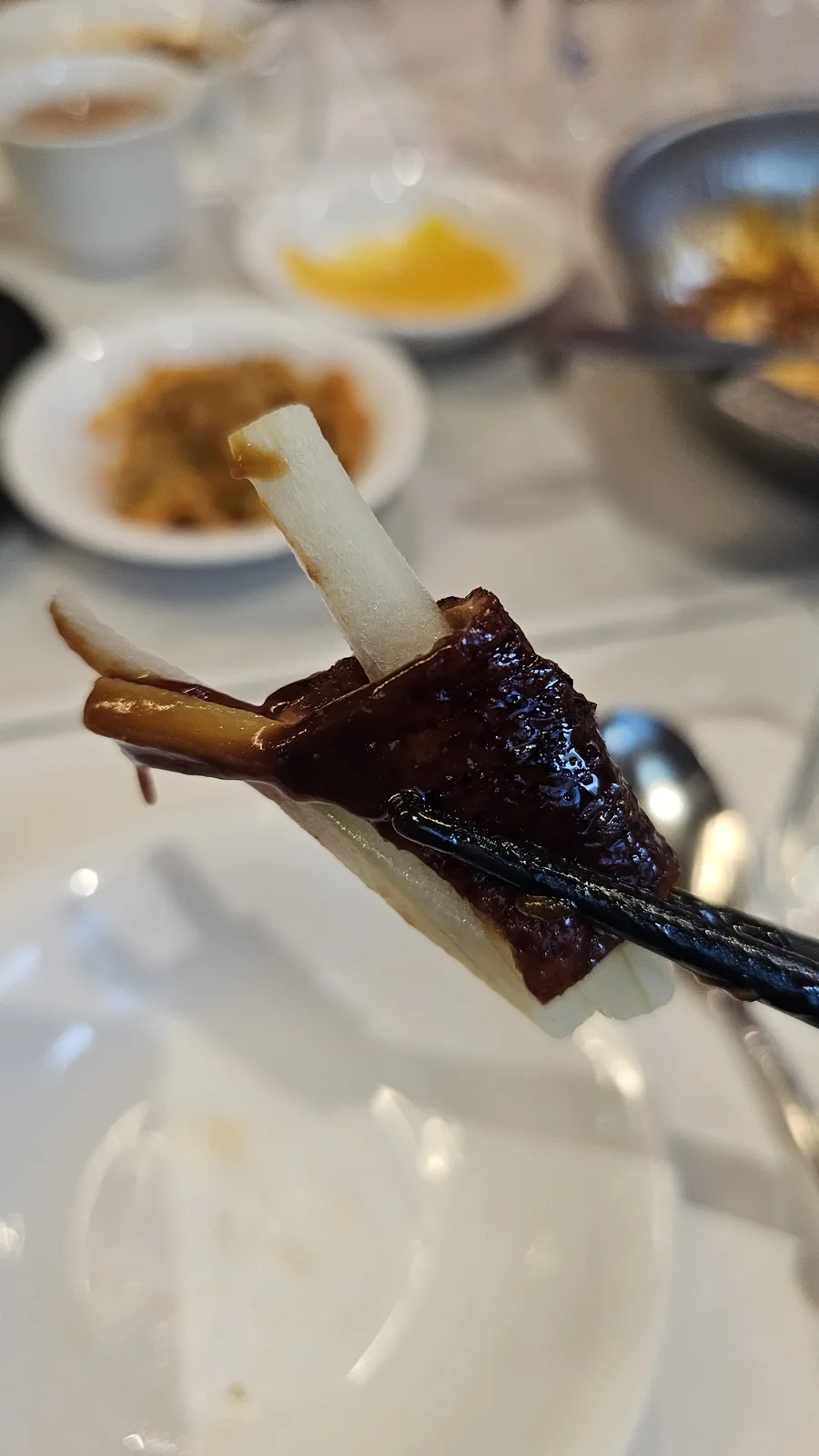
    Chopsticks picking up sliced Peking duck with julienned scallions close-up at Xin Hong Lou
    Chopsticks picking up sliced Peking duck with julienned scallions close-up at Xin Hong Lou

    The setup:

    – Thin flour crepes (빙피, bingpi) in a bamboo steamer — delicate, slightly chewy, warm

    – Julienned scallions and cucumber on a black plate

    – Hoisin sauce (첨면장, tiamianjiang) — dark, savory-sweet, the essential glue

    How to eat it: Lay a crepe flat. Brush with hoisin. Add a few slices of duck, skin side up. Scallion and cucumber on top. Roll it. One bite if you’re ambitious, two if you’re being polite.

    We ordered three ducks for the group. Right call. One bird disappears faster than you think.

    Everything Else We Ordered
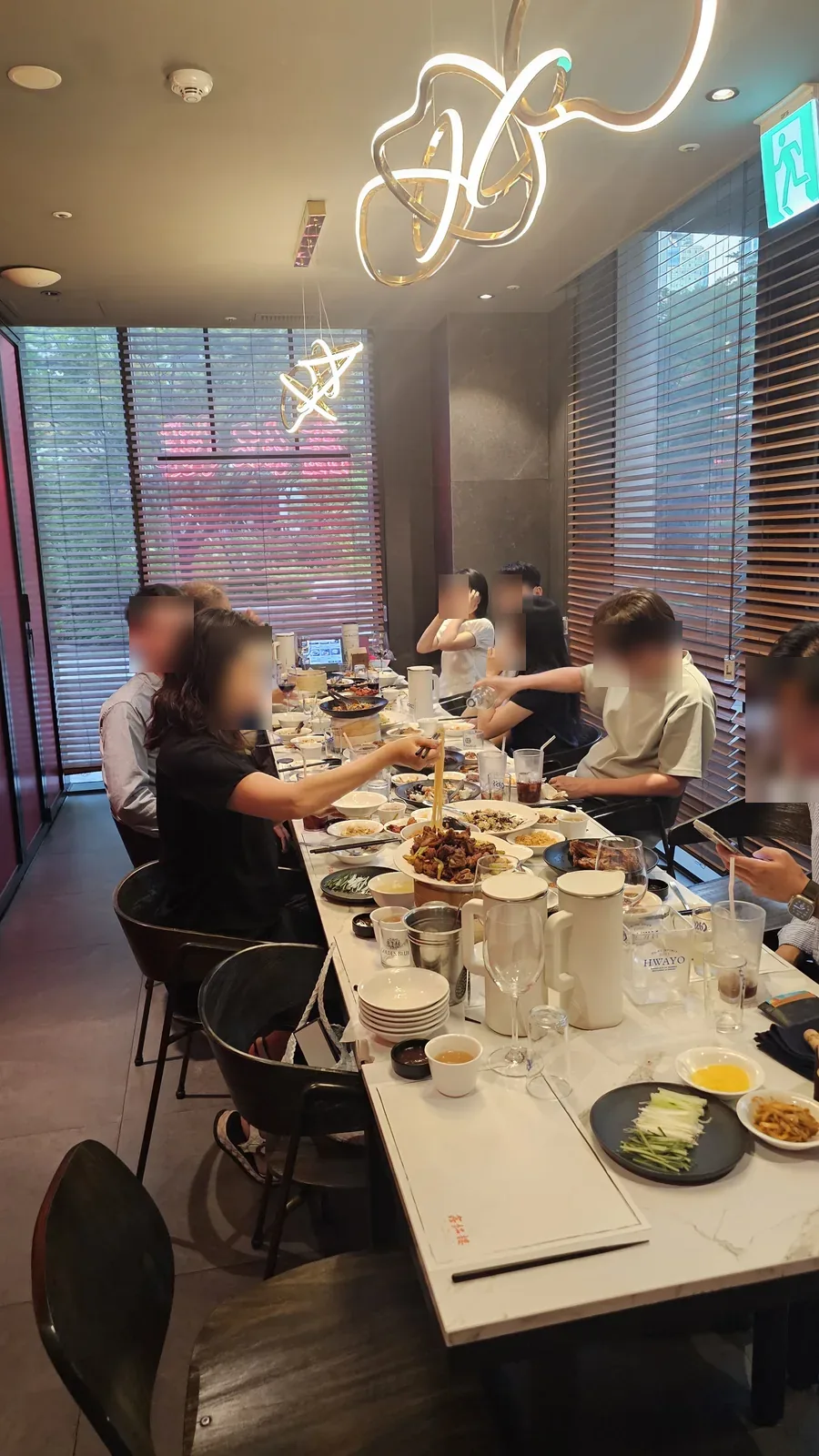
    Large group dinner table fully covered with multiple Chinese dishes at Xin Hong Lou Yeouido
    Large group dinner table fully covered with multiple Chinese dishes at Xin Hong Lou Yeouido

    We ordered a lot. Here’s what stood out:

    어향가지 (Yuxiang Eggplant / 魚香茄子)
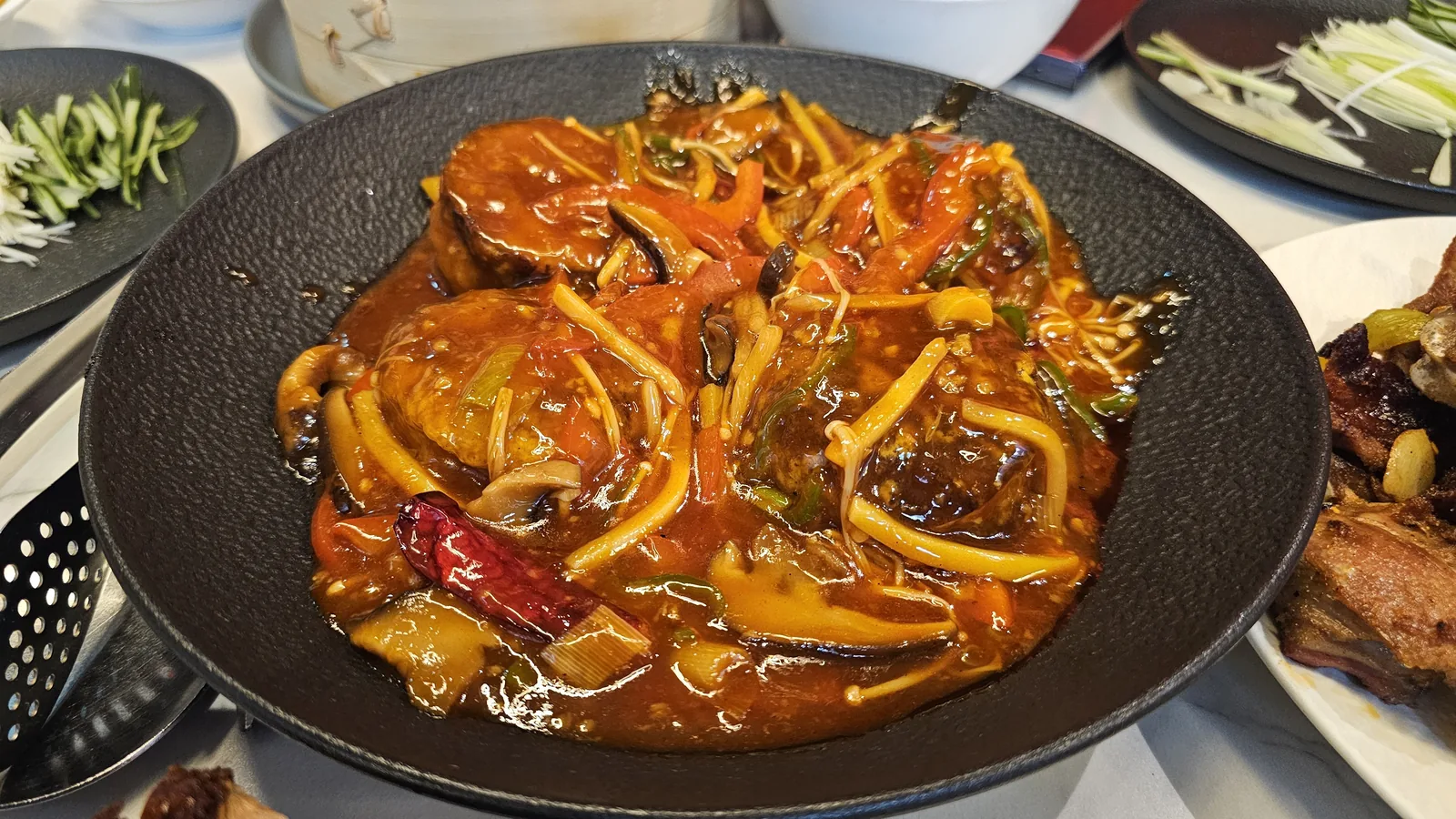
    Fish-fragrant eggplant (yuxiang qiezi) in rich dark Sichuan sauce at Xin Hong Lou Yeouido
    Fish-fragrant eggplant (yuxiang qiezi) in rich dark Sichuan sauce at Xin Hong Lou Yeouido

    Quick explanation of 어향 (yuxiang): it literally means “fish fragrant” in Chinese (魚香), which is confusing because there’s no fish in the sauce. It’s a Sichuan-style preparation built from doubanjiang (fermented chili bean paste), garlic, ginger, vinegar, and sugar. The name reportedly comes from a sauce originally used to cook fish that got repurposed for everything else. The result is savory, a little spicy, slightly sweet, and deeply flavored.

    Here, the eggplant is soft without collapsing — it’s absorbed the sauce properly. The balance is right. Good dish.

    어향동고 (Yuxiang Shiitake Mushrooms)

    Same yuxiang sauce, applied to 동고 (donggo) — dried shiitake mushrooms. Dried shiitakes have a denser, meatier texture than fresh, and they hold up to this sauce better. If you’re a mushroom person, order this. If you’re not, skip it and get a second plate of the eggplant.

    누룽지탕 (Crispy Rice Crust Soup)

    This one deserves a mention. 누룽지탕 is built around 누룽지 — the golden crispy layer that forms at the bottom of a Korean rice pot, similar to Persian tahdig. Hot broth gets poured over it tableside, creating a dramatic sizzling and crackling effect. The rice absorbs the broth, softens from the outside in, and retains a toasted, slightly nutty quality underneath. It’s as much performance as dish. Good call to order it.

    탕수육 (Sweet and Sour Pork)
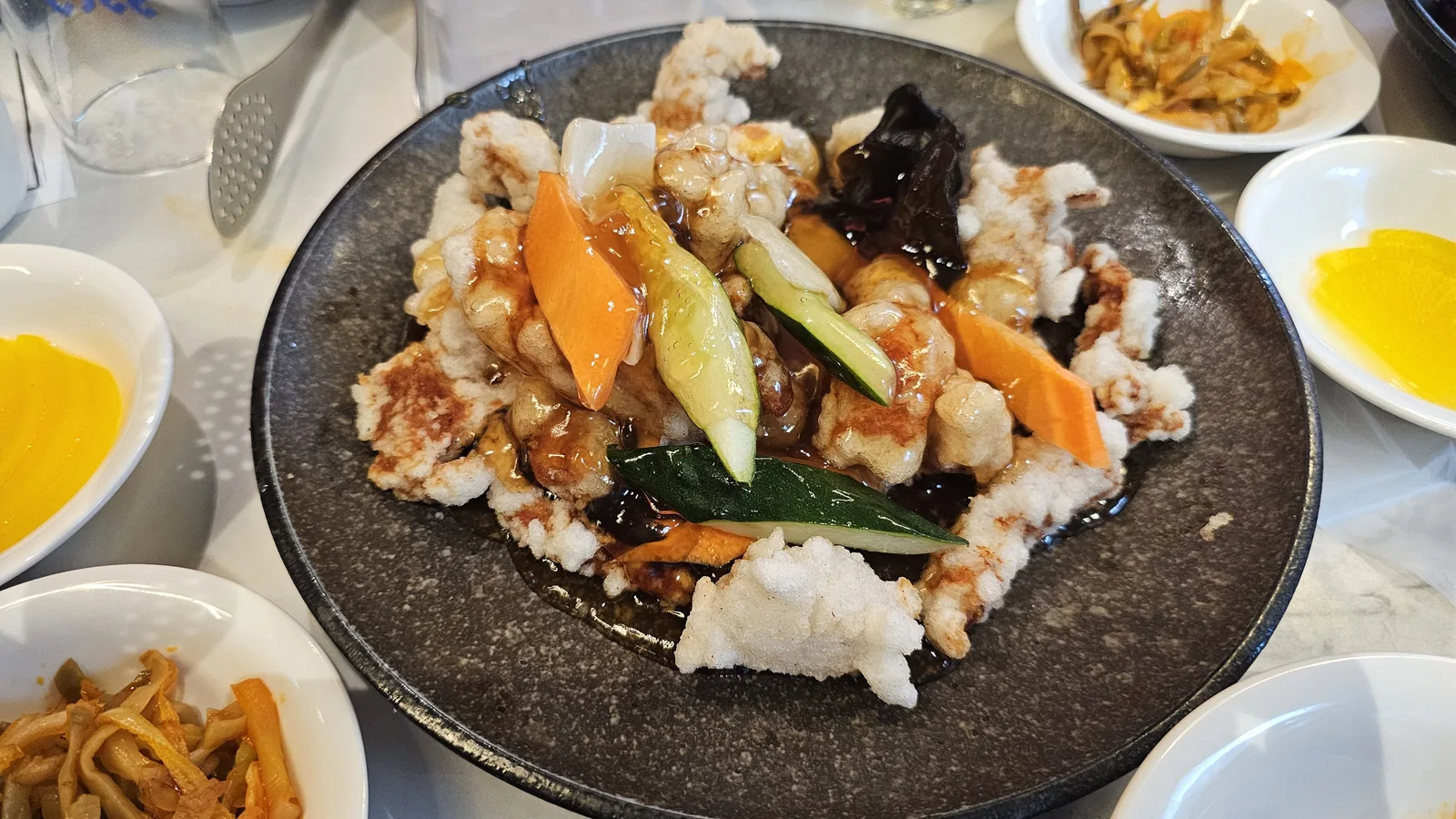
    Sweet and sour pork (tangsu yuk) with wood ear mushrooms and vegetables in red glaze at Xin Hong Lou
    Sweet and sour pork (tangsu yuk) with wood ear mushrooms and vegetables in red glaze at Xin Hong Lou

    Tangsuyu is the Korean-Chinese version of sweet and sour pork. At casual Korean-Chinese restaurants, it often comes with a thin, pale sauce. Here the glaze is darker, richer, more complex. Wood ear mushrooms and vegetables in there too. Solid execution. Not the most exciting dish on the table, but it gets finished.

    삼성짬뽕 (Premium Spicy Seafood Noodle)
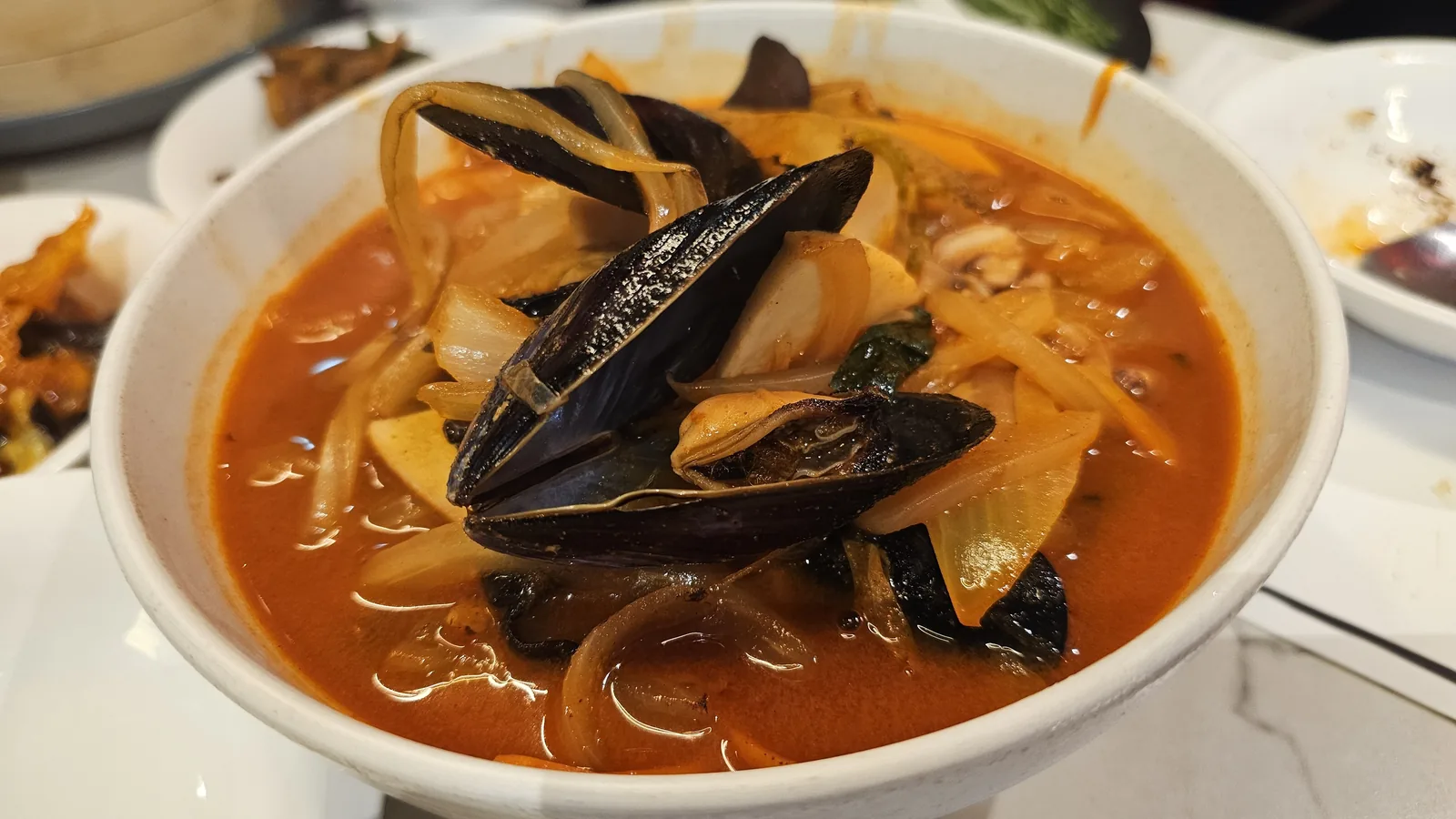
    Spicy red jjamppong noodle soup with mussels close-up at Xin Hong Lou Yeouido
    Spicy red jjamppong noodle soup with mussels close-up at Xin Hong Lou Yeouido
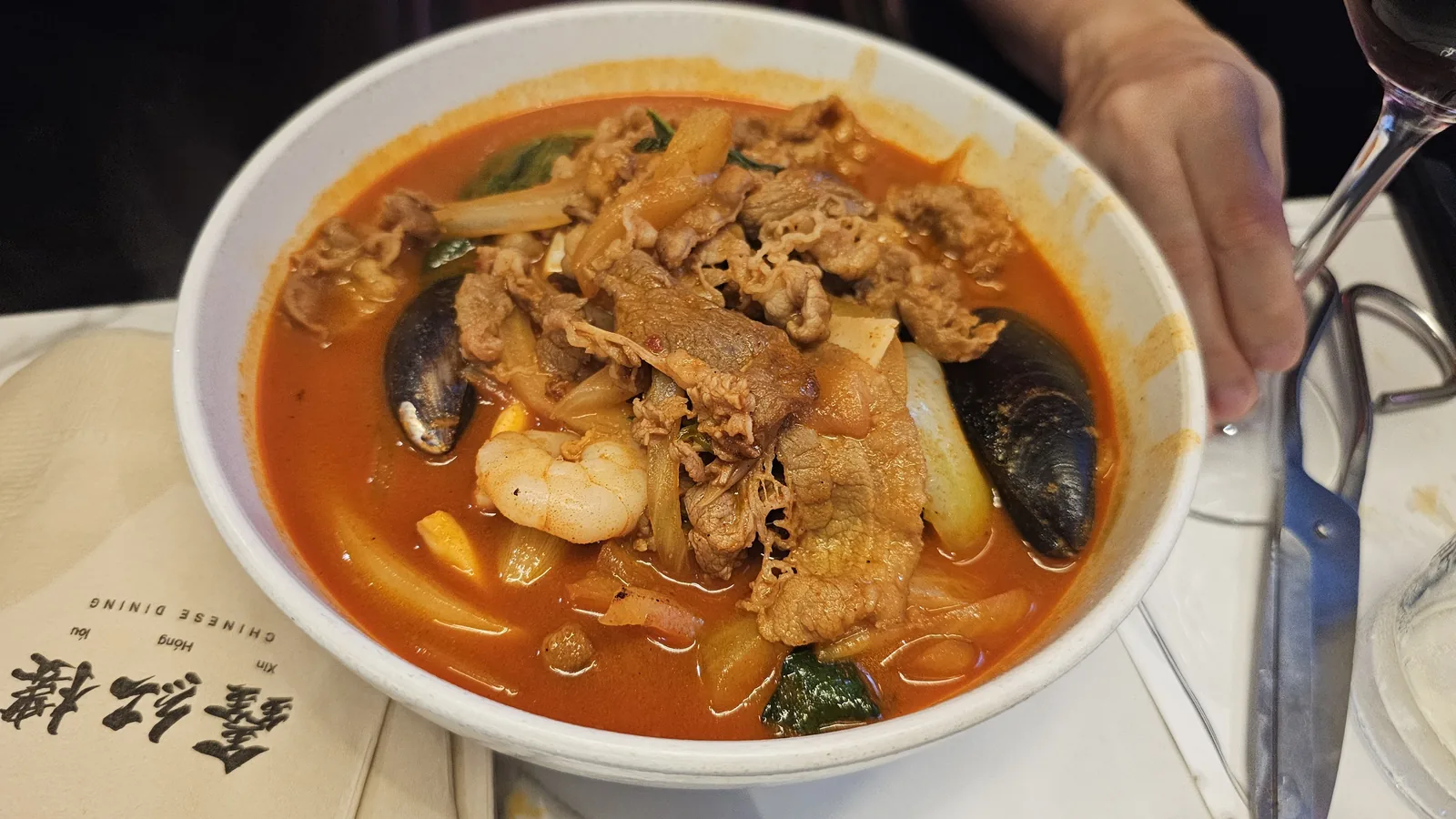
    Spicy seafood jjamppong in Xin Hong Lou branded bowl with mussels shrimp and pork
    Spicy seafood jjamppong in Xin Hong Lou branded bowl with mussels shrimp and pork

    Jjamppong (짬뽕) is actually Korean-Chinese — it developed in Korea and has little to do with mainland Chinese cuisine. At a place like this, the premium version upgrades the seafood (mussels, shrimp, pork, proper quantities) and deepens the broth. The restaurant serves it in branded 鑫紅樓 bowls. The soup itself: properly spiced, genuine seafood backbone, heat that builds. Good.

    Other Dishes
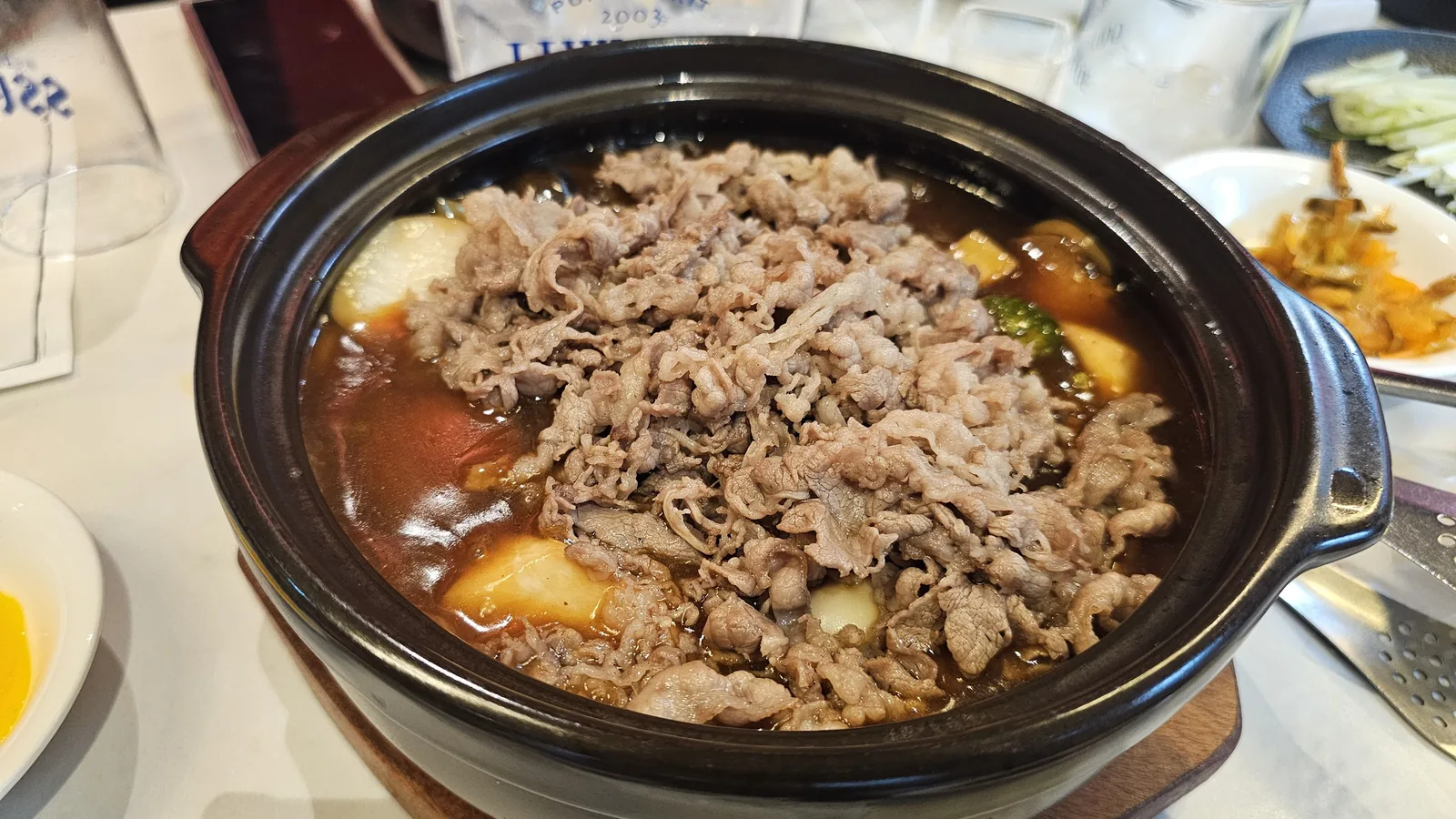
    Mapo tofu hot pot loaded with thinly sliced meat at Xin Hong Lou Yeouido
    Mapo tofu hot pot loaded with thinly sliced meat at Xin Hong Lou Yeouido
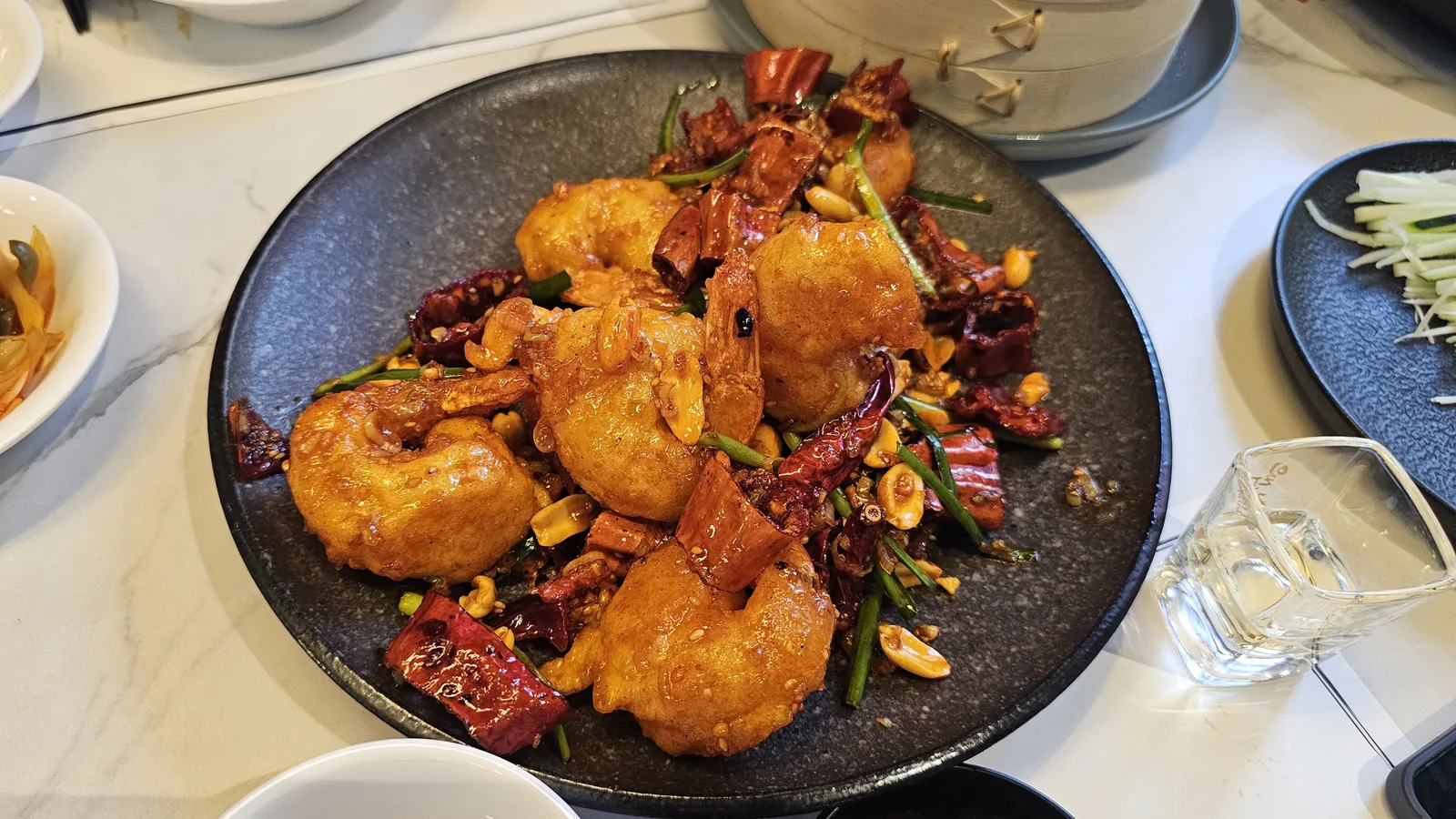
    Spicy stir-fried shrimp with dried red chilies peanuts and scallions at Xin Hong Lou
    Spicy stir-fried shrimp with dried red chilies peanuts and scallions at Xin Hong Lou
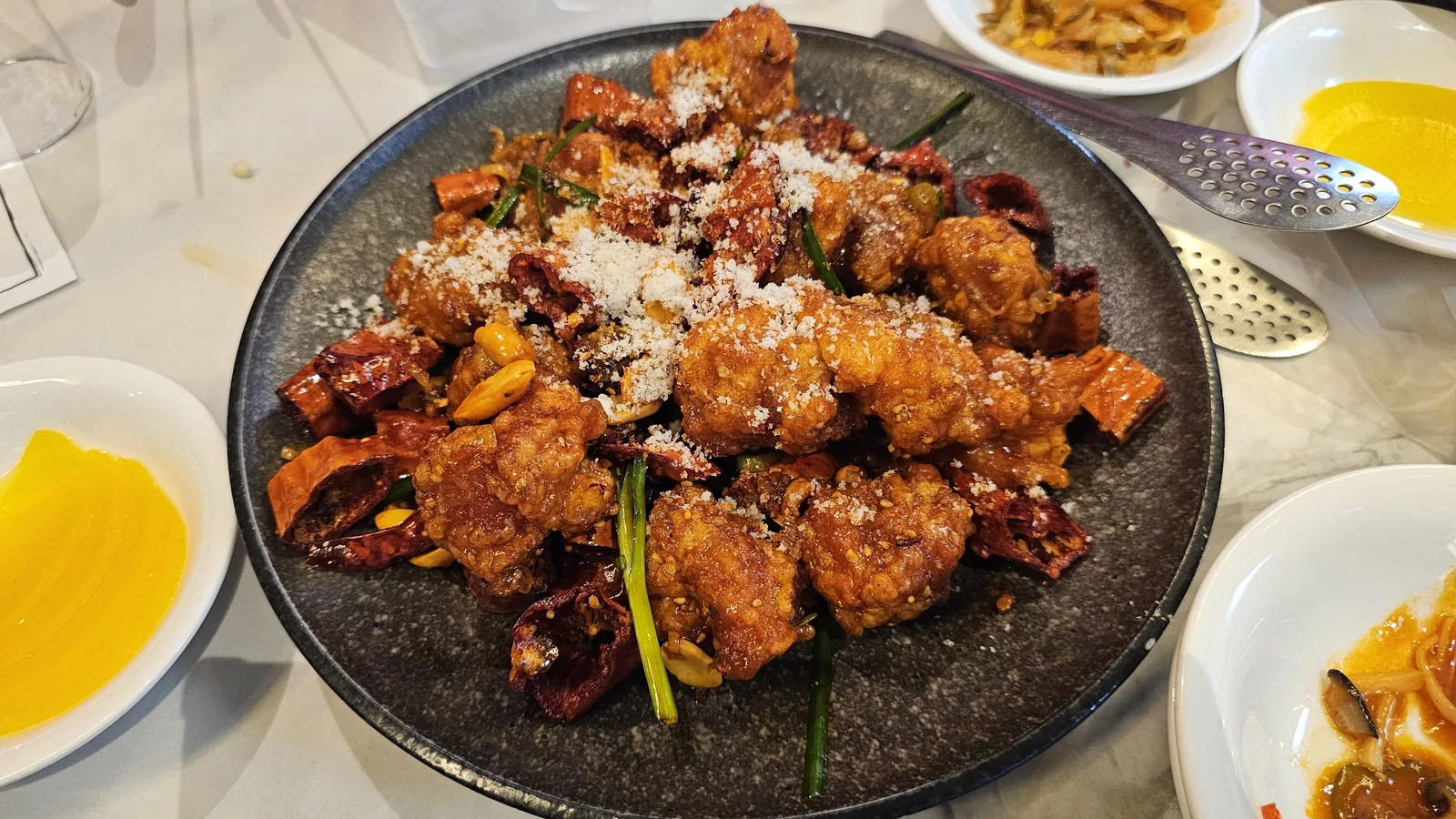
    Crispy fried chicken with dried chilies peanuts and seasoning powder at Xin Hong Lou
    Crispy fried chicken with dried chilies peanuts and seasoning powder at Xin Hong Lou

    The mapo tofu hot pot came loaded with thinly sliced meat. The Sichuan numbing tingle (마라, mala) was present without being aggressive — approachable for people who aren’t heat fanatics. The spicy shrimp stir-fry with dried chilies and peanuts had solid wok heat. Crispy fried chicken with chili powder and peanuts was the thing that disappeared from the table first.

    There was also duck fried rice and a julienned meat stir-fry with bell peppers — standard execution, well made.

    Honestly, we ordered too much. After the third Peking duck and the 누룽지탕, everything else was technically unnecessary. You have been warned.

    Drinks
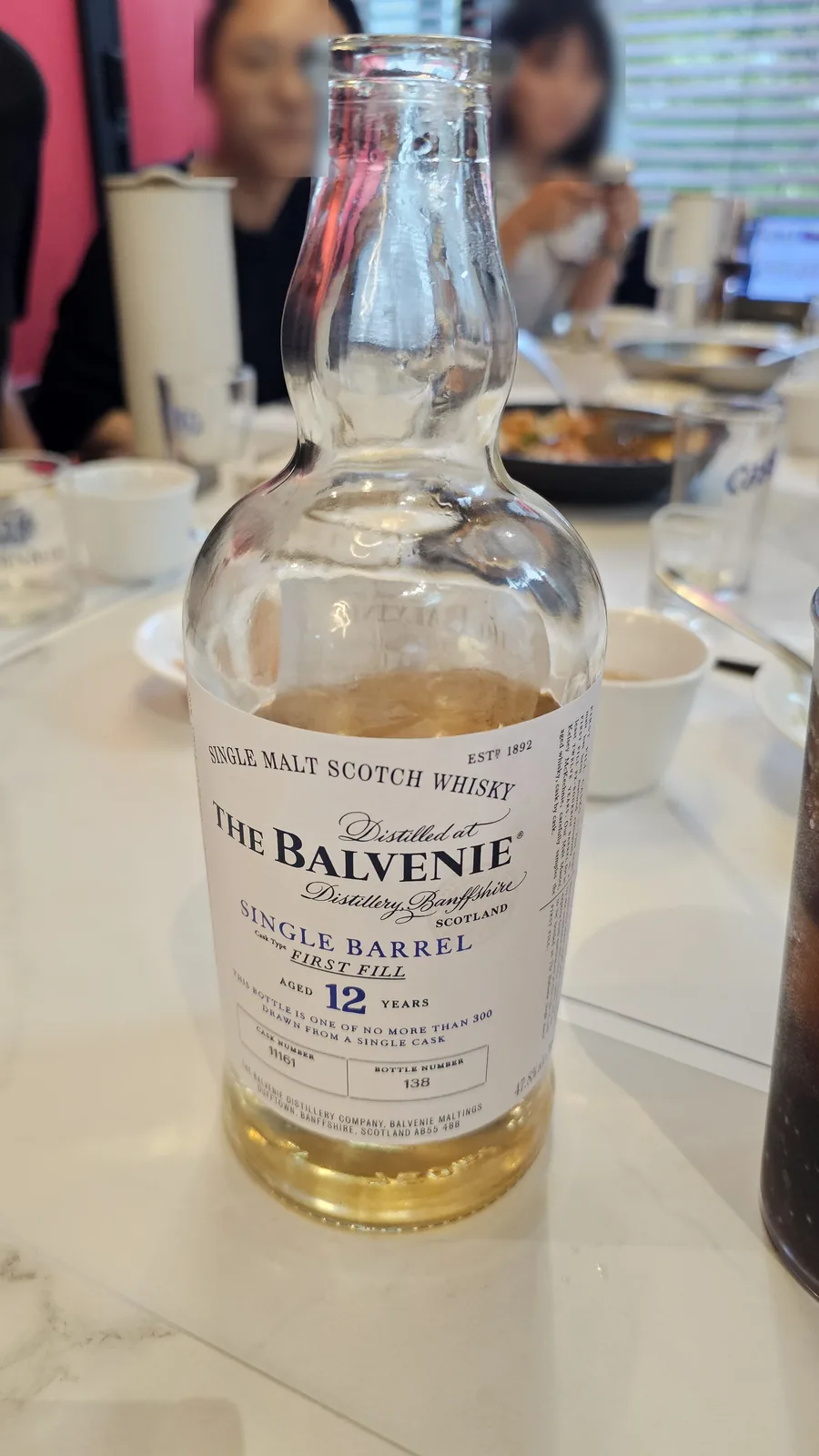
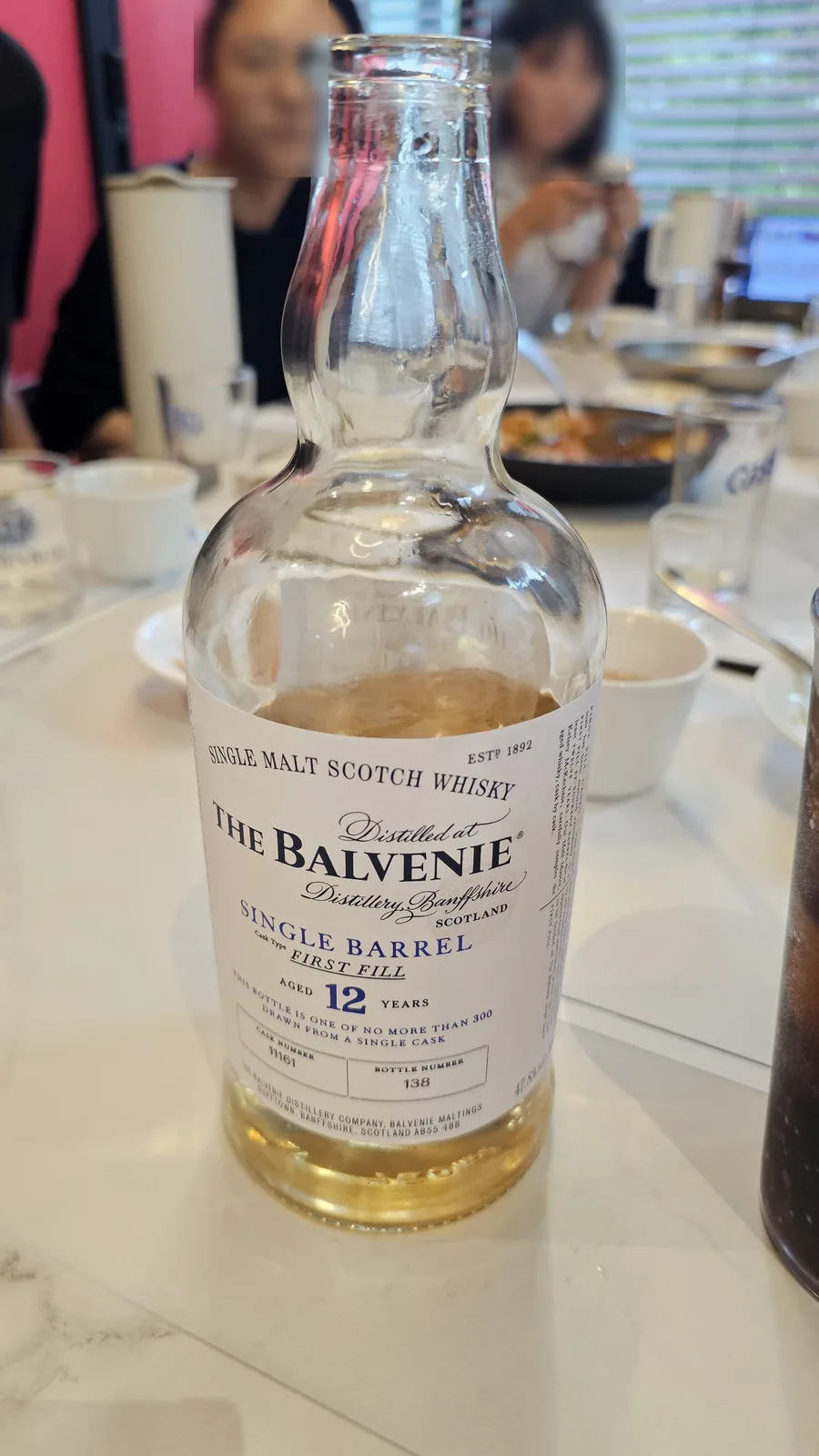
    The Balvenie 12 Year Single Barrel whiskey bottle nearly empty on table at Xin Hong Lou Yeouido
    The Balvenie 12 Year Single Barrel whiskey bottle nearly empty on table at Xin Hong Lou Yeouido
    Black-gloved staff pouring Santa Helena red wine at Xin Hong Lou Yeouido dinner
    Black-gloved staff pouring Santa Helena red wine at Xin Hong Lou Yeouido dinner
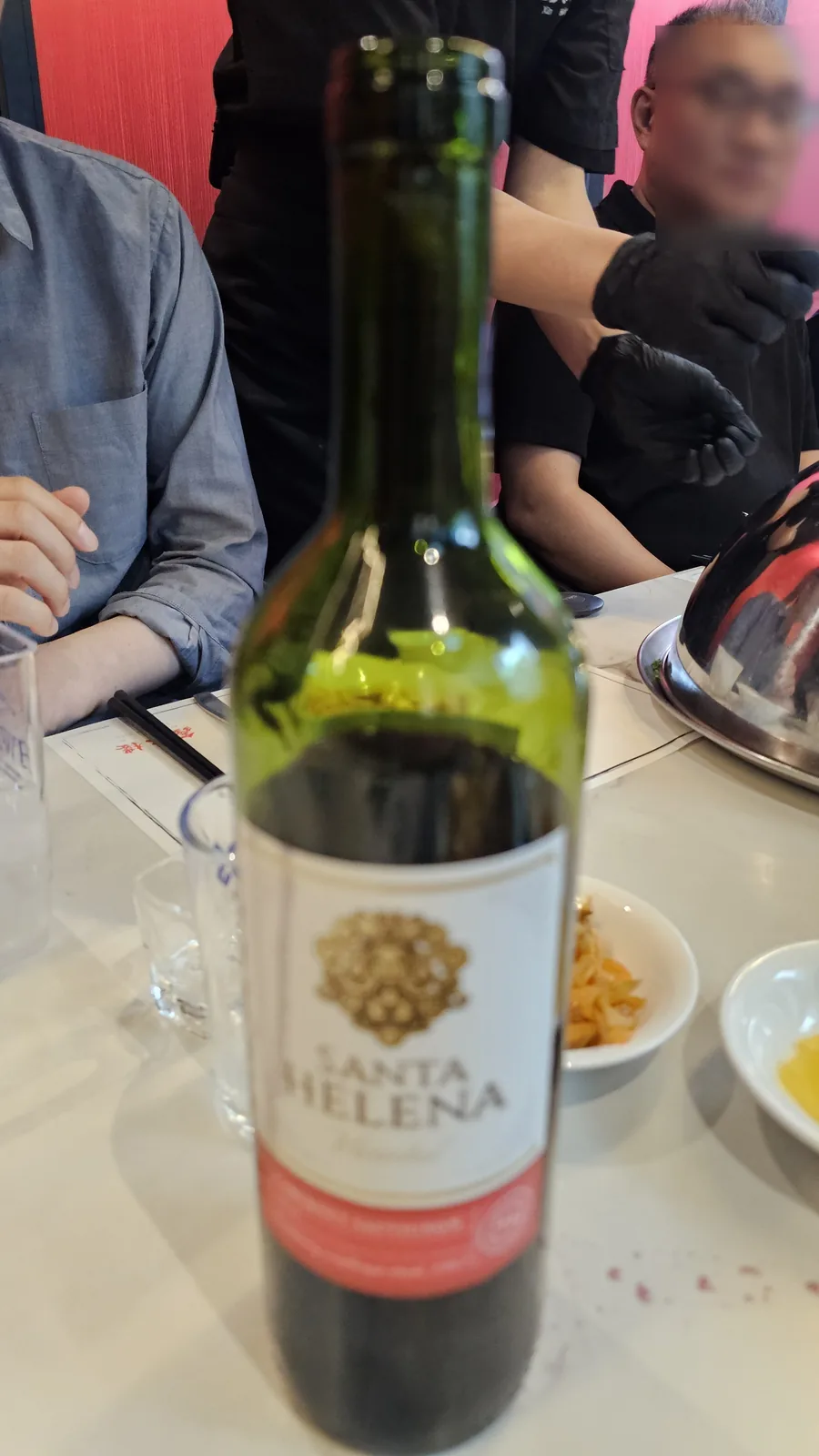
    Santa Helena Cabernet Sauvignon bottle with red foil capsule close-up at Xin Hong Lou
    Santa Helena Cabernet Sauvignon bottle with red foil capsule close-up at Xin Hong Lou

    We brought a bottle of The Balvenie 12 Year Single Barrel — BYOB with corkage, presumably. The restaurant handled it without issue. Worth checking the corkage fee when you book.

    The Santa Helena Cabernet Sauvignon came as a promotional comp from the restaurant. Decent mid-range Chilean red, no complaints for a large group dinner. Not a wine to examine, but one to drink. Fine for the occasion.

    The drinks menu covers wine (red, white, sparkling), baijiu (Chinese grain spirits), and standard spirits. If you’re the kind of person who brings their own whiskey to dinner, they’ll handle it graciously.

    Stuff Tourists Should Know

    Price: Plan on 80,000–150,000 KRW (~$60–$110 USD) per person for a full group dinner with Peking duck and multiple shared plates. Premium items push that number up. Drinks are separate.

    Reservation: Required for groups. Confirm Peking duck quantity when booking — they may need advance notice. Walk-in for 2–3 people on a weekday might work, but don’t risk it.

    English menu: Yes. Each dish has English labels. Staff speak limited English. Pointing works fine.

    Payment: Cards accepted. Foreign Visa and Mastercard generally work at upscale Seoul restaurants — confirm when booking if you’re concerned.

    Tip: No tipping in Korea. None. Don’t leave cash on the table. It creates confusion.

    Vegetarian: Limited options. The menu is heavily meat and seafood focused. Not suitable for strict vegetarians.

    Halal/Kosher: Not certified.

    Kids: Technically allowed but the atmosphere is adult corporate dinner. A 7-year-old would technically fit at the table and also technically be out of their element.

    Solo dining: Possible but awkward. This room is built for groups.

    The Verdict

    Should you go?

    Yes, if you’re doing a corporate dinner or celebration in Seoul. The Peking duck reveal alone earns its keep as a conversation starter. The room does the work for you.

    Yes, if you want upscale mainland Chinese cooking in Seoul. The yuxiang preparations are well-executed, the duck is genuinely good, and the 누룽지탕 performance is worth seeing once.

    Skip it if you’re a first-time Seoul visitor with limited days. Put Korean food first — samgyeopsal, galbi, bibimbap. Come back to Chinese fine dining on a longer trip.

    Skip it if budget is a concern. There are excellent 8,000–12,000 KRW (~$6–$9 USD) lunches within walking distance in Yeouido. This is special occasion pricing, and it knows it.

    We over-ordered, drank well, and left full in the way that requires a few minutes of sitting before standing is a reasonable option. That’s a win.

    Would I go back? Yeah — for the right reason. Corporate dinner, birthday, impressing someone. Not for a quiet Tuesday lunch.

    FAQ

    Do I need a reservation at Xin Hong Lou Yeouido?

    For groups of 6 or more, definitely reserve ahead — especially if you’re ordering Peking duck. Confirm the number of ducks when booking. Walk-ins for small parties may work on weekdays but don’t count on it.

    How much does dinner cost per person at Xin Hong Lou?

    Budget roughly 80,000–150,000 KRW (~$60–$110 USD) per person for a full group dinner with Peking duck and multiple shared dishes. Drinks and premium items (abalone, sea cucumber) push it higher.

    Is there an English menu at Xin Hong Lou?

    Yes — the menu has English labels for each dish. Staff speak limited English, but pointing at the menu works fine. No need to know Korean.

    Where exactly is Xin Hong Lou in Yeouido?

    It’s on the 9th floor of a building in Yeouido, Seoul’s financial district. Closest subway is Yeouido Station (Line 5) or Yeouinaru Station (Line 9) — about 5–10 minutes on foot from either.

    Is Xin Hong Lou good for large group dinners?

    Very much so. The tables are set up for groups, the Peking duck service is crowd-pleasing, and the dramatic room makes the dinner feel like an occasion. Pairs or solo diners might feel a bit out of place in the scale of it.

    Can I do BYOB at Xin Hong Lou?

    Corkage is available for outside bottles — confirm the policy and fee when making your reservation. The restaurant also has a full drinks menu including wine, spirits, and Chinese liqueur.
    You might also like

    📍 Location

    Open in Google Maps →

  • Guigui Yeouido: Honest Review of Korean Grilled Mackerel

    Guigui Yeouido: Honest Review of Korean Grilled Mackerel

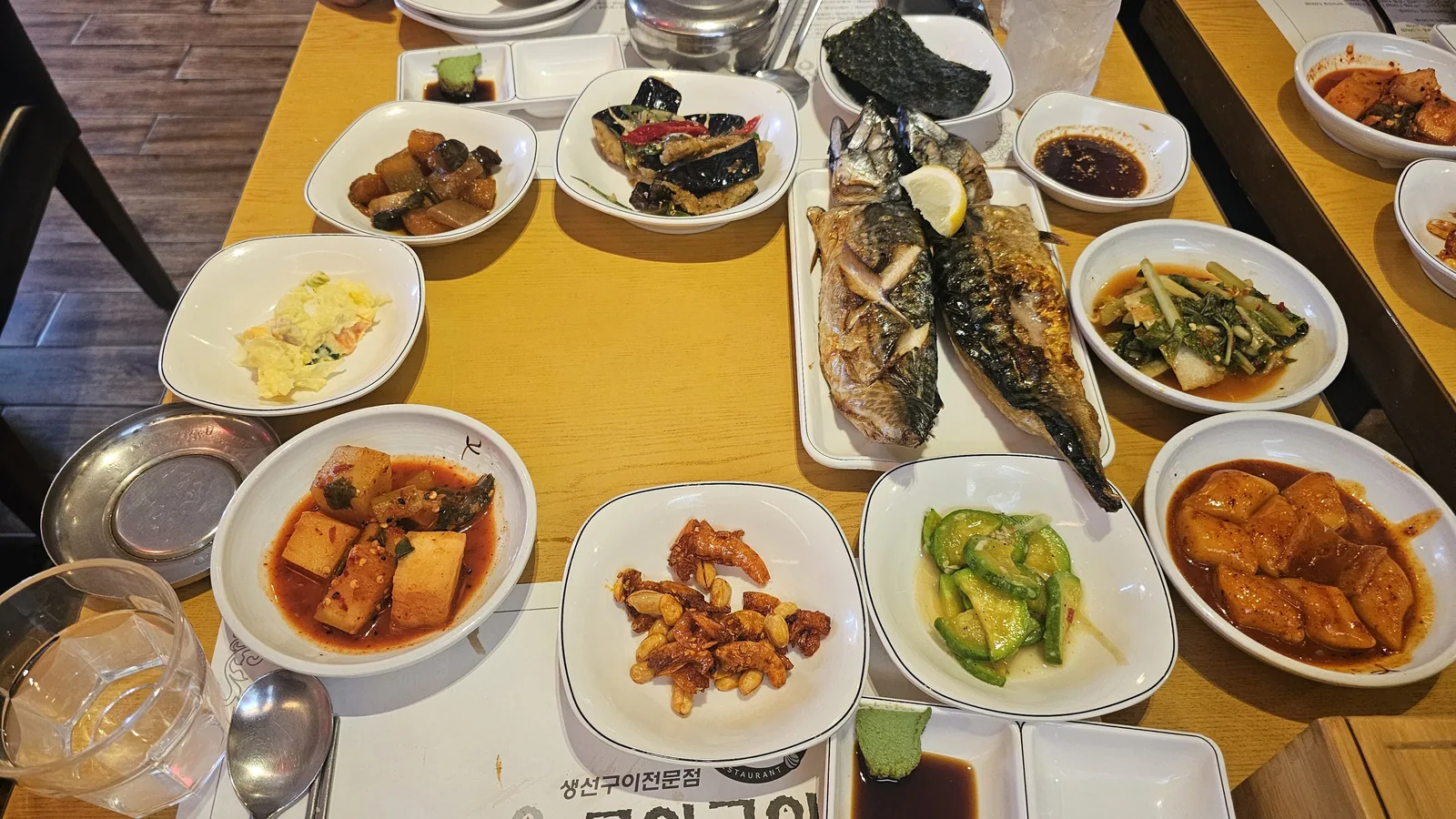
    Quick honest review of Guigui (구이구이) in Yeouido. Short version: it’s a place I keep coming back to. The grilled mackerel is solid, the side dish spread is generous, the al-tang warms you up properly, and there’s an eggplant tempura hiding in the banchan that’s quietly the best thing on the table.

    Went with one other person. Ordered one grilled mackerel and one al-tang. Shared everything.

    What Is Guigui?

    Guigui (구이구이) literally means “grill grill” in Korean. The name is exactly what it is: a grilled fish restaurant. Not a fusion concept, not a themed dining experience. Fish, grilled, served with rice and a table full of side dishes.

    In Korea, this kind of meal works on a set format. You order one main dish — in this case, a whole grilled fish — and the restaurant brings out banchan (반찬), a spread of small complimentary side dishes. Could be 8, could be 12. You don’t order them. They just show up. No extra charge.

    For anyone used to à la carte dining: the side dishes are included. You’re welcome.

    Where It Is

    Yeouido. Seoul’s financial district — think Canary Wharf in London or the lower Manhattan area in New York, but the lunch spots are genuinely better. It’s home to the National Assembly, KBS and MBC broadcasting headquarters, and a dense cluster of office towers.

    Getting there:

    – From Myeongdong: ~25 minutes by subway (Line 5)

    – From Hongdae: ~20 minutes (Line 2 transfer to Line 5)

    – From Gangnam: ~30 minutes (Line 9)

    Yeouido Station exits on both Line 5 and Line 9. The restaurant is an easy walk from there.

    This is not a tourist-heavy area. You’re eating where Seoul office workers eat, which is most of the appeal.

    The Interior

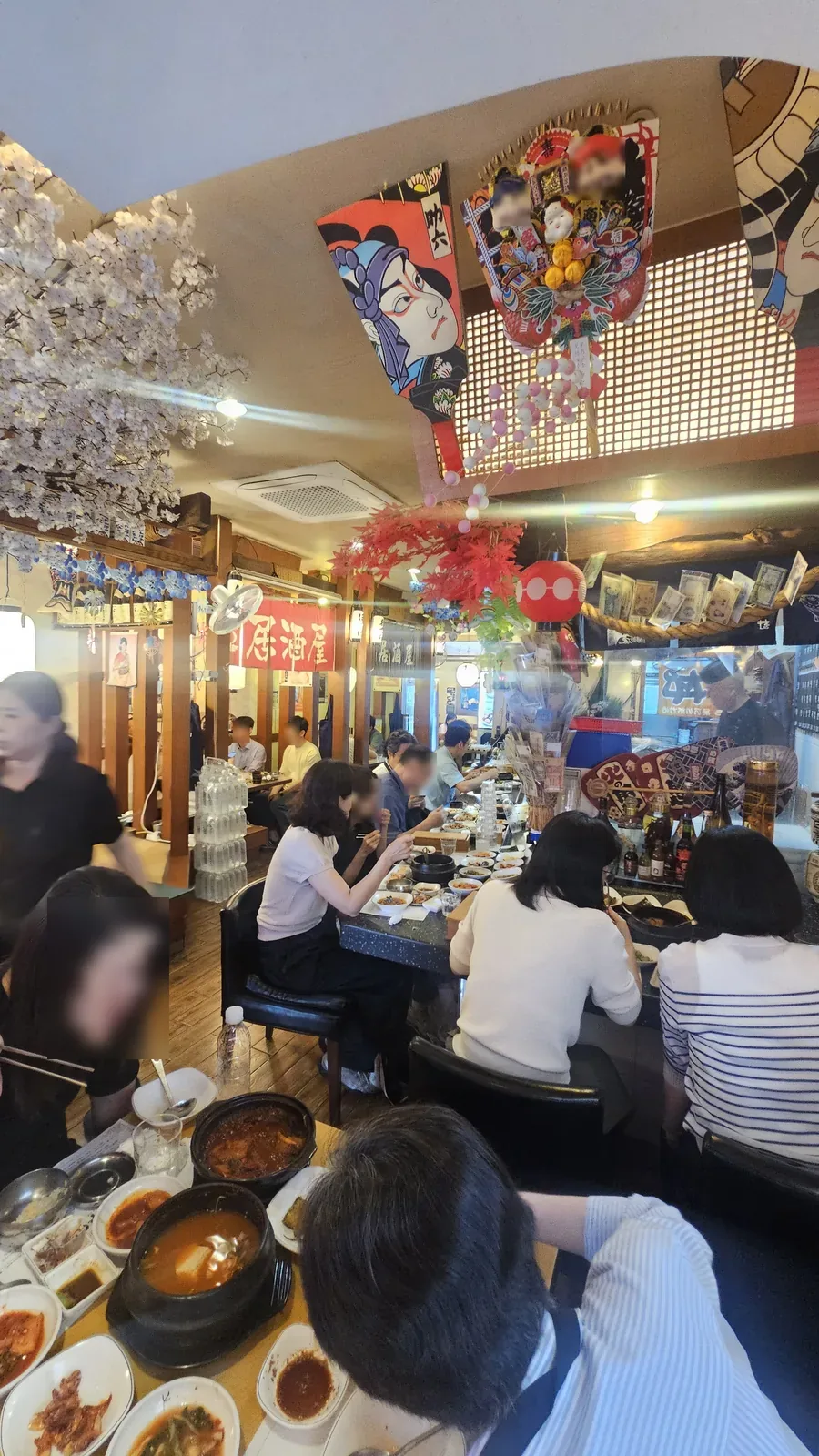
    Busy lunch crowd inside Guigui Yeouido with izakaya-style interior decor fully packed
    Busy lunch crowd inside Guigui Yeouido with izakaya-style interior decor fully packed
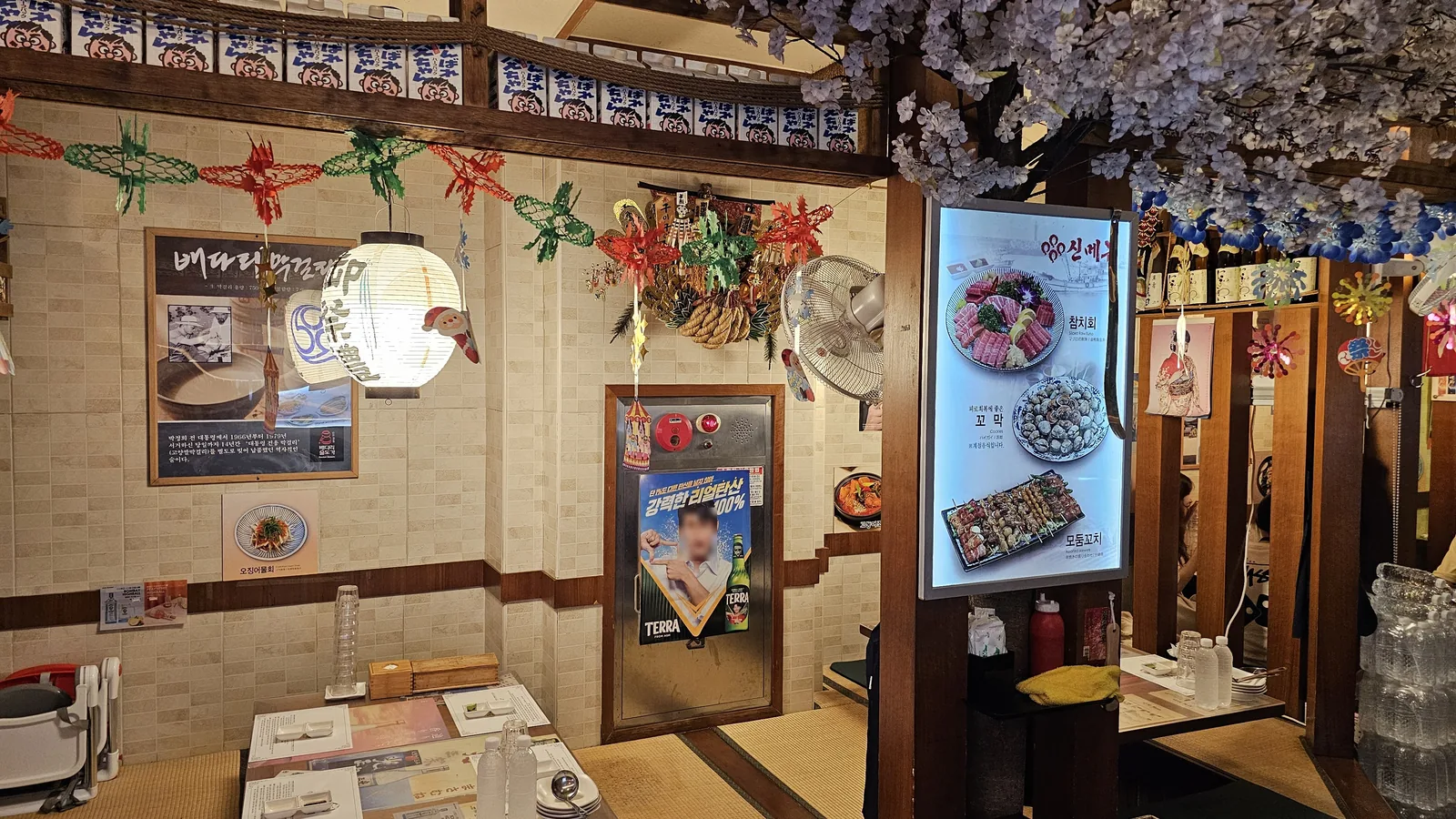
    Interior wall of Guigui Yeouido decorated with cherry blossom branches, paper lanterns, and retro TUNA advertising poster
    Interior wall of Guigui Yeouido decorated with cherry blossom branches, paper lanterns, and retro TUNA advertising poster
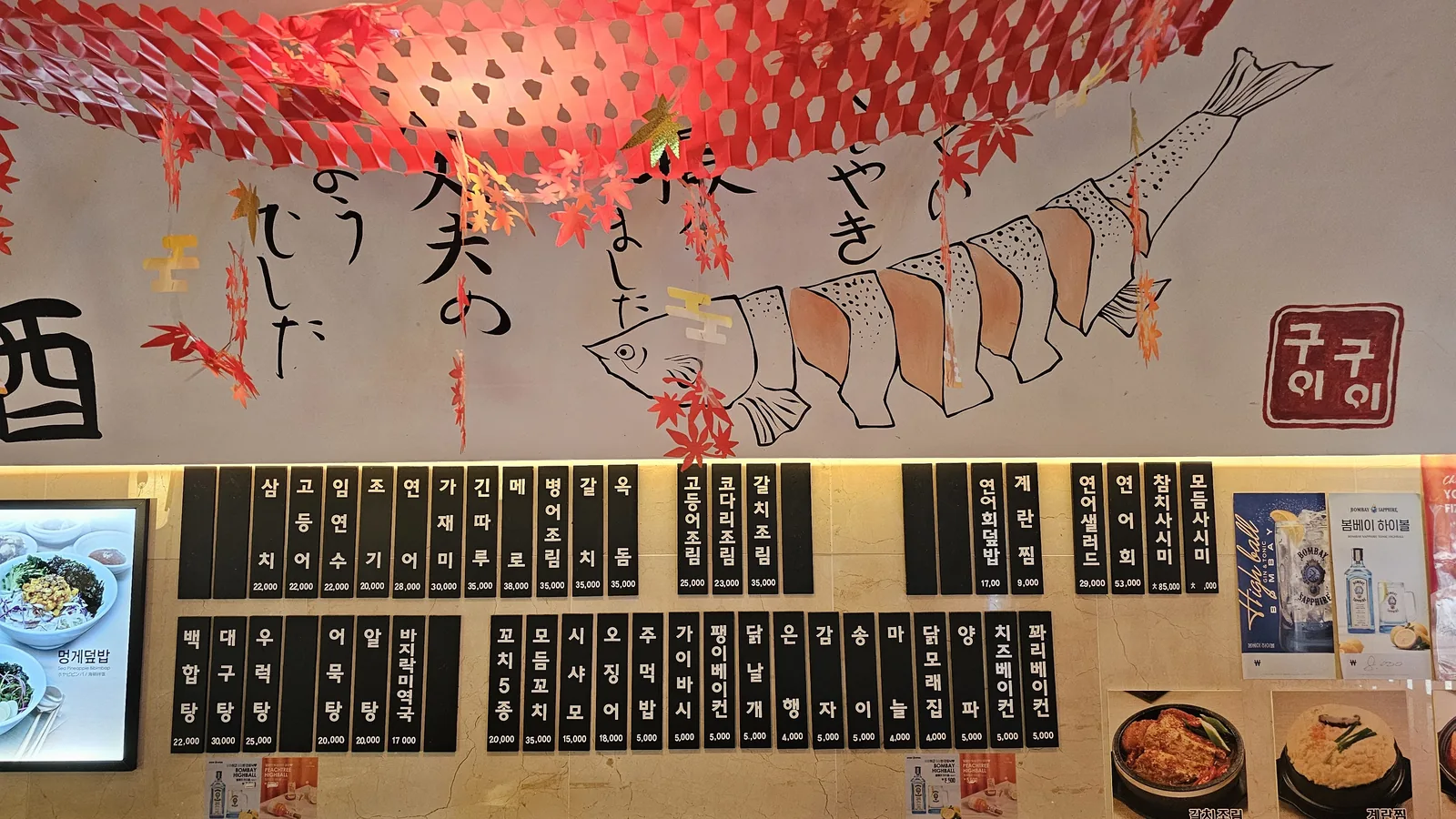
    Chalk menu board on ceiling at Guigui Yeouido with autumn leaf and fish motif decorations
    Chalk menu board on ceiling at Guigui Yeouido with autumn leaf and fish motif decorations

    Not what you’d expect from a grilled fish restaurant. There are paper lanterns hanging from the ceiling, cherry blossom branches on the walls, chalk menus written on wooden boards up top, and retro-style advertising posters — one reads “TUNA” in old-school graphics. Some tables have digital display boards. It reads like an izakaya (Japanese pub) that got reimagined by someone who really loves Korean fish markets.

    A lot of character. Chaotic in a good way.

    We visited at lunch and it was completely packed. Every table taken, steady noise level, quick turnover. This is not a lingering-over-coffee type of place.

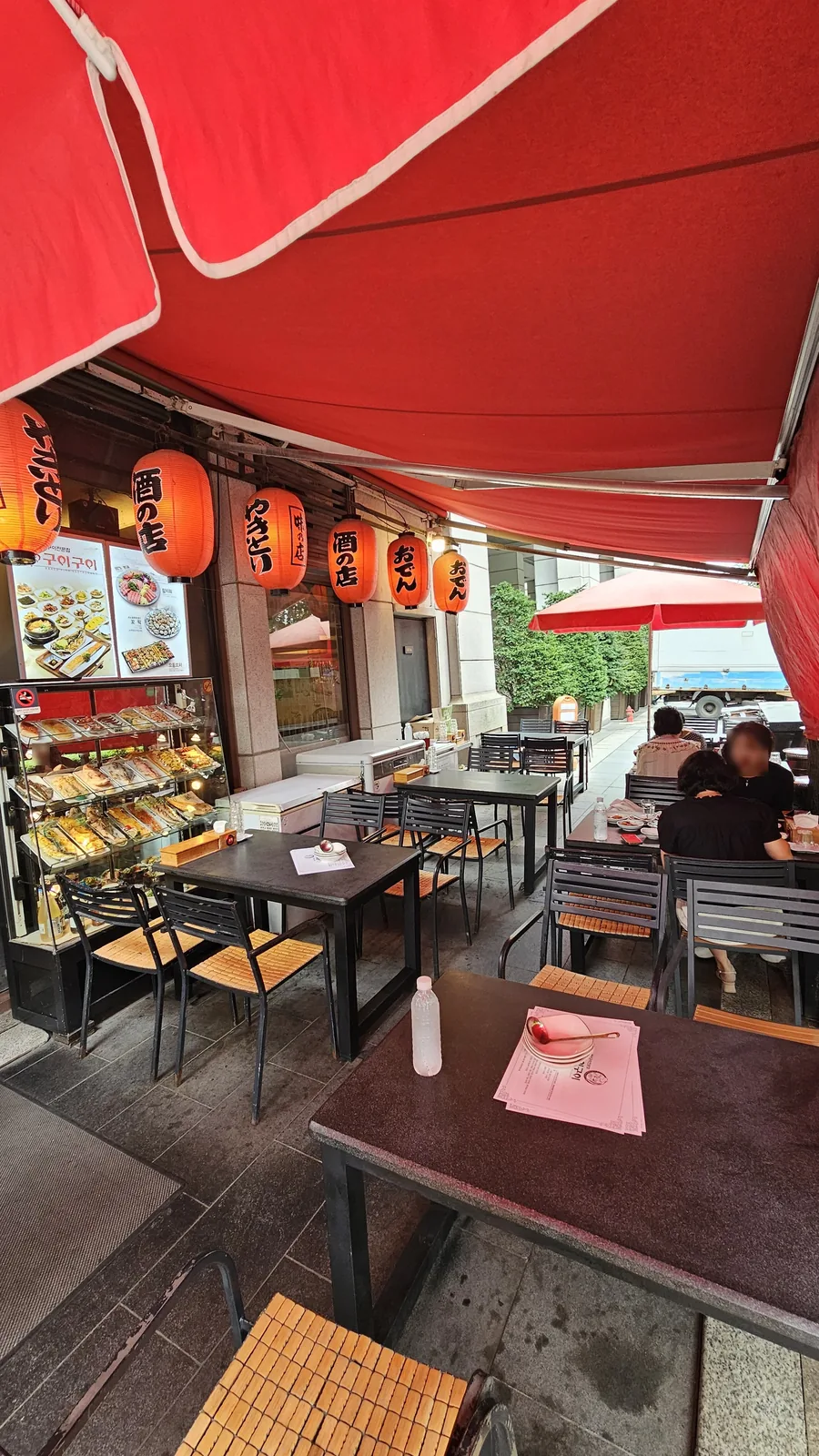
    Outdoor terrace seating at Guigui Yeouido with red awnings and orange paper lanterns
    Outdoor terrace seating at Guigui Yeouido with red awnings and orange paper lanterns
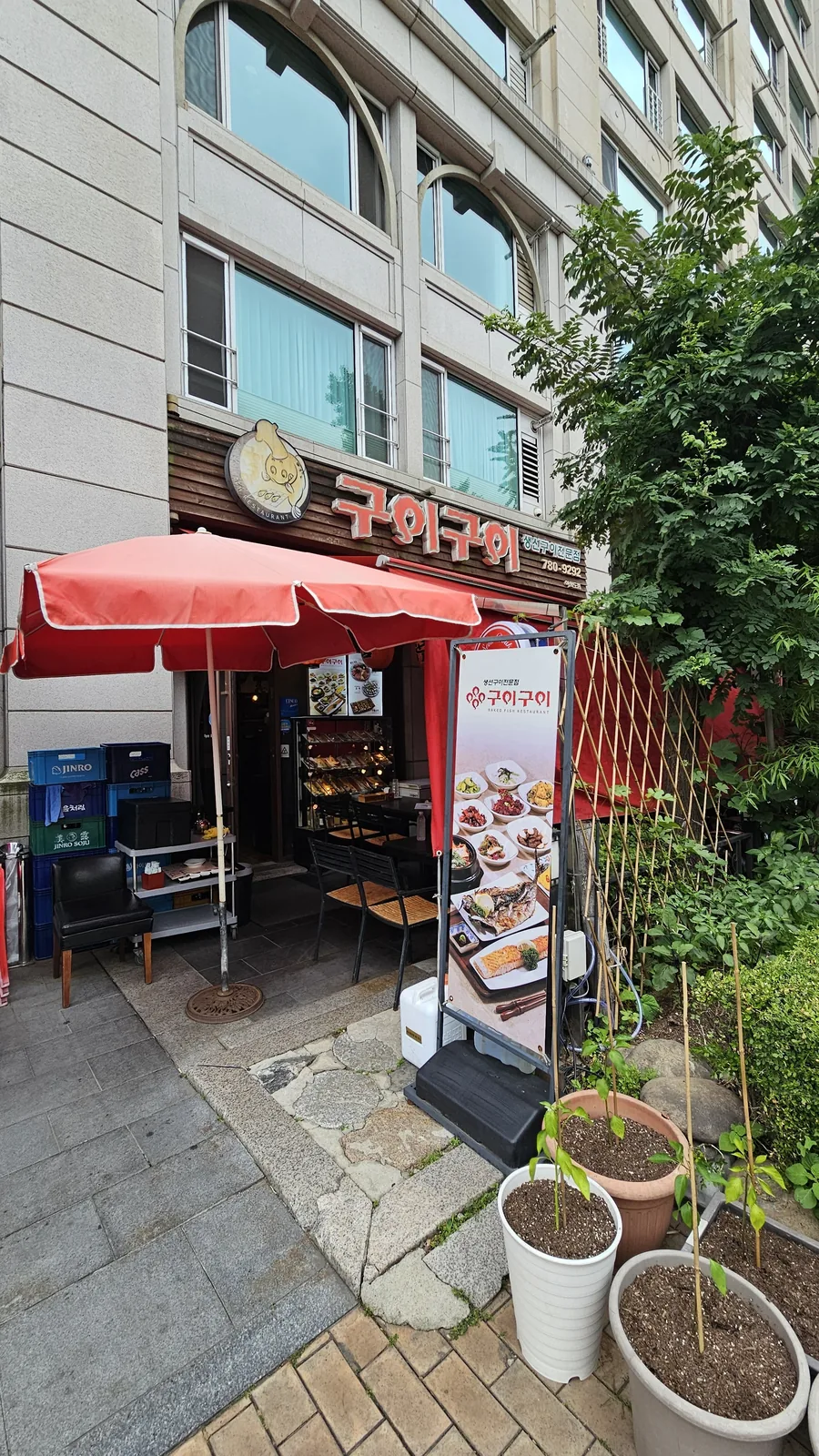
    Exterior facade of Guigui Yeouido in Yeouido Seoul showing red awning and terrace seating during daytime
    Exterior facade of Guigui Yeouido in Yeouido Seoul showing red awning and terrace seating during daytime

    Outside there’s a terrace with bar-style seating along the building face, red awnings, and orange paper lanterns. On a decent weather day, worth grabbing a spot out there.

    The Menu

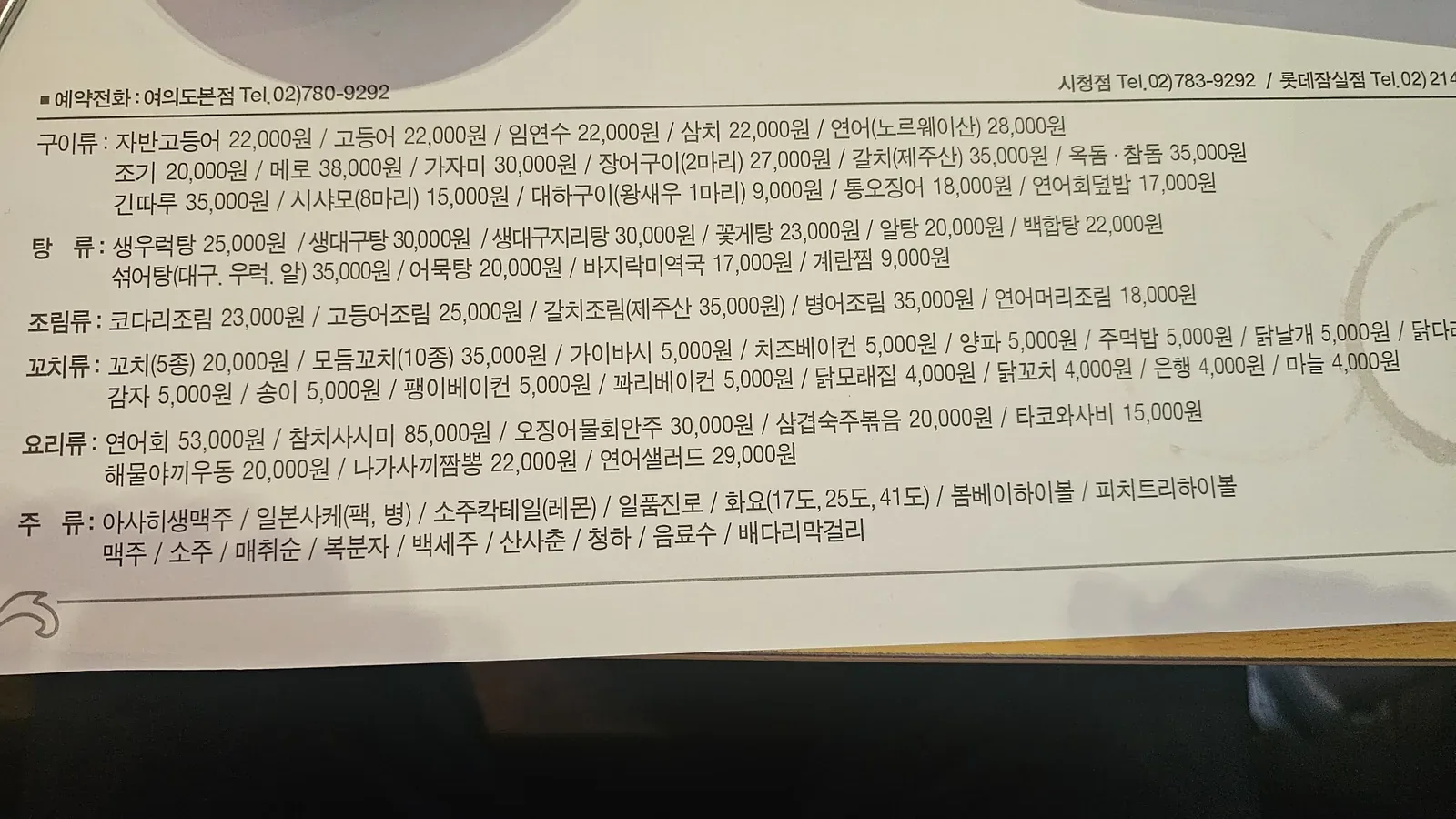
    Main items on the grilled fish side:

    – 고등어구이 (Grilled mackerel): 22,000 KRW (~$16)

    – 자반고등어 (Salt-cured mackerel): 22,000 KRW (~$16)

    – 장어구이 (Grilled eel): 27,000 KRW (~$20)

    – Plus salmon, cutlassfish, and others depending on availability

    There are also stews (탕류) and skewers. We went with the mackerel and al-tang.

    What We Ordered

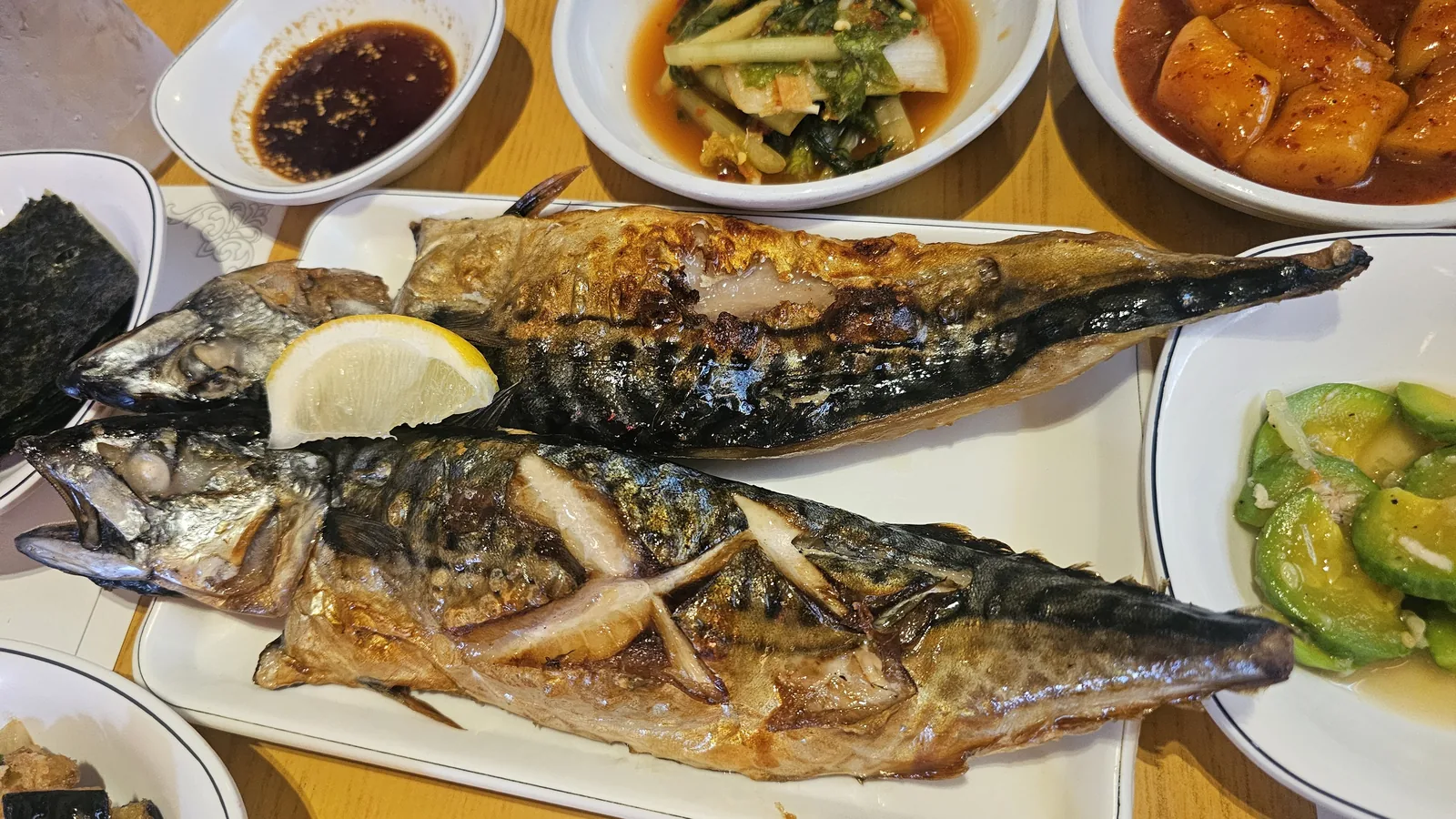
    Two whole grilled mackerel with lemon slices at Guigui Yeouido, crispy golden skin close-up
    Two whole grilled mackerel with lemon slices at Guigui Yeouido, crispy golden skin close-up

    Grilled mackerel (고등어구이) — 22,000 KRW (~$16)

    The mackerel comes whole. Two fish, skin-on, grilled until the surface blisters and the skin tightens up. Lemon wedge on top. That’s it.

    Mackerel has a stronger, oilier flavor than white fish. If you’ve had grilled fish at a Korean home or a neighborhood diner, you know the taste. Guigui’s version is well-executed — the skin is properly crispy without being dry, the flesh pulls apart in clean flakes, and the fat stays in the fish where it belongs.

    It’s not a fancy plate. It doesn’t need to be.

    If you’ve never had whole grilled mackerel before: the bones run through the center of the fish. Use your chopsticks or a spoon to pull the flesh from the spine and ribs. Slightly fiddly, completely worth it.

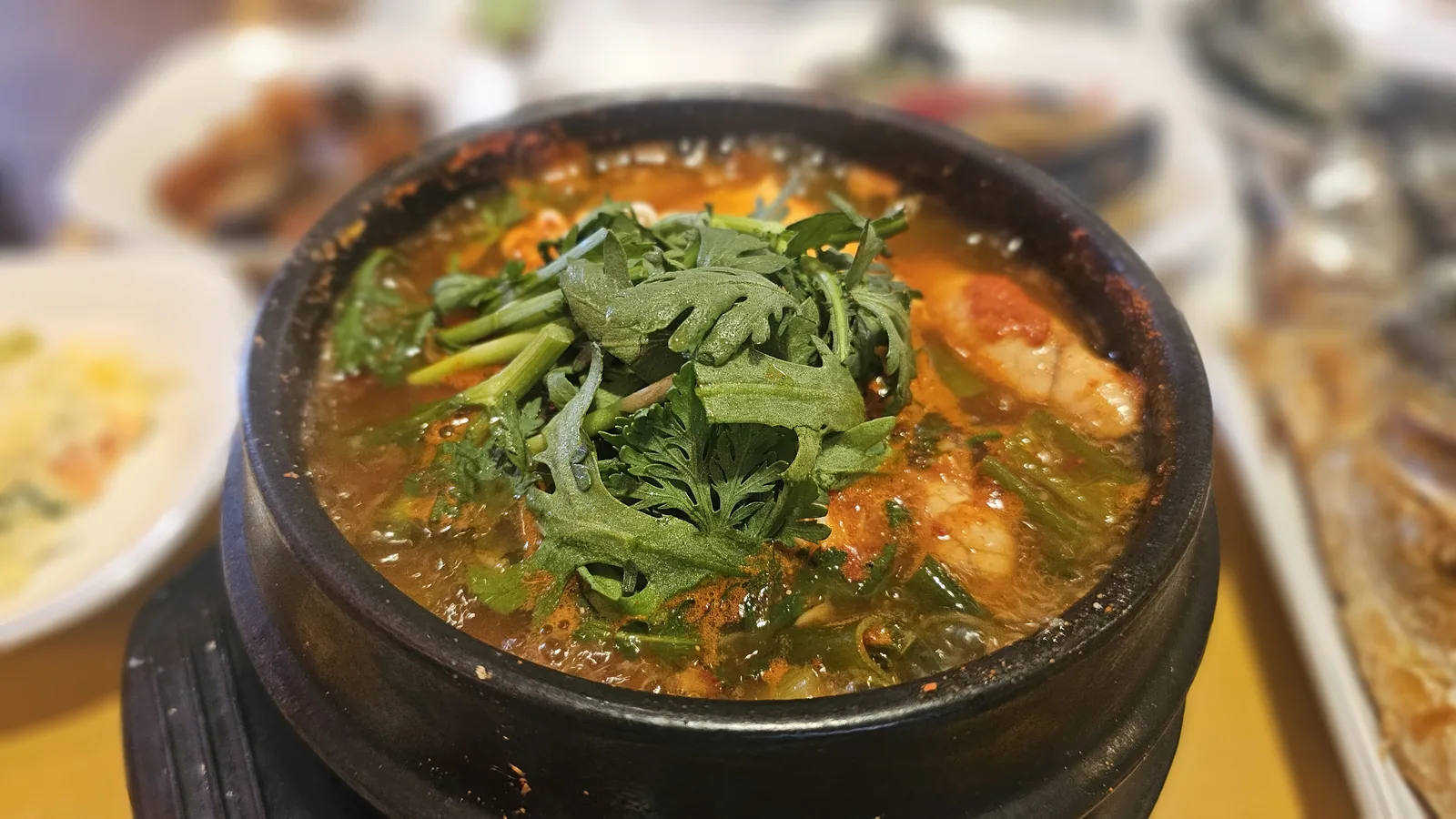
    Spicy fish stew in earthenware pot at Guigui Yeouido garnished with green onions and water parsley
    Spicy fish stew in earthenware pot at Guigui Yeouido garnished with green onions and water parsley

    Al-tang (알탕) — roughly 15,000–18,000 KRW (~$11–$13)

    Al-tang is a spicy stew made with fish roe — typically pollock roe. Red broth, heavy on the heat, piled with water parsley (미나리) and green onions. It comes in an earthenware pot (뚝배기) that holds the heat for a long time.

    If spicy food is not your thing, skip this and order a milder stew. If it is your thing — this is exactly the kind of Korean stew that makes you want to keep scooping more rice into it. The roe has a slightly firm texture, not mushy. The broth is deep and rich from the seafood base.

    Good call. Would order again.

    The Side Dishes

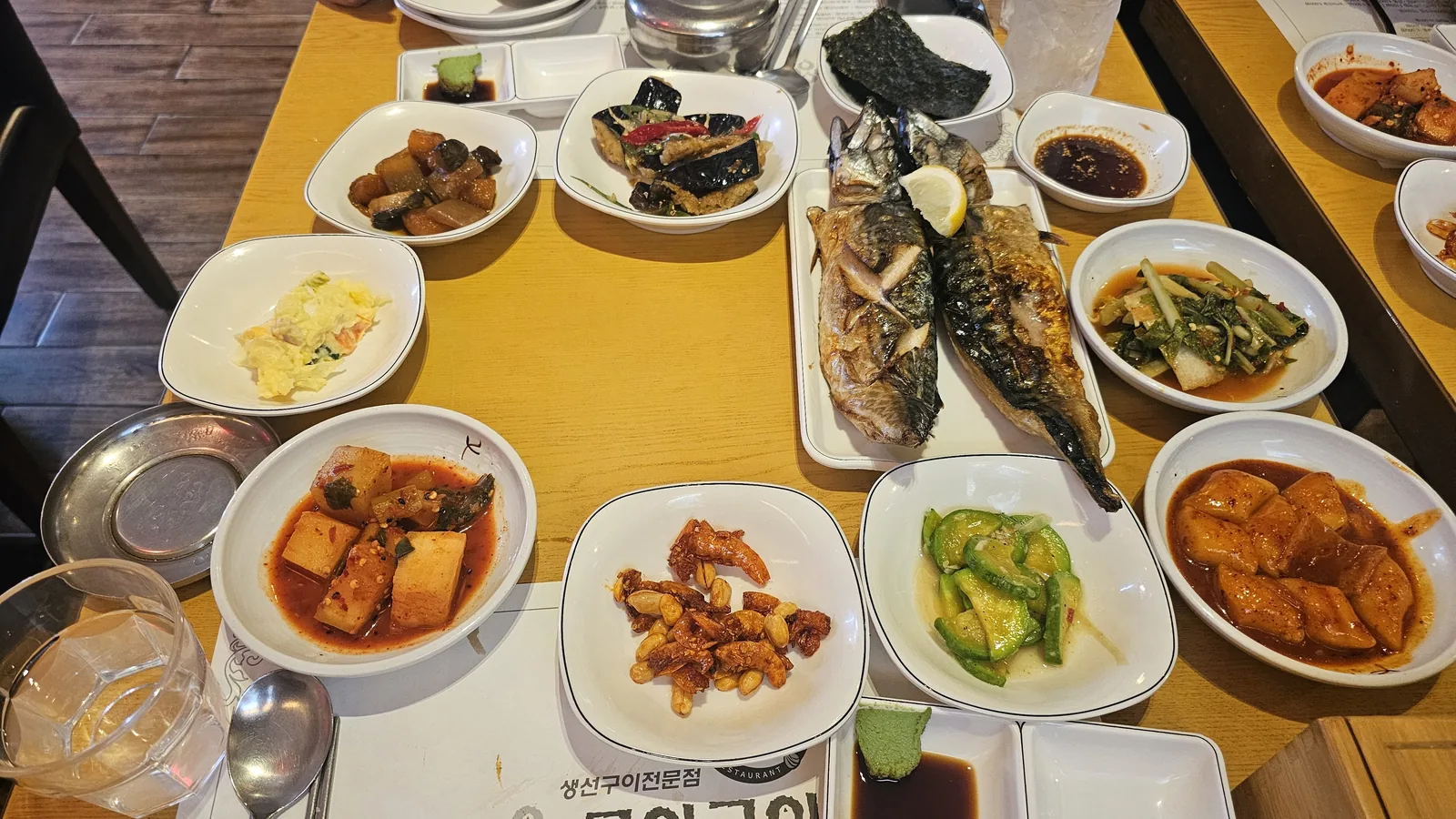
    Full Korean grilled fish set at Guigui Yeouido with two whole mackerel and over ten side dishes covering the table
    Full Korean grilled fish set at Guigui Yeouido with two whole mackerel and over ten side dishes covering the table

    This is honestly where Guigui earns its regulars.

    When the main arrived, the table filled up fast. We counted well over ten side dishes: roasted seaweed, egg roll (계란말이), acorn jelly (도토리묵), radish kimchi (깍두기), cucumber salad, braised tofu, anchovy stir-fry, something tteokbokki-adjacent, avocado salad, and a few others I didn’t catch the names of.

    Standard lineup for this style of restaurant. But then there was the eggplant tempura (가지튀김).

    I wasn’t expecting much from it. It’s one small plate among a dozen others. But — eggplant, battered lightly, fried without getting greasy, soft on the inside. I ate most of it before even getting to the mackerel.

    If you’re at Guigui and the eggplant tempura shows up on your table, don’t ignore it.

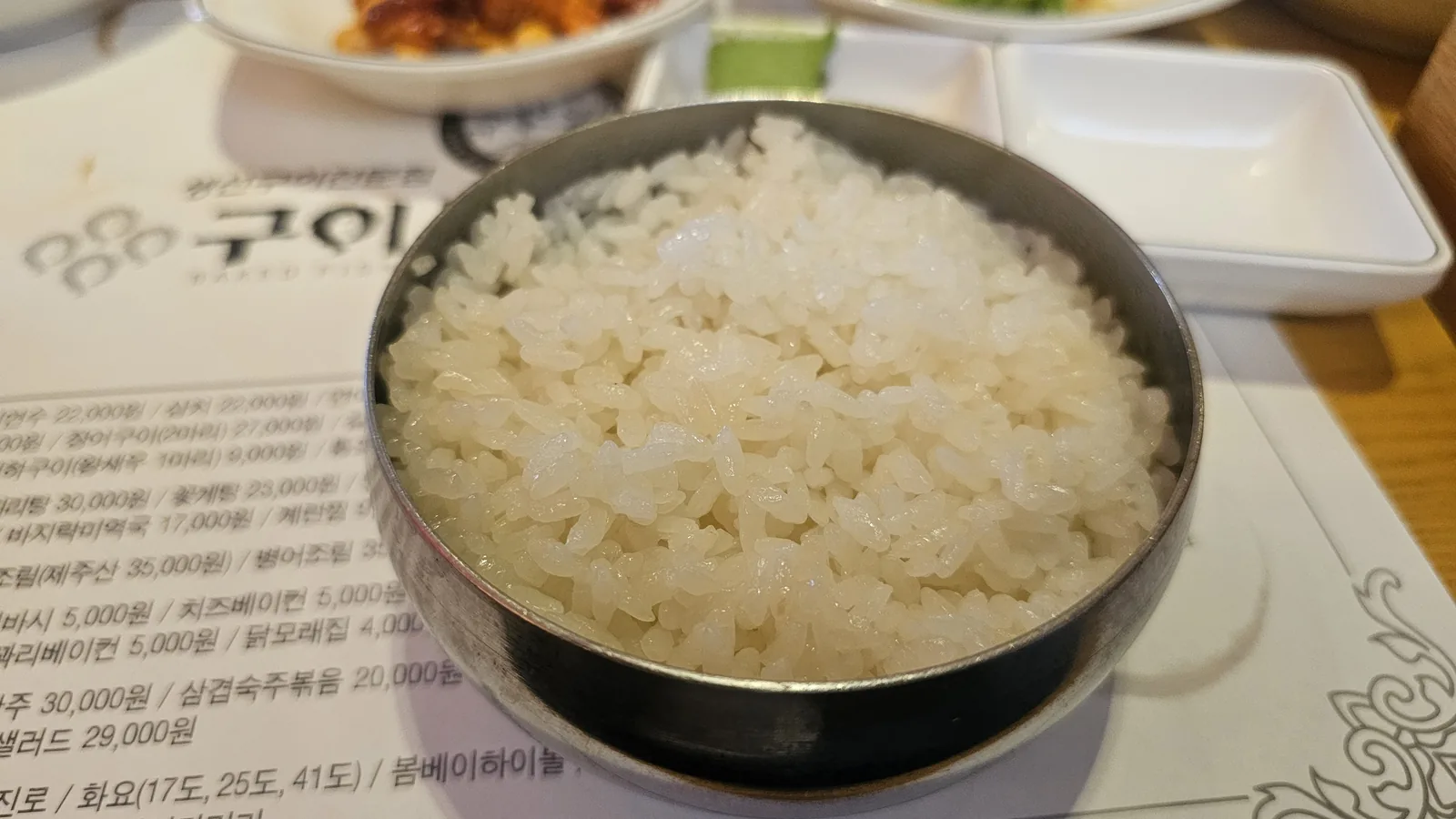
    Steel bowl of white rice at Guigui Yeouido with menu board visible in the background
    Steel bowl of white rice at Guigui Yeouido with menu board visible in the background

    Rice comes in the standard steel bowl. At most Korean restaurants of this type, you can ask for refills — just flag down the staff and point at the bowl.

    Stuff Tourists Should Know

    Language: Menu boards are in Korean only. The photo menus on the wall help significantly — pointing and holding up fingers gets the order done. Don’t stress it.

    Payment: Card payment is standard across Yeouido. Foreign Visa and Mastercard cards generally work at Korean terminals. Keep a little cash on hand as backup.

    Tipping: There is no tipping culture in Korea. Don’t leave money on the table expecting it to be kept as a tip — it may just create confusion.

    Spice: Grilled mackerel is not spicy. Al-tang is spicy. If you want a milder stew option, ask about 대구지리탕 (daegu jiri-tang, mild cod stew) if it’s available. Or just skip the stew and focus on the fish.

    Vegetarian options: Minimal. This is a fish-forward restaurant. Most banchan contain anchovy broth, dried fish, or small seafood. Not a good pick for vegetarians.

    Halal: Not halal-certified.

    Timing: Lunch rush is serious. Arrive before 11:30 AM or after 1:30 PM if you want to walk in without a wait.

    Who this is for: People who eat at the same place more than once. Office workers, Yeouido regulars, anyone building a mental list of reliable Seoul lunch spots. Not a special occasion restaurant. A very good everyday restaurant.

    The Verdict

    Should you go?

    If you’re in Yeouido for any reason — yes. The grilled mackerel is properly done, the banchan spread is more generous than most, the al-tang delivers, and the eggplant tempura is a genuine bonus. Prices land around 18,000–25,000 KRW (~$13–$19) per person, which is fair for what you get.

    If you’re a tourist with three days in Seoul — probably not your first stop. Yeouido isn’t on the typical tourist circuit, and good grilled fish exists across Seoul. But if you’re already heading to Yeouido — Han River Park is nearby, IFC Mall is close, 63 Building is a short distance — it’s worth making Guigui your lunch plan.

    It’s the kind of place you eat at once, remember, and come back to. That’s a good sign.

    FAQ

    What is the must-order dish at Guigui Yeouido?

    The grilled mackerel (고등어구이, 22,000 KRW / ~$16). It comes whole, skin-on, with rice and 10+ complimentary side dishes included. Also check if eggplant tempura shows up in your banchan — it’s genuinely good.

    How much does a meal at Guigui Yeouido cost per person?

    Around 18,000–25,000 KRW (~$13–$19 USD) per person depending on what you order. Grilled mackerel is 22,000 KRW, eel is 27,000 KRW.

    Is Guigui packed at lunch? Should I make a reservation?

    Yes, very packed on weekdays. Aim to arrive before 11:30 AM or after 1:30 PM. Check their official social media for reservation options — walk-ins work but you may wait.

    Does Guigui Yeouido have an English menu?

    The main menu boards are in Korean. The photo menus on the walls help a lot — pointing and holding up fingers gets the job done. Staff won’t speak much English but orders go through fine.

    Is the food at Guigui spicy?

    The grilled fish itself is not spicy. The al-tang (fish roe stew) is spicy. If spice is a concern, stick to grilled fish and plain rice.

    Can I pay by card at Guigui Yeouido?

    Most restaurants in Yeouido accept card including foreign Visa and Mastercard. Keep a bit of cash as backup just in case.

    You might also like

    📍 Location