Author: 알콩달콩

  • Yamaya Yeouido: Honest Review of the Mentaiko Lunch Sets

    Yamaya Yeouido: Honest Review of the Mentaiko Lunch Sets

    Yamaya Yeouido: Honest Review of the Mentaiko Lunch Sets

    Quick honest review of Yamaya Yeouido — a Japanese mentaiko chain doing teishoku lunch sets in the middle of Seoul’s financial district. Skip to the verdict if you’re short on time, but the short version: the food is solid Japanese comfort fare, nothing mind-blowing, and the unlimited mentaiko refills are genuinely the highlight of the meal.

    We went on a Tuesday at noon, two people, walked in without reservations. Ordered the chicken nanbanzuke set and the menchikatsu set. Total came to 33,800 KRW (~$25 USD) for two.
    What Is Yamaya?

    Yamaya (야마야) is a Japanese specialty chain from Fukuoka, Kyushu — founded in 1974. Their thing is mentaiko, which is spicy cured pollock roe. If you’ve eaten at a Japanese restaurant and seen that pink, slightly grainy paste served with rice or on pasta, that’s mentaiko.
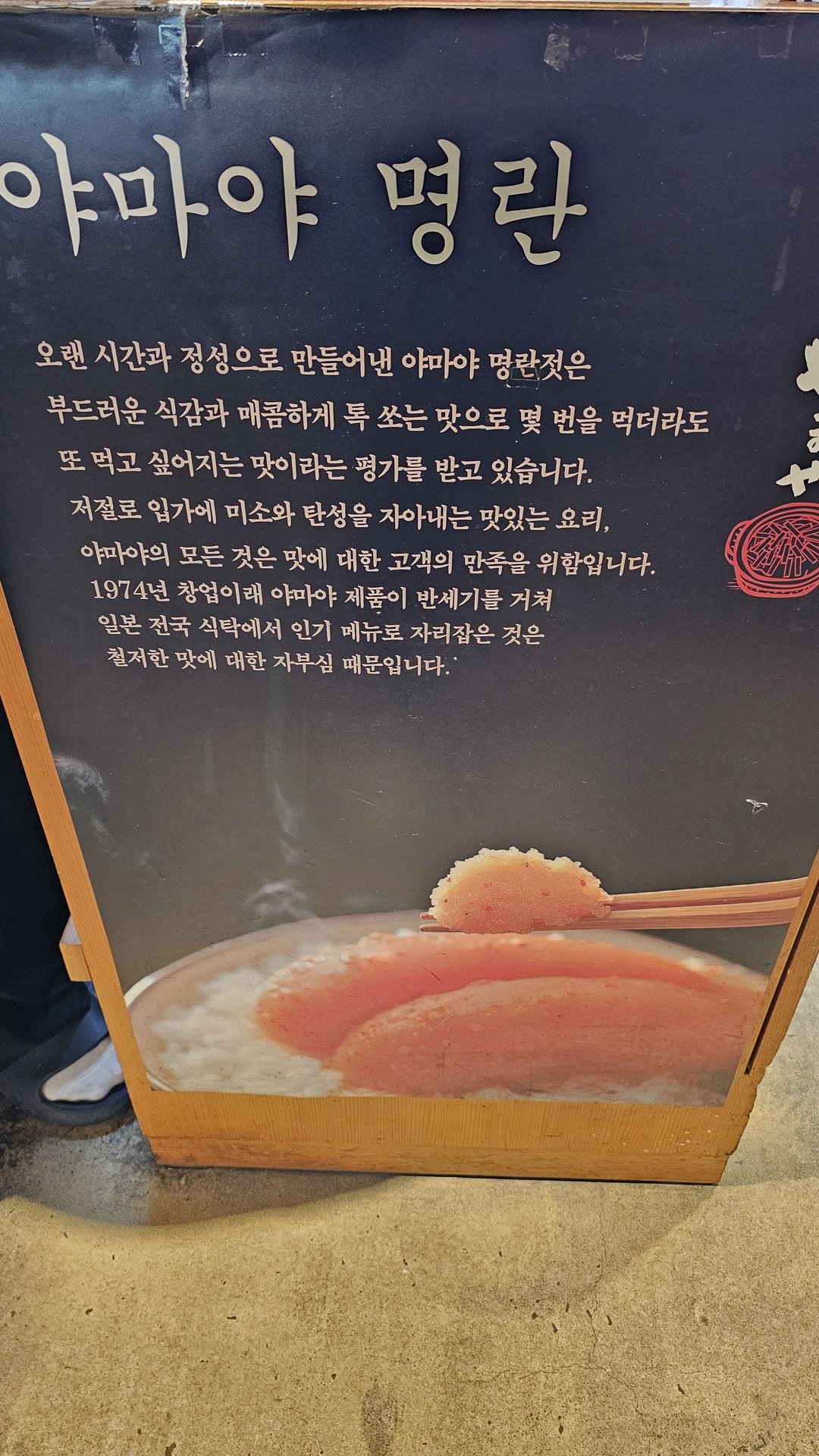
    Yamaya brand history board — mentaiko specialist founded in Fukuoka Japan in 1974
    Yamaya brand history board — mentaiko specialist founded in Fukuoka Japan in 1974

    In Japan, Yamaya runs mentaiko retail shops and restaurants. In Korea, the restaurant format leans into Japanese teishoku — set meals with a main dish, rice, miso soup, and side dishes. The twist here is that mentaiko comes as a side dish and you can refill it as many times as you want.

    That last part is the actual selling point.

    Getting There

    Yamaya Yeouido is in Yeouido — Seoul’s financial district, think Wall Street but with more convenience stores. The area is packed with office towers, a few large malls, and plenty of lunch spots targeting the nine-to-five crowd.

    Nearest subway: Yeouido Station (Line 5 and Line 9). From the station it’s a short walk. Taxis from central Gangnam take about 15 minutes outside rush hour. From Incheon Airport, roughly 50–60 minutes via the AREX express train to Gimpo then a subway transfer, or around 40 minutes by taxi.

    If you’re staying near Yeouido — IFC Residence, 63 Building area hotels — you can easily walk here for lunch.

    The Interior

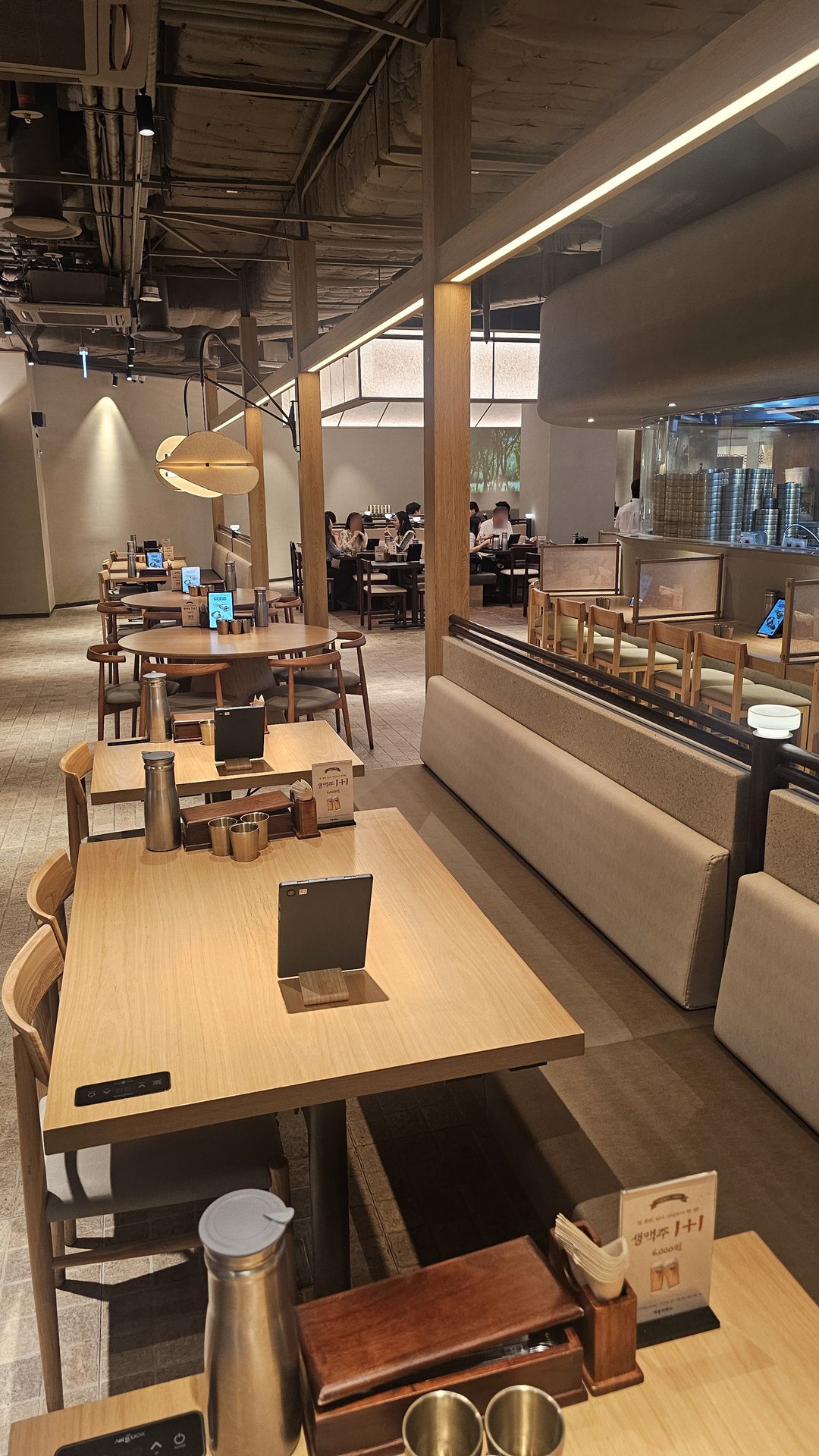
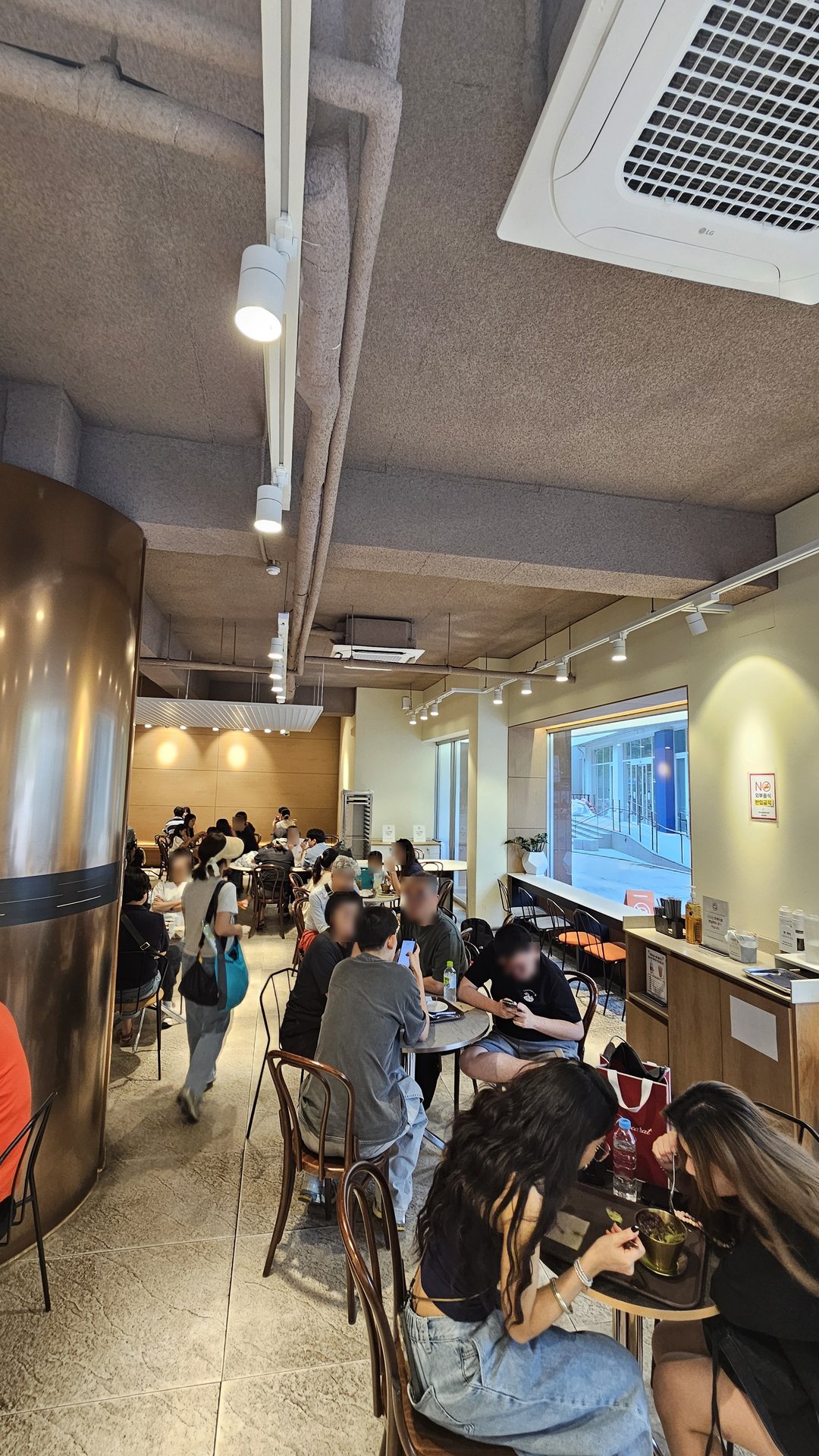
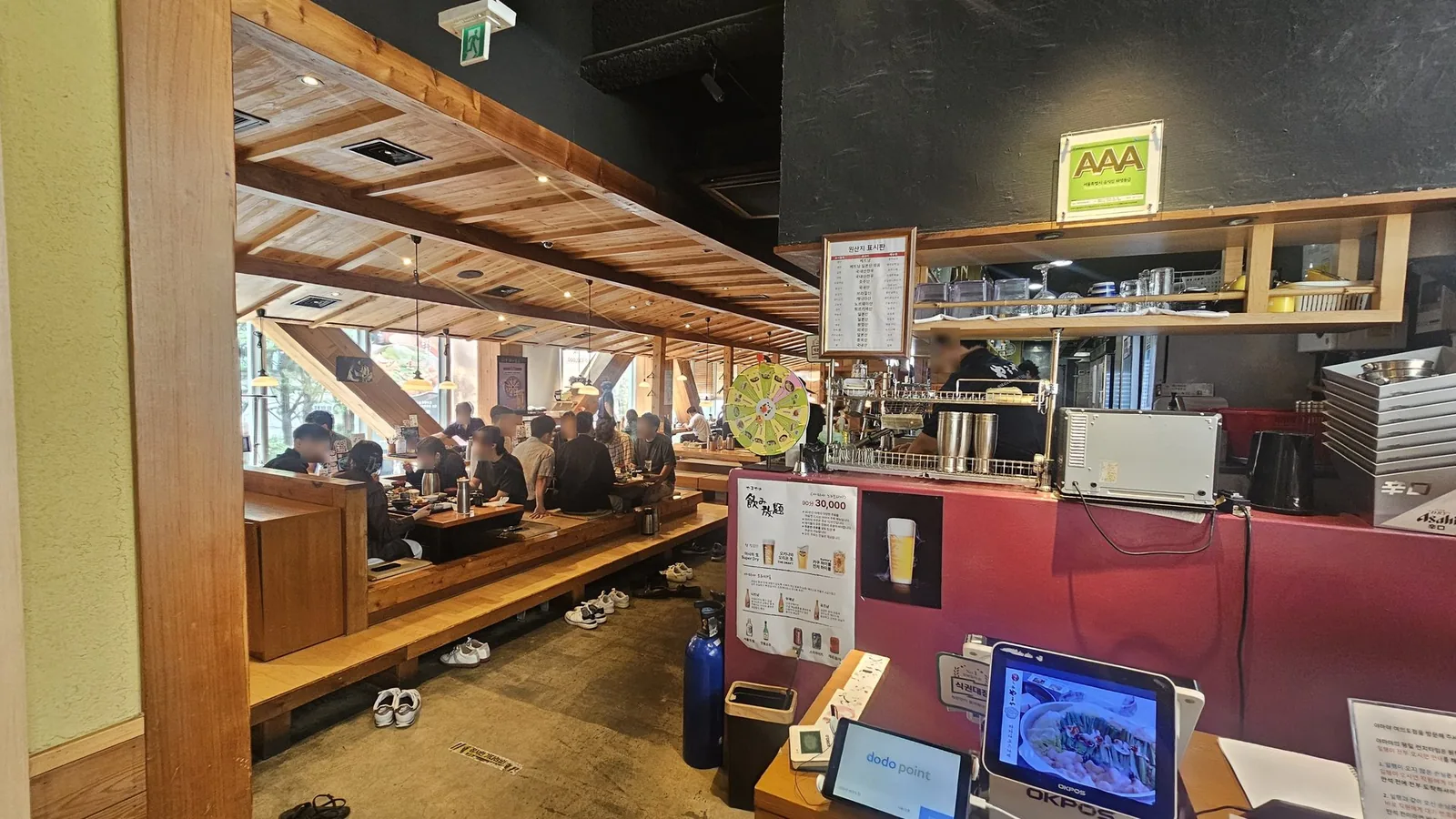
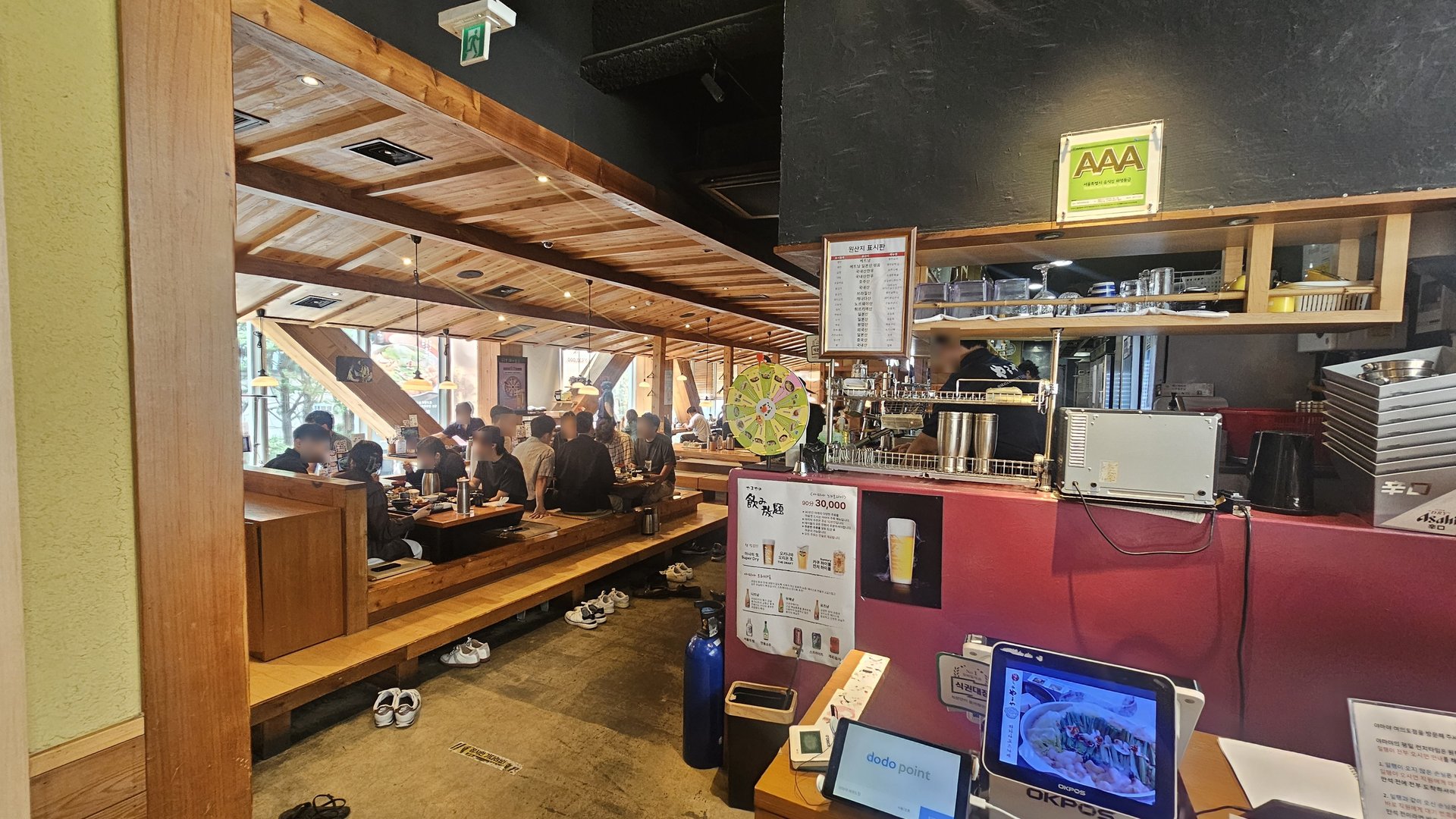
    Wooden beams, warm lighting, that slightly rustic Japanese teishoku restaurant feel. Not cramped, but not trying to be sleek either. Mixed seating — some floor-level seating (좌식) and regular table seating. Open kitchen along one side so you can see the cooking.
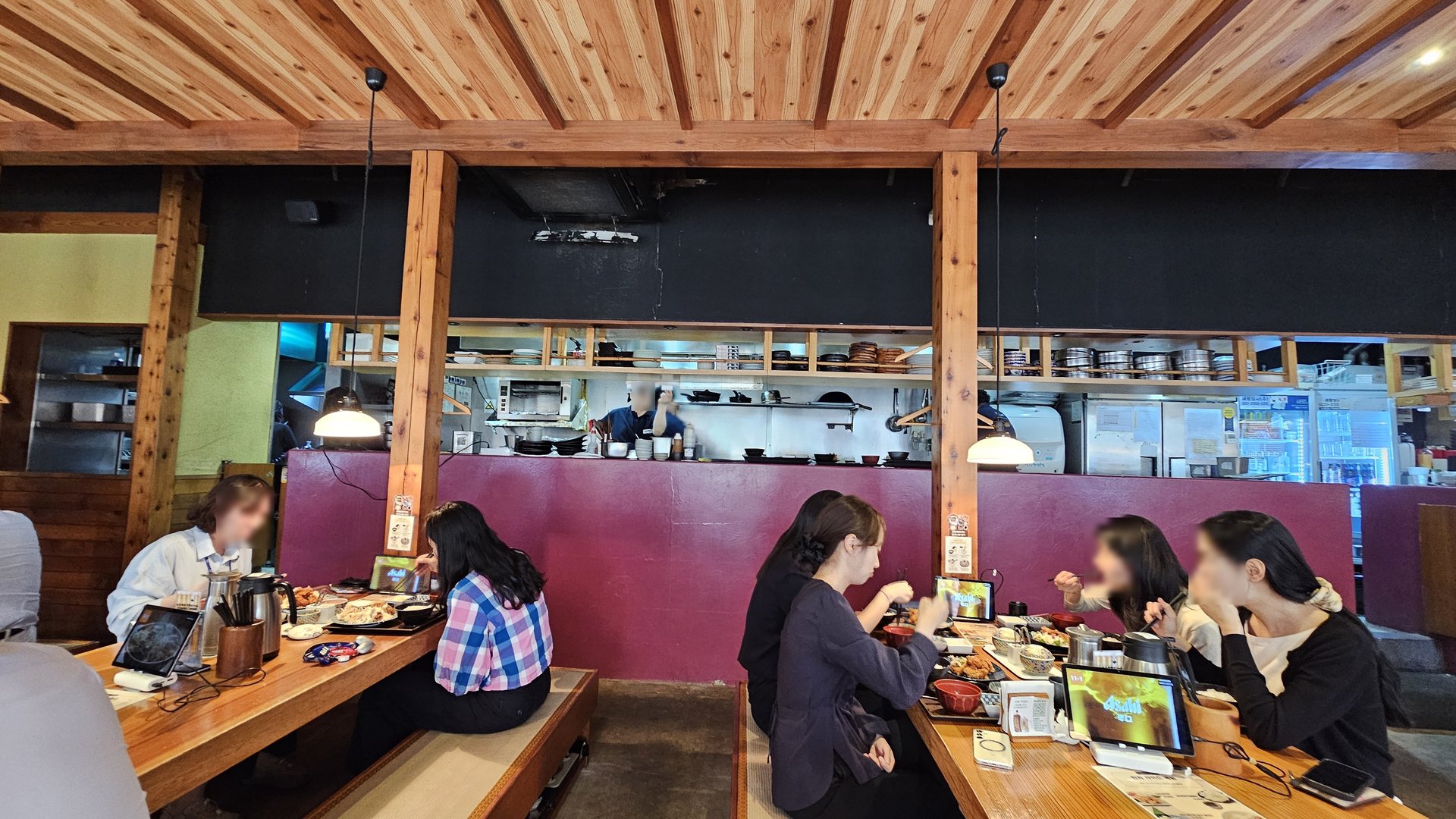
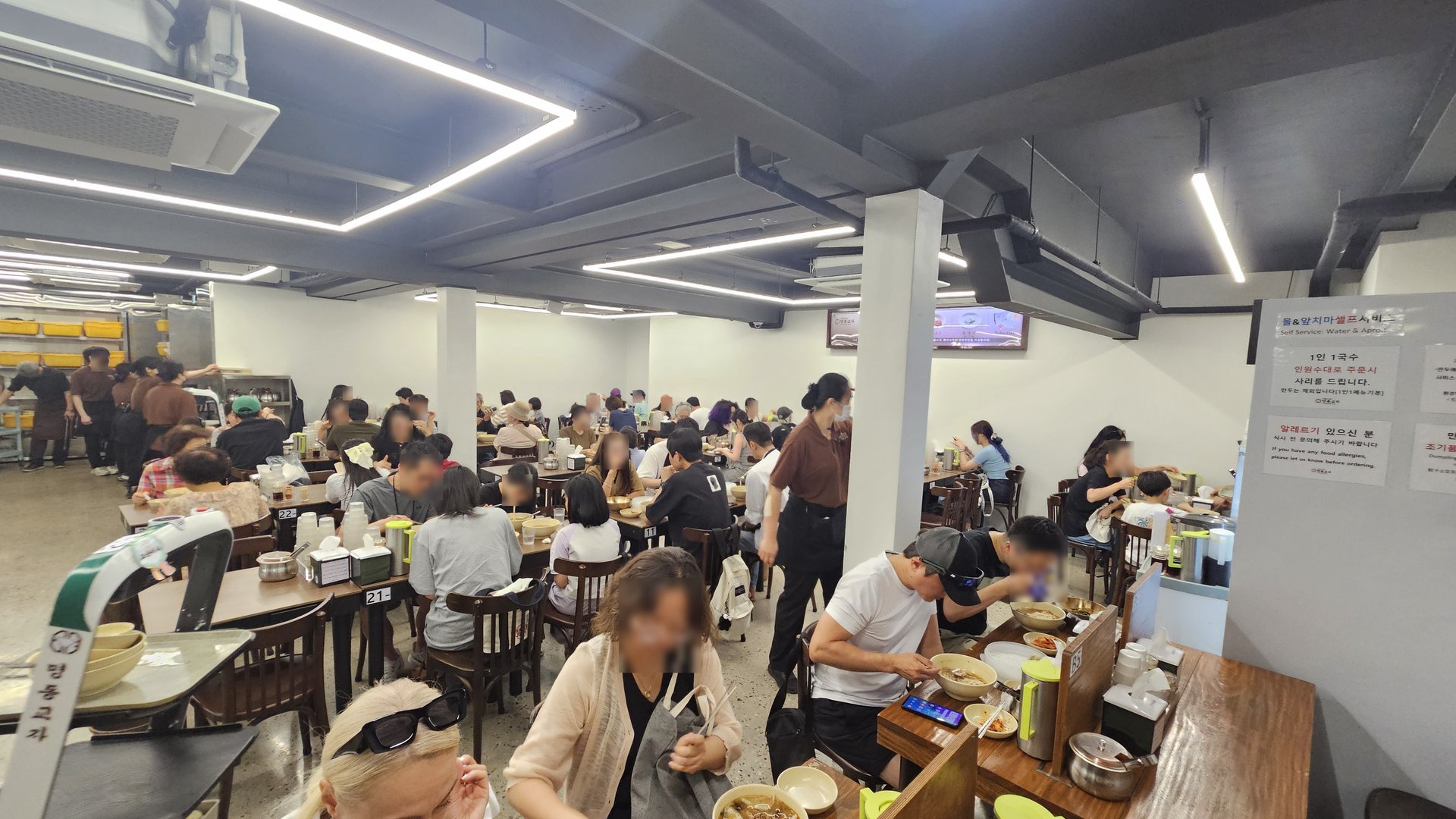
    Yamaya Yeouido dining hall with customers eating lunch, open kitchen visible in background with staff cooking
    Yamaya Yeouido dining hall with customers eating lunch, open kitchen visible in background with staff cooking

    At noon on a Tuesday it was essentially full. Most of the crowd was office workers, largely women. The pace felt efficient — people come in, eat, leave. Not a place you linger over coffee.

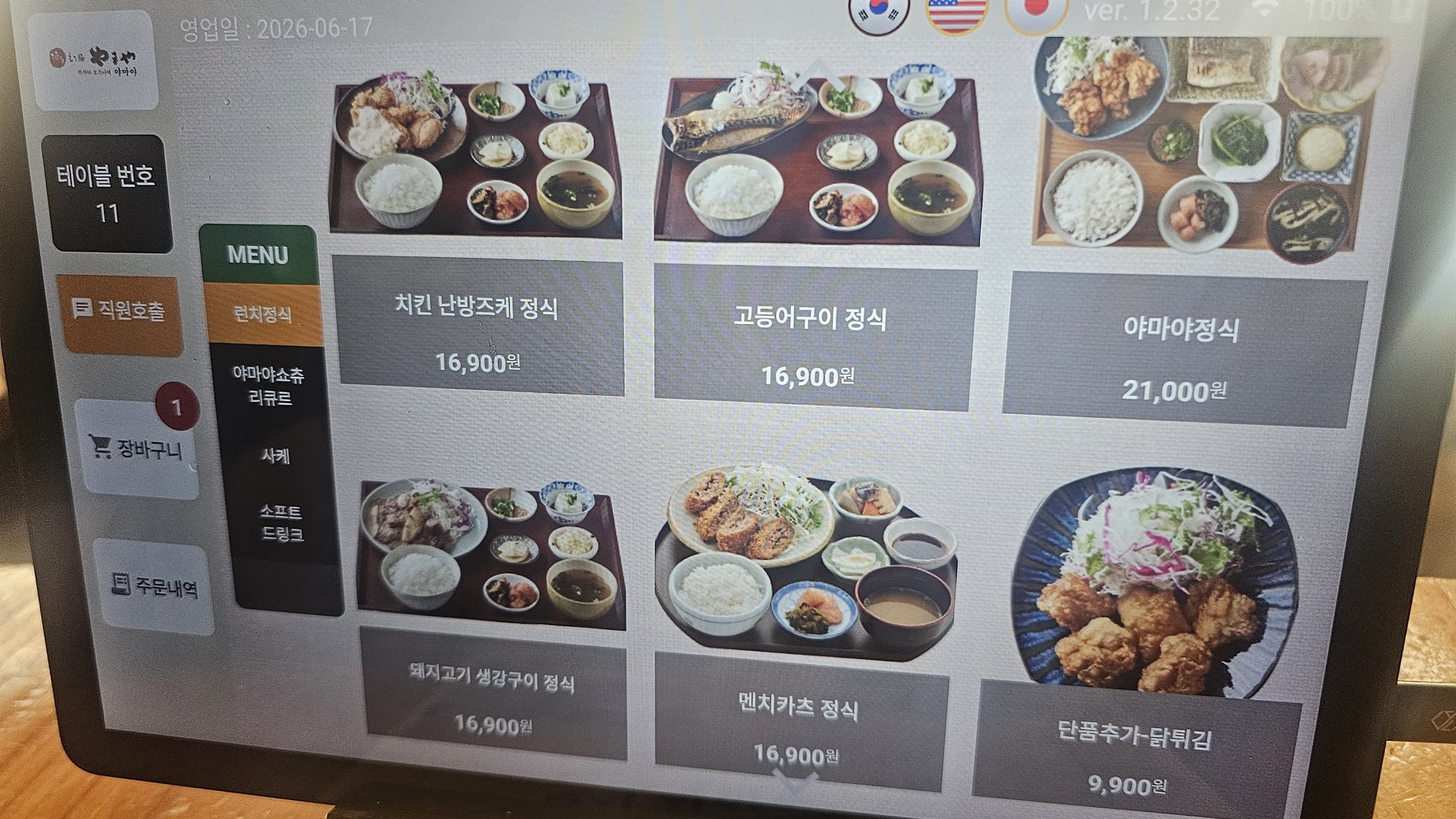
    Ordering is tablet-based (Korean only), with photos for each item. Easy enough to navigate if you point at what looks good.
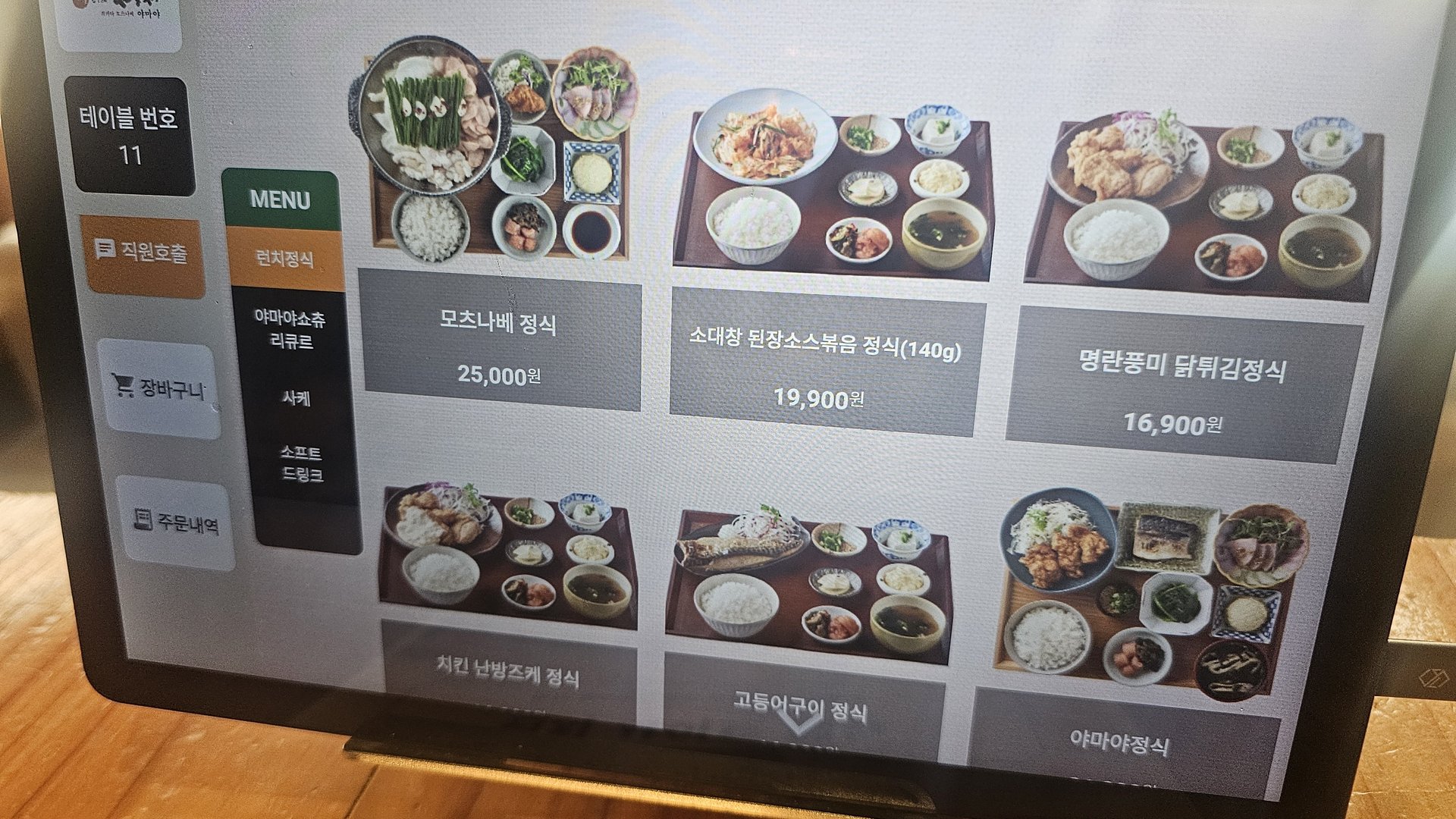
    Yamaya Yeouido tablet ordering screen showing set meal options including Mochonabe and Mentaiko Chicken sets
    Yamaya Yeouido tablet ordering screen showing set meal options including Mochonabe and Mentaiko Chicken sets
    Yamaya Yeouido tablet ordering screen showing Chicken Nanbanzuke, Menchikatsu, and Pork Ginger sets with prices
    Yamaya Yeouido tablet ordering screen showing Chicken Nanbanzuke, Menchikatsu, and Pork Ginger sets with prices

    What We Ordered

    Chicken Nanbanzuke Set — 16,900 KRW (~$12.50 USD)
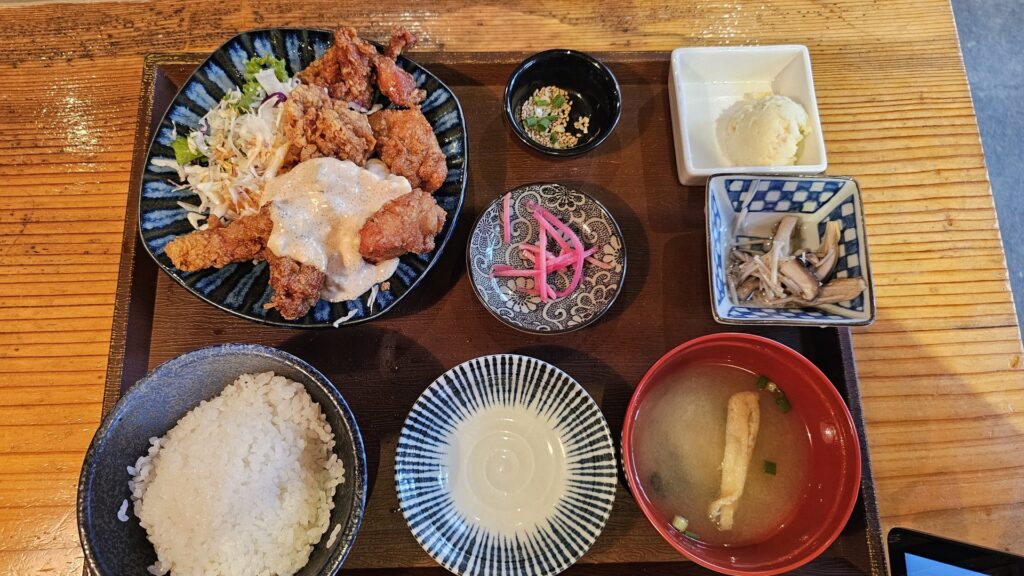
    Top-down view of Yamaya lunch set showing fried chicken main, rice, miso soup, mushroom side, and tofu

    Nanbanzuke (난방즈케) is a Japanese dish where fried chicken gets finished in a sweet vinegar marinade — it’s tangy, slightly sweet, and a bit sticky. Not the same as Korean fried chicken. Think of it as fried chicken that’s been dressed up with a sauce that’s closer to an Asian agrodolce.
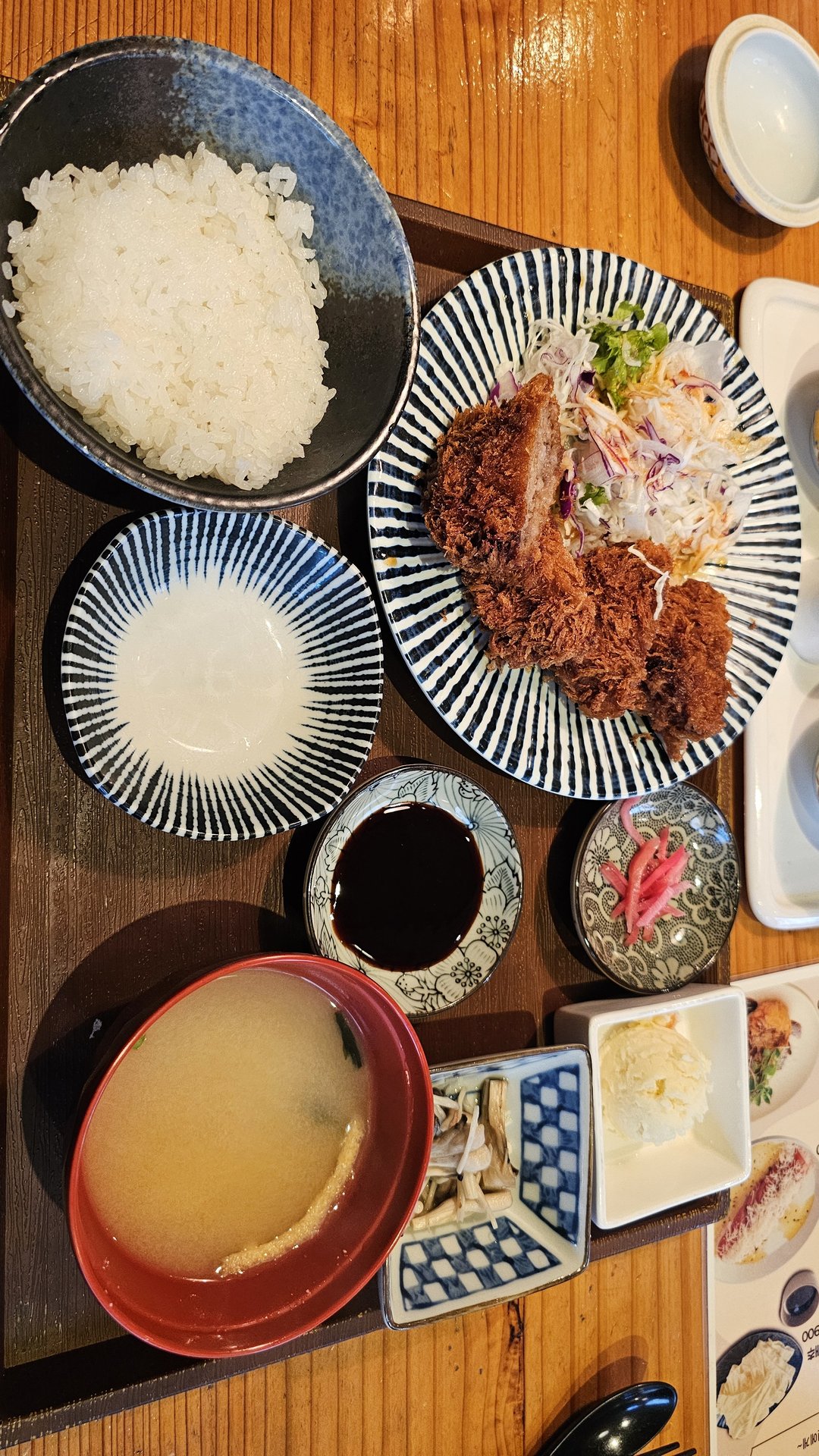
    Full Yamaya teishoku lunch set with fried main dish, rice, miso soup, and side dishes on a tray
    Full Yamaya teishoku lunch set with fried main dish, rice, miso soup, and side dishes on a tray

    The chicken itself was well-fried — crispy coating, juicy inside. The nanbanzuke sauce was on the milder, sweeter side, which actually works well with a bowl of white rice. Not the most exciting dish I’ve had this year, but solid execution. You’ll finish the plate.

    Menchikatsu Set — 16,900 KRW (~$12.50 USD)
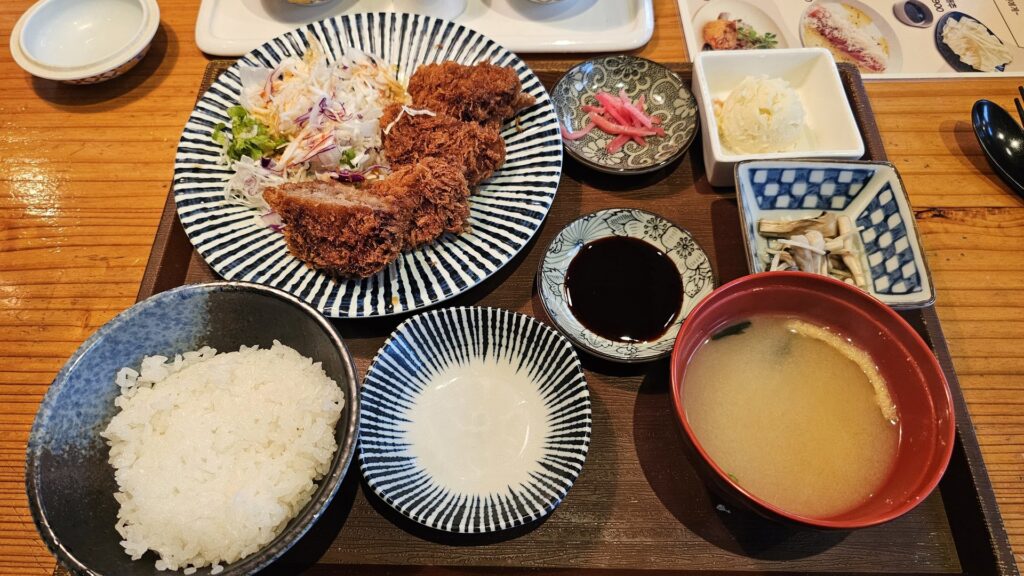
    Full Yamaya teishoku lunch set with fried main dish, rice, miso soup, and side dishes on a tray

    Menchikatsu (멘치카츠) is a ground meat patty — usually pork and beef mixed — shaped, breadcrumbed, and deep fried. Yoshoku (Western-influenced Japanese cooking) at its most straightforward.

    It’s honestly the simpler dish of the two. The patty was well-seasoned and the crumb coating was properly crisp. But there’s less going on compared to the nanbanzuke. Fine dish, slightly forgettable.

    If you’re picking between the two, the nanbanzuke has more personality.

    The Set Meal Structure

    Both sets came with rice, miso soup, and a couple of small sides. The miso soup was standard — nothing special. Rice was good.
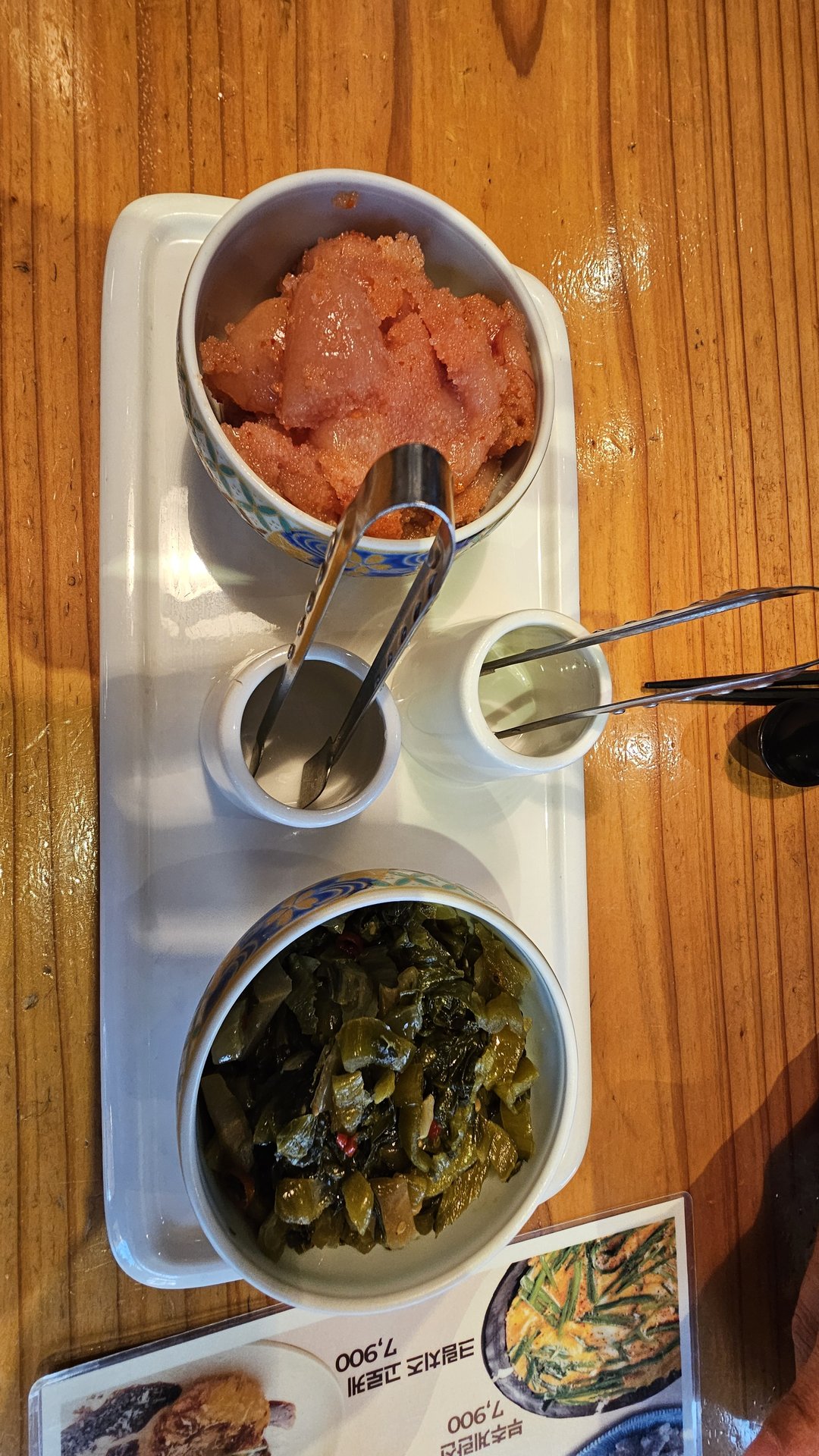
    Yamaya lunch side dish tray with mentaiko pollock roe and gochae muchim pickled greens
    Yamaya lunch side dish tray with mentaiko pollock roe and gochae muchim pickled greens

    And then there was the mentaiko.

    The Unlimited Mentaiko — Actually the Best Part

    Okay, this is what you’re coming for.

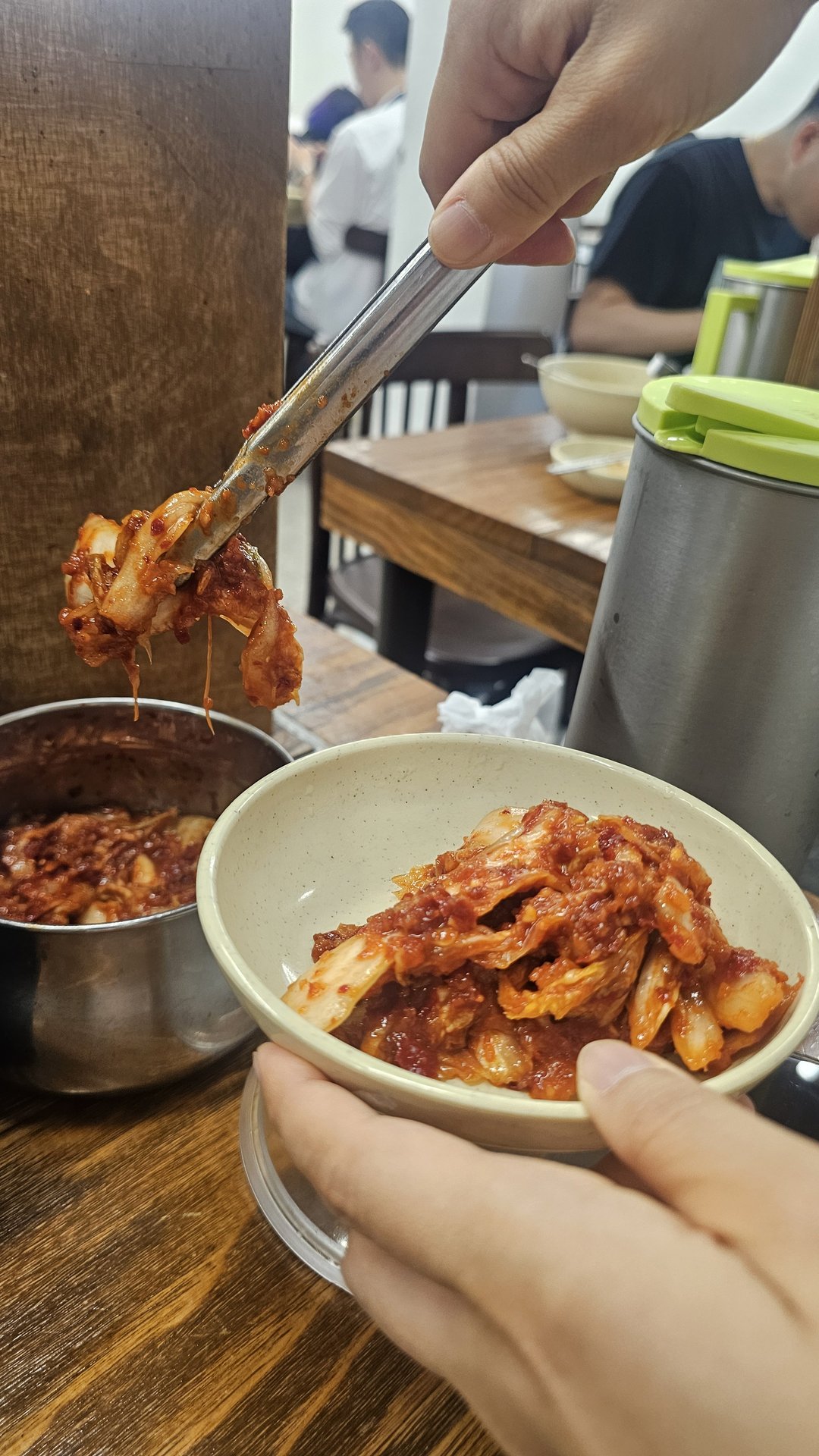
    Mentaiko and gochae muchim (고채 무침 — a pickled leafy green vegetable) come as refillable side dishes. You can ask for more as many times as you want.
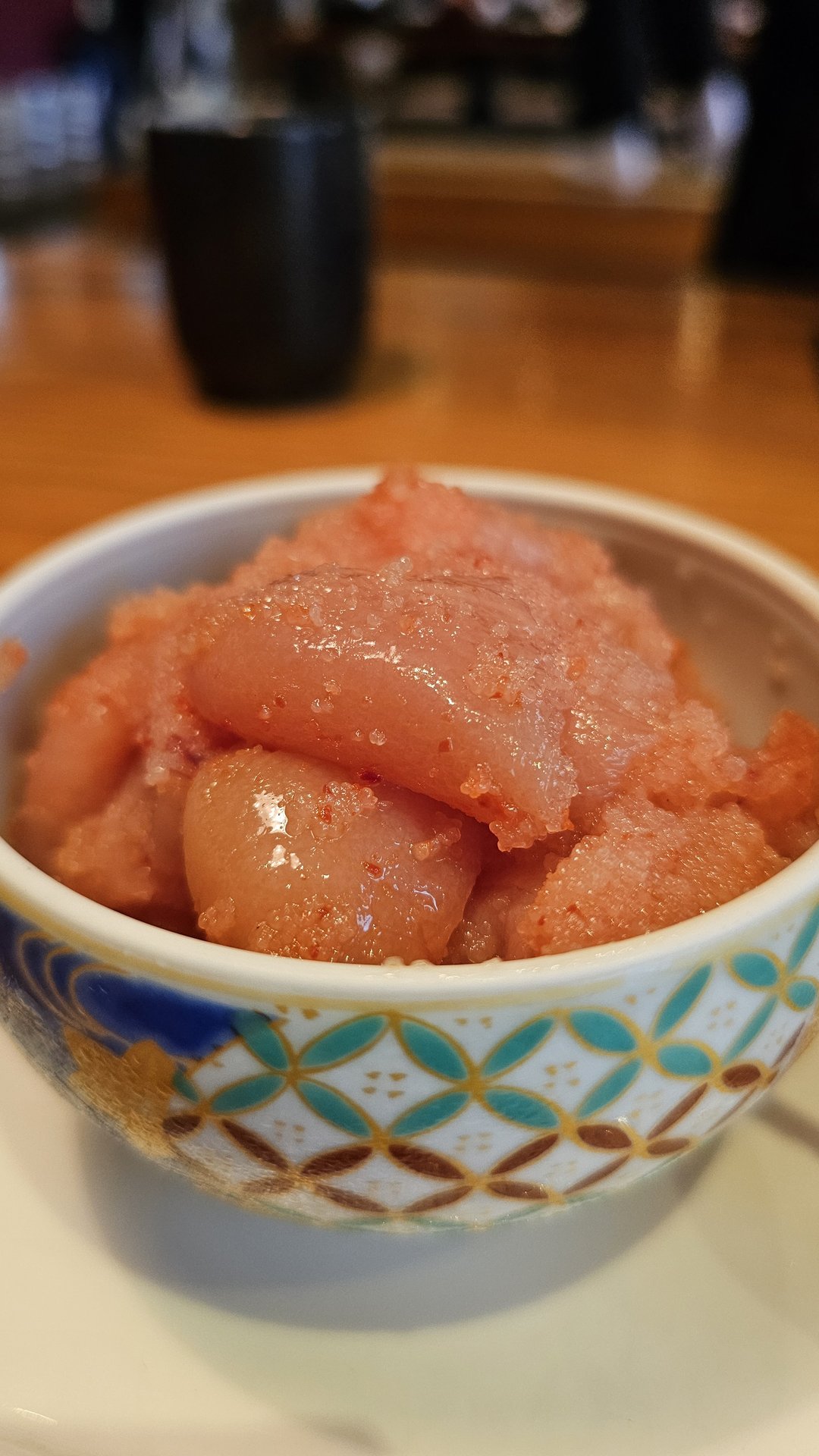
    Close-up of Yamaya mentaiko — pink spicy pollock roe in a small dish
    Close-up of Yamaya mentaiko — pink spicy pollock roe in a small dish

    The mentaiko here is properly good. It’s got that briny, slightly spicy, umami-forward flavor — the kind of thing that makes plain white rice disappear faster than you’d expect. We went through a couple of refills without even thinking about it.

    If you’ve never had mentaiko before: it’s salty, savory, and has a light heat from the chili. It pairs with rice the same way good butter pairs with bread — you just keep going back for more.

    This is genuinely Yamaya’s strongest card. The set meal food is solid but mainstream Japanese comfort food. The unlimited mentaiko is the reason to come here specifically.
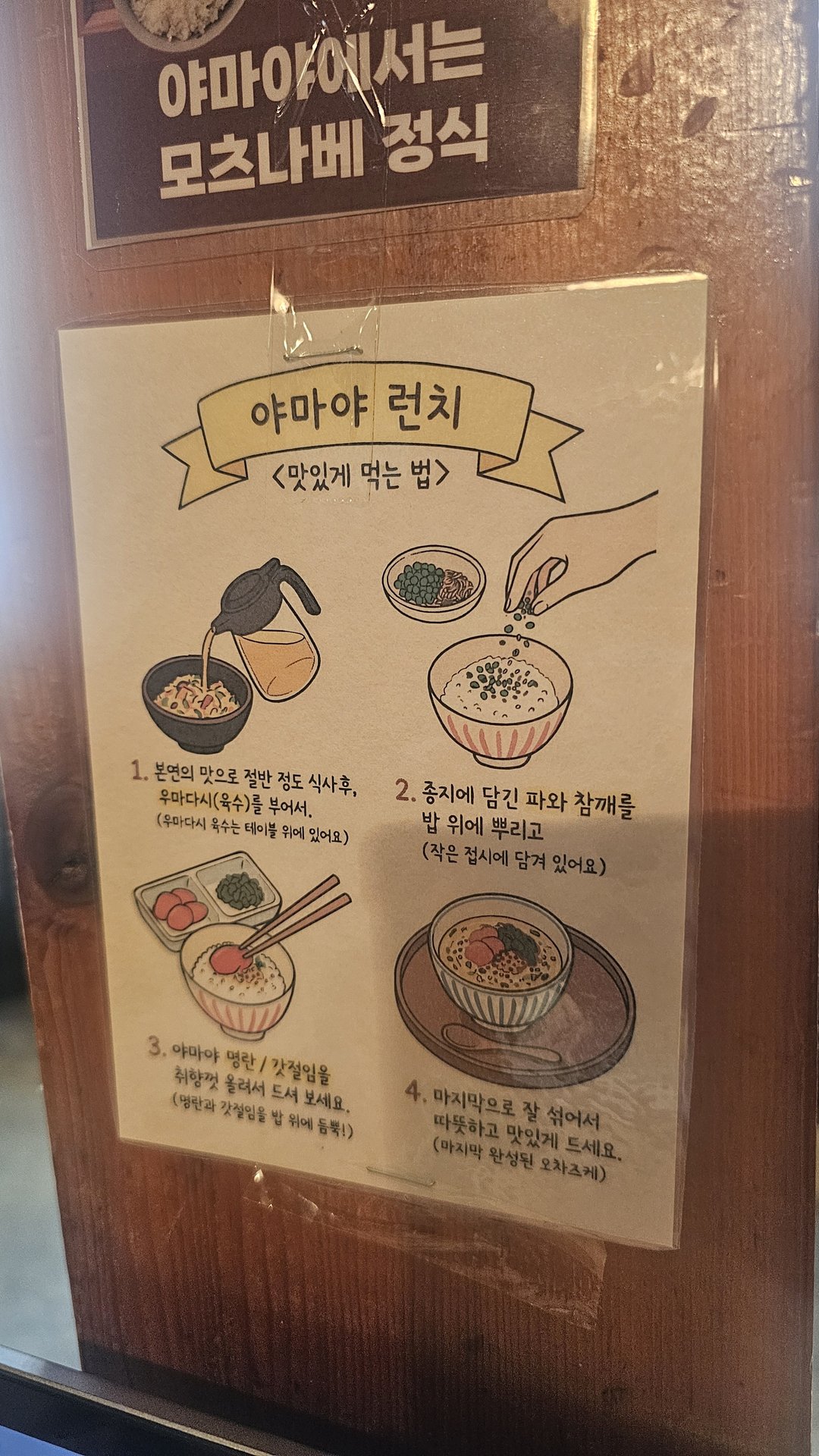
    Wall instruction guide for Yamaya Mochonabe hot pot — four-step illustrated eating guide in Korean
    Wall instruction guide for Yamaya Mochonabe hot pot — four-step illustrated eating guide in Korean

    Add-On Side Menu

    There’s a table card with optional add-ons for lunch:
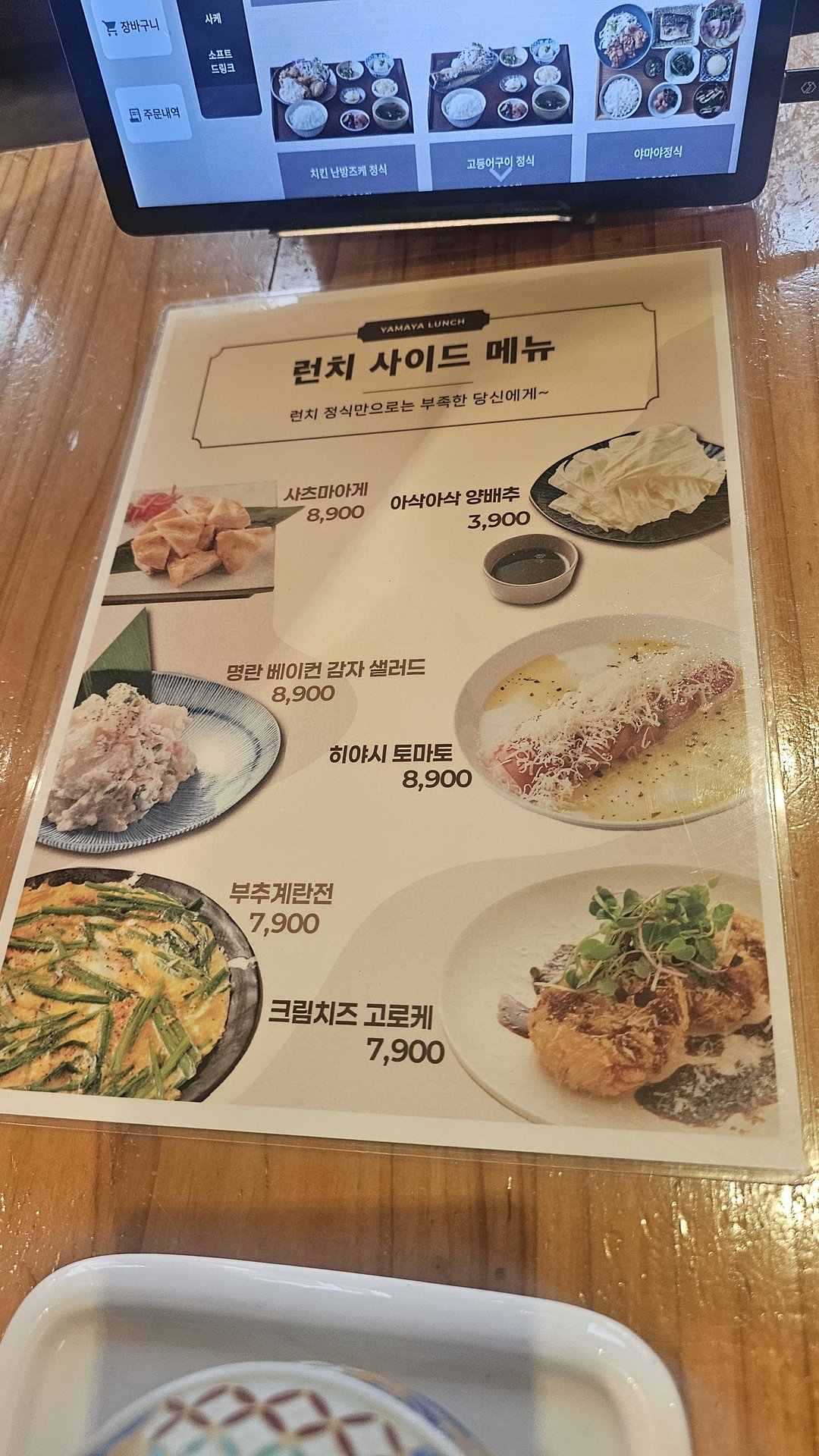
    Yamaya Yeouido table side lunch add-on menu card showing side dish options and prices
    Yamaya Yeouido table side lunch add-on menu card showing side dish options and prices

    – Cabbage — 3,900 KRW

    – Satsuma-age (Japanese fish cake) — 8,900 KRW

    – Mentaiko bacon potato salad — 8,900 KRW

    – Hiyashi tomato — 8,900 KRW

    – Chive egg jeon — 7,900 KRW

    – Cream cheese croquette — 7,900 KRW

    We skipped these — the set meals were already substantial. But the mentaiko bacon potato salad sounds interesting if you want to go deeper on the mentaiko theme.

    Stuff Tourists Should Know

    Language: Korean-only tablet ordering. Staff probably won’t speak much English. Point at the photos on the tablet — you’ll be fine.

    English menu: No, but the tablet has photos for every item.

    Payment: Cards accepted. Foreign cards should work. No tipping in Korea — don’t leave cash on the table.

    Dietary restrictions: This is a meat-focused Japanese teishoku restaurant. Vegetarian options are limited (maybe the cabbage side, the hiyashi tomato). No obvious halal options. Mentaiko contains fish roe and chili.

    Timing: Gets packed fast during the 12:00–1:00 PM window. If you want to avoid the rush, try arriving just before noon or after 1:00 PM.

    Kids: The space can accommodate families, but it’s primarily an office lunch crowd. Not a dedicated family restaurant, but not unwelcoming either.

    Solo dining: Totally fine. Counter-style seating would suit solo diners.
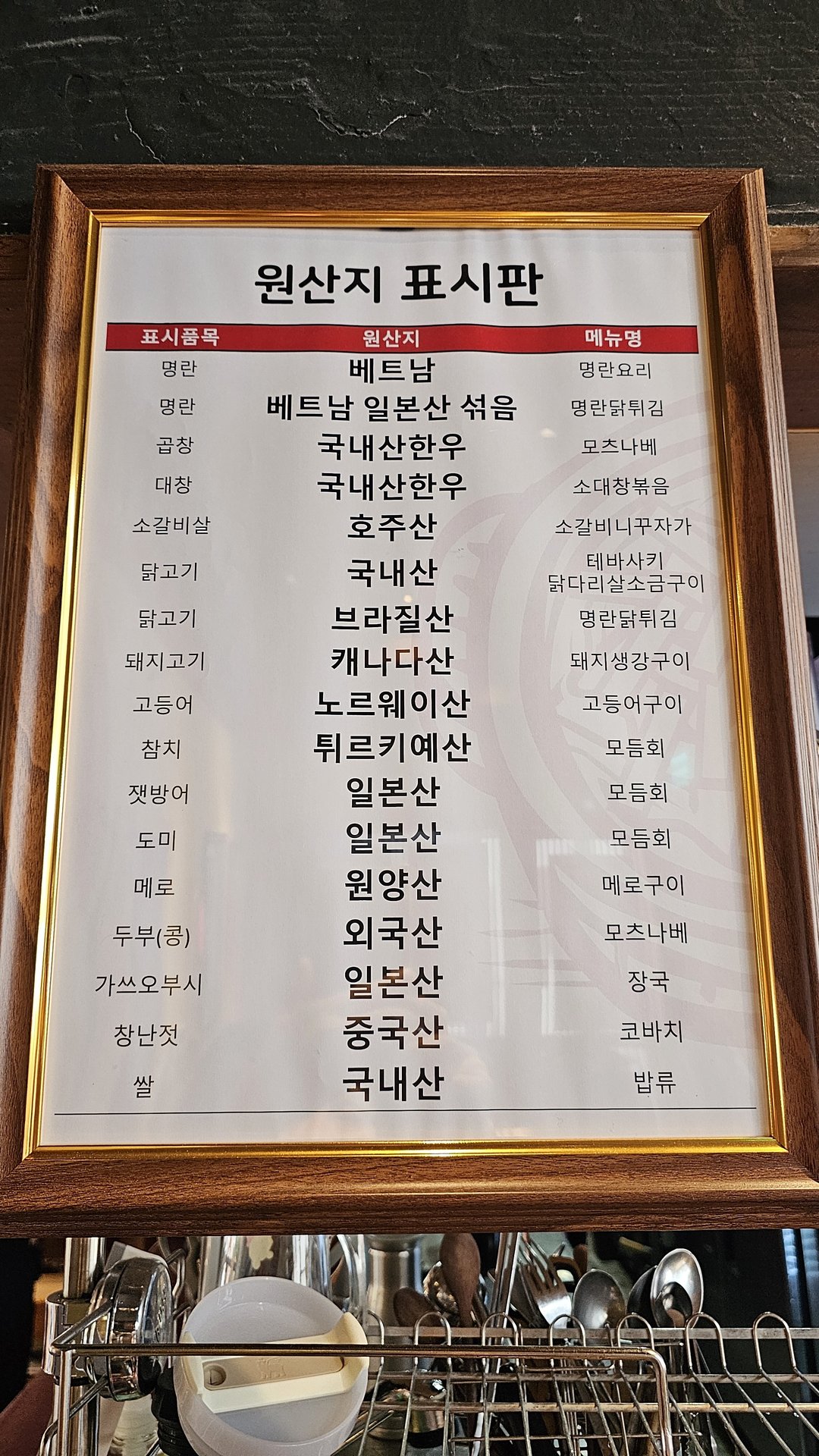
    Yamaya Yeouido ingredient origin board showing sourcing information for mentaiko, chicken, pork, and mackerel
    Yamaya Yeouido ingredient origin board showing sourcing information for mentaiko, chicken, pork, and mackerel

    The Verdict

    Should you go?

    – If you’re already in Yeouido for business or sightseeing (IFC Mall, 63 Building) — yes, this is a legit lunch option. Get the nanbanzuke set and go hard on the mentaiko refills.

    – If you only have 3–4 days in Seoul — probably not a priority. Use that meal slot for Korean food. Come back if you get more time.

    – If you’re curious about mentaiko and want to try it properly without hunting down a specialty shop — yes, this is a great intro. Unlimited refills, good quality, reasonable price.

    – If you want the most exciting meal in Seoul — no. This is reliable weekday lunch food, not a destination dinner.

    The food is good, the unlimited mentaiko is genuinely worth it, and 16,900 KRW (~$12.50) for a full lunch set is fair value for Yeouido. We’ll be back when we’re in the area.

    Yamaya Yeouido (야마야 여의도점)

    Yeouido, Seoul

    Tablet ordering (Korean only) | Card payment OK | No reservations

    FAQ

    What is Yamaya and why is it famous?

    Yamaya is a Japanese chain from Fukuoka, founded in 1974, known for mentaiko — spicy cured pollock roe. Their Korean restaurant branches serve Japanese teishoku (set meal) lunches with unlimited mentaiko on the side.

    How much does lunch cost per person at Yamaya Yeouido?

    Most lunch sets run 16,900–21,000 KRW (~$12.50–$15.50 USD) per person. The premium Mochonabe set goes up to 25,000 KRW (~$18.50 USD).

    Do I need a reservation for lunch at Yamaya Yeouido?

    No reservation system — it’s walk-in only. That said, it gets genuinely packed on weekdays around noon (office lunch crowd), so aim for 11:30 AM or after 1:00 PM if you want to walk straight in.

    Is there an English menu at Yamaya Yeouido?

    Ordering is done via tablet, which is in Korean only. The menu items are fairly visual with photos, so pointing works fine. Staff are friendly but don’t expect much English.

    Can I pay by credit card at Yamaya Yeouido?

    Yes, card payment is standard. Foreign cards (Visa, Mastercard) should work fine — the receipt shows standard Korean card terminal processing.

    Is the unlimited mentaiko actually unlimited?

    Yes. Mentaiko (pollock roe) and gochae muchim (pickled greens) come as side dishes and you can ask for refills. The mentaiko alone is worth showing up for.
    You might also like

    📍 Location

    Open in Google Maps →

  • Vivace Resort Hadong: Honest Review of the Royal Suite

    Vivace Resort Hadong: Honest Review of the Royal Suite

    Quick honest review of Vivace Resort in Hadong — a riverside resort in southern Korea that checks most of the boxes for a short domestic getaway. Skip to the verdict if you’re pressed for time, but here’s the short version: the Royal Suite is genuinely spacious and well-equipped, the views are the real selling point, and yes, the pool water is cold.

    I stayed one night in the Royal Suite, checked in on June 13 (afternoon) and checked out June 14.

    Where Is Hadong, and Why Go?

    Hadong (하동) is a county in South Gyeongsang Province, about 4 hours south of Seoul by car. Most foreign visitors don’t have it on their radar — and that’s kind of the point. It’s not Jeju Island. It’s not Busan. It’s quieter.

    The town sits along the Seomjin River (섬진강), one of Korea’s cleaner and less-developed rivers. Mountains press in on both sides. Green tea farms are nearby (Hadong is one of Korea’s top green tea regions). Ssanggyesa Temple is about 30 minutes up the valley.

    If you’re coming from Busan, it’s about 1.5 hours. Seoul — you’re looking at a long drive or a bus to Hadong terminal. Getting here without a car is annoying. Rent one.

    About Vivace Resort

    Vivace is a mid-to-upscale resort sitting right on the Seomjin River. The name is Italian (it means “lively”), the aesthetic is a mix of modern Korean resort and Mediterranean-lite — palm trees around the pool, VIVACE logos everywhere, marble-look surfaces in the lobby.

    It’s not a boutique place trying to be subtle. It leans into the “resort” branding hard, and it mostly delivers.

    VIVACE Restaurant entrance at Vivace Resort Hadong at night with marble lobby and glass facade
    VIVACE Restaurant entrance at Vivace Resort Hadong at night with marble lobby and glass facade

    The property has a main outdoor pool, a separate infinity pool, a kids’ water park area, a full-service restaurant, a cafe, and an on-site convenience store. For a resort in rural South Gyeongsang, that’s a solid lineup.

    Getting There

    From Seoul: 3.5–4 hours by car via the Namhae Expressway. There are express buses to Hadong, but the resort isn’t walking distance from the terminal — you’ll need a taxi or rental car.

    From Busan: About 1.5 hours by car. Comfortable day trip, but you’d be missing the whole point of staying overnight.

    From Incheon Airport: Realistically 5+ hours. This is a domestic nature retreat, not an airport-adjacent city hotel. Plan accordingly.

    By car: Easiest option. Parking at the resort is available.

    The Royal Suite

    This is the main event, and it earns its name.

    Royal Suite main bedroom at Vivace Resort Hadong with double bed and window view
    Royal Suite main bedroom at Vivace Resort Hadong with double bed and window view

    The Royal Suite is a duplex — two floors connected by an interior staircase. The layout gives you two separate bedrooms, which makes it ideal for families or small groups who want actual privacy rather than two beds crammed into one room.

    Duplex staircase at Vivace Resort Hadong with branch-pattern wallpaper and clothes hanger
    Duplex staircase at Vivace Resort Hadong with branch-pattern wallpaper and clothes hanger
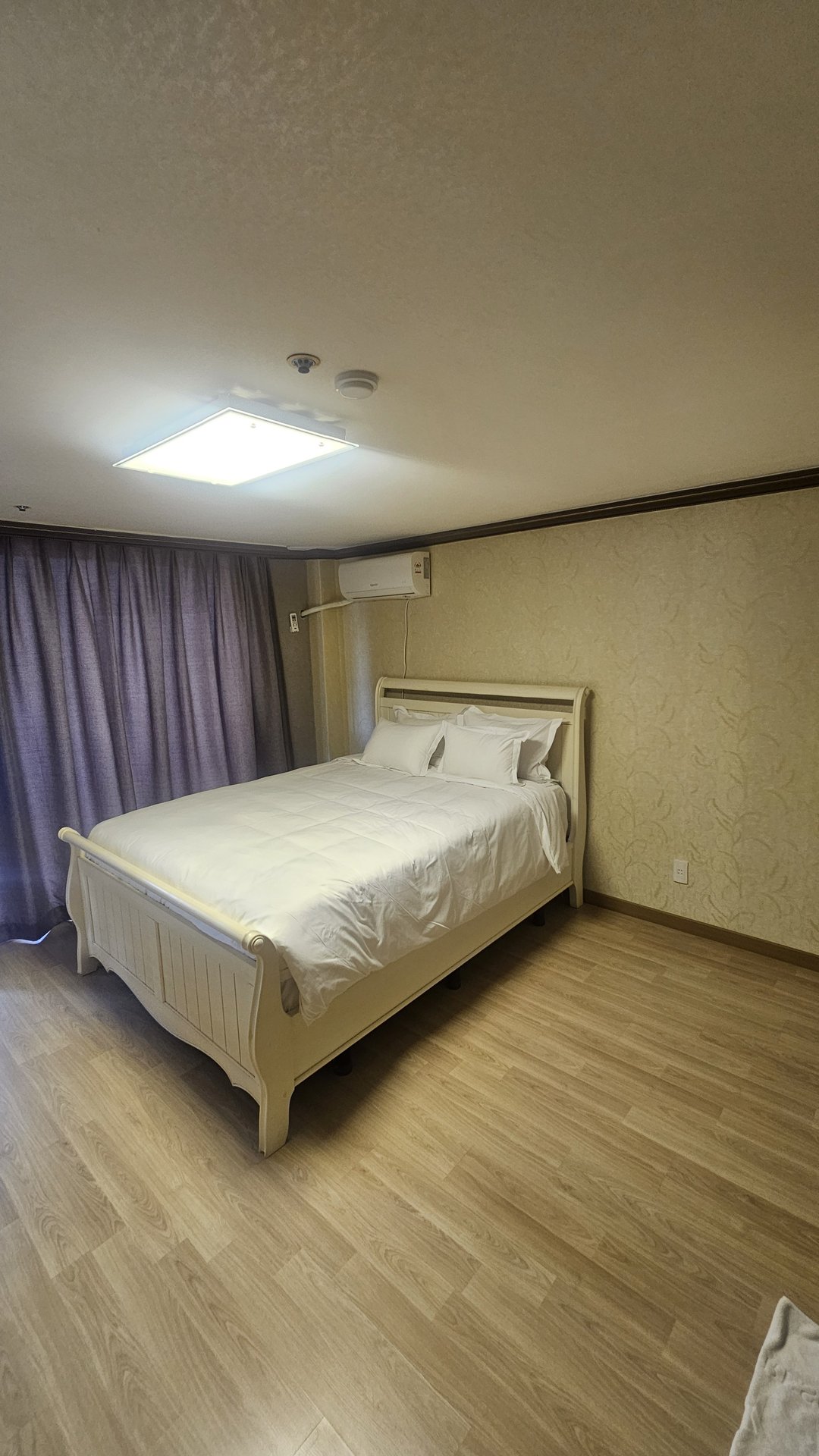
    Vivace Resort Royal Suite bedroom interior with branch-pattern wallpaper and wood flooring
    Vivace Resort Royal Suite bedroom interior with branch-pattern wallpaper and wood flooring

    Bedroom 1 (main floor): Double bed, branch-pattern wallpaper, wood flooring. Clean, straightforward. The window looks toward the river.

    Close-up of neatly made double bed with white pillows and duvet in Vivace Resort Royal Suite
    Close-up of neatly made double bed with white pillows and duvet in Vivace Resort Royal Suite

    Bedroom 2 (upper level): White-frame bed, purple carpet. Feels a bit more playful — probably ends up being the kids’ room in most bookings.

    Second bedroom in Vivace Resort Royal Suite with white frame bed and purple carpet
    Second bedroom in Vivace Resort Royal Suite with white frame bed and purple carpet

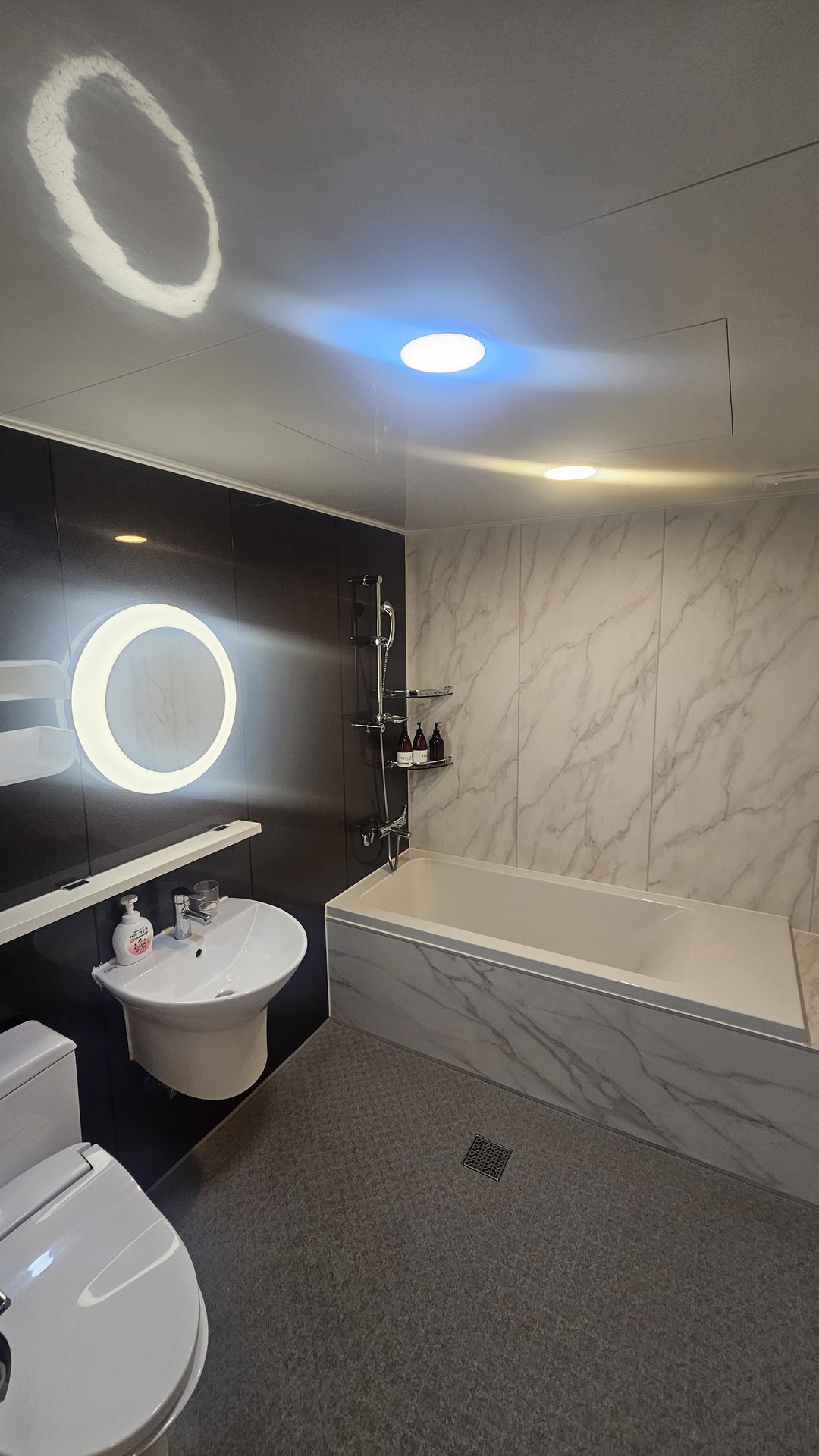
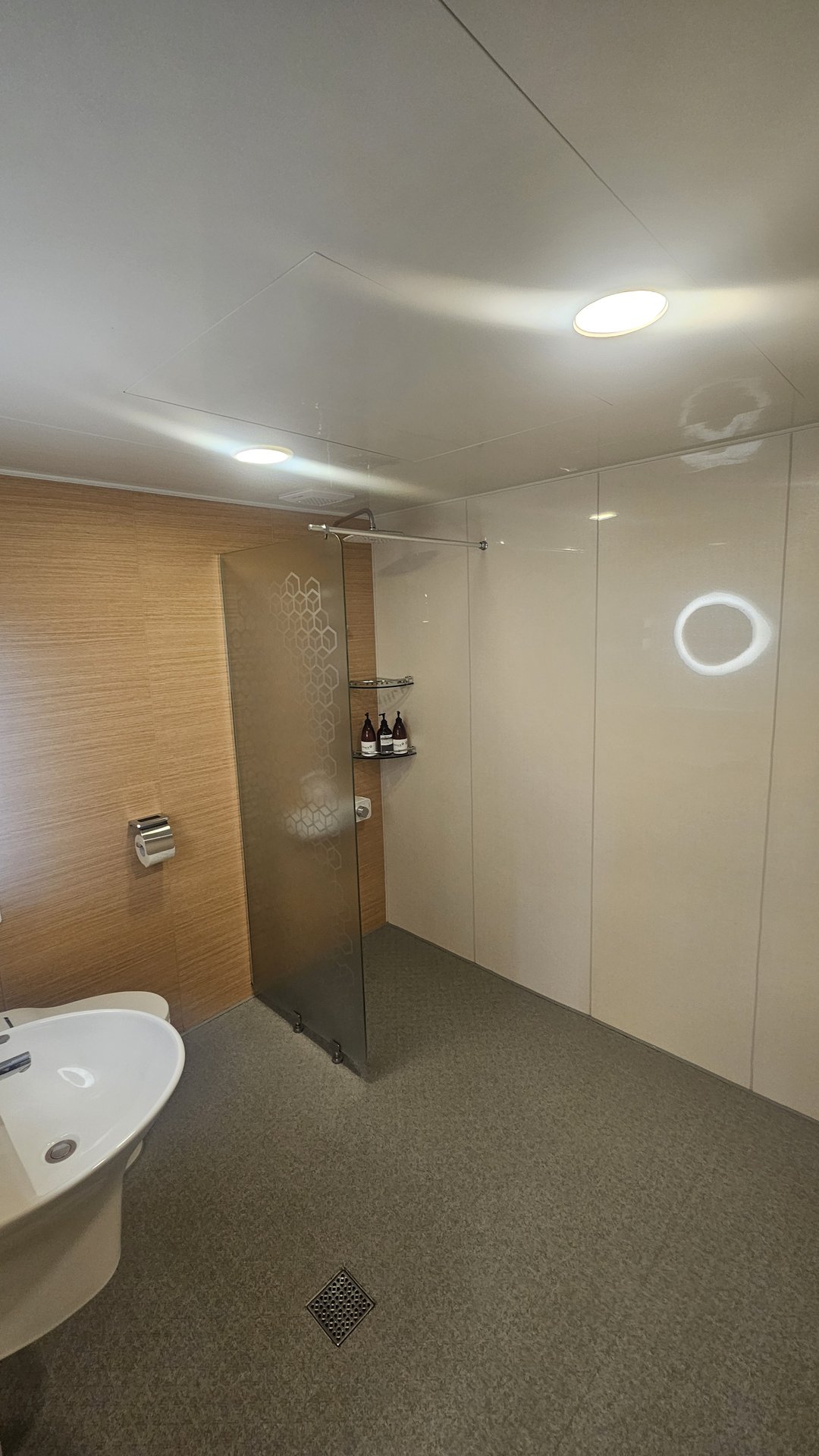
    Bathrooms: Two of them. One is a standard bathroom with a sink and toilet. The other has a walk-in shower with a hexagonal glass partition and actual amenities laid out properly.

    Bathroom at Vivace Resort Hadong with marble-pattern tile walls, black floor, sink and toilet
    Bathroom at Vivace Resort Hadong with marble-pattern tile walls, black floor, sink and toilet
    Walk-in shower at Vivace Resort Hadong with glass partition and hexagonal reinforced glass
    Walk-in shower at Vivace Resort Hadong with glass partition and hexagonal reinforced glass

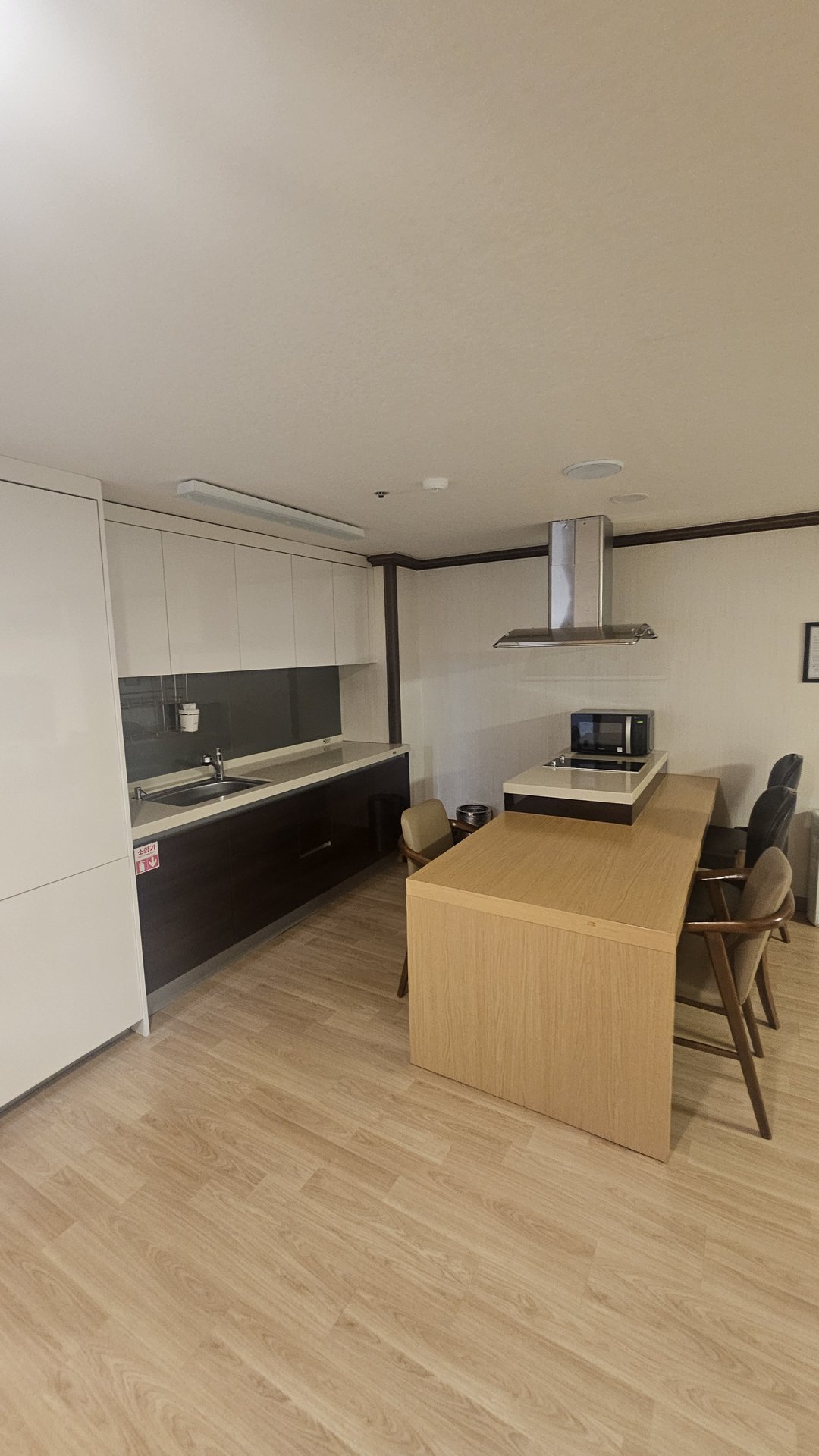
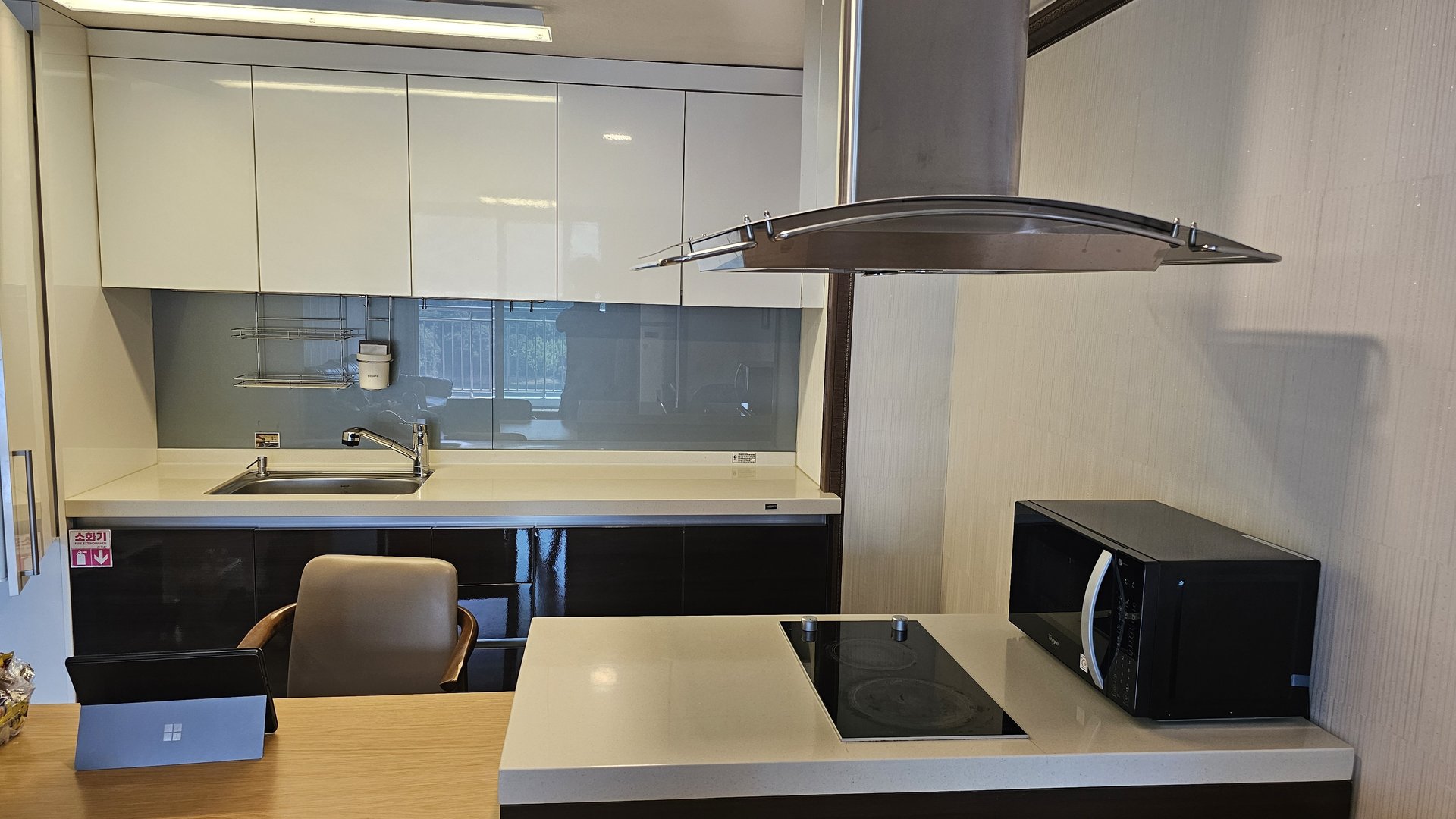
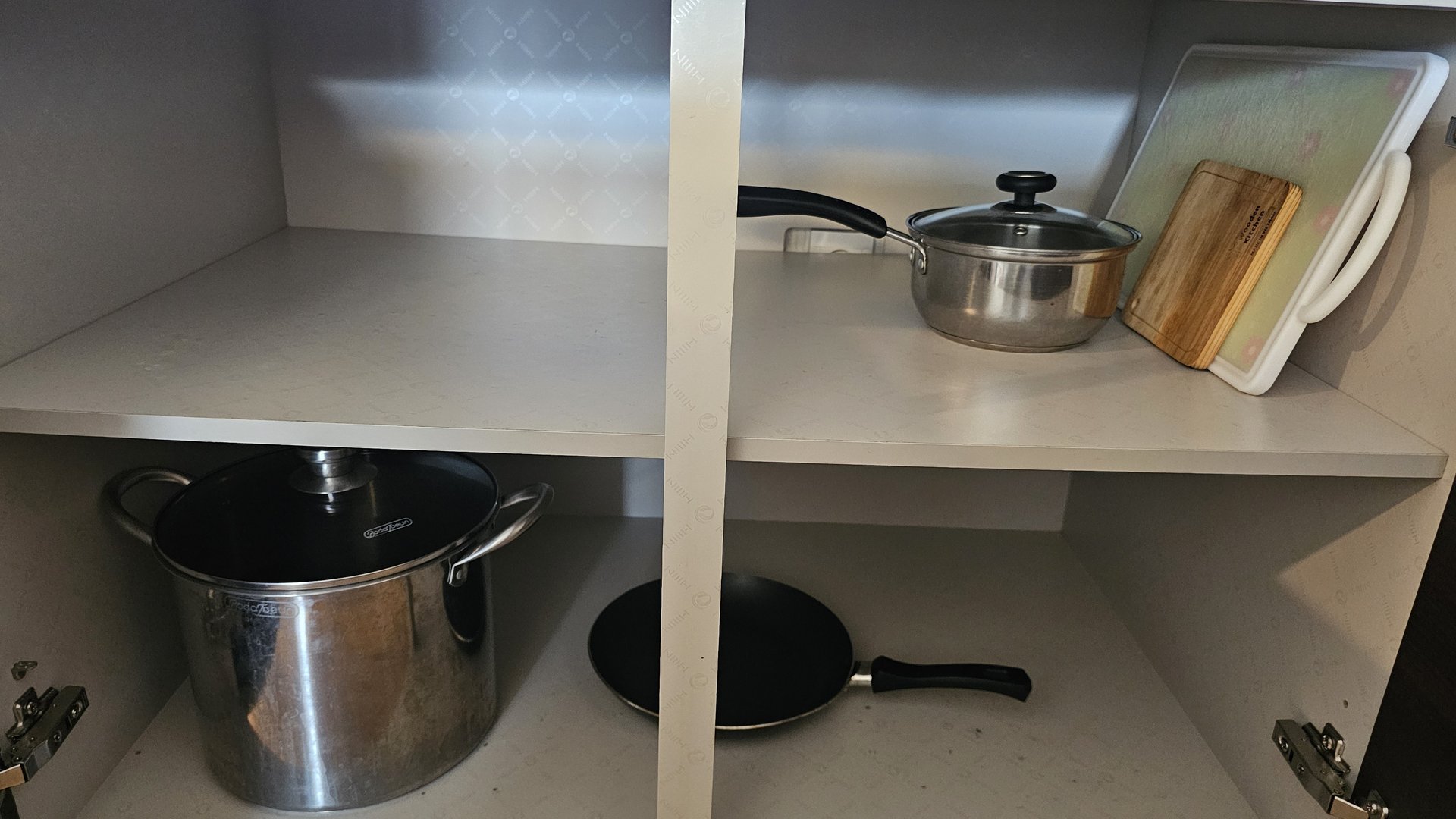
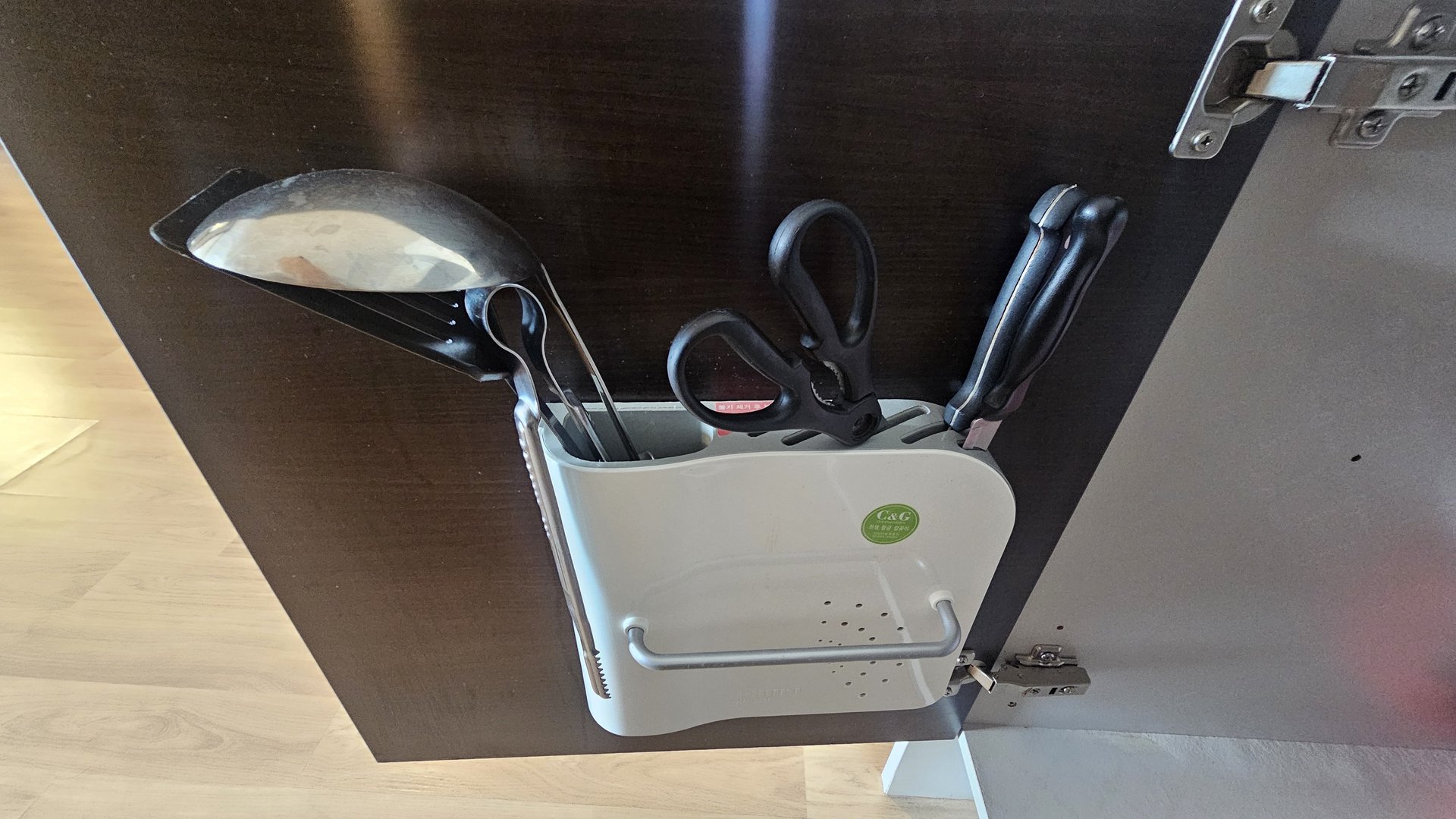
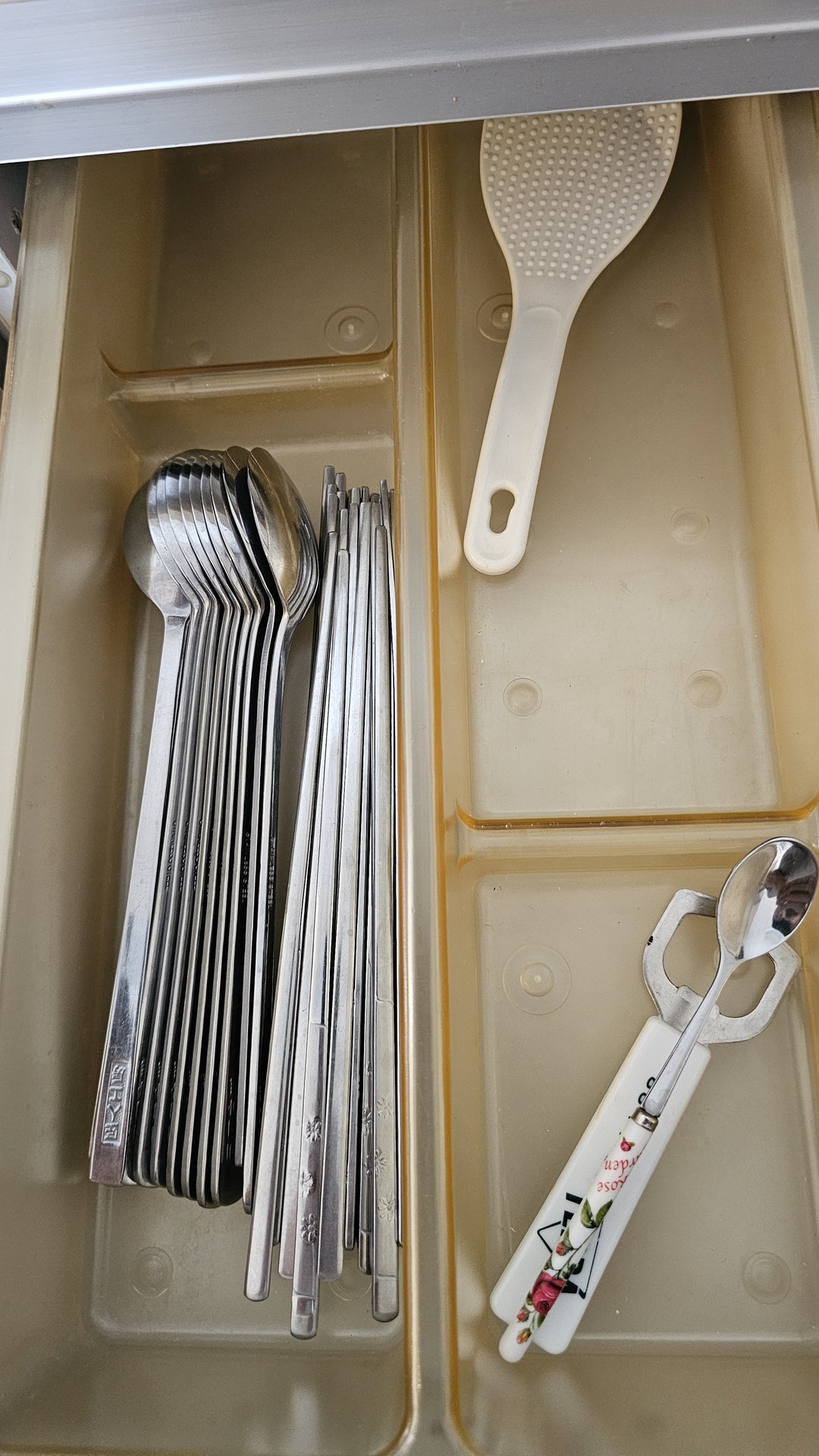
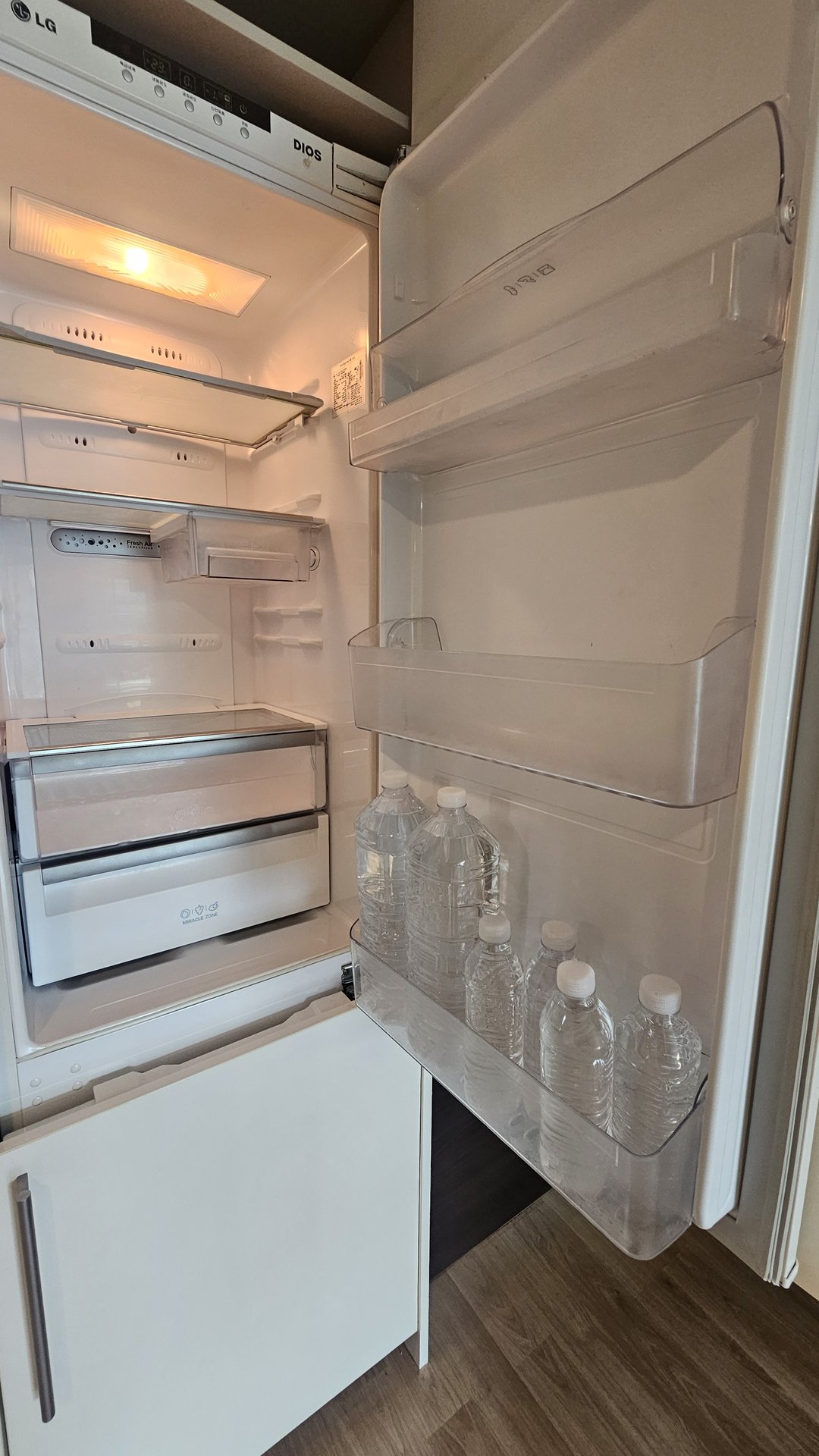
    Kitchen: Full kitchen. Not a kitchenette — an actual kitchen with an induction cooktop, range hood, microwave, and a proper dining table. The fridge comes stocked with bottled water. Drawers have cooking utensils, pots, pans, chopsticks, a rice paddle, bottle opener — the works.

    Kitchen and dining area in Vivace Resort Royal Suite with sink, microwave, and dining table
    Kitchen and dining area in Vivace Resort Royal Suite with sink, microwave, and dining table
    Full kitchen view of Vivace Resort Royal Suite showing induction cooktop, hood, microwave and dining table
    Full kitchen view of Vivace Resort Royal Suite showing induction cooktop, hood, microwave and dining table
    Kitchen storage cabinet with large pot, saucepan, frying pan and cutting board at Vivace Resort
    Kitchen storage cabinet with large pot, saucepan, frying pan and cutting board at Vivace Resort
    Kitchen drawer with scissors, ladle, spatula and cutting board at Vivace Resort
    Kitchen drawer with scissors, ladle, spatula and cutting board at Vivace Resort
    Cutlery drawer with stainless steel chopsticks, spoons, rice paddle at Vivace Resort
    Cutlery drawer with stainless steel chopsticks, spoons, rice paddle at Vivace Resort
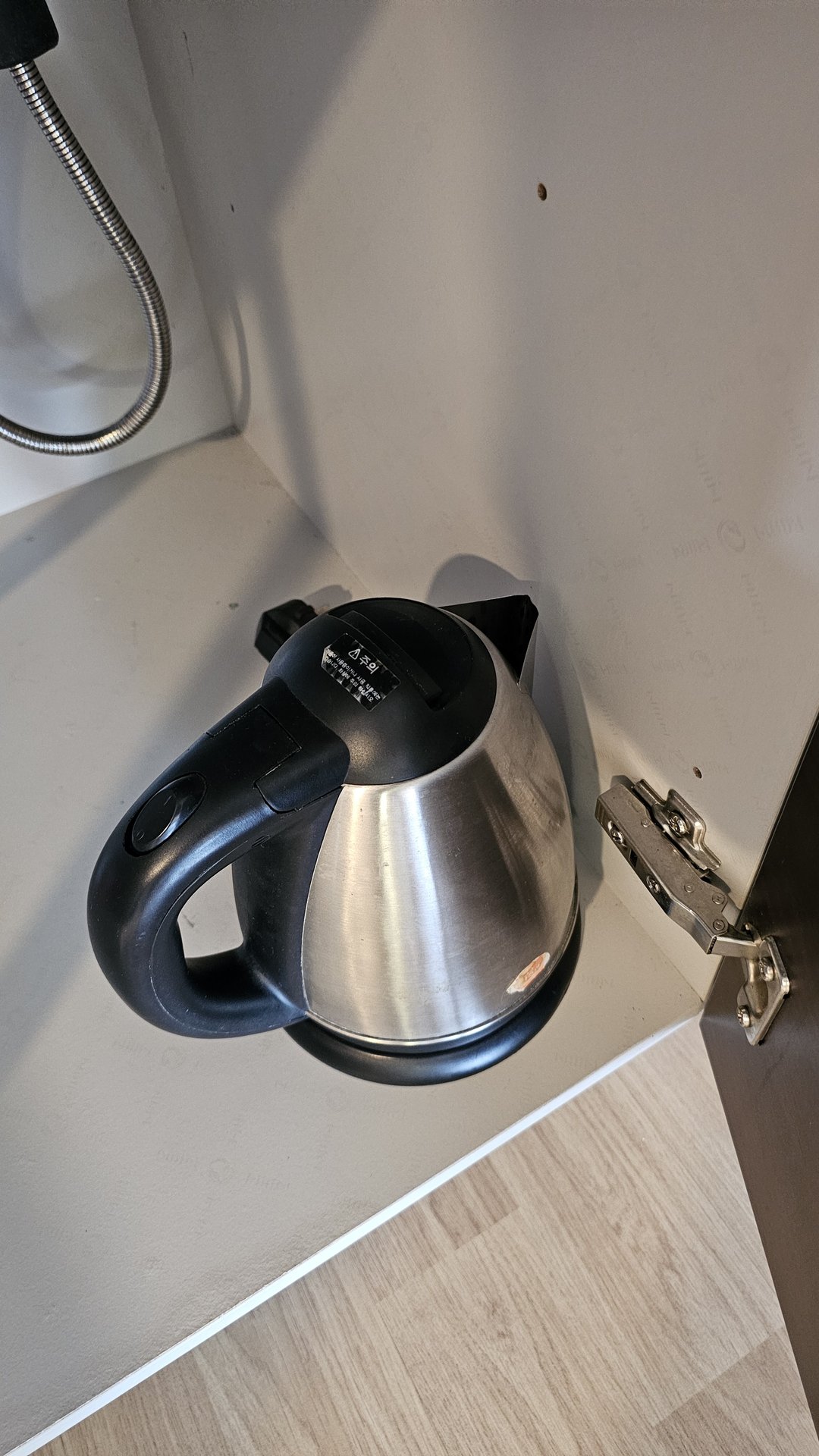
    Stainless steel electric kettle in Vivace Resort Royal Suite kitchen
    Stainless steel electric kettle in Vivace Resort Royal Suite kitchen
    LG refrigerator interior stocked with bottled water at Vivace Resort Hadong
    LG refrigerator interior stocked with bottled water at Vivace Resort Hadong
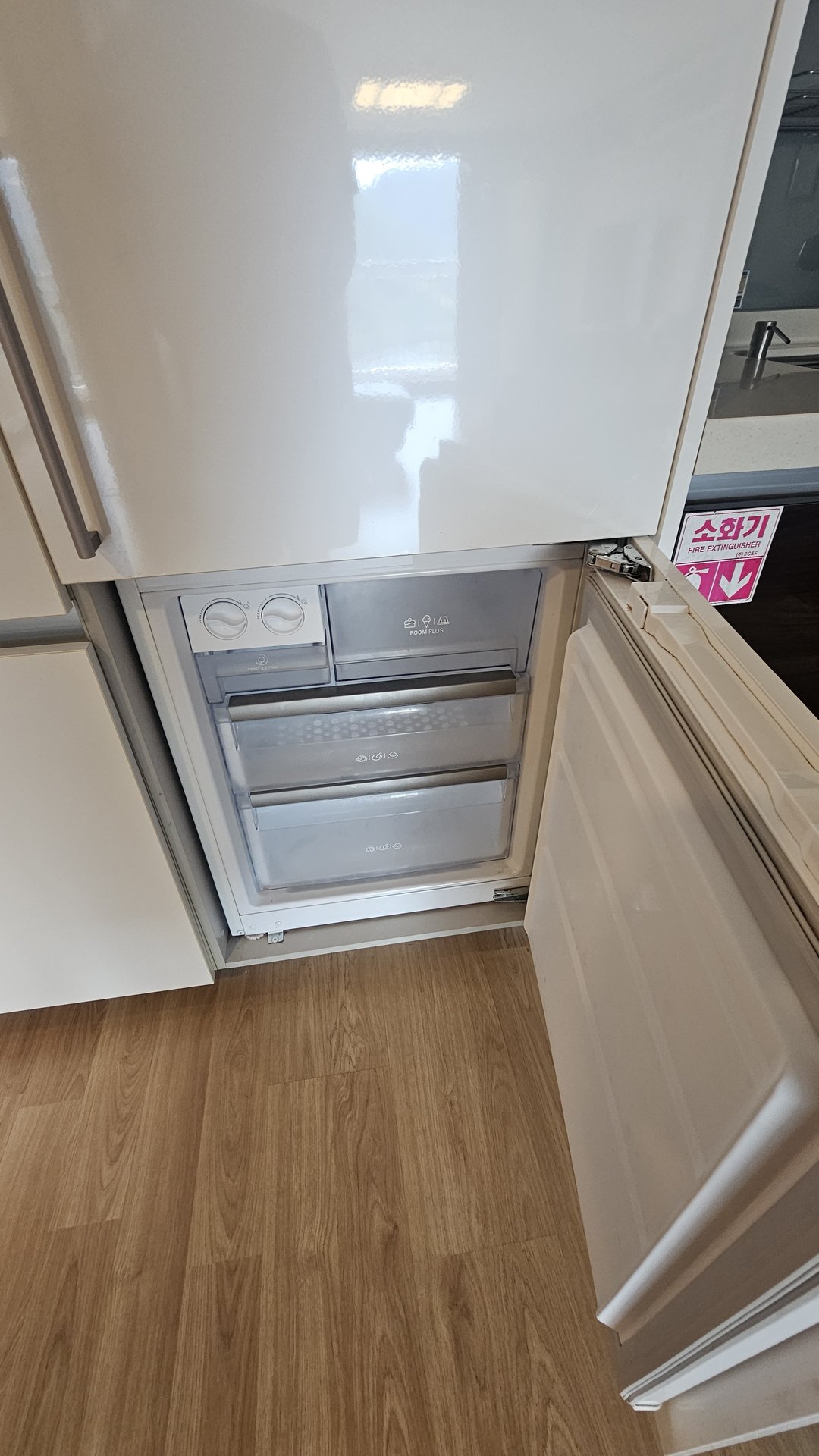
    LG refrigerator exterior and kitchen corner inside Vivace Resort Royal Suite
    LG refrigerator exterior and kitchen corner inside Vivace Resort Royal Suite

    If you’re doing a family trip and want to cook some meals, this room can handle it.

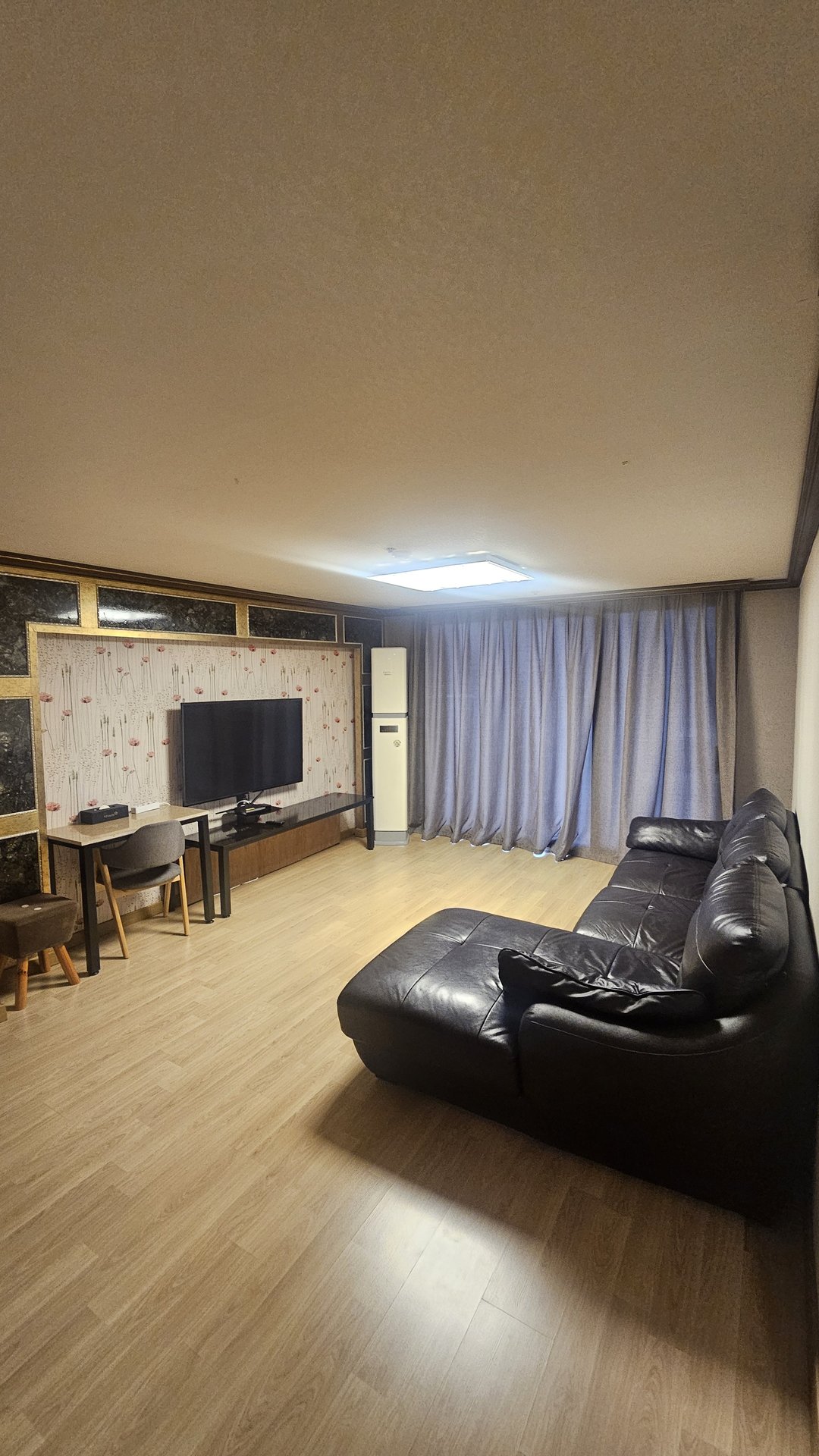
    Living room: Black leather sofa, carpet, TV with blue curtains. Decent place to crash after the pool.

    Living room in Vivace Resort Royal Suite with black leather sofa, carpet, TV and blue curtains
    Living room in Vivace Resort Royal Suite with black leather sofa, carpet, TV and blue curtains

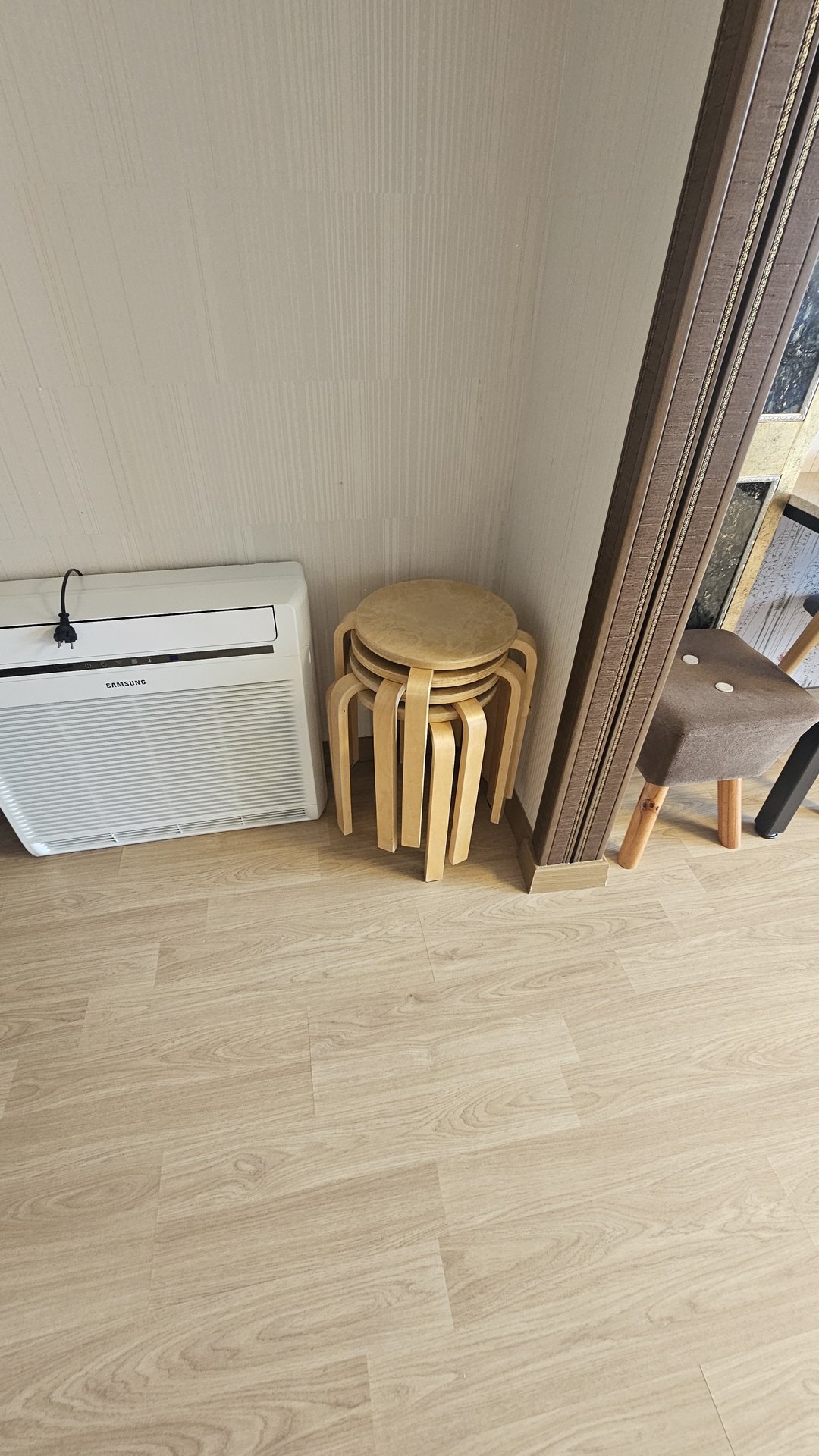
    Air conditioning: Samsung unit in the room. June in Hadong is warm and humid — you’ll use it.

    Samsung air conditioner and folding chair inside Vivace Resort Royal Suite
    Samsung air conditioner and folding chair inside Vivace Resort Royal Suite

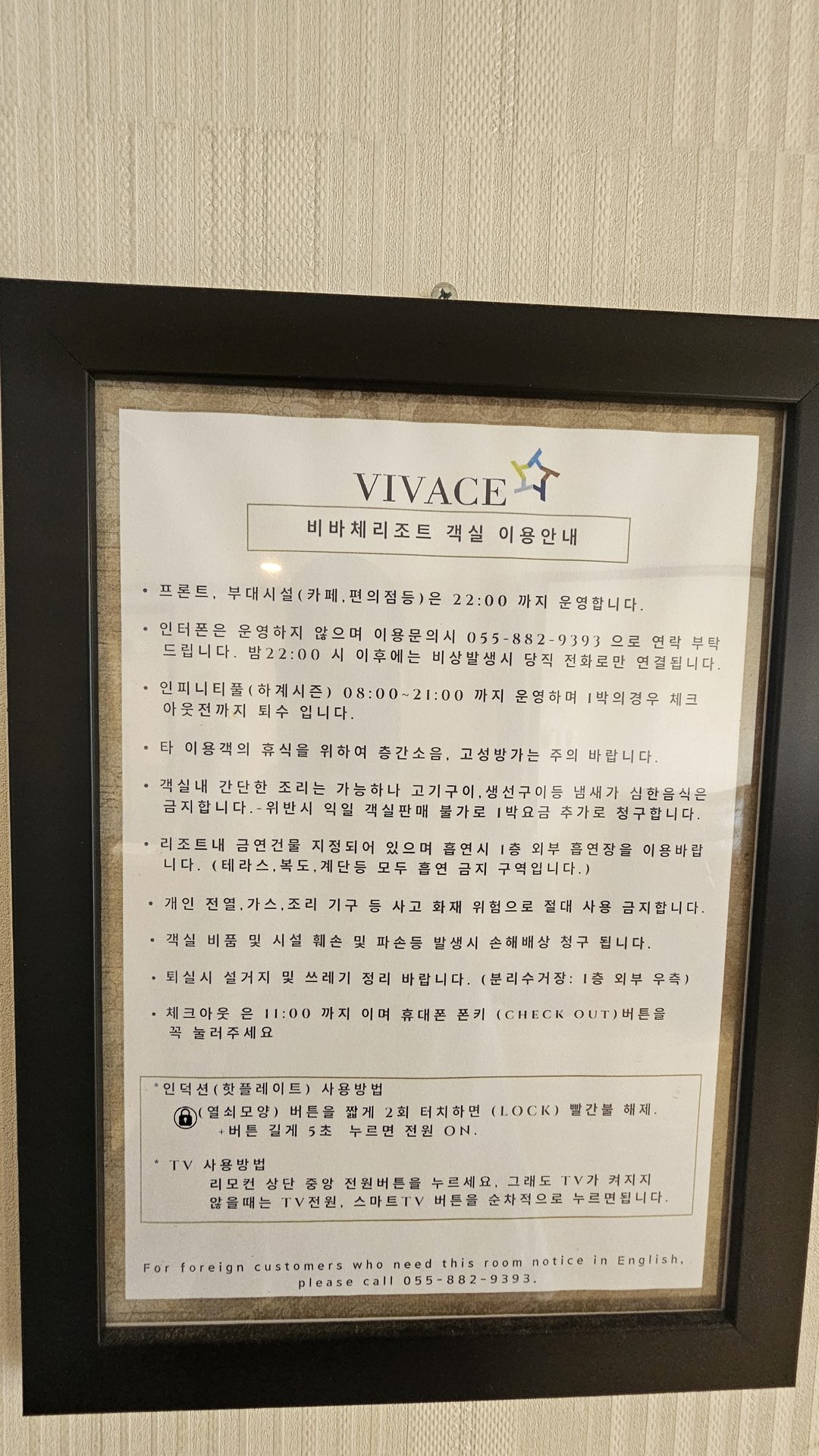
    The room came with a house rules notice in Korean — standard stuff about checkout times and facilities. Worth photographing if you need to reference it with a translation app.

    Vivace Resort room guide poster showing amenities and house rules in Korean
    Vivace Resort room guide poster showing amenities and house rules in Korean

    Tbh, the suite size surprised me. You don’t usually get this much space at a Korean resort unless you’re paying serious money. Two bedrooms, full kitchen, two bathrooms — for a group of 4 this is a comfortable setup.

    The Pools

    Here’s the honest part.

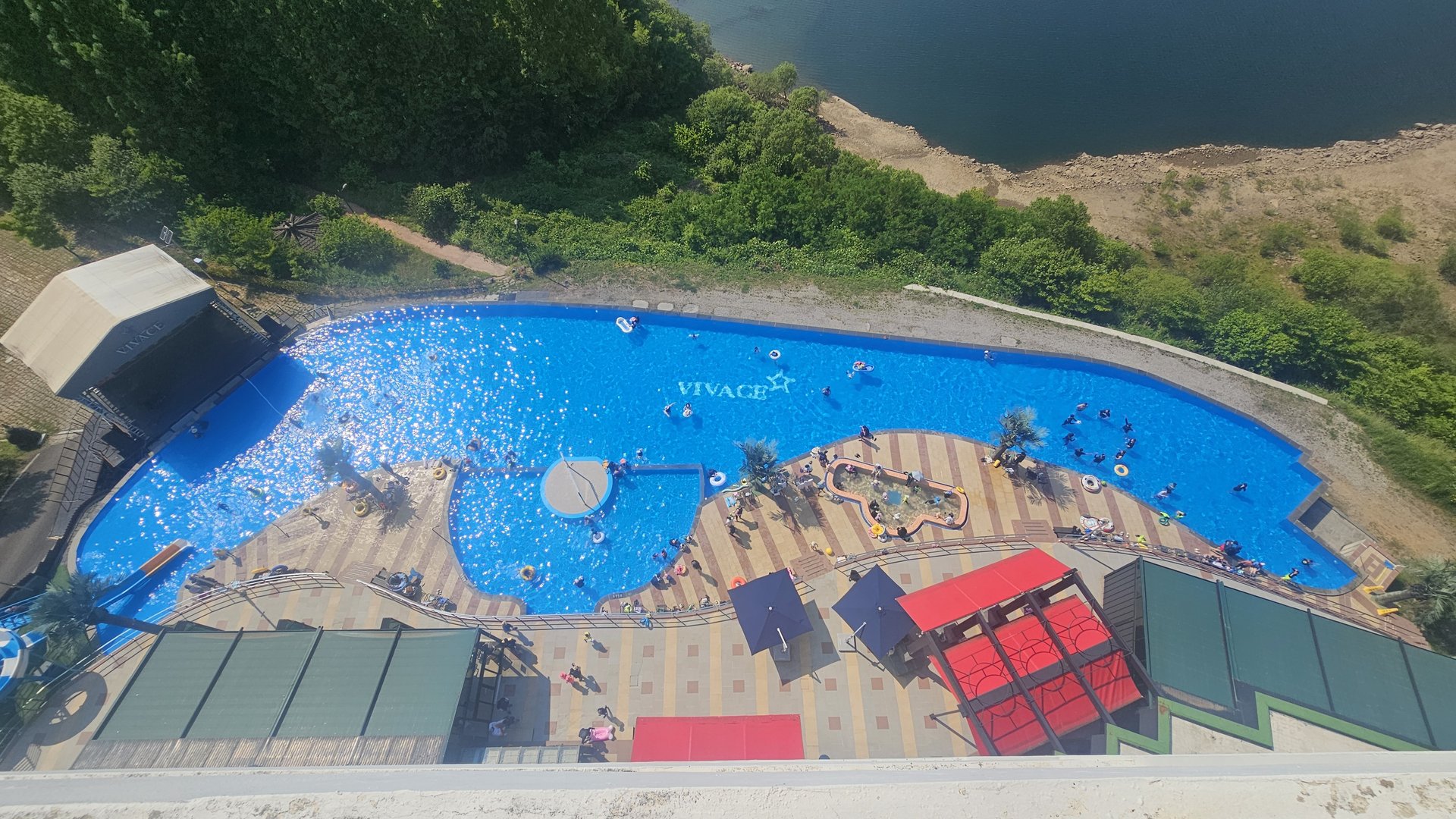
    The main outdoor pool and water park area is busy. Like, properly busy during summer. Lots of families, kids everywhere, the energy is high.

    Vivace Resort outdoor pool from above with waterpark area, swimmers, and Seomjin River nearby
    Vivace Resort outdoor pool from above with waterpark area, swimmers, and Seomjin River nearby

    The water is cold. Not refreshing-cold. Cold-cold. The kind where you stand at the edge and have a serious conversation with yourself before getting in. Adults will brace for it. Kids will run in screaming and immediately start playing — they don’t care.

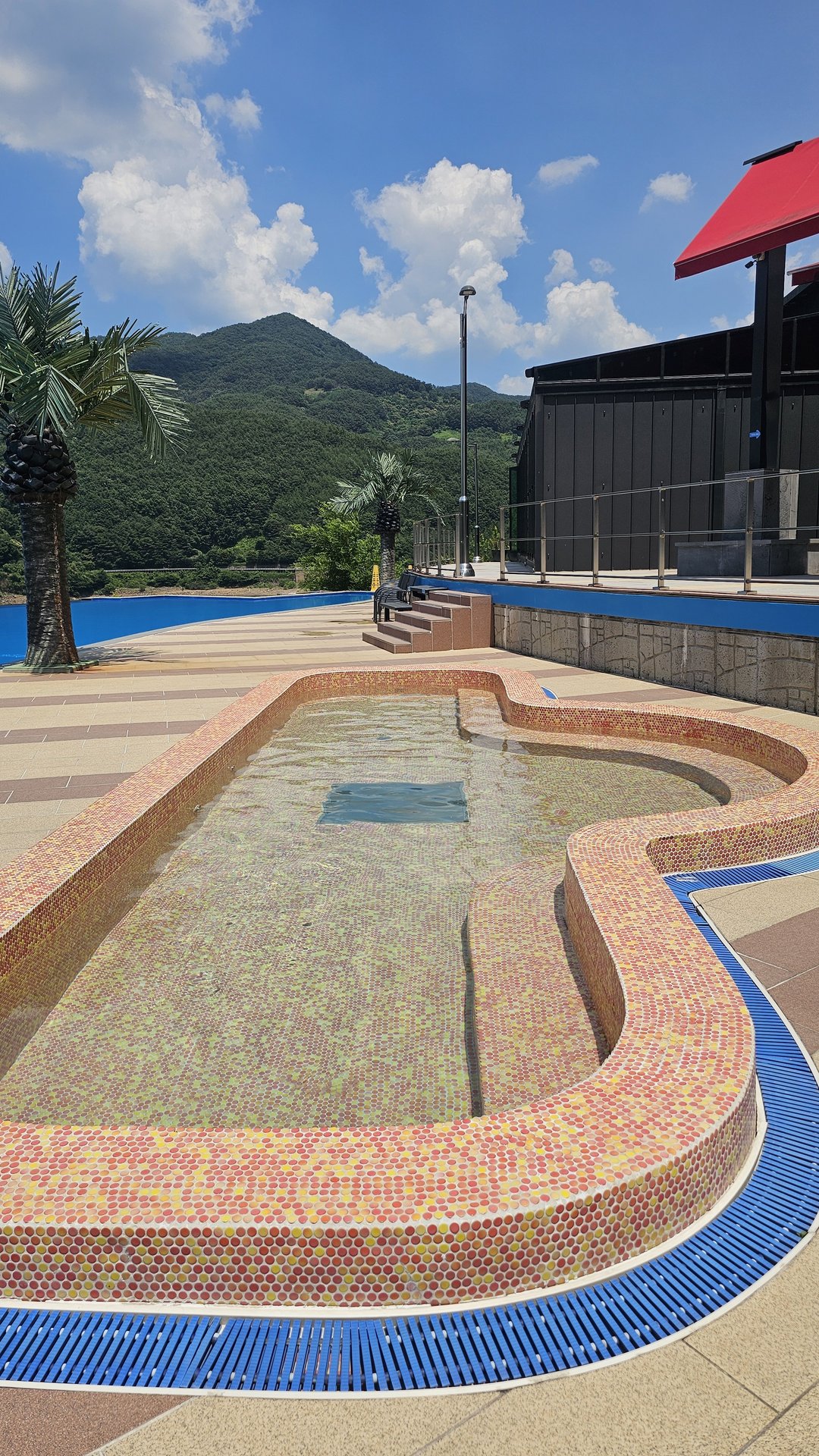
    The kids’ water park section has a shallow pool with mosaic tile, palm trees overhead, and a mountain backdrop. It’s actually charming. Palm trees in front of a Korean mountain is a slightly surreal look that works.

    Kids water park area at Vivace Resort Hadong with mosaic tile shallow pool and palm trees
    Kids water park area at Vivace Resort Hadong with mosaic tile shallow pool and palm trees

    Daytime is when the pool is most enjoyable. The afternoon sun takes the edge off. Morning and evening? You’re braver than me.

    The infinity pool is a different experience.

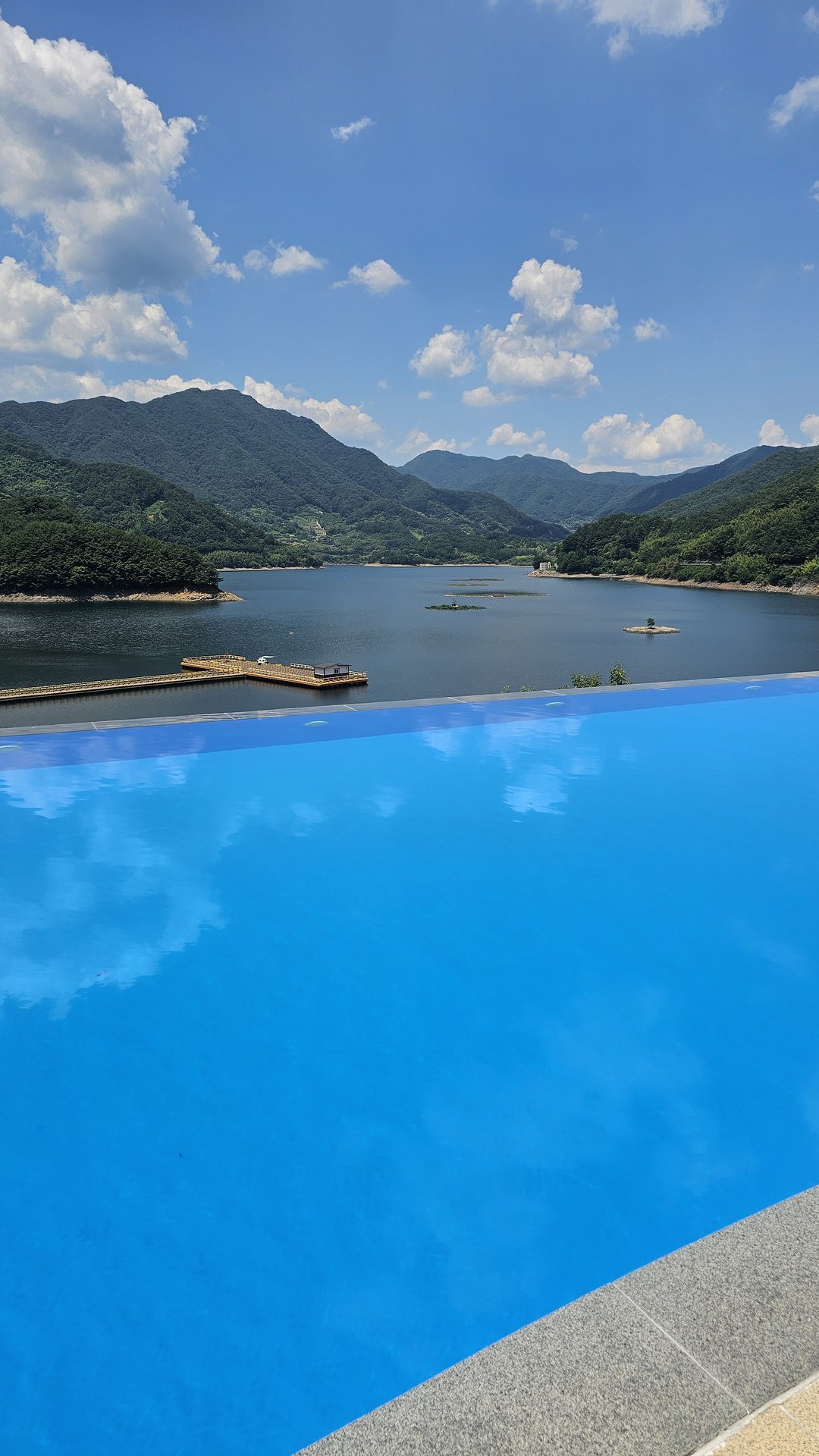
    Infinity pool edge at Vivace Resort Hadong reflecting river and mountain scenery in daytime
    Infinity pool edge at Vivace Resort Hadong reflecting river and mountain scenery in daytime
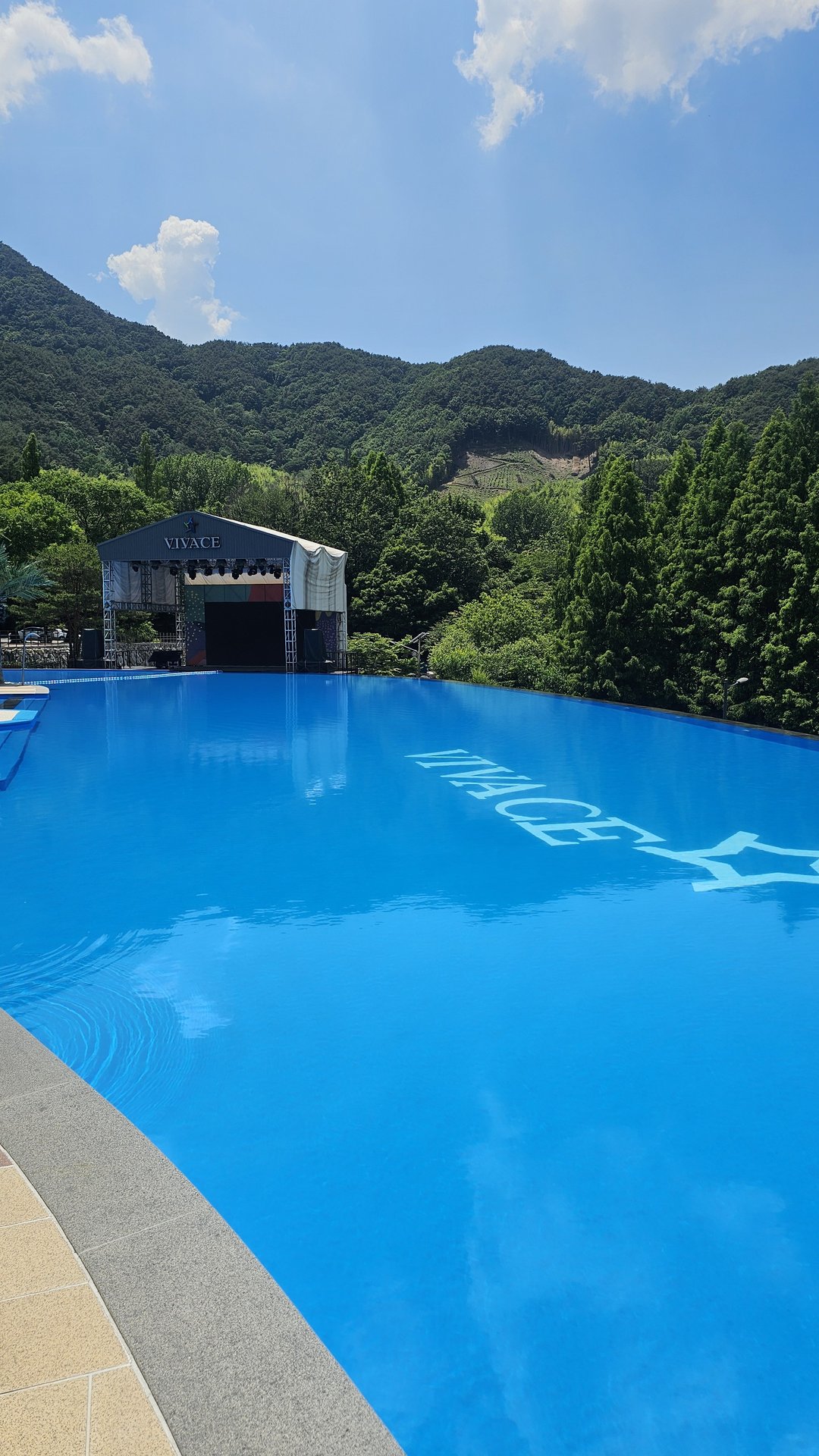
    Vivace Resort infinity pool with VIVACE logo sculpture, palm trees and green mountain backdrop
    Vivace Resort infinity pool with VIVACE logo sculpture, palm trees and green mountain backdrop
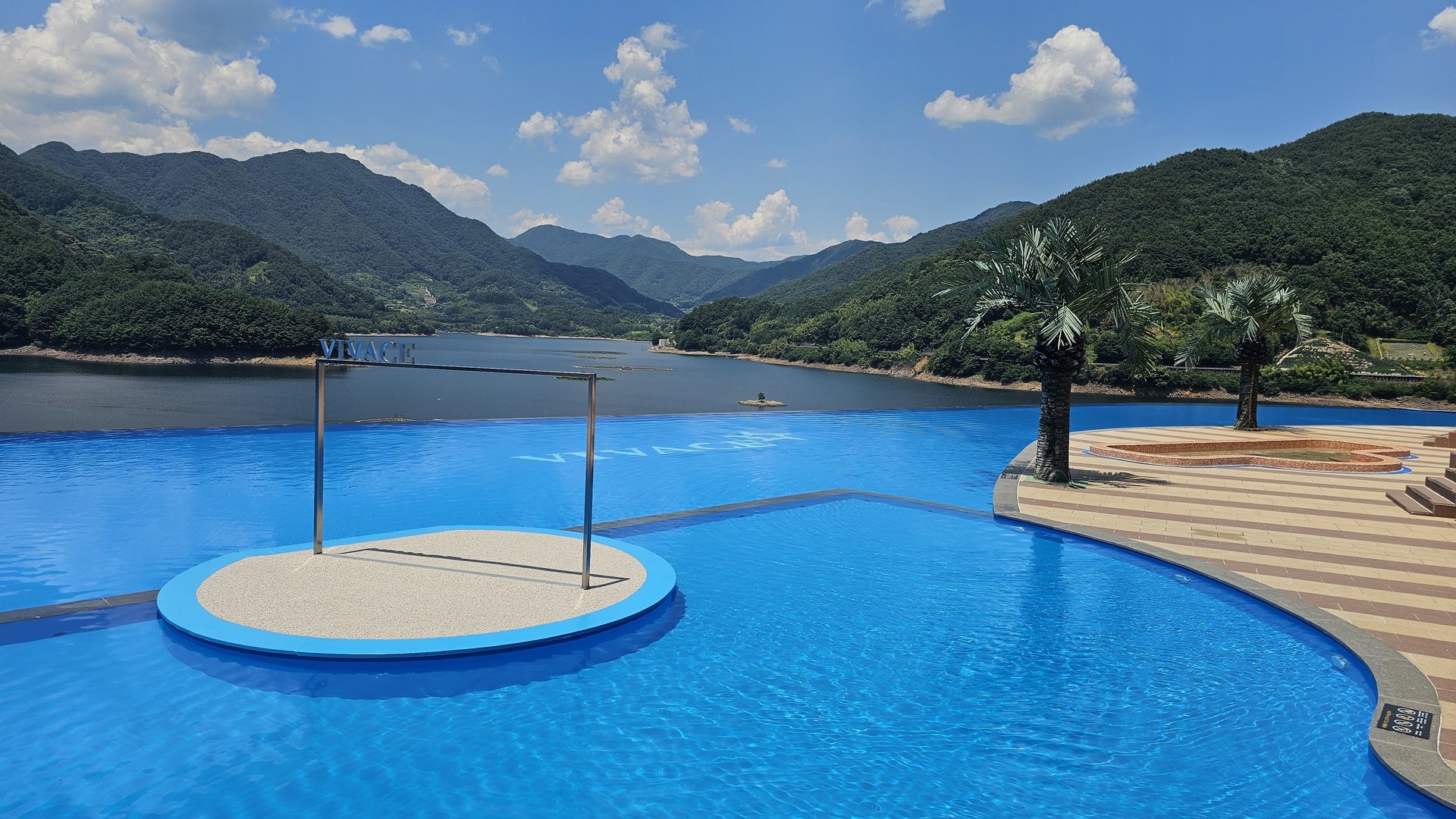
    Vivace Resort infinity pool full view with VIVACE sign sculpture, river and mountain panorama
    Vivace Resort infinity pool full view with VIVACE sign sculpture, river and mountain panorama

    The VIVACE logo sculpture sits at the end of the pool facing the river and mountains. On a clear afternoon, the reflection in the water is good. Genuinely good. The kind of shot that makes sense on Instagram and also just looks nice in real life. Palm trees, green mountains, a river running through the valley — it’s a strong view.

    On-Site Food and Drink

    You have three options without leaving the property:

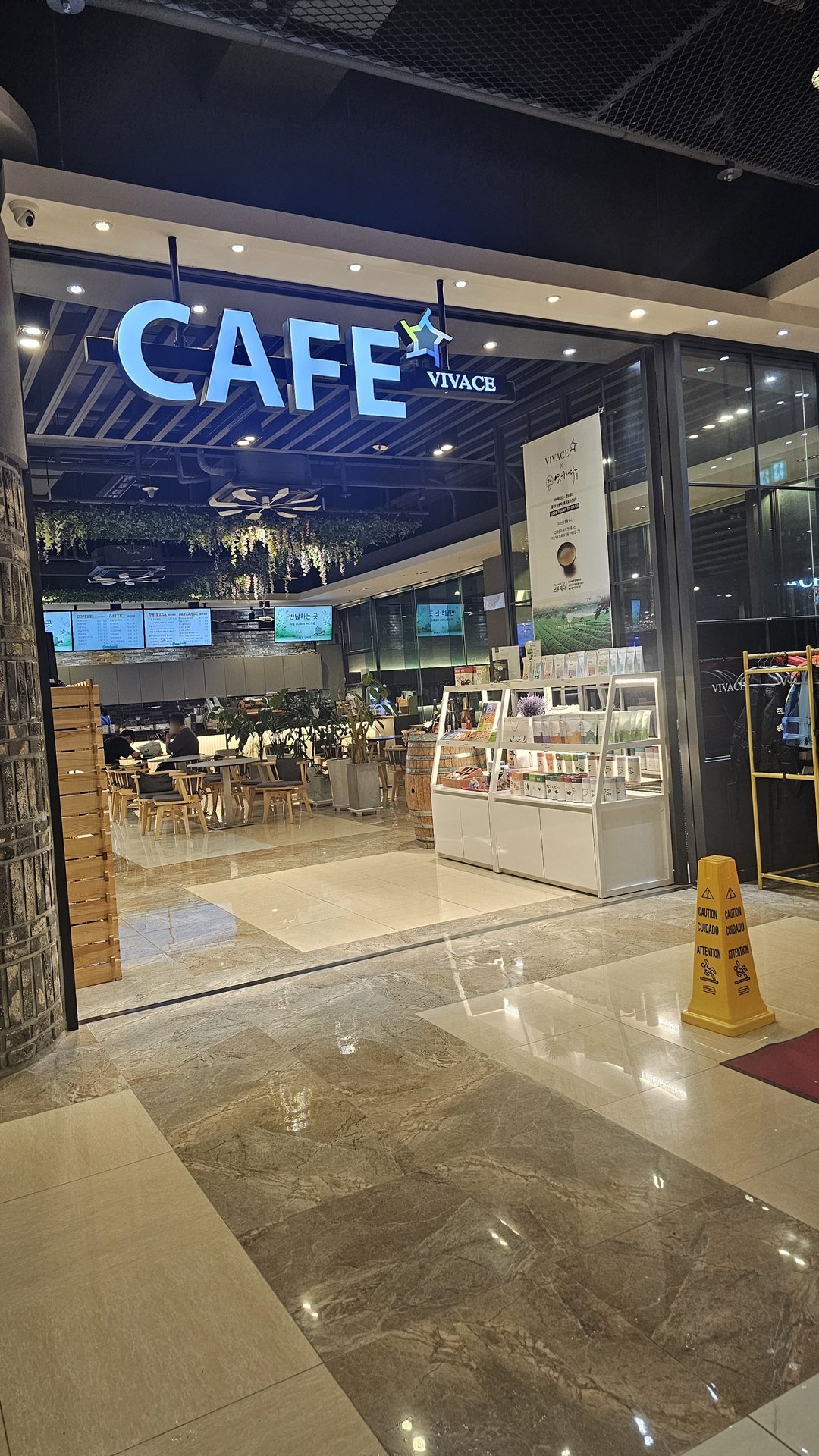
    VIVACE Cafe sign at Vivace Resort Hadong in the evening with interior seating visible through glass
    VIVACE Cafe sign at Vivace Resort Hadong in the evening with interior seating visible through glass

    VIVACE Cafe: Saw it in the evening, looked like a standard resort cafe setup. Coffee, light bites.

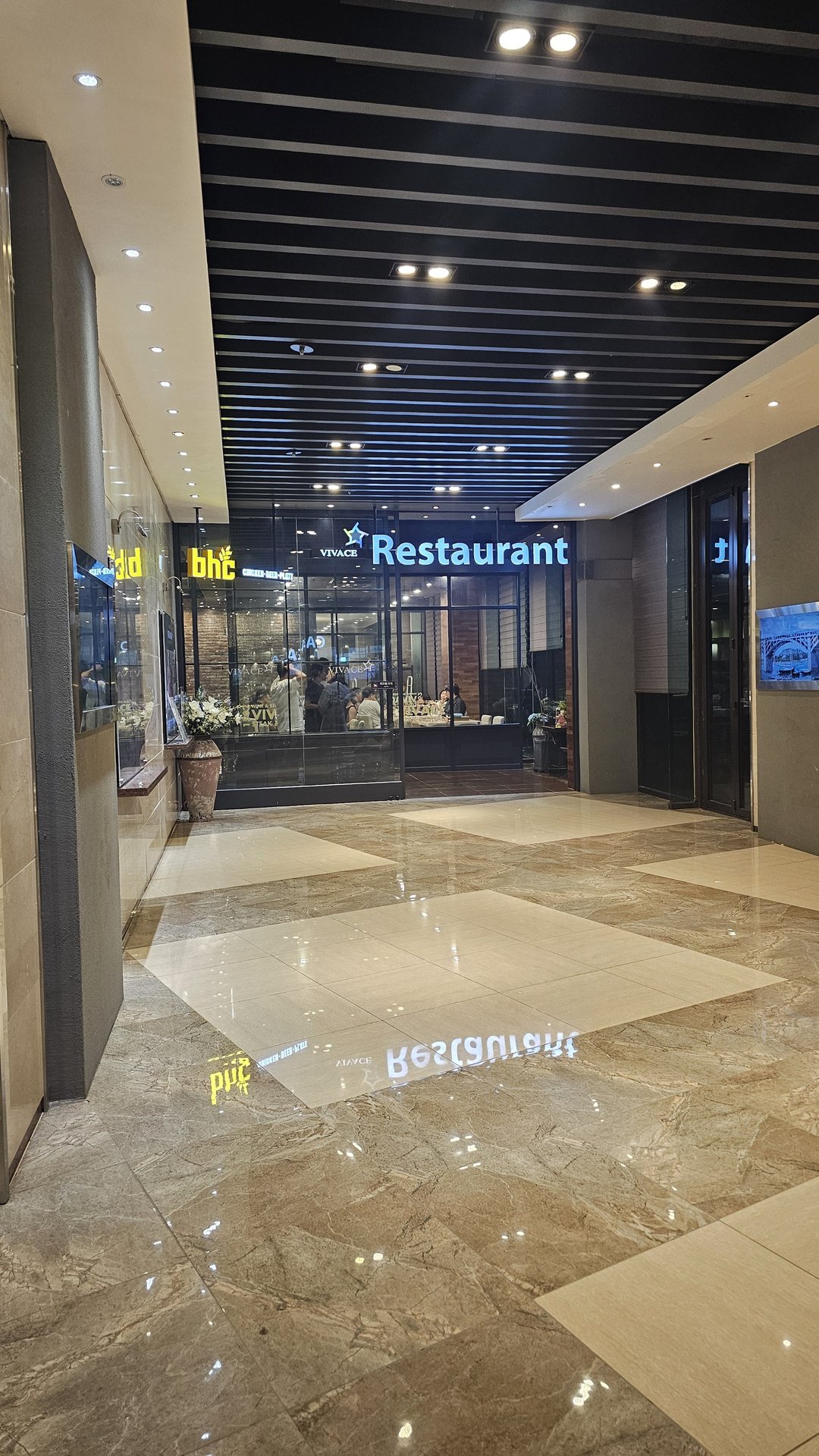
    VIVACE Restaurant: Proper sit-down dinner option. The lobby entrance looks decent — marble floors, glass facade. I didn’t eat here, so I can’t tell you what the food’s like.

    VIVACE Restaurant entrance at Vivace Resort Hadong at night with marble lobby and glass facade
    VIVACE Restaurant entrance at Vivace Resort Hadong at night with marble lobby and glass facade

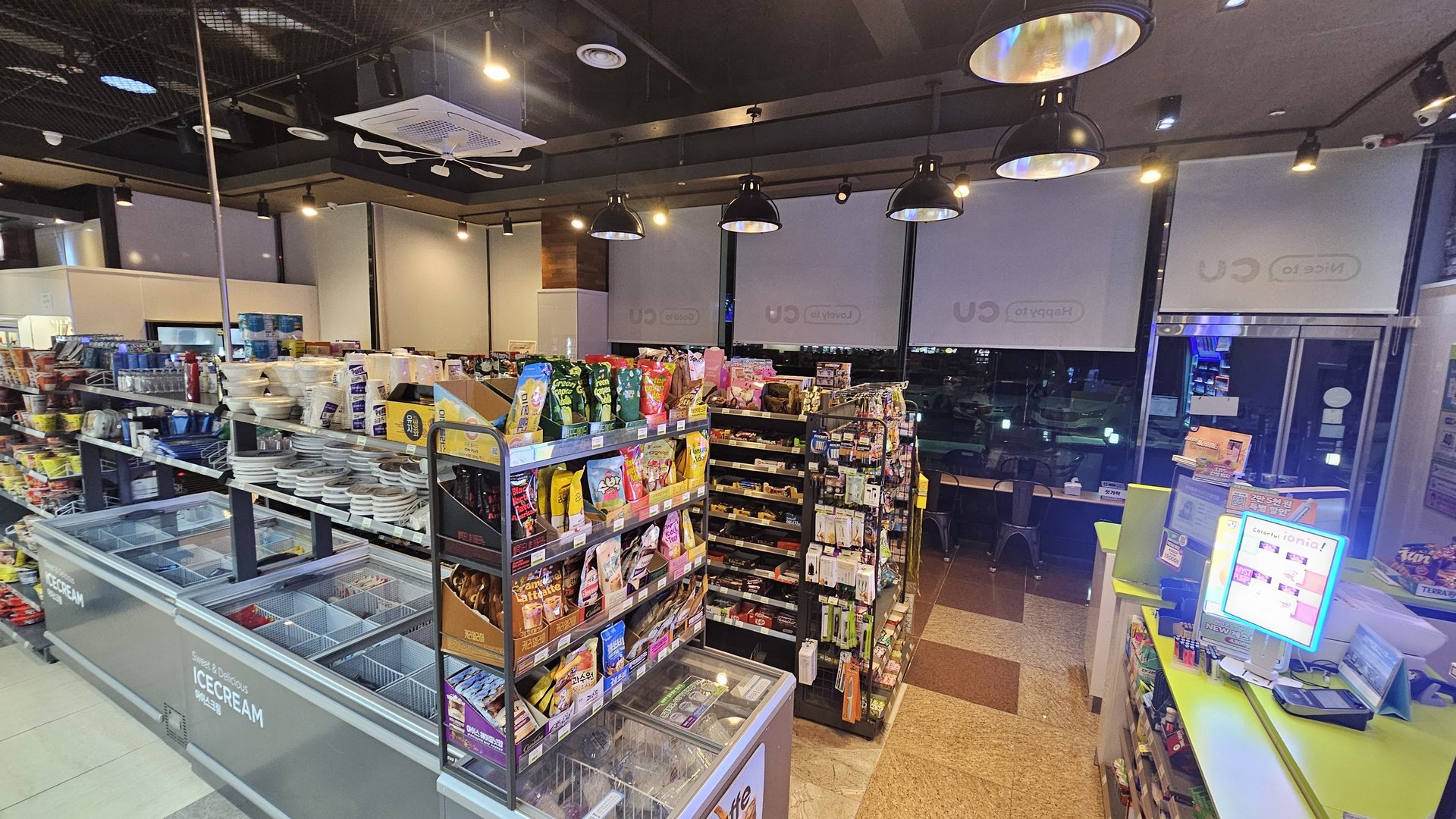
    Convenience store: The real workhorse. Ice cream freezer, snacks, drinks. After an afternoon in the pool, the ice cream section becomes very important.

    Convenience store inside Vivace Resort Hadong with ice cream freezer and snack shelves in the evening
    Convenience store inside Vivace Resort Hadong with ice cream freezer and snack shelves in the evening

    If you’re in the Royal Suite with a full kitchen, you could realistically buy groceries and cook. There’s a Hadong town market and regular supermarkets within driving distance. That’s probably the better value move for multi-night stays.

    The Views

    This deserves its own section.

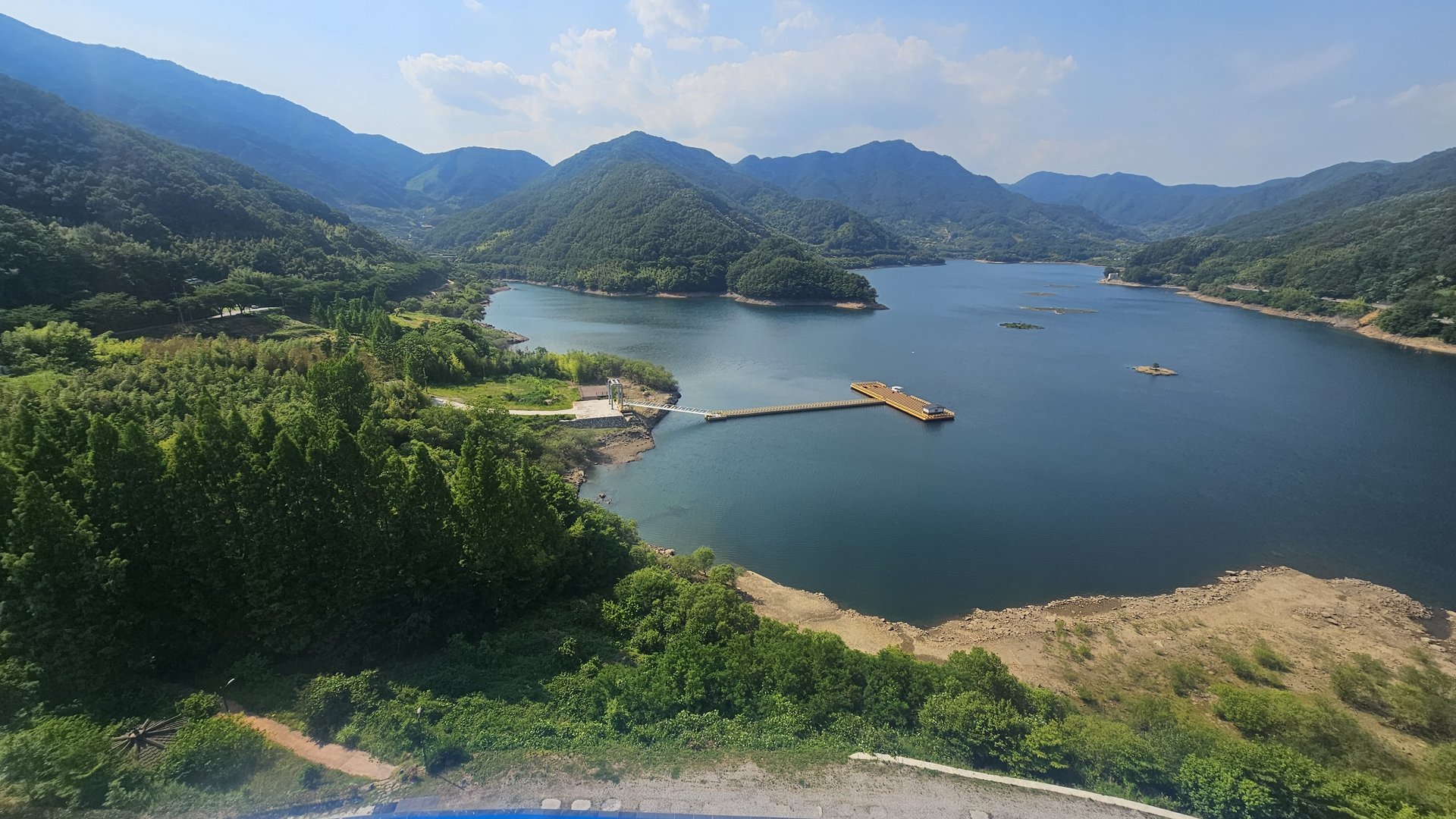
    River and mountain view from Vivace Resort Royal Suite window showing floating dock and green hills
    River and mountain view from Vivace Resort Royal Suite window showing floating dock and green hills
    Panoramic river and mountain view through Royal Suite window at Vivace Resort Hadong
    Panoramic river and mountain view through Royal Suite window at Vivace Resort Hadong

    The Royal Suite windows face the Seomjin River. On a clear day you can see the floating dock, the green hills rolling up from both banks, and the mountains behind them. It’s the kind of view that makes you stand by the window with coffee doing nothing for a few minutes.

    This is what Hadong is actually about. The river is clean, the mountains are unhurried, and nothing about the view is blocked by another building or a highway. For anyone coming from Seoul, that absence of concrete is the whole point.

    Practical Notes for Foreign Visitors

    Language: This resort isn’t set up for international visitors. Everything — signage, the house rules notice, the convenience store labels — is in Korean. Download Naver Papago or Google Translate, and use the camera scan function for menus and signs.

    Payment: Card payment works fine at the resort. Bring some cash if you want to use the convenience store (some smaller resort shops in Korea still prefer it).

    No tipping: Korea doesn’t have a tipping culture. Don’t tip — it creates awkwardness.

    Foreign cards: Most major international credit cards are accepted at Korean resorts. Visa and Mastercard work without issues. Double-check with your bank before travel.

    Getting around: You really want a car here. Hadong town is drivable, and nearby spots like Ssanggyesa Temple and green tea farms require wheels or expensive taxis.

    Best time to visit: Summer (June–August) for the pool and river. The water will still be cold — that’s not a weather problem, it’s just how this pool is. Autumn (September–November) brings different scenery along the Seomjin River, worth considering if pools aren’t the priority.

    Who’s it for:

    – Families with kids — yes, good fit. Two bedrooms, kids’ pool, space to breathe

    – Couples looking for a scenic one-night break — yes, the suite and the infinity pool view deliver

    – Solo travelers — probably overkill, both spatially and price-wise

    – Foreign tourists on a first trip to Korea — maybe save this for a second trip. Hadong is not a beginner destination logistically

    The Verdict

    The Royal Suite is genuinely good. Spacious, clean, well-equipped kitchen, two bedrooms, and a view that’s hard to beat in southern Korea. The duplex layout actually works — it doesn’t feel like a hotel room that was awkwardly expanded.

    The pools are the honest catch. Cold water is cold water. Adults adapt. Kids don’t even register it as a problem. Factor that in based on your group.

    Scenery is the real product here. The Seomjin River, the mountains, the quiet of a place that isn’t trying to be Seoul or Busan — that’s what you’re paying for. If that sounds like your idea of a good trip, Vivace Resort delivers it.
    Would I come back? Yeah. Same room, probably same time of year, definitely with people who can use the second bedroom.

    FAQ

    Is the outdoor pool at Vivace Resort Hadong heated?

    No. The water is cold even in summer — most adults find it manageable only during the hottest part of the day. Kids seem completely unfazed by it.

    Is Vivace Resort Hadong good for families with kids?

    Yes, genuinely. There’s a dedicated kids’ water park area with a shallow pool, palm trees, and a laid-back vibe. Kids handle the cold water fine and there’s space to run around.

    Does Vivace Resort have a restaurant on-site?

    Three options on the property — VIVACE Restaurant (sit-down, evening), VIVACE Cafe, and a convenience store with ice cream, snacks, and drinks. You won’t starve, but options are limited.

    How far is Hadong from Seoul and Busan?

    From Seoul, expect about 3.5–4 hours by car or express bus. From Busan, around 1.5 hours. Hadong is in the deep south of Korea, best reached by car.

    What does the Royal Suite at Vivace Resort include?

    It’s a two-level duplex with two bedrooms, two bathrooms (one with a walk-in shower), a full kitchen with induction cooktop, pots, pans, and utensils, plus a living room and river-facing windows throughout.

    Is English available at Vivace Resort Hadong?

    Basic communication is doable, but this isn’t a resort set up for international visitors. Download a Korean translation app before you go — you’ll use it.

    You might also like

    📍 Location

    Open in Google Maps →

  • Gareung Sikdang in Hadong: Honest Review of Jaecheop Clam Soup

    Quick honest review of Gareung Sikdang in Hadong — a no-frills local restaurant that’s been doing one thing for a long time: cooking freshwater clams from the Seomjin River. Skip to the verdict if you’re in a hurry, but here’s the short version: the jaecheop jinguk is the real thing, the side dishes are better than average, and 10,000 KRW (~$7.40) for a complete soup-and-rice meal in 2026 is genuinely good value.

    I visited on a Saturday morning around 10:30 AM, right after opening.

    What Is Jaecheop? (Start Here If You’ve Never Heard of It)

    Jaecheop (재첩) are freshwater clams. Not the big ocean clams you’re probably picturing.

    These are small — roughly thumbnail-sized — and they come specifically from the Seomjin River (섬진강), which runs along the border between South Jeolla and South Gyeongsang Province. Hadong sits right on that river. The clams have been harvested here for generations.

    The soup, called jaecheop jinguk (재첩진국), is pale and slightly milky. “Jinguk” means something close to “true broth” — a long-simmered stock that extracts everything from the shells. The result is clean-tasting, lightly savory, nothing fishy or briny. Koreans drink it in the morning or as 해장국 (haejangguk) — literally “hangover-clearing soup.” It’s considered good for the liver.

    It’s not a bold flavor. If you want something intense, order Korean BBQ. Jaecheop jinguk is subtle. That’s the point.

    Hadong is the main place in Korea to eat this. If you’re here and you don’t try it, you’ve missed the whole reason locals make the trip.

    About Gareung Sikdang

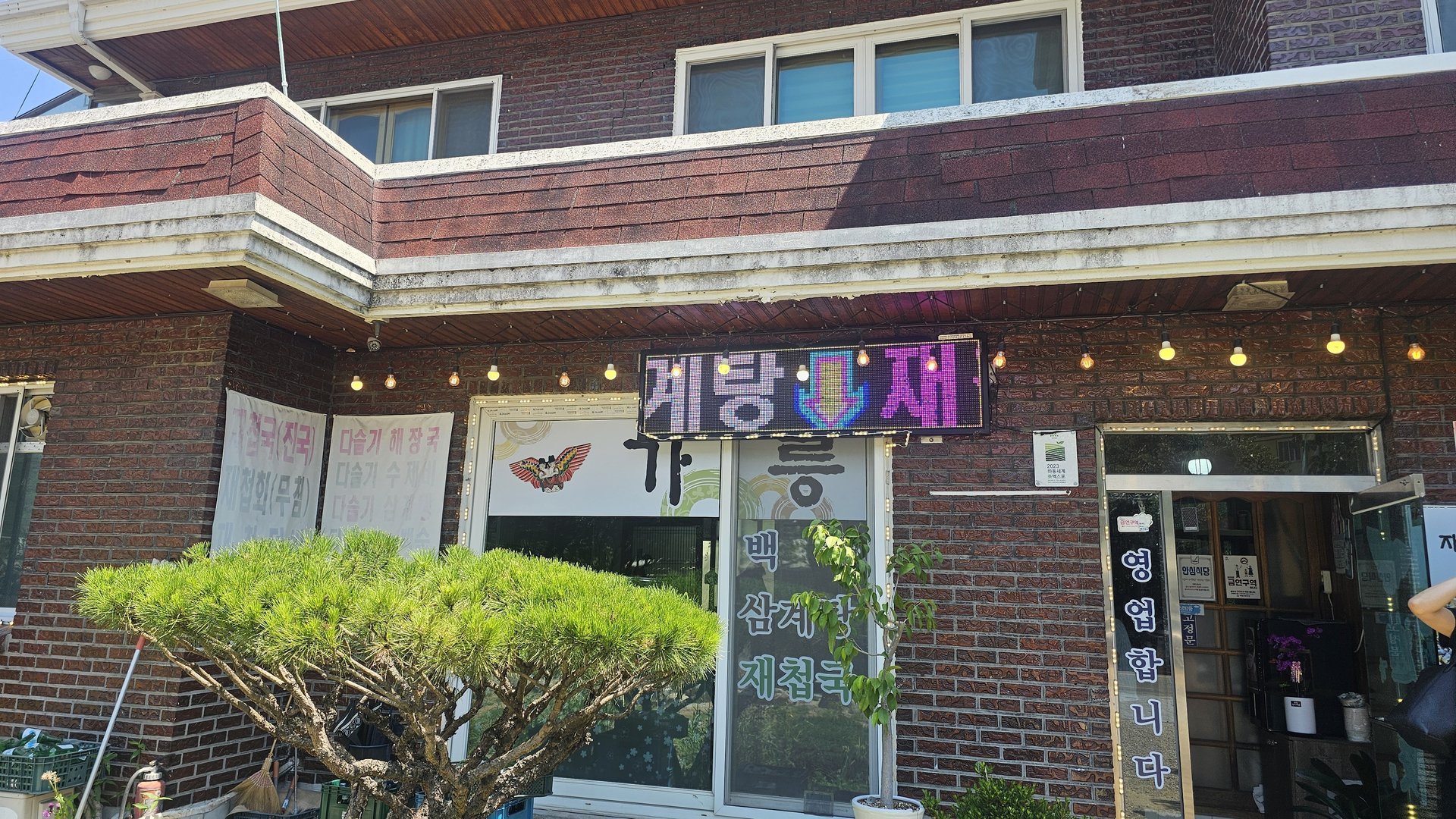
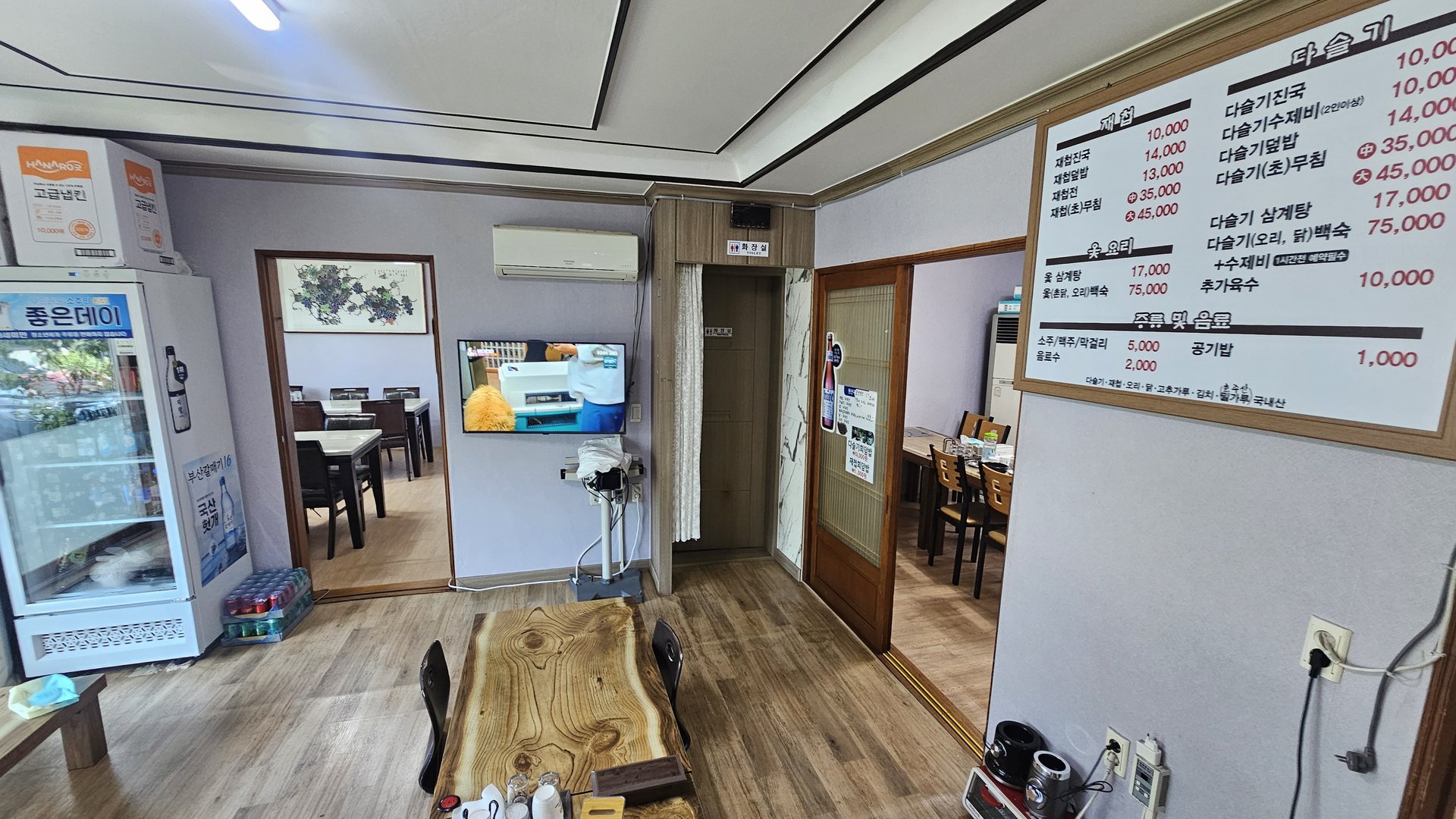
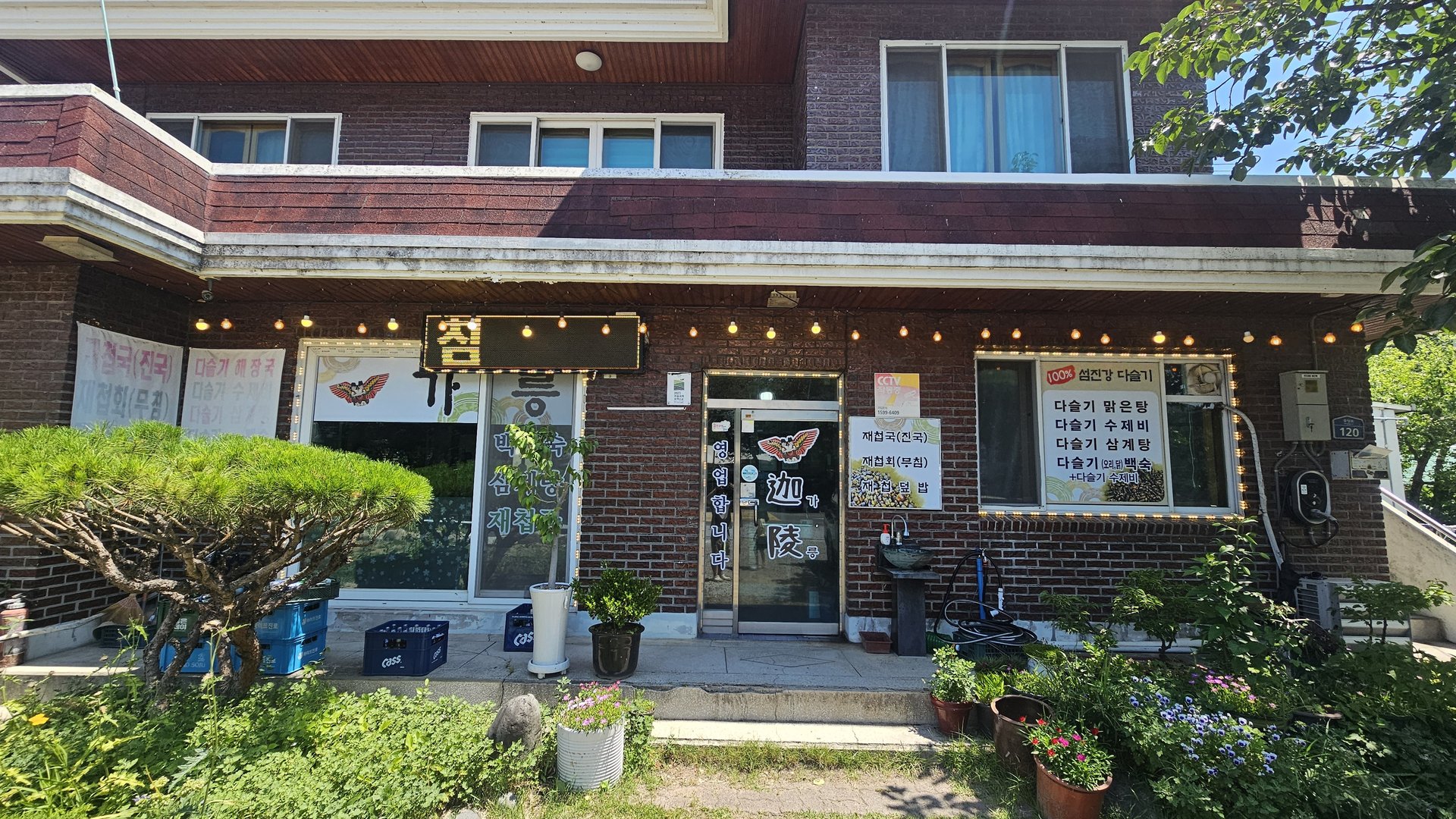
    Exterior front of Gareung Sikdang in Hadong — red brick building with neon sign and handwritten menu on glass door
    Exterior front of Gareung Sikdang in Hadong — red brick building with neon sign and handwritten menu on glass door

    Red brick building. Neon sign. Handwritten menu on the glass door listing 백숙, 삼계탕, and 재첩국. This is not a restaurant trying to impress first-time visitors. It’s a place that’s been feeding locals for years and has no real reason to change.

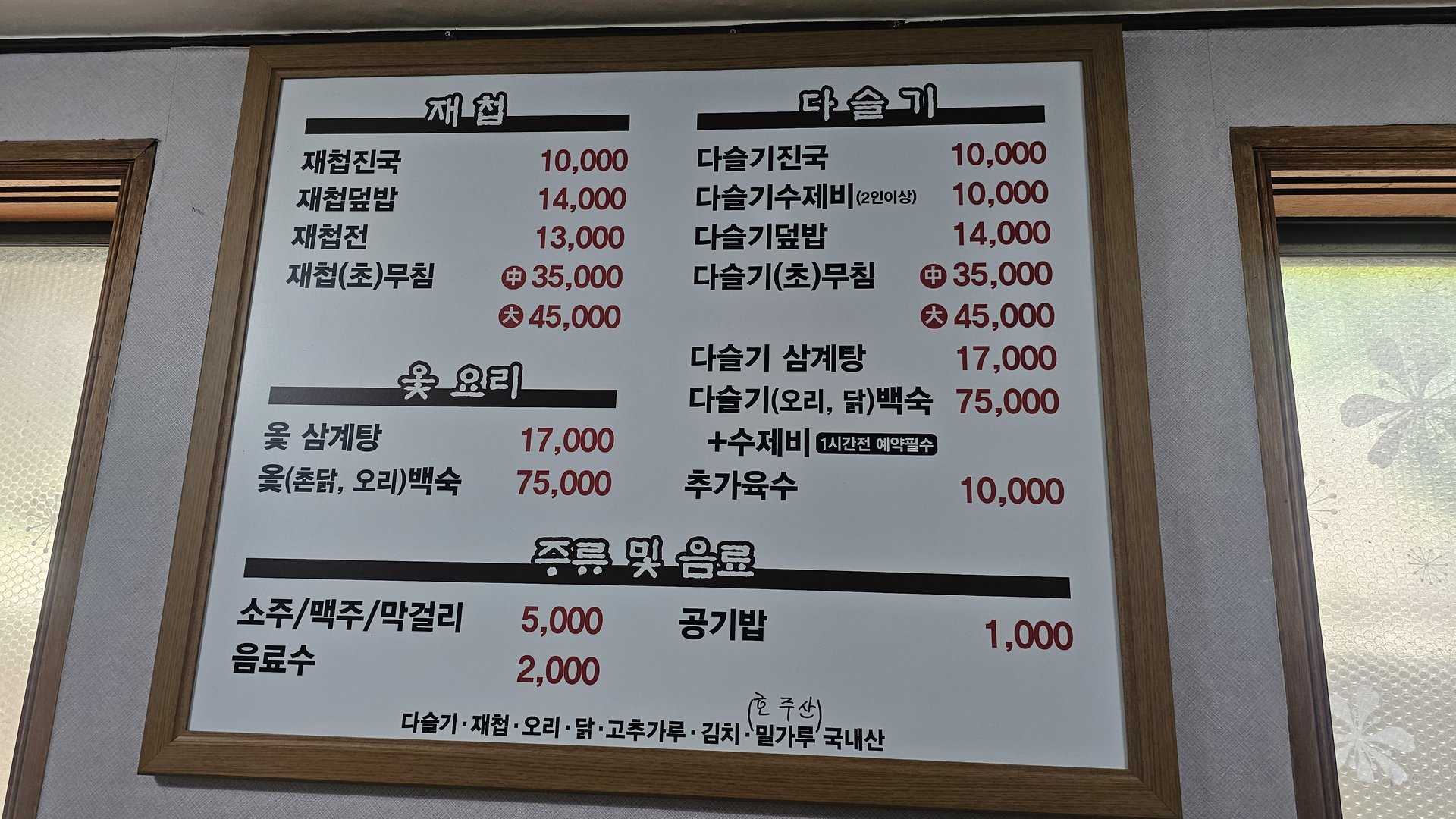
    The wall menu is worth a read even if you can’t understand Korean — you’ll get a sense of what this place is.

    Wall menu board at Gareung Sikdang Hadong showing jaecheop and daseulgi dishes with Korean won prices
    Wall menu board at Gareung Sikdang Hadong showing jaecheop and daseulgi dishes with Korean won prices

    Three main categories: 재첩 (jaecheop/freshwater clam), 다슬기 (daseulgi/freshwater snail), and 옻 요리 (ottchil — lacquer tree dishes). That last one is a traditional Korean medicinal preparation where chicken or duck is cooked with lacquer tree bark. It sounds strange but it’s been part of Korean folk medicine for centuries. The 백숙 (whole chicken/duck) version requires 1-hour advance reservation — not a same-day order.

    All ingredients listed as Korean domestic (국내산). That matters here — the whole point of Hadong jaecheop is that it comes from this river, not imported.

    Getting There

    Hadong is in South Gyeongsang Province (경남), in the deep south of Korea. Think lush mountains, river valleys, and not many foreign tourists.

    From Seoul: Express bus from Seoul Express Bus Terminal (센트럴시티, in Gangnam) to Hadong — about 3.5 to 4 hours. Budget around 25,000-30,000 KRW (~$18-22 USD) each way.

    From Busan: About 1.5-2 hours by intercity bus.

    There’s no train to Hadong. Bus or car. A rental car is the better option if you want to see more of the area — the Seomjin River, Ssanggye Temple (쌍계사), and the Hadong green tea fields are all within a short drive and make for a genuinely good full day.

    Hadong’s green tea, by the way, comes from the oldest tea garden in Korea. Worth combining with a jaecheop lunch.

    The Interior

    More spacious than the exterior suggests.

    Interior entrance area of Gareung Sikdang with drink refrigerator, TV, and hallway to private dining rooms
    Interior entrance area of Gareung Sikdang with drink refrigerator, TV, and hallway to private dining rooms
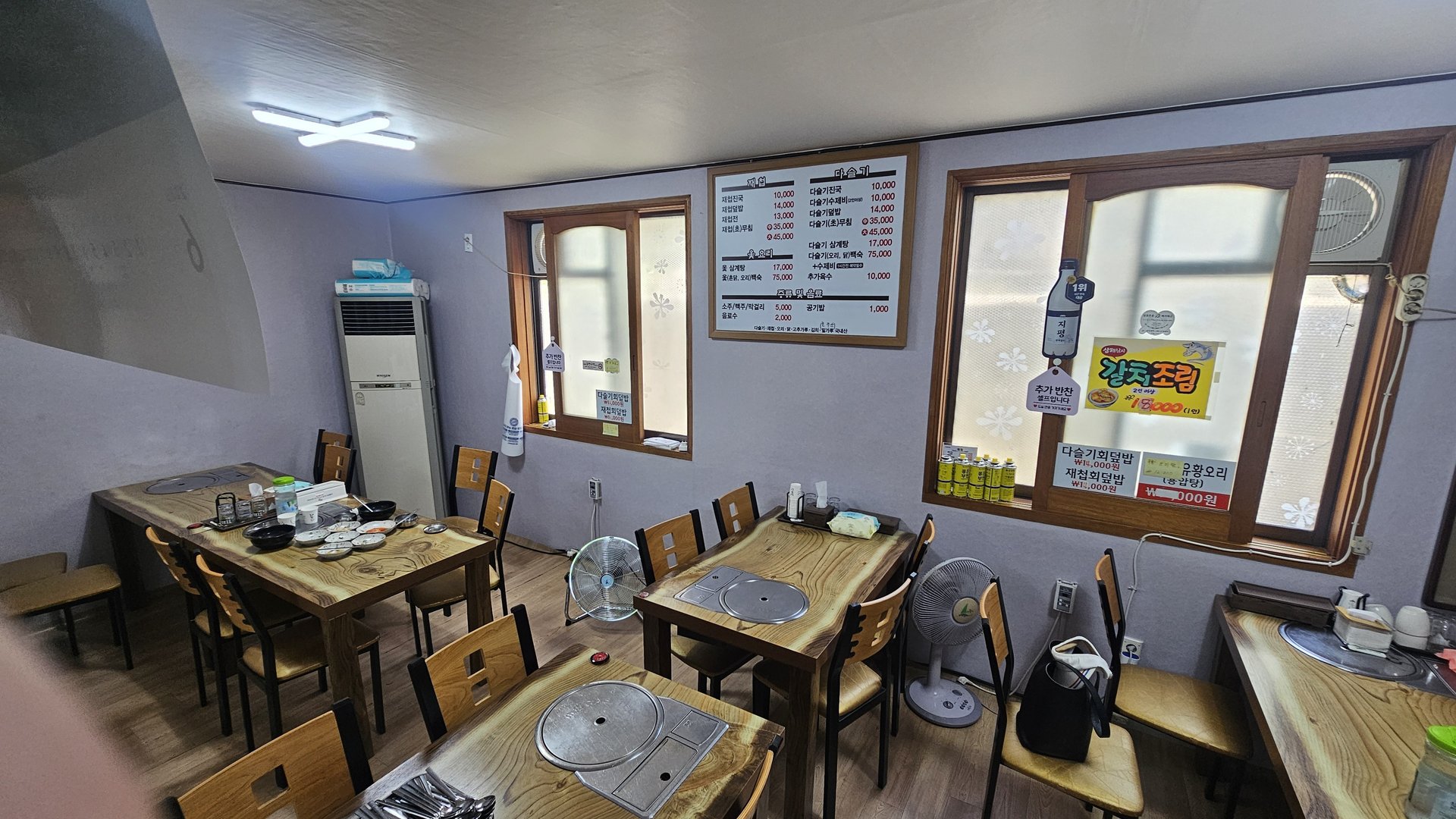
    Spacious main dining hall at Gareung Sikdang Hadong with wooden tables, chairs, fans, and large windows
    Spacious main dining hall at Gareung Sikdang Hadong with wooden tables, chairs, fans, and large windows

    Large main hall with wooden tables and chairs. Fans and air conditioning. Windows along the side. There’s also a private dining section toward the back — visible from the entrance — which means this place handles group bookings, family gatherings, that kind of thing.

    No music. No Instagram-friendly lighting. Just a clean, functional space that seats a lot of people comfortably.

    Solo diners are fine here. Nobody gave me a second glance.

    What I Ordered

    Jaecheop Jinguk — 10,000 KRW (~$7.40)

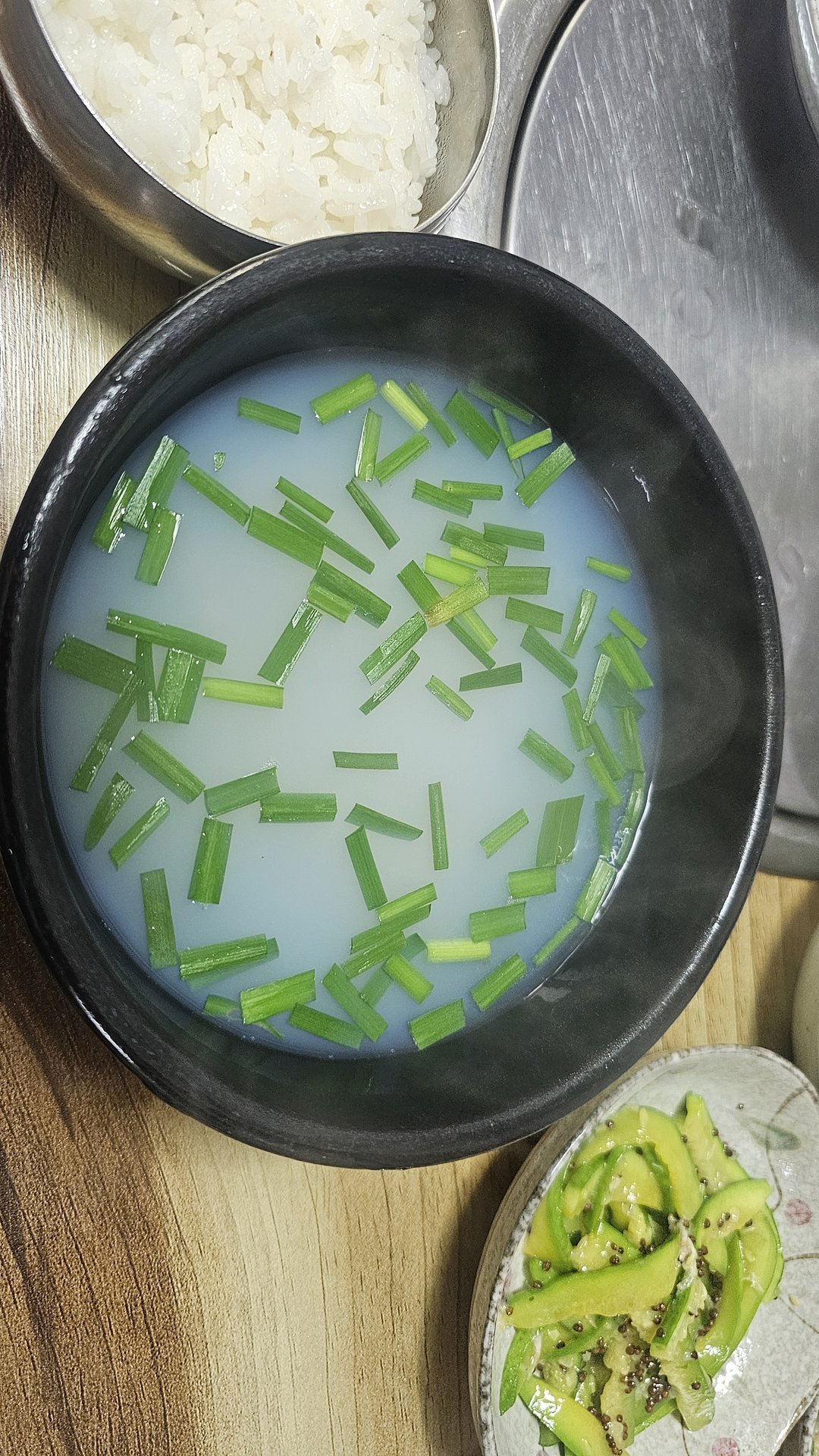
    Bowl of jaecheop jinguk freshwater clam soup with chopped green onions and a side of steamed rice at Gareung Sikdang Hadong
    Bowl of jaecheop jinguk freshwater clam soup with chopped green onions and a side of steamed rice at Gareung Sikdang Hadong
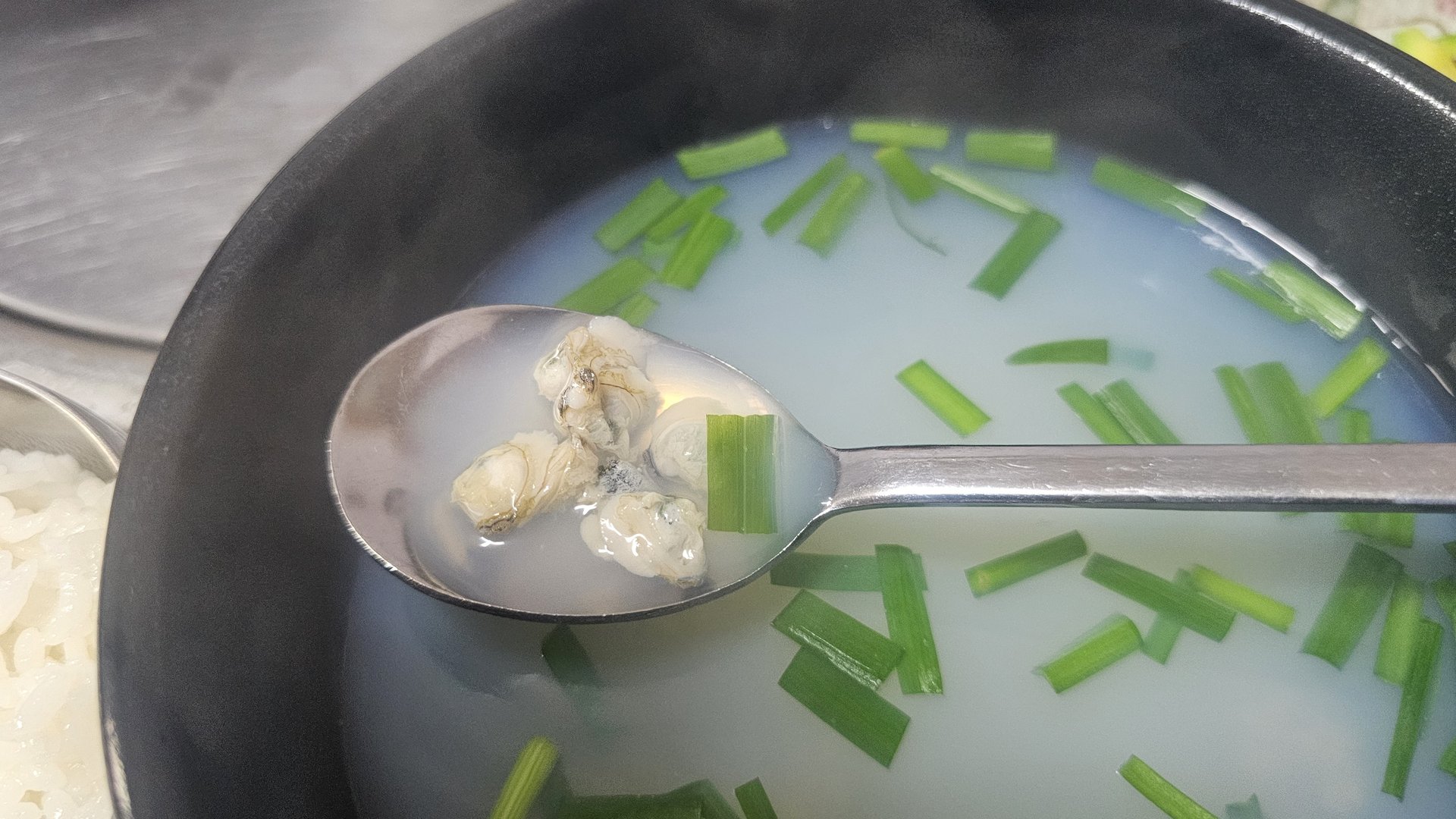
    Close-up spoonful of jaecheop jinguk showing plump Seomjin River freshwater clams from Gareung Sikdang
    Close-up spoonful of jaecheop jinguk showing plump Seomjin River freshwater clams from Gareung Sikdang

    The bowl arrives pale — not white, more like off-white, the color of a long-simmered broth. Chopped green onion on top. Rice comes with it.

    Taste: clean, lightly savory, delicate. The clam meat is small but noticeably plump. You get actual jaecheop flavor in every spoonful — not just vague broth with occasional clam fragments, but something that tastes like the river it came from.

    Honestly, this was exactly what I was hoping for. Not a transcendent experience. Not the best thing I’ve ever eaten. But properly made jaecheop jinguk at a fair price with decent-sized clams. If you’ve never had this before, this is a solid introduction. If you know what good jaecheop tastes like, this is the real thing.
    Jaecheop Jeon — 13,000 KRW (~$9.60)

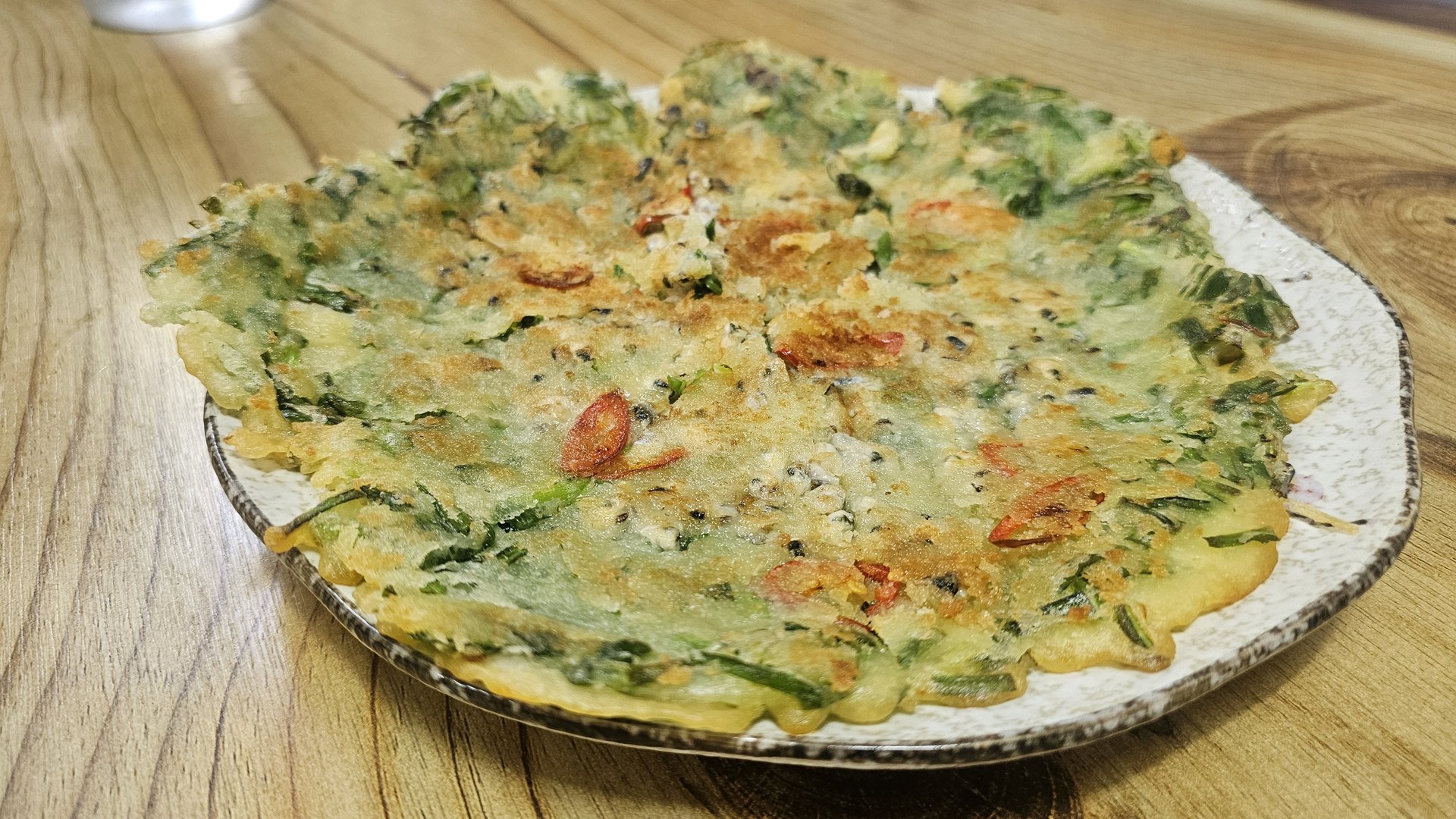
    Jaecheop jeon freshwater clam pancake at Gareung Sikdang with crispy golden edges
    Jaecheop jeon freshwater clam pancake at Gareung Sikdang with crispy golden edges

    Freshwater clam pancake. Pan-fried to a proper golden crisp at the edges, a little softer toward the center where the clam filling concentrates.

    This is the texture dish. The soup is subtle and warming — the jeon gives you something to actually chew through. Crunchy outer layer, soft interior with clam pieces distributed throughout. You can taste the jaecheop clearly.

    Get both. The soup is the main event but the jeon adds something the soup doesn’t have.

    The Banchan (Side Dishes)

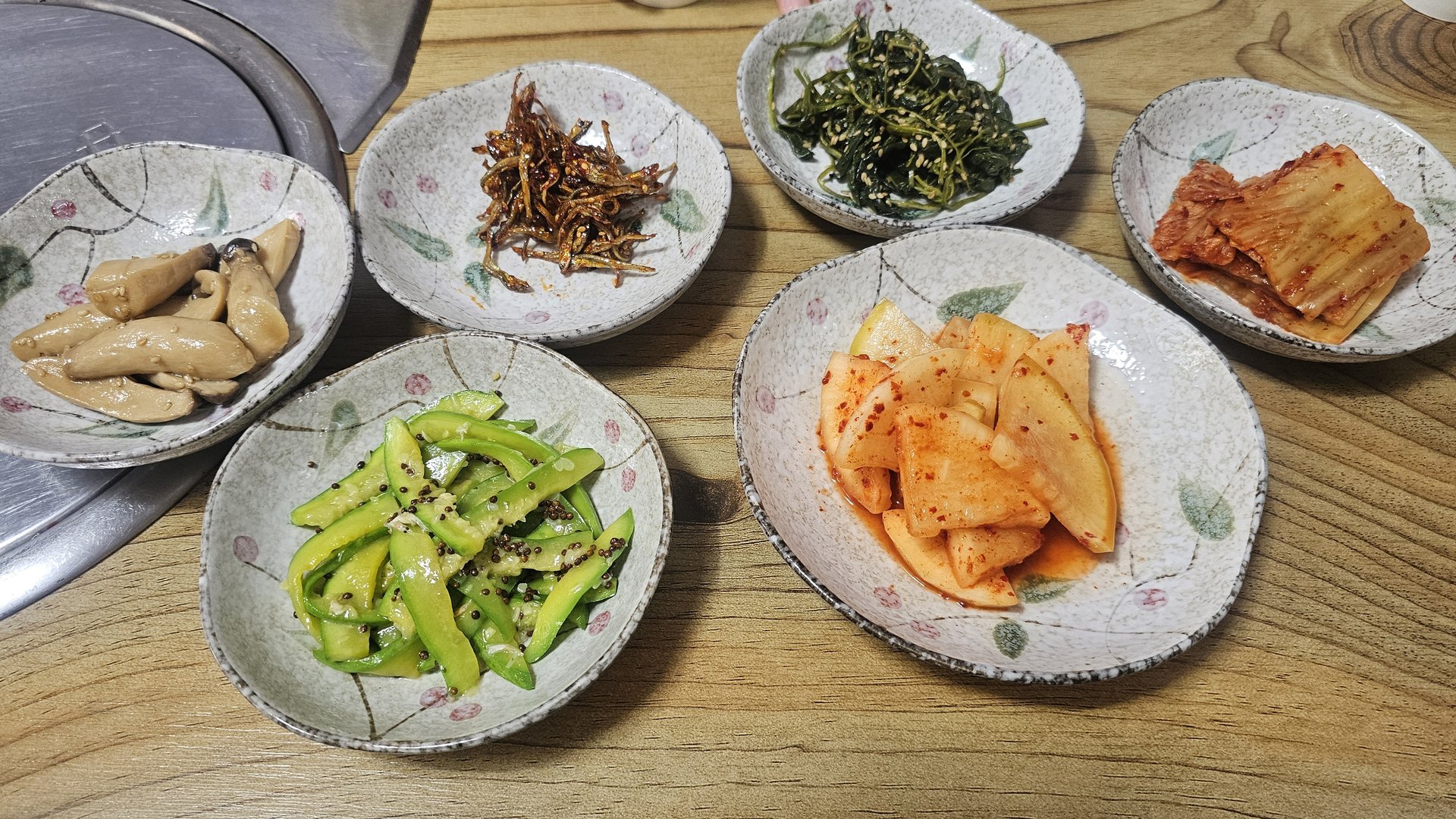
    Five Korean banchan side dishes at Gareung Sikdang including pickled ginger, stir-fried anchovies, chwinamul greens, kkakdugi radish kimchi, and cucumber salad
    Five Korean banchan side dishes at Gareung Sikdang including pickled ginger, stir-fried anchovies, chwinamul greens, kkakdugi radish kimchi, and cucumber salad

    Five side dishes: pickled ginger, stir-fried anchovies (멸치볶음), chwinamul greens (취나물무침 — wild aster, slightly bitter and earthy), kkakdugi (깍두기, cubed radish kimchi), and cucumber salad.

    Here’s the thing — at a lot of local restaurants in Korea, banchan is an afterthought. Not here. Each dish was properly seasoned. The kkakdugi had real crunch. The chwinamul wasn’t overdressed. The pickled ginger was sharp, a good palate reset between bites of rich soup and crispy pancake.

    Small details. They matter.

    Stuff Tourists Should Know

    Language: No English menu. Wall board only, all Korean. The menu is short though — point at 재첩진국 for soup, 재첩전 for pancake. Pronunciation: “jae-cheop jin-guk” and “jae-cheop jeon.” Staff won’t speak much English but they’ll understand what you’re pointing at.

    Payment: Bring cash (Korean won). Traditional local restaurants in rural areas often don’t take foreign cards, and even when they take domestic cards, foreign cards can be unreliable. ATMs are available in Hadong town center.

    Tipping: No tipping in Korea. Don’t tip.

    Reservations: Not needed for jaecheop dishes. If you want the 옻 백숙 (lacquer whole chicken/duck), call 1 hour ahead — that’s on the menu itself.

    Vegetarian/Vegan: Not an option. The menu is entirely built around freshwater clams, snails, and poultry. Banchan likely contains anchovy-based seasoning in several dishes.

    Halal: Not halal-certified.

    Kids: Completely fine. Large tables, casual setting, accessible food. The soup and pancake are kid-friendly dishes with no spice or unusual flavors.

    Best time to visit: Morning or lunch. This is morning-meal territory in Korea — jaecheop soup is traditionally a breakfast or early lunch dish.

    Price breakdown:

    – 재첩진국 (soup + rice): 10,000 KRW (~$7.40)

    – 재첩전 (clam pancake): 13,000 KRW (~$9.60)

    – Extra rice: 1,000 KRW (~$0.75)

    – Beer / soju / makgeolli: 5,000 KRW (~$3.70)

    Two people ordering one soup each and sharing one pancake: around 33,000 KRW total (~$24 USD).

    The Verdict

    Side exterior of Gareung Sikdang Hadong with illuminated sign and daseulgi freshwater snail banner in daytime
    Side exterior of Gareung Sikdang Hadong with illuminated sign and daseulgi freshwater snail banner in daytime

    Should you go?

    If you’re already in Hadong — yes, absolutely. This is what you came here for. The jaecheop jinguk is properly made, the side dishes are above average, and the price is fair. Order the soup and the jeon together.
    If you’re planning a day trip from Busan — yes. Ssanggye Temple + Hadong green tea fields + jaecheop lunch is a genuinely good day out. This place fits naturally into that itinerary.

    If you’re based in Seoul with 3-4 days in Korea — probably not. A 4-hour bus ride for a bowl of soup is hard to justify when Seoul has plenty to eat. Save Hadong for a longer trip when you have time to explore beyond the capital.

    Would I come back? Yeah. Next time I’m in Hadong, this is where I’m eating lunch.

    FAQ

    What is jaecheop and why is Hadong famous for it?

    Jaecheop (재첩) are tiny freshwater clams harvested from the Seomjin River that runs through Hadong. The soup made from them is pale, slightly milky, and clean-tasting — nothing like ocean clam chowder. Hadong is the main source of these clams in Korea, so eating jaecheop here is essentially eating them at the source.

    How much does a meal at Gareung Sikdang cost?

    Jaecheop jinguk (clam soup with rice included) is 10,000 KRW (~$7.40). Jaecheop jeon (clam pancake) is 13,000 KRW (~$9.60). For one person ordering both, expect around 23,000 KRW (~$17 USD). Two people sharing a pancake and each getting soup runs about 33,000 KRW total (~$24 USD).

    Is there an English menu at Gareung Sikdang?

    No English menu — everything is in Korean on the wall board. The menu is short and straightforward though. Point at 재첩진국 for the clam soup or 재첩전 for the pancake. Staff aren’t English speakers but they’re used to visitors figuring it out.

    How do I get to Hadong from Seoul or Busan?

    From Seoul, take an express bus from Seoul Express Bus Terminal (Gangnam, 센트럴시티) to Hadong — about 3.5-4 hours. From Busan, roughly 1.5-2 hours by bus. There’s no train to Hadong, so bus or rental car is your option. A car is worth it if you’re exploring the region.

    What are Gareung Sikdang’s opening hours?

    Based on a morning visit, the restaurant opens around 10 AM. Lunch service is the main rush. Check locally or call ahead for current hours, especially if visiting on weekdays or in off-season.

    Is Gareung Sikdang vegetarian-friendly?

    No. The entire menu is built around freshwater clams, freshwater snails, and poultry (chicken, duck). Not suitable for vegetarians. Banchan (side dishes) likely contains anchovy-based seasoning too.

    You might also like

    📍 Location

  • Ginza Yeouido: Honest Review of Seoul’s 20-Year Japanese Course Restaurant

    Ginza Yeouido: Honest Review of Seoul’s 20-Year Japanese Course Restaurant

    Ginza Yeouido: Honest Review of Seoul’s 20-Year Japanese Course Restaurant

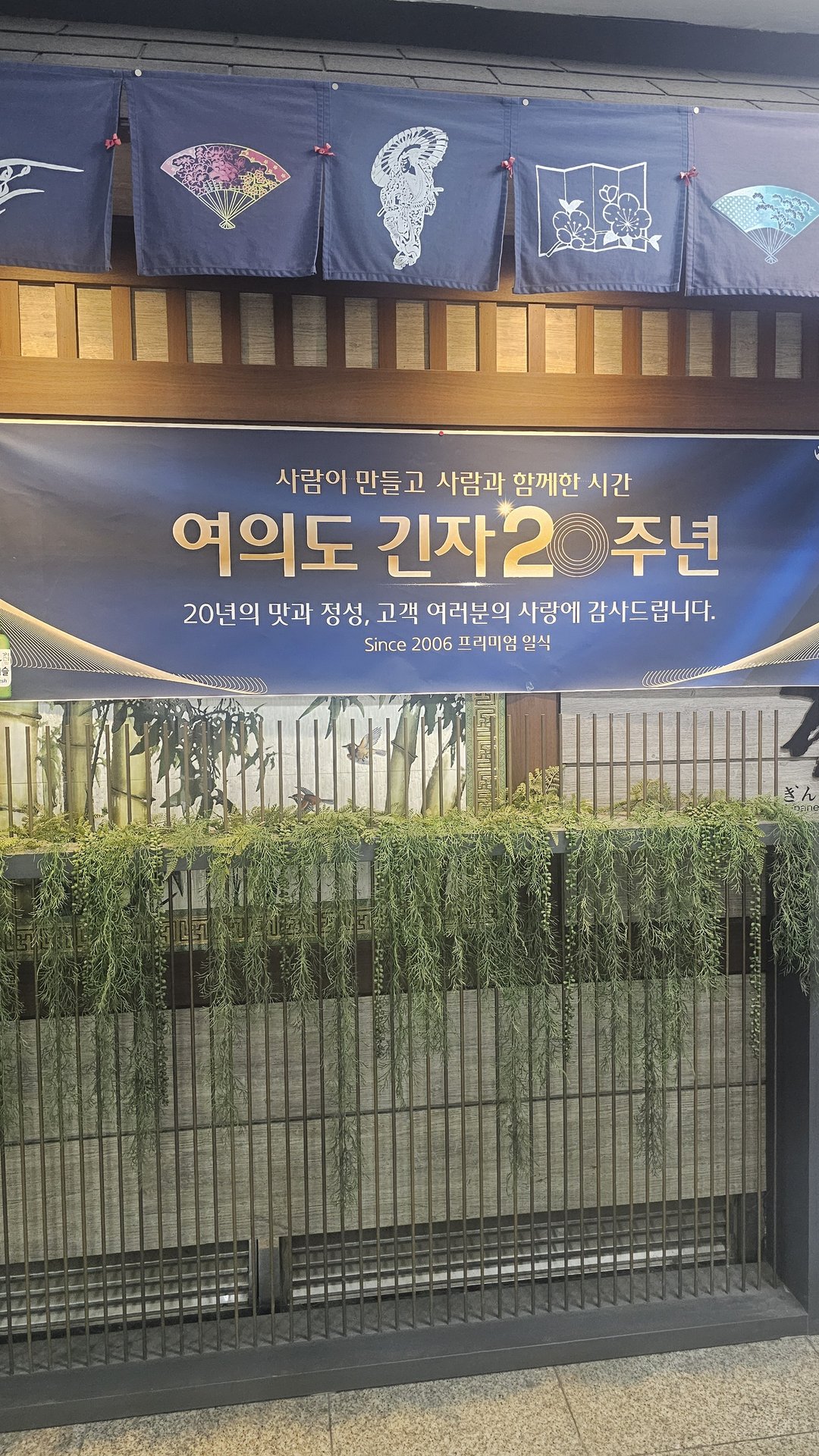
    Quick honest review of Ginza (긴자) in Yeouido — one of Seoul’s longest-running premium Japanese course restaurants. We visited on June 10, 2026, which happened to be their 20th anniversary. Four of us, full course, walked out full and slightly lighter in the wallet.

    Short version: the food is clean, refined, and well-executed. Not flashy. Not trying to impress you with trends. Just solid Japanese course cooking that’s been doing the same thing for two decades because it works. For the price, that’s actually a compliment.

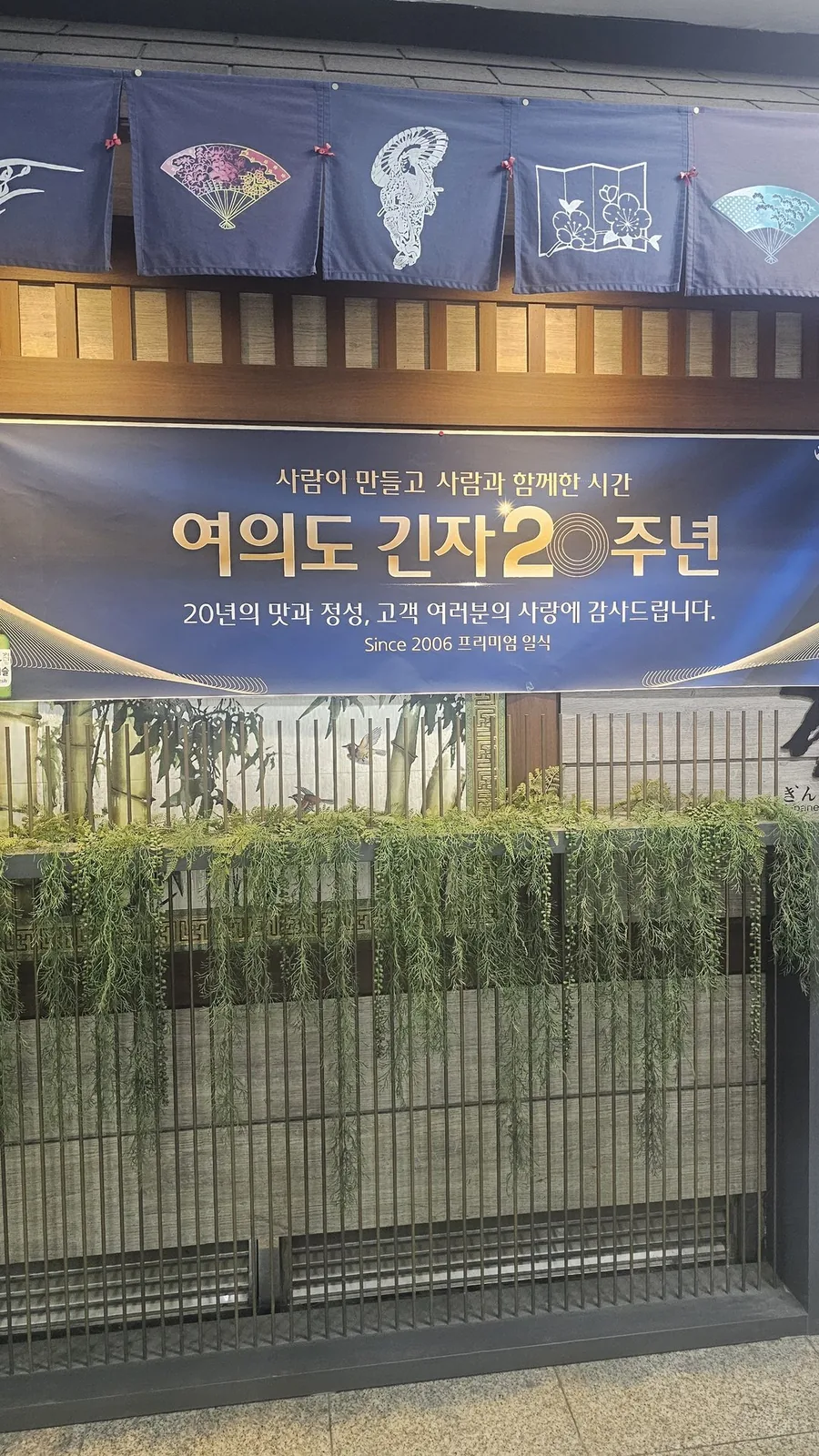
    Ginza Yeouido 20th anniversary banner on restaurant exterior
    Ginza Yeouido 20th anniversary banner on restaurant exterior

    What Is Ginza Yeouido?

    Ginza (긴자) takes its name from the famous upscale shopping and dining district in Tokyo. The Seoul version isn’t a Japanese chain — it’s a Korean-run premium Japanese restaurant that opened in Yeouido in 2006. Two decades later, it’s still one of the go-to spots for business lunches and formal meals in Seoul’s financial district.

    Yeouido, for context: think Wall Street meets Canary Wharf. This is where Korean banks, broadcast networks, and securities firms are headquartered. Lunch spots here cater to executives and client meetings, not backpackers hunting for cheap bibimbap. Ginza fits that world perfectly — formal, quiet, unhurried.

    The format is a Japanese course meal (코스 요리). You pick a tier, and dishes come out one after another over roughly 90 minutes. No à la carte scrambling, no “what should we order?” decision fatigue. Just sit down and eat.

    Getting There

    Entrance of Ginza Yeouido with traditional noren curtain and staff at the door
    Entrance of Ginza Yeouido with traditional noren curtain and staff at the door

    Yeouido is well connected by Seoul Metro:

    Line 5: Yeouido Station (여의도역), Exit 1 or 2

    Line 9: National Assembly Station (국회의사당역)

    – From Incheon Airport (ICN): about 60–70 minutes by AREX express train + subway transfer

    From the major hotels in Yeouido (Conrad Seoul, FairField by Marriott), it’s a short taxi ride — under 10 minutes, likely under 5,000 KRW.

    Drop the Korean name 긴자 여의도 into Kakao Maps or Naver Maps. Google Maps works but Korean addresses are more reliable on local apps.

    The Interior

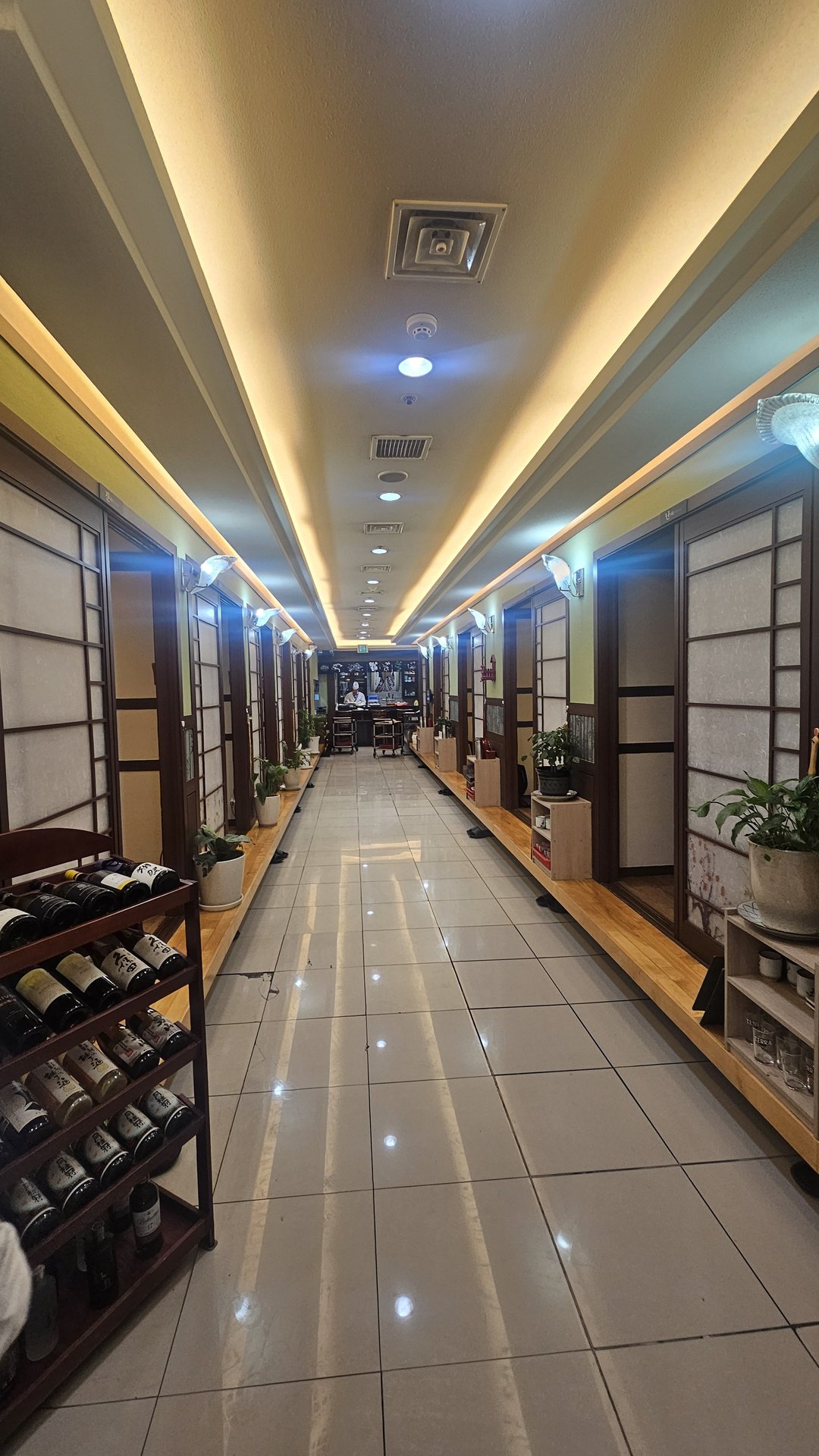
    Interior hallway of Ginza Yeouido with Japanese wood decor and private dining rooms
    Interior hallway of Ginza Yeouido with Japanese wood decor and private dining rooms

    The interior is formal Japanese — clean wood paneling, shoji-style screens, quiet lighting. Not the Instagram-bait kind of design with exposed brick and Edison bulbs. This is old-school Japanese restaurant aesthetic: calm, considered, tells you to lower your voice.

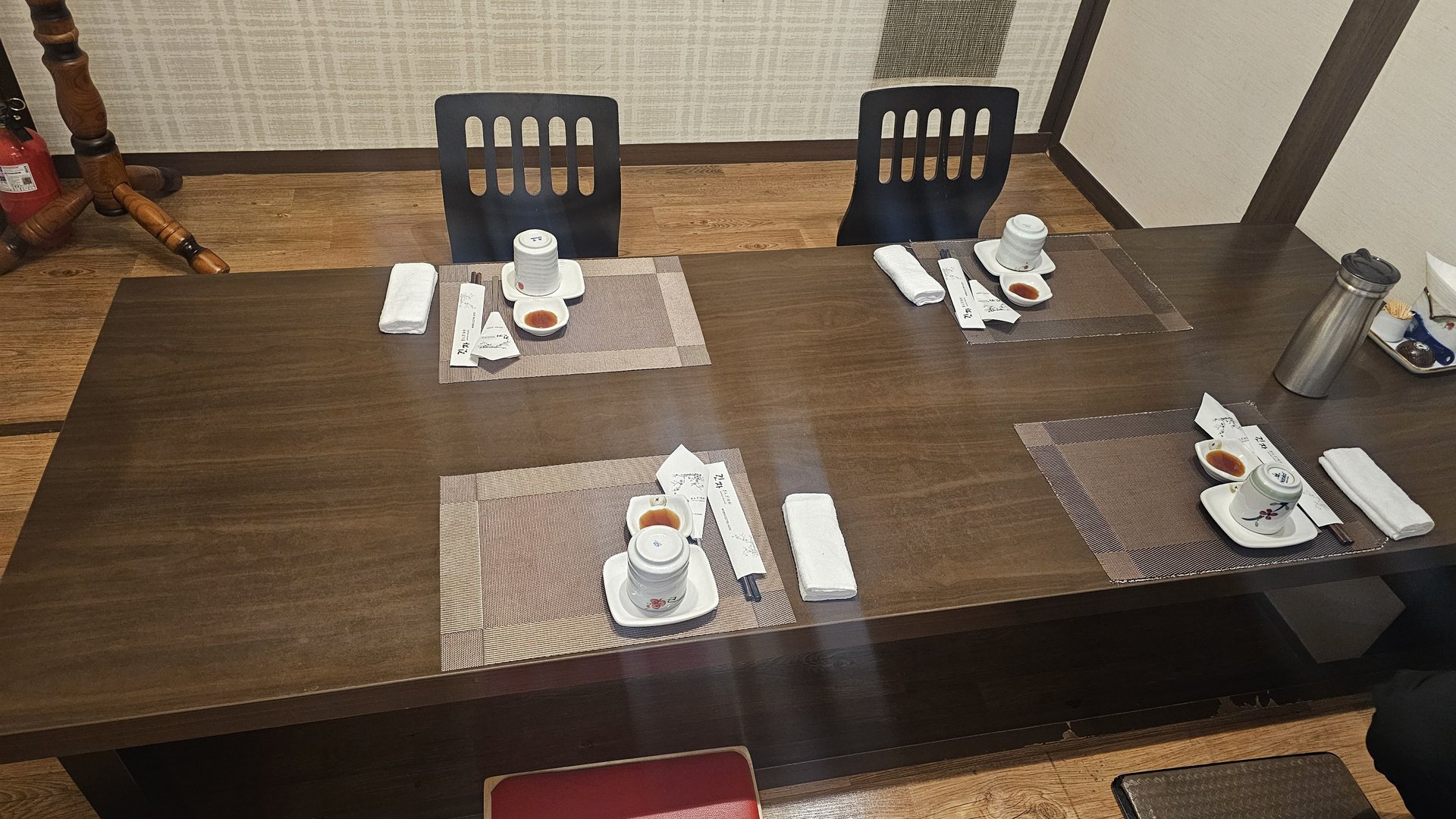
    Seating is arranged for groups. The table setting when we arrived was already fully prepared — tea poured, chopsticks laid out, napkins folded. That level of pre-set service signals what kind of restaurant you’re in before a single dish arrives.

    Four-person table setting at Ginza Yeouido with tea, chopsticks, and folded napkins
    Four-person table setting at Ginza Yeouido with tea, chopsticks, and folded napkins

    Pricing

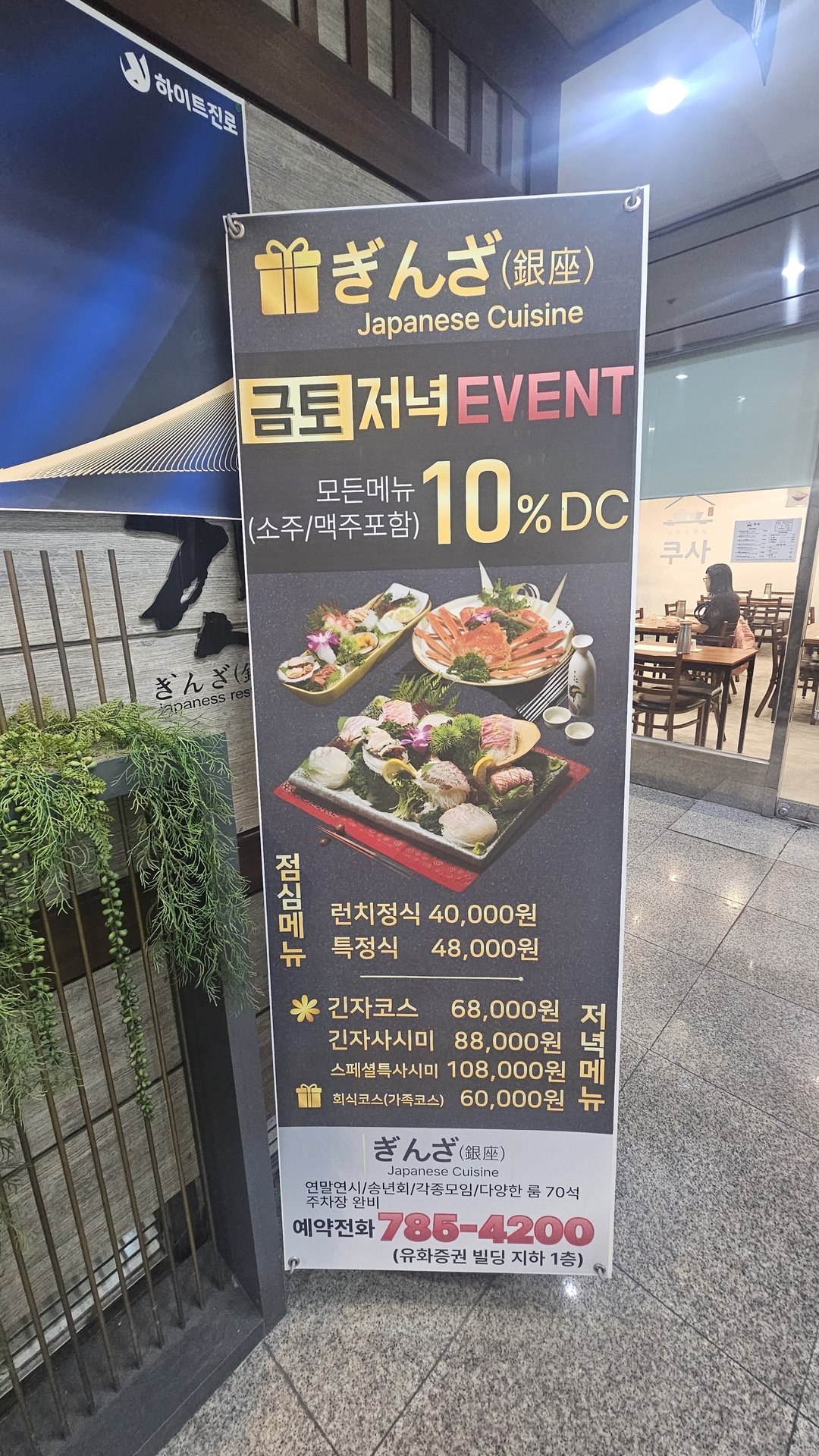
    Ginza Yeouido entrance menu board showing lunch set and Ginza course prices
    Ginza Yeouido entrance menu board showing lunch set and Ginza course prices

    This is where you need to decide before going in:

    런치정식 (Lunch Set): 40,000–48,000 KRW (~$30–36 USD per person)

    긴자코스 (Ginza Course): 68,000–108,000 KRW (~$50–80 USD per person)

    For 4 people on the full Ginza course, budget 272,000–432,000 KRW (~$200–320 USD total) before drinks.

    There’s also a Friday evening discount event — 10% off, which at this price level is actually meaningful.

    Is it expensive? Yes, for Seoul. But not for what you’re getting — a full multi-stage Japanese course that runs 90+ minutes. Comparable quality in Tokyo would cost similar or more.

    The Meal, Course by Course

    The Starters

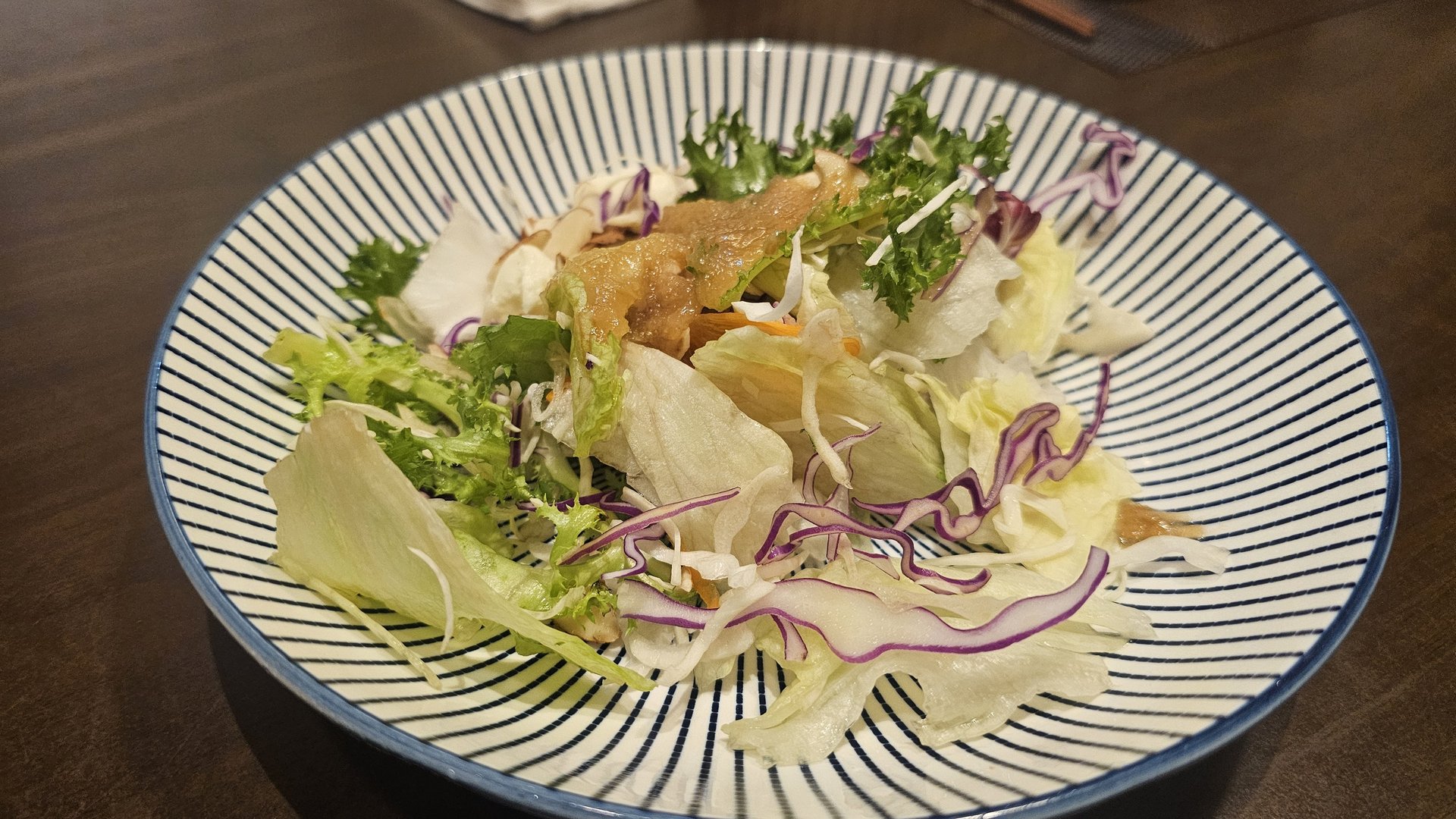
    Mixed green salad with shredded red cabbage and dressing at Ginza Yeouido
    Mixed green salad with shredded red cabbage and dressing at Ginza Yeouido
    Three dipping sauces at Ginza Yeouido including soy vinegar, ponzu, and spicy sauce
    Three dipping sauces at Ginza Yeouido including soy vinegar, ponzu, and spicy sauce
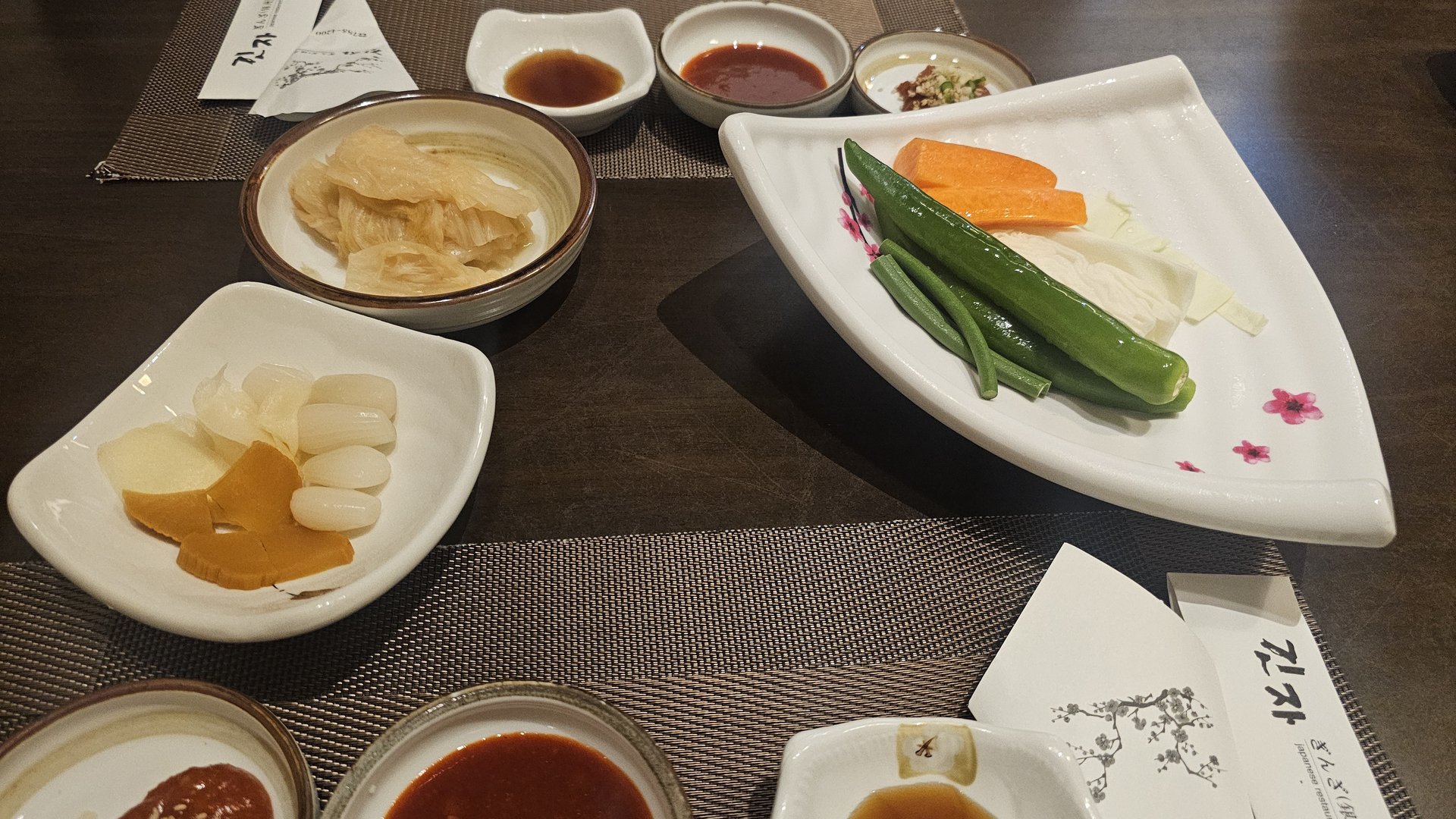
    Appetizer tray with pickled radish, fresh vegetables, and four sauce cups at Ginza Yeouido
    Appetizer tray with pickled radish, fresh vegetables, and four sauce cups at Ginza Yeouido
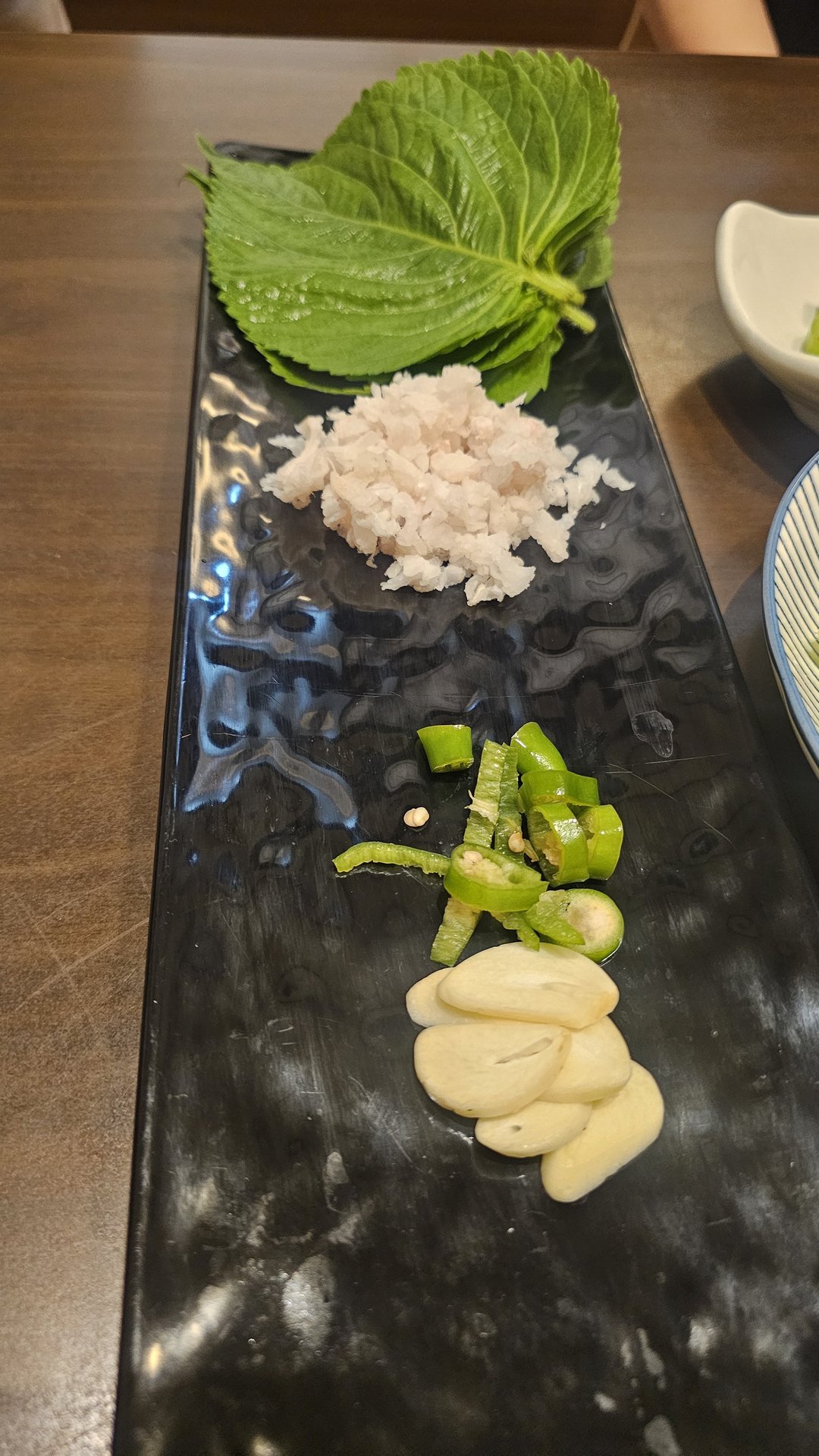
    Ssam wrapping ingredients tray with perilla leaves, salted greens, green chili, and whole garlic at Ginza Yeouido
    Ssam wrapping ingredients tray with perilla leaves, salted greens, green chili, and whole garlic at Ginza Yeouido
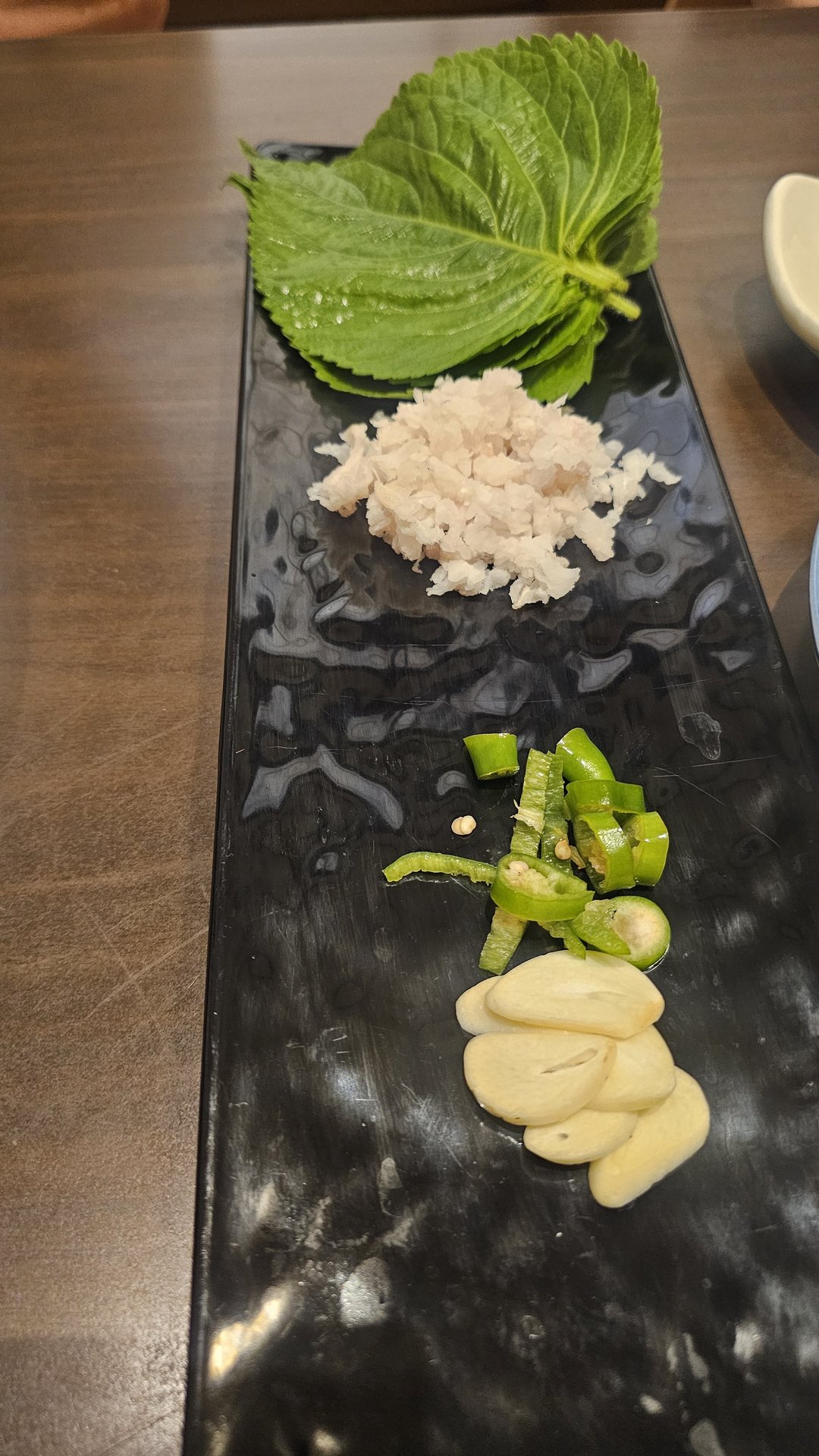
    Ssam wrapping tray with perilla leaves and condiments from alternate angle at Ginza Yeouido
    Ssam wrapping tray with perilla leaves and condiments from alternate angle at Ginza Yeouido

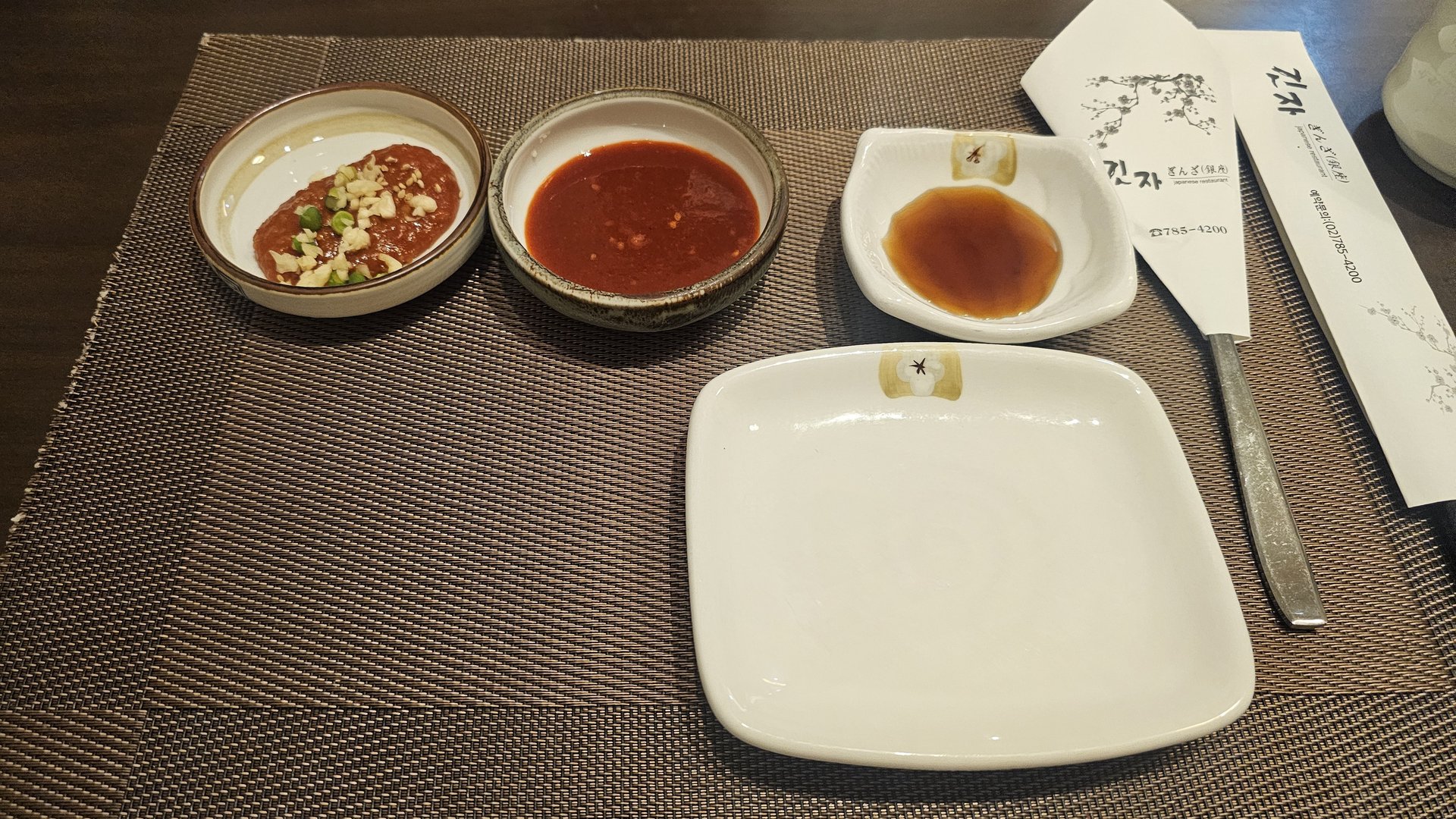
    Courses started with a mixed green salad and a small assortment of pickled radish, fresh vegetables for ssam (wrapping), and multiple dipping sauces — soy vinegar, ponzu, a spicy sauce, and a couple of others.

    Ssam (쌈) is the Korean practice of wrapping bites of meat or fish in leafy greens like perilla leaves. The tray came with perilla, salted greens, sliced green chili, and whole garlic. For the uninitiated: you grab a leaf, place whatever you want inside, add a bit of garlic or chili, fold it up, eat in one bite. You don’t need instructions — it’s intuitive once you see the tray.

    Three dipping sauces alongside: standard setup for Japanese-Korean course dining.

    Sashimi

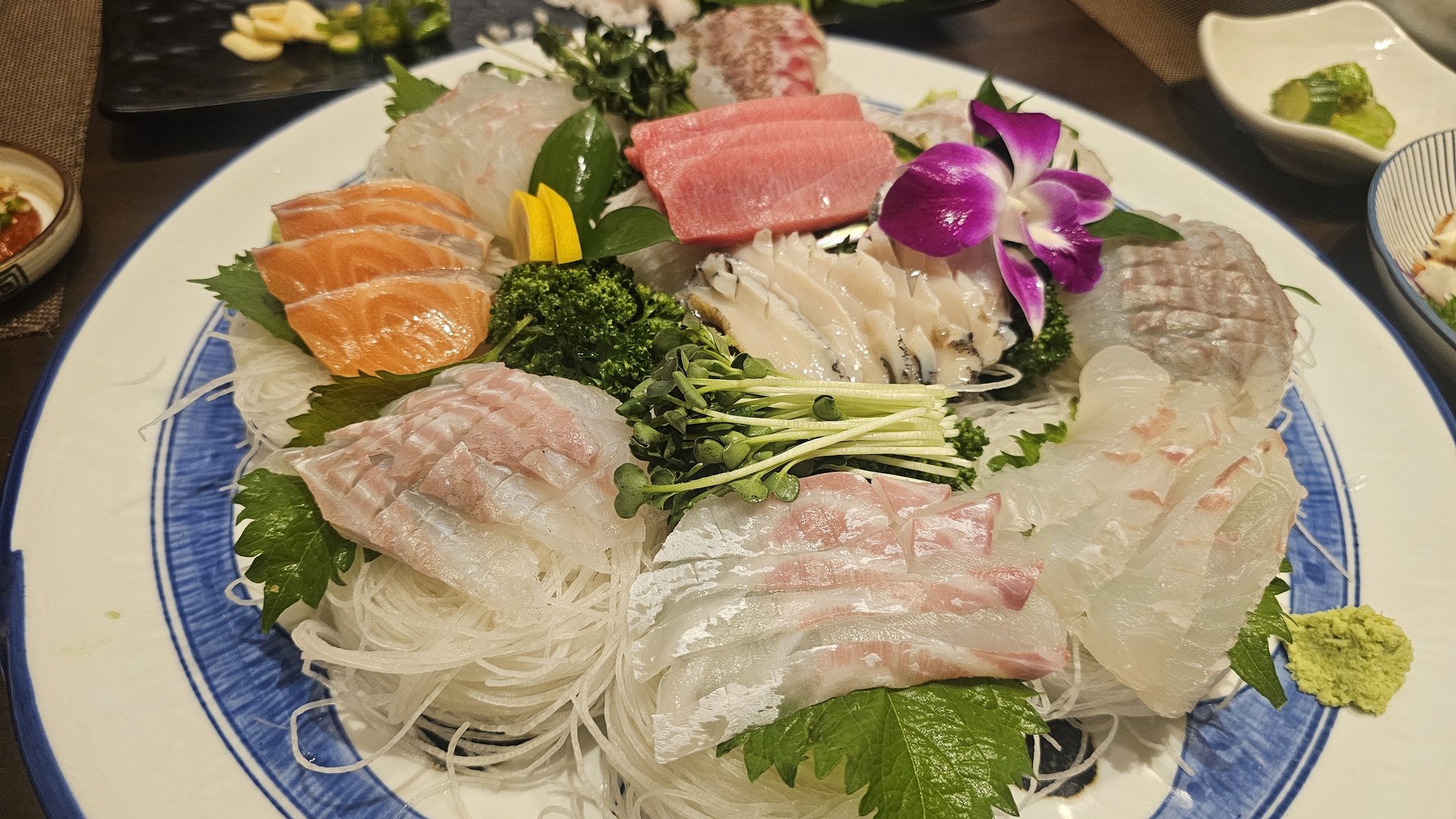
    Assorted sashimi platter with salmon, tuna belly, flounder, and sea bream at Ginza Yeouido
    Assorted sashimi platter with salmon, tuna belly, flounder, and sea bream at Ginza Yeouido

    The sashimi platter was the first real showstopper. Salmon, tuna belly (중뱃살), flounder (광어), sea bream (도미) — a wide range, all sliced thick and arranged properly on a large platter. Not a few thin slices on a corner of a plate. This was a full spread.

    The fish tasted clean. That’s the honest summary. Fresh, properly handled, no off notes. For a 20-year restaurant, you’d expect the fish sourcing to be consistent — and it was.

    Seafood Assortment

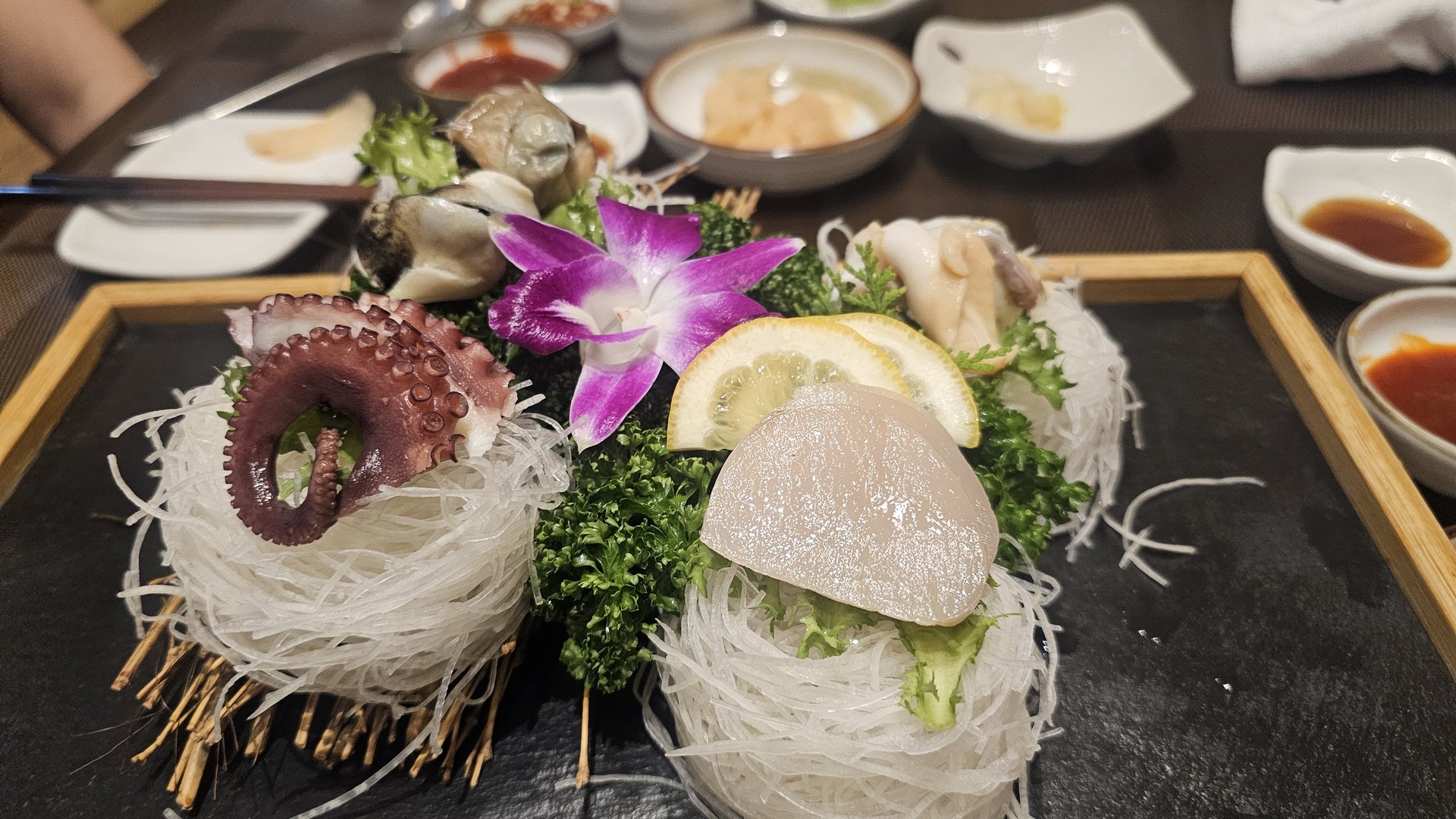
    Seafood assortment of octopus, scallop, and oyster on straw tray with sea urchin garnish at Ginza Yeouido
    Seafood assortment of octopus, scallop, and oyster on straw tray with sea urchin garnish at Ginza Yeouido

    This course included octopus (문어), scallop/gwanja (관자), oyster (굴), and what appeared to be sea urchin (성게) as a garnish on a straw tray. Presentation was genuinely good — the straw tray and careful arrangement made it look more like an omakase counter than a lunch restaurant.

    Octopus was tender, scallop was clean and sweet, oyster was fresh. No complaints on this course.

    Sushi

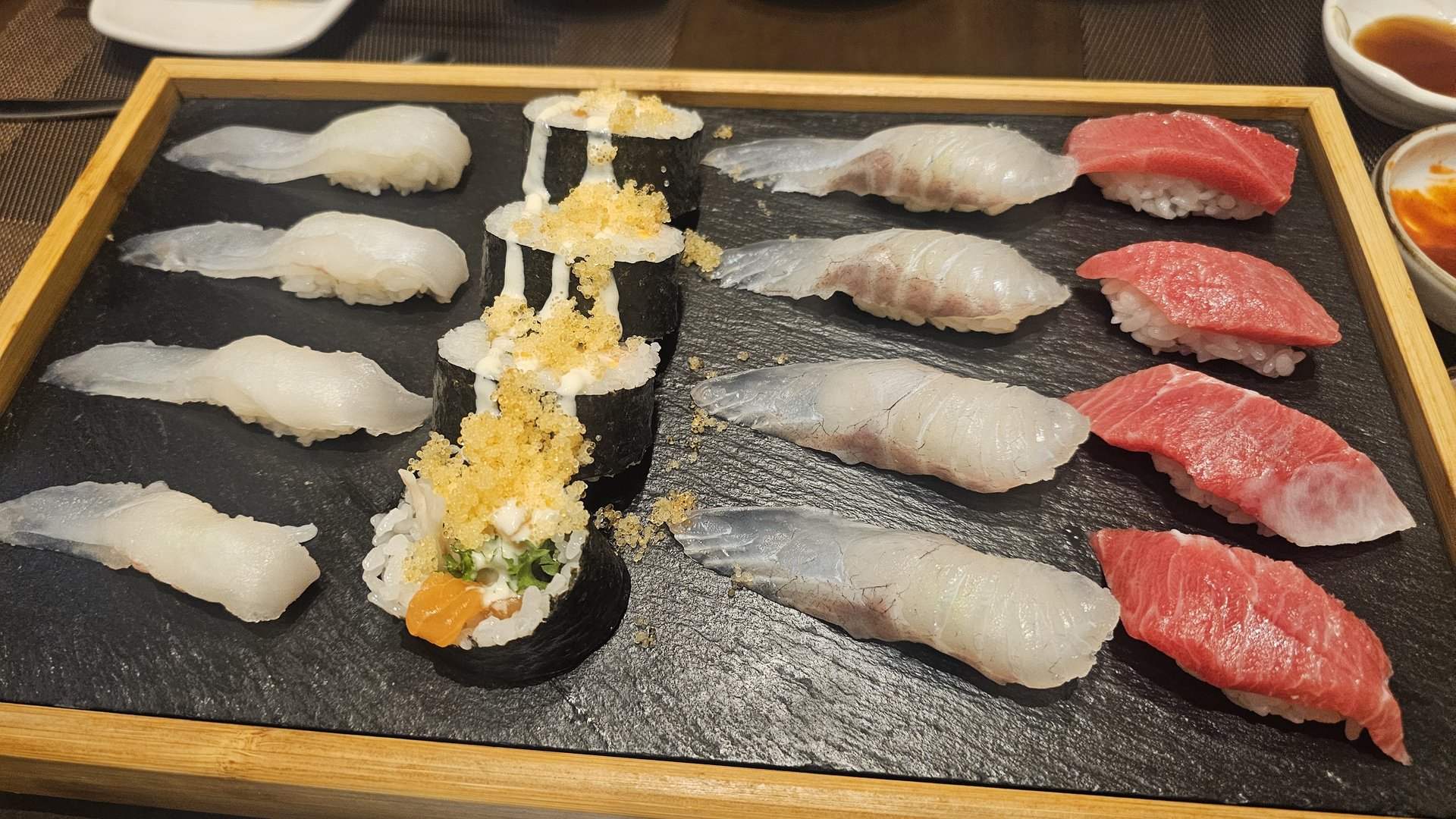
    Assorted sushi on slate board including flounder, otoro tuna, and gunkan rolls at Ginza Yeouido
    Assorted sushi on slate board including flounder, otoro tuna, and gunkan rolls at Ginza Yeouido

    Around 15 pieces of assorted nigiri and gunkan maki served on a slate board: flounder, sea bream, otoro (fatty tuna belly), and a few gunkan-style pieces. The rice was well-seasoned — this is where a lot of Korean Japanese restaurants fall short, but Ginza’s rice temperature and vinegar balance were right.

    Otoro (大トロ) is the fattiest cut of bluefin tuna — melt-on-your-tongue texture, slightly sweet, rich. If you see it on a sushi course in Seoul, it’s a good indicator of the restaurant’s quality ceiling. Theirs was solid.

    Tempura

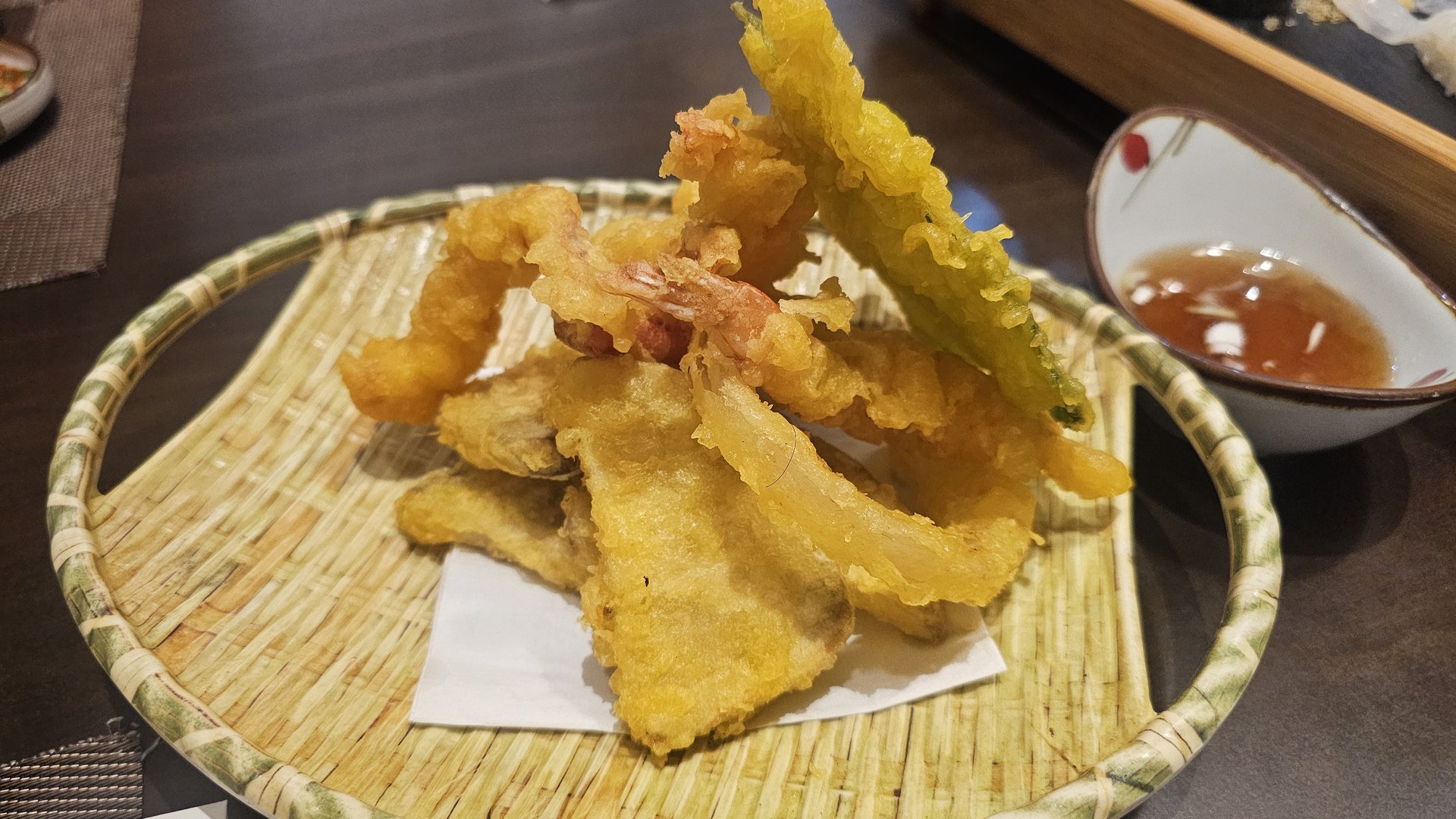
    Tempura assortment of shrimp, fish, and vegetables in bamboo basket with tentsuyu dipping sauce at Ginza Yeouido
    Tempura assortment of shrimp, fish, and vegetables in bamboo basket with tentsuyu dipping sauce at Ginza Yeouido

    Shrimp, fish, and vegetables in a bamboo basket, served with tentsuyu dipping sauce. Batter was light — the right kind of transparent, barely-there crunch. No greasiness. The tentsuyu (天つゆ — a dashi-based dipping broth) was mild and clean.

    Tempura is easy to do poorly. Heavy batter, overcooked shrimp, oil that isn’t hot enough. Ginza’s version had none of those problems.

    Grilled Fish

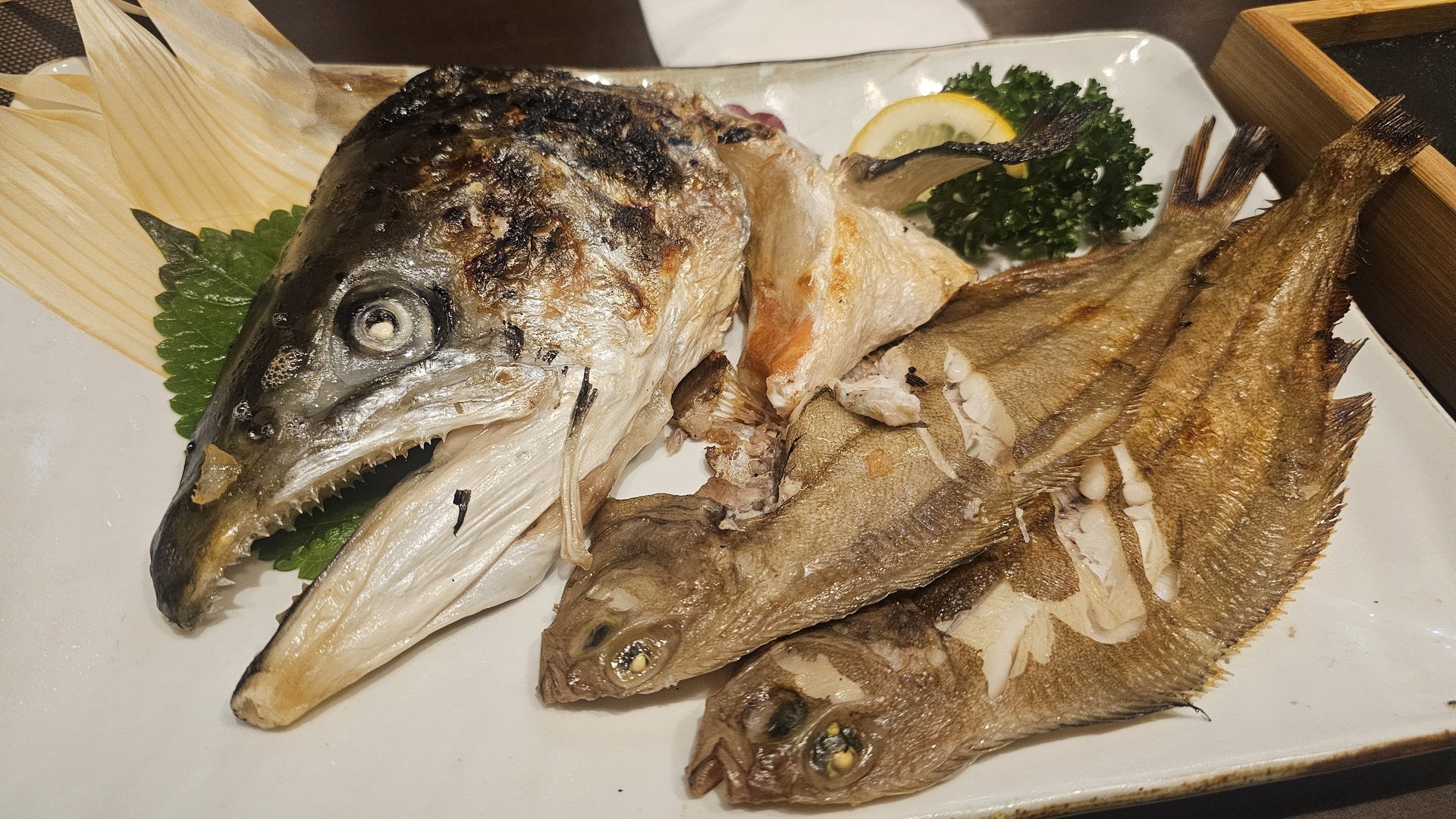
    Grilled fish course with large whole fish head and small grilled fish at Ginza Yeouido
    Grilled fish course with large whole fish head and small grilled fish at Ginza Yeouido

    A large whole fish head plus a couple of smaller whole grilled fish. Visually impressive in the way only a whole grilled fish can be. Skin properly charred, flesh flaky and moist.

    For foreign visitors: eating around a whole fish head is normal at this kind of Korean-Japanese restaurant. Staff can help if you’re not sure how to work through it.

    Noodles and Rice to Finish

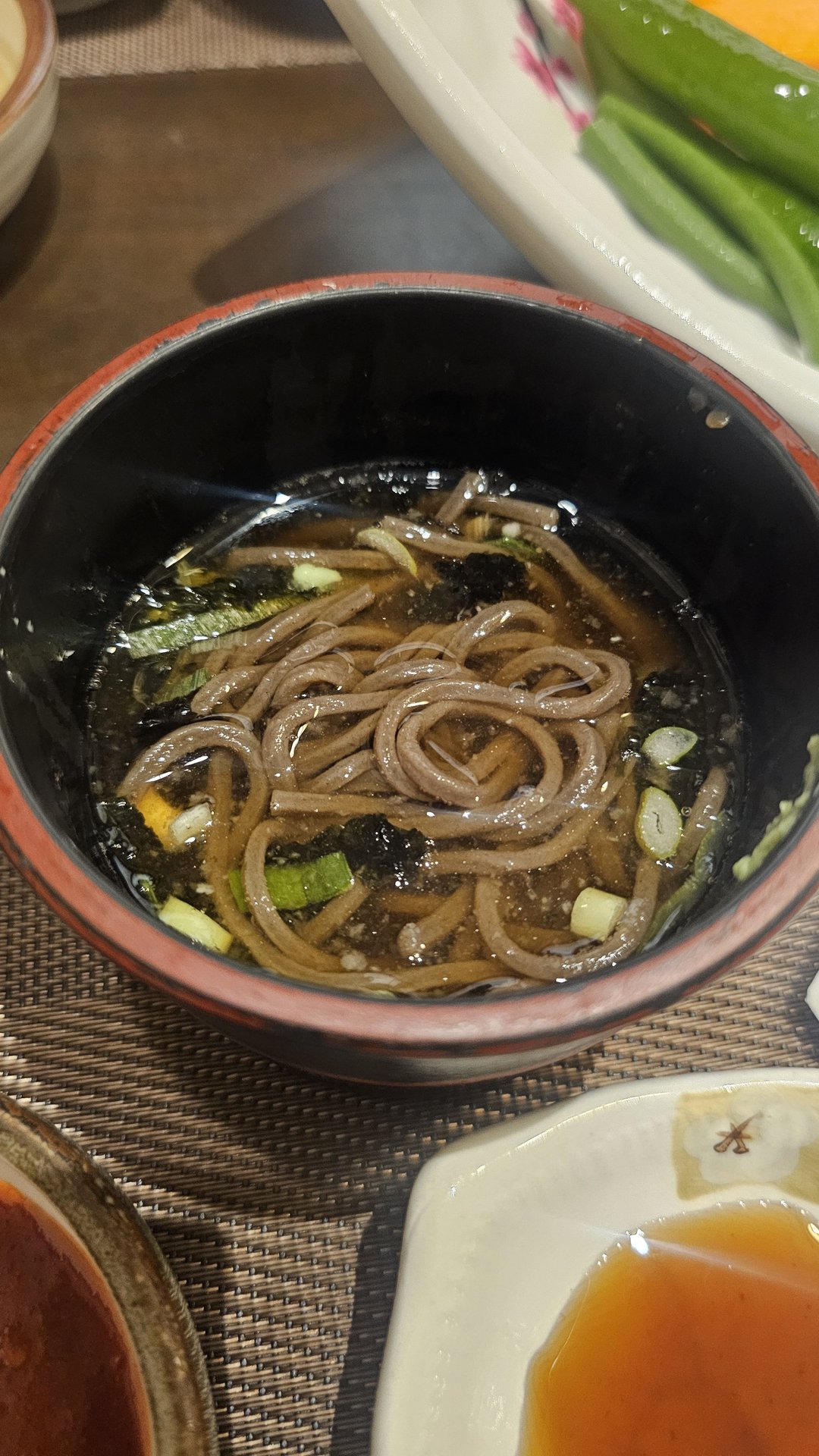
    Hot soba noodles in black lacquer bowl topped with scallions and seaweed at Ginza Yeouido
    Hot soba noodles in black lacquer bowl topped with scallions and seaweed at Ginza Yeouido
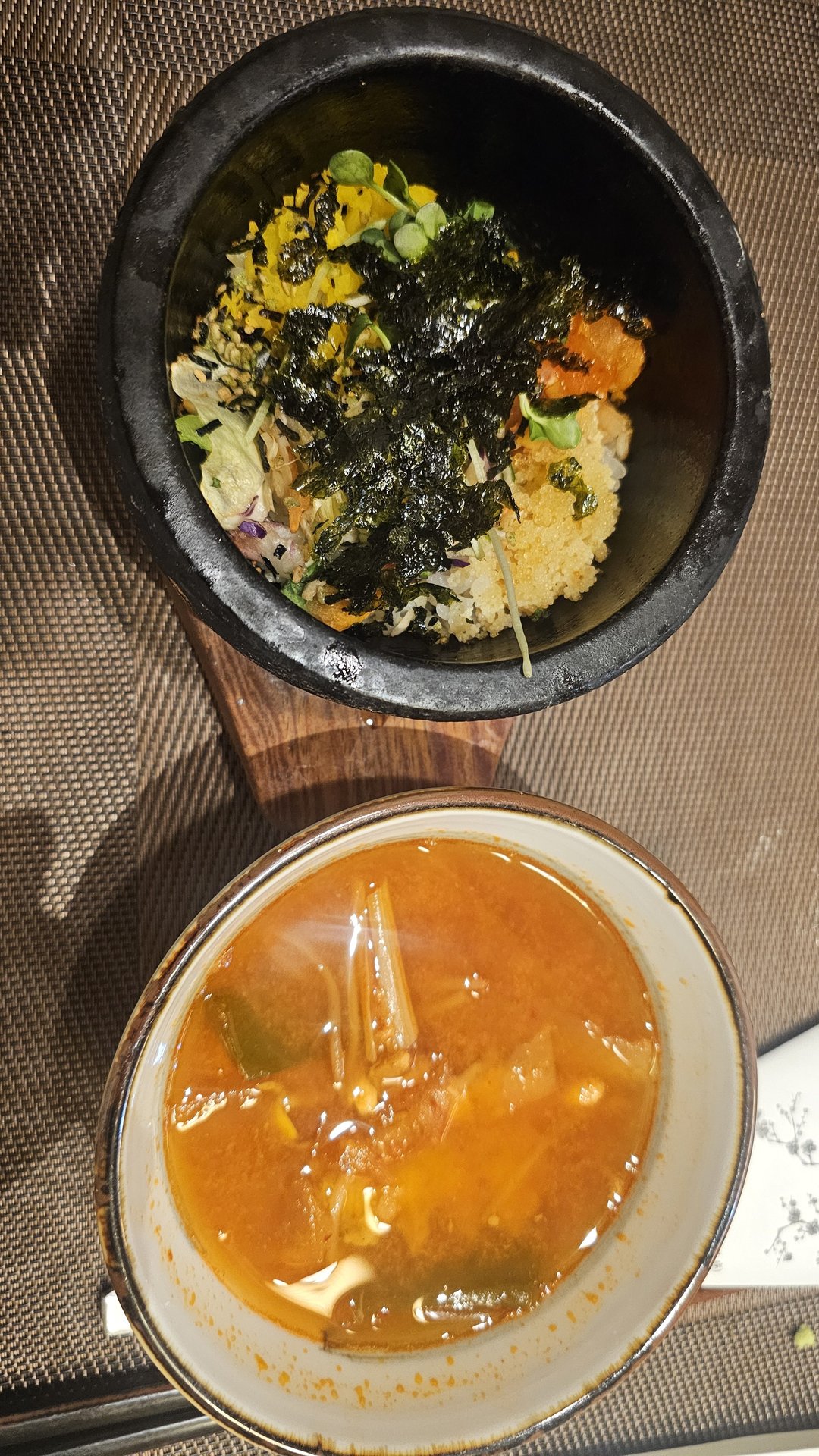
    Stone pot rice and Japanese miso soup finishing course at Ginza Yeouido
    Stone pot rice and Japanese miso soup finishing course at Ginza Yeouido

    Hot soba (温そば — buckwheat noodles in hot dashi broth) with scallions and seaweed, served in a black lacquer bowl. Then stone pot rice (돌솥밥) with Japanese-style miso soup to close the savory courses. The stone pot rice arrived with a slight crunch on the bottom — the scorched rice layer is intentional and considered good by Korean standards.

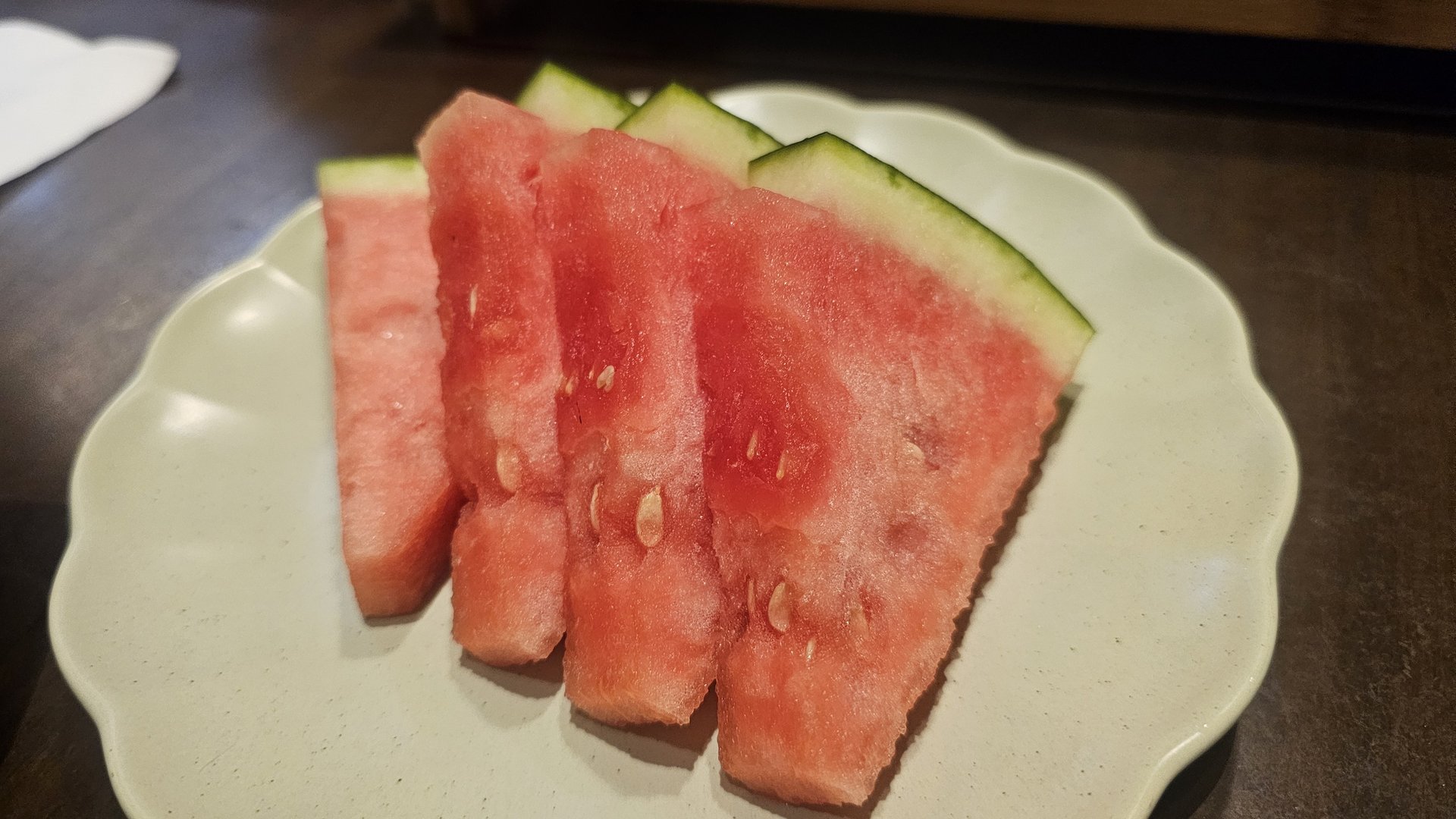
    Dessert watermelon sliced into four triangular pieces on white plate at Ginza Yeouido
    Dessert watermelon sliced into four triangular pieces on white plate at Ginza Yeouido
    Iced barley tea on the rocks next to Ginza Yeouido menu booklet
    Iced barley tea on the rocks next to Ginza Yeouido menu booklet

    Dessert was simple: four triangular slices of watermelon on a white plate. Classic light finish after a long meal. Iced barley tea on the side throughout.

    Stuff Tourists Should Know

    Language: The menu is Korean and Japanese. Don’t expect English menus. That said, the course format means you don’t really need to read anything — you pick a price tier, and the kitchen handles the rest. Pointing works.

    Payment: Card payment should be fine at a restaurant at this level. Foreign cards (Visa/Mastercard) are widely accepted in Seoul. Worth confirming at the door.
    Tipping: No tipping in Korea. Don’t tip.

    Dietary restrictions: This is a seafood-heavy Japanese course. Not suitable for vegetarians, vegans, shellfish allergies, or halal requirements. The course structure makes substitutions difficult.

    Groups: Tables are set up for groups of 4+. Solo dining would feel odd here. This is a group meal format.

    Reservation: Strongly recommended, especially at lunch. Yeouido business crowd fills up popular spots.

    Dress code: No strict policy, but the vibe is business casual. You’ll see suits and smart casual. Beach shorts would be out of place.

    The Verdict

    Should you go?

    Depends on what you’re doing in Seoul.

    Business meal or formal occasion in Yeouido — yes, this is the answer. Reliable, quiet, handles the pacing for you.
    Budget is real money to you — the lunch set (40,000–48,000 KRW / ~$30–36 USD) is the smarter entry point. Full Ginza course adds up fast for 4 people.

    You have 5 days in Seoul and want to try everything Korean — probably skip. Spend that money on Korean BBQ, raw crab, or a proper Korean hanjeonsik course. Come back to Japanese cuisine on a longer trip.

    You’ve visited Japan and want to compare — interesting to see the Seoul interpretation. Ginza serves a Korean-inflected Japanese course. The ssam tray and some of the sauce pairings are distinctly Korean. Not pure Japanese omakase, and not trying to be.

    The food was clean. That’s the honest take. Everything was properly cooked, well-presented, and tasted like what it was supposed to taste like. For a 20-year-old restaurant hitting its anniversary, that consistency is the whole point.

    Four of us left satisfied. Nobody had complaints. Nobody had a revelation either. Clean, solid, expensive. Worth it if you’re already in Yeouido and looking for a proper sit-down meal.

    FAQ

    How much does a meal at Ginza Yeouido cost per person?

    Lunch sets run 40,000–48,000 KRW (~$30–36 USD). The full Ginza course goes 68,000–108,000 KRW (~$50–80 USD) per person depending on the tier you choose.

    Do I need a reservation at Ginza Yeouido?

    Strongly recommended, especially for groups of 4 or more. This is a popular business-lunch spot in Seoul’s financial district — walk-ins are hit or miss. Check their official channels or call ahead.

    Is there an English menu at Ginza Yeouido?

    It’s a Korean-run Japanese restaurant, so the menu is primarily in Korean and Japanese. Staff can assist with orders, but don’t expect full English service. Pointing at the course price tiers on the entrance board gets you far.

    What’s included in the Ginza course menu?

    A typical Ginza course runs through multiple stages — sashimi platter, assorted seafood (octopus, scallop, oyster), sushi, tempura, grilled fish, soba, stone pot rice with miso soup, and a light dessert like watermelon. It’s a full meal.

    Is Ginza Yeouido good for a business lunch in Seoul?

    Yes, this is exactly the kind of place Seoul’s financial district crowd uses for client lunches. Private or semi-private table settings, formal Japanese service, and a course format that takes care of the conversation pacing for you.

    Does Ginza Yeouido have any discounts or promotions?

    At time of visit, they had a Friday evening event offering 10% off. Worth checking their current promotions before you go, especially if visiting on a weekday evening.

    You might also like

    📍 Location

    Open in Google Maps →

  • Keep That Coffee in Yeouido: Honest Cafe Review (Seoul)

    Keep That Coffee in Yeouido: Honest Cafe Review (Seoul)

    Quick honest review of Keep That Coffee House in Yeouido. I’m a regular here, so take this as a long-term opinion, not a one-time visit verdict. Short version: one of the better specialty coffee spots in Seoul’s financial district. Come early. Skip the lunch hour if you value your peace.

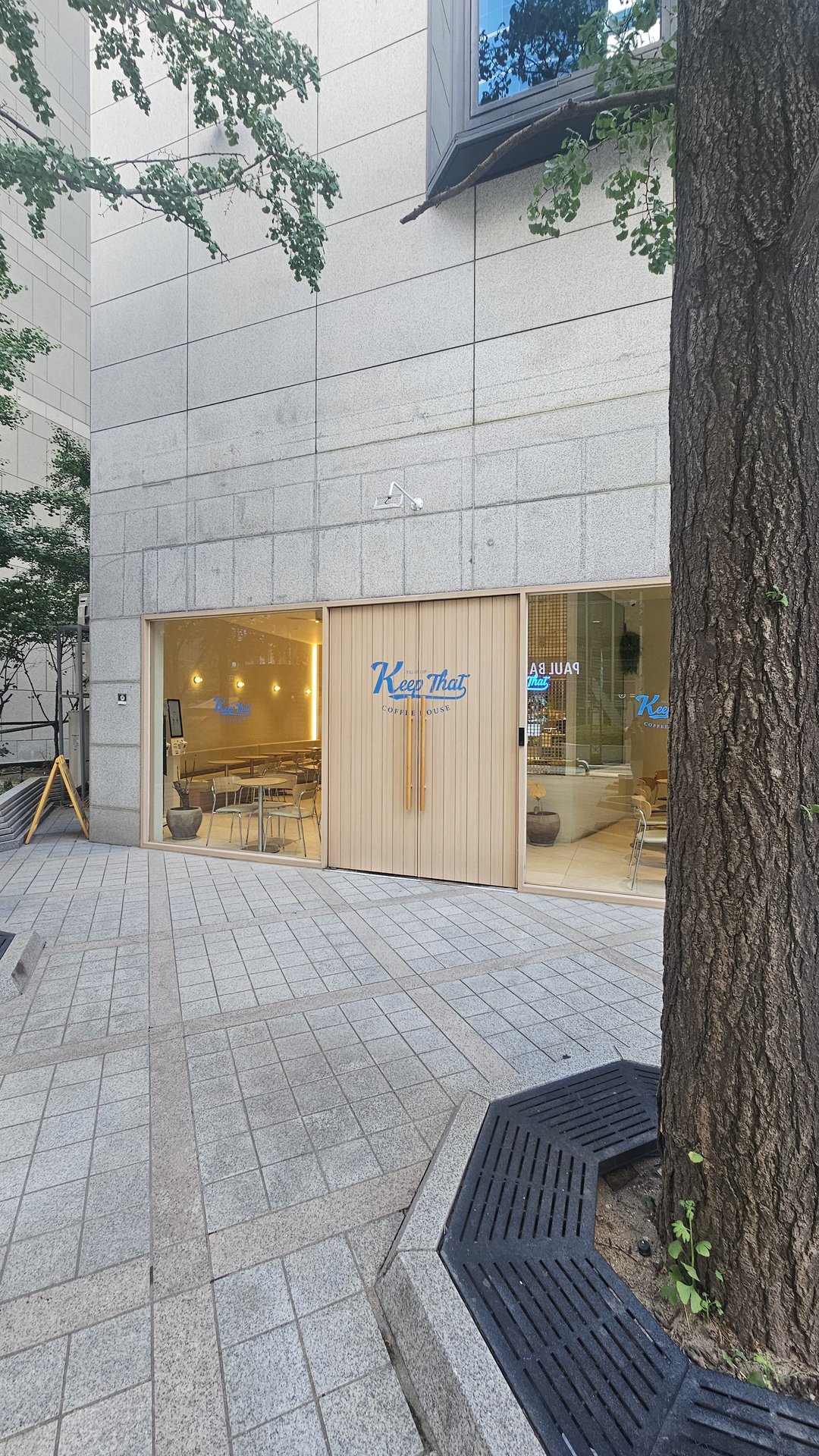
    Keep That Coffee House Yeouido exterior with floor-to-ceiling glass facade and street trees
    Keep That Coffee House Yeouido exterior with floor-to-ceiling glass facade and street trees

    What Is Keep That Coffee House?

    Keep That (킵댓) is a specialty coffee cafe in Yeouido — Seoul’s version of a financial district, think something like Canary Wharf in London or the FiDi in New York. Office towers, wide streets, the National Assembly building nearby. Not the most touristy part of Seoul, but if you’re visiting Yeouido Hangang Park or just passing through, this is one of the better coffee stops in the area.

    It’s not a chain. The branding is clean and deliberate — logo paper cups, neon sign, wood-tone interior. The kind of place that takes coffee seriously without being pretentious about it.

    Getting There

    Yeouido station (Line 5, Line 9) or National Assembly station (Line 9) — about a 5–10 minute walk depending on which exit.

    From Myeongdong or Hongdae? About 20–30 minutes on the subway. It’s not in the tourist core of Seoul, so unless you’re doing Yeouido specifically, don’t make a special trip just for coffee. But if you’re already here, yes, absolutely stop in.

    From Incheon Airport: roughly 50–60 minutes by AREX + subway.

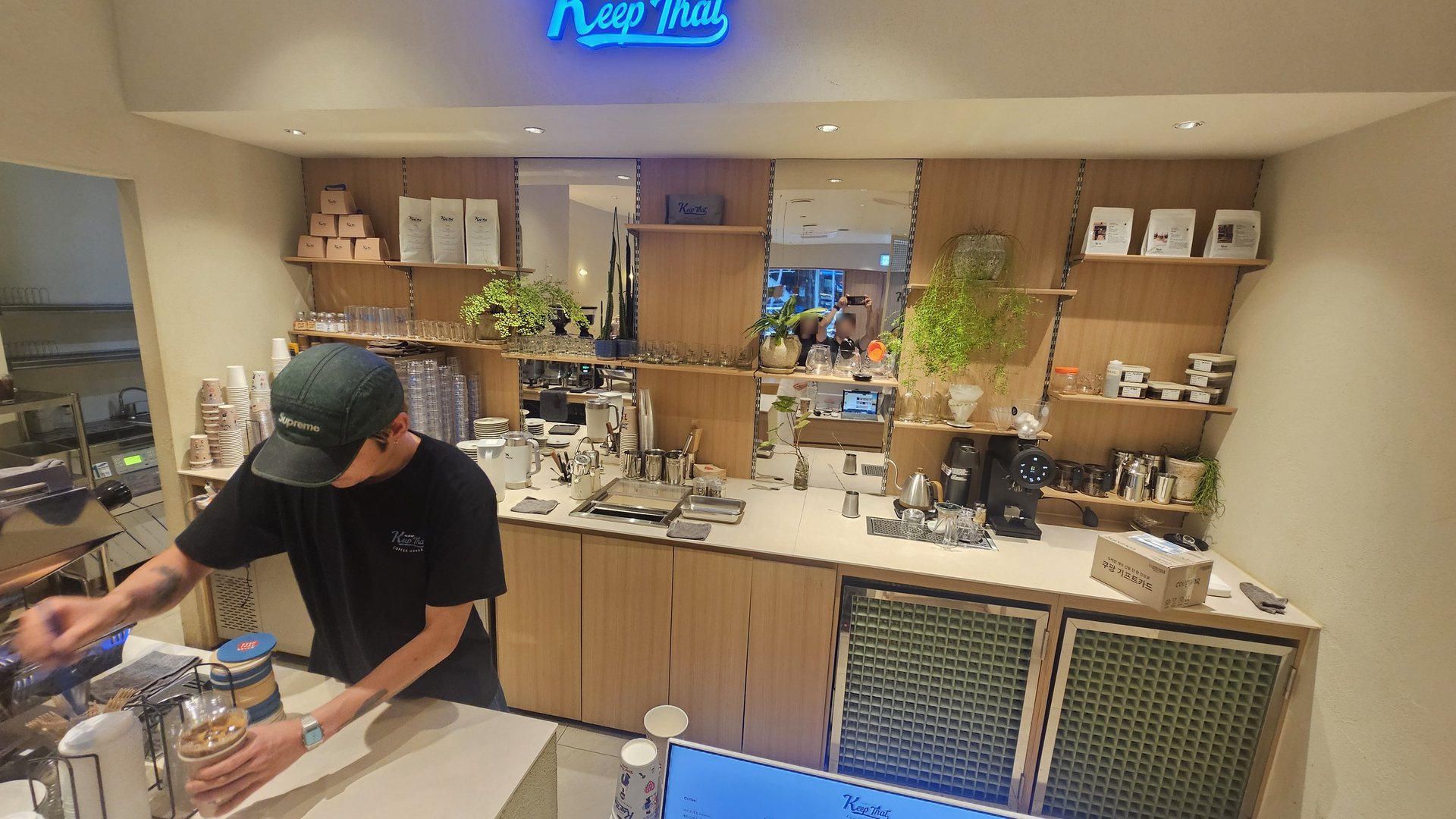
    Barista preparing drinks at the bar counter with wood-tone interior and neon Keep That logo sign
    Barista preparing drinks at the bar counter with wood-tone interior and neon Keep That logo sign

    The Interior

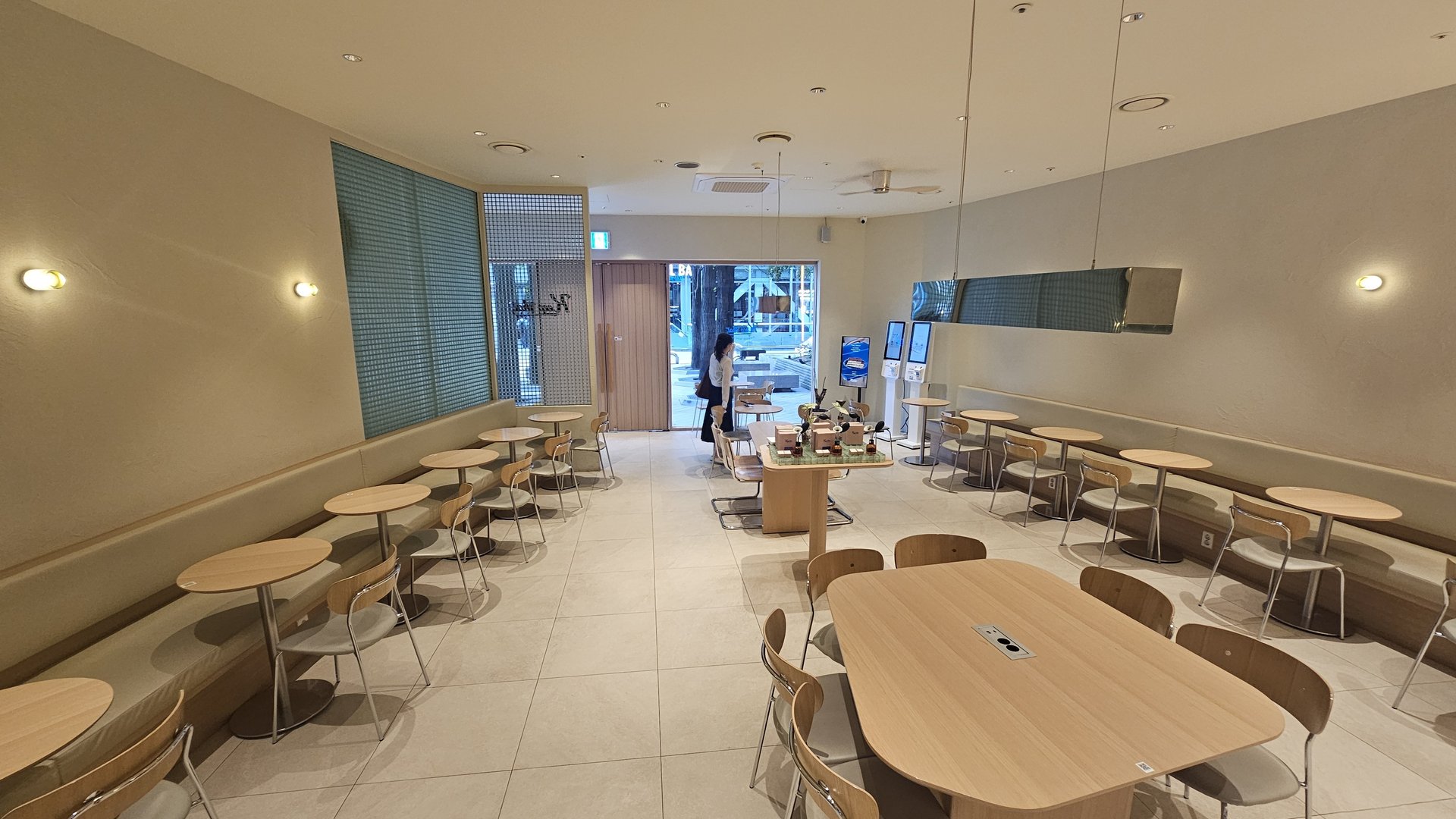
    Modern minimal. Wood tones everywhere — tables, counters, shelving. The neon Keep That logo on the wall is a good photo backdrop if you’re into that. Large floor-to-ceiling glass windows at the front let in natural light.

    Spacious and clean interior of Keep That Coffee Yeouido with round and oval wooden tables arranged in rows
    Spacious and clean interior of Keep That Coffee Yeouido with round and oval wooden tables arranged in rows

    The seating area is actually spacious for Seoul standards. Round and oval wooden tables spread across the floor — decent group seating, good for solo work too. When I visited early morning, the place was mostly empty and genuinely pleasant to sit in.

    Lunch is a different story. Yeouido office workers flood in around noon and it gets loud. Not unpleasant if you’re grabbing and going, but if you want to sit and drink quietly, the vibe completely changes.

    What I Ordered

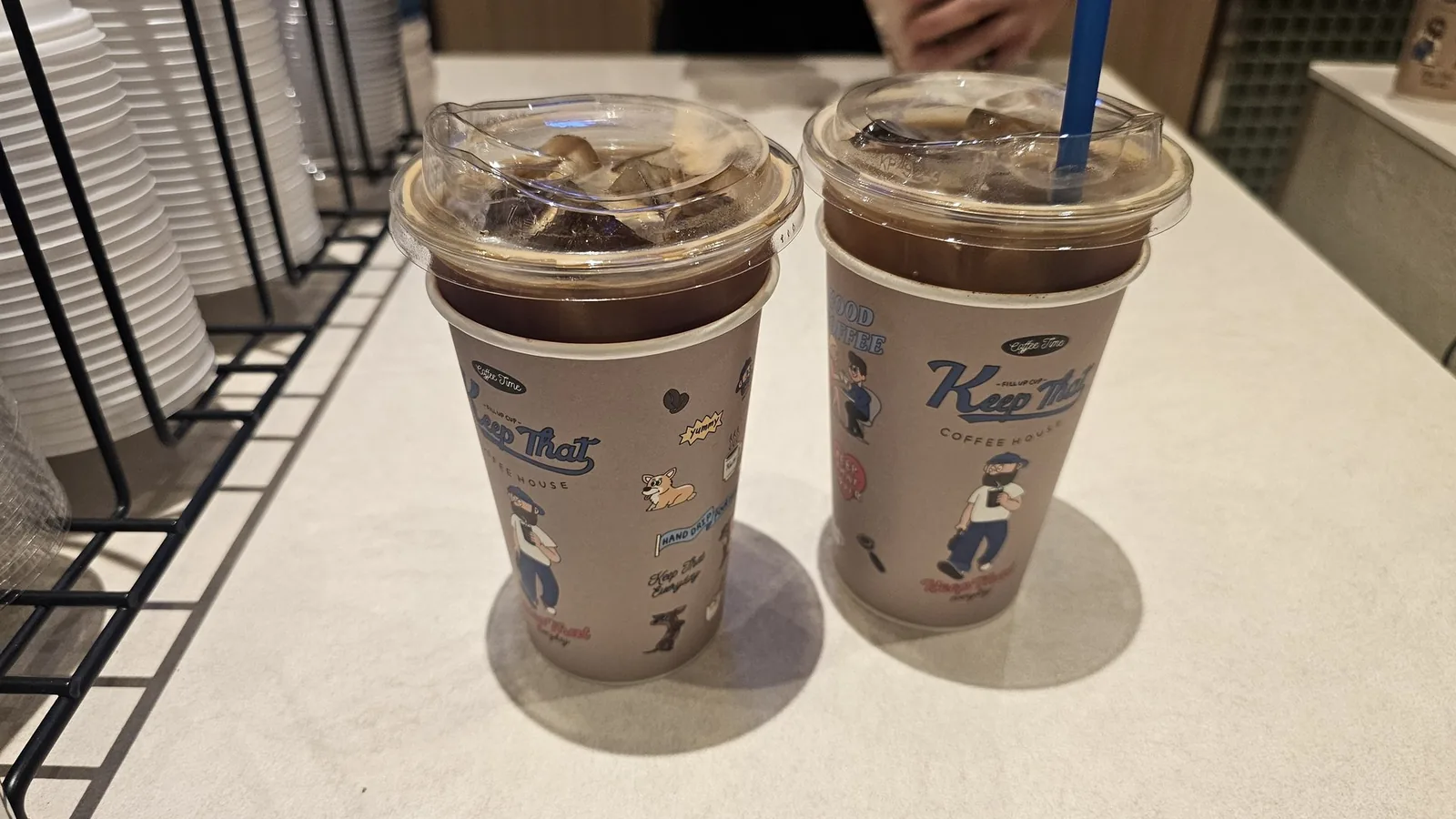
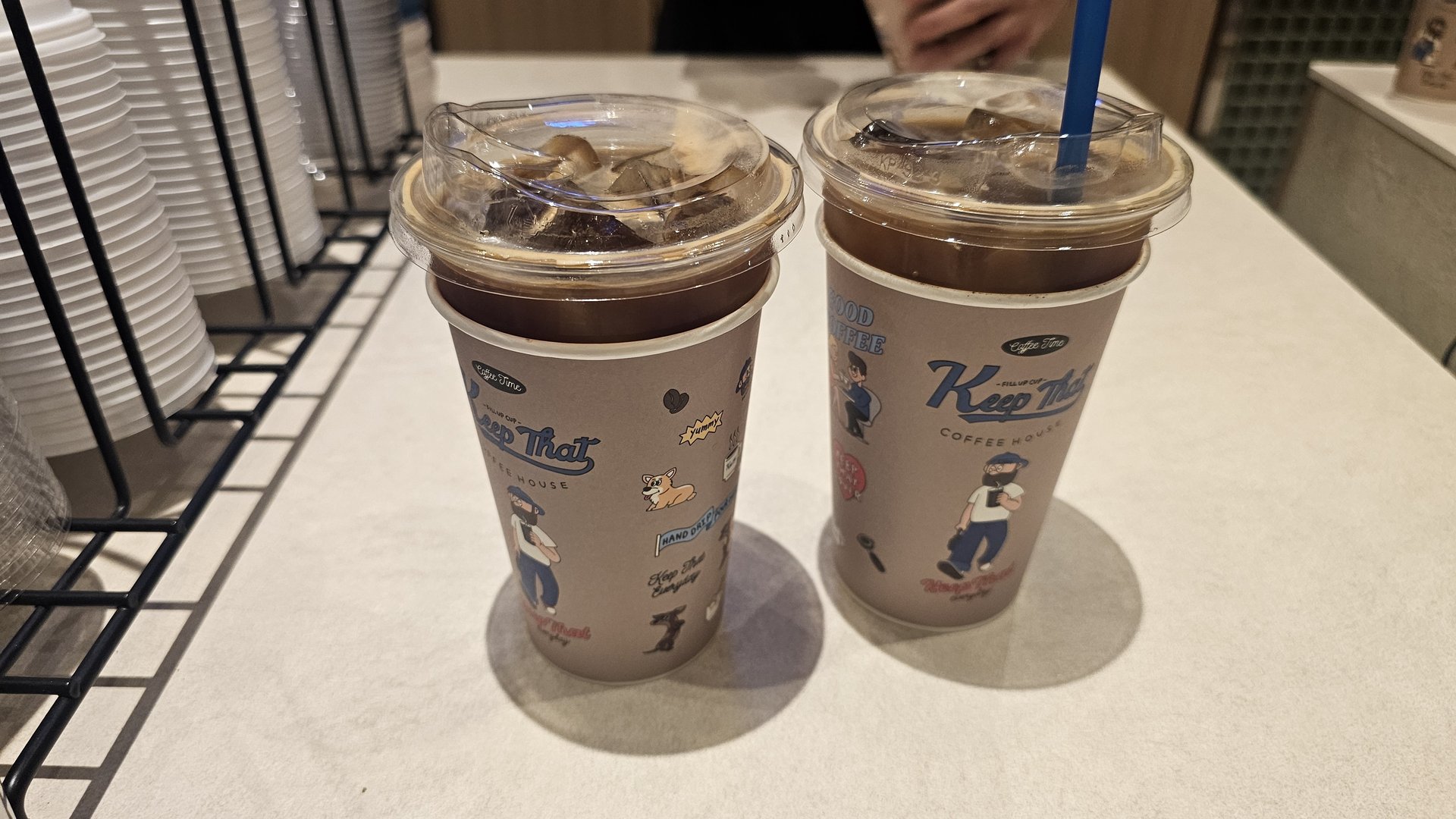
    Two iced Americanos in Keep That Coffee House logo paper cups lined up on the counter
    Two iced Americanos in Keep That Coffee House logo paper cups lined up on the counter

    Two iced Americanos. That’s it.

    Look, sometimes you just want a clean cup of coffee. This delivers. The taste is crisp — not acidic, not bitter, not watery. You can tell the beans aren’t supermarket grade. It’s the kind of Americano you come back to, which is exactly what I do. I’m a regular.

    It’s not going to blow your mind if you’ve been to Tokyo’s specialty coffee scene or Melbourne’s cafe culture. But for Yeouido, for a quick morning coffee before doing whatever you’re doing in this part of Seoul? It’s genuinely good.

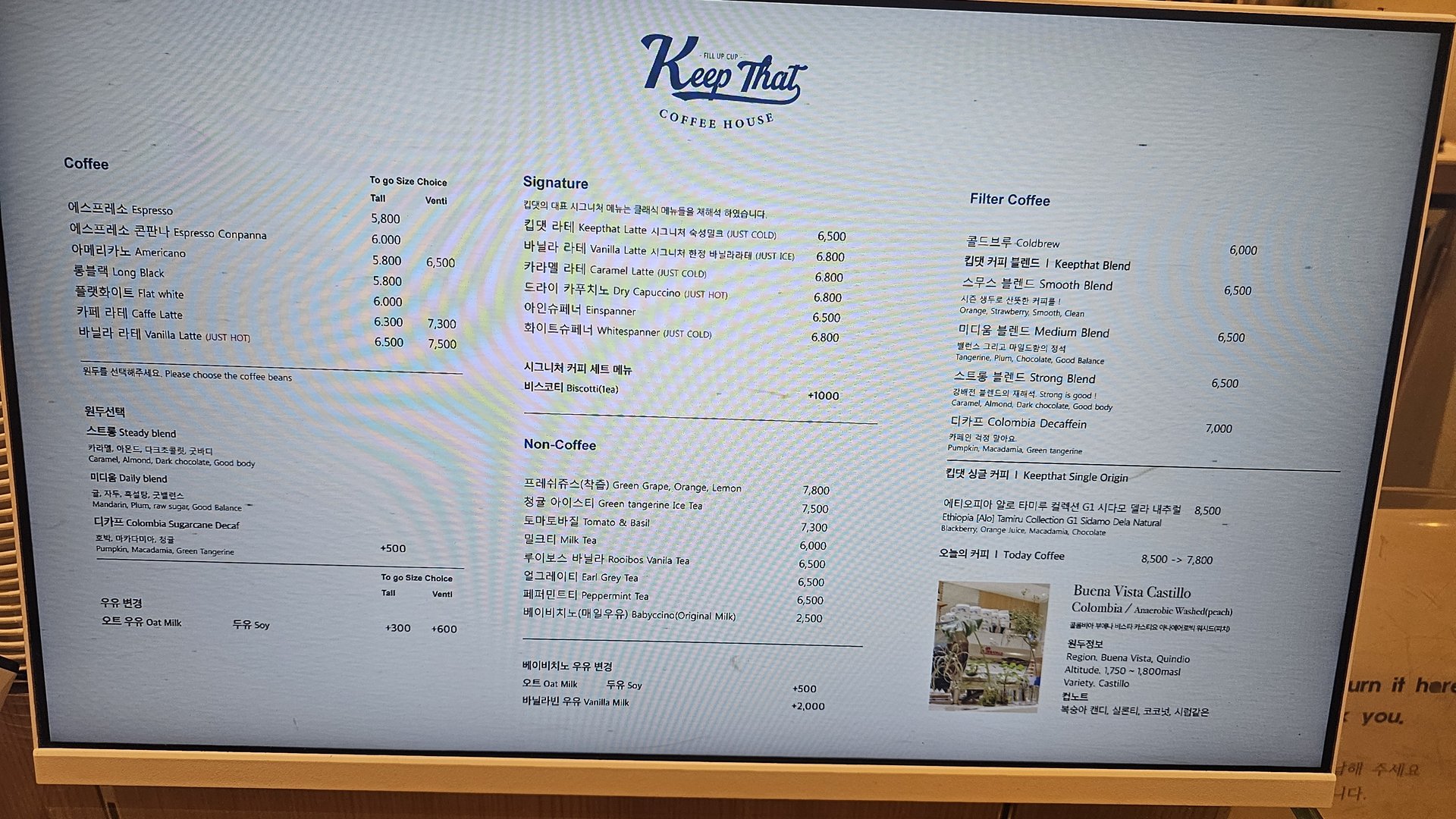
    Keep That Coffee House full menu board showing coffee, signature, non-coffee, and filter coffee with prices
    Keep That Coffee House full menu board showing coffee, signature, non-coffee, and filter coffee with prices

    The menu has more than just Americanos — signature drinks, non-coffee options, filter coffee. Prices are reasonable for the specialty coffee tier in Seoul, generally 4,500–6,000 KRW (~$3.30–$4.50 USD) range for espresso drinks.

    Stuff Tourists Should Know

    Language: Basic English is fine for ordering. The menu board is visible and self-explanatory. You can point if needed. No stress.

    Payment: Card works. Foreign cards should be fine — most Seoul cafes handle international Visa/Mastercard without issues. There’s no tipping culture in Korea, so don’t worry about that.

    Timing: Early morning is the move. The place is calm, the coffee is fresh, and you get to actually enjoy the nice interior. Lunch rush (roughly 12–1:30 PM on weekdays) is hectic. If you’re in Yeouido at that time and need coffee, fine — just grab and go rather than expecting a relaxed sit-down.

    Nearby: Yeouido Hangang Park is a short walk away. If you’re doing the park in the morning, this is a natural coffee stop before or after. The National Assembly building is also close if you’re doing a Seoul architecture/landmark tour.

    Takeaway vs. Dine-in: Both work. The paper cups with the Keep That logo are clean and well-made — takeaway is fine if you’re heading to the park.

    The Verdict

    Should you go?

    – If you’re in Yeouido for any reason — yes. One of the better coffee options in the area.

    – If you’re doing a Seoul cafe crawl specifically — probably not worth the detour from Hongdae, Ikseon, or Seongsu where the cafe density is higher.

    – Morning visit? Do it. Lunch hour? Grab and go, don’t linger.

    It’s a solid regular spot. I keep coming back, which says more than any review.

    FAQ

    What is Keep That Coffee House in Yeouido?

    It’s a specialty coffee cafe in Seoul’s Yeouido financial district, known for its clean minimal interior and well-made espresso drinks. Popular with office workers.

    Is Keep That Coffee good for tourists?

    Yes — it’s easy to order (menu board is visible, basic English works fine), and the area is near Yeouido Hangang Park if you’re already in the neighborhood.

    How crowded does it get?

    Early morning is calm and relaxed. Weekday lunch hours (12–1:30 PM) get packed and noisy with office workers. If you want a quiet coffee, come before 10 AM.

    How much does coffee cost at Keep That Coffee Yeouido?

    Expect around 4,500–6,000 KRW (~$3.30–$4.50 USD) for espresso-based drinks. Filter coffee and signature drinks may run a bit higher. Check their Instagram for the current menu.

    Where is Keep That Coffee in Yeouido and how do I get there?

    It’s in Yeouido, Seoul’s financial district. The nearest subway stations are Yeouido (Line 5 and 9) or National Assembly (Line 9). A 5–10 minute walk from either exit.

    Do they have non-coffee options?

    Yes — the menu includes non-coffee drinks alongside their espresso and filter coffee lineup.

    You might also like

    📍 Location

    Open in Google Maps →

  • Jingawa Yeouido: Honest Review of Japanese Set Lunch in Seoul

    Jingawa Yeouido: Honest Review of Japanese Set Lunch in Seoul

    Quick honest review of Jingawa (진가와) in Yeouido — a Japanese teishoku restaurant doing cold soba and warm udon sets. This is one of those places you keep coming back to when you want a clean, no-fuss lunch. Short version: the chadol miso udon is the dish to order, the full set format is genuinely good value, and the interior is nicer than most Yeouido spots. Not cheap at ~26,500 KRW (~$19.60) per person, but this is Yeouido — you’re not hunting for budget kimbap here.

    Visited on a Monday morning, right at 11 AM opening. The hall was nearly empty. Good time to go.

    What Is Teishoku? (The Format, Explained)

    If you’re not familiar with teishoku (定食) — it’s the Japanese concept of a complete set meal. You pick one main dish and everything else comes with it: sides, soup, small accompaniments. No need to order separately. One item on the menu, full meal on the table.

    At Jingawa, that means: your noodle bowl (hot udon or cold soba/somen) + a tempura plate with shrimp and vegetable tempura + two pieces of nigiri sushi + pickled radish and small condiment sides. It all arrives together.

    The Korean word for this format is 정식 (jeongshik) — you’ll see it on menus all over Korea. Jingawa does a Japanese-leaning take on it, with the noodle bowl as the centrepiece.

    About Jingawa

    Jingawa is a noodle teishoku restaurant in Yeouido — Seoul’s financial district, similar to Canary Wharf or Wall Street. The clientele is mostly office workers and business lunch crowds from nearby towers. The restaurant opens at 11 AM, which is noticeably earlier than most Seoul restaurants (most open at 11:30 or noon).

    Menu focus: cold noodles (soba and somen variations) and warm udon, each served as a full set. Prices run 25,000–31,000 KRW (~$18.52–$22.96 USD). This isn’t a cheap lunch stop, but everything is included in that price.

    Getting There

    Yeouido is one of the easier parts of Seoul to reach by subway:

    Line 5: Yeouido Station (여의도역) — Exit 1 or 2

    Line 9: National Assembly Station (국회의사당역)

    From Incheon Airport (ICN): About 60–70 minutes via Airport Railroad + Line 9, or roughly 40–50 minutes by taxi (expect 45,000–60,000 KRW / ~$33–$44)

    If you’re already in Yeouido for IFC Mall, the 63 Building, or Hangang Park — Jingawa is easy to fold in for lunch.

    The Interior

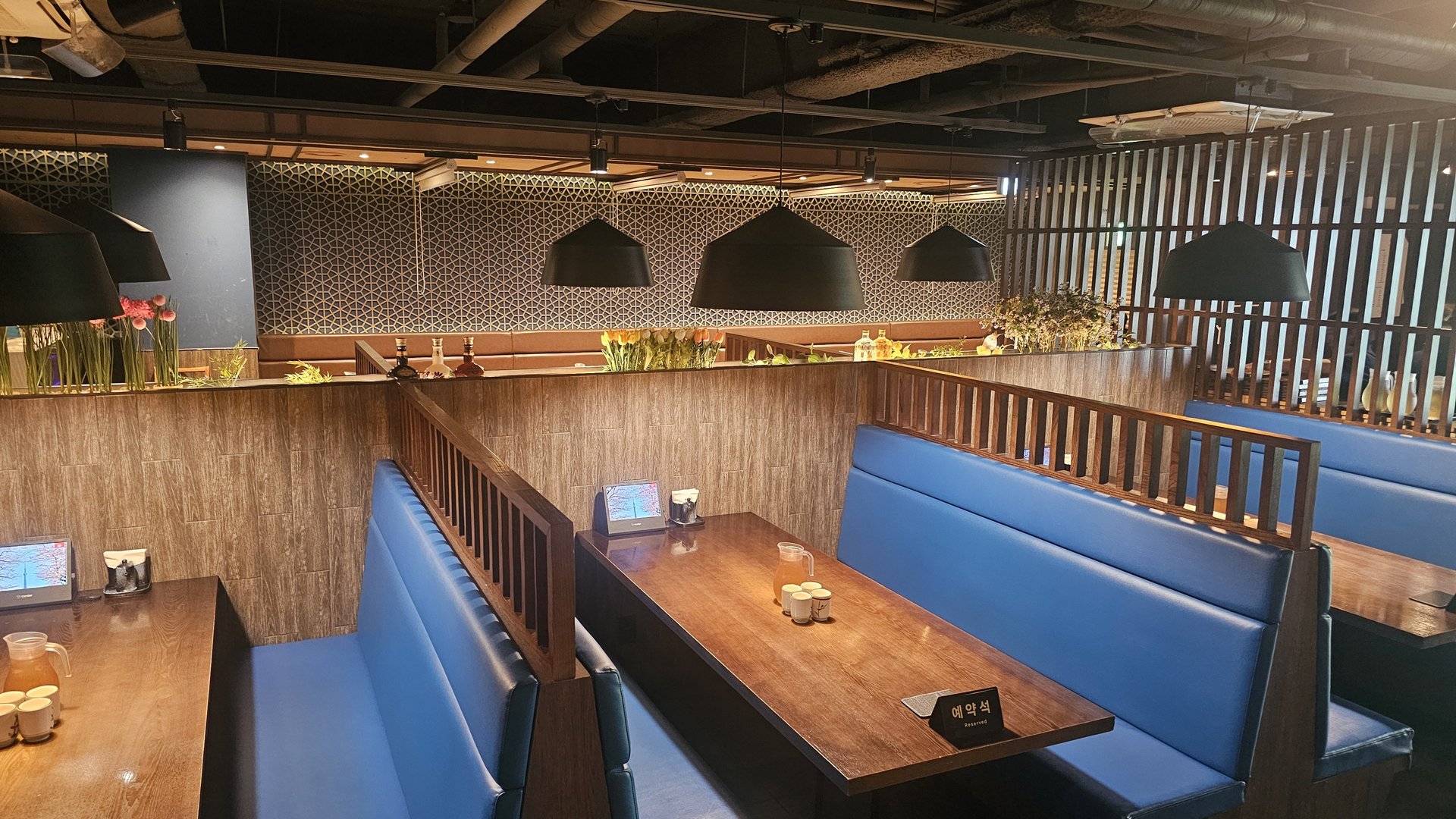
    Interior of Jingawa Yeouido with wooden tables and black iron chairs under warm lighting
    Interior of Jingawa Yeouido with wooden tables and black iron chairs under warm lighting
    Upper seating area at Jingawa Yeouido featuring blue fabric booth sofas and wooden partition dividers
    Upper seating area at Jingawa Yeouido featuring blue fabric booth sofas and wooden partition dividers

    Genuinely nice. Wooden tables, black iron chairs on the main floor. Upper level has booth seating with blue fabric upholstery and wooden partition panels between sections. Soft lighting throughout. Quiet — especially at opening hour.

    It doesn’t feel like a typical Seoul lunch place. No blaring K-pop, no cramped tables. The vibe is calm, a bit formal, well put-together. Good for a business-ish lunch or just when you want to eat without noise.

    The Menu

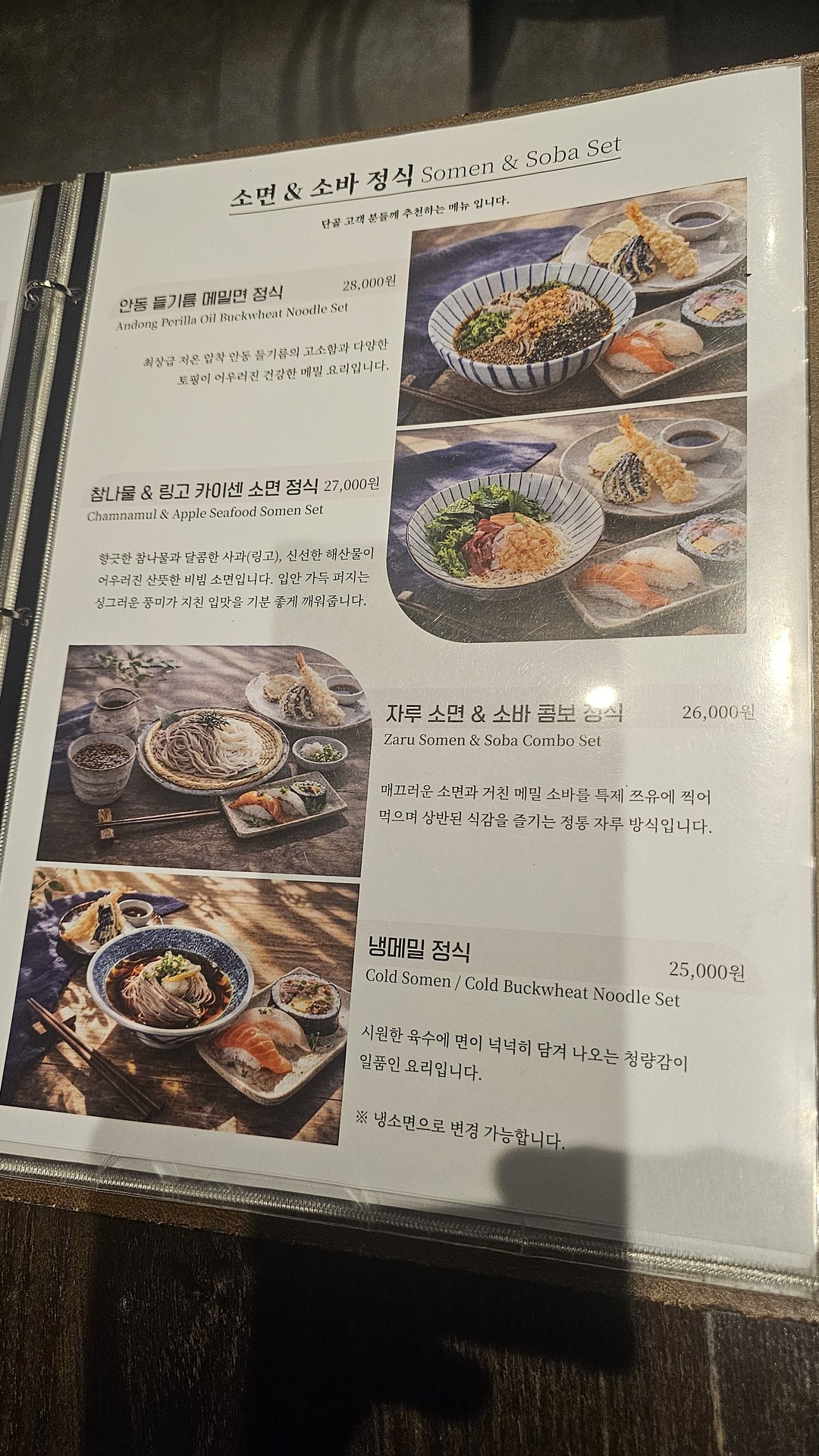
    Jingawa Yeouido cold noodle menu page showing somen and soba set meals ranging from 25,000 to 28,000 KRW
    Jingawa Yeouido cold noodle menu page showing somen and soba set meals ranging from 25,000 to 28,000 KRW
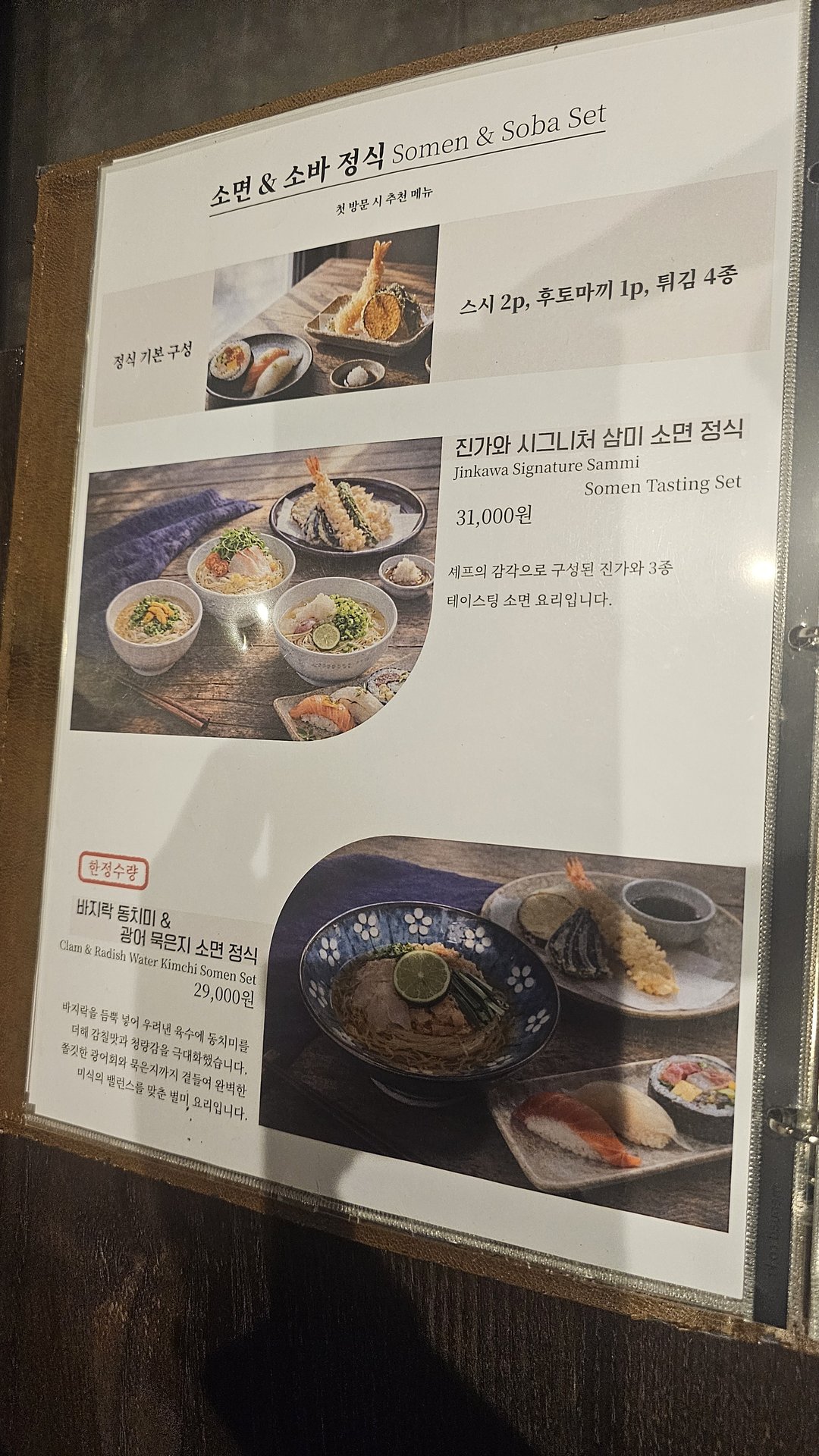
    Jingawa Yeouido signature somen menu page with Sammi somen set and clam cold noodle set priced at 29,000 to 31,000 KRW
    Jingawa Yeouido signature somen menu page with Sammi somen set and clam cold noodle set priced at 29,000 to 31,000 KRW
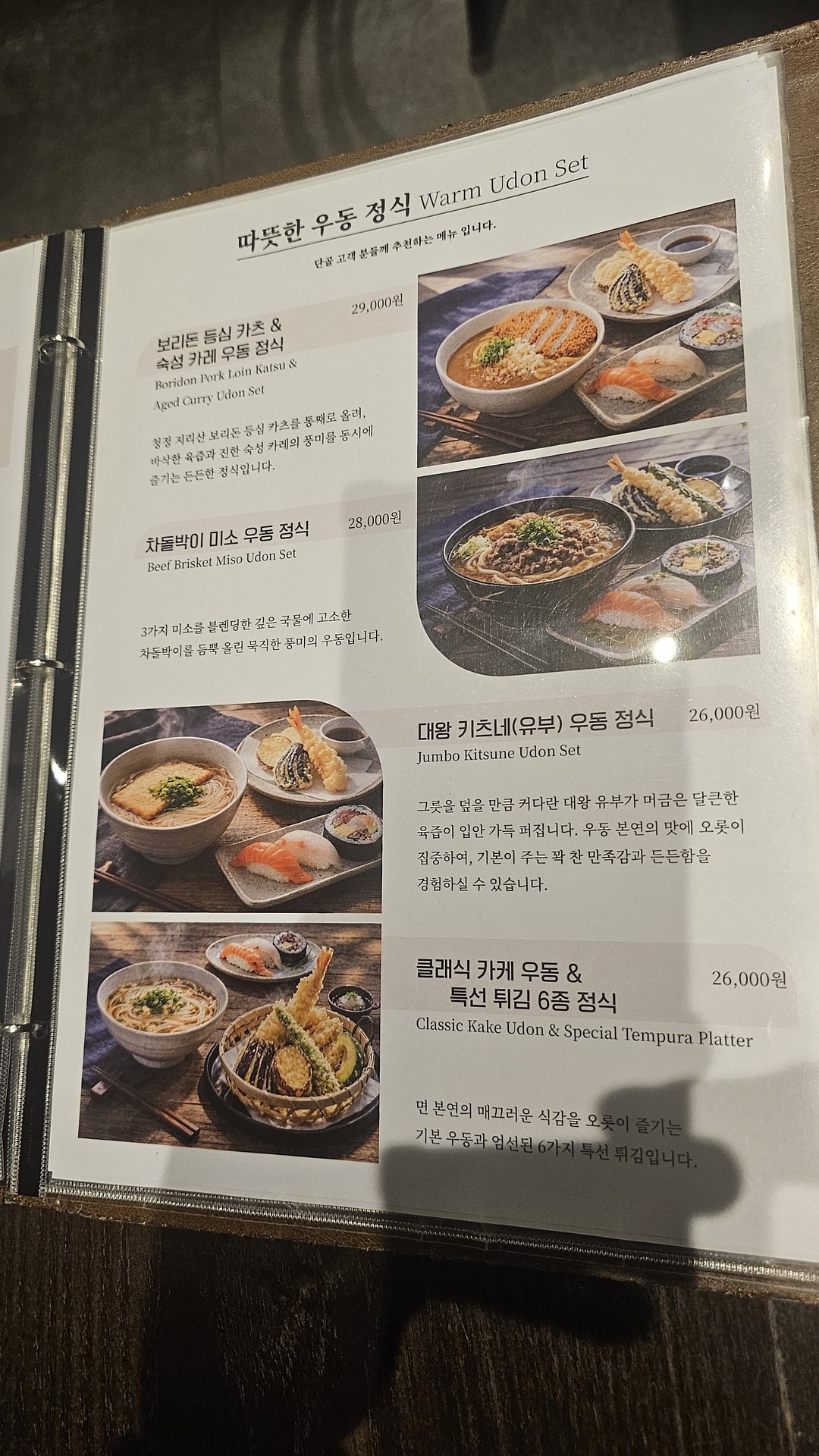
    Jingawa Yeouido warm udon menu page featuring chadol miso udon and pork katsu curry udon sets
    Jingawa Yeouido warm udon menu page featuring chadol miso udon and pork katsu curry udon sets
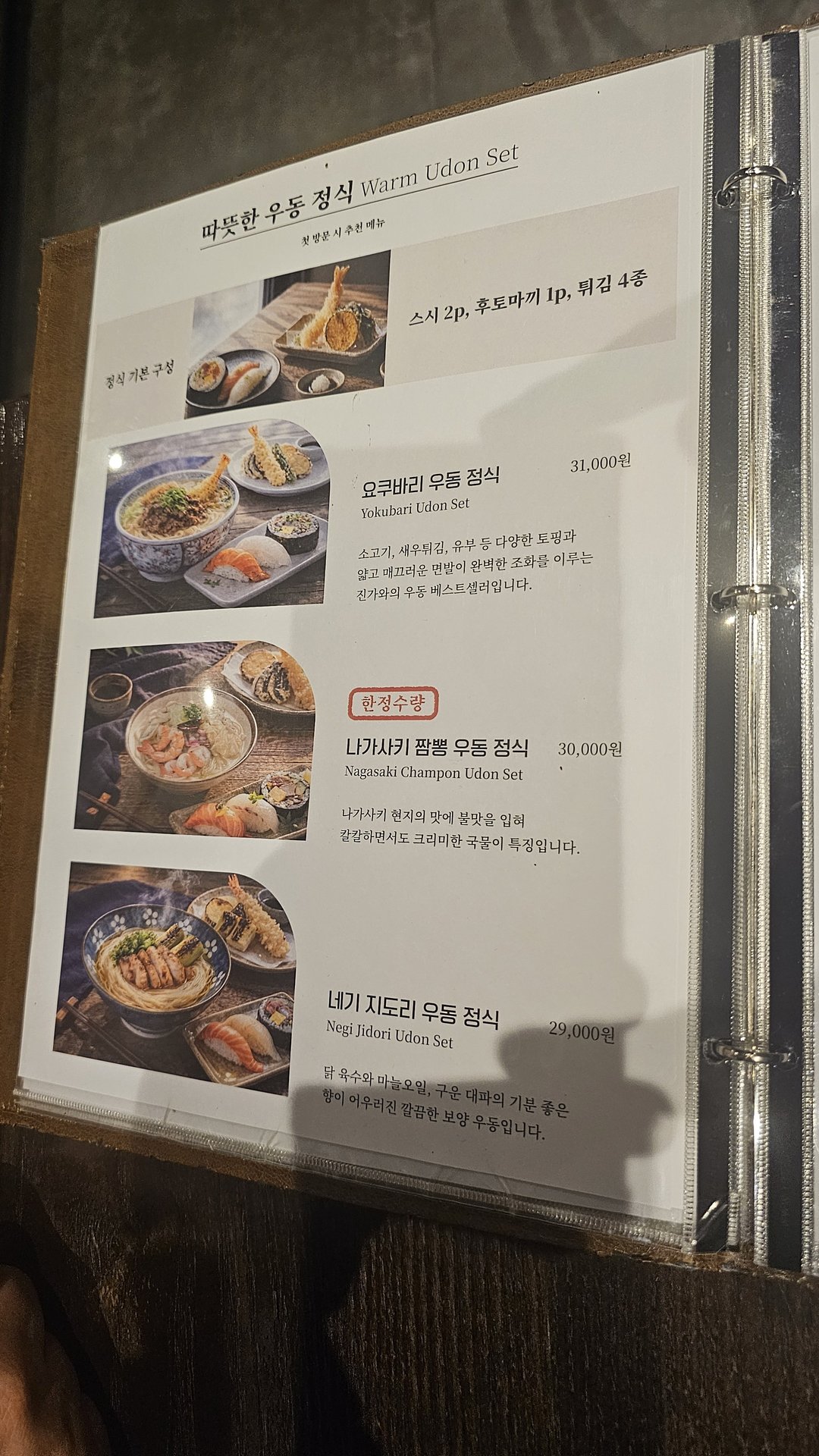
    Jingawa Yeouido udon menu page with yokubari udon, Nagasaki chanpon udon, and negi jidori udon sets
    Jingawa Yeouido udon menu page with yokubari udon, Nagasaki chanpon udon, and negi jidori udon sets

    Two main categories:

    Cold noodles (소면 & 소바 정식):

    – Cold Buckwheat Soba Set (냉메밀 정식): 25,000 KRW (~$18.52) — the entry point

    – Clam Cold Noodle Set (바지락 통도치미 소면 정식): 29,000 KRW (~$21.48)

    – Signature Sammi Somen Set (시그니처 삼미 소면 정식): 31,000 KRW (~$22.96) — three-part cold noodle set, most expensive in this category

    Warm udon (따뜻한 우동 정식):

    – Chadol Miso Udon Set (차돌박이 미소 우동 정식): 28,000 KRW (~$20.74)

    – Pork Katsu Curry Udon Set (보리멘 돼지카츠 카레 우동 정식): 29,000 KRW (~$21.48)

    – Classic Kake Udon with Assorted Tempura (클래식 카케 우동 & 특선 튀김 6종 정식): 26,000 KRW (~$19.26) — lowest-priced udon set

    – Nagasaki Chanpon Udon (나가사키 찬폰 우동 정식): 30,000 KRW (~$22.22)

    Honestly, if you’re going once, just get the chadol miso udon.

    What I Ordered

    Total for two: 53,000 KRW (~$39.26).

    Chadol Miso Udon Set — 28,000 KRW (~$20.74)

    Chadol (차돌박이) is thinly sliced beef brisket — the same cut you’d see on a Korean BBQ grill, but here it goes into the udon broth. The miso is white-style (shiro miso), lighter and less intense than the red miso you might know from miso soup. The broth is clean and slightly sweet.

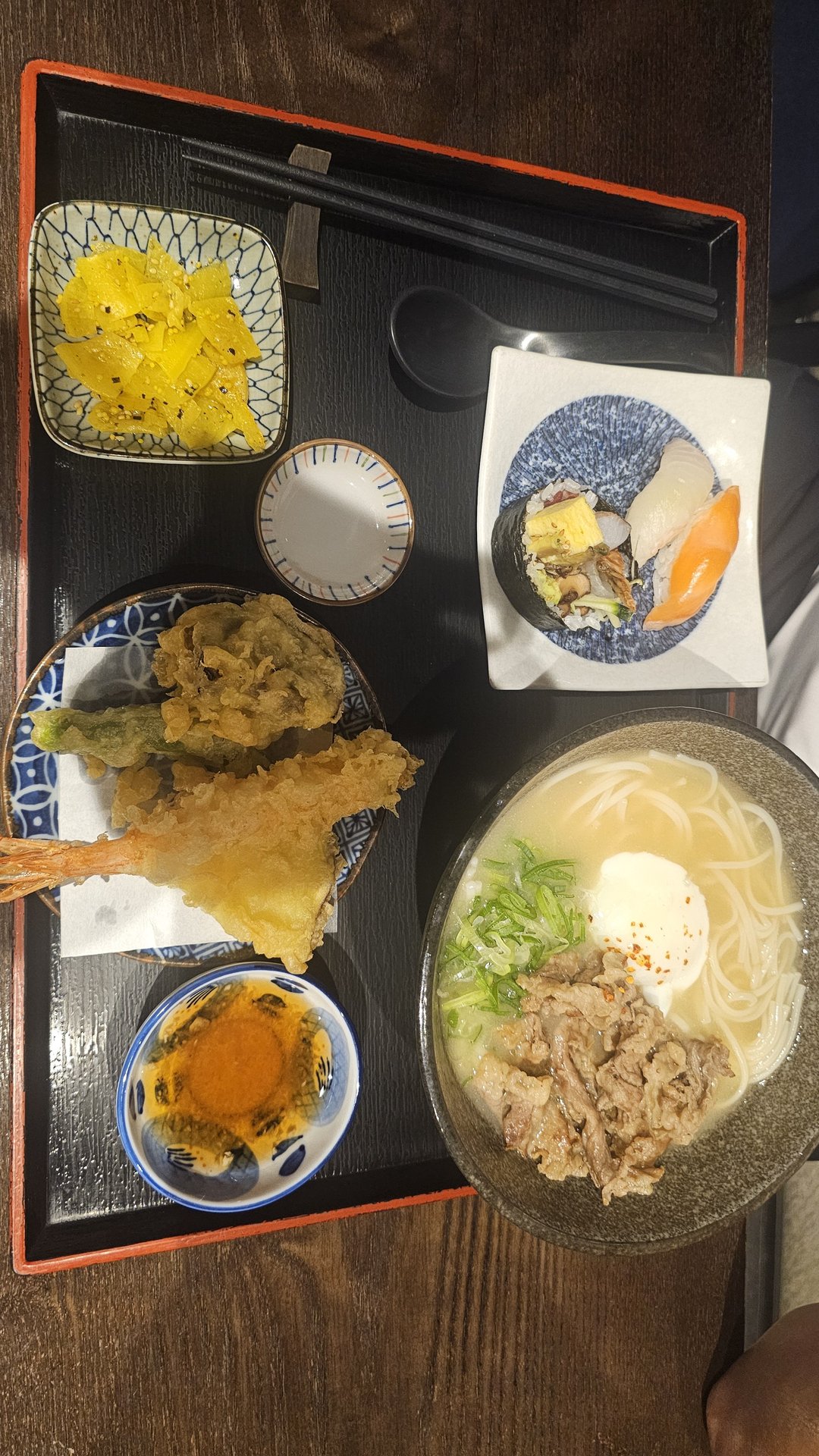
    Chadol miso udon set meal at Jingawa Yeouido featuring thinly sliced beef brisket, soft-boiled onsen tamago egg, green onions, shrimp and vegetable tempura, and nigiri sushi
    Chadol miso udon set meal at Jingawa Yeouido featuring thinly sliced beef brisket, soft-boiled onsen tamago egg, green onions, shrimp and vegetable tempura, and nigiri sushi

    On top: onsen tamago — a slow-cooked soft egg where the white is just barely set and the yolk stays runny — and thin green onion slices. The egg breaks into the broth and rounds it out.

    The set includes a separate tempura plate (shrimp tempura plus vegetable tempura), two pieces of nigiri sushi, pickled radish, and small sauce sides. It’s a lot of food. You won’t leave hungry.

    This is the dish to order.

    Cold Buckwheat Soba Set — 25,000 KRW (~$18.52)

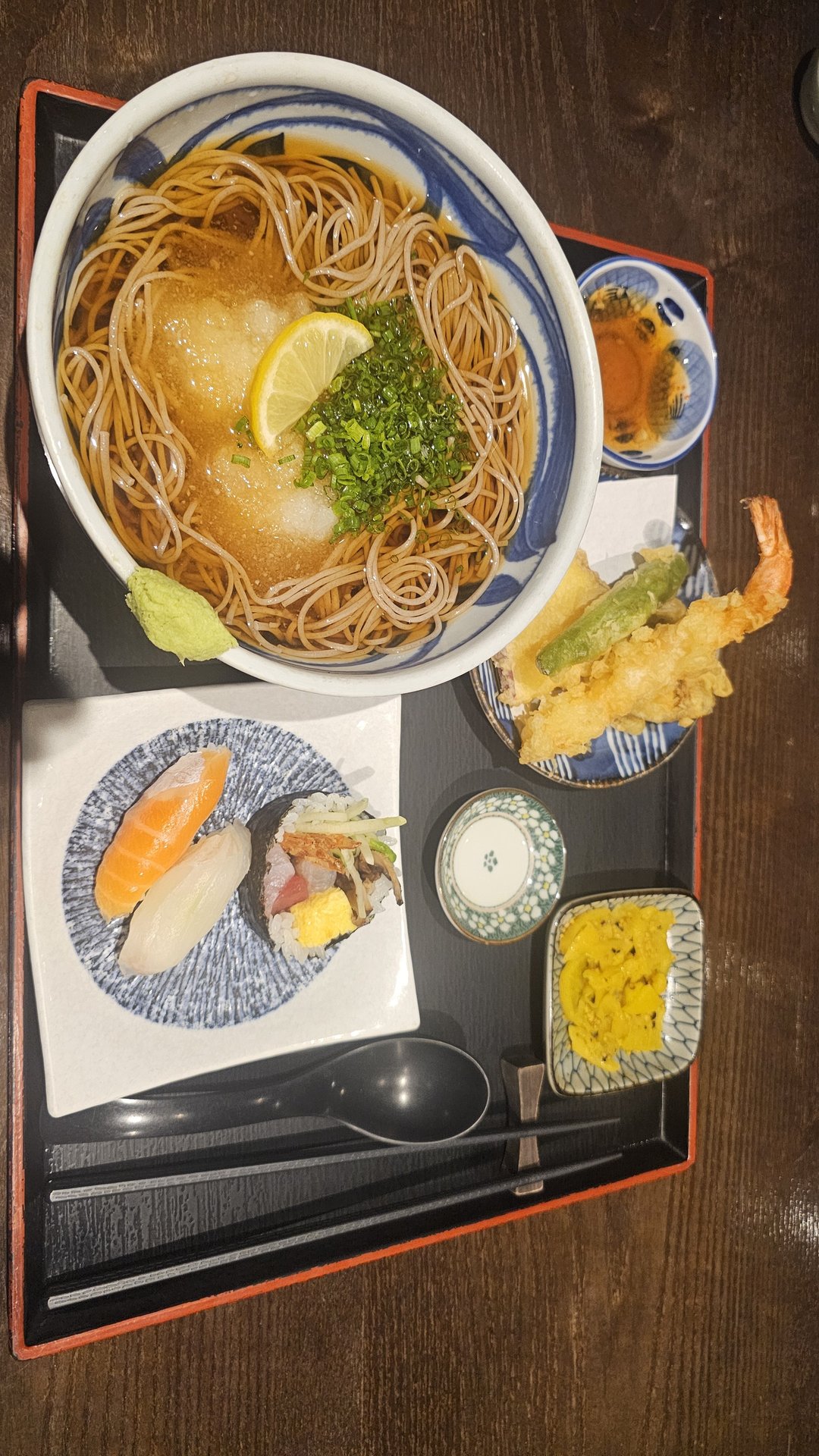
    Cold buckwheat soba set meal at Jingawa Yeouido with grated daikon radish, lemon, shrimp tempura, vegetable tempura, and two pieces of nigiri sushi
    Cold buckwheat soba set meal at Jingawa Yeouido with grated daikon radish, lemon, shrimp tempura, vegetable tempura, and two pieces of nigiri sushi

    Zarusoba style — chilled buckwheat noodles served on a bamboo tray. Grated daikon radish and a slice of lemon on top. You pour a bit of the tsuyu dipping broth into a small cup, add the daikon, and dip the noodles in as you eat.

    Same sides as the udon: tempura plate, two pieces of nigiri, pickled radish.

    It’s good. Solid cold soba, nothing to complain about. Refreshing for summer. But compared to the udon, it’s the quieter dish — simpler flavours, less going on. If you know cold soba and that’s what you want, this is a reliable version. If you’re deciding between the two: get the udon.

    Stuff Tourists Should Know

    Language: The menu is in Korean. The dish names are Japanese-influenced, which doesn’t help much if you don’t read either. That said, pointing at menu photos works fine — staff in Yeouido are used to non-Korean speakers. Basic English communication should be fine.

    Payment: Cards are standard everywhere in Yeouido. Foreign Visa and Mastercard work without issue. Cash also accepted. No tipping — it’s not done in Korea. Do not leave money on the table.

    Opening hours: They open at 11 AM. If you arrive before noon, you’ll likely walk right in. After 12:30 PM, the Yeouido office lunch rush kicks in.

    Diet restrictions: The tempura includes shrimp, and most broths are dashi-based (made from fish stock). Vegetarians and vegans will have a hard time here. No halal options. Gluten-free is not possible — noodles throughout.

    Kids: The format is calm and quiet. Kids are fine in terms of space and seating, but the menu is noodle-heavy and some younger kids might not be into cold soba. The udon is a safer bet for families.

    Solo dining: Totally fine. Counter seating or booth for one is no issue.

    Group size: Tables and booths handle 2–4 comfortably. Probably not the spot for groups of 6+, especially without a reservation.

    The Verdict

    Jingawa is a reliable, polished lunch option in Yeouido. Not trying too hard, not coasting either. The chadol miso udon delivers a complete meal — good broth, proper protein, and the full set format means you don’t need to think about ordering sides. The interior is genuinely pleasant. Early morning timing works in your favour.

    Is it worth going out of your way for? If you’re already in Yeouido, yes — it’s one of the better sit-down lunch spots. If you’re doing a tight 3-day Seoul itinerary, prioritize Korean food first. Come to Jingawa on a longer trip when you’re ready for something a bit different.

    Who should go:

    – In Yeouido for the day and want a proper sit-down lunch — yes

    – Into Japanese teishoku style and curious how Seoul does it — yes

    – Want to try Korean food while in Seoul — skip this one and go get galbi or samgyeopsal instead

    – Tight budget — the sets start at 25,000 KRW (~$18.52), which is mid-range for Seoul. Not expensive, but not cheap.

    Would I come back? Yeah. It’s already in the regular rotation.

    FAQ

    What is the average price per person at Jingawa Yeouido?

    Sets range from 25,000 to 31,000 KRW (~$18.50–$23 USD) per person, all-in. Each set includes the main noodle dish, a tempura plate, two pieces of nigiri sushi, and small sides. Budget around 26,500 KRW (~$19.60) as a realistic average.

    What should I order at Jingawa Yeouido?

    The Chadol Miso Udon Set (차돌박이 미소 우동 정식, 28,000 KRW / ~$20.74). Thinly sliced beef brisket in white miso udon broth, plus a full tempura plate and sushi. If you prefer cold noodles, the Cold Buckwheat Soba Set is the simpler, slightly cheaper pick.

    What time does Jingawa Yeouido open, and do I need a reservation?

    They open at 11 AM — earlier than most Seoul restaurants. Walk-ins work fine at opening. By 12:30 PM, Yeouido office lunch crowds show up, so arriving early is the smarter move. Check Naver Map or Kakao Map for reservations if you’re coming during peak hours.

    Is there an English menu at Jingawa Yeouido?

    The printed menu is in Korean, but the dishes are Japanese-influenced and most items have enough context to navigate by pointing. Staff in Yeouido generally handle basic English without issue.

    Is Jingawa suitable for vegetarians or people with dietary restrictions?

    Not really. Most broths are dashi-based (fish stock) and the tempura sets include shrimp. Vegetarian, vegan, and halal options are very limited here.

    Can I pay with a foreign credit card at Jingawa Yeouido?

    Yes. Card payment is standard across Yeouido. Foreign Visa and Mastercard work fine. No tipping needed — tipping is not a custom in Korea.

    You might also like

    📍 Location

    Open in Google Maps →

  • Sushi Yu in Yeouido: Honest Review of a Seoul Sushi Lunch

    Sushi Yu in Yeouido: Honest Review of a Seoul Sushi Lunch

    Quick honest review of Sushi Yu (스시유) in Yeouido — a Japanese sushi restaurant in Seoul’s financial district with a bronze plaque from Korean TV to back up its reputation. Short version: we went four people, ordered kaisendon, a 12-piece nigiri set, unaju, and tempura on the side. All of it was good. Left satisfied.

    If you’re eating lunch in Yeouido and want actual Japanese food — not a mall food court, not a chain — this is a solid choice.

    We visited on a Thursday, lunch service.

    What Is Sushi Yu?

    Sushi Yu is a mid-to-upscale Japanese restaurant focused on sushi and traditional Japanese set lunches. Think hand-formed nigiri, kaisendon (seafood sashimi rice bowls), unaju (grilled eel over rice in a lacquer box), and tempura. Sit-down service, proper tableware, the kind of place where the miso soup arrives in a lacquer bowl.

    Not a conveyor belt. Not a Korean-Japanese fusion place. Traditional Japanese, done seriously.

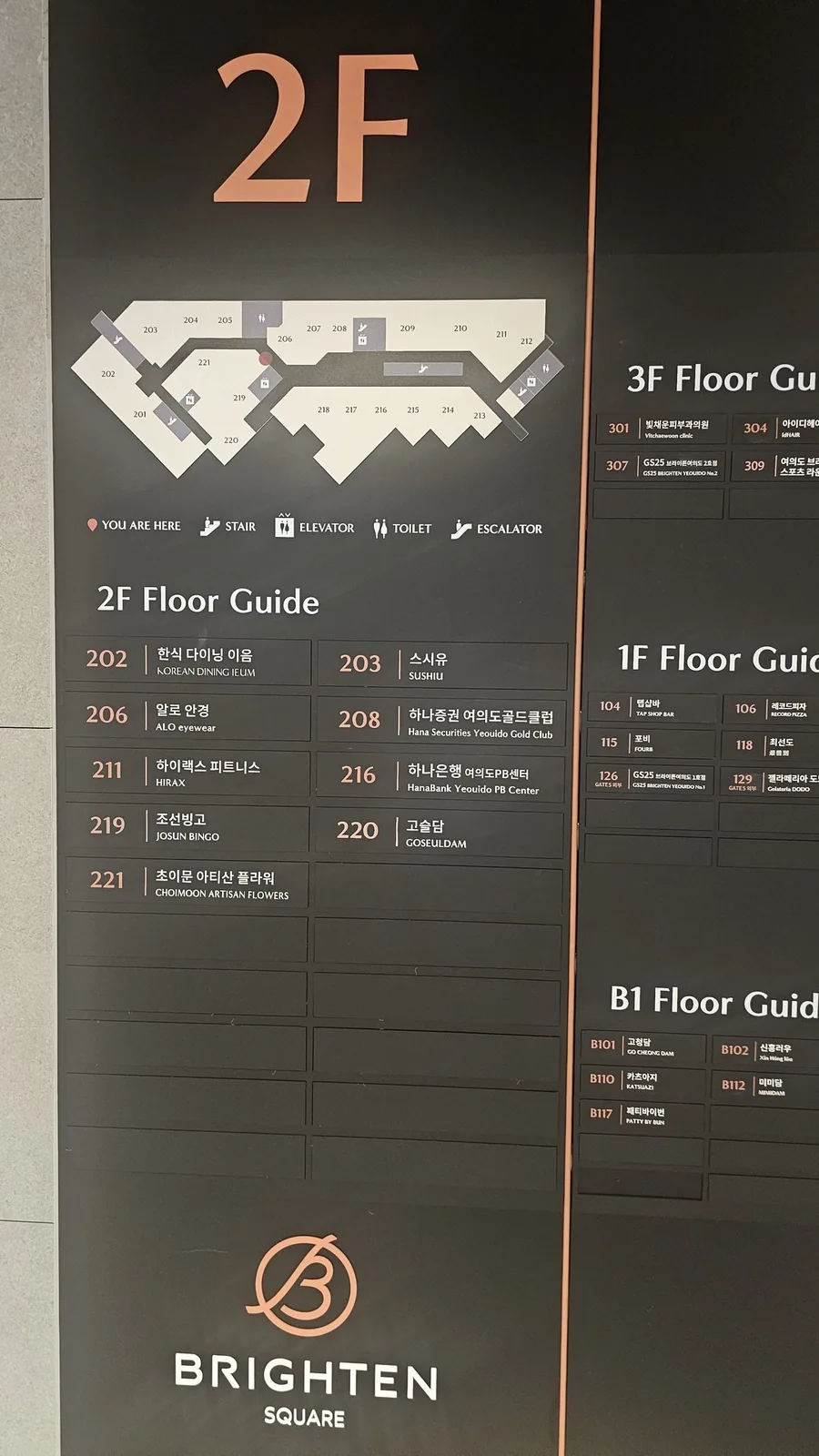
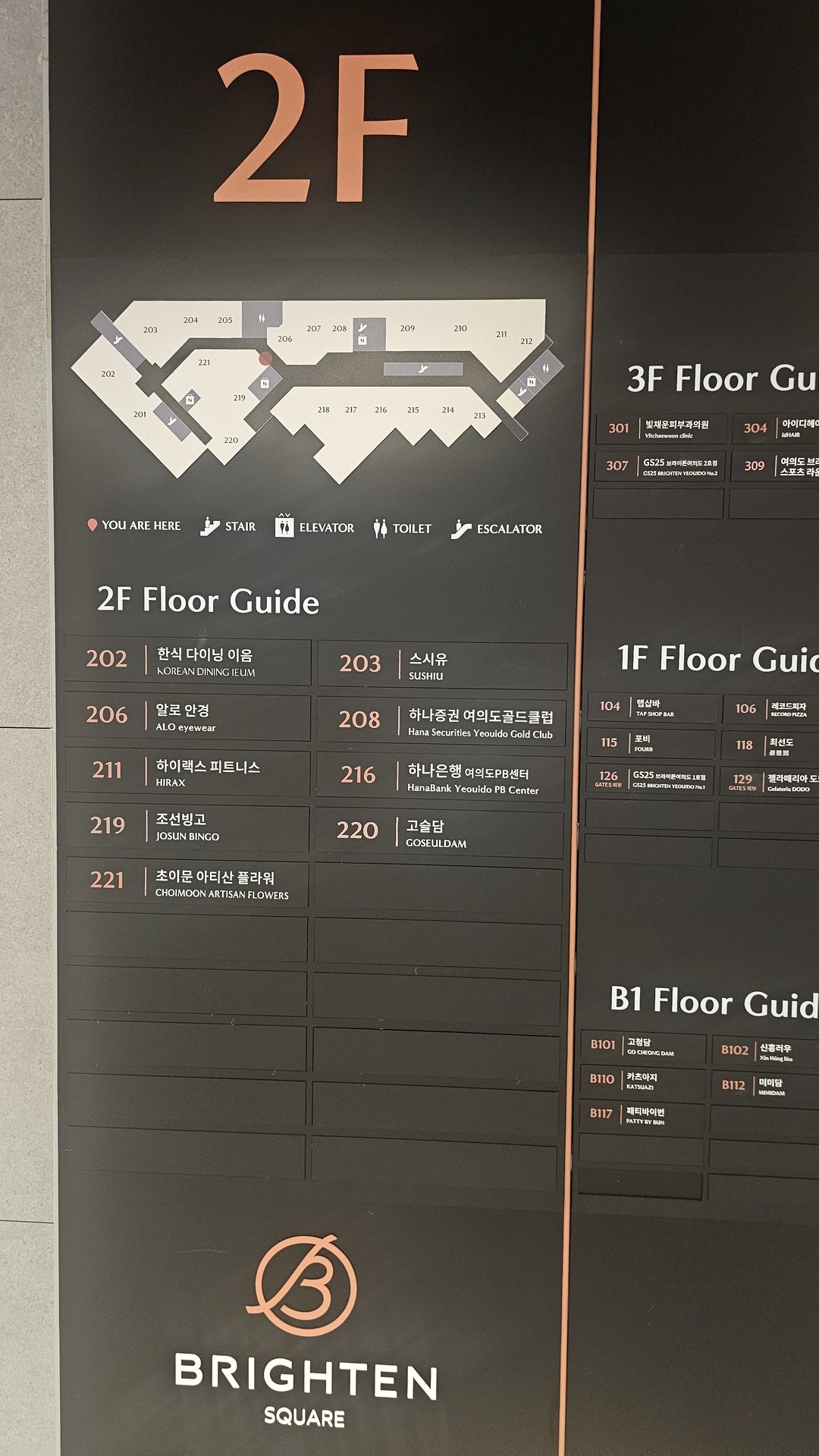
    Brighton Square Yeouido 2F directory board showing Sushi Yu at room 203
    Brighton Square Yeouido 2F directory board showing Sushi Yu at room 203

    It’s on the 2nd floor of Brighton Square Yeouido, Room 203. Yeouido is Seoul’s financial district — comparable to Wall Street or Canary Wharf. Home to the Korean parliament (여의도 국회의사당), KBS and SBS broadcasting headquarters, and a lot of corporate offices. Lunch culture here leans toward places that can handle a business crowd. Sushi Yu fits right in.

    The SBS Recognition

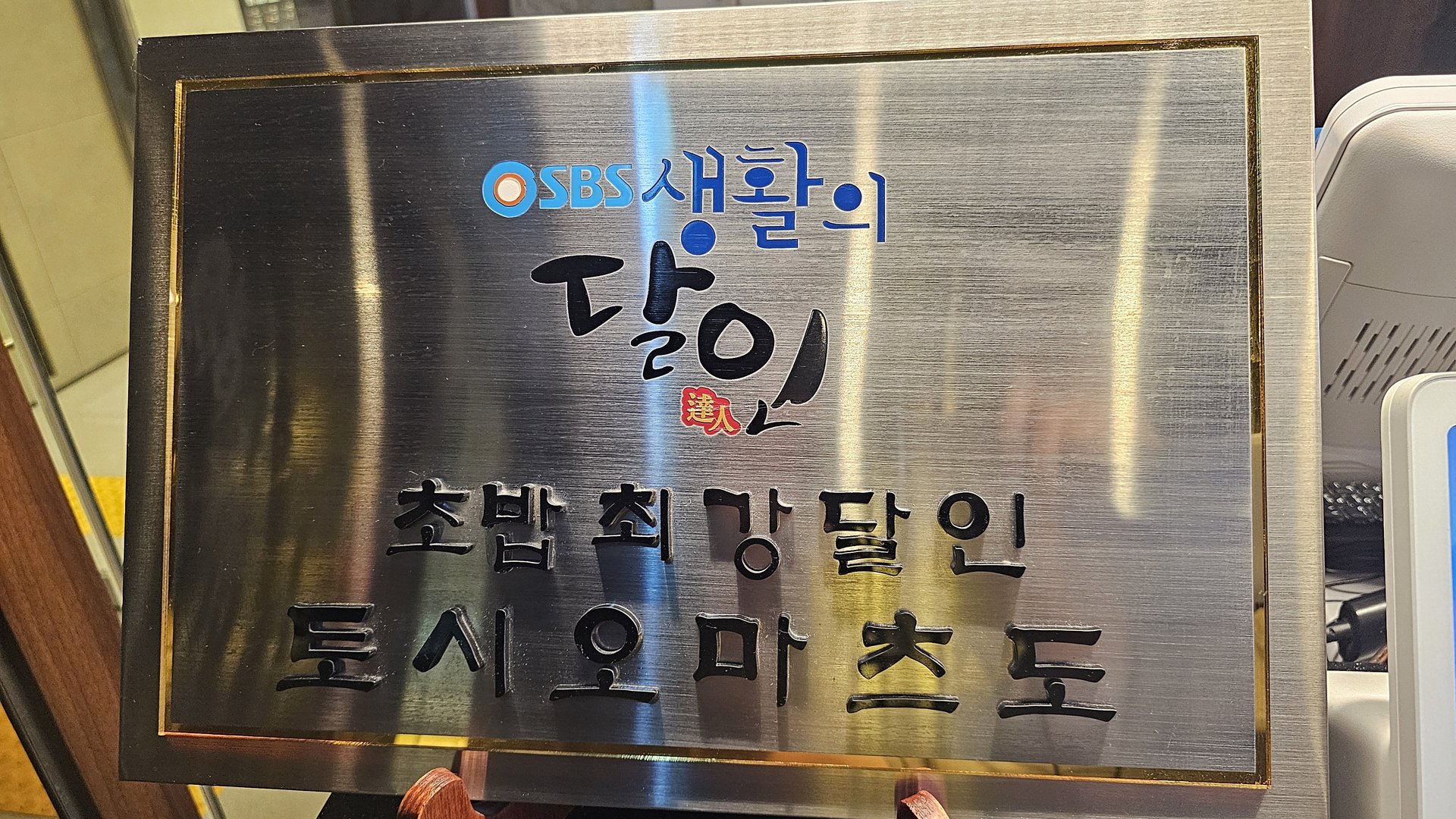
    SBS Masters of Living certified bronze plaque at Sushi Yu Yeouido entrance recognizing chef Toshio Matsudo
    SBS Masters of Living certified bronze plaque at Sushi Yu Yeouido entrance recognizing chef Toshio Matsudo

    At the entrance, there’s a bronze plaque from *SBS 생활의 달인* — a Korean TV show called “Masters of Living” that tracks down people who’ve genuinely mastered a craft. The plaque recognizes chef Toshio Matsudo as a sushi master.

    This matters. *생활의 달인* doesn’t do paid placements — it’s a production team that seeks out craft excellence and puts it on national TV. Getting featured means the chef was evaluated on actual technique. So the credentials at the door aren’t decorative.

    Getting There

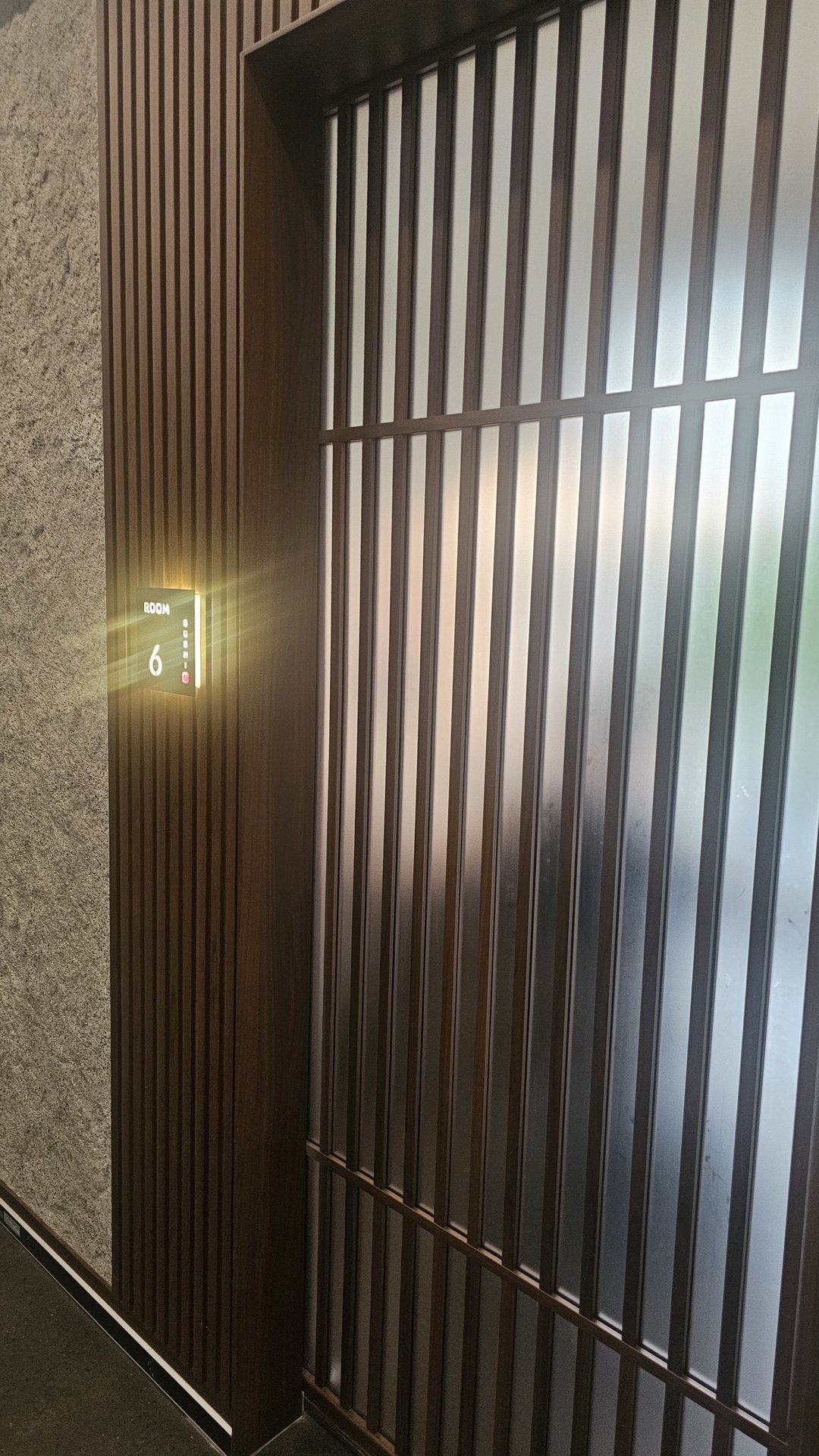
    Sushi Yu restaurant entrance with dark wood louver panel exterior at Brighton Square Yeouido
    Sushi Yu restaurant entrance with dark wood louver panel exterior at Brighton Square Yeouido

    Address: Brighton Square Yeouido, 2F, Room 203 (브라이튼스퀘어 여의도 203호)

    Subway:

    – Yeouido Station (여의도역) — Line 5 or Line 9 — about a 5–7 minute walk

    – IFC Seoul complex is nearby if you’re coming from that direction

    From Incheon Airport: Around 50–60 minutes. Take the AREX to Gimpo Airport Station, transfer to Line 9, ride to Yeouido Station. Straightforward.

    From Myeongdong or Hongdae: 20–30 minutes by subway.

    Parking is available in the Brighton Square building basement. If you’re taking a taxi, show the driver this: 여의도 브라이튼스퀘어 203호.

    The Interior

    The exterior is sharp — dark wood louver panels, illuminated signage with Japanese and Korean characters. It looks like it belongs in a boutique hotel rather than a commercial building.

    Inside: refined without being uptight. Dark tones, clean sightlines, proper tableware. The logo table mat is a detail that tells you the restaurant takes presentation seriously. Nothing over-designed. Just done right.

    The Menu

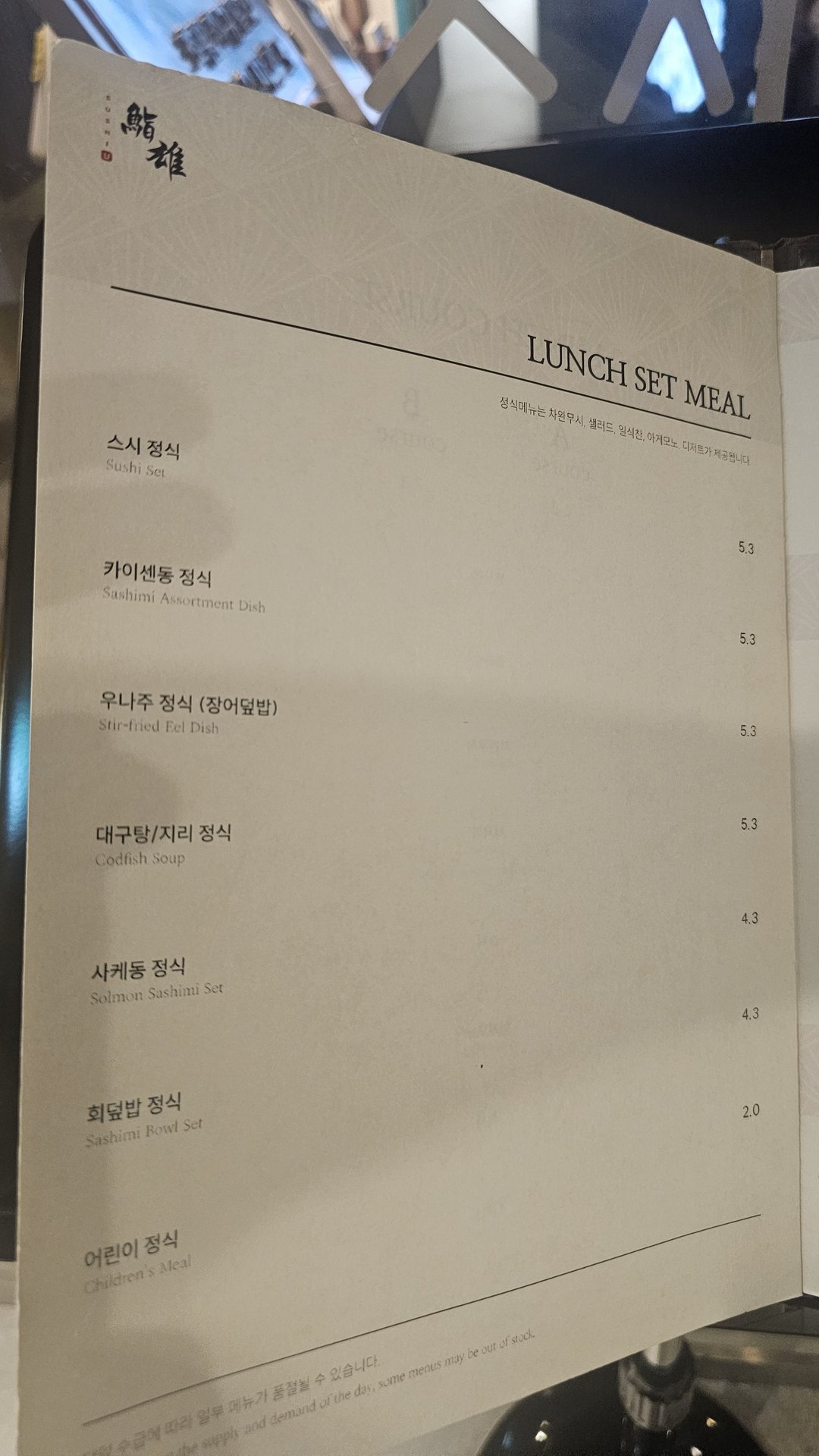
    Sushi Yu lunch set menu board showing kaisendon, sushi jeongshik, unaju, and prices in Korean won
    Sushi Yu lunch set menu board showing kaisendon, sushi jeongshik, unaju, and prices in Korean won

    Lunch sets range from about 20,000 to 53,000 KRW (~$15–$39 USD). Main options:

    Sushi Jeongshik (스시 정식) — nigiri sushi platter set

    Kaisendon Jeongshik (카이세동 정식) — kaisen sashimi rice bowl set

    Unaju Jeongshik (우나주 정식) — grilled eel rice in lacquer box set

    Hoe-deop-bap (회덮밥) — marinated sashimi over mixed rice

    Sake-don (사케동) — salmon rice bowl

    Daegu-tang (대구탕) — cod soup set

    Kids set (어린이 정식)

    Each set comes with miso soup, pickled ginger, and a starter salad. Our group of four spread across the kaisendon, sushi set, unaju, and a shared tempura side.

    What We Ordered

    Starter Salad

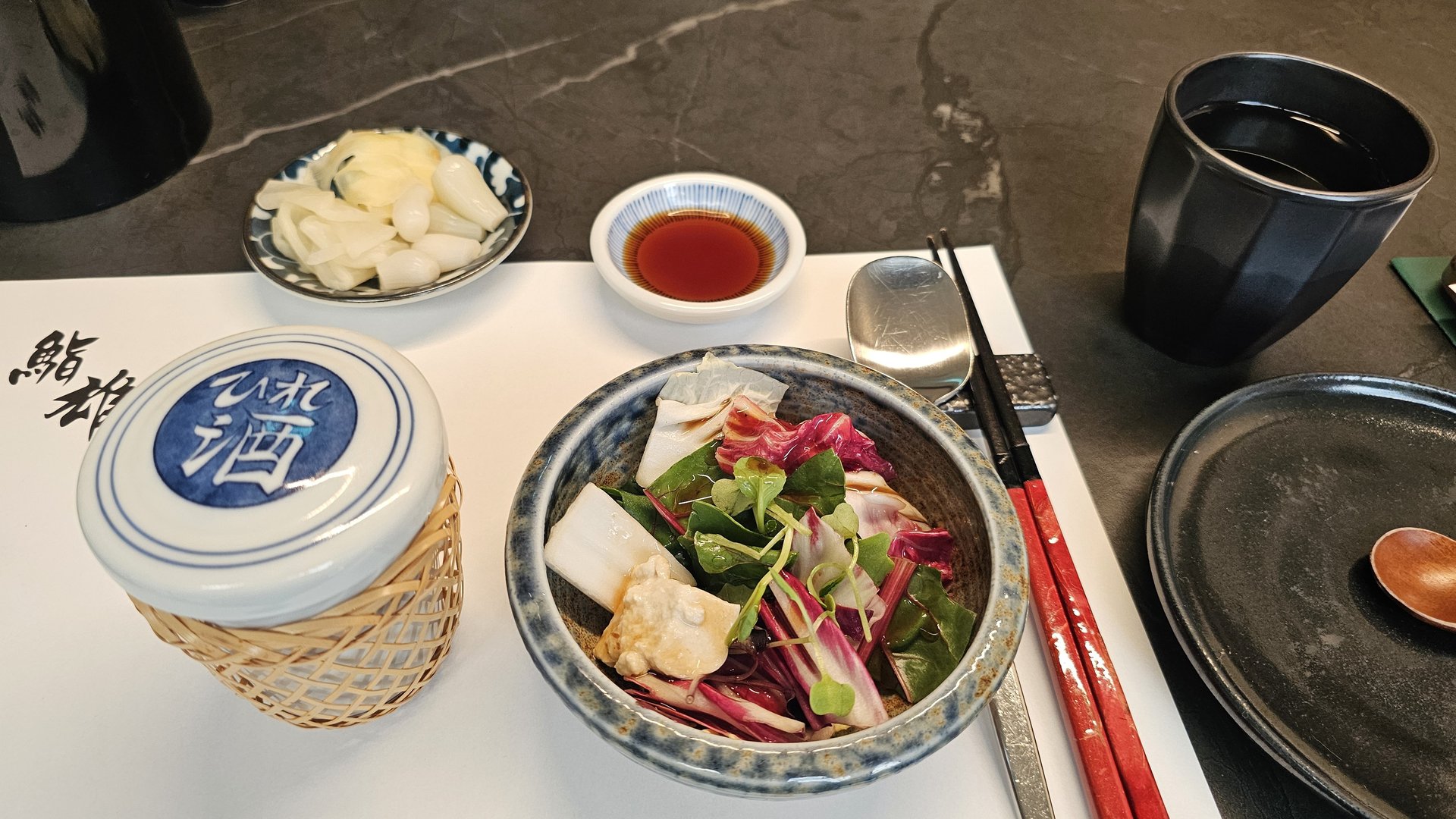
    Starter salad with seafood and vegetables at Sushi Yu, served alongside pickled ginger, soy sauce, and green tea on a logo table mat
    Starter salad with seafood and vegetables at Sushi Yu, served alongside pickled ginger, soy sauce, and green tea on a logo table mat

    Each set opens with a small seafood and vegetable salad. Nicely plated — pickled ginger on the side, green tea already poured, soy sauce set out. It’s not the reason you’re here, but it’s a proper opener and the presentation is clean.

    Fine. Does its job.

    Kaisendon Jeongshik

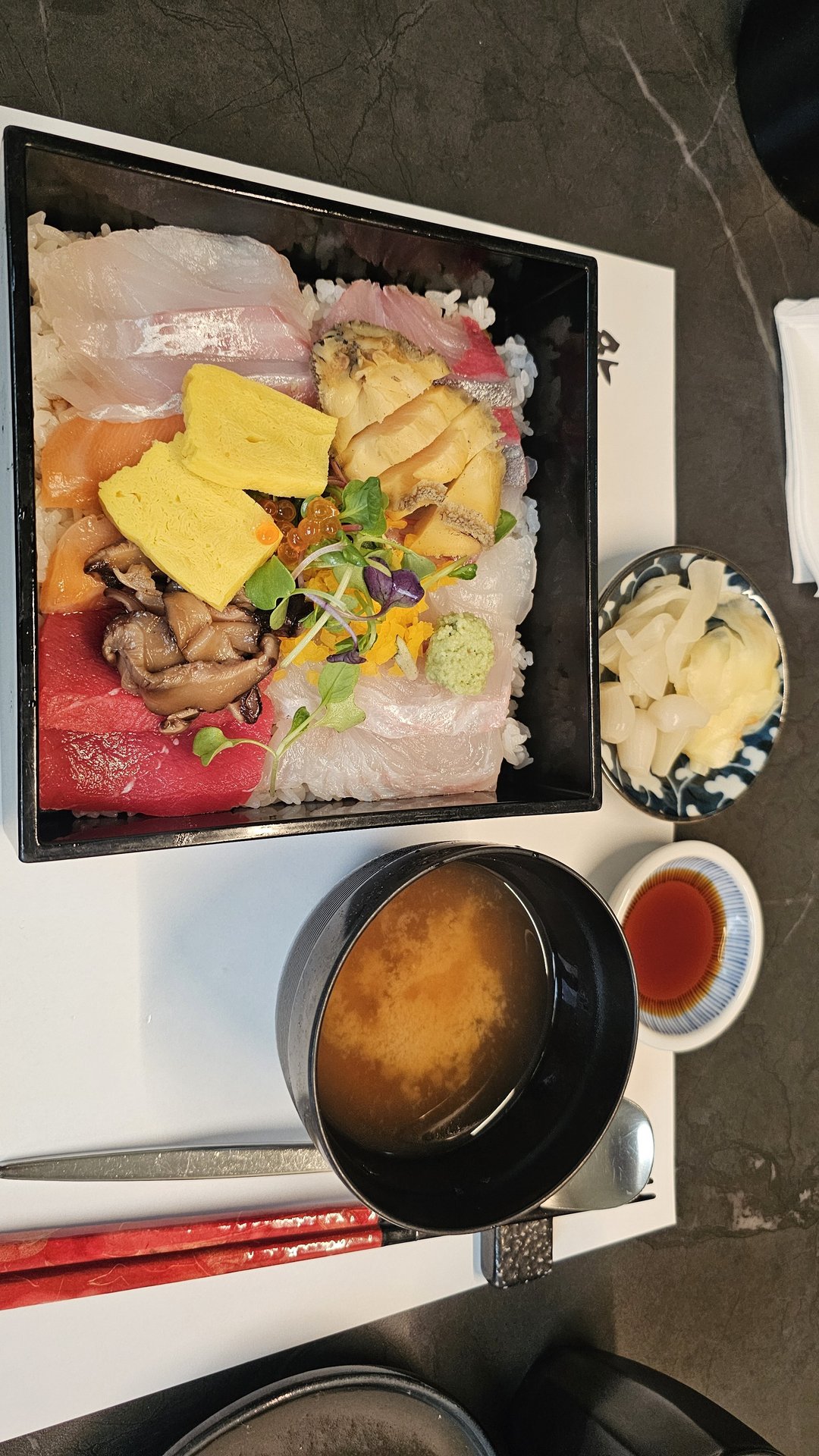
    Kaisendon set at Sushi Yu Yeouido — sashimi rice bowl topped with tuna, salmon, flatfish, uni, ikura, and tamagoyaki with miso soup
    Kaisendon set at Sushi Yu Yeouido — sashimi rice bowl topped with tuna, salmon, flatfish, uni, ikura, and tamagoyaki with miso soup

    Kaisendon (kaisen-don) is a Japanese seafood sashimi rice bowl — different cuts of sashimi layered over seasoned sushi rice. Sushi Yu’s version comes loaded: tuna, salmon, flatfish (광어/hirame), sea urchin (uni/성게), salmon roe (ikura/이크라), rolled egg (tamagoyaki), and mushrooms.

    The uni is what justifies the price point. Fresh sea urchin on a kaisendon in this range isn’t always a given — at cheaper places you either don’t get it or it’s past its prime. Here it was present and it was good.

    Sushi rice underneath is properly seasoned. Set includes miso soup.

    If you want everything in one bowl, order this.

    Sushi Jeongshik — 12-Piece Nigiri

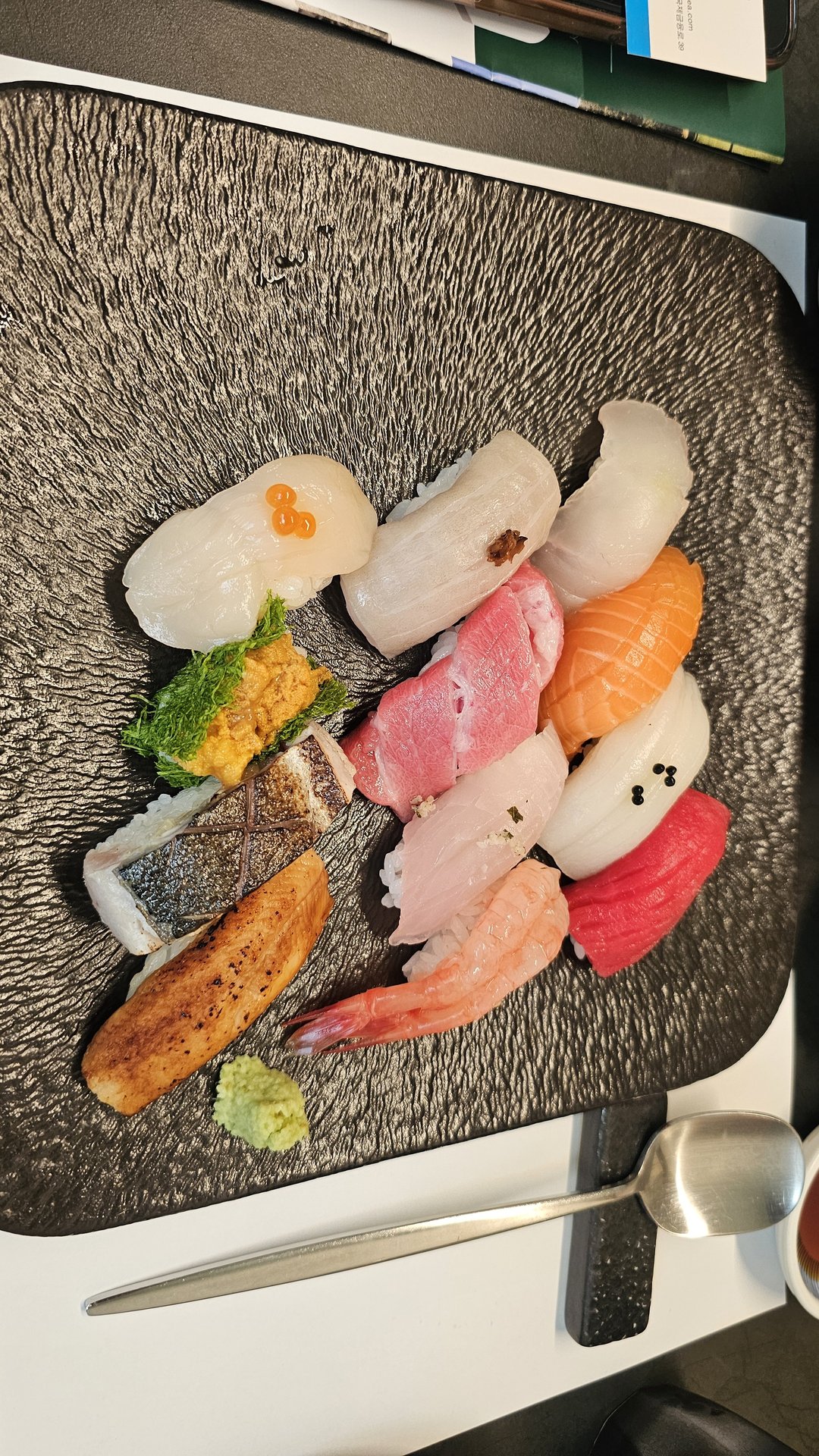
    12-piece nigiri sushi platter at Sushi Yu Yeouido featuring tuna, salmon, uni, yellowtail, and anago
    12-piece nigiri sushi platter at Sushi Yu Yeouido featuring tuna, salmon, uni, yellowtail, and anago

    Twelve pieces of nigiri: tuna, salmon, flatfish, shrimp, yellowtail (방어/buri), sea urchin, and anago (saltwater eel). The platter looks exactly like what a proper sushi set should look like.

    Each piece is hand-formed — you can tell by the shape and the way the rice holds together. The shari (sushi rice) has good texture: slightly firm, properly vinegared. Fish quality is consistent across the board.

    Best pieces: uni, anago, yellowtail. The shrimp is fine but the least interesting item on the plate. Skip obsessing over it and just eat the eel first.

    Unaju Jeongshik

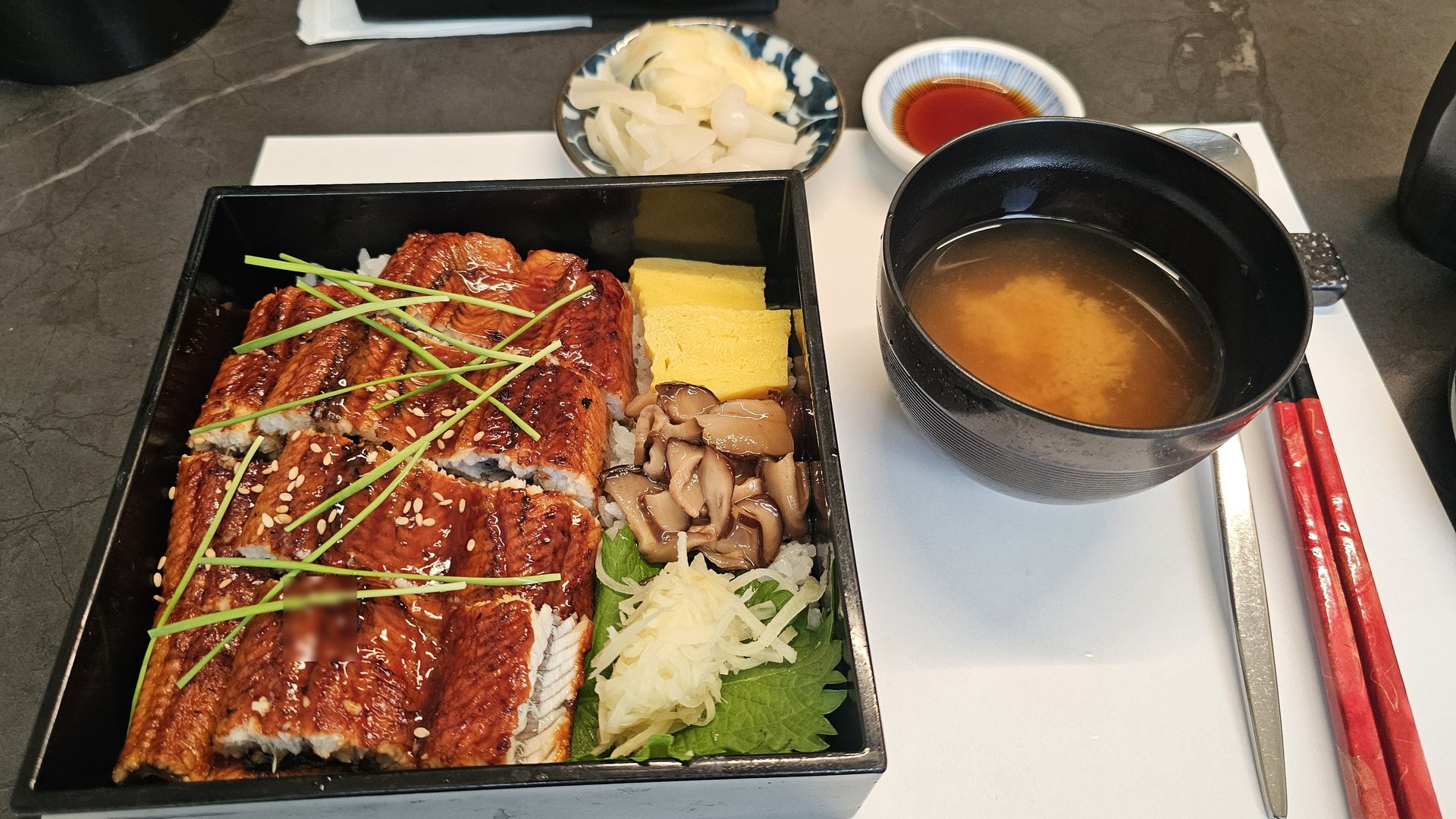
    Unaju set at Sushi Yu — thick glazed grilled eel over rice in a lacquer jubako box with miso soup
    Unaju set at Sushi Yu — thick glazed grilled eel over rice in a lacquer jubako box with miso soup

    Unaju is grilled freshwater eel (unagi/장어) over rice, served in a jubako — a lacquer box that’s kind of the Japanese equivalent of a bento box but fancier. The eel is glazed with tare sauce and grilled until caramelized on the outside.

    Okay, here’s the thing about unaju in Seoul: a lot of places get it wrong. Either the eel is undercooked and soft in a bad way, or the sauce is too sweet and cloying. Sushi Yu’s version uses thick cuts, proper caramelization on the glaze, and the sauce is balanced — not a sugar bomb.

    This is probably toward the higher end of the menu price-wise (closer to 45,000–53,000 KRW / ~$33–$39), but if eel is your thing, this is the version to order.

    Tempura

    Shrimp and asparagus tempura with tsuyu dipping sauce at Sushi Yu Yeouido
    Shrimp and asparagus tempura with tsuyu dipping sauce at Sushi Yu Yeouido

    Shrimp and asparagus tempura, served with tsuyu dipping sauce.

    The batter is light — airy rather than thick and greasy. Shrimp stays juicy inside. Asparagus is a solid choice for tempura; it holds up to heat better than most vegetables and gives you something different from all the raw fish. Good shared side for the table.

    Stuff Tourists Should Know

    English menu? The menu is in Korean and Japanese. Menu boards have photos — pointing works. Translation apps handle the rest without issue. Staff English is limited.

    Card payment? Cards accepted. Foreign Visa/Mastercard should work, but having a small amount of cash on hand doesn’t hurt.

    Tipping? No. Korea has no tipping culture. Don’t leave extra money on the table — it can actually cause awkwardness.

    Vegetarian options? Limited. This is a seafood-focused restaurant. Vegetable tempura might be available — confirm with staff. Not the right spot if you don’t eat seafood.

    Halal/Kosher? Not certified.

    Kids welcome? Yes — there’s a dedicated kids’ set on the lunch menu. Relaxed atmosphere during lunch hours.

    Solo dining? Should be fine for the counter or smaller tables.

    Date spot? Yes. Interior quality and food level make it work for a nicer lunch.

    Reservations? Recommended for groups of 3 or more. Yeouido has a big lunch crowd on weekdays — don’t assume walk-in availability.

    The Verdict

    Should you go?

    Depends on what you’re doing in Seoul.

    If you’re in Yeouido for business or just passing through the area — yes, this is one of the better lunch options around. Get the unaju or the sushi set.

    If you only have 3–4 days in Seoul and haven’t eaten Korean food yet — hold off. Do Korean BBQ, bibimbap, or samgyetang first. Come back to Japanese on a longer visit.

    If you’re a sushi person and want to benchmark Seoul’s Japanese food scene — yes, Sushi Yu is worth it. The SBS recognition isn’t decorative.

    If budget is a concern — it’s not cheap. Lunch runs 35,000–50,000 KRW per person (~$26–$37). Worth it, but not a casual drop-in.

    Four people, four different sets, all good. No weak links across the table. The food matched the credentials on the wall.

    FAQ

    Where exactly is Sushi Yu in Yeouido?

    It’s on the 2nd floor of Brighton Square Yeouido, Room 203. The nearest subway is Yeouido Station (Line 5 or Line 9), about a 5–7 minute walk.

    How much does lunch cost at Sushi Yu Yeouido?

    Lunch sets range from about 20,000 to 53,000 KRW (~$15–$39 USD) per person. Budget around 35,000–50,000 KRW for a solid set with nigiri, kaisendon, or unaju.

    Do I need a reservation at Sushi Yu?

    Recommended for groups of 3 or more. Walk-ins for 1–2 people may work on weekdays, but it’s a popular lunch spot in Yeouido so don’t count on it.

    Is there an English menu at Sushi Yu?

    The menu is in Korean and Japanese. Some menu boards have photos — point and order works fine. Translation apps handle the rest. Staff English is limited.

    Is Sushi Yu good for families or kids?

    Yes — there’s a kids’ set on the lunch menu, and the vibe is relaxed enough for a family meal during lunch hours.

    What is the SBS 생활의 달인 recognition at Sushi Yu?

    It’s a certification from SBS “Masters of Living,” a Korean TV show that features artisans who’ve mastered their craft. The plaque recognizes chef Toshio Matsudo as a sushi master — it’s editorial recognition, not advertising.

    You might also like

    📍 Location

    Open in Google Maps →

  • Cheil Jemyunso Yeouido: Honest Review of the Shabu Shabu Hot Pot

    Cheil Jemyunso Yeouido: Honest Review of the Shabu Shabu Hot Pot

    Quick honest review of Cheil Jemyunso at Yeouido IFC — a Korean chain known for cold noodles that somehow makes its shabu shabu hot pot the main reason to show up. Skip to the verdict if you’re pressed for time, but here’s the short version: the beef is thicker and better quality than the price suggests, the setup is clean, and if you’re already in Yeouido this is one of the better lunch calls you can make.

    Three of us went on a Tuesday. Walked in at 12:15 PM, no reservation, seated immediately.

    What Is Cheil Jemyunso?

    Cheil Jemyunso (제일제면소) is a Korean restaurant chain. The name translates roughly to “Number One Noodle Shop” — 제일 means “first” or “best,” 제면소 means a place that makes noodles. The menu does include naengmyeon (Korean cold noodles), warm noodles, and rice dishes.

    But the Jeil Shabu hot pot is what keeps people coming back. The Yeouido branch sits inside IFC Mall (국제금융센터 — the financial district’s main shopping complex), which means it feeds a lot of office workers on tight lunch windows. They’ve got the operation dialed in.

    What Is Shabu Shabu?

    If you haven’t done this before: shabu shabu (샤브샤브) is a hot pot style where you cook thin slices of beef and vegetables yourself by swishing them through simmering broth at your table. The name comes from the Japanese sound of the meat moving through liquid. Korea picked it up and made it their own.

    Cheil Jemyunso’s version — the Jeil Shabu Jeongol (제일 샤브 전골) — comes as a full ingredient platter: beef, mushrooms, bean sprouts, bok choy, lotus root, green chili, perilla leaves. The pot of broth sits on an induction burner built into the table. You heat it up, cook the ingredients at your own pace, and the broth gets better as the meal goes on.

    This is not a fast lunch. Plan for 45–60 minutes minimum.

    Getting There

    Subway: Yeouido Station (여의도역), Line 5 (purple line) or Line 9 (gold line). Follow IFC Mall signs from the station — you can walk the whole way underground without going outside, which matters in Seoul’s summers and winters.

    From Myeongdong: About 20 minutes by subway.

    From Hongdae/Sinchon area: About 15 minutes.

    From Gangnam: About 20 minutes via Line 9.

    From Incheon Airport: Around 50–60 minutes via Airport Railroad + subway transfer at Gimpo Airport Station.

    Yeouido is Seoul’s financial district — think Canary Wharf in London or La Défense in Paris. It’s not a typical tourist neighborhood, but plenty of visitors end up here for the Han River Park, the spring cherry blossoms along Yeouiseo-ro, or catching something at the KBS or MBC broadcast centers. If Yeouido is already on your itinerary, Cheil Jemyunso is easy to slot in.

    Jeil Myeonso Yeouido IFC branch entrance inside the shopping mall
    Cheil Jemyunso Yeouido IFC branch entrance inside the shopping mall

    The Interior

    Clean, modern, well-organized. Wooden table tops, warm lighting, and an open kitchen running along one side of the space. It reads like a polished chain — not a trendy independent restaurant, but not the soul-crushing corporate cafeteria version either.

    The counter seats facing the open kitchen are the highlight for solo diners. Real counter space, proper stools, direct view of the kitchen. Solo dining at a hot pot place can feel weird, but not here.

    Lunch crowd was busy. Staffed well, tables turned over efficiently.

    Spacious interior of Jeil Myeonso Yeouido with wooden tables and open kitchen visible in the background
    Spacious interior ofCheil Jemyunso Yeouido with wooden tables and open kitchen visible in the background
    Busy weekday lunch service at Jeil Myeonso Yeouido with customers seated and staff in motion
    Busy weekday lunch service at Cheil Jemyunso Yeouido with customers seated and staff in motion
    Open kitchen counter with single-seat bar stools at Jeil Myeonso Yeouido IFC
    Open kitchen counter with single-seat bar stools at Cheil Jemyunso Yeouido IFC

    The Menu

    Tablet ordering with photos. Even with zero Korean, you can mostly figure out what’s what by looking at the pictures. The main categories: cold noodles, warm noodles, rice dishes, the shabu shabu hot pot, drinks and alcohol.

    Full paper menu at Jeil Myeonso Yeouido showing noodles, rice dishes, hot pot, and drinks with prices in Korean won
    Full paper menu at Cheil Jemyunso Yeouido showing noodles, rice dishes, hot pot, and drinks with prices in Korean won
    Tablet menu at Jeil Myeonso showing naengmyeon cold noodle options — mul naengmyeon and bibim naengmyeon
    Tablet menu at Cheil Jemyunso showing naengmyeon cold noodle options — mul naengmyeon and bibim naengmyeon
    Tablet menu at Jeil Myeonso showing the Jeil Shabu hot pot priced at 28,000 KRW per person
    Tablet menu at Cheil Jemyunso showing the Jeil Shabu hot pot priced at 28,000 KRW per person

    The shabu shabu at 28,000 KRW (~$21) per person is the most expensive thing on the menu. If you’re doing lunch on a tighter budget, the noodle and rice dishes come in cheaper. But honestly, coming to Cheil Jemyunso and ordering the noodles when the hot pot is there feels like going to a steakhouse for the salad.

    What We Ordered

    Three orders of the Jeil Shabu. 84,000 KRW (~$62) total for three people.

    The ingredients come out on a black platter with the restaurant’s logo pick pressed into the beef. It looks good.

    Shabu shabu ingredient plate at Jeil Myeonso with marbled beef slices, mushrooms, bean sprouts, bok choy, and lotus root
    Shabu shabu ingredient plate at Cheil Jemyunso with marbled beef slices, mushrooms, bean sprouts, bok choy, and lotus root
    Black ingredient plate at Jeil Myeonso with the restaurant logo pick in the beef, showing beef, bean sprouts, lotus root, green chili, and perilla leaves
    Black ingredient plate at Cheil Jemyunso with the restaurant logo pick in the beef, showing beef, bean sprouts, lotus root, green chili, and perilla leaves

    The beef is the thing worth talking about. Most shabu shabu places cut the beef so thin it’s almost translucent — swish it in the broth for ten seconds and it’s done. That style is fine, but it’s not exciting. The beef here is noticeably thicker. You can actually feel the texture when you eat it. The marbling is solid. You’re getting real meat, not just something that absorbs broth flavor.

    This is the reason this spot gets return visits. The beef quality punches above the price.

    The vegetables: Mushrooms, bean sprouts (숙주), bok choy (청경채), lotus root (연근), green chili (청양고추), perilla leaves (깻잎). A full spread. The lotus root holds its texture even after time in the broth — it gives a crunch that the other vegetables don’t. Perilla leaves (깻잎) are a staple Korean herb — slightly minty, a little like basil. Worth trying in the broth even if you haven’t had them before.

    The broth: Clear at the start. As the meat and vegetables cook through, it picks up depth, goes slightly cloudy, and gets genuinely good. By the time the ingredients are mostly done, the leftover broth is something you want to finish. Adding noodles at this point to soak up the broth is an easy yes.

    Side dishes at Jeil Myeonso — kimchi and three dipping sauces including sesame, gochujang, and soy sauce
    Side dishes at Cheil Jemyunso — kimchi and three dipping sauces including sesame, gochujang, and soy sauce
    Initial hot pot setup at Jeil Myeonso with clear broth in the pot and raw beef and kimchi waiting on the side
    Initial hot pot setup at Cheil Jemyunso with clear broth in the pot and raw beef and kimchi waiting on the side
    Beef and vegetables cooking in the shabu shabu broth at Jeil Myeonso Yeouido
    Beef and vegetables cooking in the shabu shabu broth at Cheil Jemyunso Yeouido
    Jeil Myeonso shabu shabu hot pot boiling with cooked meat and vegetables, broth turning rich and cloudy
    Cheil Jemyunso shabu shabu hot pot boiling with cooked meat and vegetables, broth turning rich and cloudy
    Final stage of the Jeil Myeonso shabu shabu with reduced broth and fully cooked ingredients
    Final stage of the Cheil Jemyunso shabu shabu with reduced broth and fully cooked ingredients

    The dipping sauces: Three options on the table — sesame sauce (참깨소스), gochujang (고추장, Korean fermented red pepper paste — spicy and slightly sweet), and soy sauce (간장). Most people default to the sesame sauce and it’s the right call. Go gochujang if you want heat, soy sauce if you want something clean and simple.

    Kimchi comes as a side dish. Use it as a palate break between rounds of hot pot. Technically you can throw it into the broth but that’s not the intended move.

    The Cooking Process

    No formal instruction given — you figure it out quickly. Drop the beef in, swish it around until it changes color, pull it out. Vegetables need a bit longer. The induction burner keeps the broth at a steady simmer. Don’t crank it to full boil — medium heat is enough and keeps the broth from getting murky too fast.

    Staff will check in and help if you look genuinely lost. No pressure, no hovering.

    Stuff Tourists Should Know

    Price per person: 28,000 KRW (~$21). Budget for a drink if you want one — total per person comes to around 30,000–35,000 KRW (~$22–26) with sides included.

    Payment: Cards accepted, including most foreign cards (Visa/Mastercard work fine). Cash is fine too.

    Tipping: None. Korea doesn’t have a tipping culture. Do not leave money on the table — it will confuse the staff.

    English: Basic English from staff, photo-based tablet menus. You’ll be fine without Korean.

    Dietary restrictions: Not vegetarian or vegan friendly — the whole point is the beef, and the broth is meat-based. Halal not certified. If you have a shellfish or pork allergy you’re in okay shape here since neither is in the standard hot pot, but confirm with staff for your specific allergy.

    Kids: The induction burner at the table means you’d need to watch young children. The restaurant itself is family-friendly in setup — booths and regular tables have enough space.

    Solo dining: Fully comfortable. Counter section is designed for it.

    The Verdict

    This is the kind of place that earns regular visits precisely because it doesn’t try to be more than it is.

    The shabu shabu is well-executed, the beef is better than the price requires, and the IFC Mall location means it’s accessible without going out of your way if you’re already in Yeouido. It’s not going to be the most memorable meal of a Seoul trip — Korean BBQ, pojangmacha street food, or a proper naengmyeon in summer will all compete harder for that slot. But as a reliable, quality hot pot lunch in a clean comfortable space, it delivers every time.

    Go if:

    – You’re in Yeouido for the Han River, a work meeting, or IFC shopping

    – You’re 2–3 people looking for a shared, interactive lunch

    – You want to try shabu shabu without hunting down a specialty spot

    Skip if:

    – This is your first or second day in Seoul — eat Korean food first, hot pot later

    – Budget is tight — the noodle dishes elsewhere in IFC food hall are cheaper

    – You need vegetarian or halal options

    Worth coming back to. Already have.

    FAQ

    How much does the shabu shabu cost at Cheil Jemyunso Yeouido?

    The Jeil Shabu hot pot is 28,000 KRW (~$21) per person. There’s no minimum group size — you can order it solo.

    Where exactly is Cheil Jemyunso in Yeouido?

    Inside IFC Mall (국제금융센터) in Yeouido. Take subway Line 5 or Line 9 to Yeouido Station and follow signs for IFC Mall — you can walk there underground without going outside.

    Is there an English menu at Cheil Jemyunso?

    They use tablet menus with photos, so even without Korean you can navigate it. Staff speaks basic English and will help if you look stuck.

    Can you add noodles to the hot pot at the end?

    Yes — Cheil Jemyunso is primarily a noodle restaurant, so finishing your hot pot broth with naengmyeon (cold noodles) or noodles is an option. Check the tablet for add-ons.

    Do I need a reservation for lunch at Cheil Jemyunso Yeouido?

    We walked in on a weekday at 12:15 PM with no reservation and got seated right away. Peak lunch hour (noon to 1 PM) fills up, so arriving just before noon or after 1 PM is the safer move.

    Is Cheil Jemyunso good for solo dining?

    Yes. There’s a dedicated counter section facing the open kitchen built specifically for solo diners. It doesn’t feel like an afterthought — proper seats, comfortable setup.

    You might also like

    📍 Location

    Open in Google Maps →

  • Patgodang Myeongdong: Honest Red Bean Bingsu Review

    Patgodang Myeongdong: Honest Red Bean Bingsu Review

    Quick honest review of Patgodang in Myeongdong — a Korean red bean dessert cafe that makes bingsu and freshly baked red bean bread. Short version: the bingsu is solid, the bread is fine, the no-preservatives thing is a genuine selling point, and the price-to-portion ratio is a little annoying. Worth a stop if you’re already in Myeongdong. Probably not worth a special trip.

    I went on a Tuesday around 5:30 PM. Packed. Near-full capacity, small waiting line, tourists and locals mixed pretty evenly.

    What Is Patgodang?

    Patgodang (팥고당) — the name roughly translates to “red bean hall” — is a dessert cafe built entirely around 팥 (pat), Korean red bean. Think adzuki beans, the same kind you find in Japanese mochi or Chinese tang yuan, but prepared the Korean way.

    Their pitch is simple: 100% Korean-grown red beans, baked fresh daily, no preservatives. That’s not just a sign on the wall — the bread actually has storage instructions posted (refrigerate within 2 days, freeze for longer), which backs it up.

    The main draws are bingsu and 팥빵 (red bean bread). They also do coffee, but that’s clearly not the point of coming here.

    What Is Bingsu?

    If you’ve never had bingsu before: it’s not a snow cone. Korean shaved ice is milk-based, shaved so fine it comes out like actual snow — light, soft, nothing like the crunchy ice at American street fairs. You get a pile of it topped with sweet red bean, and you eat it before it melts.

    Patgodang does the classic version, served in a brass-colored bowl that photographs well.

    Getting There

    Myeongdong is Seoul’s most tourist-dense neighborhood. If you’ve just landed at Incheon Airport, you’re about 60–70 minutes away by subway (Airport Railroad + transfer at Seoul Station, then Line 4 to Myeongdong Station). Take Exit 5 or 6.

    Every major Myeongdong hotel is walkable from the station. You’ll find Patgodang without much effort — the storefront faces the main street with a clear sign, and the bingsu poster in the window is hard to miss.

    The Interior

    Patgodang Myeongdong storefront exterior with bingsu poster and glass facade showing customers inside
    Patgodang Myeongdong storefront exterior with bingsu poster and glass facade showing customers inside
    Patgodang Myeongdong side exterior with PATGODANG English signage and interior seating visible through window
    Patgodang Myeongdong side exterior with PATGODANG English signage and interior seating visible through window

    Gold and beige tones, brass-colored bingsu bowls, individually wrapped breads in clean glass cases. More polished than your average bingsu spot. Not a loud Instagram cafe — more like a refined Korean dessert brand trying to look premium.

    Crowded interior of Patgodang Myeongdong with seated customers and a waiting line near the entrance
    Crowded interior of Patgodang Myeongdong with seated customers and a waiting line near the entrance

    At 5:30 PM on a weekday, it was genuinely busy. Plan for a short wait if you’re visiting during afternoon peak hours.

    What I Ordered

    Full tray at Patgodang with red bean bingsu in brass bowl and soboro red bean cream bread on white plate
    Full tray at Patgodang with red bean bingsu in brass bowl and soboro red bean cream bread on white plate

    팥빙수 (Red Bean Bingsu) — 14,000 KRW (~$10.40 USD)

    Overhead view of red bean bingsu in brass bowl at Patgodang — snow ice topped with sweet red beans
    Overhead view of red bean bingsu in brass bowl at Patgodang — snow ice topped with sweet red beans
    Side view of red bean bingsu in brass bowl at Patgodang Myeongdong showing fluffy snow ice and generous red bean topping
    Side view of red bean bingsu in brass bowl at Patgodang Myeongdong showing fluffy snow ice and generous red bean topping

    The ice is finely shaved, the red bean is sweet without being cloying. Classic execution. The brass bowl looks good and gives it a bit of weight — like they put thought into the presentation, which they did.

    Here’s the honest part though: 14,000 KRW for a standard red bean bingsu is on the higher end for Seoul. You’re paying Myeongdong tourist-area pricing. A similar bingsu at a less branded spot would run 8,000–10,000 KRW. The portion isn’t huge. It’s good, but you’ll feel the gap between what you paid and what you got.

    소보로팥크림빵 (Soboro Red Bean Cream Bread) — 4,500 KRW (~$3.33 USD)

    Soboro red bean cream bread on white plate at Patgodang dusted with powdered sugar
    Soboro red bean cream bread on white plate at Patgodang dusted with powdered sugar
    Cross-section of soboro red bean cream bread cut open with fork revealing smooth red bean cream filling at Patgodang
    Cross-section of soboro red bean cream bread cut open with fork revealing smooth red bean cream filling at Patgodang

    Soboro (소보로) is a crumbly, streusel-like topping baked onto Korean bread — sweetened breadcrumbs that give the crust a rough, sandy texture. Patgodang’s version is filled with red bean cream inside and dusted with powdered sugar on top.

    The cream is smooth and the red bean flavor comes through without being too sweet. The soboro topping gives it a nice texture contrast. It’s a good bread.

    Small though. 4,500 KRW for a round bun you’ll finish in a few bites.

    Receipt from Patgodang showing red bean bingsu 14,000 KRW and soboro red bean cream bread 4,500 KRW totaling 18,500 KRW
    Receipt from Patgodang showing red bean bingsu 14,000 KRW and soboro red bean cream bread 4,500 KRW totaling 18,500 KRW

    Total: 18,500 KRW (~$13.70 USD)

    For two items at a dessert cafe in Myeongdong, that’s okay. Not shocking. But you won’t leave feeling like you got a lot.

    The Bread Counter

    Counter display at Patgodang Myeongdong showing assorted red bean breads with beverage shelves behind
    Counter display at Patgodang Myeongdong showing assorted red bean breads with beverage shelves behind
    Full display of multiple red bean bread varieties at Patgodang counter with price tags and variety labels
    Full display of multiple red bean bread varieties at Patgodang counter with price tags and variety labels
    Soboro-style red bean breads in refrigerated showcase at Patgodang with price tags attached
    Soboro-style red bean breads in refrigerated showcase at Patgodang with price tags attached
    Pink-toned red bean bread varieties in refrigerated display case at Patgodang Myeongdong
    Pink-toned red bean bread varieties in refrigerated display case at Patgodang Myeongdong
    Patgodang brand banner stating 100% Korean red beans, no preservatives, baked fresh daily
    Patgodang brand banner stating 100% Korean red beans, no preservatives, baked fresh daily

    They carry a wide range of red bean bread varieties — different shapes, fillings, and toppings. Some refrigerated, some at room temperature. All individually wrapped in plastic.

    The no-preservatives policy is legit. The storage poster makes it clear: eat within 2 days refrigerated, or freeze if you’re taking them back to your hotel for later in the trip. tbh, this is the best reason to buy bread here. Clean ingredients in a Myeongdong tourist shop isn’t a given.

    Stuff Tourists Should Know

    English menu: The bingsu board has English labels. Bread tags are mostly Korean, but staff can help.

    Card payment: Yes, cards accepted. Foreign Visa/Mastercard works fine.

    English-speaking staff: Basic English only, but enough to place an order.

    Tipping: Don’t. No tipping culture in Korea. Ever.

    Bread shelf life: 2 days refrigerated, freeze for longer. Don’t leave it in your bag in summer heat.

    Takeout: Faster than dine-in. Good option if you don’t want to wait for a seat.

    Solo dining: Fine. Counter and small table seating available.

    Vegetarian: Yes, bingsu and red bean breads are vegetarian. Check individual items if you’re avoiding dairy.

    The Verdict

    Decent. That’s the word. Not amazing, not bad — decent.

    The bingsu does what it’s supposed to do. The bread is solid. The no-preservatives thing is a real differentiator and worth caring about. But the price-to-portion ratio leaves you slightly underwhelmed, and Myeongdong has enough tourist traps that you notice when a place is charging a premium for brand and location as much as for food.

    Would I go back specifically for this? Probably not. But if I’m already in Myeongdong and want something cold and sweet? Yeah, it works.

    Should you go?

    – Already in Myeongdong and want Korean bingsu — yes, solid choice. Get the classic red bean bingsu.

    – First time trying bingsu in Seoul — decent introduction, though not the best value in the city.

    – Budget is tight — look outside the main tourist strip for cheaper bingsu options.

    – Care about clean ingredients — the no-preservative bread is worth grabbing as a snack for later.

    FAQ

    What is bingsu and what does Patgodang serve?

    Bingsu (빙수) is Korean shaved ice — milk-based ice shaved to a snow-like texture, topped with sweet red bean or other toppings. Patgodang specializes in red bean (팥) desserts including bingsu and freshly baked red bean bread with no preservatives.

    How much does it cost at Patgodang Myeongdong?

    Red bean bingsu starts at 14,000 KRW (~$10.40 USD). Red bean breads run 3,500–5,000 KRW (~$2.60–3.70 USD). Budget around 15,000–20,000 KRW per person for a bingsu and a bread.

    Do they accept foreign credit cards?

    Yes. Myeongdong is one of Seoul’s most foreigner-friendly areas — Visa and Mastercard work without issue.

    Is there an English menu at Patgodang?

    The main menu board includes English labels for the bingsu varieties. Individual bread tags are mostly in Korean, but staff can assist with basic English. You’ll manage fine without Korean.

    How long is the wait at Patgodang?

    During peak afternoon hours, expect a short wait for a seat — around 10–20 minutes in tourist season. Takeout bread is faster. Check their official Instagram for current hours before visiting.

    Are the breads vegetarian?

    Yes, the red bean bingsu and most red bean breads are vegetarian. All bread is made without preservatives and has a short shelf life — refrigerate within 2 days, or freeze for longer storage.

    You might also like

    📍 Location

    Open in Google Maps →

  • Myeongdong Gyoja in Myeongdong: Honest Kalguksu Review

    Myeongdong Gyoja in Myeongdong: Honest Kalguksu Review

    Quick honest review of Myeongdong Gyoja — a kalguksu institution that’s been feeding tourists and locals in Seoul’s most chaotic shopping district since 1966. Skip to the verdict if you’re in a hurry, but the short version: the mandu is excellent, the kalguksu broth is the real reason people keep coming back, and the garlic kimchi will wreck your breath for the rest of the afternoon.

    Worth it.

    Went on a Tuesday around 2:40 PM with two other people — well past the lunch rush. Still had to wait. Still packed inside.

    What Is Myeongdong Gyoja?

    “Gyoja” (교자) is the Korean reading of 餃子 — the same character used for gyoza in Japan and jiaozi in China. Dumplings, basically. But the dumplings aren’t even the main event here. It’s the kalguksu that built this place’s reputation.

    Kalguksu (칼국수) is a Korean knife-cut noodle soup. Thick, flat, hand-cut wheat noodles in a long-simmered broth. The noodles aren’t uniform — they’re not machine-extruded — so they have that rustic, slightly uneven texture that machine noodles can’t fake. Myeongdong Gyoja’s broth is chicken-based, cooked down until it turns pale golden and rich. Clean but deep. The kind of thing that doesn’t look like much until you taste it.

    Nearly 60 years of serving this soup. There’s a reason it’s still here while most restaurants around it rotate every two years.

    The Michelin Thing

    Myeongdong Gyoja main branch entrance with Michelin Guide sign and crowd waiting outside
    Myeongdong Gyoja main branch entrance with Michelin Guide sign and crowd waiting outside

    It’s on the Michelin Bib Gourmand list. Not a star — Bib Gourmand is Michelin’s “exceptional food at honest prices” category. Still real recognition, and one of the very few noodle spots in Seoul to get it.

    Not overselling this. It’s not fine dining. It’s a canteen-style lunch spot that seats maybe 80–100 people under fluorescent lights. But that’s exactly what Bib Gourmand is supposed to flag — places that deliver consistently good food without charging you for the decor.

    Getting There

    Myeongdong main street packed with tourists and shoppers Seoul

    Myeongdong main street packed with tourists and shoppers Seoul

    Myeongdong Gyoja main branch is right in the middle of Myeongdong — Seoul’s most tourist-dense shopping street, lined with K-beauty stores, street food carts, and more international visitors per square meter than almost anywhere else in the city.

    Subway: Exit 5 or 8 from Myeongdong Station (Line 4, orange line). Walk toward the main pedestrian street and look for the line outside.

    From Incheon Airport: About 1 hour by Airport Railroad (AREX) to Seoul Station, then one stop on Line 4 to Myeongdong.

    From Hongdae or Sinchon: About 30–40 minutes by subway.

    You can’t miss Myeongdong. It feels like a weekend crowd even on a Tuesday.

    The Pre-Payment System — Read This First

    Pre-payment menu board at Myeongdong Gyoja with Pay in Advance notice in English

    Pre-payment menu board at Myeongdong Gyoja with Pay in Advance notice in English
    Trilingual pre-payment policy notice in Korean English and Japanese at Myeongdong Gyoja entrance

    Trilingual pre-payment policy notice in Korean English and Japanese at Myeongdong Gyoja entrance

    You pay before you sit. This catches first-timers off guard.

    When you get to the door, they direct you to a counter where you order and pay upfront. Then you wait for a table. Signs in Korean, English, and Japanese explain the process — once you see them, it’s clear. But if you walk in expecting to sit first and pay later, just know it doesn’t work that way.

    Also: there’s a food waste notice at every table. If you don’t finish your food, there’s an environmental fee. Just eat your food.

    Inside

    Crowded interior dining hall of Myeongdong Gyoja with bright fluorescent lighting and packed tables

    Crowded interior dining hall of Myeongdong Gyoja with bright fluorescent lighting and packed tables

    Big, bright, functional. Rows of tables under fluorescent lights. At 2:40 PM on a Tuesday — past peak lunch — it was still nearly full.

    This is not an atmosphere place. No music, no mood lighting, no Instagram corner. It’s a room built to feed a lot of people fast. Tables turn quickly, staff moves quickly. Sit down, eat, leave. Everyone seems to understand this implicitly.

    What I Ordered

    Small white rice bowl held in hand at Myeongdong Gyoja

    Small white rice bowl held in hand at Myeongdong Gyoja

    Three people, three dishes: mandu, kalguksu, bibim guksu. Total came to 37,000 KRW (~$27 USD) for all three — about $9 per person. For Michelin-recognized food in the middle of Myeongdong, that’s genuinely fair pricing.

    Rice (공기밥) was thrown in extra at no charge.

    Mandu (Steamed Dumplings) — 13,000 KRW (~$9.60)

    Closeup of nine steamed mandu dumplings in bamboo steamer at Myeongdong Gyoja

    Closeup of nine steamed mandu dumplings in bamboo steamer at Myeongdong Gyoja
    Steamed mandu dumplings in bamboo steamer alongside kalguksu noodle soup at Myeongdong Gyoja

    Steamed mandu dumplings in bamboo steamer alongside kalguksu noodle soup at Myeongdong Gyoja

    The mandu is really good.

    These are large, thick-skinned Korean dumplings — not the delicate dim sum style, not pan-fried Japanese gyoza. The skin is substantial and chewy. The filling is pork and vegetables, well-seasoned and tightly packed. When you bite through, there’s good juice but not the explosive soup-dumpling situation — just proper, satisfying mandu.

    Nine dumplings per order. Solid value at 13,000 KRW.

    If your only reference point for dumplings is Japanese gyoza (thin-skinned, crispy, pan-fried), these will feel different. Heavier, more filling-forward. I prefer this style — more to actually eat.

    Kalguksu (Knife-Cut Noodle Soup) — 12,000 KRW (~$8.90)

    Kalguksu knife-cut noodle soup with minced meat and thick noodles in bowl at Myeongdong Gyoja

    Kalguksu knife-cut noodle soup with minced meat and thick noodles in bowl at Myeongdong Gyoja
    Chopsticks lifting kalguksu knife-cut noodles from bowl at Myeongdong Gyoja

    Chopsticks lifting kalguksu knife-cut noodles from bowl at Myeongdong Gyoja

    This is the dish that made the restaurant famous. And yeah — the broth delivers.

    Chicken-based, long-simmered, pale and slightly cloudy. Clean but genuinely deep. Not salty, not spicy — just rich in a way that’s hard to pin down until you’ve had a few spoonfuls. The kind of broth that makes you want to keep drinking it even when you’re already full.

    The noodles are thick and hand-cut, so they have a slightly uneven, rustic texture — not mushy, not too chewy. They hold up in the broth without going soft. Simple toppings: a few thick pieces that look like dumpling skin, some minced meat on top. The broth does all the work.

    tbh, this is the dish to order. If you’re only getting one thing, get this.

    Bibim Guksu (Spicy Mixed Noodles) — 12,000 KRW (~$8.90)

    Bibim guksu spicy cold noodles in large stainless steel bowl topped with cucumber perilla and sesame

    Bibim guksu spicy cold noodles in large stainless steel bowl topped with cucumber perilla and sesame
    Chopsticks lifting bibim guksu cold noodles showing green and yellow strands

    Chopsticks lifting bibim guksu cold noodles showing green and yellow strands

    Bibim guksu is cold noodles tossed in a spicy red sauce — think Korean cold noodles, more fiery than sweet. Myeongdong Gyoja’s version comes in a big stainless steel bowl with julienned cucumber, perilla leaves (깻잎), and sesame seeds on top. The noodles are thinner than the kalguksu, and the sauce has a clean kick — not brutal, but present.

    It’s good. Not as distinctive as the kalguksu, but if you’ve been eating heavy Korean food all week and want something cold and lighter, this works.

    Honestly, if it’s summer and you’re already hot and tired from walking around Myeongdong, order this.

    Kong Guksu — We Skipped It, But Worth Knowing About

    Interior view through glass window showing queue and menu price board at Myeongdong Gyoja

    Interior view through glass window showing queue and menu price board at Myeongdong Gyoja
    Menu board closeup at Myeongdong Gyoja showing kalguksu 12000 won and mandu 13000 won

    Menu board closeup at Myeongdong Gyoja showing kalguksu 12000 won and mandu 13000 won

    Kong guksu (콩국수) is cold noodles in chilled soy milk broth — a summer Korean specialty that sounds stranger than it tastes. Creamy, slightly nutty, surprisingly refreshing. 13,000 KRW, and it’s seasonal. Worth trying on a hot day if you’re feeling adventurous.

    The Kimchi Situation

    Table notice at Myeongdong Gyoja warning that kimchi contains a lot of garlic in English and Korean

    Table notice at Myeongdong Gyoja warning that kimchi contains a lot of garlic in English and Korean
    Self-service kimchi station with tongs at Myeongdong Gyoja

    Self-service kimchi station with tongs at Myeongdong Gyoja

    Kimchi here is self-service and free to refill. There’s also a notice on every table in English that basically says: this kimchi has a lot of garlic.

    They mean it.

    It’s garlicky, fermented, and pungent in the way properly aged kimchi should be. Goes great with the kalguksu broth. If you have any afternoon meetings or close-contact plans after this, maybe exercise some restraint. If you don’t, pile it on.

    Unlimited refills. This is one of those simple Korean restaurant things that always delights visitors.

    Stuff Tourists Should Know

    Price: 12,000–13,000 KRW per dish (~$9–10 USD). For Myeongdong — Seoul’s most expensive tourist corridor — that’s a fair deal.

    Payment: Cards accepted. Foreign Visa and Mastercard generally work fine in Seoul, and this place sees enough international visitors that it shouldn’t be an issue. Remember: pay at the counter before you sit.

    English: Signs in three languages. Menu has four items. You’ll be fine.

    Reservations: None. First-come, first-served.

    Wait time: We waited about 10–15 minutes at 2:40 PM on a Tuesday. During peak lunch (12–1 PM), expect 20–30 minutes, maybe more on weekends. Tables turn fast.

    Tipping: No. Korea doesn’t tip. Don’t leave coins behind.

    Vegetarian options: Limited. The mandu filling has pork. The kalguksu broth is chicken-based. Kong guksu (soy milk) is the closest thing to a vegetarian option — verify with staff if you’re strict about it.

    Solo dining: Fine. No issues eating alone here.

    Families with kids: Kalguksu is mild, mandu is universally liked. The place is loud and busy, which works well or badly depending on your kids.

    Operating hours: 10:30 AM – 9:00 PM, last order 8:30 PM.

    Operating hours sign at Myeongdong Gyoja showing open 10:30 AM close 9:00 PM

    Operating hours sign at Myeongdong Gyoja showing open 10:30 AM close 9:00 PM

    The Verdict

    Should you go?

    Depends on your Seoul situation.

    – If you’re in Myeongdong already — yes. Get the kalguksu. Don’t overthink it.

    – If you have 3 days in Seoul and haven’t tried proper Korean noodle soup yet — yes. Kalguksu is one of those dishes every visitor should try, and this is one of the better versions in the city.

    – If you’ve done all the Korean classics and just want lunch — also yes. It’s fast, cheap for what you get, and the food is consistent.

    – If you need a calm, cozy dining experience — skip. This place is efficient, not relaxing.

    The mandu is excellent. The kalguksu broth is genuinely distinctive — that slow-cooked chicken depth isn’t something you stumble into everywhere. Prices are honest. The garlic kimchi is aggressive in the right way.

    I’ve been here multiple times over the years and it’s always the same: fast service, reliable food, zero pretension. That’s actually harder to maintain than it sounds.

    Rating: 4/5 — would edge toward a 5 if the space had any soul, but the canteen vibe is part of what keeps the prices down. Fair trade.

    FAQ

    What’s on the menu at Myeongdong Gyoja?

    Four items only — kalguksu (knife-cut noodle soup, 12,000 KRW), mandu (steamed dumplings, 13,000 KRW), bibim guksu (spicy cold noodles, 12,000 KRW), and kong guksu (cold soy milk noodles, 13,000 KRW, seasonal).

    Do you need to pay in advance at Myeongdong Gyoja?

    Yes. You order and pay at the counter before you’re seated. Signs explaining this are posted in Korean, English, and Japanese, so you won’t be caught off guard.

    Is Myeongdong Gyoja Michelin-starred?

    It’s on the Michelin Bib Gourmand list — that’s Michelin’s "great food at honest prices" category, not a star. Still real recognition, and one of the few noodle spots in Seoul to earn it.

    What are the opening hours of Myeongdong Gyoja?

    Open 10:30 AM to 9:00 PM daily, last order at 8:30 PM. No reservations — it’s first-come, first-served.

    Is Myeongdong Gyoja tourist-friendly?

    Very. Signs are in Korean, English, and Japanese. The menu has just four items, so ordering takes about ten seconds. Staff speaks enough English to get you through.

    How much does it cost per person at Myeongdong Gyoja?

    One dish runs 12,000–13,000 KRW (~$9–10 USD). Budget around that per person and you’re covered — kimchi refills are free.

    You might also like

    📍 Location

    Open in Google Maps →